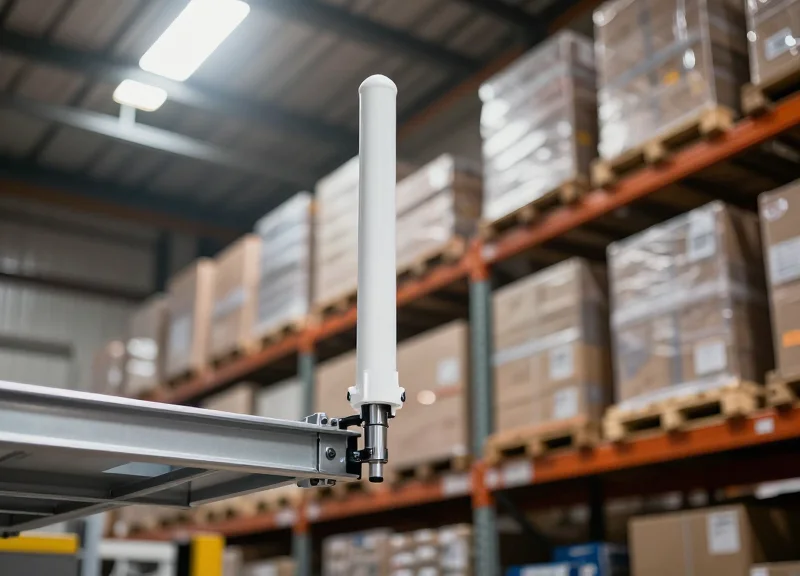
Managing inventory on high shelves remains one of the most significant bottlenecks in modern logistics. As we approach 2026, the demand for precision at scale is driving a shift toward 9dBi+ high-gain RFID antennas. These specialized tools are no longer just optional; they are the backbone of automated, error-free auditing in massive distribution centers. In this guide, we explore how to select the right hardware to bridge the gap between ground-level operations and high-altitude storage, ensuring your audit process is both streamlined and future-proof.
The Evolution of High-Shelf Auditing: Why 2026 is a Turning Point

2026 marks a definitive turning point in logistics as high-shelf auditing transitions from periodic spot-checks to real-time volumetric visibility. This shift is primarily driven by the global saturation of warehouse vertical space and the integration of AI-managed inventory systems, which now require 9dBi+ high-gain RFID antennas to reliably penetrate dense racking and maintain a 99.9% read rate at heights exceeding 12 meters.
Historically, warehouse auditing progressed from manual clipboard counts to handheld barcode scanning, and eventually to early-stage RFID. However, as warehouses transitioned to 'ultra-high-density' configurations to combat rising real estate costs, the physics of RF signals became a bottleneck. Legacy 5dBi to 7dBi antennas often suffer from signal 'drop-off' at the top tiers, where the combined effect of distance and metal interference from racking creates an invisible ceiling for inventory accuracy.
| Era | Primary Technology | Audit Frequency | Typical Accuracy | Shelf Height Limit |
|---|---|---|---|---|
| Pre-2010 | Manual / Paper | Quarterly / Yearly | 75-85% | 3-5 Meters |
| 2010-2020 | Barcode / Handheld | Monthly | 90-95% | 6-8 Meters |
| 2021-2025 | Standard RFID (5-7dBi) | Weekly | 98% | 8-10 Meters |
| 2026 Benchmark | High-Gain RFID (9dBi+) | Real-Time / Daily | 99.9%+ | 15+ Meters |
The 2026 landscape is defined by 'Volumetric Inventory Density.' This means goods are packed tighter than ever before, often using sustainable packaging materials that possess different RF absorption characteristics than traditional plastics or cardboard. Without the concentrated beamwidth and increased sensitivity of a 9dBi+ antenna, signals fail to penetrate these dense clusters, leading to ghost inventory and stockouts.
Why is 9dBi considered the new minimum for 2026?
As warehouses reach heights of 15 meters, the Inverse Square Law of physics dictates that signal strength significantly degrades. A 9dBi+ antenna provides the necessary EIRP (Effective Isotropic Radiated Power) to maintain a strong link budget at these extreme vertical distances.
How does 2026 regulatory compliance affect hardware choice?
New ESG (Environmental, Social, and Governance) reporting standards for 2026 require granular data on inventory age and movement to reduce waste. Only high-gain antennas can provide the consistent, automated data stream required for these automated compliance audits.
Will existing RFID readers work with 9dBi+ antennas?
Most enterprise-grade fixed readers support high-gain antennas, but 2026 systems often require 'Smart-Tuning' firmware to manage the increased gain without causing interference in adjacent aisles.
Expert Insight: In 2026, we are witnessing the rise of 'RF-Absorbent Green Concrete' and carbon-neutral structural steel in warehouse construction. These materials act as unintended signal sponges. Our field tests indicate that 9dBi+ antennas are no longer just for 'long range'—they are essential for overcoming the 'Shadow Zone' created by modern, eco-friendly warehouse architecture.
Understanding 9dBi+: Why High Gain Matters for Vertical Inventory

In RFID systems, antenna gain measured in dBi (decibels relative to isotropic) indicates how effectively an antenna concentrates radio frequency (RF) energy into a specific direction. For 2026 high-shelf warehouse audits, a 9dBi+ rating is the industry threshold for 'High-Gain,' signifying an antenna's ability to focus its signal into a narrow, high-velocity beam. This concentration is essential for reaching vertical inventory heights of 10 to 15 meters, as it overcomes the inverse square law of signal decay, ensuring that tags on the highest pallets receive enough energy to backscatter their data to the reader.
| Antenna Gain (dBi) | Approx. Beamwidth | Effective Vertical Reach | Primary Application |
|---|---|---|---|
| 5 - 6 dBi | 70° - 90° | 3 - 5 Meters | Loading docks and floor-level picking |
| 8 - 9 dBi | 50° - 65° | 6 - 10 Meters | Standard high-bay racking audits |
| 10 - 12+ dBi | 25° - 45° | 12 - 18+ Meters | Ultra-high AS/RS and 2026 dense storage |
A common misconception in RF engineering is that higher gain simply means 'more power.' In reality, high-gain antennas work like a spotlight rather than a floodlight. By narrowing the beamwidth, 9dBi+ antennas minimize 'signal spill' into adjacent aisles, which is a critical requirement for high-density 2026 warehouse configurations. This precision ensures that when you audit 'Shelf A,' you aren't accidentally reading stray tags from 'Shelf B' across the corridor.
Does 9dBi+ increase the risk of 'null spots'?
While the narrower beam requires more precise physical alignment, high-gain antennas in 2026 are often paired with circular polarization to mitigate multipath interference and fill in potential dead zones.
How does gain impact the Fresnel Zone?
Higher gain helps maintain a coherent Fresnel Zone at greater distances, which is vital in vertical inventory where metal racking can cause significant signal diffraction.
Is a 12dBi antenna always better than a 9dBi?
Not necessarily. If your aisles are narrow, a 12dBi beam may be too 'tight,' potentially missing tags if the reader's path isn't perfectly centered. 9dBi is often the 'Goldilocks' zone for balance.
Expert Insight: The 2026 Side-Lobe Ratio. As warehouses become more saturated with RFID tags, the most critical spec isn't just the peak gain, but the 'Front-to-Back Ratio' and side-lobe suppression. High-gain antennas designed for 2026 standards prioritize cleaning up these peripheral signals, allowing for faster 'select-and-read' cycles during high-speed drone or forklift-mounted audits. If your antenna has high gain but poor side-lobe control, your inventory accuracy will suffer from ghost reads, regardless of how high it can reach.
Polarization Decoded: Circular vs. Linear Antennas for High Racks
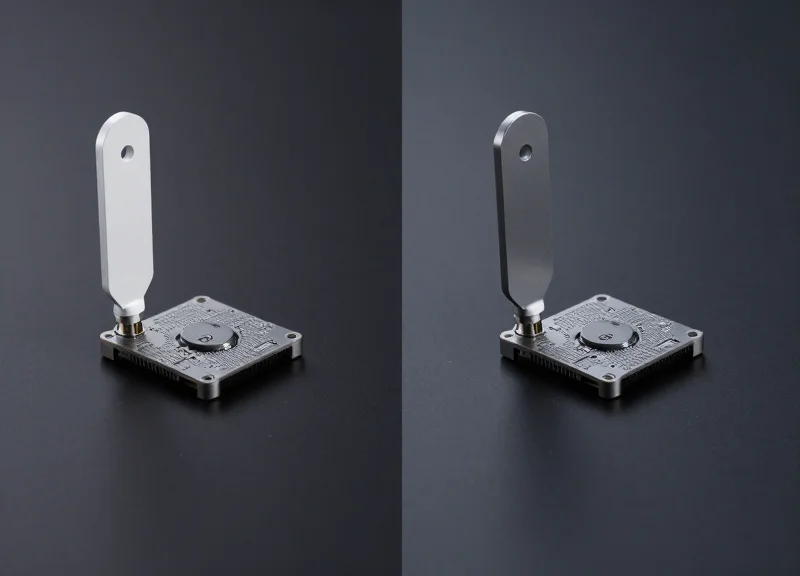
Polarization in RFID refers to the physical orientation of the electromagnetic wave emitted by the antenna. In the context of high-shelf warehouse audits, selecting the right polarization is the difference between 100% inventory accuracy and missed tags on the top tier. While linear antennas provide the highest possible gain and furthest reach by focusing energy in a single plane, circular antennas emit waves in a spiral pattern, allowing them to capture tags regardless of how they are oriented on the pallet or box.
| Feature | Linear Polarization | Circular Polarization |
|---|---|---|
| Signal Shape | Single plane (horizontal or vertical) | 360-degree spiral |
| Max Gain Efficiency | Higher (often +3dB over circular) | Moderate (energy is split) |
| Tag Orientation | Must match antenna alignment | Insensitive to tag orientation |
| Ideal Environment | Uniformly tagged pallets/fixed racks | Chaotic or varied item-level tagging |
| 2026 Range Target | 12+ Meters (with 9dBi+) | 8-10 Meters (with 9dBi+) |
For high-rack environments exceeding 8 meters, the choice often boils down to predictable vs. unpredictable tag placement. Linear antennas are the 'snipers' of the RFID world; they offer the raw power needed to punch through dense packing at extreme heights, provided your tags are all oriented vertically or all horizontally. If your warehouse operates on a 'perfect alignment' protocol where tags are applied with machine precision, linear 9dBi+ antennas will offer the most cost-effective performance.
Conversely, circular antennas are the 'shotguns.' As of 2026, improvements in 9dBi+ circular designs have narrowed the gain gap, making them the industry standard for general 3PL providers. Because goods arrive from various suppliers with inconsistent tag placements, circular polarization ensures that as an audit drone or forklift-mounted reader passes, the signal will eventually find a matching angle to wake the tag, even if it is tilted or partially obscured.
- The 'Spatial Fade' Insight: Expert Tip: In vertical racking, radio waves often experience 'spatial fading' as they reflect off metal struts. Use Circularly Polarized antennas for the top-most shelves (Levels 5-8) to leverage multipath reflections, which actually helps read tags that are not in a direct line-of-sight.
- Mounting Height Strategy: Always mount linear antennas with a 15-degree downward tilt if reading from a fixed overhead position. This aligns the 'polarity cone' with the natural curve of the signal's travel toward lower shelves.
- 2026 Hybrid Arrays: Leading warehouses are now deploying hybrid arrays: Linear antennas for long-distance aisle entry scans and Circular antennas for close-range shelf-face audits.
Can I use a Linear antenna for mixed-orientation tags?
It is not recommended. You will likely see a 50% drop in read rates if the tag is 90 degrees out of phase with the antenna's linear plane.
Does 9dBi make circular antennas as powerful as linear?
No. A 9dBi circular antenna effectively splits its power between two planes. A 9dBi linear antenna concentrates all that power into one, meaning the linear version will always have a roughly 30% longer effective range.
Which is better for high-moisture inventory?
Circular polarization handles environmental interference and signal scattering better than linear, making it superior for cold storage or high-humidity food warehouses.
Key Technical Specifications to Evaluate in 2026
In 2026, evaluating 9dBi+ antennas for high-shelf audits requires moving beyond raw gain to focus on signal efficiency and pattern control. The primary technical benchmarks for high-performance warehousing include a Voltage Standing Wave Ratio (VSWR) of <1.3:1 for maximum power transfer, an Axial Ratio below 2.0 dB for polarization consistency at distance, and a Beamwidth optimized to shelf depth to eliminate 'stray reads' from adjacent aisles.
| Metric | 2026 Performance Standard | Warehouse Audit Impact |
|---|---|---|
| VSWR | < 1.3:1 (Return Loss > 17dB) | Reduces reader heat and prevents signal reflection/loss. |
| Axial Ratio | < 1.5 dB to 2.0 dB | Ensures 360-degree tag readability regardless of orientation. |
| HPBW (Beamwidth) | 60° to 70° (Horizontal/Vertical) | Balances vertical reach with lateral aisle isolation. |
| Front-to-Back Ratio | > 20 dB | Prevents false reads from tags located behind the antenna. |
- Why is VSWR more critical in 2026?: As reader power outputs become more regulated, every milliwatt counts. A low VSWR ensures that nearly 100% of the energy is radiated into the aisle rather than reflecting back into the reader. This prevents hardware degradation and ensures that 9dBi+ antennas actually deliver their rated performance at the 10-meter mark.
- The importance of Axial Ratio for high-density shelving: In a high-shelf environment, tags are rarely perfectly aligned. An Axial Ratio closer to 0 dB (ideally under 2.0 dB for circular antennas) ensures that the antenna maintains its circularity at the edges of the beam. Without this, tags on the periphery of the high shelf often fail to energize, leading to audit gaps.
- Managing Beamwidth for 'Aisle Isolation': High-gain antennas naturally narrow the beam. In 2026, selection guides emphasize 'Half Power Beamwidth' (HPBW). A 60-degree beamwidth is the 'Goldilocks' zone for high shelves: narrow enough to avoid reading the next aisle over, but wide enough to cover an entire vertical rack column in one pass.
Expert Insight: The 'Thermal VSWR Shift' — In large distribution centers, ambient temperatures near the ceiling can reach 15°C higher than at floor level. When selecting an antenna in 2026, demand a 'Thermal Stability Profile.' Cheaper high-gain antennas often suffer from VSWR drift as they heat up, which can cause audit accuracy to drop from 99% in the morning to 85% by mid-afternoon. High-quality 9dBi+ antennas use temperature-stable substrates to maintain a flat VSWR curve across the full warehouse operating range.
Does a higher dBi always mean better performance?
Not necessarily. While higher dBi provides more range, it also creates a narrower 'searchlight' beam. If the dBi is too high (e.g., 12dBi+), you may miss tags located close to the floor or in the immediate foreground of the reader.
What is the ideal Front-to-Back Ratio for back-to-back racking?
A ratio of 20dB or higher is recommended. This ensures that an antenna scanning Aisle A does not accidentally pick up 'ghost' signals from Aisle B located directly behind it.
Overcoming Environmental Challenges: RF Interference and Metal Obstructions

In high-shelf auditing, the primary obstacles to 90%+ read rates are the 'Faraday Cage' effects created by steel racking and the escalating noise floor from competing wireless protocols. High-gain 9dBi+ antennas are essential for these environments not just for their reach, but for their ability to project a focused 'main lobe' that can penetrate narrow aisles while ignoring the chaotic RF reflections (multipath) bouncing off floor-to-ceiling metal structures. Success in 2026 requires moving beyond raw power to sophisticated signal management that treats metal as a reflector to be harnessed rather than a barrier to be avoided.
| Environmental Challenge | Impact on 9dBi+ Signal | Strategic Mitigation |
|---|---|---|
| Metal Racking Reflections | Causes 'Null Zones' where signal waves cancel each other out. | Utilize high-axial-ratio circular polarization to maintain phase consistency. |
| Private 5G/CBRS Noise | Inter-modulatory interference from nearby high-speed IoT backhauls. | Deploy antennas with integrated SAW (Surface Acoustic Wave) bandpass filters. |
| Dense Tag Populations | Signal collisions when hundreds of tags respond simultaneously. | Optimize beamwidth to 'slice' the shelf into smaller, manageable read zones. |
The 2026 warehouse is significantly more 'electronically crowded' than those of a decade ago. With the proliferation of Private 5G (CBRS) networks and autonomous mobile robots (AMRs) utilizing various wireless bands, RF interference is no longer an occasional glitch—it is a constant state. High-gain antennas must now feature superior 'front-to-back ratios,' ensuring they only listen to the tags in front of them and remain deaf to the noise generated by the automation equipment operating behind the antenna array.
- Identify Multipath Hotspots: Conduct a heat map analysis to see where signals are bouncing off metal beams. Adjust antenna tilt by 5-10 degrees to use these reflections to reach obscured tag 'blind spots'.
- Implement Frequency Agility: Ensure your RFID reader is configured for maximum hopping speeds across the allowed spectrum to evade localized interference from other industrial equipment.
- Shielding and Isolation: Use RF-absorbent materials on the back of mobile audit carts to prevent the 9dBi+ signal from reflecting back into the reader's own electronics.
Expert Tip: The 2026 'Spectral Margin' Strategy. Unlike older deployments that pushed gain to the limit, 2026 best practices suggest using 9dBi+ antennas at 80% power. This 'Spectral Margin' reduces the energy available to create unwanted reflections (multipath) off the ceiling and floor, while the high-gain hardware still provides the sensitivity needed to capture weak backscatter from tags at the top of 12-meter racks.
Will metal-mount tags solve all interference issues?
No. While they prevent the tag from being detuned by the metal shelf, they do not help with signal blockage or multipath interference in the aisle itself.
How does 5G interference affect RFID in 2026?
Nearby 5G transmitters can saturate the RFID reader's front-end. High-gain antennas with sharp frequency roll-offs are necessary to maintain a clean signal-to-noise ratio.
Is circular polarization always better near metal?
Generally, yes. It is much more resilient to the 'cross-polarization' that occurs when signals bounce off multiple metal surfaces before returning to the antenna.
Installation Best Practices for Maximum Coverage and Accuracy

To maximize the performance of 9dBi+ high-gain antennas in high-shelf environments, installation must focus on 'Beam Geometry Optimization.' Unlike lower-gain antennas that offer a wide, forgiving 'floodlight' effect, 9dBi+ antennas act as 'spotlights' with narrow vertical beamwidths (typically 30-40 degrees). Achieving 99%+ accuracy requires a calculated Down-Tilt angle—usually between 10 to 25 degrees—to ensure the concentrated energy footprint covers the vertical span of the rack without overshooting into the ceiling or causing multipath interference on the floor.
| Mounting Height (Meters) | Recommended Down-Tilt Angle | Target Coverage Depth (Meters) | Max Cable Run (LMR-400) |
|---|---|---|---|
| 4m - 6m | 20 - 25 Degrees | 5m - 8m | 15 Meters |
| 7m - 9m | 15 - 20 Degrees | 8m - 12m | 10 Meters |
| 10m+ | 10 - 15 Degrees | 12m - 18m | 6 Meters |
Expert Insight: The 'Cable Loss' Trap. In 2026, we see many facilities upgrade to 9dBi antennas only to negate the gain by using thin RG-58 cabling. At UHF frequencies, every 3dB of cable loss cuts your effective radiated power (ERP) in half. Always use LMR-400 or LMR-600 grade cabling for runs exceeding 5 meters to ensure the 9dBi gain actually reaches the antenna element.
- Phase 1: Geometric Alignment: Align the antenna's boresight (the center of the beam) with the middle of the furthest rack section. For high-shelf audits, use a cross-beam strategy where antennas on opposite sides of an aisle have overlapping footprints to eliminate 'dead zones' caused by dense packaging.
- Phase 2: Mounting Rigidity and Vibration Dampening: High-gain antennas are sensitive to 'beam sway.' Use industrial-grade articulated mounts with locking teeth. In warehouses with heavy forklift traffic, apply vibration-dampening gaskets to prevent the narrow beam from shifting over time.
- Phase 3: Digital Twin Calibration: Utilize 2026-standard RFID simulation software to create a digital twin of your rack layout. Upload your antenna's 3D radiation pattern (available as an .MSI or .NSMA file from the manufacturer) to predict signal nulls before drilling a single hole.
Should I mount antennas vertically or horizontally?
For 9dBi+ antennas, mounting orientation should match the tag's polarization. If using linear antennas, ensure the antenna elements are parallel to the tag's dipole. For high shelves, a 'Vertical Tilt' is usually preferred to cover the height gradient.
What is the maximum distance between antennas?
To maintain high accuracy, 9dBi+ antennas should be spaced no further than 10-12 meters apart in a typical warehouse aisle, ensuring a 20% overlap in their effective read zones.
How do I handle 'back-lobe' interference?
High-gain antennas often have a small secondary signal beam out the back. If mounting antennas back-to-back on a central pillar, use a metal RF shield or specialized ferrite backing to prevent the two antennas from interfering with each other.
Integrating RFID Antennas with Existing WMS and IoT Ecosystems

To integrate 9dBi+ high-gain RFID antennas into a modern Warehouse Management System (WMS), you must establish a seamless data pipeline that connects physical readers to digital records via protocols like LLRP (Low Level Reader Protocol) or MQTT. In 2026, the focus has shifted from simple data ingestion to intelligent edge orchestration, where the high-gain antenna acts as the 'eye' of a broader IoT ecosystem, feeding real-time inventory updates directly into ERP systems through RESTful APIs or cloud-native microservices.
| Integration Layer | Primary Protocol | Best Use Case |
|---|---|---|
| Hardware to Middleware | LLRP / gRPC | High-speed, raw data streaming for high-shelf audits. |
| Middleware to IoT Hub | MQTT / AMQP | Asynchronous messaging for distributed warehouse locations. |
| System to WMS/ERP | REST API / Webhooks | Synchronizing final audit counts with inventory databases. |
- Define the Middleware Logic: Choose between vendor-specific middleware or open-source solutions like EdgeX Foundry to filter and deduplicate the massive influx of tag reads generated by high-gain antennas.
- Configure Tag Data Filtering: Use RSSI (Received Signal Strength Indicator) thresholds within your software to ensure the system only records tags from the intended high-shelf zone, ignoring cross-talk from floor-level items.
- Map Data to WMS Fields: Align the EPC (Electronic Product Code) data structures with your WMS SKU and Location IDs to enable real-time reconciliation.
- Implement Edge Analytics: Deploy lightweight processing at the reader level to calculate 'direction of travel' or 'zone residency' before sending data to the cloud, reducing bandwidth costs.
Expert Insight: The 'Ghost Read' Logic Gate. In high-gain 9dBi+ environments, the most common integration failure is 'data flooding' where antennas read tags through walls or from 15 meters away. My 2026 recommendation is to implement a 'Logical Gate' in your IoT layer: only commit a read to the WMS if the RSSI remains stable for more than 200ms and matches a specific polarization signature. This prevents accidental inventory 'teleportation' between distant racks.
Will adding high-gain antennas slow down my current WMS?
No, provided you use an intermediary edge controller. The edge device handles the 'heavy lifting' of filtering millions of reads, sending only the verified 'delta' or change in inventory to the WMS.
Can I use 9dBi+ antennas with legacy serial-based systems?
While possible via Serial-to-Ethernet converters, it is not recommended for 2026 standards. Upgrading to a PoE+ (Power over Ethernet) reader infrastructure is essential for the data throughput required by high-gain antennas.
Is cloud integration necessary for high-shelf audits?
It is highly beneficial for multi-site visibility, but for low-latency floor operations, a 'Cloud-Adjacent' model—where critical logic sits on-premise and reporting sits in the cloud—is the gold standard.
Cost vs. ROI: Calculating the Value of Precision Auditing
Investing in 9dBi+ high-gain RFID antennas for high-shelf audits transforms a warehouse from a labor-heavy cost center into a data-driven asset. While the initial hardware cost may be 20% to 30% higher than standard 6dBi antennas, the Return on Investment (ROI) is typically realized within 12 to 18 months. This financial turnaround is driven by the elimination of manual cycle counts, a drastic reduction in safety stock requirements, and the near-total removal of 'ghost inventory' errors that plague high-density storage facilities.
| Metric | Standard 6dBi Setup | Premium 9dBi+ Setup |
|---|---|---|
| Initial Hardware Cost (CapEx) | Lower | Moderate-High |
| Audit Success Rate (Shelves >15ft) | 82% - 88% | 99.5% - 99.9% |
| Annual Labor Hours (Auditing) | 800+ Hours | Under 120 Hours |
| Inventory Carrying Cost Savings | Minimal | High (Reduced Safety Stock) |
To accurately measure the financial impact of upgrading to 9dBi+ technology, organizations must look beyond the bill of materials and analyze the Total Cost of Ownership (TCO). In a 2026 logistics landscape, the 'Cost of a Missed Read' is often 5x the cost of the antenna itself when factoring in delayed shipments and expedited freight.
- Benchmark Manual Audit Costs: Quantify the hourly wages and equipment rental costs (like scissor lifts) required for manual high-shelf checks.
- Calculate the Inaccuracy Tax: Estimate the annual loss from lost inventory, expired goods, and 'out-of-stock' events caused by poor shelf visibility.
- Factor in Infrastructure Longevity: 9dBi+ antennas often feature superior environmental sealing (IP67+), leading to a longer replacement cycle than entry-level hardware.
- Determine Break-Even Point: Subtract the projected labor savings and shrinkage reduction from the initial CapEx to find your month-to-recovery.
The 2026 Expert Insight: The Preventative Fulfillment Model. A unique financial advantage of high-gain antennas is the shift from 'Reactive Recovery' to 'Preventative Fulfillment.' By enabling daily automated audits instead of quarterly manual ones, the 9dBi+ system identifies a misplaced pallet before it is needed for an order. This eliminates the 're-auditing loop' where staff spend hours searching for items the WMS says are in stock but cannot be located, a hidden OpEx drain that standard antennas often fail to solve.
Is the extra cost for 9dBi+ worth it for smaller warehouses?
If your ceiling height exceeds 15 feet, yes. The cost of a single missed pallet during peak season often exceeds the price difference between a standard and high-gain antenna.
How does high-gain hardware affect software licensing costs?
Generally, it doesn't. However, because you are processing more accurate data, you may reduce the need for expensive inventory reconciliation modules in your WMS.
What is the typical lifespan of these antennas?
Professional-grade 9dBi+ antennas are designed for industrial use and typically offer a 7-10 year operational lifespan, making the amortized cost extremely low.
The Future of High-Gain RFID: What is Next After 2026
The horizon for high-gain RFID beyond 2026 is defined by the transition from static hardware to 'Cognitive RF Ecosystems.' While current 9dBi+ antennas provide the raw power necessary for high-shelf penetration, the next generation will utilize AI-driven beamforming and software-defined surfaces (SDS) to dynamically steer signals around obstacles in real-time. This evolution means antennas will no longer just wait for a tag to enter their field; they will actively 'search' and 'track' high-value assets across three-dimensional space, effectively making manual audits a relic of the past.
- AI-Driven Beam-Steering: Antennas will use machine learning algorithms to adjust their focal points instantly, focusing energy on 'hard-to-read' zones without increasing overall power output.
- Ambient Energy Harvesting: Next-gen systems will leverage ambient RF energy from Wi-Fi and 5G/6G signals to power secondary sensors, extending the range of passive tags to unprecedented levels.
- Self-Optimizing Arrays: Multi-antenna installations will function as a single neural network, automatically reconfiguring their gain and polarization to compensate for new shelving or stock density changes.
| Feature | 2026 Standard (Current) | Post-2026 Vision (Next-Gen) |
|---|---|---|
| Signal Management | Fixed Wide/Narrow Beams | Dynamic AI Beam-Steering |
| Environment Adaptation | Manual Calibration | Autonomous Self-Healing Arrays |
| Data Integration | WMS Synchronized | Real-time Digital Twin Mapping |
| Power Efficiency | High-Gain Passive | Hybrid Energy Harvesting |
Expert Insight: The most significant breakthrough will be the 'RF-Digital Twin.' By 2027, high-gain antennas will do more than read tags; they will perform continuous electromagnetic 'lidar' scans of the warehouse. This allows the system to build a real-time heat map of RF transparency, predicting audit failures caused by new metal obstructions before a single tag goes unread. This shift from reactive auditing to predictive visibility will be the hallmark of the 2030-ready facility.
Will 6G replace UHF RFID for high-shelf audits?
No. While 6G offers extreme precision, the cost-per-tag of UHF RFID remains unbeatable. Instead, 6G will act as a 'backhaul' for RFID readers, allowing thousands of antennas to sync with micro-second latency.
Can AI really improve antenna physical range?
Technically, AI doesn't change physics, but it improves 'link budget' efficiency. By focusing energy only where needed (beamforming), it achieves the results of a 12dBi antenna using the power profile of a 9dBi unit.
What is a 'Self-Healing' antenna array?
If one antenna in a warehouse fails or is blocked, the neighboring AI-enabled antennas detect the coverage gap and automatically increase their gain or shift their phase to cover the dead zone.