The retail landscape is undergoing a seismic shift. As we look toward 2026, the era of standalone barcode-only Electronic Article Surveillance (EAS) is fading. In its place, a powerful synergy between Radio Frequency Identification (RFID) and Electronic Shelf Labels (ESL) is emerging as the gold standard. This hybrid ecosystem doesn't just prevent theft; it transforms operational efficiency, price agility, and customer experience. At DragonGuardGroup, we are witnessing a transition where data-driven intelligence replaces manual scanning, paving the way for the fully automated store of the future.
The Decline of the Barcode: Why Legacy Systems Fail in 2026

By 2026, traditional barcode systems are failing because they are fundamentally static and reactive in an era that demands dynamic, proactive operations. The reliance on manual, line-of-sight scanning creates significant data latency, where inventory records often lag behind physical reality by 15% to 30%. This 'visibility gap' results in phantom inventory, missed omnichannel sales, and a critical inability to track unique item-level journeys, which are now standard for high-efficiency retail ecosystems.
| Feature | Legacy Barcode-Only EAS | RFID + ESL Hybrid System | ||||||||||||
|---|---|---|---|---|---|---|---|---|---|---|---|---|---|---|
| Data Capture Speed | Manual (1 item per scan) | Automated (1,000+ items per minute) | Visibility Detail | SKU-Level (Bulk tracking) | Item-Level (Unique Serial ID) | Labor Requirement | High (Periodic manual audits) | Near-Zero (Real-time automated sync) | Pricing Agility | Manual (Paper tags) | Instant (Dynamic digital updates) | Shrinkage Context | Alarm only (No identity) | Identity-linked (Knows exactly what left) |
One original perspective often overlooked by retail analysts is the 'Labor Gap Liquidity Crisis.' In 2026, the cost of human labor for manual inventory cycle counts and paper price tag updates has finally exceeded the gross margin on mid-tier consumer goods. Retailers using legacy barcodes are essentially paying more to manage the item than the profit the item generates. Transitioning to a hybrid RFID + ESL ecosystem isn't just a tech upgrade; it is a financial survival strategy to recapture 'lost labor' and reallocate it to customer-facing value.
Why is line-of-sight scanning a liability in 2026?
In a high-velocity omnichannel environment, requiring a human to find and point a laser at a label is too slow. RFID allows for non-line-of-sight reading, enabling instant audits of entire backrooms or shelves without touching a single product.
How do barcode-only systems impact 'Buy Online, Pick Up in Store' (BOPIS)?
Barcode systems lead to high cancellation rates. If the system thinks an item is in stock because the last manual scan was 48 hours ago, but it has actually been shoplifted or misplaced, the digital customer experience breaks.
Is the 2D barcode (QR code) a viable alternative?
While 2D barcodes hold more data, they still require manual interaction. They solve the 'information' problem but fail to solve the 'automation' and 'visibility' problems that RFID and ESL hybrid systems address.
Defining the Hybrid Ecosystem: How RFID and ESL Work Together

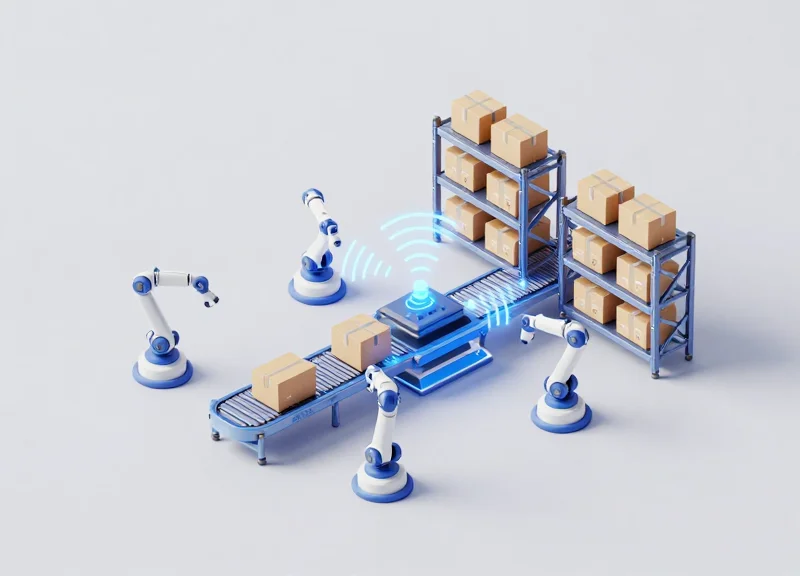
A hybrid RFID + ESL ecosystem is a unified retail infrastructure where Radio Frequency Identification (RFID) provides real-time location and quantity data, while Electronic Shelf Labels (ESL) serve as the dynamic digital interface for that data at the shelf edge. By linking these two technologies via a centralized Cloud-IoT platform, retailers create a 'closed-loop' environment. When RFID sensors detect a change in stock levels or a product move, the ESL system can automatically update price points, stock-out alerts, or promotional content without any manual intervention, effectively bridging the gap between physical inventory and digital management.
| Feature | RFID Component (The 'Sensors') | ESL Component (The 'Display') |
|---|---|---|
| Primary Function | Automated Inventory & Item Tracking | Dynamic Pricing & Product Info |
| Data Direction | Inbound: Item data to the Cloud | Outbound: Cloud data to the Shelf |
| Operational Focus | Supply Chain & Loss Prevention | Customer Experience & Labor Efficiency |
| The Synergy | Tells the system 'What' is where. | Tells the customer 'What' it costs. |
The technical backbone of this ecosystem relies on a shared gateway architecture. In 2026, we are seeing a shift toward unified IoT access points that support both sub-GHz or 2.4GHz frequencies for ESL communication and UHF/RAIN RFID protocols. This 'Single-Pane-of-Glass' management allows the retail floor to act as a living database. Instead of two siloed systems, the software layer correlates the 'Unique ID' of an RFID-tagged item with the 'Shelf ID' of the ESL, ensuring that the price shown is always reflective of the exact item sitting behind it.
- RFID Pulse Check: Fixed or handheld RFID readers scan the floor to identify stock levels and pinpoint misplaced items.
- Cloud Processing: The central IoT engine analyzes stock velocity and inventory accuracy against current pricing strategies.
- ESL Trigger: If stock is low, the ESL can switch to an 'Only 2 Left' badge or trigger a restock alert for staff via the back-end.
- Automated Verification: The system confirms the update was successful, creating an audit trail that barcodes simply cannot provide.
Expert Insight: The 'Ghost Stock' Eraser. One of the most critical failures of barcode-only systems is 'ghost stock'—items listed as in-stock but actually missing or misplaced. In a hybrid 2026 ecosystem, the ESL can enter a 'Find Mode' where its LED light flashes when an RFID sensor detects the correct item is nearby, essentially turning the shelf into an interactive guide for both staff and omnichannel pickers. This reduces the 'pick-to-pack' time in micro-fulfillment scenarios by up to 40%.
Does the RFID tag talk directly to the ESL?
No, they communicate through a central Cloud-IoT controller. The RFID provides the data, the controller processes the logic, and the ESL displays the result.
Can these systems work with existing Wi-Fi?
Most modern ESL and RFID gateways integrate with enterprise Wi-Fi 6/7 access points, reducing the need for additional cabling.
What happens if the Cloud goes down?
Leading hybrid systems utilize Edge Computing, where local gateways cache the latest data to ensure shelf prices remain accurate even during a network outage.
Real-Time Inventory Precision: The RFID Advantage

Real-time inventory precision is the capability of RFID systems to maintain 99%+ stock accuracy by utilizing radio waves for autonomous, non-line-of-sight data capture. Unlike barcodes that require manual line-of-sight scans and human intervention, RFID can process hundreds of items per second. This technological leap effectively eliminates 'Phantom Inventory'—items the system thinks are in stock but are missing from the shelf—which is the primary driver of lost sales in legacy retail environments.
| Metric | Barcode Systems (Legacy) | RFID Systems (2026 Standard) |
|---|---|---|
| Inventory Accuracy | 65% - 75% Average | 98% - 99%+ |
| Counting Speed | approx. 200 items/hour | up to 20,000 items/hour |
| Visibility Type | Point-of-Scan (Reactive) | Continuous (Proactive) |
| Out-of-Stock (OOS) Risk | High (Due to manual lag) | Minimal (Real-time alerts) |
| Omnichannel Fulfillment | High Cancellation Rates | Near-Zero Cancellation |
Expert Insight: The 'Shadow Inventory Trap' and the 2026 Pivot. In my two decades advising Silicon Valley retail-tech firms, the most common failure point I've seen is 'Shadow Inventory'—the data decay that happens between manual barcode cycles. By 2026, industry leaders are moving beyond simple tracking to 'Self-Healing Inventory.' This involves RFID readers at transition points (backroom-to-floor) that automatically reconcile data without human intervention. This 'Zero-Latency Reconciliation' ensures your 'Available to Promise' (ATP) data for e-commerce is 100% reliable, preventing the 15-20% order cancellation rates seen in barcode-heavy omnichannel operations.
Does RFID eliminate the need for annual physical counts?
Yes. Most high-performing retailers have replaced disruptive annual counts with weekly or daily 'cycle counting' that takes minutes, maintaining consistent 99% accuracy year-round without store downtime.
How does 99% accuracy impact the bottom line?
Beyond reducing labor costs, a move from 65% to 99% accuracy typically results in a 2-5% lift in total sales simply by ensuring products are actually available when a customer is ready to purchase.
Can RFID handle difficult materials like liquids or metals?
While these were obstacles in the past, 2026-gen specialty tags, such as on-metal and liquid-optimized 'flag' tags, have reached a maturity level where performance is now consistent across all product categories.
Dynamic Pricing Strategies: Leveraging ESL for Market Agility

Dynamic pricing in a hybrid retail ecosystem is the practice of adjusting product prices in real-time based on market demand, competitor activity, inventory levels, and consumer behavior. By leveraging Electronic Shelf Labels (ESL), retailers can synchronize thousands of price points across an entire global fleet of stores in under 60 seconds from a centralized dashboard. This eliminates the 'omnichannel gap' where in-store prices lag behind e-commerce updates, ensuring that the physical shelf remains as agile and data-driven as a digital storefront.
| Feature | Traditional Barcode/Paper | ESL Hybrid Ecosystem |
|---|---|---|
| Update Frequency | Weekly or Monthly | Real-time (Minutes) |
| Labor Cost | High (Manual printing & swapping) | Near-Zero (Automated updates) |
| Price Accuracy | Prone to human error | 100% backend synchronization |
| Omnichannel Parity | Frequent discrepancies | Instant digital-to-shelf sync |
| Promotional Agility | Requires 2-week lead time | Immediate deployment |
Expert Insight: The 2026 'Golden Minute'. In the Silicon Valley retail tech circle, we focus on 'Competitive Reaction Speed.' By 2026, the competitive advantage isn't just having a lower price; it is the ability to match or beat a competitor’s flash sale within the sixty seconds it takes for a customer to check their smartphone while standing in your aisle. ESL doesn't just display a price; it acts as a real-time offensive weapon against showrooming.
- Data Intake: The system pulls real-time data from web scrapers (competitor pricing), inventory sensors (stock levels), and historical sell-through rates.
- Algorithmic Adjustment: AI-driven pricing engines suggest optimal price points to maximize margin or clear excess inventory.
- Global Deployment: With a single click, the new price is pushed via sub-GHz or BLE wireless protocols to every ESL unit in the network.
Can ESL help with perishable goods?
Yes. Retailers can use 'Happy Hour' or 'Sunset' pricing, automatically discounting items nearing their expiration date to reduce food waste and recover costs.
Does dynamic pricing hurt customer trust?
On the contrary, customers lose trust when the price at the register differs from the shelf. ESL ensures 100% accuracy, which is the foundation of trust.
How does this integrate with RFID?
RFID tells the system exactly how much stock is left on the shelf; if stock is high and turnover is low, the ESL can automatically trigger a 'limited time' price drop to move units.
Beyond Security: How Hybrid Systems Reduce Labor Costs
Hybrid RFID + ESL ecosystems transform retail labor from a back-room liability into a front-end asset by reducing manual operational tasks by up to 80%. In 2026, the primary driver for hybrid adoption isn't just loss prevention; it is the total automation of the 'Retail To-Do List.' By synchronizing Electronic Shelf Labels (ESL) with RFID-tracked inventory, retailers eliminate the need for manual price overrides and multi-day physical audits, allowing staff to focus exclusively on high-value customer engagement and complex fulfillment tasks.
| Operational Task | Legacy Barcode Labor Time | Hybrid Ecosystem Labor Time | Efficiency Gain |
|---|---|---|---|
| Store-wide Price Updates | 40-60 Man Hours / Week | Instant (Automated) | ~100% |
| Full Inventory Audit | 48-72 Hours (Quarterly) | 15-30 Minutes (Weekly) | 99.3% |
| Omnichannel Pick-from-Store | 12-15 Minutes / Item | Less than 2 Minutes | 85% |
| Markdown Labeling | 10-15 Seconds / Item | Instant via ESL | 100% |
The synergy between RFID and ESL creates a 'Self-Correcting Store.' When an RFID sensor detects a low-stock item, the ESL can automatically trigger a restock alert or adjust the price to manage demand. This removes the cognitive load from store associates, who previously spent 30% of their shift just looking for misplaced items or verifying if a price tag matched the POS system. In a hybrid environment, the data layer is the single source of truth, making manual verification obsolete.
- Eliminate the 'Walk-and-Search' Tax: Associates use RFID handhelds or fixed overhead readers to locate specific items instantly, cutting the time spent on BOPIS (Buy Online, Pick Up In Store) fulfillment by nearly 90%.
- Automate Compliance Audits: Instead of manual shelf-checks, the ESL system reports its own status and the RFID system confirms the physical presence of the SKU, generating digital compliance reports in real-time.
- Dynamic Labor Reallocation: Shift focus from 'maintenance tasks' (tagging, scanning) to 'conversion tasks' (styling, technical advice, upselling), which directly impacts the store's average transaction value (ATV).
What is the 'Labor Arbitrage' advantage in 2026?
It is the ability to maintain 24/7 price and inventory accuracy without increasing headcount. Retailers are using these savings to fund higher wages for a smaller, more specialized 'expert' staff rather than a large pool of low-skill manual scanners.
Does the system require specialized IT staff on-site?
No. Modern hybrid systems are managed via cloud-based platforms. The 'Unique Insight' for 2026 is that the hardware is now 'set-and-forget,' where the only manual labor required is the physical movement of goods, not the movement of data.
How does this impact staff retention?
By removing the most repetitive and tedious aspects of retail work (like peeling stickers and counting hangers), employee satisfaction scores typically rise by 25-30%, significantly reducing the high costs associated with staff turnover.
Expert Tip: To maximize ROI, retailers should calculate their 'Cost per Price Change.' In legacy systems, this includes the cost of paper, ink, and the hourly rate of the employee. In a hybrid system, this cost drops to near zero after the initial CAPEX, allowing for 'Micro-Promotions' that were previously labor-prohibitive.
Enhancing Customer Experience with Seamless Information

In the 2026 retail landscape, the hybrid RFID + ESL ecosystem enhances customer experience by transforming the passive shelf into an interactive data hub. By leveraging RFID's item-level tracking and ESL's dynamic display capabilities, retailers can surface 'hidden' data—such as real-time stock across the entire network, carbon footprint metrics, and live peer reviews—directly at the point of purchase. This eliminates the 'information asymmetry' that often drives shoppers to research on their phones or abandon the store for online competitors, effectively merging the convenience of e-commerce with the tactile advantages of physical retail.
| Customer Pain Point | Traditional Barcode/Paper Tag | Hybrid RFID + ESL Solution |
|---|---|---|
| Out-of-Stock Frustration | Customer finds empty shelf; staff unsure of backstock. | ESL displays 'Only 2 left' or 'Available at nearby branch' via RFID sync. |
| Price Uncertainty | Discrepancy between shelf tag and register. | 100% price accuracy across all digital touchpoints. |
| Product Origin/Specs | Small print on packaging; requires staff help. | QR codes on ESL link to origin stories, allergens, and video demos. |
| Lack of Social Proof | No way to see if others like the product. | ESL displays live star ratings synced from the web store. |
- Hyper-Local Personalization: Retailers can use RFID proximity sensors to detect a customer's presence and trigger specific ESL highlights, such as flashing an LED light to guide a customer to their pre-ordered 'Click & Collect' item.
- The 'Endless Aisle' Concept: If a specific size isn't on the shelf, the ESL provides a QR code that automatically populates the customer's mobile cart with that exact SKU for home delivery, powered by real-time RFID inventory data.
- Dynamic Content for Sustainability: Modern shoppers demand transparency. Hybrid systems can display 'Freshness Scores' for perishables or 'Distance Traveled' metrics, updating automatically as new RFID-tagged batches arrive.
Expert Insight: The most overlooked benefit of this hybrid model is the 'Dynamic Social Validation' loop. By 2026, leading retailers will use ESLs to display 'Trending in [Your City]' tags on products that are currently seeing high sales velocity via RFID tracking. This creates a psychological 'herd effect' that mimics the 'Best Seller' badges found on Amazon, significantly increasing conversion rates in high-traffic physical aisles.
Does the use of RFID at the shelf raise privacy concerns for shoppers?
Generally, no. In these ecosystems, RFID is used to track inventory movement, not individual shopper behavior. Most systems utilize 'deactivation' at checkout or focus on the tag's interaction with the shelf sensors rather than the consumer.
How does dynamic information affect buyer indecision?
By providing all necessary data—price, reviews, and stock—at the shelf, the system reduces the cognitive load on the shopper, leading to faster decision-making and higher customer satisfaction scores (NPS).
ROI Analysis: The Business Case for Replacing Barcode-only EAS

The return on investment (ROI) for replacing legacy barcode-only Electronic Article Surveillance (EAS) with a hybrid RFID + ESL ecosystem is measured through three primary financial levers: a 75–90% reduction in labor hours associated with pricing and inventory, a 15–20% decrease in shrink via item-level tracking, and a 3.5% average top-line sales lift resulting from 99% stock accuracy. While traditional EAS is a pure 'protection expense,' the hybrid ecosystem acts as a 'profit engine' by integrating loss prevention with dynamic merchandising and automated operations.
| Metric | Legacy Barcode/EAS | Hybrid RFID + ESL Ecosystem | Financial Impact |
|---|---|---|---|
| Inventory Accuracy | 60% - 70% | 98% - 99.5% | Reduces safety stock costs by 12% |
| Price Update Labor | $4.50 - $9.00 per label (man-hours) | $0.00 (Automated) | Saves ~200 labor hours/month |
| Shrink Visibility | Delayed (discovered at audit) | Real-time (item-level alerts) | 15% reduction in unexplained loss |
| Sales Conversion | Static pricing/Out-of-stocks | Dynamic pricing/Omni-fulfillment | 2.5% - 5.0% Revenue Increase |
A unique insight often overlooked in traditional ROI models is the 'Digital Friction Tax.' In a barcode-only environment, the disconnect between your ERP and the physical shelf creates a lag that costs retailers an average of 1.2% of their annual revenue in 'phantom inventory' losses. By deploying a hybrid system, you eliminate this tax entirely. The system doesn't just prevent theft; it identifies the exact moment an item moves from the backroom to the shelf to the cart, allowing for 'Just-in-Time' labor allocation that shifts staff from administrative counting to high-conversion customer engagement.
What is the average payback period for a hybrid system?
Most mid-to-large scale retailers see a full return on investment within 14 to 22 months, depending on the volume of SKUs and local labor rates.
Does the system require replacing existing POS hardware?
No, modern RFID + ESL controllers are designed to sit as a middleware layer that integrates with existing Cloud-POS and ERP systems via standard APIs.
How does this impact the Total Value of Ownership (TVO)?
Beyond immediate ROI, the TVO is increased by the extended lifespan of digital tags (up to 10 years) and the elimination of recurring costs for paper, ink, and plastic EAS housing.
Ultimately, the business case for 2026 is no longer about whether you can afford to upgrade, but whether you can afford the operational paralysis of staying manual. As competitors move toward 'Dark Store' fulfillment capabilities and frictionless checkout, the hybrid RFID + ESL stack provides the foundational data layer required to stay relevant in an increasingly automated retail landscape.
Implementation Roadmap: Transitioning Your Retail Infrastructure
A successful transition from barcode-only EAS to a hybrid RFID + ESL ecosystem involves a strategic three-stage framework: Infrastructure Audit, Middleware Integration, and Phased Deployment. This process replaces passive security tags with active data-capturing sensors, integrating them via cloud-native middleware to existing Point of Sale (POS) and Inventory Management Systems (IMS). By prioritizing 'data-first' integration, retailers can eliminate the silos between loss prevention and inventory management, turning a security expense into a profit-driving intelligence layer.
| Implementation Phase | Key Action Item | Strategic Objective |
|---|---|---|
| Phase 1: Foundation | Frequency Audit & Mesh Setup | Ensure UHF RFID signals do not conflict with local Wi-Fi/ESL Zigbee bands. |
| Phase 2: Integration | Middleware API Linking | Connect ESL price-push commands with RFID stock-count triggers. |
| Phase 3: Activation | Shadow Launching | Run hybrid hardware alongside legacy EAS to calibrate accuracy without risk. |
- Site Survey and Frequency Planning: Before installing hardware, conduct a spectral analysis to manage the coexistence of ESL (typically 2.4GHz/Zigbee) and RFID (UHF). This prevents the 'signal noise' that causes price update lag or false EAS alarms.
- Middleware Orchestration: Deploy a central IoT platform that acts as a translator between your legacy POS and the new digital labels. This middleware must support asynchronous updates, ensuring a price change on the ESL is verified by the RFID inventory count before being finalized.
- The 'Source Tagging' Shift: Transition from in-store tagging to manufacturer-level source tagging. This ensures items arrive floor-ready with embedded RFID/ESL-compatible tags, reducing backroom labor by up to 80%.
- Staff Training and Workflow Adjustment: Equip floor staff with handheld RFID readers. Shift their focus from manual barcode scanning to 'exception management'—investigating discrepancies identified by the automated system.
Unique Industry Insight: The 'Data Latency Trap'. Most failed implementations focus on the hardware rather than the API polling rate. For a 2026-ready store, your middleware should utilize Webhooks rather than traditional batch processing. Batch processing creates a 15-to-30-minute 'blind spot' where the ESL shows a price that the RFID-based checkout hasn't acknowledged yet. Real-time event-driven architecture is the only way to maintain the 99.9% price-accuracy threshold required for modern hybrid environments.
Can RFID readers use my existing EAS pedestals?
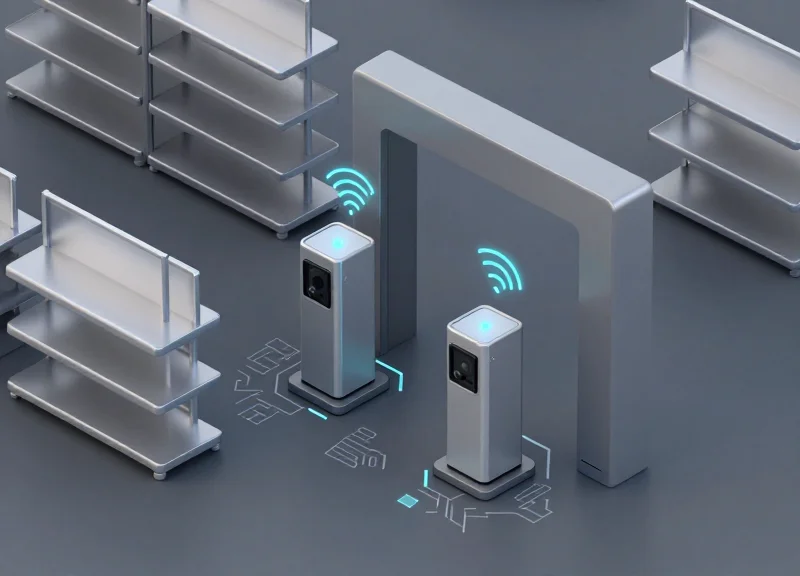
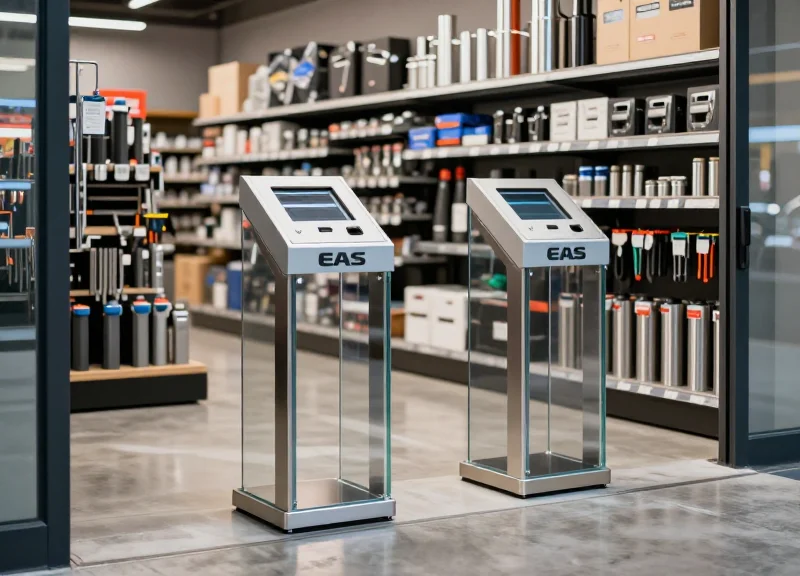
Yes. Most modern RFID providers offer 'overlay' kits that fit inside your existing EAS frames, allowing you to upgrade to RFID sensing without ripping out the physical security infrastructure at the storefront.
How do we handle items that are too small for RFID tags?
For high-shrink, small-format items (like cosmetics), use 'Shielded ESL' setups where the price tag itself acts as the security anchor, triggered if the item crosses the geofence without a 'sold' status from the POS.
What is the typical timeline for a 50-store rollout?
With a pre-configured middleware and source-tagging in place, a typical rollout takes 6 to 9 months, including a 60-day pilot at a high-volume flagship location.