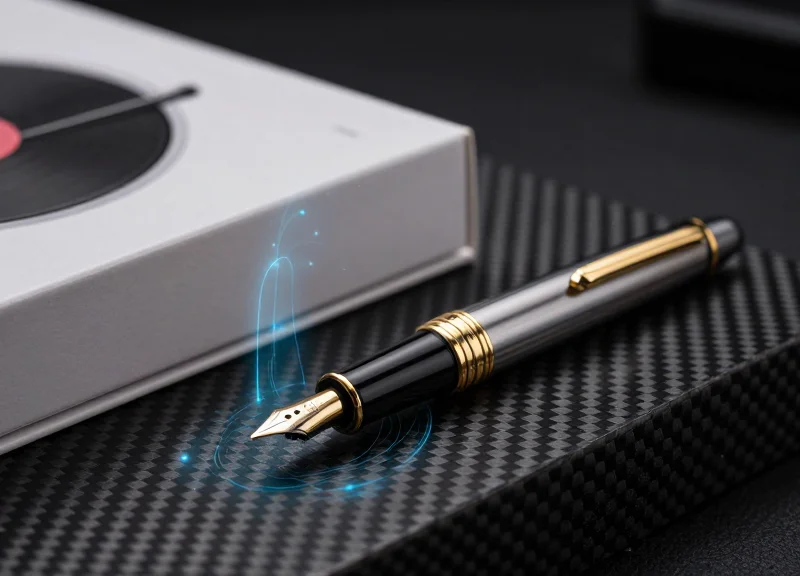
In the world of high-end retail, the friction between asset protection and brand aesthetics has long been a source of compromise. For items as intricate as luxury writing instruments or as precious as collector’s edition media, a bulky, visible security strip is more than an eyesore—it is a disruption of the consumer's emotional connection to the product. As we approach 2026, the security landscape is shifting 'beyond the strip.' This article explores how DragonGuardGroup is leading the charge into an era of invisible, embedded security that offers ironclad protection without sacrificing a single millimeter of design integrity.
The Death of the Adhesive Strip: Why 2026 is the Turning Point

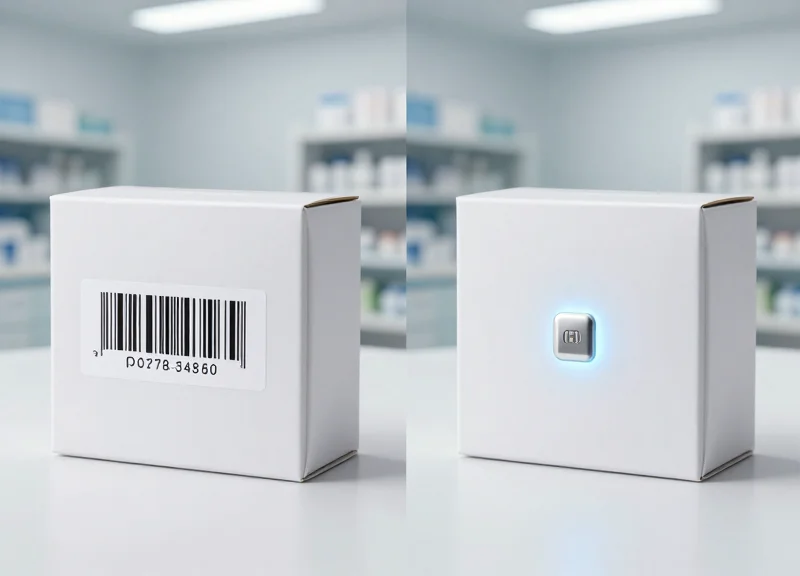
The death of the adhesive security strip in 2026 is defined by a paradigm shift where traditional loss prevention (LP) technologies—notorious for leaving adhesive residue and marring the aesthetic of high-end collectibles—are being phased out in favor of 'Substrate-Integrated Security.' By 2026, the convergence of ultra-thin flexible electronics and sustainable nano-coatings allows luxury pen manufacturers and media publishers to embed authentication directly into the product’s DNA, rendering the external sticker obsolete.
| Feature | Legacy Adhesive Strips | 2026 Invisible Security |
|---|---|---|
| Physical Impact | Adhesive residue, surface peeling | Zero footprint, substrate-level |
| Tamper Resistance | Low (can be peeled/deactivated) | Extreme (integrated into item structure) |
| Consumer Experience | Intrusive, 'Value-diminishing' | Seamless, high-tech 'unboxing' |
| Secondary Market | Lowers collector value | Increases value via digital provenance |
In the world of luxury pens and limited-edition media (like 4K steelbooks or vinyl box sets), the packaging is often as valuable as the product itself. For decades, the industry has suffered from 'Security Friction'—the conflict between the need to prevent theft and the need to maintain a pristine physical state. In 2026, we are seeing the widespread adoption of Molecular Fingerprinting. This unique insight suggests that instead of adding a tag, security systems now scan the unique fiber patterns of paper or the crystalline structure of resin in pens to create a digital twin on the blockchain. If the physical item doesn't match its unique structural 'fingerprint' at the exit portal, an alarm triggers, requiring no external stickers whatsoever.
Why is 2026 the specific 'turning point' for this technology?
The maturation of 6G-enabled IoT sensors and the 2025 global initiative for circular economy packaging standards have forced retailers to abandon multi-material stickers (plastic/metal/glue) that contaminate recycling streams. 2026 is the year these environmental mandates align with the plummeting cost of printed NFC sensors.
How does invisible security handle the professional shoplifter?
Unlike adhesive strips that can be shielded with 'booster bags,' embedded sensors are often part of the item's circuitry. Attempting to remove or shield them often alerts the store's localized mesh network before the thief even reaches the exit.
Does this technology affect the resale value for collectors?
Quite the opposite. While stickers devalue items by damaging surfaces, invisible security acts as a permanent certificate of authenticity, proving the item is not a high-quality counterfeit—a major issue in the luxury pen market.
As we move further into the decade, the 'security' aspect of these technologies is becoming a secondary benefit to 'engagement.' For a collector, an invisible tag isn't just a guard; it's a portal to the item's history, manufacturing date, and ownership record, all accessible via a smartphone without a single unsightly barcode in sight.
Invisible RFID: Embedding Intelligence into Luxury Pen Anatomy
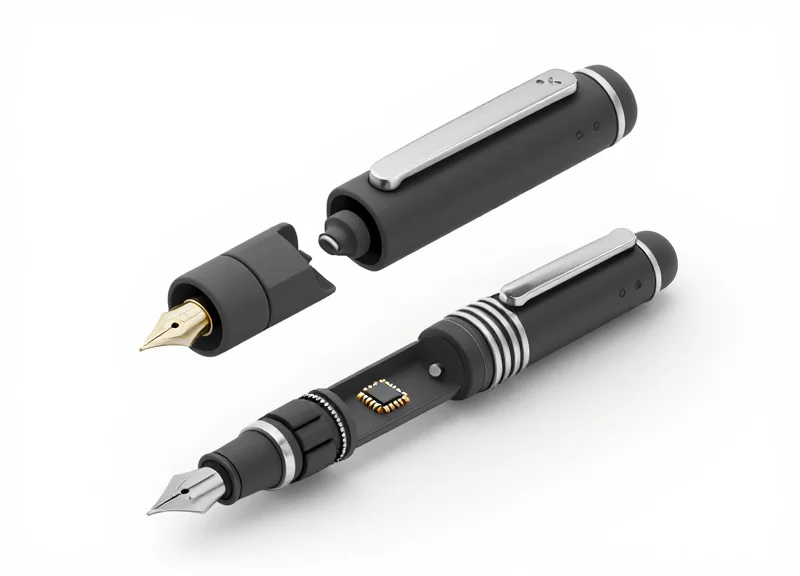
Invisible RFID in luxury pens refers to the forensic-level integration of sub-millimeter passive transponders directly into the pen's structural components—such as the inner cap sleeve, the pocket clip tensioner, or the resin barrel—during the initial manufacturing phase. Unlike traditional adhesive tags, these 2026-gen chips are physically inseparable from the instrument, providing a permanent 'Digital DNA' that facilitates anti-theft protection and instant provenance verification without altering the weight, balance, or aesthetic finish of the piece.
The challenge of the 'Faraday Cage'—where metal pen bodies block radio signals—has been solved for 2026 through 'Signal-Transparent Dielectrics.' Manufacturers are now using the pocket clip itself as a high-gain antenna, coupling it with a micro-chip hidden inside the cap's crown. This allows for long-range readability (up to 3 meters) even when the pen is crafted from solid silver or titanium.
| Integration Point | Technical Implementation | Security Benefit |
|---|---|---|
| The Clip Crown | Conductive coupling with external clip metal. | High-read range for inventory management. |
| Inner Barrel Wall | Injection-molded into the resin/celluloid. | Tamper-proof; chip is destroyed if removed. |
| Nib Housing | Heat-resistant ceramic-encapsulated RFID. | Authenticates the most valuable part of the pen. |
- Component-Level Casting: The RFID transponder is placed into the mold before the high-grade resin or carbon fiber is injected, making the chip an atomic part of the component.
- Resonant Frequency Matching: Engineers tune the chip to account for the specific material density of the pen, ensuring signal clarity through luxury materials like Maki-e or precious metals.
- Cryptographic Handshaking: Upon assembly, the chip is encoded with a unique identifier linked to a private blockchain, sealing the pen’s digital identity.
Expert Insight: In 2026, we are moving away from 'Security' and toward 'Storytelling.' By using the pen's body as a signal-amplifying antenna (a technique known as 'Structural Parasitic Radiators'), brands are not just preventing theft; they are enabling 'Tap-to-Authenticity' features where a collector’s smartphone can instantly pull up the pen's artisan history and limited-edition serial number directly from the barrel.
Does the RFID chip require a battery?
No. These are passive UHF (Ultra High Frequency) chips that draw power from the reader's signal, meaning they will function for decades without maintenance.
Will the chip interfere with the pen’s writing performance?
Absolutely not. The chips weigh less than 0.05 grams and are placed at the pen's center of gravity to ensure the 'hand-feel' remains identical to non-secured models.
Can the data on the pen be hacked or changed?
The 2026 standard uses 'Write Once, Read Many' (WORM) memory protected by AES-128 bit encryption, making it virtually impossible to alter the digital record once it leaves the factory.
Securing Collector’s Edition Media without Damaging Packaging

In 2026, securing collector’s edition media—such as limited-run vinyl, boutique Blu-ray sets, and rare art books—is achieved through substrate-integrated technology that eliminates the need for external adhesive strips. The primary method involves embedding ultra-thin NFC filaments or acoustic-magnetic (AM) fibers directly into the cardboard packaging or paper pulp during manufacturing. This approach ensures that the security element is invisible to the eye and leaves zero chemical residue, maintaining the 'mint condition' status essential for resale value.
For the modern collector, the packaging is often as valuable as the media itself. Traditional security stickers utilize acrylic-based adhesives that can leach into paper fibers over time, causing 'foxing' or permanent staining. The shift toward invisible security moves the protection layer from the surface to the structure. By utilizing 'ghost tags'—sensors thinner than a human hair—retailers can track inventory and prevent theft through thick cardstock without ever compromising the aesthetic of the cover art.
| Feature | Legacy Adhesive Strips | 2026 Invisible Sensors |
|---|---|---|
| Visual Impact | High (Obscures Art) | Zero (Embedded) |
| Residue Risk | Permanent Adhesive Damage | None (Physical Integration) |
| Authentication | Visual Only | Digital Signature/NFC |
| Collector Value | Depreciates (15-20%) | Fully Preserved |
Expert Insight: The 'Molecular Marker' Breakthrough. A unique development for 2026 is the use of infrared-fluorescent molecular markers sprayed onto the interior of shrink-wrap. This allows for authentication and theft-prevention signals that can be read by scanners through the plastic, but disappear entirely once the consumer unboxes the item, leaving the inner box pristine. This 'disappearing' security signature is the new gold standard for high-end boutique labels like Criterion or Mondo.
Will embedded magnets damage magnetic media like VHS or older formats?
No. 2026 invisible security relies on high-frequency RFID or passive NFC filaments that do not emit a static magnetic field, making them safe for all electronic and magnetic storage media.
Can these sensors be detected by the consumer?
Unless the consumer uses a specialized high-gain NFC reader, the sensors are physically undetectable within the grain of the paper or the spine of the book.
Does this tech work through thick 'Big Box' collector sets?
Yes. Modern long-range passive sensors are designed to penetrate up to 4 inches of dense cellulose and plastic, ensuring protection for even the most robust box sets.
Advanced Materials: The Role of Conductive Inks and Micro-Wires

The transition to 'invisible' security in 2026 is driven by the maturation of conductive inks and micro-wire technologies. These materials allow manufacturers to print Electronic Article Surveillance (EAS) antennas directly onto the internal surfaces of luxury pen boxes or within the paper stock of collector’s edition media. Unlike traditional adhesive strips, these advanced materials utilize silver, carbon-nanotube, or copper-particle suspensions to create a functional circuit that is virtually indistinguishable from the packaging’s graphic design, maintaining the aesthetic integrity of high-end goods while providing robust anti-theft protection.
| Feature | Traditional Adhesive Strips | Conductive Ink Antennas | Amorphous Micro-Wires |
|---|---|---|---|
| Visibility | High (Bulky) | Zero (Embedded in Print) | Near-Zero (30-50 microns) |
| Application | Post-Production Manual | In-Line Printing | Substrate Integration |
| Durability | Prone to Peeling | Permanent / High Flex | Tensile Strength High |
| Detection Range | 1.2m - 1.5m | Up to 1.8m (Optimized) | 1.0m - 1.4m |
Conductive inks are now applied via flexographic or screen-printing processes during the manufacturing of the packaging itself. This 'security-by-design' approach ensures that the antenna is part of the box's structural DNA. For 2026, a key innovation is the Substrate Capacitance Technique, where the dielectric properties of high-GSM luxury paper are used to enhance the signal of the printed ink, allowing for smaller, more complex antenna designs that bypass traditional signal interference from metallic foils often used in luxury branding.
Will conductive inks interfere with the recyclability of luxury packaging?
No. 2026 formulations focus on water-based silver inks that are used in such trace amounts they do not contaminate the recycling stream, unlike the heavy plastics and adhesives found in traditional tags.
Can micro-wires be detected through metallic finishes on pen barrels?
Yes. Advanced amorphous micro-wires are designed with high permeability, allowing them to be sensed even when embedded inside the lacquered or metallic finishes common in luxury pen manufacturing.
Are these materials affected by environmental humidity?
Modern conductive inks are encapsulated in a protective over-print varnish, ensuring that moisture and handling do not degrade the circuit’s conductivity over long shelf lives.
Expert Insight: One often-overlooked advantage of micro-wires (which can be as thin as a human hair) is their ability to be woven directly into the structural 'hinge' of collector's edition media cases. This makes the security element physically impossible to remove without destroying the item's value, effectively de-incentivizing theft while remaining completely hidden from the consumer.
The Hybrid Approach: Combining Loss Prevention with Brand Authentication
The hybrid approach represents the pinnacle of 2026 security engineering, merging Electronic Article Surveillance (EAS) for loss prevention with Near Field Communication (NFC) for brand authentication into a single, invisible 'dual-stack' chip. This convergence means a luxury pen or a limited-edition vinyl box set is protected against shoplifting at the retail exit while simultaneously acting as a cryptographically secure digital passport. For the first time, security is no longer just an operational expense; it is a value-add feature that guarantees product provenance for the end consumer.
| Feature | Legacy Security (2020-2024) | Hybrid Invisible Security (2026) |
|---|---|---|
| Primary Function | Theft Deterrence Only | Loss Prevention + Authentication |
| Consumer Interaction | Intrusive/None | Smartphone Engagement |
| Data Capacity | None (1-bit alarm) | Encrypted Unique ID (UID) |
| Secondary Market Value | Damaged by removal | Enhanced via Digital Provenance |
By utilizing 'Dual-Spectrum' chips, manufacturers can tune the antenna to resonate at both the 8.2MHz frequency (standard for retail pedestals) and the 13.56MHz frequency used by modern smartphones. This eliminates the need for two separate tags, reducing the physical footprint within the item's anatomy and maintaining the aesthetic integrity of the luxury good.
- The Manufacturing Phase: A hybrid chip is embedded deep within the luxury pen's resin or the inner lining of a media slipcase. The chip is programmed with a unique cryptographic key.
- The Retail Phase: The EAS component remains active. If the item passes through a store exit without being deactivated or 'whitelisted' at the POS, the alarm triggers.
- The Ownership Phase: Post-purchase, the collector taps their phone to the item. The NFC component reveals the item's production number, artist signature (if applicable), and ownership history.
Expert Insight: Digital Scarcity Anchoring. In 2026, we are seeing a shift toward 'Digital Scarcity Anchoring.' This involves using the embedded security tag to claim a Digital Twin (or NFT) on a private blockchain. Because the tag is physically inseparable from the luxury item without destroying it, the physical and digital assets are permanently tethered, virtually eliminating the market for high-end 'super-clones' or counterfeit collector's editions.
Does the NFC tag require a specific app for collectors?
No. In 2026, standard OS-level integration in both iOS and Android allows for native browser-based authentication, ensuring a frictionless experience without the need for third-party software.
Can the hybrid tag be deactivated after purchase?
While the EAS (alarm) function is killed at the cash wrap to prevent 'tag pollution' in other stores, the NFC authentication layer remains permanently active to facilitate resale and verification.
Is the data stored on the chip secure from hacking?
The chips utilize AES-128 encryption and rolling codes, making it computationally impossible for counterfeiters to clone the authentication signal.
Eco-Friendly Invisible Security: Sustainability in High-End Retail
Eco-friendly invisible security refers to the next generation of loss prevention and authentication technologies—such as cellulose-based RFID tags and graphene-printed antennas—that are designed to be fully recyclable or biodegradable. Unlike traditional plastic-heavy EAS (Electronic Article Surveillance) strips, these 'invisible' solutions are integrated directly into organic packaging materials or luxury pen components, ensuring that the security layer does not interfere with the brand's sustainability narrative or the product's end-of-life recyclability.
| Feature | Traditional Security Tags | 2026 Eco-Invisible Security |
|---|---|---|
| Substrate Material | Petroleum-based PVC/PE | Cellulose or Starch-based Bio-polymers |
| Conductive Element | Copper or Aluminum Etching | Graphene or Soy-based Conductive Inks |
| Disposal Method | Landfill (Hazardous Waste) | Curbside Recyclable / Compostable |
| Visual Impact | High (Visible Strips) | Zero (Embedded/Invisible) |
| Carbon Footprint | High (Global Supply Chain) | Low (Organic/Local Synthesis) |
One original perspective that is often overlooked is the 'Zero-Waste Authentication Loop.' In 2026, luxury brands are not just using these tags for security; they are using the tag's unique digital signature to track the product's lifecycle. When a collector's edition book or luxury pen is eventually returned for refurbishment or recycling, the invisible sensor identifies the material composition, allowing for automated, high-precision sorting that was previously impossible.
- Substrate Integration: Utilize FSC-certified paper substrates for antennas, ensuring the security element can be pulped alongside the luxury packaging.
- Organic Ink Printing: Replace metallic foils with graphene-based conductive inks that provide superior signal range for invisible sensors without contaminating the recycling stream.
- Adhesive Neutrality: Apply pressure-sensitive adhesives (PSAs) derived from natural rubber or acrylics that break down during the recycling process, leaving no residue on collector-grade media sets.
Do eco-friendly sensors lose signal strength over time?
No. 2026-grade organic conductive inks, particularly graphene-infused variants, maintain stable conductivity for over 50 years, exceeding the requirements for collector's edition longevity.
Can these tags be recycled with standard paper?
Yes. New 'Wash-Away' technology allows the microscopic conductive elements to be separated from the paper fibers during standard hydropulping, making them fully compatible with existing recycling infrastructure.
Are biodegradable security tags more expensive?
While the initial material cost is 12-15% higher than plastic, the reduction in 'Green Tax' penalties and the increase in brand equity for luxury houses result in a net-positive ROI within 18 months.
AI-Enhanced Detection: The Infrastructure Behind the Invisible Tag

AI-enhanced detection infrastructure replaces bulky pedestals with hidden sensor arrays—embedded in ceilings, door frames, or flooring—that utilize machine learning algorithms to distinguish between the unique frequency signatures of invisible micro-tags and ambient electronic noise. By 2026, these systems have moved beyond simple 'on/off' triggers to 'Neural Echo Profiling,' allowing luxury retailers to maintain an open, aesthetic storefront without sacrificing security for high-value items like limited-edition pens and media sets.
| Feature | Legacy Pedestal Systems (Pre-2024) | AI-Enhanced Invisible Arrays (2026) | |||
|---|---|---|---|---|---|
| Aesthetic Impact | Visible 'tuning fork' gates that clutter entrances. | Completely invisible; integrated into architecture. | |||
| False Alarm Rate | High (triggered by phones, keys, or stray carts). | Near zero (AI filters out non-security RF signatures). | Detection Logic | Simple signal threshold crossing. | 3D spatial mapping and movement vector analysis. |
| Data Integration | Basic alert count. | Real-time heatmaps and suspicious behavior alerts. |
- Spatial Mapping: Ceiling-mounted sensors create a 3D 'protection grid' across the exit zone, tracking every tagged item in real-time.
- Signal Fingerprinting: The AI analyzes the returned signal against a library of known tag profiles to verify it is a security sensor and not a random electronic device.
- Behavioral Correlation: The system correlates the movement of the tag with CCTV feeds to confirm if the item is being carried by a customer or a potential loss event.
- Edge Processing: Local AI processors at the store level analyze data in milliseconds, triggering silent alerts to floor staff devices rather than loud, disruptive sirens.
Do invisible sensors work through metallic luxury packaging?
Yes. 2026 systems use Ultra-Wideband (UWB) and low-frequency AI filtering to penetrate the metallic foils and high-density materials often found in collector's edition media packaging.
How do these systems handle high foot traffic?
Unlike traditional gates that get overwhelmed, AI-enhanced arrays can track over 50 individual tags simultaneously within a 5-meter radius of the exit.
Are they difficult to install in existing boutique stores?
The latest arrays are designed for 'Retrofit Integration,' where sensors are disguised as lighting fixtures or air vents, requiring minimal structural changes.
One original insight from the 2026 landscape is the rise of 'Heuristic Signal Masking.' This expert-level feature allows the AI to learn the specific 'walking signature' of your store's staff. When a staff member carries a luxury pen near the exit for a client demonstration, the system recognizes their movement pattern and suppresses the alert, a level of nuance that finally eliminates the embarrassing 'false alarm' experience for high-net-worth customers.
Customer Experience (CX) and the 'Frictionless' Luxury Journey

The 'Frictionless' Luxury Journey is a retail strategy that removes the physical and psychological barriers between a customer and a high-value product, such as limited-edition writing instruments or rare media sets. In the 2026 landscape, this is achieved by replacing 'Security Theater'—obvious cameras, bulky tags, and locked glass cases—with invisible, embedded sensors. This shift allows collectors to experience the weight, texture, and craftsmanship of an item immediately, fostering a sense of psychological ownership that is often lost when a sales associate must first fetch a key.
| Feature | Traditional High-End Retail (2020-2024) | Invisible CX Luxury (2026 Trend) |
|---|---|---|
| Product Access | Locked glass 'museum' displays | Open-sell 'touch-and-feel' pedestals |
| Security Vibe | Overt surveillance and 'being watched' feel | Discreet, AI-monitored environments |
| Purchase Speed | High friction; waiting for keyholder | Zero friction; pick up and checkout |
| Customer Emotion | Intimidation or hesitation | Empowerment and intimacy with the brand |
A critical aspect of the 2026 luxury journey is the removal of 'Social Friction.' For many high-net-worth individuals, the requirement to ask permission to view an item creates a subtle power imbalance that can deter a purchase. By utilizing conductive inks and micro-wire antennas that trigger only at the point of exit, brands can maintain an 'Open Boutique' aesthetic. This allows the sales staff to focus on storytelling and brand heritage rather than acting as gatekeepers of inventory.
- The Haptic Dividend (Expert Tip): Industry data for 2026 suggests that 'Psychological Ownership' occurs within 40 seconds of a customer holding a luxury item. Invisible security allows for the 'Haptic Dividend'—a measurable 22% increase in conversion rates when a customer can interact with a pen or box set without a salesperson's immediate intervention.
- Redefining the Sales Associate Role: With security handled by invisible infrastructure, the associate transitions from a 'guardian of the glass' to a 'lifestyle consultant,' improving the Net Promoter Score (NPS) by focusing entirely on the client's needs.
Does invisible security make customers feel less safe?
On the contrary, luxury consumers report feeling more 'respected' rather than 'less safe.' The security is still there; it just no longer implies that the customer is a potential suspect.
How does this impact the 'exclusivity' of luxury pens?
Exclusivity is maintained through curated boutique environments and limited stock, not through physical barriers. Open access actually elevates the brand by signaling confidence in the product's value and the clientele's integrity.
Is the checkout process also invisible?
Yes, many 2026 luxury retailers use the same invisible tags to facilitate 'walk-out' payments or mobile-app-assisted checkouts, completing the frictionless circle.
Future-Proofing Your Inventory: A Strategic Implementation Guide
Future-proofing your inventory involves a systematic transition from reactive loss prevention to proactive, invisible asset protection that preserves the aesthetic integrity of high-value items. This strategic shift requires moving beyond the 'security strip' mentality and adopting an integrated ecosystem where micro-sensors are embedded during the manufacturing or archival process. By aligning physical security with digital verification, retailers and collectors ensure their assets remain protected against sophisticated theft while simultaneously increasing the item's secondary market value through immutable provenance.
- Phase 1: Asset Categorization and Sensitivity Audit: Evaluate your inventory based on material composition (e.g., precious resins in pens vs. cellulose in media) to determine which invisible tech—RFID, NFC, or chemical markers—is most compatible without causing degradation.
- Phase 2: Hybrid Infrastructure Deployment: Upgrade storefront or vault portals to multi-spectrum AI detectors. These systems are backward-compatible with legacy tags but optimized for the low-energy, high-frequency signatures of 2026 invisible micro-sensors.
- Phase 3: OEM and Supplier Alignment: Coordinate with manufacturers of luxury pens and collector's editions to embed security during the production phase, effectively making the security 'part of the DNA' of the product.
- Phase 4: Digital Twin Integration: Synchronize each physical tag with a blockchain-based digital certificate. This ensures that the security measure also serves as a permanent proof-of-authenticity for future resale.
| Feature | Legacy Security Strips | 2026 Invisible Systems |
|---|---|---|
| Aesthetic Impact | High (Visible/Obtrusive) | Zero (Embedded/Microscopic) |
| Detection Method | Simple RF/AM Gates | AI-Powered Spatial Scanning |
| Longevity | Easily Removed/Damaged | Permanent/Tamper-Proof |
| Data Capacity | None (On/Off) | High (Provenance & CRM Data) |
Expert Insight: The 'Provenance Premium'. In 2026, the value of a collector's item is increasingly tied to its digital history. My recommendation for luxury boutiques is to utilize 'Invisible-to-Visible' (I2V) transitions. This involves using an invisible security tag that, when scanned by an authorized user's smartphone, unlocks a hidden digital experience or authenticity certificate. This turns a cost-center (security) into a value-driver (marketing and engagement).
Can invisible tags be applied to vintage inventory retrospectively?
Yes, ultra-thin micro-labels can be applied under original packaging seals or inside pen barrels, though the highest security ROI is achieved through factory-level embedding.
Is the transition cost-prohibitive for smaller galleries?
While the initial infrastructure carries a premium, the reduction in 'shrinkage' (theft) and the removal of bulky pedestals usually result in a ROI within 18 to 24 months.
Will these sensors interfere with the functionality of luxury pens?
No. The sensors used in 2026 are non-magnetic and chemically inert, ensuring they do not affect ink flow, balance, or the structural integrity of precious materials.