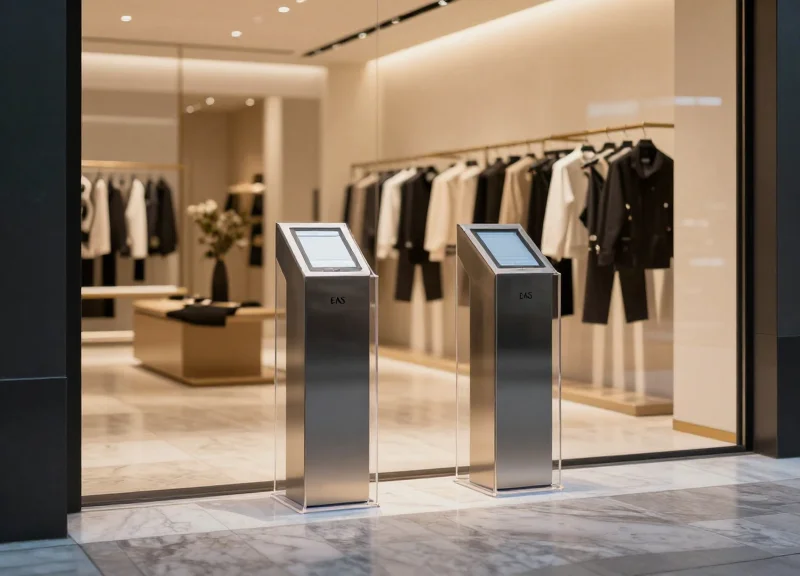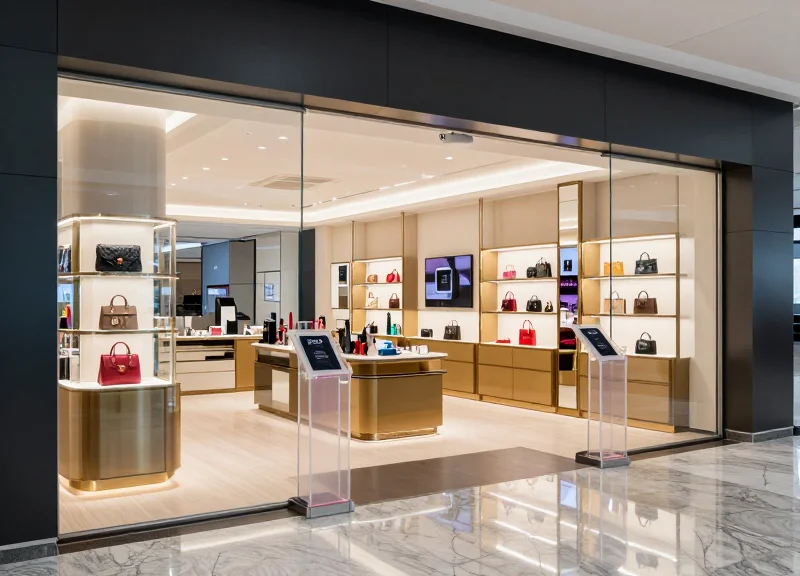
As global travel reaches unprecedented levels in 2026, airport duty-free shops have evolved into high-traffic luxury hubs where traditional security measures often fall short. The challenge is twofold: protecting high-value assets like premium spirits, jewelry, and cosmetics while maintaining a seamless, frictionless experience for travelers in a rush. This selection guide provides a strategic roadmap for retail managers to navigate the complexities of modern Electronic Article Surveillance (EAS), ensuring robust loss prevention that aligns with the sophisticated demands of the airport environment.
The Evolution of Airport Duty-Free Security Challenges in 2026

By 2026, airport duty-free security has shifted from traditional gate-keeping to a complex ecosystem managing micro-boutique vulnerabilities and high-density passenger flow. Modern Electronic Article Surveillance (EAS) must now provide a seamless, 'invisible perimeter' that protects high-margin luxury goods without impeding the rapid transit of international travelers. The primary challenge lies in the dual pressure of increasing passenger volumes—projected to hit record highs in 2026—and the proliferation of open-concept luxury pop-ups that lack traditional storefront boundaries, making legacy pedestal systems both aesthetically and operationally obsolete.
| Risk Factor | Legacy Challenge (Pre-2024) | 2026 Reality |
|---|---|---|
| Store Layout | Fixed storefronts with gates | Open-flow terminal 'islands' & pop-ups |
| Theft Profile | Local opportunistic shoplifting | Coordinated 'Transitional Theft' across borders |
| Customer Experience | Visible security deterrence | Frictionless, high-touch luxury engagement |
| Data Integration | Stand-alone alarm systems | AI-linked POS and passenger flow analytics |
The rise of the 'Terminal Boutique' model has significantly altered the risk landscape. In these high-traffic luxury hubs, the distance between the product shelf and the international departure gate is often less than 50 meters. This creates a 'high-velocity theft window' where shoplifters can exit a retail zone and enter a secure boarding area within seconds, making rapid detection and discrete intervention more critical than ever before.
What is 'Transitional Theft' in the 2026 context?
Transitional Theft refers to organized retail crime syndicates utilizing the transient nature of international travel to move high-value luxury goods across borders. Stolen items are often moved into airside transit zones where local jurisdiction and physical pursuit are restricted, necessitating EAS solutions that provide real-time alerts before the thief exits the immediate retail footprint.
Why are traditional EAS pedestals failing in 2026 airport designs?
Modern airport architecture emphasizes 'see-through' terminal vistas and wide-open walkways. Traditional pedestals create physical bottlenecks that disrupt passenger flow and clash with the aesthetic requirements of luxury brands like LVMH or Richemont. 2026 standards demand overhead or floor-concealed systems that maintain security without visual clutter.
How does high-frequency 5G and airport Wi-Fi impact EAS?
Signal interference is a major 2026 hurdle. With the saturation of 5G networks and terminal-wide IoT devices, legacy AM (Acousto-Magnetic) systems can suffer from false alarms or reduced sensitivity. Leading solutions now utilize ultra-stable RF or RFID frequencies designed specifically for high-interference environments.
Expert Insight: In 2026, the most successful duty-free retailers are moving away from 'detection at the door' toward 'protection at the product.' This involves the use of ultra-discreet, brand-integrated tags that act as data points for terminal-wide IoT networks, allowing security teams to track high-value assets across the entire concourse, not just at the shop exit.
Frequency Selection: Comparing AM, RF, and RFID for Airport Environments
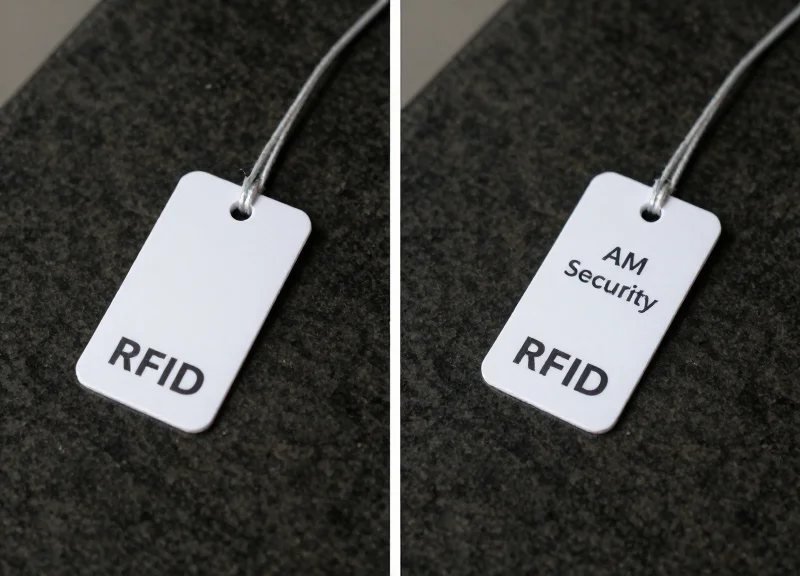
Selecting the right EAS frequency for airport duty-free involves evaluating three primary technologies: Acousto-Magnetic (AM) at 58 kHz for superior performance around metal and liquids; Radio Frequency (RF) at 8.2 MHz for cost-effective protection of soft goods; and Radio Frequency Identification (RFID) for integrated security and real-time inventory accuracy. In the high-interference environment of a modern terminal, the decision hinges on the '3 M's': Metal, Moisture, and Multipath signals.
| Feature | Acousto-Magnetic (AM) | Radio Frequency (RF) | RFID (UHF) |
|---|---|---|---|
| Operating Frequency | 58 kHz | 8.2 MHz | 860 - 960 MHz |
| Metal/Liquid Tolerance | High (Best for Perfumes/Liquor) | Low (Susceptible to shielding) | Moderate (Requires specialized tags) |
| Detection Range | Wide (Up to 2.4m) | Standard (Up to 1.8m) | Extensive (Up to 6m+) |
| Primary Benefit | Resilience against terminal noise | Lowest cost-per-tag | Item-level data & logistics |
For luxury duty-free hubs, AM technology remains the industry benchmark. Airport architectures are heavily reliant on steel frames, aluminum storefronts, and moving metal (baggage carts and elevators). AM systems are inherently more stable in these environments because their low-frequency signal is less affected by 'environmental noise'—the electronic chatter from terminal Wi-Fi, cellular repeaters, and flight information displays. While RF is budget-friendly, its higher frequency is prone to 'dead zones' when placed near large metal fixtures or when protecting foil-lined packaging common in high-end cosmetics.
Can RFID completely replace traditional EAS in an airport setting?
While RFID offers item-level visibility, it is often used alongside AM in a 'Hybrid' approach. RFID identifies the item, while AM provides the raw physical barrier. As of 2026, many luxury brands are moving toward RFID-only for inventory, but retaining EAS pedestals for visual deterrence and high-speed exit gate alarms.
Why do airport security systems often 'false alarm' near jet bridges?
This is usually caused by 'phantom signals' or metal movement. RF systems are particularly vulnerable to this. AM systems utilize digital signal processing (DSP) to filter out these structural vibrations, making them more reliable for stores located near heavy terminal machinery.
Which technology is best for duty-free liquor and tobacco?
AM is the undisputed winner. The high moisture content in spirits and the foil-lined packaging of luxury tobacco brands significantly degrade RF performance, whereas AM signals pass through these materials with minimal attenuation.
Expert Insight: The 2026 Dual-Modality Shift. The most sophisticated airport retailers are now deploying 'Dual-Modality' pedestals. These units house both AM and RFID antennas within a single slim-line acrylic frame. This allows the system to trigger a high-decibel alarm via the AM signal for immediate theft deterrence, while simultaneously logging the specific SKU of the stolen item via RFID. This 'Intelligence-Led Security' allows retailers to reconcile stock losses in real-time and even alert terminal security with the exact description of the item being moved toward a specific gate.
Prioritizing Aesthetics: Hidden and Integrated Antenna Solutions

In 2026, the 'open-concept' storefront is the standard for luxury duty-free retail, making traditional security pedestals an aesthetic liability. Hidden and integrated EAS solutions, such as floor-embedded loops and overhead sensors, provide a transparent security layer that protects high-value inventory without obstructing the grand entrances or curated visual merchandising essential to the luxury passenger experience. These systems utilize advanced Acousto-Magnetic (AM) or RFID technology to create a discreet detection zone that is entirely invisible to the shopper.
| Solution Type | Installation Method | Detection Range | Visual Impact |
|---|---|---|---|
| Under-Floor Loops | Embedded in sub-floor or under carpet | Up to 2.5m width | Zero (Invisible) |
| Overhead Sensors | Recessed into ceiling or light tracks | Variable (up to 3.5m height) | Near-Zero (Looks like lighting) |
| Integrated Frames | Built into door frames or glass fins | Standard doorway width | Low (Minimalist profile) |
Expert Insight: The 'Shielding Effect' in Airport Terminals. A unique challenge in airport environments is the high concentration of structural metal and power cabling under terminal floors. When selecting floor-based EAS loops for 2026 hubs, ensure they feature 'Active Noise Cancellation' (ANC) algorithms. Without this, the metallic rebar and electrical interference from baggage handling systems located on levels below can cause phantom alarms or dead zones. We recommend a site-specific electromagnetic interference (EMI) survey before choosing between floor-based or overhead deployments.
Do hidden systems work as well as traditional pedestals?
Yes. Modern floor and overhead systems use phased-array antenna technology to provide 360-degree tag detection that often exceeds the performance of standard pedestals, especially in wide-opening 'mall-style' storefronts.
Can overhead sensors distinguish between shoppers and merchandise?
Advanced 2026 overhead systems utilize integrated AI-vision or IR sensors to filter out 'tag pollution'—tags that are sitting near the door but are not actually exiting the store—reducing false alarms significantly.
What is the maintenance requirement for under-floor systems?
Under-floor systems are highly durable but require professional installation. Maintenance is generally low, as the hardware is protected from physical impact (trolleys, luggage) that often damages exposed pedestals.
- Design Consultation: Collaborate with architects during the terminal design phase to ensure floor depths can accommodate loop cabling (typically 15-20mm).
- EMI Analysis: Conduct a frequency sweep to identify potential interference from airport Wi-Fi, gate electronics, and subterranean power lines.
- Redundancy Planning: In ultra-high-traffic zones, combine overhead RFID sensors with floor-based AM loops for a 'hybrid' approach that covers both inventory tracking and anti-theft.
Mitigating False Alarms in High-Traffic Transit Hubs
Mitigating false alarms in high-traffic transit hubs involves implementing Advanced Signal Processing (ASP) and Artificial Intelligence (AI) to differentiate between legitimate Electronic Article Surveillance (EAS) tag signals and environmental noise caused by metallic luggage carts, metal-clad suitcases, or nearby security infrastructure. In the high-stakes environment of airport duty-free, minimizing these 'nuisance alarms' is critical to preventing 'alarm fatigue' among staff and maintaining the prestige of luxury retail brands by ensuring a frictionless passenger exit. Modern 2026 solutions prioritize high signal-to-noise ratios to ensure that only active security tags trigger a response, even in electromagnetically dense terminal environments.
| Source of Interference | Cause of False Alarm | 2026 Mitigation Strategy |
|---|---|---|
| Metallic Luggage Carts | Large moving metal masses create 'phantom' signals in traditional RF loops. | AI-based pattern recognition that ignores non-tag metallic signatures. |
| Adjacent Security Gates | Signal 'crosstalk' between nearby stores in tight terminal layouts. | Synchronized frequency hopping and phased-array antenna shielding. |
| Metal-Clad Suitcases | Shielding effects or eddy currents that mimic tag resonance. | Multi-frequency 'Tag-Check' protocols to verify the specific Q-factor of a tag. |
| High-Voltage Cables | Electromagnetic interference (EMI) from terminal power grids. | Digital Signal Processing (DSP) filters that isolate 50/60Hz noise. |
Expert Insight: In 2026, the industry has shifted toward 'Contextual Alarm Logic.' Instead of a simple binary trigger, systems now analyze the speed and trajectory of an object. A luggage cart pushed at 1 m/s has a different 'signal footprint' than a high-end handbag moving at the same speed. Systems that fail to integrate this velocity data see 40% higher false alarm rates in transit hubs.
- Electromagnetic Site Survey: Before installation, conduct a 24-hour baseline noise map of the terminal location to identify peak interference times from airport machinery.
- Dynamic Sensitivity Tuning: Configure the EAS system to automatically adjust sensitivity levels based on passenger density and terminal activity cycles.
- Source Tagging Verification: Ensure all luxury vendors use high-quality, calibrated tags to prevent 'resonance drift,' which often triggers alarms when passing near metal structures.
- Staff Protocol Training: Educate staff on 'Shadow Alarms' caused by proximity—reminding them to keep display stock at least 3 feet from the antenna line.
How do 'Smart Zones' reduce nuisance alarms?
Smart Zones use overhead sensors to confirm a person is actually exiting the store before activating the pedestal, preventing alarms from customers just browsing near the entrance.
Can floor-based systems handle heavy luggage carts?
Yes, but they require specialized 'heavy-load' shielding to prevent the metal in the cart from de-tuning the floor loop antenna.
What is 'Alarm Fatigue' and why is it a risk?
Alarm fatigue occurs when staff ignore alerts due to frequent false positives. In luxury duty-free, this leads to increased shrink and a diminished sense of security for high-net-worth shoppers.
The Synergy of EAS and ESL: Real-Time Security Meets Smart Pricing

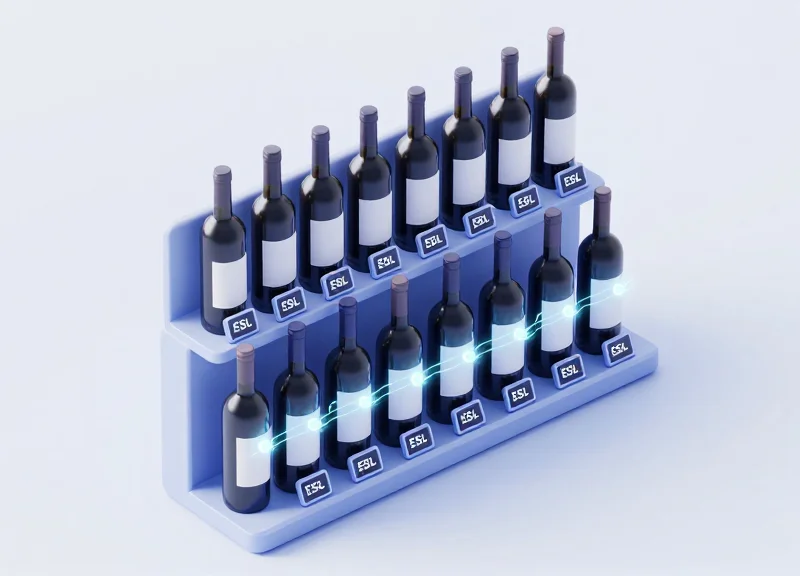
The synergy of EAS (Electronic Article Surveillance) and ESL (Electronic Shelf Labels) represents the convergence of loss prevention and operational intelligence, where digital price tags act as the 'eyes' on the shelf while EAS serves as the 'shield' at the exit. By 2026, top-tier duty-free operators are moving away from siloed systems toward integrated IoT platforms where an ESL update can trigger a security status change, and a removed EAS tag can instantly notify the ESL system to verify the transaction in the cloud, effectively neutralizing Organized Retail Crime (ORC) through real-time item-level visibility.
Expert Insight: The 'Anomalous Dwell Time' Metric. While traditional security focuses on the exit, the EAS-ESL synergy allows for 'Pre-Detection.' By monitoring the connection between the ESL and the physical product via Bluetooth Low Energy (BLE) or sub-Ghz links, the system can identify 'anomalous dwell time'—when a high-value item, such as a $5,000 watch, is removed from its cradle but does not pass a Point of Sale (POS) within a 180-second window. This triggers a silent haptic alert to floor staff's wearables, allowing for a 'customer service intervention' before the suspect even reaches the terminal exit.
| Feature | Legacy Standalone Systems | Integrated EAS + ESL (2026 Standard) |
|---|---|---|
| Price Agility | Manual updates; 2-4 hours per zone | Instant; synchronized across terminal in seconds |
| Theft Detection | Reactive (alarms at the gate) | Proactive (alerts on shelf-removal anomalies) |
| Inventory Accuracy | Dependent on manual cycle counts | Real-time; 'Shelf-to-Exit' automated tracking |
| Staff Utilization | High labor cost for labeling and guarding | Automated; staff focused on luxury storytelling |
- Unified Communication Infrastructure: Deploy a single gateway architecture that supports both ESL (Zigbee/BLE) and RFID-based EAS protocols to reduce hardware footprint and interference.
- API-First Integration: Connect the ESL management software directly to the EAS backend and the Duty-Free ERP to ensure that price changes and security deactivations happen simultaneously.
- Dynamic Security Thresholds: Implement logic that increases EAS sensitivity or triggers CCTV recording when the ESL system detects high-velocity 'shelf sweeping' behavior.
- Edge-Based Analytics Deployment: Process movement data at the shelf level to minimize latency, ensuring alerts reach security personnel in milliseconds rather than waiting for cloud round-trips.
Does ESL integration significantly drain the battery life of security tags?
No. Modern 2026 systems use ultra-low-power wake-up triggers. The ESL system only communicates with the security tag when movement is detected, preserving a 5-7 year battery life.
How does this synergy handle 'Flash Sales' in high-traffic airports?
The system automatically adjusts security protocols during high-traffic sales. If an ESL triggers a 'limited time offer,' the EAS system can be set to prioritize 'bulk-theft' patterns over individual item movements to prevent false alarms during the rush.
Can integrated systems distinguish between a traveler and a staff member?
Yes. Staff members carry 'authorized-move' fobs that whitelist their interactions with ESL-protected items, preventing internal security triggers during restocking or cleaning.
Source Tagging Strategies for High-Value Luxury Goods

Source tagging is the strategic practice of embedding Electronic Article Surveillance (EAS) or RFID sensors into products or their packaging during the manufacturing process. For airport duty-free hubs, this approach shifts the security burden from the retail staff to the supplier, ensuring that 100% of high-value inventory—from Swiss watches to designer leather goods—is protected before it even reaches the terminal. By eliminating the need for manual tag application in-store, luxury retailers can maximize 'speed-to-floor' and maintain the pristine aesthetic integrity of premium items.
- Upstream Integration: Collaborate with luxury maisons to embed discrete AM or RF circuits inside garment seams or high-end box linings, making the security feature invisible to the consumer.
- Standardization of Tagging Protocols: Establish a global compliance manual for vendors to ensure tags are placed in consistent, optimized locations for maximum detection by airport pedestal or overhead systems.
- Verification and Audit: Implement a 'Source Tagging Certification' program where shipments are sampled upon arrival at the hub to verify tag deactivation performance and detection strength.
| Metric | Manual In-Store Tagging | Manufacturer Source Tagging |
|---|---|---|
| Labor Requirement | High (Requires dedicated staff hours) | Zero (Staff focus on sales/service) |
| Product Aesthetics | Bulky external tags may obscure branding | Hidden or integrated tags preserve design |
| Time-to-Shelf | Delayed (Hours to days post-arrival) | Instant (Shelf-ready upon delivery) |
| Shrinkage Control | Vulnerable during the tagging backlog | Protected from dock to display |
Expert Insight for 2026: The 'Invisible Aesthetic' Mandate. In the high-stakes environment of 2026 luxury retail, the physical 'hard tag' is increasingly seen as a brand detractor. We are seeing a pivot toward conductive ink sensors and micro-RFID threads woven directly into luxury textiles. My recommendation for duty-free operators is to move toward dual-technology source tags (AM+RFID) which provide both the robust physical security needed for high-traffic terminals and the inventory precision required for omnichannel duty-free 'reserve and collect' models.
How does source tagging impact the manufacturer's cost?
While there is a marginal increase in unit cost, most luxury brands absorb this to ensure their products are handled less by third-party staff and to maintain brand consistency globally.
Can source tags be deactivated without damaging luxury packaging?
Yes, modern high-speed deactivators used at POS terminals are designed to neutralize integrated tags through layers of leather or thick cardstock without any physical contact or heat.
Is source tagging compatible with 'Ship-from-Store' terminal models?
Absolutely. Because the tag is already embedded, it provides consistent protection regardless of whether the item is sold in-terminal or dispatched via an airport-to-city delivery service.
Data Analytics and Remote System Management

In 2026, the standard for luxury airport duty-free security has shifted from reactive hardware to proactive, data-driven ecosystems. Data Analytics and Remote System Management represent the integration of IoT sensors within EAS pedestals to provide a bird's-eye view of store performance and security health. By aggregating data from multiple gates across various terminals into a single cloud-based dashboard, retail managers can move beyond merely stopping theft to understanding the 'why' and 'when' of retail shrinkage. This connectivity ensures that security is no longer a siloed expense but a source of actionable business intelligence.
- Real-Time Health Monitoring: Automated alerts for system outages or sensor interference, allowing for remote troubleshooting before a technician is even dispatched.
- Traffic Correlation Analytics: Integrating footfall counters with EAS data to determine high-risk periods and optimize staff-to-customer ratios in luxury zones.
- Alarm Pattern Recognition: Identifying 'hot times' for theft attempts, which enables airport security to adjust patrol routes dynamically based on real-world incident data.
- Remote Sensitivity Tuning: Adjusting sensor thresholds via the cloud to compensate for new environmental noise or metallic displays without on-site visits.
| Data Category | Operational Insight | Strategic Benefit |
|---|---|---|
| Alarm Timing Data | Identifies peak theft windows. | Optimized security guard scheduling. |
| Inbound/Outbound Counts | Measures 'bounce rates' and dwell time. | Improved store layout and merchandising. |
| System Up-time Logs | Tracks hardware reliability. | Reduced maintenance costs and zero downtime. |
| Deactivator Usage | Monitors POS efficiency. | Detection of internal 'sweethearting' or fraud. |
Expert Insight: The 'Signature Analysis' Advantage. One of the most significant 2026 breakthroughs is 'Alarm Signature Analysis.' By using Edge-AI, modern EAS systems can distinguish between a professional booster bag (which generates a specific signal distortion) and a legitimate customer who accidentally left a tag on an item. This allows remote managers to filter out noise and only escalate high-probability theft events to security teams, preserving the premium atmosphere of the luxury hub.
Is the data collected compliant with airport privacy regulations?
Yes. Modern EAS analytics focus on anonymous metadata (signal strength, timestamps, and counts) rather than personally identifiable information, ensuring GDPR and local aviation security compliance.
Can I manage systems in different countries from one HQ?
Absolutely. Cloud-native platforms allow global retail directors to compare the security performance of a London Heathrow boutique with a Dubai International outlet in real-time.
Does remote management require a dedicated IT team?
No. Most 2026 solutions are 'Software-as-a-Service' (SaaS) models where the vendor provides the dashboard and automated reporting, requiring minimal internal IT overhead.
Operational Resilience: Maintenance and Support in 24/7 Hubs
Operational resilience in airport duty-free environments is the capacity of an EAS system to maintain continuous protection through a 'Continuous Shield' model. This involves integrating AI-driven predictive diagnostics with globally distributed technical support teams capable of sub-4-hour response times. In a 24/7 high-traffic terminal, system downtime is not merely a technical glitch; it is a direct financial leak where every hour of inactivity can result in thousands of dollars in unrecovered shrinkage and compromised luxury brand integrity.
| Support Feature | Standard Retail Support | Airport-Grade 2026 Support |
|---|---|---|
| Response Time | Next Business Day | Sub-4 Hour Guaranteed |
| Diagnostic Method | Reactive (On-site) | Proactive (Remote AI Cloud) |
| Security Clearance | Local Tech (Varies) | Pre-vetted Airside Certified |
| Redundancy | Single Controller | N+1 Hardware Failover |
Expert Insight: The 'Virtual Technician' and Sterile-Zone Bypassing. One of the greatest bottlenecks in airport maintenance is the time lost during security clearance for external technicians. By 2026, the gold standard in operational resilience is the 'Virtual Technician'—an IoT-enabled remote management layer that allows 90% of system recalibrations and firmware patches to occur via a secure cloud. This ensures that the physical security of the sterile zone is never a barrier to maintaining the electronic security of the merchandise.
- Validate Global Spare Parts Logistics: Ensure the provider maintains local 'forward stocking locations' near major hub airports to bypass international shipping delays for critical hardware.
- Assess Remote Health Monitoring Capabilities: The provider should demonstrate a centralized dashboard that alerts their NOC (Network Operations Center) to system anomalies before a store manager even notices an issue.
- Verify Airside-Ready Certification: Confirm that technicians hold permanent airport credentials (ASIC/SIDA) to ensure they can access terminals immediately without escorted visitor passes.
- Audit the 'Follow-the-Sun' Support Model: Technical support desks must be geographically distributed to provide native language support and active monitoring across all time zones simultaneously.
How does 24/7 maintenance affect the Total Cost of Ownership (TCO)?
While premium support contracts have higher upfront costs, they lower TCO by significantly reducing 'Shrinkage Spikes' that occur during system outages in high-volume periods.
Can remote support fix hardware alignment issues?
While physical shifts require a technician, modern phased-array antennas can often be 'digitally steered' via software to compensate for environment changes until a tech arrives.
What happens if the airport's internet goes down?
Resilient 2026 EAS solutions feature cellular failover (LTE/5G) specifically for maintenance data, ensuring the system stays connected to the monitoring center independently of terminal Wi-Fi.
Sustainability in Loss Prevention: 2026 Trends
By 2026, sustainability has transitioned from a corporate social responsibility (CSR) goal to a core procurement requirement for airport duty-free retailers. Modern loss prevention strategy now integrates eco-friendly EAS hardware, such as antennas manufactured from recycled plastics and tags made of biodegradable materials, to align with the 'Green Airport' mandates seen in global hubs like Singapore Changi and London Heathrow. These solutions reduce the carbon footprint of security operations without compromising the high-detection rates required for luxury goods.
| Feature | Traditional EAS (Pre-2024) | 2026 Sustainable Solutions |
|---|---|---|
| Tag Materials | Virgin ABS plastics and non-recyclable ferrites. | Bio-based polymers and ocean-bound recycled plastics. |
| Power Consumption | Always-on, high-wattage draw. | AI-driven 'Sleep-to-Wake' proximity sensors. |
| Lifecycle Management | Linear (use and discard). | Circular (refurbishment and closed-loop recycling). |
| Environmental Impact | High landfill waste from one-time-use labels. | Dissolvable adhesive labels and compostable backing. |
- AI-Enhanced Power Management: Next-generation EAS antennas use integrated computer vision to detect foot traffic. If no shoppers are within a 5-meter radius, the system enters an ultra-low-power mode, reducing energy consumption by up to 40% in 24/7 airport environments.
- The Rise of Plastic-Free Labeling: For high-turnover duty-free items like perfumes and liquor, 2026 sees the adoption of paper-based RF labels that eliminate the internal plastic layers, making the entire packaging easily recyclable for the traveler.
- Modular Hardware for Longevity: Instead of replacing entire antenna pedestals, 2026 hardware is designed with modular 'brain' units. Retailers can upgrade the internal electronics to the latest AI standards while keeping the structural frames for 10+ years.
Expert Insight: The 'Hidden Carbon' of RF Interference. A unique challenge in 2026 is managing the increased energy draw caused by signal noise in high-density terminals. Leading-edge EAS systems now utilize 'Smart Tuning' software that dynamically adjusts signal strength based on ambient RF interference. By not broadcasting at maximum power constantly, airports can save thousands of kilowatt-hours annually across a single terminal's luxury wing.
Do eco-friendly tags perform as well as traditional ones?
Yes. Current bio-polymers provide the same tensile strength as traditional ABS plastic, ensuring that tags cannot be easily pried off or tampered with by shoplifters.
How do sustainable EAS solutions help with airport leasing?
Many major airport authorities now offer 'Green Incentives' or lower utility surcharges for retail tenants who prove their loss prevention hardware meets specific energy-efficiency certifications.
Are biodegradable tags expensive?
While the initial cost is 5-8% higher, the reduction in waste-handling fees and the brand equity gained with eco-conscious Gen Z and Millennial travelers provide a net-positive ROI within 12 months.