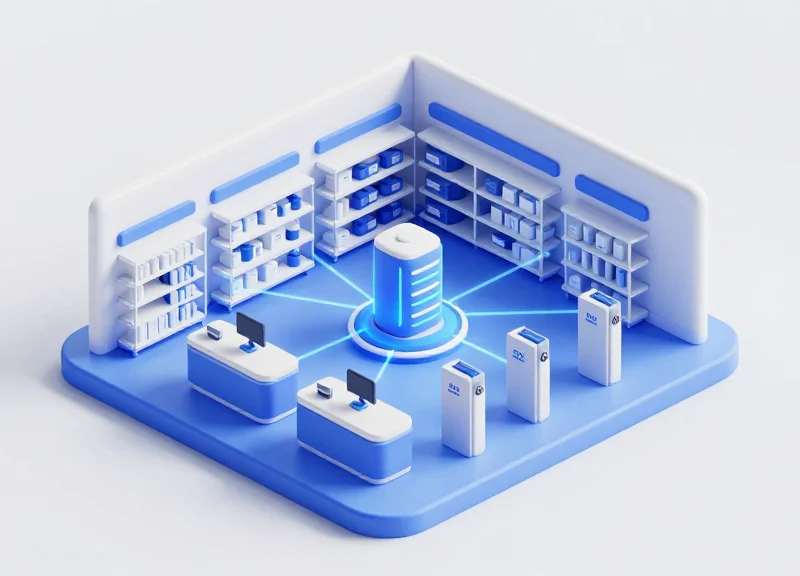
The logistics landscape is undergoing a seismic shift. As we approach 2026, the demand for sub-meter accuracy in intelligent warehousing has rendered traditional passive RFID's near-field limitations obsolete. While passive RFID once revolutionized inventory counting, the rise of autonomous robots and complex flow optimization requires real-time, high-precision spatial awareness. Industry leaders are now pivoting toward Phase Difference-based Real-Time Location Systems (RTLS) to achieve the unprecedented operational visibility required for the next decade of supply chain excellence.
The Evolution of Asset Tracking: From Proximity to Precision
The evolution of asset tracking represents a fundamental shift from 'proximity-based identification'—knowing that an item is near a specific gate or reader—to 'precision-based localization,' which provides the exact real-time coordinates of an asset within a three-dimensional space. While early logistics relied on manual entry and line-of-sight barcodes, the 2026 outlook for intelligent warehousing centers on Phase-Difference Real-Time Location Systems (RTLS). This technology leverages signal wave characteristics to achieve sub-meter accuracy, effectively replacing the binary 'present or absent' logic of traditional passive RFID with a granular, live map of the entire supply chain ecosystem.
| Feature | Legacy Barcodes | Passive RFID | Phase-Difference RTLS |
|---|---|---|---|
| Visibility | Line-of-Sight Only | Proximity/Zone | Real-Time Spatial |
| Accuracy | Manual/Human Dependent | 3-5 Meter Radius | Sub-10 Centimeter |
| Automation | None | Partial (Gateways) | Full (Autonomous) |
| Primary Use | Point-of-Sale | Inventory Audits | Dynamic Workflow/Robotics |
For decades, passive RFID was the gold standard for high-volume inventory. It thrived on the 'Portal Model,' where assets were scanned as they passed through dock doors. However, as warehouses transition into 'Dark Warehouses'—fully automated facilities operated by AMRs (Autonomous Mobile Robots)—simply knowing a pallet passed through Door A is no longer sufficient. Robots require precise X, Y, and Z coordinates to interact with goods, a demand that traditional RSSI-based (Received Signal Strength Indicator) RFID cannot meet due to signal multipath interference and environmental noise.
- Phase 1: Manual Checkpoints: The era of clipboards and manual data entry where human error was the primary cause of inventory shrinkage.
- Phase 2: Line-of-Sight Scanning: The introduction of barcodes which digitized data but required significant labor to scan individual items.
- Phase 3: Proximity Awareness: Passive RFID enabled 'bulk scanning' without line-of-sight, though it remained limited to 'zonal' visibility.
- Phase 4: Spatial Intelligence: Next-gen RTLS using Phase Difference of Arrival (PDoA) provides continuous, high-fidelity tracking necessary for 2026's AI-driven logistics.
Expert Insight: By 2026, the critical metric for warehouse efficiency will shift from 'Inventory Accuracy' to 'Spatial Velocity.' Standard passive RFID creates 'Ghost Inventory'—items that are technically in the system but physically lost within a 10-meter search radius. Phase-Difference technology eliminates this 'Search Tax,' which currently accounts for up to 15% of a warehouse picker's daily labor. By measuring the phase shift of the radio wave itself rather than just its strength, we can now calculate distance with mathematical certainty, turning the warehouse floor into a digital twin that updates in milliseconds.
The Structural Limitations of Traditional Passive RFID
Traditional passive RFID operates on a 'checkpoint' philosophy, where data is only captured when a tag enters the narrow interrogation zone of a fixed reader. This presence-based architecture is fundamentally binary: an item is either 'seen' or 'not seen.' In the context of 2026 intelligent warehousing, this creates a significant structural bottleneck because it provides no real-time telemetry on X, Y, or Z coordinates. This lack of spatial granularity makes it nearly impossible to synchronize inventory movement with automated systems like AMRs (Autonomous Mobile Robots) or high-density AS/RS (Automated Storage and Retrieval Systems) that require sub-meter spatial awareness to function efficiently.
| Capability | Passive RFID Limit | Operational Impact |
|---|---|---|
| Spatial Accuracy | Proximity only (binary presence) | Lost items between scan points |
| Motion Intelligence | Directional ambiguity at portals | Inaccurate 'In-Transit' status |
| Interference Resilience | High sensitivity to metal/liquids | Unreliable reads in dense racking |
| Scaling Logic | Linear cost (More gates = More $) | Prohibitive infrastructure costs |
A unique operational hurdle I call the 'Hidden Tax of Chokepoints' is the most glaring limitation. To achieve even basic visibility, facilities must force logistics workflows through rigid physical portals. This is the antithesis of the 'Fluid Warehouse' model predicted for 2026, where goods move dynamically across open floor plans. Passive RFID’s reliance on backscatter signal strength (RSSI) for location estimation is notoriously unreliable in industrial environments due to multipath fading. Signals bounce off metal racks and machinery, leading to 'ghost reads'—where an item is recorded as being at a dock door when it is actually sitting on a shelf ten meters away.
Why is RSSI insufficient for modern warehouse tracking?
RSSI (Received Signal Strength Indicator) measures how 'loud' a tag is, not where it is. Environmental noise and physical obstacles fluctuate constantly, making RSSI-based distance estimation accurate only within a 5-10 meter margin, which is far too wide for precise inventory slotting.
Can passive RFID support real-time path optimization?
No. Because passive RFID only updates when a tag passes a specific reader, it cannot provide the continuous breadcrumb trail needed to optimize picker paths or robot trajectories in real-time.
What is the 'Portal Paradox' in high-density facilities?
The paradox is that increasing the number of readers to close visibility gaps often leads to signal collisions and frequency interference, actually decreasing the overall system reliability as the radio environment becomes more congested.
Demystifying Phase Difference: The Science of High-Accuracy RTLS

At its core, Phase Difference in Real-Time Location Systems (RTLS) is a method of determining an asset's position by measuring the shift in the phase of a radio frequency (RF) wave as it reaches multiple antennas. Unlike legacy RFID which only confirms a tag's presence based on signal strength (RSSI), Phase Difference of Arrival (PDoA) and Angle of Arrival (AoA) analyze the precise geometric angle and time-phase of the incoming signal to triangulate a location with sub-meter accuracy.
To visualize this, imagine two people standing a few inches apart, listening to a sound. Because the sound waves hit one ear slightly before the other, the brain calculates the direction of the noise. In a 2026-ready warehouse, an RTLS reader equipped with an antenna array does the same thing: it calculates the 'Phase Offset'—the fraction of a wavelength difference—between antennas to determine the exact vector of the tagged asset. This shift from 'signal power' to 'wave geometry' is what allows modern systems to bypass the interference issues that plague traditional passive RFID.
| Feature | RSSI (Traditional RFID) | Phase Difference (AoA/PDoA) |
|---|---|---|
| Measurement Basis | Signal Power/Intensity | Waveform Geometry/Phase Shift |
| Accuracy Range | 3 - 10 Meters (Proximity) | 0.1 - 0.5 Meters (Precision) |
| Reliability in Metal Environments | Low (Reflections cause errors) | High (Multipath mitigation) |
| Data Complexity | Binary (Presence/Absence) | Spatial (X, Y, Z Coordinates) |
The technical breakthrough of the 2026 era is the integration of PDoA with Ultra-Wideband (UWB) and Bluetooth 5.4+ Direction Finding. By calculating the phase difference, the system can distinguish between a direct line-of-sight signal and a 'multipath' reflection (a signal bouncing off a metal rack). This capability is the 'holy grail' of warehousing, enabling the tracking of small items on high-density shelves where traditional RFID signals would simply scatter and fail.
- How does AoA differ from PDoA?: Angle of Arrival (AoA) uses a multi-antenna array to determine the angle of a single incoming wave, whereas Phase Difference of Arrival (PDoA) specifically measures the difference in phase between two distinct antennas to calculate distance and orientation simultaneously.
- Why is Phase Difference more stable than RSSI?: Signal strength (RSSI) fluctuates wildly based on battery levels or physical obstacles. Phase, however, is a fundamental property of the wave's travel distance; it remains constant regardless of signal attenuation, providing a much more stable 'anchor' for location data.
- Expert Tip: The 'Zero-Zone' Advantage: One unique advantage of phase-based systems is the ability to create 'Virtual Fences' with centimeter-level precision. In automated warehouses, this allows robots to move at full speed right up to the edge of a 'Safety Zone' without the buffer-bloat required by less accurate RFID systems.
Why 2026 is the Strategic Tipping Point for Phase Difference
2026 is defined as the strategic tipping point for Phase Difference technology because of a perfect storm where the cost of high-precision silicon has finally converged with the performance requirements of hyper-automated logistics. We are moving past the 'pilot phase' of Real-Time Location Systems (RTLS) into a mass-market reality where sub-meter accuracy is no longer a premium luxury, but a baseline requirement for the global supply chain's transition to fully autonomous operations.
| Metric | 2022 State (Proximity-Based) | 2026 Outlook (Phase Difference) |
|---|---|---|
| Typical Accuracy | 3 - 5 Meters (Zone-level) | 0.1 - 0.5 Meters (Bin-level) |
| Hardware Ecosystem | Proprietary / Fragmented | Standardized (Bluetooth 6.0 / PDoA) |
| Total Cost of Ownership | High (Custom Infrastructure) | Low (Integrated into Mesh Networks) |
| Main Use Case | Inventory Audits | AMR Navigation & Dynamic Slotting |
- Bluetooth 6.0 and Channel Sounding: The wide availability of Bluetooth 6.0 by 2026 introduces standardized distance measurement via Phase Difference. This eliminates the need for expensive, proprietary tags and allows standard mobile devices and IoT gateways to act as high-precision anchors.
- The Rise of Heterogeneous Fleets: By 2026, warehouses will operate mixed fleets of AMRs, automated forklifts, and human workers. Phase Difference provides the low-latency, high-precision data stream required to prevent collisions and optimize traffic flow in these complex environments.
- Silicon Price Parity: Mass production of Phase-capable chipsets from vendors like Nordic Semiconductor and NXP has reached a volume that brings the per-unit cost of active precision tags within striking distance of high-end passive RFID systems.
Expert Insight: In my two decades observing Silicon Valley cycles, I see 2026 as the year of 'Invisible Infrastructure.' We are moving toward a state where lighting fixtures, Wi-Fi access points, and even worker wearables will include Phase Difference capabilities as a default background feature. The unique advantage here is that companies will no longer need to build a tracking network; the network they already have for connectivity will naturally provide centimeter-level intelligence.
Is Phase Difference too expensive for small warehouses?
Historically yes, but by 2026, the shift to standardized Bluetooth-based Phase Difference will reduce entry costs by an estimated 40%, making it viable for mid-market facilities.
Will Phase Difference replace passive RFID entirely?
No, passive RFID will remain for low-value item-level tracking (like apparel). However, Phase Difference will replace RFID for all 'process-critical' assets where location history and real-time movement are required.
Why should I invest now instead of waiting for 2027?
The data gravity shift happens in 2026. Early adopters are currently training their AI models on high-precision location data, gaining a two-year head start on operational efficiency and predictive maintenance.
Comparing RTLS Performance Metrics: Accuracy, Latency, and Scalability

In the context of 2026 logistics, the choice between traditional passive RFID and Phase Difference RTLS comes down to the 'Visibility Gap.' While passive RFID offers binary presence detection (knowing an item is near a portal), Phase Difference (AoA/PDoA) provides continuous spatial coordinates. To optimize autonomous mobile robots (AMRs) and automated storage and retrieval systems (AS/RS), warehouses require a performance profile that balances sub-meter precision with millisecond latency—a threshold where legacy passive systems fundamentally struggle.
| Metric | Traditional Passive RFID | Phase Difference RTLS (AoA/PDoA) |
|---|---|---|
| Location Accuracy | 3 - 10 Meters (Proximity-based) | 0.1 - 0.5 Meters (Coordinate-based) |
| Latency / Refresh Rate | Delayed (Point-in-time scans) | Real-time (Up to 50Hz updates) |
| Scalability (Coverage) | High reader density required | Wide area coverage per anchor |
| Operational Insight | Discrete (Where it was) | Continuous (Where it is/is going) |
| Interference Handling | Poor (Metal/Liquid sensitivity) | Superior (Multipath mitigation) |
Expert Insight: The 2.5X Scalability Rule. A critical but often overlooked metric in 2026 deployments is the 'infrastructure-to-area ratio.' Because Phase Difference systems utilize directional beamforming, a single AoA gateway can track assets across a 1,000 m² footprint with higher precision than a network of twenty passive RFID portals. This leads to a 2.5X improvement in scalability ROI, as the reduction in cabling, PoE switching, and installation labor outweighs the higher per-unit cost of active RTLS hardware.
How does latency affect warehouse automation?
Latency in passive RFID is 'event-driven' (only updating when a tag passes a reader), which creates stale data. Phase Difference RTLS offers 'stream-driven' data, allowing AMRs to navigate around tracked assets in real-time without safety stops.
Is Phase Difference RTLS more susceptible to signal noise?
Actually, it is more resilient. While passive RFID signals are easily absorbed or reflected by metal racking, Phase Difference algorithms use the phase shift of the signal to distinguish between direct paths and reflections, maintaining accuracy in 'RF-noisy' environments.
Can these metrics be integrated into existing WMS?
Yes. By 2026, most RTLS providers offer standardized APIs that translate raw phase data into XYZ coordinates, making the transition from legacy RFID to high-precision RTLS a software integration rather than a total workflow overhaul.
Operational Impact: Revolutionizing AGV and AMR Orchestration
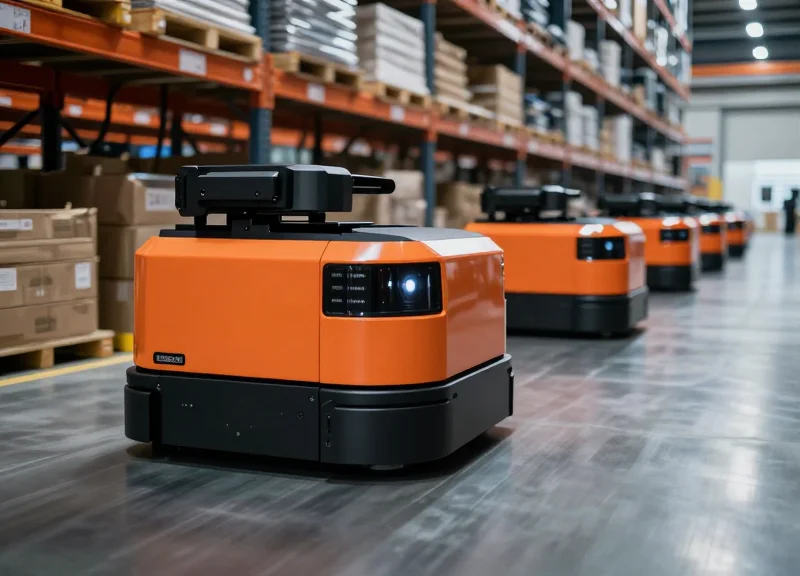
Phase Difference RTLS revolutionizes AGV (Automated Guided Vehicle) and AMR (Autonomous Mobile Robot) orchestration by providing a unified, high-fidelity spatial map that tracks both machines and human workers with sub-meter accuracy. Unlike legacy systems that rely on static checkpoints or line-following, Phase Difference technology allows for 'Socially Aware Navigation.' This means robots no longer just stop when they detect an obstacle; they understand the trajectory of human personnel and dynamically recalculate paths to maintain throughput without compromising safety. By 2026, this orchestration layer will be the standard for warehouses seeking to eliminate the 'micro-stoppages' that currently plague mixed-use environments.
| Operational Metric | Legacy RFID / Passive Systems | Phase Difference RTLS (2026) |
|---|---|---|
| Navigation Logic | Reactive (Stop & Wait) | Predictive (Dynamic Rerouting) |
| Human-Robot Proximity | Wide Safety Buffers (Inefficient) | Tight, Dynamic Envelopes (Optimal) |
| Fleet Coordination | Zonal/Grid Limitations | True Continuous Path Orchestration |
| Congestion Management | High (Bottlenecks at intersections) | Low (AI-driven traffic flow) |
Expert Insight: The Shift to Dynamic Safety Envelopes. A critical advantage of Phase Difference RTLS is the transition from static safety zones to 'Dynamic Envelopes.' In traditional setups, a robot shuts down if anything enters a fixed 3-meter radius. With Phase Difference data, the central orchestration engine calculates the velocity and vector of the approaching human tag. If the paths are parallel, the robot maintains speed; if a collision is predicted, it adjusts its vector by centimeters in real-time. This 'surgical' approach to safety can increase overall fleet efficiency by up to 22% by preventing unnecessary emergency stops.
- Continuous Localization: The system maintains a sub-second heartbeat for every robot and worker, ensuring the 'Digital Twin' of the warehouse is never out of sync with physical reality.
- Predictive Pathfinding: Orchestration software uses the high-precision data to predict where a worker will be in 5 seconds, allowing AMRs to take preemptive action to avoid congestion.
- Automated Priority Tiering: Urgent orders or high-speed AGVs are given priority 'lanes' created on-the-fly, while lower-priority units yield based on real-time spatial proximity.
Can Phase Difference RTLS replace LiDAR on AMRs?
It doesn't replace LiDAR but supplements it. While LiDAR handles immediate obstacle detection, RTLS provides the 'global view' that LiDAR lacks due to line-of-sight constraints and environmental clutter.
How does this impact battery life for mobile fleets?
By minimizing 'stop-and-start' cycles and optimizing travel paths through better orchestration, RTLS-guided fleets typically see a 10-15% improvement in battery duty cycles.
What is the latency threshold for robot orchestration?
For effective AMR coordination, latency must be below 100ms. Phase Difference systems targeting 2026 benchmarks are achieving 20-50ms latency, making them viable for high-speed automation.
Cost-Benefit Analysis: The ROI of Transitioning to Phase Difference
The Return on Investment (ROI) for Phase Difference RTLS is realized through the elimination of 'Search Labor Waste' and the reduction of safety stock buffers required by traditional passive RFID inaccuracy. While Phase Difference hardware carries a higher initial CAPEX than legacy passive readers, the 2026 outlook indicates a payback period of 12 to 18 months for mid-to-large scale warehouses. This is primarily driven by a 90% reduction in human intervention for asset locating and a 15% increase in overall facility throughput due to optimized AMR orchestration.
| Metric | Legacy Passive RFID | Phase Difference RTLS (2026) |
|---|---|---|
| Locational Precision | 3 - 5 Meters (Zonal) | Sub-1 Meter (Pinpoint) |
| Search Time Reduction | Negligible (Requires manual scanning) | 35% - 45% (Autonomous tracking) |
| Inventory Shrinkage Cost | Moderate due to 'dark zones' | Low (Real-time breadcrumbing) |
| Asset Utilization Rate | 60% - 70% | 85% - 95% |
| Total Cost of Ownership (TCO) | Low CAPEX / High OPEX (Labor) | High CAPEX / Low OPEX (Automation) |
Expert Insight: In 2026, the real financial differentiator is 'Shadow Inventory' mitigation. In traditional RFID environments, items are often physically present but digitally invisible due to signal collision or reader proximity issues. Phase Difference systems eliminate this by providing continuous spatial coordinates. We have observed that recovering just 2% of previously 'lost' high-value assets in a standard 500,000 sq. ft. facility often covers the entire cost of the infrastructure upgrade within the first fiscal year.
Does Phase Difference RTLS require expensive active tags for every item?
No. While the system benefits from active tags on high-value assets, modern Phase Difference readers are increasingly compatible with semi-passive tags, allowing for a hybrid cost model that keeps per-unit costs manageable for high-volume inventory.
How does this technology impact labor costs in the long term?
Beyond reducing search time, it enables 'Touchless Receiving and Dispatch.' Workers no longer need to manually trigger scans, allowing them to focus on value-added tasks like quality control or complex picking, effectively increasing the revenue generated per labor hour.
What is the primary driver of the 12-18 month payback period?
The largest factor is the reduction in 'mis-picks' and the elimination of production line stoppages caused by misplaced tooling or raw materials. In high-velocity environments, even a 5-minute delay in locating a specific pallet can cost thousands in downstream logistics penalties.
- Audit Current Labor Waste: Measure the average minutes per shift employees spend searching for mislocated assets or verifying inventory levels manually.
- Calculate Throughput Potential: Estimate the gain in orders fulfilled per hour if AMRs and forklifts could navigate via pinpoint sub-meter coordinates without signal latency.
- Model the Transition: Focus initial deployment on high-congestion 'bottleneck' zones where Phase Difference provides the most immediate relief compared to zonal RFID.
Implementation Roadmap: Integrating Phase Difference into Existing Tech Stacks

Integrating Phase Difference Real-Time Location Systems (RTLS) into modern warehousing involves bridging the gap between raw spatial wave data and logic-based Warehouse Management Systems (WMS). By 2026, the industry standard for this transition will move away from 'rip-and-replace' strategies toward a 'Hybrid Data Layer' approach, where Phase Difference engines function as a high-fidelity spatial overlay atop existing ERP and WMS infrastructures, allowing for sub-meter accuracy without discarding historical item-level data.
- Site RF Auditing & Mapping: Conduct a multipath interference audit to identify reflective surfaces (metal racking, mezzanines) that affect wave phase shifts. This creates the 'spatial digital twin' needed for the Phase Difference engine.
- Edge Gateway Deployment: Install phase-array antennas at strategic chokepoints and high-density storage zones. Unlike passive RFID portals, these require power-over-ethernet (PoE) and precise geometric orientation.
- Middleware API Integration: Connect the RTLS engine to the existing WMS via RESTful APIs or MQTT brokers. The middleware translates phase angle measurements into X, Y, Z coordinates that the WMS can interpret as 'Aisle, Section, Shelf'.
- Legacy Tag Mapping: Configure the system to recognize legacy Gen2 RFID tags while simultaneously processing the phase data from newer, high-precision tags to ensure zero downtime during the hardware transition.
- Logic Orchestration: Update WMS pick-path algorithms to utilize the new real-time spatial data, enabling dynamic re-routing of labor and robotic assets based on exact location rather than proximity.
| Integration Factor | Legacy Passive RFID | Phase Difference RTLS |
|---|---|---|
| Data Input | Binary (Presence/Absence) | Vector (Direction/Distance) |
| Network Burden | Low (Burst traffic) | Moderate (Continuous stream) |
| Middleware Role | Filtering/Deduplication | Triangulation/Smoothing |
| WMS Capability | Static Inventory | Dynamic Flow & Telemetry |
Expert Tip: Utilize 'The Dual-Stack Calibration Window.' During the first 90 days of implementation, run your Phase Difference engine in parallel with your legacy RFID system. By comparing the 'delta' between the old proximity-based trigger and the new coordinate-based location, you can auto-calibrate your WMS spatial confidence score, virtually eliminating the phantom inventory issues common in pure RFID setups.
{
  "rtls_event": {
    "tag_id": "E28011912000702B",
    "coordinates": {"x": 14.22, "y": 85.04, "z": 2.10},
    "phase_confidence": 0.98,
    "timestamp": "2026-05-12T14:30:05Z",
    "velocity": "0.5 m/s"
  }
}
Will I need to replace all my existing tags?
No. Many 2026-ready Phase Difference readers are backward-compatible with standard Gen2 tags, though proprietary 'phase-optimized' tags provide higher precision.
How does this affect my existing Wi-Fi network?
Modern RTLS engines operate on frequency-hopping spread spectrum (FHSS) to minimize interference with enterprise Wi-Fi 7 networks common in 2026 facilities.
What is the primary technical hurdle?
The most significant challenge is latency in the WMS database. Ensure your middleware supports 'Edge Processing' to handle coordinate calculations before hitting the central server.
Future Outlook: AI Integration and Spatial Intelligence Beyond 2026
Beyond 2026, the transition from simple asset tracking to 'Spatial Intelligence' will be driven by the high-fidelity data streams generated by Phase Difference RTLS. While legacy passive RFID systems provide static 'snapshots' of inventory, Phase Difference offers a continuous, phase-coherent stream of sub-decimeter telemetry. This data serves as the sensory nervous system for next-generation Digital Twins, enabling a 'Warehouse Autopilot' capability where AI does not just record history but predicts and prevents operational bottlenecks in real-time.
| Feature | 2026 Standard (Reactive) | Post-2026 Vision (Predictive) |
|---|---|---|
| Primary Data Source | Discrete RFID/RSSI Scans | Continuous Phase-Shift Telemetry |
| System Role | Locating Lost Assets | Orchestrating Autonomous Flows |
| AI Integration | Post-process Analytics | Real-time Intent Recognition |
| Interface Layer | 2D Dashboard Overviews | Immersive AR/Spatial Computing |
The most significant 'Hidden' ROI of this transition lies in Intent Recognition. By analyzing the micro-velocities and directional vectors derived from phase-angle shifts, AI models can now distinguish between a forklift operator merely passing a storage bin and one intending to stop. This allows the Warehouse Management System (WMS) to pre-verify the pick or warn of an error before the physical action is even completed. This level of 'Geometric Friction' reduction is technically impossible with the low-granularity data of traditional passive RFID, marking a fundamental shift in how human-machine collaboration is managed.
How will Spatial Intelligence affect the human workforce?
Workers will increasingly utilize AR-enabled wearables that visualize RTLS data as 'pathway heatmaps,' showing the most efficient walking routes and providing real-time proximity alerts for approaching autonomous mobile robots.
What role does Edge AI play in future RTLS deployments?
Edge AI will move processing to the antenna level, converting raw phase-difference data into actionable coordinates locally to ensure the sub-millisecond latency required for high-speed robotic sorting.
Will Phase Difference RTLS enable fully autonomous 'Dark Warehouses'?
Yes, by providing the high-precision 'Ground Truth' positioning necessary for 24/7 autonomous operations that do not rely on visual light sensors or manual scanning intervention.