In the high-velocity world of Fast-Moving Consumer Goods (FMCG), shrinkage remains a multi-billion dollar challenge that directly erodes bottom-line profits. As we approach 2026, the humble EAS soft label is evolving from a simple sticker into a data-integrated security powerhouse. Retailers can no longer afford a one-size-fits-all approach to loss prevention. This guide explores the sophisticated selection criteria necessary to protect margins, maintain shelf availability, and enhance the customer experience in the next era of smart retail.
The Evolution of FMCG Loss Prevention: Why 2026 is a Turning Point

2026 represents the 'Great Decoupling' in retail—the moment where the speed of the consumer journey finally outpaces the human ability to monitor it manually. As Fast-Moving Consumer Goods (FMCG) move toward hyper-automated checkout systems and dark-store fulfillment, traditional Electronic Article Surveillance (EAS) must evolve. This turning point is defined by the intersection of three forces: the professionalization of Organized Retail Crime (ORC), the global mandate for sustainable packaging, and the rise of 'invisible friction'—security measures that must be powerful enough to deter theft but subtle enough to not disrupt the 0.5-second automated scan cycle.
| Feature | Legacy LP (Pre-2025) | 2026 Turning Point |
|---|---|---|
| Primary Goal | Visual Deterrence | Data-Integrated Protection |
| Checkout Speed | Manual / Semi-Auto | Hyper-Automated / Frictionless |
| Theft Profile | Opportunistic Shoplifting | Organized Retail Crime (ORC) |
| Label Function | Trigger Alarm Only | Authentication & Path-to-Purchase |
Expert Insight: The 'Ghost-Tagging' Phenomenon. By 2026, the industry is moving away from visible stickers toward source-integrated EAS solutions. My 20 years in the Valley suggest that the most successful FMCG brands will be those that treat soft labels not as an afterthought, but as a digital fingerprint. In 2026, a 'dumb' sticker is a liability; an 'intelligent' label is a strategic asset that bridges the gap between the physical shelf and the digital ledger.
Why is 2026 considered the 'tipping point' for EAS technology?
The convergence of AI-driven surveillance and automated checkouts means that EAS labels now require higher detection rates at extreme speeds. Legacy labels often fail in these high-velocity environments, leading to false positives or missed detections.
How is Organized Retail Crime (ORC) influencing label selection?
Modern theft rings focus on high-volume FMCG items like infant formula and cosmetics. 2026 labels must be tamper-resistant and feature high-bond adhesives that prevent 'switch-tagging,' a common tactic among professional shoplifters.
What role does sustainability play in 2026 loss prevention?
New environmental regulations are forcing a shift toward plastic-free or recyclable EAS labels. Companies must now select labels that maintain security integrity while meeting strict ESG (Environmental, Social, and Governance) targets.
Factor 1: Frequency Compatibility - Choosing Between AM and RF Systems

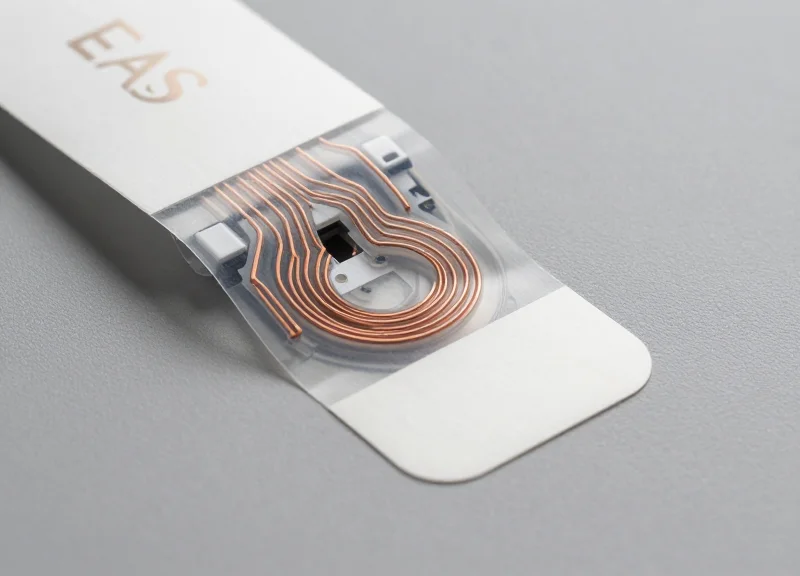
Frequency compatibility is the foundational technical decision in FMCG security, determining whether a soft label will effectively trigger an alarm or remain silent during a theft event. Acousto-Magnetic (AM) systems operate at 58 kHz, providing high resistance to interference from liquids and metals, while Radio Frequency (RF) systems typically operate at 8.2 MHz, offering a cost-effective solution for high-volume, paper-based packaging. In the 2026 retail landscape, choosing the wrong frequency doesn't just lead to shrink; it creates friction in automated checkout environments and disrupts the customer experience.
| Feature | AM (58 kHz) Systems | RF (8.2 MHz) Systems |
|---|---|---|
| Material Compatibility | High (Works well with liquids/foils) | Moderate (Shielded by metals/liquids) |
| Detection Range | Wide (Up to 2.4m between pedestals) | Standard (Up to 1.8m between pedestals) |
| Label Profile | Slightly thicker (3D structure) | Ultra-thin (Paper-thin stickers) |
| Deactivation Speed | Moderate | Very Fast (Ideal for high-throughput) |
| Primary FMCG Use Case | Health & Beauty, Spirits, Canned Goods | Dry Grocery, Apparel, Boxed Commodities |
Expert Insight: for 2026: As 'Smart Stores' become the norm, we are seeing a rise in 'Signal Saturation'—a phenomenon where high densities of IoT sensors and 5G repeaters interfere with legacy RF systems. Retailers moving toward hyper-connected environments should prioritize AM systems for their narrower frequency bandwidth, which is significantly less susceptible to environmental electronic noise. This shift is critical for maintaining a 95%+ detection rate in urban flagship stores.
Can I use RF labels with an AM antenna system?
No. EAS frequencies are not cross-compatible. An RF label (8.2 MHz) will not be detected by an AM (58 kHz) pedestal. Retailers must audit their existing hardware before procurement to avoid massive inventory waste.
Is RF still relevant for FMCG in 2026?
Absolutely. RF remains the gold standard for high-speed, high-volume grocery environments due to its lower cost-per-unit and the ability to integrate labels into printed packaging during the manufacturing process.
Which frequency is better for self-checkout kiosks?
RF is generally preferred for self-checkout because the deactivation pads have a faster 'reset' time, allowing for the rapid-fire scanning of multiple FMCG items without manual intervention.
Factor 2: Adhesion and Surface Compatibility for Diverse Packaging
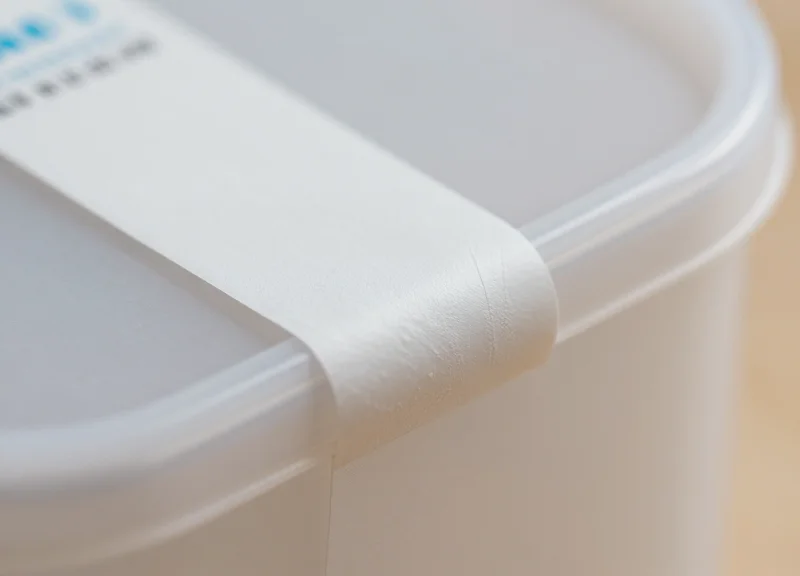
In 2026, EAS soft label effectiveness is defined by the chemical bond between the adhesive and the substrate, a factor often overlooked until shrinkage spikes. High-performance adhesion requires matching the label’s tack and shear strength to the packaging's surface energy, measured in Dyne levels. For FMCG goods ranging from high-energy glass containers to low-energy polyolefin plastics, the wrong adhesive choice results in 'flagging' (edges lifting) or easy removal by shoplifters, rendering the security system useless. A truly secure label must achieve a fiber-tear bond, where the packaging itself is damaged if the label is forcibly removed.
| Packaging Substrate | Surface Energy | Adhesion Challenge | Recommended Adhesive Type |
|---|---|---|---|
| Glass & PET Bottles | High | Condensation and moisture | Water-resistant Acrylic |
| Flexible Foil Pouches | Medium | Metallic interference & slipping | High-Tack Rubber-based |
| PCR (Recycled Plastics) | Low | Surface oils and impurities | Modified Solvent Acrylic |
| Frozen Food Cartons | Variable | Sub-zero temperatures | Specialty Cold-Chain Hot-melt |
How does cold-chain logistics impact EAS label adhesion?
Standard adhesives crystallize and lose 'grab' at temperatures below 4°C. For 2026 FMCG security, labels must utilize 'all-temperature' adhesives that maintain flexibility and bond strength in both deep-freeze and high-humidity environments common in grocery retail.
Why do labels fall off metalized or foil packaging?
Beyond signal shielding, metallic surfaces are often treated with anti-scuff coatings. These coatings lower surface energy, requiring a high-tack adhesive with superior wetting properties to flow into the microscopic texture of the foil for a permanent bond.
Can EAS labels be applied to curved or small-radius surfaces?
Yes, but they require high initial tack and a flexible carrier material. Labels with high 'memory' will attempt to return to a flat shape, causing the edges to lift (flagging) on cylindrical products like cosmetics or energy drinks.
Expert Insight: The 'PCR Challenge' of 2026. As FMCG brands shift toward 100% Post-Consumer Recycled (PCR) plastics to meet ESG goals, security professionals must adapt. PCR materials often contain residual fatty acids and inconsistent polymer chains that cause 'adhesive migration,' where the glue is absorbed into the plastic over 60-90 days, leading to spontaneous label detachment. Always specify 'migration-resistant' adhesives when tagging recycled plastic containers to ensure your security investment doesn't literally slide off the shelf before the product is sold.
Factor 3: Detection Reliability and Deactivation Precision

Detection reliability and deactivation precision represent the 'dual-integrity' of an EAS system: the ability to trigger an alarm with nearly 100% accuracy at wide exits while ensuring the label is completely neutralized at the point of sale. In the 2026 retail landscape, where 'frictionless' and 'high-speed' checkout are standard, a label that fails to detect allows shrinkage to erode margins, while a label that fails to deactivate creates 'non-confrontational' friction that destroys customer trust.
| Performance Metric | Standard Label (Legacy) | Premium FMCG Label (2026 Std) |
|---|---|---|
| Detection Rate (Wide Exit >1.8m) | 75% - 82% | 95% - 99% |
| Deactivation Height (from pad) | Up to 5cm | Up to 15cm |
| Reactivation Rate | < 2% | < 0.1% |
| Signal-to-Noise Ratio | Variable | High (Interference Shielded) |
Expert Insight: The 'Deactivation Shadow' and High-Speed Throughput. One often overlooked factor is the 'Deactivation Shadow.' In modern self-checkout kiosks, items are often scanned and moved at speeds exceeding 1.5 meters per second. Cheaper labels suffer from 'incomplete deactivation' if they aren't centered perfectly over the deactivation coil. The best 2026 soft labels utilize a higher 'Q-factor' (quality factor) in their internal circuits, allowing for instantaneous neutralization even when the product is flipped or moving rapidly through a 3D deactivation field.
- Detection Sensitivity: The ability of the label to respond to the antenna's magnetic field at the maximum distance. For FMCG, labels must be detectable even when buried in a basket of mixed materials.
- Resonant Frequency Stability: Ensuring the label stays exactly at 58kHz (AM) or 8.2MHz (RF) despite environmental humidity or pressure during shipping.
- Clean Deactivation: The permanent alteration of the label's magnetic or electrical properties so it cannot 're-tune' itself and cause an embarrassing false alarm when the customer enters another store.
Why do my labels keep causing false alarms at other stores?
This is likely due to 'magnetic memory' in low-quality AM labels. If the deactivator isn't strong enough or the label is poorly made, it may partially deactivate but eventually 'recover' its signal, leading to tag pollution and customer embarrassment.
How does gate width affect label choice?
Wider exits (standard in modern airy retail designs) require labels with a higher signal amplitude. A standard label may work at a 1.2m gap but fail completely at 2.0m.
Can labels be deactivated through liquid packaging?
Yes, but it requires high-performance AM labels. RF labels often struggle with deactivation and detection when placed on or near liquids or high-moisture FMCG products.
Factor 4: Sustainability and Eco-Friendly Labeling Materials

By 2026, sustainability is no longer a corporate social responsibility (CSR) checkbox; it is a regulatory mandate. Sustainable EAS soft labels for the FMCG sector involve transitioning from petroleum-based plastics and non-recyclable adhesives to FSC-certified paper substrates, PFAS-free components, and water-based adhesives that allow labels to be recycled or composted without contaminating the waste stream. The challenge for 2026 is ensuring these 'green' materials maintain the structural integrity required to protect high-shrink goods in demanding supply chains.
| Feature | Traditional EAS Labels | 2026 Eco-Friendly EAS Labels |
|---|---|---|
| Substrate Material | BOPP / Synthetic Plastic | FSC-Certified Paper / Bio-polymers |
| Adhesive Type | Solvent-based (High VOC) | Water-based / Biodegradable |
| Recyclability | Non-recyclable (Landfill) | Recyclable-compatible (Paper stream) |
| Security Performance | Standard | Optimized (Zero Signal Loss) |
A critical hurdle in eco-friendly labeling is the 'Metallic Contamination' paradox. Standard AM and RF labels contain aluminum or cobalt-based alloys which can disrupt paper recycling processes. To solve this, the next generation of 2026 labels utilizes ultra-thin, high-purity etched circuits that are designed for easier mechanical separation during the pulping process. This allows brands to maintain high detection rates while meeting the stringent Digital Product Passport (DPP) requirements emerging in global markets.
Do eco-friendly EAS labels cost more than standard options?
While the initial unit price may be 5-10% higher, the total cost of ownership is often lower when factoring in reduced plastic taxes, lower waste disposal fees, and improved brand loyalty from eco-conscious consumers.
Will biodegradable labels fall off in cold-chain environments?
No. Advanced 2026 formulations use 'active-link' bio-adhesives that maintain high tack even in moisture-heavy or refrigerated FMCG environments, ensuring the security element remains attached from factory to floor.
Are these labels compatible with existing deactivators?
Yes. The shift to sustainable materials focuses on the carrier and adhesive, not the resonance frequency, meaning they are fully backward compatible with your current AM or RF hardware.
Expert Insight: The 'Invisible Carbon Footprint' of Deactivation. In my 20 years of retail consulting, I've seen brands overlook the energy efficiency of the deactivation process itself. For 2026, the leading EAS labels are being optimized for 'Low-Energy Deactivation.' By refining the magnetic properties of the label's internal resonator, retailers can reduce the power consumption of POS deactivators by up to 15%, contributing to a lower overall store carbon footprint while speeding up the checkout process.
Factor 5: Future-Proofing with RFID and Dual-Technology Integration

In the 2026 retail landscape, future-proofing your security means evolving from 'loss prevention' to 'inventory intelligence.' Selecting EAS soft labels that integrate dual-technology (EAS + RFID) allows retailers to maintain robust theft deterrence while simultaneously gaining granular, real-time visibility into stock levels across the supply chain. By embedding a UHF RFID inlay alongside a traditional AM or RF circuit, FMCG brands can bridge the gap between the security gate and the digital stockroom, ensuring that security hardware becomes a value-adding asset for omnichannel fulfillment.
| Feature | Standard EAS Label | UHF RFID Label | Dual-Tech (Hybrid) Label |
|---|---|---|---|
| Primary Goal | Theft Deterrence | Inventory Accuracy | Total Retail Visibility |
| Detection Range | 1.2m - 2.0m | Up to 10m+ | Optimized for Both |
| Data Capacity | None (Bit only) | Unique Serial ID | Unique ID + Security Bit |
| 2026 ROI Factor | Low (Cost Center) | Medium (Logistics) | High (Security + Sales) |
The Silicon Valley perspective on retail tech emphasizes 'Data Liquidification.' An original insight for 2026 is the emergence of 'Shadow Shrinkage' identification. Historically, retailers attributed 100% of missing FMCG items at the end of a cycle to theft. Dual-technology labels allow you to differentiate between actual shoplifting and internal administrative errors or 'ghost stock.' When a dual-tech label isn't seen by the back-office RFID reader but never triggered the EAS alarm at the front door, you've identified a logistical leak, not a security breach. This distinction alone can save high-volume FMCG retailers millions in misallocated security spend.
- Audit Current Hardware: Ensure your existing pedestals are firmware-ready for RFID upgrades or select dual-frequency sensors that support both 58kHz/8.2MHz and 860-960MHz.
- Source Hybrid Inlays: Specify labels that utilize a 'nested' design where the RFID antenna does not interfere with the EAS resonator, preventing detection dead zones.
- Phased Implementation: Start with high-value FMCG categories (e.g., premium cosmetics or spirits) to validate the ROI of dual-tech before a store-wide rollout.
Is the cost of dual-tech labels significantly higher?
While the unit price is higher than standard EAS, the ROI is typically 2x-3x faster due to reduced out-of-stocks and improved labor efficiency in cycle counting.
Do I need to replace my existing EAS gates?
Not necessarily. Many dual-tech labels work with legacy AM or RF gates, allowing you to use mobile handhelds for RFID inventory while keeping your current exit security intact.
Can these labels be applied at the source?
Yes, source tagging with dual-tech labels is the gold standard for 2026, ensuring the product is protected and trackable from the factory floor to the point of sale.
The Role of Source Tagging in Modern Supply Chain Efficiency
Source tagging is the strategic process of integrating Electronic Article Surveillance (EAS) labels into a product's packaging or onto the item itself during the manufacturing phase. By shifting the application of security measures from the retail backroom to the production line, FMCG brands can ensure that items arrive at the storefront 'floor-ready.' In the high-velocity retail environment of 2026, this approach is no longer a luxury but a fundamental requirement for maintaining supply chain agility and reducing the 'hidden labor tax' associated with manual in-store tagging.
| Feature | In-Store Manual Tagging | Manufacturing Source Tagging |
|---|---|---|
| Labor Cost | High (Retail hourly rates) | Low (Automated integration) |
| Tag Placement | Inconsistent/Human Error | Precision Calibrated |
| Speed to Floor | Delayed (Hours/Days) | Immediate (Instant Shelf-Ready) |
| Inventory Visibility | Reactive | Proactive (Full Chain Traceability) |
Expert Insight: The 'Invisible Protection' Advantage. One of the most significant shifts for 2026 is the move toward 'embedded' source tagging. Modern soft labels can now be placed inside packaging or behind primary labels during the printing process. This not only prevents tampering by sophisticated shoplifters but also preserves the aesthetic integrity of the product packaging, ensuring that security never interferes with brand marketing or consumer experience.
- Audit and Selection: Identify high-shrink SKUs and select EAS soft labels that match the manufacturing environment (e.g., heat resistance for shrink-wrap tunnels).
- Vendor Integration: Coordinate with packaging suppliers to automate label application using high-speed applicators that keep pace with production lines.
- Verification and Testing: Implement a 'Recirculation Test' to ensure that tags remain active through the distribution journey but deactivate cleanly at the POS.
- Data Feedback Loops: Use scan-rate data from retailers to verify that the source tagging program is hitting the required 99%+ compliance threshold.
Does source tagging increase manufacturing costs significantly?
While there is a marginal increase in packaging costs, the total cost of ownership (TCO) is lower because it eliminates the much higher cost of retail labor and reduces shrink-related losses.
Can source tagging handle high-speed FMCG production lines?
Yes, 2026-spec EAS applicators are designed to operate at speeds exceeding 600 units per minute, ensuring zero impact on manufacturing throughput.
Is source tagging compatible with global supply chains?
Absolutely. By standardizing on global frequencies (such as 8.2MHz RF or 58kHz AM), brands ensure their products are protected regardless of which international retailer they are shipped to.
Total Cost of Ownership: Beyond the Per-Unit Label Price
Total Cost of Ownership (TCO) in EAS soft label procurement is a financial metric that aggregates the initial unit cost with indirect expenses such as labor for manual tagging, system maintenance caused by low-quality adhesive residue, and the revenue lost from 'nuisance alarms' (false positives). In 2026, savvy procurement managers view the sticker price as merely 30% of the total economic impact, focusing instead on how label performance optimizes the entire loss prevention ecosystem.
| Cost Component | Budget-Grade Label Impact | High-Performance Label (2026 Std) |
|---|---|---|
| Direct Unit Price | Low ($0.008 - $0.012) | Moderate ($0.015 - $0.022) |
| False Alarm Rate | High (4% - 7%) | Ultra-Low (<0.5%) |
| Labor Costs | High (Manual re-tagging/intervention) | Low (High deactivation success) |
| Customer Retention | Negative (Friction at exit) | Positive (Seamless experience) |
The 'Friction Tax' Insight: Every false alarm at the exit pedestal doesn't just waste a security guard's time; it imposes a psychological 'friction tax' on your most loyal customers. Data from 2025 retail audits suggests that a single false alarm reduces the likelihood of a repeat visit within 30 days by 12%. When calculating TCO, loss prevention leaders must include the 'Customer Lifetime Value (CLV) Erosion' caused by faulty deactivation.
- Audit the Deactivation Success Rate (DSR): Measure how many labels fail to deactivate on the first pass. A 2% failure rate can lead to hundreds of hours in annual labor costs for staff handling manual overrides.
- Calculate the Shielding Cost: Lower-quality labels often fail near foil packaging or liquids. Factor in the cost of stolen goods that budget labels simply cannot protect.
- Evaluate Adhesive Integrity: Assess the cost of 'label drop-off.' Labels that peel easily require staff to re-label items and increase the risk of 'ticket switching' by shoplifters.
Does a higher-priced label always guarantee lower TCO?
Not necessarily. TCO is optimized when the label technology (AM or RF) is perfectly calibrated to the store's hardware and the specific FMCG category, such as high-liquid or high-metal content items.
How does source tagging influence TCO calculations?
Source tagging significantly lowers TCO by shifting labor costs from expensive in-store retail hours to optimized manufacturing environments, while ensuring 100% placement consistency.
What is the biggest hidden cost in EAS procurement?
The 'Phantom Alarm' cost. This occurs when labels reactivate themselves after purchase, leading to embarrassing alarms when the customer enters a different store, severely damaging your brand reputation.
Selecting a Strategic Security Partner: Why DragonGuardGroup Leads
In the high-stakes retail landscape of 2026, a strategic security partner is defined by their ability to provide a future-proofed technology stack that transcends simple loss prevention. Unlike traditional vendors who focus on transactional hardware sales, a leader like DragonGuardGroup offers a holistic 'Security-as-a-Service' model. This framework integrates Electronic Article Surveillance (EAS), Radio Frequency Identification (RFID), and Electronic Shelf Labels (ESL) into a unified ecosystem, ensuring that security measures also function as high-velocity data tools for inventory intelligence and operational efficiency.
| Feature | Generic Label Vendor | DragonGuardGroup (Strategic Partner) |
|---|---|---|
| Product Range | Basic EAS labels/tags | Comprehensive EAS, RFID, ESL, and Dual-Tech solutions |
| R&D Capability | Follows industry trends | Proprietary labs for eco-friendly and high-detection materials |
| Global Logistics | Limited to regional hubs | Seamless source-tagging support across global manufacturing sites |
| Consultative Value | Transactional sales | TCO analysis and customized loss prevention strategies |
Does the partner support multi-protocol integration?
A strategic partner must offer solutions that bridge EAS and RFID. DragonGuardGroup leads by providing labels that work with legacy hardware while paving the way for item-level tracking in the same footprint.
Can they scale with global source-tagging programs?
As FMCG production moves across borders, DragonGuardGroup’s global network ensures that soft labels are applied at the point of manufacture, maintaining consistent quality and reducing in-store labor costs worldwide.
How does the partner handle the sustainability mandate of 2026?
Beyond basic security, DragonGuardGroup innovates with compostable substrates and recyclable components, ensuring your security strategy aligns with corporate ESG goals without sacrificing detection rates.
Expert Insight: The Unified Retail Architecture. The most significant differentiator for DragonGuardGroup in 2026 is the 'Unified Retail Architecture'—the ability to sync EAS security triggers with ESL (Electronic Shelf Label) updates. By leveraging this synergy, retailers can receive real-time alerts when high-value items are moved from shelves in unusual patterns, allowing for intervention before the thief even reaches the exit. This proactive data layer transforms a simple 'sticker' provider into a vital architect of your store's digital transformation.