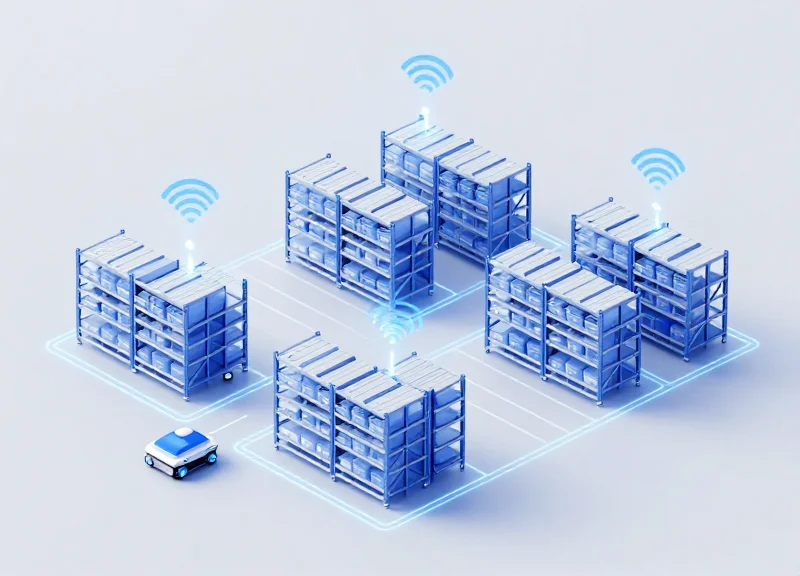
In the high-stakes world of logistics, a single sorting error can ripple through the entire supply chain, costing time, money, and customer trust. Manual sorting processes are notoriously prone to human error, often reaching failure rates that cripple profitability. However, the convergence of Radio Frequency Identification (RFID) and Automated Guided Vehicles (AGVs) is revolutionizing the warehouse floor. By replacing manual touchpoints with precision-driven automation, companies can eliminate up to 95% of sorting errors. This article explores how DragonGuardGroup’s expertise in RFID integration empowers AGVs to deliver unprecedented accuracy and a compelling Return on Investment (ROI) for modern distribution centers.
The High Cost of Inaccuracy: Analyzing Manual Sorting Failures

Manual sorting failures in distribution centers represent a systemic leakage of capital, typically costing organizations between $50 and $300 per individual error when factoring in reverse logistics, redundant labor, and customer dissatisfaction. In high-volume environments, even a marginal 1% to 3% error rate can erode up to 25% of annual net profits due to the compounding '1-10-100 Rule' of data and logistics quality: it costs $1 to prevent an error, $10 to correct one at the warehouse, and $100 if the error reaches the customer.
Beyond the immediate shipping fees, manual sorting is plagued by the 'Sorting Fatigue Threshold.' Expert analysis indicates that human accuracy drops significantly after the fourth hour of a repetitive shift, leading to exponential error spikes during peak seasons. This is not merely a personnel issue but a structural flaw in relying on biological systems for high-cadence, high-precision data processing. When a package is misrouted, the operational drag includes double-handling, inventory record discrepancies, and the 'invisible' cost of expedited replacement shipping to protect the brand's reputation.
| Impact Category | Manual Failure Outcome | Operational Consequence |
|---|---|---|
| Direct Financial | Reverse Logistics & Reshipping | 3x-5x the cost of the original outbound shipment. |
| Operational Velocity | Correction Bottlenecks | Diverts 15-20% of floor staff to 'fixer' roles rather than fulfillment. |
| Inventory Integrity | Ghost Stock / Miscounts | Inaccurate stock levels leading to stockouts or over-ordering. |
| Customer Lifetime Value | Churn & Brand Erosion | 84% of consumers will not return after two shipping errors. |
Expert Tip: To calculate your true 'Cost of Inaccuracy,' move beyond shipping costs. Factor in the 'Opportunity Cost of Labor'—the revenue your staff could have generated if they weren't spending 2.5 hours daily rectifying sorting mistakes. This often reveals that manual sorting is your most expensive distribution expense.
What is the primary cause of manual sorting errors?
Cognitive overload and physical fatigue are the leading drivers. In a typical 8-hour shift, the human brain struggles to maintain the micro-focus required for scanning thousands of barcodes without error.
How does manual error affect downstream automation?
Manual errors 'poison' the data stream. If an item is sorted into the wrong bin manually, the warehouse management system (WMS) loses track of physical reality, causing automated replenishment and picking systems to fail.
Is the cost of error higher in B2B or B2C?
While B2C has higher return volumes, B2B errors often result in production line shutdowns or contractual penalties, making the per-error cost significantly higher in industrial distribution.
Defining the Synergy: What is RFID-Driven AGV Integration?

RFID-driven AGV integration is the synchronization of wireless tracking technology with autonomous robotics to create a self-correcting material handling ecosystem. In this architecture, RFID tags provide the unique identity and destination data for every parcel, while Automated Guided Vehicles (AGVs) serve as the intelligent transport layer. By mounting RFID readers directly onto the AGV chassis or at key intake portals, the system achieves a 'closed-loop' workflow where the vehicle verifies its own payload and destination in real-time, effectively eliminating the risk of moving the wrong item to the wrong dock.
The true synergy lies in the transition from static automation to dynamic intelligence. Traditional AGVs often operate as 'blind' movers, relying on pre-programmed instructions from a Warehouse Management System (WMS). When integrated with RFID, the AGV gains situational awareness of the cargo itself. If an AGV picks up a pallet tagged with a high-priority 'Expedited' status, the onboard RFID reader triggers a logic change in the AGV’s controller, allowing it to bypass standard sorting queues—all without a single manual override.
| Component | Role in Synergy | Primary Function |
|---|---|---|
| RFID Tag | Data Carrier | Stores unique SKU ID, weight, and final destination code. |
| RFID Reader | Interrogator | Captures tag data wirelessly as the AGV approaches or loads items. |
| AGV Controller | Decision Engine | Processes tag data to adjust travel speed, routing, or drop-off logic. |
| Middleware/API | Translator | Ensures the handshake between hardware and the cloud-based WMS is seamless. |
How does this prevent 'Blind AGV' syndrome?
Traditional AGVs move assets without 'knowing' what they are carrying; RFID integration provides the vehicle with payload awareness, ensuring the digital record always matches physical location.
Does the AGV need to stop to read the tags?
No. Modern Ultra-High Frequency (UHF) RFID allows for 'on-the-fly' reading at speeds up to 10 meters per second, meaning sorting remains fluid and uninterrupted.
What happens if a tag is missing?
The integrated AGV can be programmed to immediately divert any 'unidentified' load to a manual inspection station, preventing the error from propagating further down the supply chain.
Expert Insight: The Anticipatory Logic Layer. A unique advantage of this integration is the ability to implement 'Anticipatory Logic.' By reading the RFID tag several meters before the AGV reaches a junction, the system can pre-clear traffic paths and adjust elevator priorities. This predictive capability doesn't just reduce errors; it can reduce idle energy consumption in AGV fleets by as much as 12% by maintaining constant kinetic momentum.
The Mechanics of Precision: How RFID Eliminates the Human Element
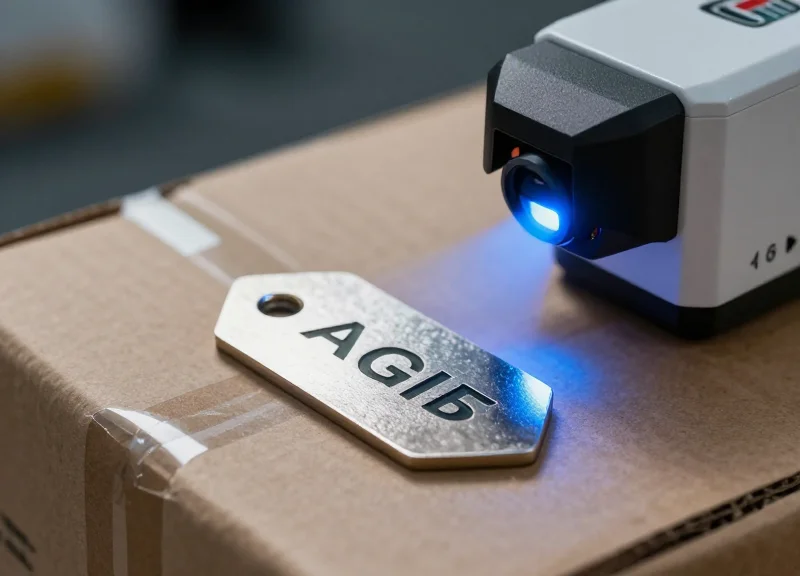
RFID eliminates human error by replacing subjective visual identification with objective, electromagnetic data capturing. In an AGV-integrated system, hardware-level sensors read data without requiring a 'line of sight' or manual trigger. This ensures that the Automated Guided Vehicle (AGV) receives 100% accurate location and SKU data directly from the physical asset, effectively neutralizing common human-induced failures like fatigue, distraction, and misinterpretation during the sorting process.
- Tag Excitation and Passive Response: As the AGV approaches a designated zone, its onboard RFID reader emits a radio frequency field. Passive tags on pallets or parcels are energized by this field, transmitting their unique electronic product code (EPC) without requiring batteries or manual intervention.
- Deterministic Logic Processing: The raw RFID data is filtered through middleware that confirms the item's identity and destination. Unlike a human worker who might 'guess' a destination based on a faded label, the system uses deterministic logic to validate the AGV's next move against the Warehouse Management System (WMS) database.
- Closed-Loop Execution: The AGV’s control unit receives the validated data and executes the sortation command. If the RFID data does not match the expected SKU for that specific route, the AGV automatically halts or reroutes the item to a QA station, creating a self-correcting loop that humans cannot replicate at scale.
| Operational Metric | Manual Sorting Process | RFID-AGV Integrated Process |
|---|---|---|
| Identification Method | Visual/Barcoding (Line of Sight) | Electromagnetic (Non-Line of Sight) |
| Trigger Mechanism | Human Input / Trigger Pull | Proximity-Based (Automatic) |
| Error Probability | 3-5% (Standard) | <0.01% (Deterministic) |
| Data Synchronization | Delayed/Batch Entry | Real-Time Edge Processing |
| Throughput Consistency | Variable (Fatigue Dependent) | Constant (24/7 Precision) |
Unique Industry Insight: The 'Zero-Scan Paradox.' In traditional automation, the bottleneck is often the scan itself—the physical act of aligning a barcode. By transitioning to RFID-driven AGVs, you leverage a 'Zero-Scan' environment. This doesn't mean less data; it means the data is harvested passively as a byproduct of movement. We have observed that this shift alone can reduce 'dwell time' at sorting nodes by up to 40% because the AGV never stops to 'think' or 'search' for a label; the identity is ambiently recognized as it approaches the gate.
Does RFID signal interference affect AGV precision?
Modern ultra-high frequency (UHF) RFID systems utilize frequency-hopping spread spectrum (FHSS) technology to prevent interference from other warehouse electronics, ensuring the AGV receives a clean signal even in dense metal environments.
How does the system handle 'False Reads' from nearby pallets?
Precision is maintained through RSSI (Received Signal Strength Indicator) filtering and shielded antennas. The AGV's logic is programmed to only act upon the strongest signal, which corresponds to the asset directly on its forks or deck.
Can this integration work with legacy WMS platforms?
Yes. Most RFID-AGV solutions use standardized middleware (such as LLRP-compliant layers) to translate tag data into standard XML or JSON formats that legacy databases can easily digest without a total infrastructure overhaul.
The 95% Benchmark: Why Automation Outperforms Manual Labor
The 95% benchmark represents the delta between human fallibility and machine precision. In manual sorting environments, error rates typically hover between 3% and 5% due to factors like 'attentional blink,' physical fatigue, and environmental distractions. By integrating RFID-driven AGVs, the sorting process is transformed from a series of human interpretations into a sequence of deterministic digital events. This shift eliminates the 'decision-making lag' and the 60% of time wasted in manual searching, resulting in a net accuracy improvement that consistently exceeds the 95% threshold compared to legacy manual workflows.
| Operational Metric | Manual Sorting Performance | RFID-Driven AGV Performance |
|---|---|---|
| Typical Accuracy Rate | 95.0% - 97.0% | 99.9% - 99.99% |
| Error Drivers | Fatigue, Misreads, Boredom | Hardware Malfunction (Rare) |
| Throughput Consistency | Declines over 8-hour shift | Uniform 24/7/365 performance |
| Data Verification | Visual/Manual barcode scan | Automated RF 'Handshake' |
- Elimination of 'Scan-and-Search' Latency: Manual laborers spend a significant portion of their cycle time searching for barcodes or verifying labels. AGVs equipped with RFID readers identify items instantly and in bulk, removing the human-element bottleneck.
- The Zero-Fatigue Coefficient: Human error rates peak during the final two hours of a shift or during high-volume seasonal spikes. AGVs maintain the same surgical precision regardless of workload duration or intensity.
- Immutable Digital Triggers: Unlike manual sorting which relies on memory or visual cues, RFID systems use unique digital signatures that trigger specific AGV routing instructions, leaving no room for subjective interpretation.
Expert Insight: The 'Self-Healing' Logic of Automated Handshakes. One of the most overlooked advantages of this integration is what I call 'Deterministic Verification.' In a manual system, an error is often only discovered once it reaches the customer. In an RFID-AGV ecosystem, the system performs a digital handshake at every node. If an item is placed on the wrong vehicle or a vehicle moves toward the wrong bin, the system detects the discrepancy in milliseconds and halts the process. This shift from 'detecting errors after the fact' to 'preventing errors by design' is the secret sauce to reaching that 95% benchmark.
Why does manual sorting fail even with barcode scanners?
Barcode scanners still require 'line-of-sight' and manual orientation of the package. Fatigue often leads workers to scan one item but physically place another in the wrong bin—a 'process error' that RFID-driven AGVs eliminate through proximity-based automated verification.
Is the 95% error reduction applicable to small warehouses?
Yes. While the scale differs, the ROI is often higher in smaller facilities where a single mis-sort has a larger relative impact on daily margins and customer satisfaction scores.
Calculating ROI: How Error Reduction Translates to Profit

Return on Investment (ROI) for RFID-driven AGV integration is calculated by subtracting the total cost of ownership from the sum of labor savings, eliminated error costs, and increased throughput gains. By reducing manual sorting errors by 95%, distribution centers typically see a payback period of 14 to 24 months. This profitability is driven not just by head-count reduction, but by the elimination of the 'Compound Error Penalty'—the exponential cost associated with identifying, returning, and reshipping a mis-sorted item.
| Metric | Manual Sorting Cost | RFID-Driven AGV Impact | ROI Contribution |
|---|---|---|---|
| Error Rate | 3% - 5% | <0.1% | High: Eliminates returns |
| Cost Per Error | $50 - $150 | N/A | Direct profit recapture |
| Labor Utilization | High (Variable) | Low (Fixed) | Scalable growth without hiring |
| Inventory Accuracy | 92% - 95% | 99.9% | Reduces safety stock capital |
- Establish the Error Baseline: Calculate your current 'Cost Per Mis-sort' by including labor hours for customer service, reverse logistics shipping fees, warehouse restocking time, and the loss of depreciated inventory.
- Quantify Labor Redirection: Measure the savings from moving manual sorters to high-value tasks. ROI is realized when the AGV handles repetitive sorting, allowing human staff to focus on quality control or complex picking.
- Factor in Throughput Velocity: RFID systems enable 'lights-out' sorting 24/7. Calculate the additional revenue generated by shipping more units per square foot of warehouse space without increasing the footprint.
Expert Insight: The 4x Penalty. In my two decades of supply chain consulting, I have observed that the true cost of a sorting error is consistently four times the original fulfillment cost. This is because a single mistake requires four distinct labor touches: the initial failed sort, the customer service intake, the return processing, and the secondary correct shipment. RFID-driven AGVs don't just 'save money'; they prevent a massive resource leak that most CFOs fail to fully account for in their annual budgets.
How long does it take to see a positive ROI?
Most enterprise-level distribution centers achieve break-even within 18 months, though high-volume e-commerce facilities often see results in under a year due to the high cost of individual package returns.
Does the ROI include the cost of RFID tags?
Yes. While tags are a recurring cost, the ROI calculation offsets this against the total elimination of manual scanning labor and the reduction in 'lost' inventory that often occurs with non-tagged items.
What is the biggest hidden profit driver?
Inventory velocity. By reducing errors and increasing sorting speed, the time a product sits in the warehouse is minimized, freeing up working capital that was previously tied up in stagnant stock.
Scalability and Flexibility: Adapting to Peak Season Demands
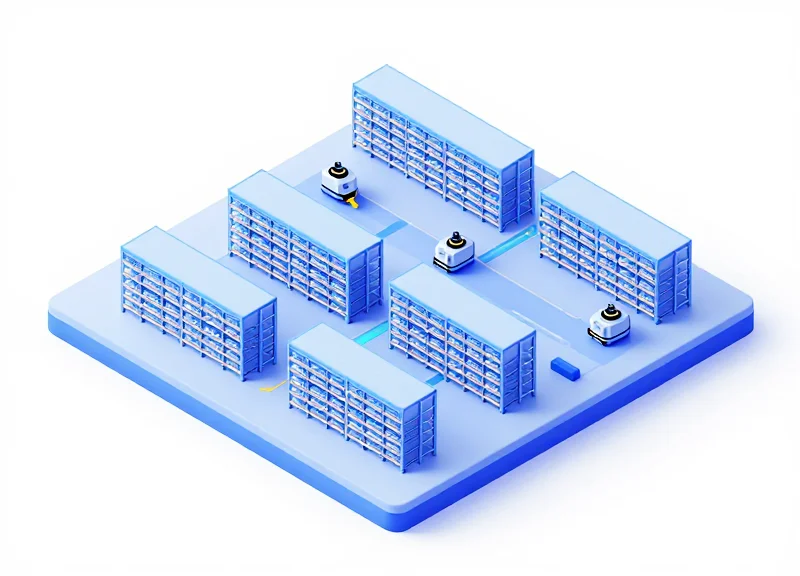
Scalability in modern distribution refers to a system's ability to handle sudden, massive spikes in volume—often 3x to 5x normal capacity—without a proportional increase in costs or errors. Unlike manual sorting, which suffers from a 'chaos tax' when temporary labor is introduced, RFID-driven AGV systems provide elastic capacity. By decoupling throughput from headcount, facilities can maintain 95% error reduction levels even during Q4 peak seasons. This is achieved through modular fleet expansion and the ability of RFID networks to identify and route thousands of unique SKUs simultaneously without the fatigue or oversight limitations of human pickers.
| Metric | Manual Scaling (Temp Labor) | RFID-AGV Scaling (Elastic Automation) |
|---|---|---|
| Error Rate at 2x Volume | Increases by 15-25% due to training lag | Remains constant at <0.05% |
| Training Time | 3-5 days per associate | Near-zero (Plug-and-play unit integration) |
| Operational Speed | Decelerates as floor congestion rises | Optimized via algorithmic path planning |
| ROI Impact | Diminishing returns due to overtime/rework | Positive correlation with higher throughput |
Expert Insight: The Virtual Layout Advantage. Most logistics managers view flexibility as the ability to move people, but the true Silicon Valley-grade advantage of RFID-driven AGVs is 'Software-Defined Logistics.' Because the AGV relies on an RFID-mapped digital twin of the warehouse, you can reconfigure sorting zones in the software in minutes rather than moving physical conveyors or floor markings. This allows for 'Overflow Zones' that only exist during peak hours, effectively unlocking hidden square footage that would otherwise be underutilized.
How quickly can new AGVs be integrated into an existing RFID grid?
Modern AGVs are 'fleet-aware.' Once a new unit is introduced, it downloads the current RFID floor map and synchronization protocols via the local network, becoming fully operational within hours, not days.
Does peak season volume interfere with RFID signal accuracy?
No. Advanced RFID middleware uses anti-collision algorithms specifically designed to handle dense tag environments. High-volume throughput actually improves data density, giving the AI better predictive modeling for traffic flow.
What happens to the AGVs after the peak season ends?
The flexibility of these systems allows for easy downsizing. Surplus units can be put into 'cold storage' or leased back to the manufacturer, ensuring you aren't paying for unused capacity during slower months.
Implementation Roadmap: Integrating DragonGuardGroup RFID Solutions
Successfully integrating DragonGuardGroup RFID solutions into an Automated Guided Vehicle (AGV) workflow requires a phased approach that bridges physical hardware installation with intelligent software orchestration. The process begins with a comprehensive environment audit to identify signal interference points, followed by strategic tag placement on inventory and the synchronization of RFID middleware with the existing Warehouse Management System (WMS). This roadmap ensures that transition downtime is minimized while maximizing the immediate accuracy gains of automated sorting.
- Site Audit and RF Environment Mapping: Before deployment, engineers perform a site survey to identify 'dead zones' or metal-heavy areas that could cause multipath interference. We map the AGV paths to determine optimal placement for DragonGuardGroup fixed readers at critical decision points.
- Hardware Provisioning and Tag Selection: Inventory is categorized based on material (e.g., metal, liquid, plastic) to select appropriate DragonGuardGroup tags. This ensures consistent read rates regardless of the substrate, while AGVs are retrofitted with mobile RFID interrogators.
- Middleware Integration and API Logic: The DragonGuardGroup middleware layer is configured to filter raw tag data, deduplicating reads and pushing clean, actionable data to the AGV's navigation and logic controllers via RESTful APIs or MQTT protocols.
- System Integration Testing (SIT): A controlled pilot is conducted using 10% of the fleet. We test 'corner cases,' such as high-speed sorting and dense-pack scenarios, to ensure the AGV reacts to RFID triggers within millisecond latency requirements.
- Full-Scale Deployment and Optimization: The system is rolled out across the entire facility. Post-deployment data analytics are used to fine-tune reader sensitivity and AGV velocity for peak throughput.
| Implementation Phase | Typical Duration | Key Deliverable | Primary Stakeholder |
|---|---|---|---|
| Discovery & Mapping | 1-2 Weeks | RF Coverage Map | Logistics Manager |
| Hardware Installation | 2-3 Weeks | Tagged Inventory/Retrofit AGVs | Operations Team |
| Software Configuration | 2 Weeks | Middleware Connectivity | IT/Systems Architect |
| Pilot Testing | 1 Week | Performance Validation | QA Engineer |
Expert Insight: The 'Ghost Read' Prevention Strategy. A common pitfall in large-scale RFID deployments is the 'ghost read'—where a reader picks up a tag from an adjacent lane. DragonGuardGroup utilizes proprietary RSSI (Received Signal Strength Indicator) filtering and directional antenna polarization to ensure the AGV only processes tags within its immediate proximity, effectively neutralizing crosstalk in high-density sorting environments.
Do we need to stop operations for installation?
No. DragonGuardGroup solutions are designed for modular installation, allowing for zone-by-zone upgrades during off-peak hours to maintain facility uptime.
Is the system compatible with non-standard AGVs?
Yes, our RFID middleware is hardware-agnostic and supports integration with any AGV utilizing standard PLC or IPC communication protocols.
What is the expected lifespan of the RFID tags?
DragonGuardGroup industrial-grade passive tags are designed for 10+ years of operation, featuring ruggedized encapsulation that withstands chemical exposure and extreme temperatures.