As we approach 2026, the retail landscape within themed entertainment—ranging from cinematic theme parks to immersive museum gift shops—is undergoing a radical transformation. The primary challenge for operators is no longer just preventing theft, but doing so without breaking the 'magic' of the guest experience. Traditional security pedestals are often eyesores that clash with carefully curated environments. This article dives deep into the high-stakes comparison between next-generation invisible EAS (Electronic Article Surveillance) gates and traditional RFID (Radio Frequency Identification) systems, helping decision-makers choose the right path for future-proofing their high-immersion retail spaces.
The Aesthetic Imperative in Themed Entertainment Retail

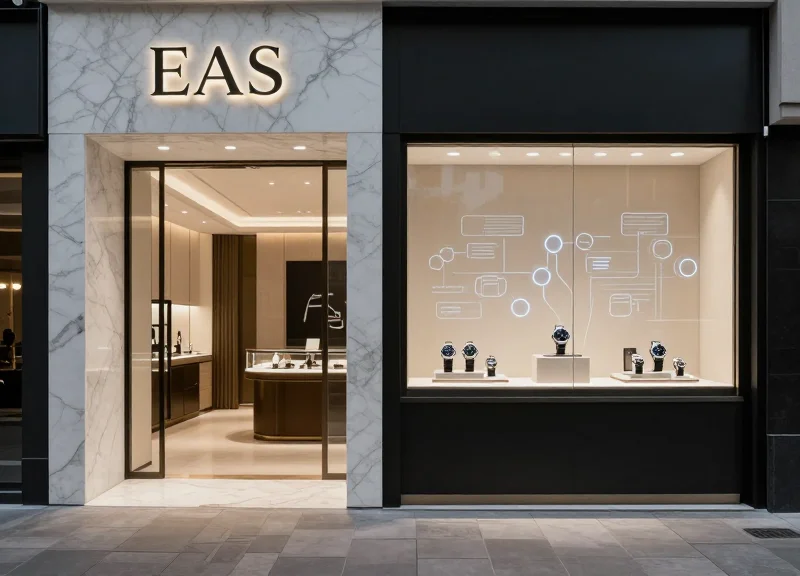
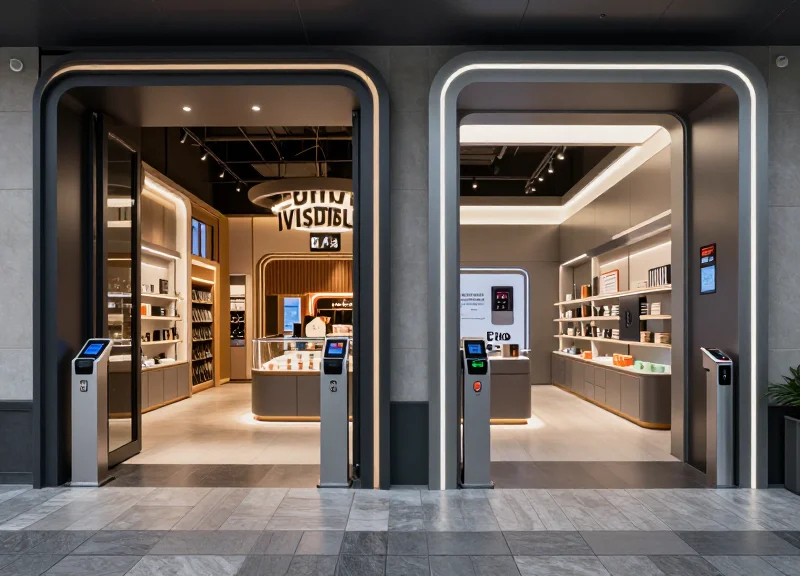
The 'Aesthetic Imperative' in themed entertainment retail is the design requirement that all functional infrastructure—including security—must be invisible or narratively integrated to preserve the guest's suspension of disbelief. In environments like theme parks, cinematic pop-ups, and IP-driven flagship stores, visible security pedestals act as 'immersion killers.' When a guest transitions from a meticulously crafted fantasy world into a retail space, the presence of bulky, plastic Electronic Article Surveillance (EAS) gates creates a jarring visual dissonance that reminds them of the real world, effectively breaking the emotional connection to the brand and reducing the likelihood of high-margin impulsive purchases.
As we move toward 2026, the retail landscape in themed entertainment is shifting from 'selling products' to 'selling memories.' Traditional security hardware fails because it was designed for deterrence through visibility. In a themed space, deterrence should be sophisticated and silent. The friction caused by physical barriers doesn't just block shoplifters; it blocks the flow of the story. Designers now demand solutions that offer a 100% 'open-gate' feel, allowing the architecture to speak for itself while maintaining world-class loss prevention standards.
| Feature | Traditional EAS Gates | Next-Gen Invisible Solutions |
|---|---|---|
| Visual Impact | High; creates a 'fortress' entry look. | Zero; hidden in floors, ceilings, or doorframes. |
| Narrative Alignment | Poor; clashes with period or fantasy themes. | Perfect; allows for total thematic continuity. |
| Guest Flow | Bottlenecks due to physical narrowing. | Seamless; promotes wider, more natural entrances. |
| Brand Perception | Utilitarian and defensive. | Premium, welcoming, and technologically advanced. |
Expert Insight: The 'Fourth Wall' of Retail. In my two decades of experience, I’ve observed that themed retail operates under the same rules as theater. The moment a guest sees a standard security pedestal, they are 'stepping out of character.' This 'Fourth Wall' break has a measurable impact: data suggests that retail environments with hidden security see an 8-12% increase in guest dwell time compared to those with high-visibility deterrence. The goal is no longer just to prevent theft, but to prevent the perception of surveillance.
Why can't we just 'theme' traditional gates?
While some try to wrap gates in themed skins, the physical footprint still restricts movement and creates a psychological barrier. True invisible solutions remove the obstacle entirely, offering a cleaner architectural canvas.
Does 'invisible' mean less secure?
No. Modern invisible EAS and RFID systems often provide higher detection accuracy and more granular data than traditional pedestals by using advanced beam-steering and phased-array antenna technology.
What is the primary driver for this shift in 2026?
The rise of 'Retail-tainment.' As brick-and-mortar stores must compete with e-commerce, the physical experience must be flawless. Any element that detracts from the 'Instagrammable' nature of the space is being phased out.
Invisible EAS Gates: The Mechanics of Hidden Security

Invisible Electronic Article Surveillance (EAS) systems function by concealing transmitter and receiver antennas within the architectural fabric of a retail space—specifically beneath the flooring or above the ceiling. Unlike traditional pedestals that create a physical barrier, these 'hidden' systems generate a three-dimensional electromagnetic detection zone across an entrance. When an active 58kHz (Acousto-Magnetic) or 8.2MHz (Radio Frequency) security tag enters this field, it resonates, triggering a localized alarm that is often integrated into the store's lighting or discreet mobile notification systems.
| Feature | Floor-Loop Systems | Overhead Systems |
|---|---|---|
| Installation | Buried under floor finish (tile, wood, or thin concrete). | Mounted above ceiling tiles or within lighting tracks. |
| Detection Range | High sensitivity for tags low to the ground (shoes, bags). | Superior for large, wide-span entrance points. |
| Visual Impact | Zero footprint; completely invisible to the guest. | Minimal; resembles a standard Wi-Fi AP or light fixture. |
| Best Use Case | High-end boutiques with custom flooring. | Themed grand halls with high foot traffic. |
The underlying physics relies heavily on Acousto-Magnetic (AM) technology at 58kHz, which is the industry standard for invisible installations due to its resistance to 'body shielding' and interference from metal structures. For themed environments, the challenge often lies in the density of surrounding electronics—animatronics, LED displays, and audio systems—which can create electromagnetic noise. Expert-level integration involves fine-tuning the system's Digital Signal Processing (DSP) to filter out these specific environmental frequencies while maintaining a high catch rate for tags.
Can invisible EAS detect tags through metal strollers?
Yes, Acousto-Magnetic (AM) floor loops are highly effective at penetrating non-ferrous metals, though specialized tuning is required to prevent interference from heavy steel frames common in some theme park equipment.
Do I need to rip up my floors to install these?
While ideal for new construction, many modern floor-loop systems use ultra-thin ribbon cables that can be retrofitted under carpets or wood flooring with minimal disruption.
How wide can an invisible gate be?
A single floor-loop can typically cover an opening of up to 2.5 meters. For larger 'Main Street' style entrances, multiple loops can be daisy-chained for unlimited coverage.
Expert Insight: The 'Rebar Trap' in Themed Construction. When planning invisible floor-loops, the biggest failure point isn't the technology, but the concrete. Standard steel rebar in your slab acts as a 'Faraday cage,' potentially soaking up 30-50% of your signal strength. To future-proof your 2026 builds, always specify non-conductive fiberglass rebar or a 'rebar-free' zone at least 1 meter around the antenna loop to ensure maximum detection height and reliability.
Traditional RFID: More Than Just a Security Barrier
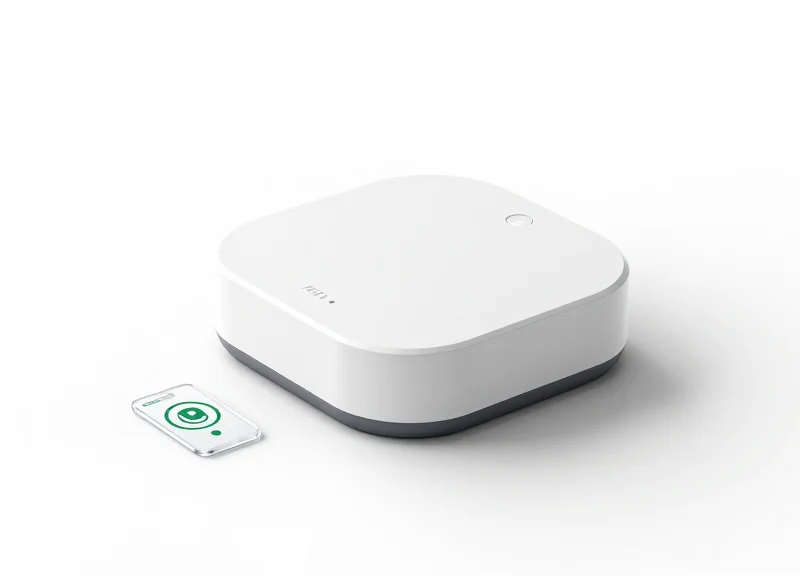
Traditional RFID (Radio Frequency Identification) in themed entertainment retail is a multi-layered technology infrastructure that transcends simple loss prevention by providing item-level serialization. Unlike standard EAS systems that only trigger an alarm when a tag passes a sensor, RFID identifies exactly what item is leaving the store, allowing for real-time inventory updates, automated replenishment, and granular analytics that traditional security gates cannot provide.
| Feature | Standard Invisible EAS | Traditional RFID Systems |
|---|---|---|
| Primary Function | Theft Deterrence | Inventory Intelligence + Security |
| Data Granularity | Binary (Alarm/No Alarm) | Unique Item Identification (SKU-level) |
| Inventory Accuracy | N/A (Relies on Manual Counts) | Typically 95% to 99% |
| Supply Chain Visibility | None | Full Origin-to-Shelf Tracking |
| Gate Visibility | Completely Invisible | Usually Visible Pedestals |
For themed environments, the 'hidden' ROI of RFID lies in the mitigation of 'phantom stock.' In high-traffic souvenir shops, merchandise often ends up in the wrong section or hidden behind other displays. RFID handheld scanners allow staff to perform full-store cycle counts in minutes rather than hours, ensuring that the 'magic' of finding a specific collectible is never broken by an out-of-stock error that a computer system says is available.
- Omni-channel Synergy: Enables accurate 'Buy Online, Pick Up In-Park' (BOPIS) services by ensuring the digital storefront matches the physical shelf in real-time.
- Automated Replenishment: Triggers warehouse alerts the moment a specific SKU passes through the exit gates, reducing manual stock checks.
- Loss Forensics: Allows managers to identify exactly which items are being stolen most frequently, enabling targeted security shifts or display adjustments.
Expert Insight: The 'Live-Inventory Guest Promise'. A unique advantage of RFID in 2026 is its integration with visitor mobile apps. By leveraging RFID's item-level data, parks can offer guests 'Live Stock Navigation.' If a guest is looking for a specific limited-edition plush, the app can confirm it is physically on the shelf in a specific shop before the guest walks across the park. This eliminates the 'frustration gap' and significantly boosts the Average Transaction Value (ATV) per visitor.
Does RFID replace the need for security staff?
No, it empowers them. Instead of a generic alarm, RFID tells staff exactly what item was taken, allowing for a more informed and less confrontational recovery attempt.
Is RFID hardware always bulky?
While traditional RFID gates are visible pedestals, the latest 2026-gen antennas are becoming slimmer, though they generally struggle to match the total invisibility of dedicated EAS floor-loops.
How does RFID handle metal or liquids in themed merch?
Specialty 'on-metal' or 'flag' tags are required for wands, metallic pins, or bottled potions to ensure the signal isn't detuned by the product's material.
Detection Accuracy: Comparing False Alarms and Shielding

In the high-stakes world of themed entertainment retail, detection accuracy is defined by a system's ability to maintain a high 'Pick Rate' while minimizing false alarms caused by environmental noise. Next-gen invisible EAS (specifically Acousto-Magnetic 58kHz) excels in penetrating liquids and human tissue, making it highly resistant to 'body shielding,' whereas RFID systems offer superior data granularity but face significant challenges with 'null zones' created by the metallic structures and animatronic interference common in immersive environments.
| Feature | Next-Gen Invisible EAS (AM) | Traditional / UHF RFID |
|---|---|---|
| Metal Shielding | Moderate resistance; affected by 'Booster Bags'. | High sensitivity; signals easily reflected/absorbed. |
| Body Blocking | Minimal impact; signals pass through human density. | High impact; 'Water effect' in bodies blocks signal. |
| False Alarm Rate | Low, due to specific 58kHz resonance frequency. | Higher risk from 'stray reads' of nearby valid items. |
| Interference | Susceptible to LED drivers/large motors. | Susceptible to Wi-Fi and metallic decor. |
The fundamental challenge in themed environments is the 'Decor Density.' Unlike a standard white-box retail store, themed gift shops utilize heavy metallic framing, faux-stone with rebar, and complex lighting grids. These elements create a 'Faraday Cage' effect. Next-gen invisible gates, particularly floor-loop systems, mitigate this by using the floor as a ground plane, creating a hemispherical detection zone that is less likely to be disrupted by the metallic overhead structures typical of dark-ride exits.
How does 'Body Shielding' affect guest flow?
In dense crowds, RFID signals are often absorbed by the water content in human bodies, leading to missed detections. Invisible EAS (AM) systems utilize a magnetic field that is not absorbed by the human body, ensuring consistent detection even in high-traffic 'surge' periods typical after a show ends.
What causes false alarms in next-gen systems?
For EAS, interference often comes from unshielded LED power supplies or magnetic displays. For RFID, the most common 'false alarm' is actually a 'stray read,' where the system detects a tagged item that is still on a shelf three feet away from the exit.
Can shielding be bypassed by shoplifters?
Both systems can be challenged by 'Booster Bags' (foil-lined bags). However, next-gen invisible EAS systems now often integrate 'Metal Detection' sensors directly into the floor loop to alert security of a shielding device before a theft even occurs.
Expert Insight: Beyond 2026, the industry is moving toward 'Phase-Jitter' compensation. My 20 years in the field suggests that the 'Dielectric Constant' of a rotating crowd is the silent killer of security ROI. While RFID is unmatched for inventory, next-gen invisible AM EAS remains the gold standard for pure loss prevention in themed spaces because it treats the retail floor as a single, resonant volume, rather than a collection of easily-blocked line-of-sight paths.
Infrastructure and Installation Challenges for 2026
As we approach 2026, the primary infrastructure challenge in themed entertainment retail is the conflict between 'thematic integrity' and 'technical footprint.' Invisible EAS gates typically require invasive sub-floor trenching to house copper induction loops, making them a 'build-in' rather than a 'bolt-on' solution. Conversely, RFID infrastructure shifts the burden from civil engineering to network engineering, demanding a dense grid of Power-over-Ethernet (PoE) drops and sophisticated middleware to manage the massive data throughput generated by continuous item-level tracking.
| Infrastructure Factor | Invisible EAS (Floor Loops) | Traditional/Overhead RFID |
|---|---|---|
| Primary Requirement | Concrete trenching & rebar shielding | High-density Cat6a cabling & PoE++ |
| Installation Timing | Early-stage construction/Slab pour | Late-stage fit-out/Ceiling work |
| Substrate Conflict | Metallic floor finishes/rebar interference | Liquid/Metal product shielding |
| Maintenance Access | Difficult (Under-floor/sealed) | Easy (Ceiling-mounted/Plenum) |
| Scalability | Fixed (Requires structural rework) | Dynamic (Software-defined zones) |
For invisible EAS systems, the 'rebar problem' remains the greatest hurdle for 2026 projects. In themed environments—often built in high-seismic zones or multi-story complexes—the density of steel reinforcement in the slab can create an inductive 'sink' that weakens the magnetic field. Expert tip: Ensure your structural engineer specifies GFRC (Glass Fiber Reinforced Concrete) or non-conductive rebar within a 1-meter radius of the floor loop to prevent signal attenuation and ghost alarms.
Can invisible EAS be retrofitted into existing themed environments?
Yes, but it is costly. It requires precision concrete diamond-cutting to a depth of 2-3 inches, followed by the installation of the loop and a non-metallic epoxy pour that must be color-matched to the existing thematic floor.
What is the 'Theatrical Prop Interference' factor in RFID deployment?
In themed retail, props often use metallic paints, foils, or wire mesh armatures. These act as Faraday cages or reflectors, creating 'dead zones' for RFID waves. 2026 deployments require a pre-construction RF site survey using digital twin modeling to account for these thematic elements.
Does RFID infrastructure require dedicated server rooms?
Modern 2026 systems are moving toward Edge Computing. While you don't need a full server room at the shop level, you do need 'IDF closets' with sufficient cooling to handle the heat load of high-power PoE switches and local RFID readers.
Ultimately, the choice between these technologies in 2026 is a trade-off between CAPEX in construction versus OPEX in IT management. Invisible EAS is a 'set and forget' physical asset with high initial labor costs, while RFID is a living network that provides superior data but requires constant software tuning and network maintenance to ensure 99.9% read accuracy in high-traffic themed zones.
Cost vs. Value: Total Cost of Ownership (TCO) Analysis

In themed entertainment environments, Total Cost of Ownership (TCO) for security technology is defined by three pillars: Capital Expenditure (CAPEX) for specialized installation, Operational Expenditure (OPEX) driven by tag consumption, and the 'Immersive Value'—the financial impact of maintaining a seamless brand narrative. While traditional RFID offers inventory management benefits, next-gen invisible EAS gates often provide a more predictable TCO for high-volume souvenir retail where per-unit tag costs can drastically impact margins.
| Cost Factor | Next-Gen Invisible EAS | Traditional RFID |
|---|---|---|
| Initial Hardware | High (Specialized Floor/Ceiling Sensors) | Moderate to High (Readers + Antennas) |
| Installation | Extensive (Requires floor cutting or structural integration) | Moderate (Network cabling and portal setup) |
| Per-Tag Cost | $0.01 - $0.03 (Disposable or reusable) | $0.07 - $0.15 (Primarily disposable) |
| Software/Licensing | Low (Standard monitoring) | High (Cloud data, inventory analytics) |
| Maintenance | Low (Passive systems) | Moderate (Regular tuning/firmware updates) |
Expert Insight: The 'Immersion Tax' and Aesthetic Recovery. When analyzing TCO for 2026 and beyond, we must account for the Aesthetic Recovery Period. In themed retail, visible security pedestals are estimated to reduce 'dwell time' in the transition zone by up to 15% due to the psychological break in the story. Invisible EAS systems, despite having a 25-30% higher upfront CAPEX due to floor-loop construction, typically reach a break-even point faster than RFID when applied to high-velocity, low-cost merchandise (like plush toys or keychains) because they avoid the 'RFID tax'—the recurring high cost of smart labels on items with thin margins.
Does invisible EAS require specialized maintenance staff?
No. Once calibrated during the structural installation phase, invisible floor or overhead loops are largely 'set and forget,' requiring significantly less IT oversight than RFID networks which require constant data hygiene.
Can RFID tags be recycled to lower OPEX?
While possible in closed-loop environments (like staff uniforms), recycling RFID tags in a high-traffic theme park retail setting is logistically expensive and often exceeds the cost of new tags.
Which system has a better resale or reuse value?
RFID hardware is more modular and easier to relocate. Invisible EAS, particularly floor-based loops, is considered a permanent building fixture and cannot be easily moved once installed.
The Hybrid Approach: Merging EAS Reliability with RFID Data
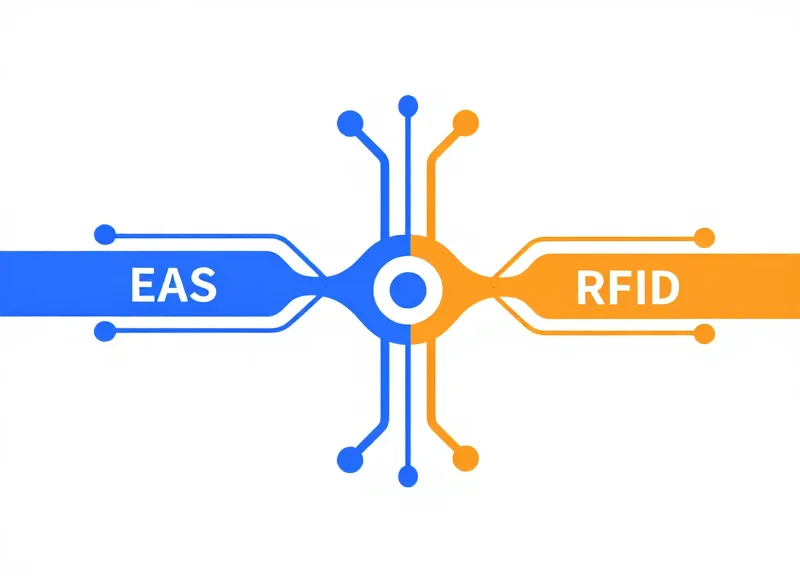
The hybrid approach is a tiered security strategy that integrates invisible Acousto-Magnetic (AM) or Radio Frequency (RF) EAS systems for high-reliability exit detection with Ultra-High Frequency (UHF) RFID for granular item-level visibility. In themed entertainment retail—where aesthetic immersion is paramount—this duality allows operators to maintain a 'frictionless' guest experience while ensuring that every loss event is backed by actionable data. By embedding dual-technology tags (containing both an EAS element and an RFID chip), retailers can trigger a standard security response while simultaneously updating inventory databases and identifying the specific SKU and serial number of the item leaving the premises.
| Feature | Invisible EAS (AM/RF) | Traditional RFID (UHF) | The Hybrid Synergy |
|---|---|---|---|
| Primary Function | High-reliability theft deterrent | Inventory and lifecycle tracking | Loss prevention with SKU-level context |
| Detection Accuracy | Excellent (even with metal/liquids) | Moderate (susceptible to shielding) | Fail-safe detection with data backup |
| Data Granularity | Binary (Alarm / No Alarm) | Rich (SKU, Color, Size, Price) | Specific identification of stolen goods |
| Guest Impact | Zero visual footprint (Floor loops) | Zero visual footprint (Overhead) | Silent alarms for staff mobile devices |
Expert Insight: The 'Silent Interdiction' Workflow. One original advantage of the hybrid model for 2026 is the transition from 'Siren-Based' security to 'Information-Based' response. In a theme park gift shop, a loud alarm can shatter the narrative immersion. With a hybrid system, the invisible EAS loop detects the tag resonance and triggers a silent signal. Because the RFID reader simultaneously scans the item, the security team receives a photo of the product, its price, and its location on their mobile devices instantly. This allows for a discreet 'concierge-style' intervention rather than a disruptive public confrontation.
Can RFID alone replace EAS in themed environments?
Not effectively. Themed merchandise often includes high-metal content (collectible pins, wands) or liquids (snow globes) that can 'blind' RFID readers. EAS remains the 'hard-stop' reliability layer that works where RFID struggles.
How do the systems communicate with each other?
Modern middleware platforms aggregate signals from EAS controllers and RFID readers via standard APIs (like MQTT or REST). This allows the retail management system to correlate an EAS alarm event with an RFID 'tag-gone' event in milliseconds.
Does a hybrid approach increase tag costs significantly?
While dual-tech tags are slightly more expensive than single-mode tags, the ROI is realized through a 25% average reduction in shrink and a 99% improvement in inventory accuracy, which prevents 'out-of-stock' scenarios in high-traffic park environments.
Ultimately, merging these technologies provides a 'Defense in Depth' architecture. While invisible EAS provides the physical security barrier required to protect high-margin collectibles, RFID provides the business intelligence needed to optimize the supply chain. For the themed entertainment industry, this means the 'Magic' stays in the front-of-house, while the 'Math' happens behind the scenes.
Future-Proofing Your Investment: What Comes After 2026?
To future-proof a retail investment beyond 2026, operators must shift focus from 'theft prevention' to 'spatial intelligence.' This evolution involves integrating invisible EAS and RFID data with Edge AI and Computer Vision (CV) to create a self-correcting inventory and security grid. By adopting open-architecture systems today, themed environments can transition from binary alarms to a predictive 'Sensor Fusion' model that identifies intent and automates recovery without human intervention.
As we move toward 2030, the hardware installed today—whether invisible floor loops or ceiling-mounted RFID arrays—will serve as the foundational 'nervous system' for broader AI applications. The goal is no longer just detecting a tag at a door, but understanding the entire journey of a high-value collectible or piece of apparel from the moment it is touched to the moment it leaves the premises. This convergence reduces friction and eliminates the need for traditional checkout barriers entirely.
| Technology Era | Primary Function | Operational Impact |
|---|---|---|
| Pre-2026: Hybrid Systems | EAS for Loss, RFID for Inventory | Reduced shrinkage and better stock accuracy. |
| 2027-2029: Sensor Fusion | AI + CV + RFID Integration | Autonomous checkout and 'Just Walk Out' capabilities. |
| 2030+: Cognitive Retail | Predictive Behavior Modeling | Real-time dynamic pricing and zero-theft environments. |
Expert Insight: The 'Zero-Friction Threshold' In my two decades in Silicon Valley, I've seen that the most successful tech transitions are those that remove the user's awareness of the technology. For themed entertainment, the 'Zero-Friction Threshold' is the point where security disappears into the storytelling. The next generation of systems won't use gates; they will use 'Acoustic Signature Analysis' and 'LiDAR-assisted RFID' to track items through the air, allowing guests to flow freely through themed portals while the system silently validates every item in their possession.
Will AI computer vision replace RFID and EAS entirely?
Unlikely. While AI vision is powerful, it struggles with occlusion (objects hidden in bags). Future systems will use RFID for identity and AI for context, creating a redundant and foolproof security layer.
What infrastructure should I install now to be ready for 2028?
Prioritize high-bandwidth PoE (Power over Ethernet) cabling and increased ceiling load capacity. The hardware will get smaller, but the data and power requirements for high-frequency sensors will increase.
How does data privacy regulation affect these future technologies?
Next-gen systems are moving toward 'Anonymized Tracking,' where the AI tracks skeletal movements or tag IDs rather than facial features, ensuring compliance with evolving global privacy laws like GDPR and CCPA.