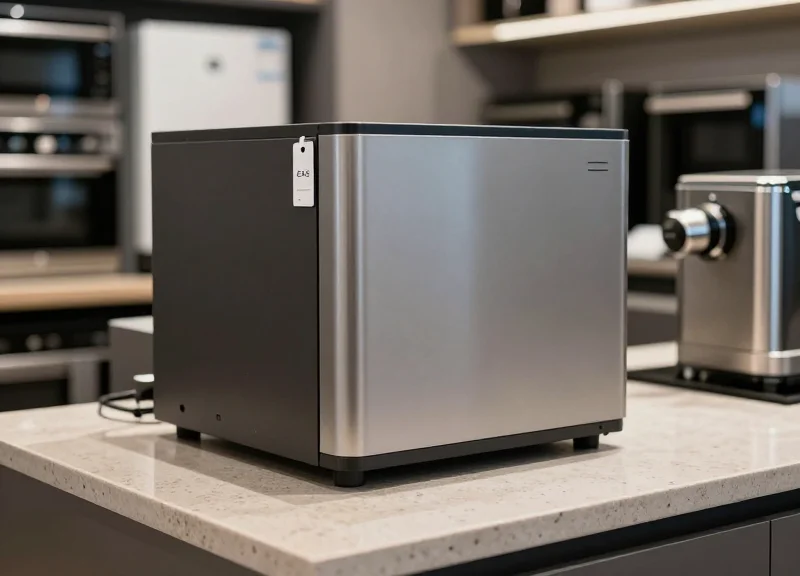
In the competitive world of high-end appliance retail, the 'open display' model is essential for driving sales, yet it exposes retailers to significant shrinkage risks. The challenge lies in securing expensive items—from premium espresso machines to high-tech smart ovens—without causing permanent scratches, adhesive residue, or mechanical damage that devalues the display unit. This comprehensive guide, backed by decades of retail security expertise, outlines the critical factors for selecting EAS (Electronic Article Surveillance) tags that offer maximum protection with zero footprint.
The High Cost of Surface Damage on Display Inventory
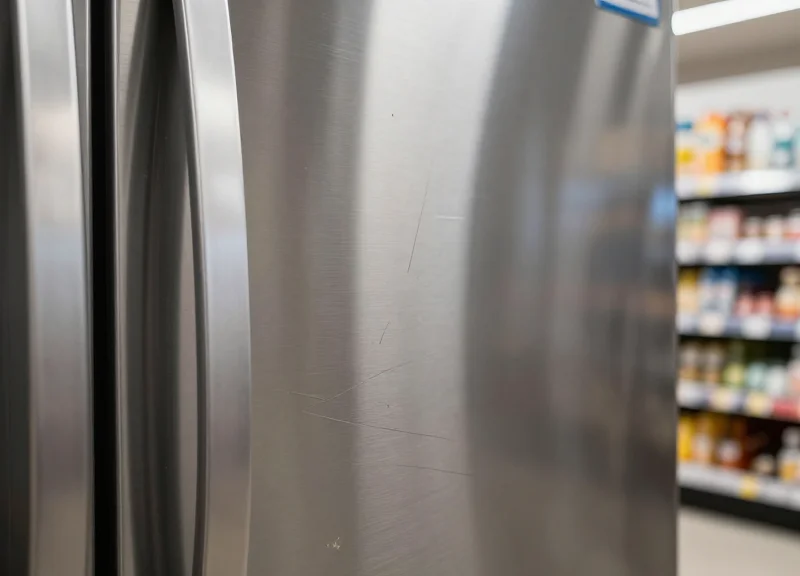
Surface damage on display inventory refers to any aesthetic degradation—such as micro-scratches, adhesive staining, or finish discoloration—caused by the improper application of EAS (Electronic Article Surveillance) security tags. For high-value appliances like stainless steel refrigerators or designer ranges, maintaining a 'pristine-off-the-line' appearance is critical. When a floor model is eventually sold as an 'open-box' item, even minor surface imperfections can trigger significant price markdowns, often ranging from 15% to 40% of the original MSRP, directly impacting the retailer’s bottom line.
| Condition Level | Resale Value Retention | Customer Perception | Net Profit Impact |
|---|---|---|---|
| Pristine (No Tags/Non-Damaging) | 90% - 95% | Premium / New | High Margin |
| Minor Scratches (Hard Tag Rub) | 75% - 80% | Floor Worn | Break-even |
| Adhesive Residue/Staining | 60% - 70% | Neglected | Marginal Loss |
| Surface Pitting/Dents | 40% - 55% | Damaged/Defective | Significant Loss |
Beyond the immediate financial markdown, surface damage creates a 'Brand Confidence Gap.' High-end consumers associate physical integrity with mechanical reliability. If a display model shows visible wear or damage from a security device, it psychologically signals a lack of care by the retailer, potentially driving the customer to a competitor where the same model is displayed in immaculate condition.
- Inventory Liquidation Velocity: Units with visible surface damage often remain on the floor 3x longer than pristine units, tying up valuable showroom real estate and capital.
- Manufacturer Relationship Risks: Many premium appliance manufacturers have strict Visual Merchandising (VM) standards; failing to maintain display integrity can lead to the loss of co-op marketing funds or exclusive dealership status.
- The 'Hidden' Labor Cost: Retailers frequently spend hundreds of man-hours annually attempting to buff out scratches or remove stubborn adhesive left by inferior security tags, often with limited success.
Expert Insight: The 3% Rule. In the high-end appliance sector, market data suggests that a surface defect covering as little as 3% of the visible frontage can justify a customer's demand for a discount that exceeds the retailer's entire net profit margin for that unit. Using 'Non-Damaging' EAS solutions isn't just about security—it is a vital capital preservation strategy.
Material Science: Why Soft-Touch and Non-Abrasive Coatings Matter

In the world of retail security, the material composition of an EAS tag is the primary determinant of whether a display model retains its 'out-of-the-box' luster or suffers from permanent surface degradation. Non-damaging tags utilize advanced polymers and soft-touch coatings designed to have a lower Mohs hardness than the appliance's finish. By using materials like Thermoplastic Elastomers (TPE) or medical-grade silicone, these tags create a non-reactive physical barrier that absorbs mechanical vibrations and prevents the friction-induced 'burnishing' that occurs when hard plastic rubs against stainless steel, brushed aluminum, or powder-coated surfaces.
| Material Type | Surface Interaction | Risk Factor | Best Use Case |
|---|---|---|---|
| Standard ABS Plastic | High friction; rigid contact points | High (Scratches & Scuffs) | Low-cost boxed goods only |
| TPU (Polyurethane) | Semi-flexible; moderate grip | Medium (Potential residue) | Mid-range appliances |
| TPE / Silicone Padding | Low friction; shock absorbent | Zero (Non-abrasive) | High-end stainless & glass |
### The Expert Perspective: The 'Micro-Vibration' Phenomenon A common misconception in retail management is that damage only occurs during the application or removal of a security tag. However, my 20 years in the industry have shown that 'micro-vibrations'—caused by customers touching the display, floor traffic, or HVAC airflows—cause rigid plastic tags to act like fine-grit sandpaper. Over weeks of display, these microscopic movements create dull spots on high-gloss finishes. Expert Tip: Always look for tags with 'durometer-rated' soft contact points (specifically Shore A 40-60) which are soft enough to conform to surface textures but firm enough to maintain a secure grip without slipping.
Why do standard security tags leave 'ghosting' marks on stainless steel?
Ghosting occurs when the hard plastic of the tag reacts with the protective oils or clear coats on stainless steel. Soft-touch coatings are chemically inert, preventing this molecular-level migration that leads to permanent discoloration.
Does the weight of the tag affect the material choice?
Yes. Heavier tags require higher friction-coefficient materials like silicone to prevent sliding. If a tag slides, even a soft material can trap dust particles underneath, which then act as abrasives against the appliance surface.
How can I test if a tag's coating is truly non-damaging?
Perform a 'Rub Test': Take the tag and firmly rub a discarded piece of the same material (e.g., a stainless steel scrap) 50 times. If any cloudiness appears under a bright LED light, the material is too abrasive for high-value displays.
Adhesive vs. Mechanical Locking: Choosing the Right Attachment Method
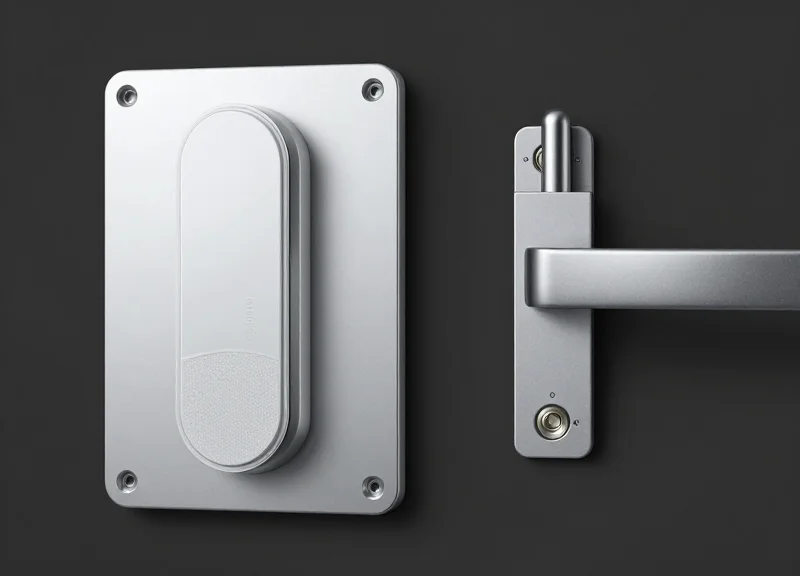
Choosing between adhesive and mechanical EAS tags for high-value appliances requires evaluating the substrate material—such as brushed stainless steel, enamel, or glass—against the security requirements of the retail environment. While adhesives provide a low-profile, versatile solution for flat surfaces, mechanical locking mechanisms offer reusable, high-strength protection for items with accessible edges or handles, provided they utilize non-marring contact points to prevent structural damage.
| Feature | Adhesive Attachment | Mechanical Locking |
|---|---|---|
| Best For | Flat, smooth surfaces (Glass/Enamel) | Handles, frames, and ventilation grills |
| Primary Risk | Chemical residue or surface ghosting | Pressure-induced denting or scratching |
| Installation Speed | High (Peel-and-stick) | Moderate (Manual tightening required) |
| Reusability | Single-use adhesive (Consumable cost) | Fully reusable (Higher long-term ROI) |
| Visual Impact | Low-profile and discreet | Bulky but highly visible deterrent |
When should I prioritize residue-free adhesives?
Adhesives are the preferred choice for appliances with 'seamless' designs where there are no protruding parts to clamp onto. They are also ideal for tempered glass panels or sensitive touch-screen interfaces where a mechanical clamp might exert dangerous localized pressure.
How can I prevent damage from mechanical clamps?
To avoid 'biting' into the finish, ensure all mechanical locks feature high-density silicone padding or polymer gaskets. Additionally, look for devices with torque-limiting keys that prevent over-tightening, which is the leading cause of frame warping on thin-gauge steel appliances.
Are adhesives secure enough for high-theft environments?
Modern high-bond industrial adhesives (like 3M VHB) offer incredible shear strength, making them nearly impossible to pull off by hand. However, they are more susceptible to cutting tools than steel-reinforced mechanical cables or straps.
Expert Tip: Be mindful of the 'Heat Ghosting' effect. In premium showrooms, display appliances like wine coolers or ovens are often functional and generate heat. This localized temperature increase can catalyze the chemical bond of standard adhesives, making them react with the surface finish. Always specify 'low-surface energy' (LSE) adhesives for units that will be powered on, as these are designed to release cleanly even after prolonged heat exposure, preventing the permanent 'ghosting' marks that destroy floor model resale value.
Optimizing Signal Performance: AM vs. RF for Metallic Surfaces

Optimizing EAS signal performance for high-value appliances requires navigating the physical phenomenon of electromagnetic interference. When a security tag is placed on a metallic surface, it creates a 'detuning' effect that can render traditional Radio Frequency (RF) systems useless. To ensure reliable detection without false alarms, Acousto-Magnetic (AM) technology at 58kHz is generally the superior choice for appliances, as its lower frequency and magnetostrictive properties allow the signal to penetrate and wrap around metallic mass more effectively than the 8.2MHz signals used in RF systems.
| Feature | Acousto-Magnetic (AM) 58kHz | Radio Frequency (RF) 8.2MHz |
|---|---|---|
| Metallic Interference | Low; maintains resonance near metal | High; signal 'detunes' or dies on contact |
| Detection Distance | Wide (up to 2.5m between pedestals) | Narrow (typically 1.2m to 1.8m) |
| Application Suitability | Best for Refrigerators, Ovens, Washers | Best for Apparel and Non-Metallic Goods |
| Tag Profile | Slightly thicker (housed in plastic) | Flat stickers or thin hard tags |
The 'Faraday Cage' effect is a primary concern for appliance retailers. Large metallic bodies can absorb or reflect RF energy, creating 'dead zones' where a tagged floor model could be moved through a security gate without triggering an alarm. AM technology mitigates this by utilizing a mechanical vibration of the tag's internal material, which is less susceptible to the electrostatic shielding of stainless steel. For premium appliances, this means higher detection rates and fewer 'blind spots' near the base of the unit.
Can I use RF tags if my store is already hard-wired for 8.2MHz?
Yes, but you must use 'off-metal' RF tags. These feature a built-in ferrite spacer or a thick foam backing that creates a 2-3mm air gap between the tag antenna and the appliance surface to prevent signal cancellation.
Does the finish of the appliance (e.g., Matte vs. Chrome) affect the signal?
The visual finish matters less than the conductivity of the substrate. However, high-gloss chrome often indicates a thicker metallic plating which increases interference more than a painted or powder-coated finish.
What is the 'Golden Rule' for tag placement on appliances?
Always place the tag on a non-metallic component (like a plastic trim or handle) if possible. If it must be on metal, AM tags are the non-negotiable standard for reliability.
Expert Insight: The 2mm Buffer Rule. In my 20 years of field engineering, I have found that even the best AM tags can lose 15% of their read range when flush against industrial-grade steel. The secret to 100% detection is the 'Ferrite Buffer'—choosing tags that incorporate a thin layer of non-conductive polymer or ferrite material between the active element and the adhesive. This tiny separation breaks the eddy currents that would otherwise dampen the tag's resonance.
Ergonomics and Aesthetics: Maintaining the Customer Experience
In high-value appliance retail, ergonomics and aesthetics represent the 'invisible' bridge between security and a successful sale. Effective EAS tag selection focuses on maintaining the appliance's 'Haptic Integrity'—the tactile feedback of buttons, the weight of handles, and the smoothness of dials—ensuring that the security measure does not create friction during the customer's evaluation process. A low-profile, ergonomically designed tag allows shoppers to interact with the unit naturally, preventing the 'security-first' look that can subconsciously devalue premium inventory.
Expert Insight: From a marketing psychology perspective, the first 10 seconds of physical interaction with a display model are critical for 'ownership visualization.' If a customer's finger hits a bulky plastic tag while trying to reach a microwave's keypad or a refrigerator's touchscreen, that visualization is broken. We recommend a 'Zero-Shadow' placement strategy where tags are positioned to avoid casting shadows over LED displays or obstructing the ergonomic sweep of a user's hand.
| Feature | Standard EAS Tags | Low-Profile Non-Damaging Tags |
|---|---|---|
| Button Accessibility | Often blocks adjacent controls | Tapered base for full button access |
| Visual Impact | High-contrast, industrial look | Color-matched, sleek form factor |
| User Interaction | Significant tactile interference | Minimal impact on appliance operation |
| Weight Distribution | Can unbalance small doors/lids | Ultra-lightweight polymer construction |
How do I ensure the tag doesn't block the appliance's control panel?
Select tags with a 'remote-sensor' configuration. These allow the bulky electronics to be hidden on the side or rear of the unit, while only a small, thin sensor wire or low-profile contact point is placed near the control surface.
Can security tags interfere with internal appliance lighting?
Yes, if placed incorrectly. Use transparent or semi-translucent adhesive bases for tags placed near internal sensors or lights to ensure the appliance's own illumination remains the focal point.
What is the 'Clearance Rule' for display handles?
Always maintain at least 95% of the original handle clearance. Use 'C-clamp' or 'Lasso' style tags with soft-touch coatings that sit flush against the handle support rather than the center of the grip.
Operational Efficiency: Fast Application and Clean Removal
Operational efficiency in high-value appliance security is defined by the '30-Second Rule': the ability for store associates to securely apply a tag and later remove it during a floor reset in under 30 seconds total, without requiring specialized chemical cleaners. For premium appliances like brushed stainless steel refrigerators or matte-finish ovens, the goal is a friction-less workflow where the security hardware leaves no 'adhesive shadow' or mechanical marring, ensuring the unit remains in 'Grade A' condition for eventual open-box sale.
- Surface Pre-Check: Quickly wipe the application area with a dry microfiber cloth to remove oils; avoid wet solvents that can react with certain tag adhesives.
- One-Click Engagement: Utilize mechanical clamps with preset tensioners or 'peel-and-place' non-residue adhesives that provide instant structural bonding without a cure time.
- Magnetic or Keyed Release: Ensure tags use high-strength neodymium magnetic detachers or proprietary keys that allow for one-handed removal during fast-paced floor rotations.
- Zero-Trace Inspection: Perform a visual sweep post-removal. High-efficiency tags use cohesive-bond technology that pulls away cleanly from the substrate rather than shearing and leaving fragments.
| Feature | Standard Industrial Tags | High-Efficiency Appliance Tags |
|---|---|---|
| Application Time | 45-90 Seconds | Under 15 Seconds |
| Removal Method | Manual prying/Scraping | Quick-release Magnetic/Mechanical |
| Post-Removal Cleanup | Requires Alcohol/Goo-Gone | None (Dry removal) |
| Staff Training | Moderate (due to tool use) | Minimal (Intuitive design) |
The 'Hidden Labor Tax' is a critical metric often overlooked by loss prevention departments. In a typical showroom reset involving 50 display models, using traditional adhesive tags can rack up nearly 4 hours of cumulative labor just in residue scrubbing. By switching to 'Clean-Peel' or mechanical 'Soft-Clamp' systems, retailers reclaim this time, allowing staff to focus on customer engagement rather than maintenance. My expert tip: Always opt for 'Dry-Release' polymers; these materials are engineered to lose their grip only when a specific shear force is applied by the removal tool, leaving the appliance finish completely untouched.
What should I do if a tag leaves a ghosting effect on stainless steel?
Ghosting is usually caused by UV light fading the surrounding area while the tag-covered area remains pristine. To prevent this, rotate tag placement slightly every 30 days or use tags with transparent footprints.
Are mechanical clamps faster than adhesive tags?
Generally, yes. Modern mechanical clamps with rubberized grips can be snapped on and off in seconds, whereas even non-residue adhesives require careful alignment and firm pressing to ensure a bond.
Do non-damaging tags require special storage?
For adhesive-based non-damaging tags, shelf life is vital. Store them in a cool, dry environment to prevent the adhesive from 'wetting' too deeply into the appliance surface over time, which makes removal more difficult.
Multi-Layered Security: Integrating EAS with RFID for Real-Time Tracking

Integrating EAS with RFID transforms a passive deterrent system into an active intelligence network. While traditional EAS (Electronic Article Surveillance) focuses solely on triggering an alarm at the storefront to prevent shrink, RFID (Radio Frequency Identification) adds a unique digital identity to every display unit. For high-value appliances, this multi-layered approach means retailers can move beyond knowing that something was stolen to knowing exactly what was moved, when it was moved, and its current location within the store—all without using invasive hardware that could mar the appliance's finish.
| Feature | Standard EAS | Integrated EAS + RFID |
|---|---|---|
| Primary Purpose | Theft Deterrence | Deterrence + Inventory Visibility |
| Data Granularity | Binary (Alarm/No Alarm) | Unique Serialized Tracking |
| Floor Localization | Limited to Pedestals | Real-Time Zone Tracking |
| Inventory Accuracy | No Impact | Up to 99% Accuracy |
Expert Insight: The 'Ghost Inventory' Shield. A common pain point for appliance retailers is 'phantom inventory'—where the system shows a floor model in stock, but it has actually been stolen or moved to a backroom, leading to lost sales. Integrating RFID into your non-damaging EAS tags creates a digital 'tether.' If a premium espresso machine or high-end vacuum is moved from its designated display zone, the system logs the event immediately. This allows for 'cycle counting' in seconds rather than hours, ensuring your high-margin floor models are always exactly where they should be.
Can RFID tags be non-damaging to stainless steel?
Yes. Modern 'Dual-Tech' tags use specialized foam-backed adhesives or padded clamps that create an air gap between the RFID inlay and the metallic surface, which prevents signal interference while protecting the appliance's finish.
Does RFID replace the need for AM/RF EAS systems?
Not necessarily. While RFID can trigger alarms, many retailers prefer a hybrid approach where EAS provides the heavy-duty security at the door and RFID manages the data and movement analytics on the floor.
Is the cost of integration justifiable for display models?
For appliances retailing over $500, the ROI is typically achieved within 12 months through a combination of reduced shrink and significantly lower labor costs associated with manual inventory audits.
- Identify High-Risk Zones: Map out your showroom to identify where high-value, portable appliances are most vulnerable.
- Select Dual-Technology Tags: Choose tags that house both an EAS ferrite core (for the alarm) and an RFID chip (for the data) in a single, non-marring housing.
- Deploy Fixed Readers: Install overhead or shelf-mounted RFID readers to automate the tracking of display models without staff intervention.
Evaluating ROI: Calculating the Value of Damage Prevention
Return on Investment (ROI) for non-damaging EAS security tags is calculated by measuring the 'Total Cost of Asset Preservation' rather than just the unit price of the tag. While standard adhesive or abrasive tags may have a lower upfront cost, the true expense includes the depreciation of display models due to surface damage, the labor hours spent on residue removal, and the significant markdowns required to sell damaged floor units. A premium, non-damaging tag often pays for itself within a single floor-reset cycle by maintaining the appliance's 100% retail value.
| Cost Variable | Standard Adhesive/Mechanical Tags | Premium Non-Damaging Tags |
|---|---|---|
| Average Markdown (Damaged Unit) | 15% - 30% of MSRP | 0% (Pristine Condition) |
| Labor (Application/Removal) | 10-15 mins (Scrubbing/Polishing) | 1-2 mins (Click-and-Release) |
| Consumables Cost | Chemical solvents & abrasive pads | None required |
| Secondary Market Value | Significant Loss (B-Grade) | Maximum (A-Grade/Open Box) |
- Determine Your Baseline Damage Rate: Audit the last 12 months of floor model sales. Identify what percentage of units required a 'damage markdown' due to scratches, adhesive ghosting, or mechanical punctures from security hardware.
- Calculate the 'Labor Leakage': Multiply the hourly wage of your floor staff by the time spent cleaning units after tag removal. In high-volume showrooms, this hidden cost often exceeds the cost of the security tags themselves.
- Factor in the 'Resale Delta': Subtract the actual sale price of a damaged floor model from the price of a pristine 'Open Box' unit. This difference represents the direct loss prevented by high-quality tags.
- Apply the ROI Formula: [(Total Markdowns Avoided + Labor Saved) - (Cost of Premium Tags)] / (Cost of Premium Tags) * 100.
Expert Insight: The 'Hidden Surface' Fallacy. Many retailers assume that placing damaging tags on the back or side of an appliance mitigates ROI loss. However, high-value customers purchasing premium brands like Sub-Zero or Miele often inspect the entire chassis. A single adhesive stain or scratch on a side panel can trigger a request for a 'scratch and dent' discount, instantly erasing the savings gained from using a cheaper security tag.
How does the 'Surface Integrity' affect brand perception?
When high-value appliances look damaged while still on display, it subconsciously devalues the brand in the customer's eyes, leading to longer sales cycles and lower closing rates.
Can non-damaging tags be reused?
Yes. Unlike adhesive-based solutions that lose tackiness or damage the housing upon removal, premium mechanical non-damaging tags are designed for hundreds of cycles, further increasing long-term ROI.
What is the impact on warranty claims?
Some manufacturers consider mechanical drilling or chemical damage to be a violation of the exterior finish warranty. Non-damaging tags ensure the manufacturer's warranty remains fully intact for the eventual buyer.