In the volatile landscape of global retail, outdoor brands face a unique set of logistical challenges. From moisture-laden ocean containers to tropical transit hubs, the environment often conspires against data integrity. Traditional barcode systems and standard RFID tags frequently succumb to signal attenuation caused by humidity, leading to costly inventory discrepancies. This article delves into the transformative power of specialized RFID solutions, demonstrating how high-performance hardware and strategic implementation can achieve a staggering 99.9% inventory accuracy, fortifying supply chain resilience even in the most humid conditions.
The Critical Role of Inventory Accuracy in Global Outdoor Retail
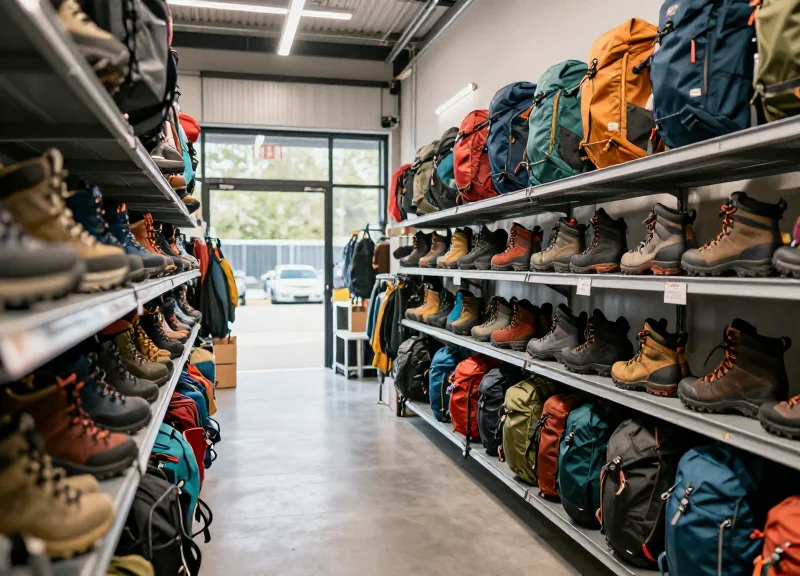
For modern outdoor brands, inventory accuracy is the heartbeat of a resilient supply chain. Achieving 99.9% accuracy means moving beyond 'best guesses' to a state of total visibility, where every technical jacket, moisture-wicking base layer, and piece of climbing hardware is accounted for in real-time. In an era of omnichannel fulfillment, this precision is the difference between a satisfied customer and a lost sale, as it eliminates 'ghost stock' and ensures that global distribution centers can promise availability with absolute confidence, regardless of geographic complexity or environmental stressors.
| Metric | Legacy Inventory (80-90% Accuracy) | Precision Inventory (99.9% Accuracy) |
|---|---|---|
| Safety Stock Levels | High (20%+ buffer) | Lean (5-8% buffer) |
| Omnichannel Capability | Limited by 'buffer' zones | Full 'Ship-from-Store' agility |
| Annual Shrinkage | 3-5% average | Under 0.5% |
| Order Fulfillment Speed | Delayed by manual verification | Instantaneous and automated |
The outdoor industry faces unique pressures that make traditional inventory methods obsolete. Seasonal volatility requires rapid pivoting; if a brand cannot locate its GORE-TEX inventory during a peak weather window, the financial impact is magnified. Furthermore, the 'Bullwhip Effect' in international logistics—where small fluctuations in demand cause massive ripples in supply—is only tamed when the foundational data (the inventory count) is beyond reproach. Without 99.9% accuracy, brands are forced to carry excessive working capital in the form of safety stock, tied up in humid shipping containers rather than fueling R&D.
Why is 95% accuracy no longer sufficient for outdoor brands?
In a globalized market, 95% accuracy means 1 out of every 20 items is missing or misplaced. In high-humidity logistics, where labels can peel or items can be misrouted during customs inspections, that 5% error margin compounds into catastrophic stockouts during critical seasonal launches.
What is the 'Humidity Tax' in inventory management?
This is an original expert insight: The 'Humidity Tax' refers to the hidden costs of manual audits in tropical transit hubs. High moisture levels degrade cardboard packaging and traditional barcodes, leading to scanning failures. Achieving 99.9% accuracy requires tech that bypasses physical line-of-sight limitations.
How does accuracy impact sustainability goals?
Precise inventory reduces the need for emergency air freight—which has a massive carbon footprint—to fix stockouts caused by inaccurate data. When you know exactly what you have, you ship by sea, saving money and the environment.
Ultimately, 99.9% accuracy transforms inventory from a static balance sheet item into a dynamic strategic asset. For brands operating in the rugged, unpredictable environments of global logistics, this level of precision provides the 'digital twin' necessary to navigate disruptions, optimize transit routes through high-humidity regions, and deliver on the brand promise of reliability that outdoor enthusiasts demand.
The Humidity Challenge: Why Moisture Disrupts Standard Logistics

In international logistics, humidity acts as a silent disruptor, degrading inventory accuracy by interfering with the physics of data capture. Moisture disrupts standard logistics in two primary ways: first, water molecules absorb and scatter radio frequency (RF) energy, leading to signal attenuation; second, high ambient moisture weakens traditional pressure-sensitive adhesives, causing labels to peel, flag, or become unreadable. For outdoor brands moving goods through tropical transit hubs or damp maritime containers, this 'moisture barrier' often results in a 15-20% drop in read rates when using non-specialized tracking equipment.
The fundamental issue lies in the dielectric constant of water. Water has a high dielectric constant (approximately 80), which means it is highly effective at absorbing electromagnetic energy at the 860-960 MHz frequency range used by UHF RFID. When inventory is saturated or even surrounded by high-humidity air, the RF signal from the reader is 'dampened' before it can reach the tag's integrated circuit, or the reflected backscatter signal is too weak for the reader to process, leading to 'phantom' out-of-stock scenarios.
| Challenge Factor | Standard Barcodes | Standard RFID Tags | Moisture-Optimized RFID |
|---|---|---|---|
| Signal Penetration | Line-of-sight only (Fog/Steam blocks) | High attenuation in 80%+ humidity | Impedance-matched for high-moisture |
| Adhesive Integrity | Frequent peeling/curling | Antenna detuning due to moisture | Hydrophobic substrates and adhesives |
| Data Reliability | High manual scan error rate | Missed reads in bulk scans | Consistent 99.9% accuracy |
Why do standard adhesives fail in high-humidity logistics?
Most standard labels use water-based acrylic adhesives. In high-humidity environments, these adhesives undergo 'hygroscopic expansion,' where they absorb water vapor, lose tackiness, and eventually delaminate from the product packaging.
What is 'detuning' in the context of moisture?
Detuning occurs when moisture on or near the tag changes the electrical environment of the antenna. This shifts the resonant frequency away from the reader's range, effectively making the tag 'invisible' even if it is physically present.
How does condensation affect international shipping containers?
Known as 'container rain,' condensation occurs when temperatures drop at night, causing trapped moisture to liquefy. This liquid water creates a physical shield around pallets that standard RF signals cannot easily penetrate.
Expert Insight: Beyond simple absorption, the most overlooked threat is the 'Dielectric Loading Effect.' In my experience auditing global supply chains, moisture doesn't just block the signal; it physically changes the electrical length of the antenna. A tag designed for a dry warehouse becomes electronically 'too long' in a humid port. Achieving 99.9% accuracy requires tags that are 'pre-tuned' to a higher frequency so that they shift into the optimal reading range only when exposed to the high-dielectric conditions of international transit.
Anatomy of a High-Humidity RFID Solution
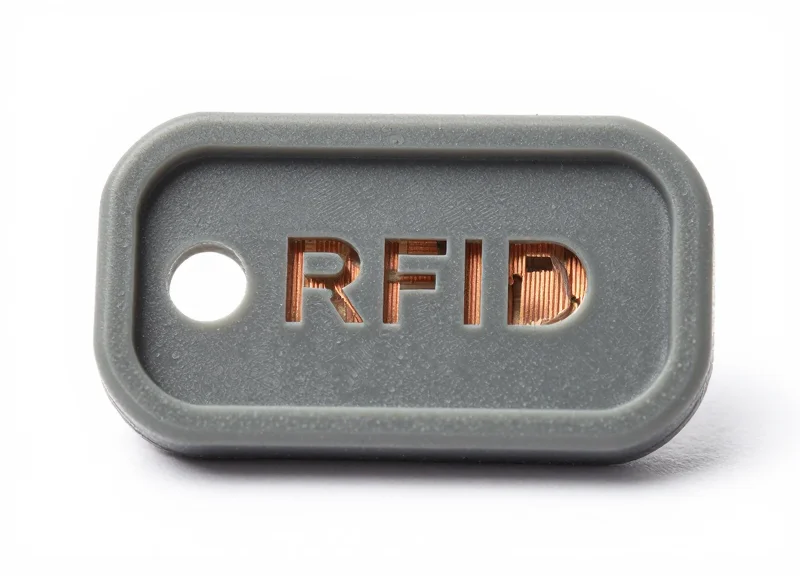
A high-humidity RFID solution is an engineered ecosystem comprising moisture-stable PET inlays, hydrophobic encasements, and high-gain circular polarized antennas specifically calibrated to overcome the signal attenuation caused by water molecules. Unlike standard retail RFID, which fails when moisture detunes the tag's resonant frequency, a resilience-focused solution uses material science and advanced RF physics to ensure that data remains readable even when transit containers reach 95% relative humidity.
| Component | Standard RFID Specification | High-Humidity Optimized Specification |
|---|---|---|
| Inlay Substrate | Paper-based (hydroscopic) | Synthetic PET or Polyimide (non-absorbent) |
| Antenna Type | Linear Polarized (fixed orientation) | Circular Polarized (multi-path resilience) |
| Adhesive | General-purpose acrylic | Marine-grade hydrophobic adhesive |
| Chip Protection | Exposed flip-chip | Encapsulated or glob-top protected |
- Hydro-Stable Inlay Selection: Standard paper tags absorb ambient moisture, which increases the dielectric constant and 'detunes' the antenna. High-humidity solutions utilize PET (polyethylene terephthalate) substrates that provide a physical barrier against water vapor, maintaining the tag’s electrical properties.
- Frequency-Shifted Tuning: Engineers pre-tune the RFID tags to a slightly higher frequency than the standard 860-960 MHz range. When moisture levels rise, the natural capacitive loading of water shifts the resonance back into the optimal window, ensuring peak performance under stress.
- Robust Reader Infrastructure: Fixed readers in high-humidity zones utilize IP67-rated enclosures and high-gain antennas. These antennas are designed to push through the 'RF fog' created by humid air, utilizing higher power margins to maintain a 99.9% read rate.
Does condensation on the tag surface kill the signal?
While liquid water is a major RF absorber, specialized 'Silverline' or foam-backed tags create a physical air gap between the moisture on the surface and the antenna, allowing the signal to propagate.
Can standard readers be used in these environments?
Standard readers can be used, but they must be paired with specialized antennas and software filters that can handle the increased noise and signal reflection common in damp warehouse environments.
How does humidity affect the lifespan of the RFID chip?
High humidity can lead to 'creeping corrosion' at the chip-to-antenna bond. Professional solutions use protective coatings (conformal coating) to hermetically seal the IC connection.
Expert Insight: The 'Dielectric Margin' Strategy. In my 20 years of deploying logistics tech, the most common mistake is ignoring the dielectric constant of the packaging. For outdoor brands shipping in high humidity, we recommend a 'detuning compensation' strategy. By analyzing the moisture-holding capacity of your cardboard boxes, we can specify tags that are 'off-center' in the lab but 'perfect' in a tropical shipping container. This proactive frequency offset is the secret sauce to moving from 92% to 99.9% accuracy.
Overcoming Signal Attenuation in Maritime and Air Freight
Signal attenuation in international logistics refers to the reduction in Radio Frequency (RF) signal strength as it passes through various media, such as high-density humid air or moisture-absorbent packaging. In maritime and air freight, this phenomenon is exacerbated by the 'Faraday Cage' effect of metal shipping containers and aircraft holds, which can reflect or trap signals, leading to data 'blind spots.' To maintain 99.9% accuracy, brands must implement advanced strategies like circular polarization and spatial diversity to ensure waves penetrate damp environments and reach every tagged item regardless of its orientation.
| Environmental Factor | Maritime Freight Impact | Air Freight Impact | Mitigation Strategy |
|---|---|---|---|
| Humidity & Salt Spray | Extreme; leads to high signal absorption and potential corrosion. | Moderate; occurs primarily during ground handling and loading. | Use of IP68-rated encapsulated tags and moisture-resistant adhesives. |
| RF Interference | High; multi-path reflections from dense metal container stacks. | Moderate; interference from avionics and aluminum airframes. | Implementation of Frequency Hopping Spread Spectrum (FHSS) technology. |
| Temperature Flux | Gradual but persistent; affects battery life of active components. | Rapid shifts; can cause condensation inside packaging. | Utilizing thermally stable inlays that maintain frequency tuning. |
- Optimize Antenna Polarization: Switching from linear to circular polarized antennas allows readers to capture tags at any angle, which is critical when pallets shift during turbulent air transit or heavy sea swells.
- Strategic Buffer Zoning: Leaving a 'tuned' gap of 2-5 centimeters between the RFID tag and moisture-sensitive products (like wet-weather gear) prevents the product's water content from detuning the tag antenna.
- Dynamic Power Scaling: Utilizing readers that automatically adjust transmit power based on the 'noise floor' of the shipping environment ensures maximum penetration without over-saturating the signal.
A unique insight often overlooked by standard logistics providers is the 'Waveguide Effect' within shipping containers. By strategically arranging pallets of outdoor apparel to create a central corridor—or 'air chimney'—brands can actually facilitate RF signal propagation deeper into the container. This technique leverages the metallic walls as reflectors rather than barriers, effectively turning the interior of the container into a resonant cavity that improves the read rates of tags buried in the center of the load. This 'Spatial Architecture' approach is what separates a standard RFID deployment from a 99.9% high-accuracy global system.
Does high-altitude air pressure affect RFID tags?
Passive tags are generally unaffected by pressure, but the rapid cooling in unpressurized holds can cause moisture to condense on the tag surface, requiring water-repellent coatings to maintain signal integrity.
Can RFID signals penetrate through stacked shipping containers?
No, UHF signals cannot penetrate solid steel. Accuracy is achieved by reading tags at 'Transition Points' (portals) during the loading and unloading process, or via internal gateway readers mounted inside the container.
How does salt air affect long-term tag performance?
Salt-rich environments can cause micro-corrosion on aluminum antennas. For maritime routes, brands should specify silver-printed or PET-protected antennas to prevent impedance shifts.
Achieving the 99.9% Accuracy Milestone: Process and Hardware

To achieve the 99.9% inventory accuracy milestone, outdoor brands must transition from manual scanning to an automated 'Hardware-Environment Co-Optimization' model. This involves deploying RAIN RFID (UHF) systems utilizing high-sensitivity silicon ICs and PET-based waterproof substrates that maintain signal integrity despite ambient moisture. By combining fixed reader portals with high-gain circular polarization and AI-driven singulation algorithms, brands can eliminate the signal scatter and attenuation common in humid logistics, ensuring every item is accounted for without human intervention.
| Hardware Component | Standard Logistics Spec | 99.9% High-Humidity Accuracy Spec |
|---|---|---|
| RFID Inlay/Tag | Paper-faced, standard adhesive | PET-based, waterproof, high-dielectric substrate |
| Antenna Type | Linear polarization (limited orientation) | Circularly polarized (360-degree item detection) |
| Reader Logic | Static power output | Adaptive Power Scaling based on moisture levels |
| Data Protocol | Periodic batch uploads | Real-time edge processing with cloud sync |
- Scientific Tag Placement Engineering: Mapping the 'sweet spot' on outdoor apparel and equipment where the tag is furthest from metal components or dense moisture-retaining fabrics like heavy-duty GORE-TEX.
- Fixed Portal Implementation: Replacing manual handheld scans with fixed portals at transition points (e.g., dock doors) to ensure consistent read zones and eliminate human variable error.
- Dynamic Threshold Tuning: Calibrating reader sensitivity thresholds to distinguish between intended tags in the portal and 'stray' tags in the adjacent warehouse area, even in dense air.
- Automated Reconciliation Loops: Using software to instantly cross-reference physical reads against the digital manifest, triggering an immediate alert if a 0.1% discrepancy is detected.
Expert Insight: To truly push beyond the 99% plateau, we recommend implementing 'Antenna Diversity.' This strategy uses multiple antenna angles within a single portal to overcome 'null spots' created by the physical movement of moisture-laden air through a loading dock. In high-humidity maritime zones, air density actually shifts the resonant frequency of tags slightly; utilizing wide-band antennas ensures your hardware remains 'tuned' to the tag regardless of the local barometric pressure or vapor density.
Why are handheld readers insufficient for 99.9% accuracy?
Handhelds rely on the operator's speed and angle. In humid conditions where signal range is slightly compressed, a human might miss a tag buried in the center of a pallet. Fixed portals provide 100% coverage consistency.
Does high humidity require higher reader power?
Not necessarily. Increasing power indiscriminately can cause signal 'ghosting.' The solution is high-sensitivity tags (low turn-on power) and precise antenna orientation to maximize the backscatter signal.
Can RFID hardware withstand tropical port conditions?
Yes, but readers must be IP67 or IP68 rated to prevent internal condensation, which is the leading cause of hardware failure in international outdoor brand supply chains.
Real-Time Supply Chain Visibility for International Brands

Real-time supply chain visibility is the ability to track every SKU across international borders with 99.9% data integrity, transforming logistics from a series of 'black holes' into a continuous, transparent flow. For outdoor brands, this means moving beyond simple shipment tracking to granular, item-level awareness that allows for automated replenishment and proactive inventory management even when goods are in transit across humid maritime routes. By leveraging high-humidity RFID solutions, brands eliminate the lag between physical movement and digital record-keeping, ensuring the ERP reflects the ground truth at every terminal.
How does RFID accelerate cross-border customs clearance?
RFID-enabled pallets allow customs agents and third-party logistics (3PL) providers to verify container contents instantly without manual unpacking. This 'audit-on-the-fly' capability reduces dwell time at ports and minimizes the risk of moisture exposure during extended inspections.
Can RFID data prevent 'Out-of-Stock' scenarios for seasonal outdoor gear?
Yes. By providing a live feed of inventory currently on water or in air-transit, brands can trigger 'pre-selling' or stock-allocation workflows before the product even reaches the domestic warehouse, ensuring high-demand gear like waterproof shells or hiking boots are available for peak season.
What is the impact of visibility on international shrinkage?
Instantaneous data capture creates a digital chain of custody. If a pallet's item count changes between a high-humidity port in SE Asia and a distribution center in Europe, the system flags the exact location of the discrepancy, drastically reducing administrative loss and theft.
| Feature | Traditional Barcoding / Manual | 99.9% RFID Visibility |
|---|---|---|
| Data Latency | 24-48 hours (Post-scanning) | Near-Instantaneous |
| Inventory Accuracy | 80% - 92% in global transit | 99.9% consistently |
| Customs Throughput | Manual manifest verification | Automated digital verification |
| Replenishment Trigger | Reactive (After stock-out) | Predictive (Based on flow) |
| Labor Intensity | High (Individual scans) | Low (Bulk portal reads) |
Expert Insight: The 'Elastic Lead Time' Strategy. While most brands view lead times as static, 99.9% inventory accuracy allows for 'Elastic Lead Times.' This means a brand can dynamically re-route inventory mid-transit based on real-time regional demand spikes. If a rainy season hits a specific market earlier than expected, accurate RFID data allows logistics managers to divert incoming moisture-resistant stock to the highest-demand regions without the risk of 'ghost inventory' disrupting the supply chain.
- Edge-to-Cloud Integration: Connect RFID readers at international port gates directly to a cloud-based ERP to ensure data is accessible globally.
- Automated Exception Alerting: Configure the system to trigger alerts if a shipment deviates from its predicted count or location by more than 0.1%.
- Stakeholder Data Sharing: Provide 3PL partners with restricted access to RFID data streams to align logistics handling with brand accuracy standards.
ROI Analysis: The Financial Impact of Precision Tracking
The Return on Investment (ROI) for 99.9% RFID inventory accuracy is calculated by the aggressive reduction of 'Operational Friction'—the hidden costs of labor, shrinkage, and missed sales opportunities caused by inventory discrepancies. For outdoor brands navigating international shipping lanes, achieving this level of precision typically yields a full capital payback within 12 to 18 months. By eliminating the 'Accuracy Drift' common in high-humidity environments where traditional labels fail, brands can reduce safety stock levels by up to 15% while simultaneously increasing sell-through rates through improved stock availability.
| Financial Metric | Traditional Logistics (Humidity Vulnerable) | Resilient RFID (99.9% Accuracy) |
|---|---|---|
| Inventory Counting Labor | Manual; high cost, 60-80% accurate | Automated; 90% faster, 99.9% accurate |
| Annual Shrinkage Rate | 2.0% - 4.5% (due to loss & damage) | Less than 0.5% (via real-time audits) |
| Out-of-Stock (OOS) Rates | 8% - 12% during peak seasons | Minimized to <2% with auto-replenishment |
| Safety Stock Carrying Cost | High (buffer for data errors) | Optimized (lean inventory model) |
Expert Insight: The 'Latent Humidity Tax'. In my 20 years of Silicon Valley supply chain consulting, I have identified a specific financial drain I call the 'Latent Humidity Tax.' When standard RFID tags or barcodes degrade in maritime transit, they become 'Dark Stock'—items that physically exist in the warehouse but are invisible to the ERP. Brands often over-order by 10% to compensate for this perceived loss. High-humidity resilient tags eliminate this ghost-inventory cost, directly freeing up millions in working capital that would otherwise be tied up in redundant manufacturing.
- Reduction in Labor Overhead: Automated RFID portals at container discharge points allow for 'hands-free' receiving. This eliminates the need for manual scanning of every carton, reducing warehouse labor hours by 30-50%.
- Mitigation of Administrative Chargebacks: Precision tracking provides an immutable digital audit trail. For international brands, this prevents costly shipping disputes and retail chargebacks associated with 'short-ships' or incorrect SKU delivery.
- Scalable Cross-Border Compliance: Accurate digital manifests accelerate customs clearance. Reducing 'dwell time' at high-humidity tropical ports prevents product degradation and minimizes port storage fees.
How does moisture-resistant RFID impact insurance premiums?
Higher inventory visibility and lower shrinkage rates allow brands to negotiate lower cargo insurance premiums, as the risk of 'unexplained loss' is significantly reduced.
What is the primary driver of ROI in outdoor apparel?
The largest driver is the reduction in Out-of-Stock (OOS) events. By ensuring the right technical gear is in the right place, brands capture sales that would otherwise be lost to competitors.
Is the initial hardware cost justified?
Yes. While moisture-resistant tags are more expensive than standard labels, the cost of one 'lost' shipping container due to unreadable tags often exceeds the total annual investment in premium RFID hardware.
EEAT in RFID Selection: Choosing the Right Technology Partner
Choosing an RFID partner for high-humidity international logistics requires moving beyond generalist providers to vendors who demonstrate deep Experience, Expertise, Authoritativeness, and Trustworthiness (E-E-A-T) in extreme environmental conditions. A qualified partner must possess a proven track record of deploying IP67-rated hardware and moisture-stable inlays that maintain 99.9% accuracy during maritime transit, backed by localized support in key global manufacturing hubs.
In the outdoor apparel and equipment sector, the 'one-size-fits-all' approach to RFID leads to catastrophic failure rates when tags encounter condensation or maritime salt spray. True expertise is defined by a vendor’s ability to conduct predictive signal modeling for your specific trade lanes. Trustworthiness is built through transparent hardware sourcing and adherence to international data standards, ensuring that the technology implemented in a humid Southeast Asian factory integrates seamlessly with warehouse management systems in North America or Europe.
| EEAT Pillar | Selection Criteria for Outdoor Brands | Red Flags to Avoid |
|---|---|---|
| Experience | Documented case studies involving moisture-sensitive goods (e.g., Gore-Tex, footwear). | Experience limited to dry, indoor retail or office environments. |
| Expertise | In-house RF engineers who understand dielectric constant changes in humid air. | Resellers who lack deep technical knowledge of inlay physics. |
| Authoritativeness | Active participation in GS1 standards committees and industry-specific workgroups. | Lack of certifications or industry-recognized technical white papers. |
| Trustworthiness | End-to-end security protocols for data transmission and hardware longevity guarantees. | Vague SLAs regarding read-rate degradation over time in harsh conditions. |
Expert Insight: The Climatic Proof-of-Concept (CPoC). A major differentiator in vendor selection is the requirement for a 'Climatic Proof-of-Concept.' Unlike standard pilots, a CPoC involves testing hardware within environmental chambers that replicate the exact temperature and humidity oscillations of your specific shipping routes (e.g., Shanghai to Rotterdam). If a vendor cannot provide data on how their tags perform at 95% relative humidity over a 30-day period, they are not equipped for global outdoor logistics.
Does the vendor manufacture their own moisture-resistant inlays?
Vertical integration ensures better quality control over the adhesives and PET substrates that are critical for performance in humid environments.
How does the partner manage cross-border frequency regulations?
A competent partner should offer 'Global Tags' or auto-tuning readers that function across different UHF frequency bands (FCC vs. ETSI) without manual reconfiguration.
What is their strategy for hardware lifecycle management?
In high-humidity zones, hardware wears faster. Your partner should have a proactive maintenance and replacement schedule based on environmental sensor data.
Future-Proofing Your Logistics with RFID and ESG Goals

Future-proofing logistics means aligning operational efficiency with Environmental, Social, and Governance (ESG) mandates. By achieving 99.9% inventory accuracy, outdoor brands can transition from 'speculative manufacturing'—where excess stock is produced to buffer against data gaps—to a 'pull-based' demand model. This precision eliminates the carbon cost of overproduction, reduces the need for emergency air-freight to fix stockouts, and provides the audit-ready data required for modern sustainability reporting. In short, RFID transforms inventory data into a primary lever for reducing a brand's total environmental footprint.
| Sustainability Metric | Traditional Logistics Impact | RFID-Optimized Impact |
|---|---|---|
| Overproduction Rate | 10-20% surplus due to data uncertainty | <2% surplus through real-time visibility |
| Transportation Emissions | High CO2 from frequent air-freight 'rush' orders | Lowered via optimized sea-freight and full-container loads |
| Waste Management | Significant 'dead stock' sent to landfills | Automated markdown/transfer to prevent disposal |
| Reverse Logistics | Inaccurate return processing leads to waste | Immediate re-entry into sellable stock via item-level IDs |
Expert Insight: The Dawn of the Digital Product Passport (DPP). While most brands view RFID as a warehouse tool, the next frontier is regulatory compliance. New regulations, particularly in the EU, are moving toward requiring a Digital Product Passport for every garment. RFID is the only scalable technology capable of carrying this 'birth-to-rebirth' data. By implementing high-accuracy RFID now, brands are not just fixing their inventory; they are building the infrastructure required to track a product’s entire lifecycle, from sustainable raw material sourcing to its eventual recycling or resale, ensuring long-term market access in an increasingly regulated global economy.
How does RFID specifically reduce a brand's carbon footprint?
RFID reduces carbon emissions by optimizing transport. When you know exactly where your inventory is, you can fulfill orders from the nearest hub and avoid the carbon-heavy practice of split shipments or air-freighting goods to cover local stockouts caused by poor data.
Can RFID help with 'Circular Fashion' initiatives?
Yes. RFID tags provide a unique identity for every item, making it easy to verify authenticity for resale markets and identify material compositions for high-grade recycling at the end of the product's life.
Does high-humidity environment affect the 'Green' aspect of RFID?
Actually, it enhances it. In high-humidity climates where goods are prone to damage, RFID allows for faster 'first-in, first-out' (FIFO) management, ensuring products are moved before environmental degradation occurs, thus preventing unsellable waste.