In an era where supply chain vulnerabilities cost global industries billions, standard RFID tags are no longer sufficient to combat sophisticated cloning and data tampering. To achieve 100% secure product traceability, enterprise leaders are turning to AES-128 encryption—a robust cryptographic standard that provides a definitive barrier against unauthorized access. This technical deep dive explores the architecture, implementation protocols, and strategic advantages of integrating AES-128 into your RFID infrastructure, ensuring every item in your inventory remains authenticated and untraceable to bad actors.
The Evolution of RFID Security: From Open Data to AES-128

The evolution of RFID security represents a fundamental shift from simple identification to robust authentication. Originally designed for inventory speed, legacy RFID systems (like standard EPC Gen2) broadcasted their data openly to any reader within range, making them susceptible to cloning and skimming. Modern AES-128 encrypted RFID chips solve this by implementing a symmetric-key cryptographic standard where both the tag and the reader must verify each other's identity before sensitive data is exchanged, effectively turning a passive 'label' into a secure digital vault.
| Security Feature | Legacy RFID (Open Data) | AES-128 Secure RFID |
|---|---|---|
| Data Visibility | Plaintext (Readable by any device) | Encrypted (Ciphertext only) |
| Cloning Protection | None; UIDs are easily duplicated | Cryptographic handshake prevents copying |
| Authentication | Static (Permanent password) | Dynamic (Challenge-Response) |
| Typical Use Case | Basic stock counting | High-value anti-counterfeiting |
The primary driver for this evolution is the rising sophistication of supply chain fraud. In 'open data' environments, an attacker can use a 'skimmer' to capture a product's unique identifier (UID) and replicate it onto a blank tag. This 'cloning' allows counterfeit goods to pass as genuine items in a retail system. AES-128 mitigates this because the secret key never leaves the chip. Even if a bad actor captures the radio transmission, the data is mathematically scrambled and useless without the corresponding key.
Why is AES-128 considered the gold standard for RFID?
AES-128 is a symmetric-key algorithm approved by NIST that offers 3.4 x 10^38 possible combinations. For RFID, it strikes the perfect balance between high-level security and low power consumption, allowing passive chips to perform complex math using only harvested RF energy.
Can't hackers just brute-force the 128-bit key?
With current computing power, it would take billions of years to brute-force an AES-128 key. The security bottleneck is almost never the algorithm itself, but rather how the keys are managed and injected during the manufacturing process.
Does encryption slow down the scanning process?
While there is a slight overhead for the cryptographic handshake (typically measured in milliseconds), modern chips like the Impinj M700 or NXP UCODE DNA are optimized to handle these operations at speeds sufficient for high-volume logistics.
Expert Insight: The 'Zombie Tag' Fallacy. A common misconception in the industry is that 'locking' a tag's memory with a 32-bit password provides security. In reality, these passwords can be intercepted via simple power analysis or over-the-air sniffing. True traceability requires a 'Dynamic Challenge-Response' where the tag generates a unique mathematical proof for every single scan. If the proof doesn't change every time you tap it, it isn't truly secure.
Decoding AES-128: The Mechanics of Symmetric Key Encryption

At its core, the Advanced Encryption Standard (AES) with a 128-bit key is a symmetric-key block cipher that encrypts and decrypts data in fixed blocks of 128 bits. Unlike asymmetric encryption, which uses a public-private key pair, AES-128 relies on a single shared secret key, making it exponentially faster and more computationally efficient—a critical requirement for passive RFID tags with limited processing power. By utilizing a Substitution-Permutation Network (SPN), AES-128 ensures that any change in a single bit of the plaintext or the key results in a completely different, randomized ciphertext.
| Feature | AES-128 | AES-192 | AES-256 |
|---|---|---|---|
| Key Length | 128 bits | 192 bits | 256 bits |
| Number of Rounds | 10 | 12 | 14 |
| RFID Overhead | Low (Optimal) | Medium | High |
| Security Level | Military Grade | Top Secret | Top Secret+ |
- SubBytes (Substitution): Each byte in the data state is replaced by a corresponding byte from a fixed lookup table called the S-Box, introducing non-linearity to the encryption process.
- ShiftRows (Permutation): The rows of the state matrix are shifted cyclically to ensure that bits from different blocks are mixed together, providing essential diffusion.
- MixColumns (Diffusion): Each column of the state is multiplied by a fixed polynomial, further spreading the influence of every single input bit across the entire output block.
- AddRoundKey (XOR Operation): A unique sub-key derived from the main 128-bit key is combined with the current state using a bitwise XOR operation, sealing the transformations.
Expert Insight: In the world of Silicon Valley hardware engineering, we often discuss the 'Security-to-Gate Count Ratio'. While AES-256 offers more rounds, the 10-round architecture of AES-128 is the 'Goldilocks' zone for RFID. It provides enough complexity to withstand all known classical brute-force attacks while maintaining a low enough gate count to fit on tiny silicon footprints without draining the RF energy harvested from the reader.
Is AES-128 vulnerable to brute force?
No. With 2 to the power of 128 possible combinations, even the world's fastest supercomputer would take billions of years to crack a single key.
Why is it called 'Symmetric'?
It is symmetric because the exact same key used to lock the data on the RFID chip is used by the authenticated reader to unlock it.
Does AES-128 slow down RFID scanning?
When implemented via hardware-accelerated crypto-engines on the chip, the latency is negligible, allowing for high-speed bulk scanning in logistics.
Hardware Requirements for Encrypted RFID Ecosystems
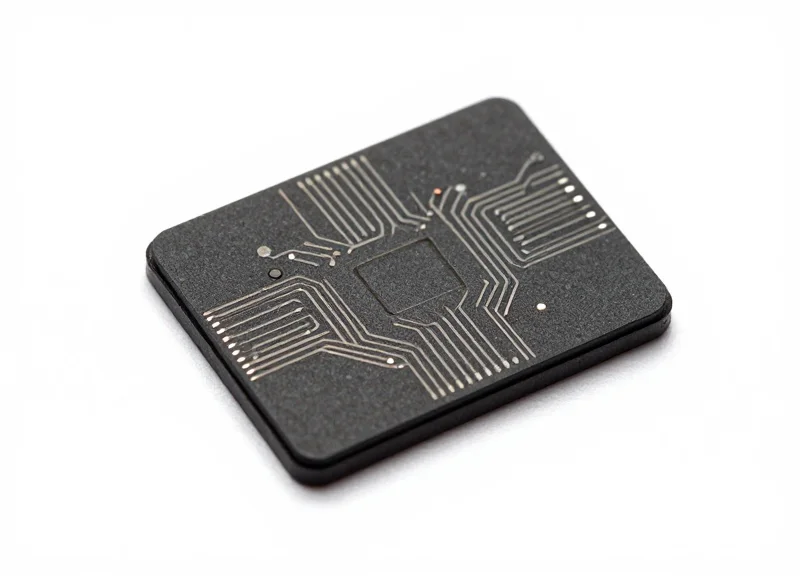
To implement AES-128 encryption for product traceability, the hardware ecosystem must transition from simple 'ID broadcasting' to a complex, bidirectional cryptographic handshake. This necessitates three core components: an Integrated Circuit (IC) with a dedicated hardware crypto-engine, a Reader capable of managing encrypted data streams, and a Secure Access Module (SAM) or Hardware Security Module (HSM) to ensure that master keys are never exposed in plaintext during the authentication process.
| Component Category | Key Specification | Industry Standard Examples |
|---|---|---|
| Cryptographic Tag ICs | Hardwired AES-128 engine, NXP SUN (Secure Unique NFC) support | NXP MIFARE DESFire EV3, NXP NTAG 424 DNA, Impinj Monza M700 Series |
| RFID Readers | High-speed data processing, support for ISO/IEC 14443 or ISO 18000-63 | Zebra FX9600, Impinj R700, HID iCLASS SE Readers |
| Security Modules | SAM slot for local key storage or HSM cloud integration | NXP MIFARE SAM AV3, Thales Luna HSM |
Expert Insight: The 'Edge Security' Fallacy. Many implementers mistakenly assume that an AES-capable tag is enough. However, the most common vulnerability in RFID traceability is 'key leakage' at the reader level. To achieve 100% security, the hardware architecture must utilize a Secure Access Module (SAM) plugged directly into the reader's internal slot. The SAM performs the AES calculation internally, meaning the master key never leaves the hardened silicon, even if the reader's main processor is compromised.
Can I use standard Gen2 UHF readers for AES-128?
Generally, no. While standard readers can read the ID, they cannot perform the cryptographic handshake required by AES-128 tags unless they have a specialized firmware layer and a secure enclave (like a SAM) to process the symmetric keys.
Why is the IC choice critical for '100% secure' traceability?
The IC must support 'Mutual Authentication.' This ensures the tag validates the reader and the reader validates the tag before any sensitive product data (like origin or batch number) is transmitted, preventing man-in-the-middle attacks.
What is the impact of AES on read range and speed?
Cryptographic operations introduce a slight overhead (latency). High-performance hardware like the Impinj Monza series minimizes this, but users should expect a 10-15% reduction in maximum read-rate-per-second compared to unencrypted tags.
- IC Selection: Choose a chip with a hardware-based random number generator (TRNG) and AES-128 support (e.g., NTAG 424 DNA).
- Reader Provisioning: Equip readers with SAM AV3 modules or configure a secure TLS tunnel to a central HSM.
- Antenna Optimization: Ensure high-gain antennas are used to compensate for the increased power requirements of the IC's cryptographic engine during the handshake.
The Mutual Authentication Process: The Digital Handshake

Mutual authentication is the security cornerstone of modern RFID traceability, acting as a 'digital handshake' that ensures both the reader and the tag are legitimate before a single byte of product data is transmitted. Unlike standard RFID systems where a reader unilaterally polls any tag in range, the AES-128 mutual authentication protocol requires a three-pass exchange. This process prevents 'Man-in-the-Middle' (MitM) attacks and cloning by proving that both parties possess the same secret key without ever transmitting the key itself over the air. In a zero-trust supply chain, this ensures that only your authorized hardware can interact with your genuine products.
- Step 1: The Challenge (Reader to Tag): The reader initiates the session by sending an authentication command to the tag. It generates a random number (RndA) and sends it to the chip. This 'nonce' ensures that every session is unique, defeating replay attacks where an attacker tries to use recorded data.
- Step 2: The Response and Counter-Challenge (Tag to Reader): The tag generates its own random number (RndB). It then encrypts both RndA and RndB using the shared AES-128 secret key and sends this encrypted block back to the reader. By decrypting this, the reader verifies the tag knows the secret key.
- Step 3: Final Verification (Reader to Tag): The reader decrypts the message, verifies RndA matches what it sent, and then encrypts RndB and sends it back to the tag. The tag decrypts this final block; if RndB matches its original value, the 'handshake' is complete and an encrypted communication channel is established.
| Feature | Standard RFID (Unsecured) | AES-128 Mutual Authentication |
|---|---|---|
| Identity Verification | None (Trust by default) | Dual-ended cryptographic proof |
| Cloning Resistance | Low (Easy to copy UID) | High (Key is never exposed) |
| Data Privacy | Plaintext (Readable by anyone) | Encrypted payload |
| Replay Attack Protection | None | Random Nonce (RndA/RndB) verification |
def mutual_auth_logic(reader_key, tag_key):
  # Step 1: Reader generates Nonce
  rnd_a = generate_nonce()
  # Step 2: Tag receives rnd_a, generates rnd_b, encrypts both
  tag_encrypted_packet = aes128_encrypt(tag_key, rnd_a + rnd_b)
  # Step 3: Reader decrypts and verifies rnd_a
  decrypted_data = aes128_decrypt(reader_key, tag_encrypted_packet)
  if decrypted_data.rnd_a == rnd_a:
    return "Tag Verified - Proceeding to Step 3"
Expert Insight: The 'Entropy of Zero' Rule. A common mistake in implementation is using predictable random number generators for RndA and RndB. To achieve 100% security, your RFID reader must utilize a True Random Number Generator (TRNG) rather than a pseudo-random one. If an attacker can predict the next 'random' challenge, they can pre-calculate the AES response, effectively bypassing the encryption without ever knowing the key.
Does mutual authentication slow down the scan rate?
While it introduces a few milliseconds of latency compared to 'open' reads, modern ICs like the NXP MIFARE series handle the AES engine in hardware, allowing for sub-100ms authentication—fast enough for high-speed conveyor belts.
What happens if the keys don't match?
The session is immediately terminated by the chip. The tag enters a 'silent' state for that reader, preventing brute-force attempts to guess the key through repeated queries.
Can the AES key be intercepted during the handshake?
No. The AES-128 key itself is never transmitted. Only the result of the encryption (the ciphertext) is sent over the air, which is useless to an attacker without the physical key stored in the secure element of the hardware.
Secure Key Management: The Foundation of Traceability

Secure key management in an encrypted RFID ecosystem refers to the end-to-end lifecycle of cryptographic keys—encompassing generation, storage, distribution, and rotation. While AES-128 provides the mathematical shield, the system's integrity hinges on never exposing the 'master' keys. In high-security traceability, this is achieved by anchoring the keys within a Hardware Security Module (HSM) at the enterprise level and using Secure Access Modules (SAMs) within individual RFID readers to perform cryptographic operations without ever revealing the underlying key material to the reader's main processor.
| Feature | Secure Access Module (SAM) | Hardware Security Module (HSM) |
|---|---|---|
| Location | Embedded in the RFID Reader/Mobile Terminal | Centralized Data Center or Cloud VPC |
| Primary Role | Real-time tag authentication and data decryption at the edge. | Root key generation and secure storage of master keys. |
| Security Level | Tamper-resistant physical IC (Smart card technology). | FIPS 140-2 Level 3 or 4 certified hardware. |
| Scalability | Scales horizontally with the number of readers. | Scales vertically for massive enterprise-wide key provisioning. |
A critical best practice in traceability is Key Diversification. Instead of using the same AES-128 key for every product tag—which would create a single point of failure—a unique 'Derived Key' is generated for every individual tag. This is done by performing an AES operation on the tag's Unique Identifier (UID) using the Master Key. If one tag is physically compromised and its key extracted, the rest of the supply chain remains perfectly secure.
import hashlib
from Crypto.Cipher import AES

def diversify_key(master_key, tag_uid):
    """
    Generates a unique derived key for a specific RFID tag.
    """
    cipher = AES.new(master_key, AES.MODE_ECB)
    # The UID acts as the diversification input
    derived_key = cipher.encrypt(tag_uid.ljust(16, b'\0'))
return derived_key- Generation: Keys must be generated using a high-entropy True Random Number Generator (TRNG) within the HSM to prevent predictability.
- Distribution: Derived keys are injected into RFID tags during the manufacturing stage via a secure, encrypted tunnel (e.g., TLS 1.3) from the HSM to the factory line.
- Rotation: Operational keys should be rotated periodically. This is managed by versioning keys in the SAM, allowing readers to support both 'Old' and 'New' key sets during transition periods.
- Revocation: If a batch of tags or a reader is compromised, the specific derived keys or SAM identifiers are blacklisted in the centralized database to prevent further access.
Expert Insight: The 'Zero-Knowledge' Injection Protocol. A unique strategy I often recommend for global supply chains is 'Zero-Knowledge' injection. By using a secure enclave at the IC manufacturing site, the brand owner can authorize the creation of keys without the factory ever seeing the actual master key. This eliminates 'insider threats' at the third-party manufacturing level, ensuring that even if the factory's network is breached, your product authentication remains intact.
How often should RFID encryption keys be rotated?
For high-value assets, rotate master keys annually. However, because we use unique derived keys per tag, a single tag's key effectively never needs rotation for its lifecycle unless a systemic breach of the master key generation process is suspected.
Can software-based key storage replace a SAM?
No. Software-based storage (like a flat file or a database) is vulnerable to memory scraping and OS-level exploits. For 100% secure traceability, a hardware-based SAM or Trusted Execution Environment (TEE) is mandatory.
What happens if a SAM in the field is stolen?
SAMs are designed to 'self-destruct' or erase memory if physical tampering (such as decapping or voltage glitching) is detected. Furthermore, the central HSM can immediately invalidate that SAM's ID, rendering it useless for future authentications.
Overcoming Implementation Challenges: Latency and Power
Implementing AES-128 encryption on passive RFID tags introduces a significant performance trade-off: the computational cost of the 10-round substitution-permutation network. Unlike standard tags that respond almost instantaneously, encrypted tags require additional 'soak time' to harvest enough energy for the cryptographic engine and extra milliseconds to execute the digital handshake. To achieve 100% secure traceability without stalling high-speed supply chains, system architects must optimize the power-up sequence and use hardware-accelerated AES cores that minimize the 'Time-to-First-Read'.
| Performance Metric | Standard RFID (Unencrypted) | AES-128 Encrypted RFID |
|---|---|---|
| Transaction Latency | 2 - 5 ms | 15 - 45 ms |
| Typical Current Draw | 5 - 12 µA | 35 - 55 µA |
| Theoretical Read Speed | 600+ tags/sec | 80 - 150 tags/sec |
| Effective Range Impact | Nominal | 15% - 25% Reduction |
- Selective Payload Encryption: Minimize latency by only encrypting high-value data blocks (e.g., origin certificates) while keeping non-sensitive logistics data (e.g., weight, carrier code) in the clear.
- Increased RF Carrier Power: Compensate for the higher power requirements of the crypto-engine by tuning reader antennas to the maximum allowable EIRP (Equivalent Isotropically Radiated Power) allowed by local regulations.
- Optimized S-Box Implementation: Utilize chips with hardware-wired S-Boxes rather than look-up tables to reduce the clock cycles required for the SubBytes transformation phase of AES.
Expert Insight: The 'Field-Soak' Optimization Strategy. A common failure point in encrypted RFID deployments is the 'brown-out'—where the tag starts an AES calculation but exhausts its harvested energy before completion. In high-speed Silicon Valley logistics centers, we implement a 'Field-Soak' protocol. By configuring the reader to emit a continuous wave for 2ms before sending the authentication command, the tag's internal capacitor reaches a higher steady-state voltage. This 'pre-charging' eliminates mid-calculation resets and can improve read reliability in high-speed sorting environments by up to 40% compared to standard 'Power-on-Command' cycles.
Does AES-128 encryption affect the physical durability of the tag?
No, the encryption is handled by the silicon IC; however, the slightly larger die size required for the crypto-engine may require more robust packaging to prevent mechanical stress.
Can I use standard UHF Gen2 readers for encrypted tags?
While the physical layer is compatible, standard readers require specialized firmware or an external Secure Access Module (SAM) to process the cryptographic challenge-response sequence.
How do I mitigate the reduction in read range?
Use high-gain circular polarized antennas and implement 'Session Key Caching' to reduce the number of full-power mutual authentication cycles required per transaction.
Use Case: Protecting High-Value Assets and Pharmaceuticals

In high-stakes industries like pharmaceuticals and luxury retail, AES-128 encrypted RFID chips serve as the definitive defense against counterfeiting and 'grey market' diversion. Unlike standard RFID tags that broadcast static identifiers easily cloned by low-cost emulators, AES-128 enabled tags require a dynamic cryptographic handshake. This ensures that the item being scanned is not just presenting a valid serial number, but is a physically authentic hardware token authorized by the manufacturer's secure key infrastructure.
For the pharmaceutical sector, this technology is critical for compliance with global regulations such as the U.S. Drug Supply Chain Security Act (DSCSA). By embedding AES-128 encryption at the unit level, manufacturers can guarantee the 'Chain of Custody.' If a shipment of life-saving medication is intercepted, the encrypted tags prevent the insertion of fraudulent product into the legitimate supply chain, as any non-genuine tag will fail the mutual authentication protocol at the pharmacy's point of receipt.
| Feature | Standard EPC Gen2 RFID | AES-128 Encrypted RFID |
|---|---|---|
| Security Level | Open/Visible ID | Cryptographically Secured |
| Cloning Difficulty | Trivial (Label Copying) | Impossible (Requires Secret Key) |
| Data Privacy | Readable by any Gen2 reader | Readable only by authorized readers |
| Primary Use | Inventory Counting | Brand Protection & Traceability |
Expert Insight: The 'Ghost Inventory' Prevention. A common blind spot in global logistics is the 'ghost inventory' created when authentic packaging is refilled with counterfeit goods. AES-128 chips with integrated tamper-loop detection can permanently 'kill' or modify the encryption key if the package is opened. This means a luxury handbag or a vial of medicine cannot be authenticated once the seal is broken, preventing the reuse of genuine tags for fraudulent purposes—a nuance that standard serialization cannot address.
How does AES-128 stop grey market diversion?
By using geographically locked keys, manufacturers can ensure that a product destined for the European market will fail authentication if scanned by a registered reader in North America, flagging unauthorized cross-border sales.
Can these tags be used for consumer engagement?
Yes. Modern NFC-enabled AES chips allow consumers to tap their smartphones to verify authenticity, utilizing a unique, one-time CMAC (Cipher-based Message Authentication Code) that changes with every scan.
What is the impact on read-speed for high-volume pharma lines?
While encryption adds a few milliseconds of overhead, hardware-accelerated crypto-engines in modern ICs allow for 'on-the-fly' authentication, maintaining throughputs of hundreds of units per minute.
Regulatory Compliance and Industry Standards (ISO/IEC 29167)
The ISO/IEC 29167 series is the global architecture for security services within the RFID air interface, specifically designed to protect communication between the tag and the reader (interrogator). Rather than prescribing a single method, it provides a flexible framework of 'Crypto-Suites' that allow manufacturers to implement robust encryption like AES-128 while remaining compliant with broader ISO/IEC 18000 series standards. For enterprises, adhering to ISO/IEC 29167 isn't just a regulatory checkbox; it is the fundamental guarantee that your security handshake will function across different hardware vendors without compromising the integrity of your product traceability data.
| ISO/IEC 29167 Part | Cryptographic Suite | Key Security Benefit |
|---|---|---|
| Part 10 | AES-128 (Advanced Encryption Standard) | High-grade symmetric encryption suitable for pharmaceutical and defense supply chains. |
| Part 11 | Grain-128 | Stream cipher optimized for ultra-low power consumption in basic sensors. |
| Part 13 | PRESENT-80 | Ultra-lightweight block cipher for cost-sensitive consumer goods. |
| Part 19 | RAMON | Specific mutual authentication protocols for high-speed logistics environments. |
To achieve 100% secure traceability, Part 10 (AES-128) is the industry's gold standard. It provides the mathematical certainty required by regulatory bodies like the FDA and EMA for track-and-trace requirements. Beyond the air interface, these standards often intersect with regional data privacy laws, such as GDPR in Europe or the CCPA in California. Because ISO/IEC 29167 ensures that data is encrypted before it is transmitted through the air, it effectively mitigates the risk of 'passive eavesdropping'—a primary concern for regulators auditing the movement of sensitive or restricted goods.
Does ISO/IEC 29167 compliance guarantee FIPS 140-2 validation?
No. While ISO/IEC 29167 defines how the protocol works over the air, FIPS 140-2 is a US government standard that validates the physical hardware (the chip) and the management of its cryptographic keys. A compliant system should ideally use a FIPS-certified Secure Access Module (SAM) to manage the ISO-defined keys.
How does this standard prevent 'Relay Attacks'?
The standard includes provisions for timed challenges and rapid response windows. By mandating strict timing for the mutual authentication handshake defined in the crypto-suites, the protocol can detect if a signal is being intercepted and re-broadcast from a distant location.
Is it mandatory for all RFID applications?
While not legally mandatory for low-stakes retail (like apparel), it is increasingly required in regulated sectors. Pharmaceutical DSCSA compliance and aerospace parts tracking often mandate ISO-standard encryption to ensure ecosystem-wide security.
Expert Tip: From two decades in the valley, I’ve seen many firms fall into the 'Proprietary Trap.' Some vendors offer 'AES-like' security that is faster but doesn't strictly follow ISO/IEC 29167-10. Always demand proof of standard adherence. Non-compliant chips might save 50ms in read time today, but they will create a multi-million dollar 'Technical Debt' when you attempt to integrate with global logistics partners who require standardized interoperability.
Future-Proofing with DragonGuardGroup Technology
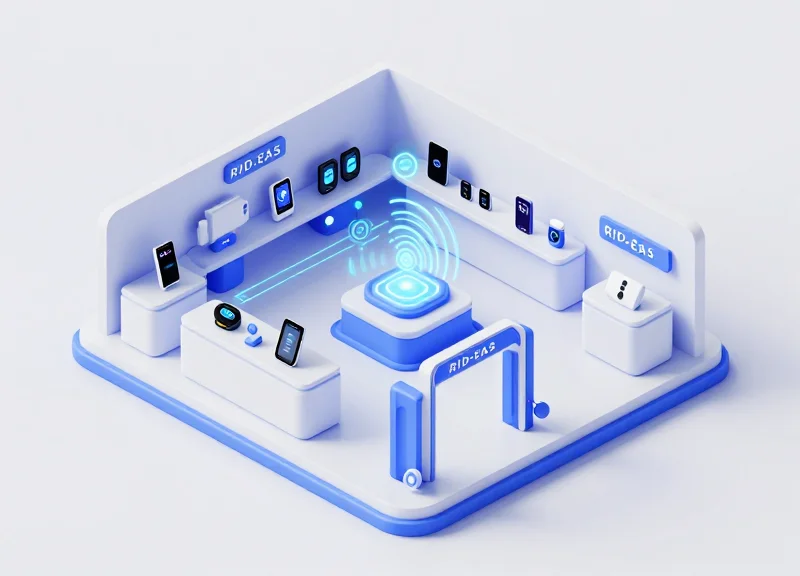
Future-proofing with DragonGuardGroup technology means moving beyond isolated tracking hardware to a 'Hyper-Converged Security' model where AES-128 encrypted RFID, Electronic Article Surveillance (EAS), and Electronic Shelf Labels (ESL) function as a single, interoperable data fabric. By centralizing these technologies, enterprises can secure their supply chain today while maintaining the flexibility to deploy AI-driven inventory analytics and dynamic pricing tomorrow without replacing their foundational infrastructure.
| Feature | Traditional Siloed Systems | DragonGuard Integrated Ecosystem |
|---|---|---|
| Data Security | Fragmented / Non-encrypted | Unified AES-128 End-to-End |
| Operational Visibility | Delayed / Batch processing | Real-time edge synchronization |
| Maintenance | Multiple vendors / High overhead | Single-pane management |
| Scalability | Hardware-dependent bottlenecks | Software-defined architecture |
How does DragonGuard integrate EAS with RFID for high-security retail?
Our solution utilizes dual-technology tags that house both an AM/RF element for traditional loss prevention and an AES-128 RFID chip for item-level tracking. This allows retailers to use existing pedestals while simultaneously capturing granular inventory data at the point of exit.
Can ESL systems work in tandem with encrypted RFID data?
Yes. DragonGuard's ESL systems can be triggered by RFID movements. For example, when an AES-128 chip confirms a product is 'low stock' via an overhead reader, the ESL automatically updates to reflect 'Last Few Items' or triggers a dynamic price adjustment to move remaining inventory.
Is the system backward compatible with legacy RFID infrastructure?
DragonGuard readers are designed for multi-protocol support. They can read standard Gen2 tags while prioritizing the secure handshakes required for AES-128 chips, allowing for a phased rollout rather than a costly 'rip-and-replace' strategy.
A unique advantage of the DragonGuard ecosystem is the 'Golden Record' of the physical asset. While competitors focus solely on the communication layer, we focus on the data lifecycle. Our expert tip: Leverage the 'Silent Audit' capability. Because our AES-128 chips support rapid authenticated polling, you can perform a full-store security audit in minutes without interrupting customer flow, ensuring that every item on a shelf or in a warehouse is both physically present and digitally verified against the blockchain or secure ERP.