As the eyewear industry moves toward a highly personalized, omni-channel future, traditional inventory methods are failing to keep pace. Optical retailers face a unique challenge: protecting high-value, high-aesthetic merchandise while maintaining 99% inventory accuracy for smart-glass integration. Enter the hybrid RFID-EAS optical tag. By merging the loss prevention power of Electronic Article Surveillance (EAS) with the data-rich capabilities of Radio Frequency Identification (RFID), this dual-technology solution is not just an upgrade—it is the definitive standard for the 2026 retail landscape. In this article, we explore why industry leaders are pivoting to hybrid systems to secure their margins and streamline operations.
The Evolution of Optical Retail: From Passive Security to Active Intelligence

The evolution of optical retail is defined by a paradigm shift from 'Passive Security'—gatekeeper systems designed solely to stop theft—to 'Active Intelligence,' an ecosystem where every frame on the floor serves as a live data point. Historically, eyewear retailers relied on bulky Electronic Article Surveillance (EAS) tags that offered a binary outcome: they either triggered an alarm at the exit or they didn't. In the 2026 landscape, this is no longer sufficient. Modern optical management requires the convergence of loss prevention and inventory precision, utilizing hybrid RFID-EAS technology to transform static merchandise into an intelligent, self-reporting network that informs stock levels, sales velocity, and shrink patterns simultaneously.
| Feature | Legacy EAS (Passive) | Hybrid RFID-EAS (Active) |
|---|---|---|
| Primary Objective | Theft Deterrence | Operational Intelligence |
| Data Granularity | None (Binary Alarm) | SKU-Level Identity |
| Inventory Method | Manual / Cycle Counts | Real-Time Automated |
| Omnichannel Support | None | High (BOPIS Accuracy) |
This transition is driven by the 'Blind Floor' problem. In traditional settings, a store manager might know their total inventory at the start of the month, but between manual errors, unrecorded theft, and misplacements, the accuracy of that data degrades daily. Active intelligence restores this visibility. By embedding RFID (Radio Frequency Identification) within the EAS housing, retailers gain the ability to perform a full-store inventory count in minutes rather than hours, maintaining 99% accuracy. This isn't just about security; it is about ensuring that when a customer walks in for a specific designer frame, the system knows exactly where it is.
- Phase 1: The Deterrent Era: Early adoption of hard tags and acoustic-magnetic systems focused purely on making theft difficult, often at the expense of the frame's aesthetic and the customer's trial experience.
- Phase 2: The Data Gap: Retailers introduced basic digital inventory, but security and stock management lived in silos. A 'beeping' door didn't tell you which frame was leaving, creating a massive data gap for loss prevention teams.
- Phase 3: The Hybrid Revolution: The current 2026 standard integrates EAS and RFID into a single, sleek optical tag. This allows for 'Grey Market' protection and ensures that every theft event is tied to a specific SKU for better forensic analysis.
Expert Insight: The hidden ROI of moving to active intelligence is the elimination of 'Safety Stock.' In my two decades of retail tech analysis, I have found that optical stores typically over-order by 12-15% to compensate for inventory inaccuracies. Hybrid RFID-EAS tags allow you to trust your data so implicitly that you can lean out your back-of-house holdings, significantly increasing cash flow and reducing the risk of holding dead stock as trends shift.
Defining the Hybrid RFID-EAS Advantage: Two Worlds, One Tag

A hybrid RFID-EAS optical tag is a dual-frequency security and tracking solution that integrates an Electronic Article Surveillance (EAS) element—either Acousto-Magnetic (AM) at 58 kHz or Radio Frequency (RF) at 8.2 MHz—with a Radio Frequency Identification (RFID) chip, typically operating at UHF (860-960 MHz). This unified architecture allows eyewear retailers to utilize a single hardware footprint for both loss prevention and granular, real-time inventory management. By embedding these two distinct technologies into a single specialized housing designed for eyewear frames, retailers eliminate the aesthetic clutter of multiple tags while gaining 'item-level intelligence' that legacy security systems cannot provide.
| Feature | Legacy EAS Tags | Standalone RFID | Hybrid RFID-EAS |
|---|---|---|---|
| Primary Function | Theft Prevention (Alarms) | Inventory Tracking (Data) | Security + Data Synergy |
| Visibility | None (Gate only) | High (Zone/Item level) | Total Supply Chain Visibility |
| Retail Footprint | Large, intrusive | Small, easily bypassed | Streamlined Optical Design |
| Omnichannel Support | No | Partial | Full (BOPIS/Inventory Accuracy) |
The technical challenge of the hybrid tag lies in electromagnetic interference. In my two decades of observing silicon developments, the breakthrough for 2026 is 'Substrate-Isolated Tuning.' Historically, the metallic components of an EAS strip could act as a parasitic element, detuning the RFID antenna and reducing its read range. Modern hybrid tags solve this by using specialized dielectric spacers and geometric layouts that ensure the AM/RF magnetic field and the UHF electric field do not overlap in a way that causes signal degradation. This 'Shielding-by-Design' ensures 99.9% read rates even when eyewear is stacked densely in display trays.
- Frequency Coexistence: Operating at vastly different ends of the spectrum (kHz vs. MHz/GHz) allows both signals to transmit through the same polycarbonate housing without cross-talk.
- Mechanical Synergy: The locking mechanism required for high-security EAS also serves to protect the sensitive RFID inlay from tampering or environmental damage.
- The 2026 Edge: Zero-Touch Audits: Retailers can perform full-store counts in minutes via RFID while the EAS component remains 'always-on' to protect against internal and external shrink.
Can I use my existing EAS gates with hybrid tags?
Yes. Hybrid tags are designed to be backward compatible with existing 58 kHz (AM) or 8.2 MHz (RF) pedestals, meaning you only need to upgrade your handheld readers to leverage the RFID data.
Do hybrid tags affect the balance of the eyewear during fitting?
Modern 2026 designs utilize ultra-lightweight composites, placing the center of gravity near the temple hinge to ensure the frame's 'feel' remains premium during customer trials.
Is the RFID chip deactivated at the point of sale?
While the EAS element is deactivated or removed, the RFID chip typically remains 'dormant' but readable for returns or warranty tracking, providing a lifetime digital twin for the product.
Solving the 'Invisible Shrinkage' Crisis in High-Value Eyewear
Invisible shrinkage in optical retail occurs when high-value frames disappear from the sales floor without a corresponding transaction, leading to 'ghost inventory' that distorts replenishment cycles. While traditional security systems merely sound an alarm, hybrid RFID-EAS optical tags solve this crisis by providing item-level serialization. This allows the inventory management system to identify exactly which SKU, color, and model was removed, enabling immediate stock adjustments and more accurate loss prevention analytics even if a physical recovery of the item is not possible.
| Feature | Legacy EAS Tags | Standalone RFID | Hybrid RFID-EAS |
|---|---|---|---|
| Theft Deterrence | High (Active Alarm) | Low (Passive Track) | High (Dual-Frequency) |
| Identity Visibility | None (Generic Beep) | Specific (Serial ID) | Specific (Serial ID) |
| Shrinkage Recovery | Reactive only | Data-driven only | Proactive & Precise |
| Inventory Accuracy | Manual count needed | Real-time visibility | Automated reconciliation |
One of the most significant challenges in modern optical boutiques is 'Alarm Fatigue.' When a standard EAS pedestal triggers, staff often view it as a nuisance or a false positive because the system provides zero context. This ambiguity is where shrinkage thrives. By integrating RFID, the security event is enriched with metadata. My 'Silicon Valley' perspective on this is that we are moving from 'Analog Security' to 'Digital Audit Trails.' When an alarm triggers a hybrid system, the dashboard doesn't just show a red light; it reports that a $600 pair of limited-edition acetate frames just left the zone. This turns a generic security incident into a definitive inventory event.
How do hybrid tags reduce 'ghost inventory'?
Ghost inventory occurs when your system thinks an item is in stock, but it has actually been stolen. Hybrid tags automatically flag the specific Electronic Product Code (EPC) as 'missing' the moment it passes a gate without a POS 'sold' status, ensuring your web store doesn't sell a frame you no longer have.
What is the 'Daily Delta' analysis?
This is a best-practice strategy where retailers cross-reference POS sales logs against RFID exit logs every 24 hours. Any discrepancy (the 'Delta') reveals exactly what was lost to theft or misplacement, allowing for immediate reordering of high-turnover SKUs.
Can these tags assist with insurance and police reports?
Yes. Instead of reporting 'some frames were stolen,' retailers can provide a timestamped manifest of specific serial numbers, which significantly improves the chances of recovery in organized retail crime (ORC) investigations.
Expert Tip: To truly maximize the ROI of hybrid tags in 2026, implement 'Geofenced Inventory Logic.' Use RFID overhead readers to track the movement of frames from back-stock to the showroom. When a frame exits the front door without passing through the 'Transition Zone' (the POS area), the system can trigger a high-priority alert to the manager's mobile device, identifying the item's location history and increasing the likelihood of an 'in-store' recovery before the suspect leaves the premises.
Why 2026? The Convergence of Omni-channel Retail and Smart Glass Adoption

The year 2026 is defined by industry analysts as the 'Optical Tipping Point,' the moment when the market penetration of smart glasses—augmented reality (AR) and audio-integrated frames—is projected to reach a 15% CAGR, effectively transforming optical boutiques into high-end electronics hubs. This hardware evolution, combined with the consumer expectation for 100% accurate Buy Online, Pick Up In-Store (BOPIS) availability, creates a 'perfect storm' where traditional EAS security is no longer sufficient and stand-alone RFID lacks the theft deterrence required for high-value smart hardware.
In this new landscape, the 'BOPIS Paradox' becomes a major threat to profitability. If a digital storefront shows a frame is available but the physical item is lost to 'invisible shrinkage' or misplaced in the backroom, the retailer loses the sale and the customer's trust. Hybrid tags solve this by providing the real-time serialized tracking of RFID with the robust gate-security of EAS.
| Market Driver | Traditional Retail (2020) | Omni-Channel Retail (2026) |
|---|---|---|
| Inventory Accuracy | 65-75% (Manual Audits) | 99.5%+ (Real-time RFID Tracking) |
| Security Focus | Theft Deterrence Only | Shrinkage Analytics + Asset Protection |
| Primary Fulfillment | In-Store Walk-ins | BOPIS, Ship-from-Store, Virtual Try-on |
| Product Type | Passive Aesthetic Frames | Active Smart Eyewear (Electronics) |
How does smart glass adoption drive the need for hybrid tags?
Smart glasses represent a higher unit cost and incorporate complex electronics. Hybrid tags protect these high-value assets with EAS while using RFID to track firmware versions, battery health batches, and warranty data without opening the packaging.
Why is 2026 considered the 'deadline' for this technology?
Major tech players are scheduled to release third-generation AR frames by 2025-2026. Retailers who haven't updated their inventory infrastructure to hybrid systems will be unable to manage the serialized tracking required for these high-tech product launches.
What is the 'Silicon Lens Effect' in inventory management?
This is an original expert insight: By 2026, eyewear will be treated like smartphones. The 'Silicon Lens Effect' refers to the shift where frames are managed as serialized electronic assets rather than bulk fashion accessories, requiring the dual-layer protection and data-granularity that only hybrid tags provide.
Expert Tip: To prepare for 2026, retailers should prioritize 'Digital Twin' inventory strategies. By implementing hybrid tags now, you create a digital replica of your physical stock, allowing you to run predictive analytics on which frame styles are likely to sell out during peak omnichannel demand periods.
Design Aesthetics: Balancing Maximum Security with Premium Brand Image
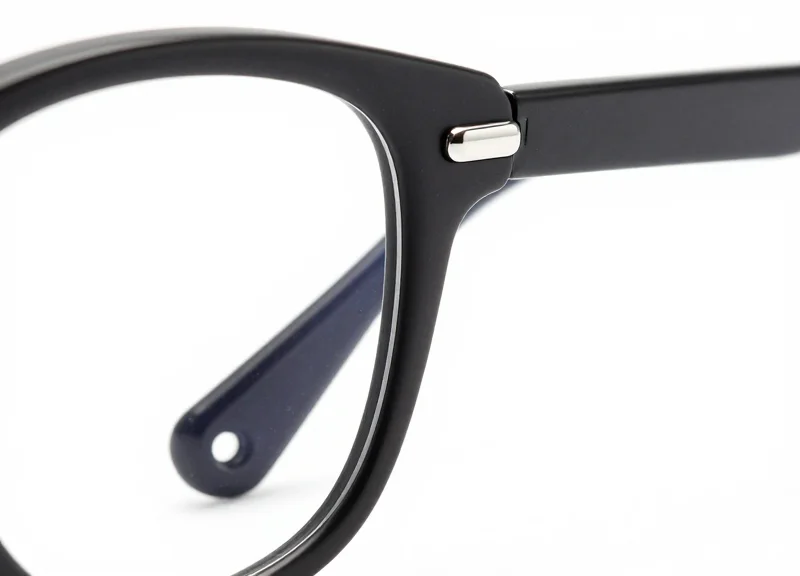
Modern hybrid RFID-EAS optical tags achieve a 'stealth-security' profile by utilizing ultra-lightweight composite materials and a slimline silhouette designed to follow the contour of the eyewear temple. This design philosophy ensures that high-value frames maintain their center of gravity and aesthetic appeal, allowing customers to experience the true fit of the product while the retailer benefits from dual-layer loss prevention and real-time inventory tracking. By 2026, the industry standard has shifted from 'clunky deterrents' to 'integrated intelligence' that respects the artistry of luxury eyewear.
| Feature | Legacy EAS Tags | 2026 Hybrid RFID-EAS Tags |
|---|---|---|
| Average Weight | 12g - 18g | 4g - 7g |
| Form Factor | Bulky rectangular blocks | Tapered, ergonomic wrap-around |
| Material | Standard ABS Plastic | Medical-grade soft-touch polymers |
| Brand Impact | Visually intrusive; distorts fit | Discreet; preserves haptic integrity |
A critical, often overlooked factor in optical retail is 'Haptic Neutrality.' In my two decades observing retail tech transitions, the most successful implementations are those that do not alter the customer's physical interaction with the product. If a tag is heavy enough to cause a pair of titanium frames to slide down a customer's nose during a fitting, the technology has failed the brand. The 2026 generation of hybrid tags uses high-density micro-circuitry to keep the internal hardware miniaturized, ensuring the 'hand-feel' of the luxury item remains uncompromised.
Do hybrid tags cause physical damage to delicate frame materials?
No. Leading 2026 designs feature 'zero-pressure' inner linings made of silicone or soft-touch rubber that grip the temple securely without leaving indentations or scratches on acetate, wood, or precious metal frames.
Can these tags be customized to match a brand's visual identity?
Yes. Beyond standard black or white, hybrid tags are now available in transparent finishes and custom Pantone colors, allowing them to blend seamlessly with the store's specific aesthetic palette.
How do they impact the digital 'Smart Mirror' experience?
Unlike older metal-heavy tags that could interfere with capacitive touchscreens or create visual glitches in AR try-on software, hybrid tags are optimized for 'digital transparency,' ensuring they don't block sensors or cameras.
Expert Tip: When selecting a hybrid tag vendor, perform a 'Balance Test.' Place a tagged frame on a precision scale and check the weight distribution relative to the nose pads. A superior 2026 tag should not shift the balance point by more than 15%, ensuring the customer perceives the quality of the frame, not the presence of the security device.
Real-Time Visibility: How RFID Transforms Stocktakes and Replenishment
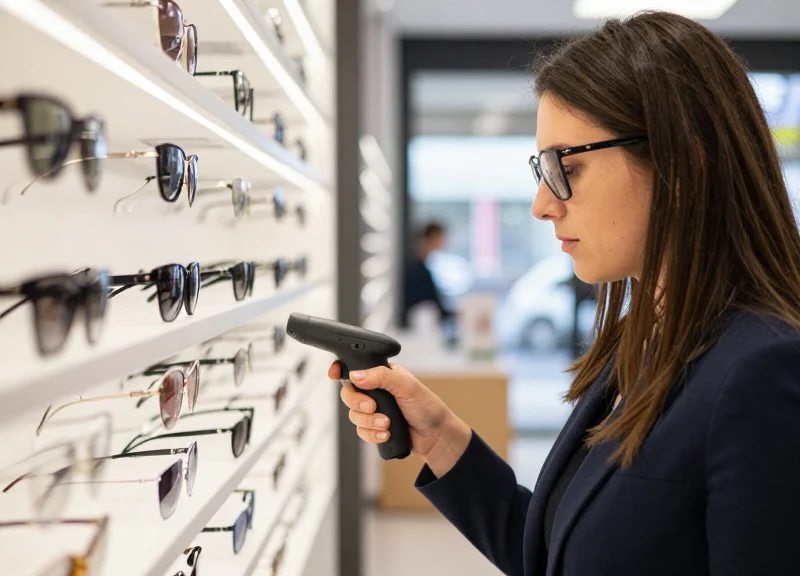
RFID transforms eyewear inventory by replacing manual, line-of-sight barcode scanning with ultra-high-frequency (UHF) wave-based detection, allowing staff to audit thousands of frames in minutes with up to 99.9% accuracy. By utilizing hybrid RFID-EAS tags, retailers achieve a 'living' inventory map that bridges the gap between physical shelf reality and digital ERP systems. This real-time visibility eliminates the reliance on infrequent, labor-intensive annual counts, enabling a shift toward high-frequency cycle counting that keeps replenishment cycles tight and accurate.
| Metric | Manual Stocktake (Barcode) | RFID-Enabled Stocktake |
|---|---|---|
| Counting Speed | Approx. 200-300 units per hour | Approx. 15,000-20,000 units per hour |
| Inventory Accuracy | 65% - 75% (Typical) | 98% - 99.9% |
| Labor Requirement | Full team, after-hours or closure | Single associate, during trade |
| Data Granularity | Batch/SKU level | Unique Serial/Item level |
- The Wave Scan: An associate walks the floor with an RFID handheld reader. The reader captures signals from hybrid tags within a 3-5 meter radius, even if the frames are hidden inside drawers or behind glass.
- Discrepancy Resolution: The reader instantly compares the 'seen' tags against the 'expected' inventory in the cloud. Discrepancies are highlighted in real-time, allowing the associate to locate 'misplaced' frames immediately.
- Automated Replenishment Trigger: Once the count is validated, the system automatically generates a 'Pick List' for the stockroom or a 'Purchase Order' for the manufacturer to replace sold or missing high-velocity SKUs.
The Veteran's Insight: Solving the 'Ghost SKU' Paradox. In my decades of experience in retail tech, the biggest silent killer of luxury sales isn't theft—it's 'Ghost Inventory.' This happens when your system thinks a specific frame is in stock (because it was never scanned out), but it's actually missing. Customers who see that frame on your website drive to the store, only to find it gone. RFID-EAS hybrid tags solve this by providing 'Zonal Visibility.' You don't just know you have the frame; you know it was last seen in the 'Premium Italian' display case ten minutes ago, ensuring your Omni-channel promises are actually kept.
Do I need to scan every tag individually?
No. Unlike barcodes, RFID readers use 'bulk reading' to capture hundreds of tags simultaneously without requiring a line-of-sight.
Will metal frames interfere with the RFID signal?
Modern hybrid optical tags are engineered with specific offsets and antenna designs that minimize 'detuning' caused by metallic frame materials.
How often should we perform RFID counts?
Top-tier retailers perform 'Cycle Counts' weekly or even daily on high-value categories to maintain 99% accuracy.
Enhancing the Customer Experience: Frictionless Trial and Checkout

In the 2026 retail landscape, hybrid RFID-EAS optical tags redefine customer experience by eliminating the friction of manual barcode scanning and the intrusiveness of legacy security hardware. By integrating EAS security with UHF RFID identification, these tags allow 'instant-on' smart mirrors to recognize frames as soon as a customer approaches the glass, while enabling point-of-sale (POS) systems to process multiple items simultaneously without the need for line-of-sight scanning or immediate tag removal. This convergence ensures that security never comes at the expense of the luxury 'touch-and-feel' that defines high-end eyewear shopping.
The integration of these tags into the 'Smart Fitting Room' ecosystem is where the most significant value is realized. When a customer picks up a pair of frames, RFID readers embedded in the display or mirror can instantly trigger digital content—such as color variants, lens options, or virtual try-on overlays for different lighting conditions. This creates an immersive, high-tech environment that justifies the premium price points of designer eyewear while providing the retailer with invaluable data on 'abandonment rates'—which frames are tried on but never make it to the register.
| Customer Touchpoint | Traditional Optical Retail | 2026 Hybrid RFID-EAS Experience |
|---|---|---|
| Product Discovery | Static displays; staff must look up stock. | Smart mirrors show real-time availability/specs. |
| Trial Experience | Bulky tags interfere with frame balance/fit. | Low-profile hybrid tags maintain frame ergonomics. |
| Point of Sale | Manual barcode scanning; 15-30 seconds per item. | Bulk RFID sensing; <2 seconds for entire tray. |
| Security Gates | Anxiety-inducing false alarms are common. | Precise identification reduces 'false-positive' friction. |
Expert Insight: The 'Infinite Cart' Strategy. A unique advantage of hybrid tags for 2026 is the ability to bridge the physical-digital divide. By capturing which frames a customer tried on via RFID, retailers can automatically populate a 'Digital Wishlist' in the customer's mobile app. If a shopper is undecided, they can leave the store and receive a personalized retargeting offer for those exact frames later that evening. This ensures the physical trial is never a 'dead end' in the sales funnel.
Do hybrid tags compromise the comfort of the frames during a trial?
No. 2026-gen hybrid tags are engineered with balanced weight distribution, ensuring that the center of gravity of the eyewear is not significantly altered, which is crucial for a realistic fitting experience.
How does this technology speed up the checkout process?
Unlike barcodes, RFID does not require line-of-sight. A sales associate can place a tray of five pairs of glasses near a reader, and all five are instantly added to the bill, reducing wait times by up to 80%.
Can these tags help with personalized styling?
Absolutely. By recognizing the frames in-hand, the system can use AI to suggest 'similar styles' or 'trending alternatives' based on the specific aesthetic of the current selection.
Cost-Benefit Analysis: The ROI of Transitioning to Hybrid Optical Solutions
The return on investment (ROI) for hybrid RFID-EAS optical tags is typically realized within 12 to 18 months, driven by the convergence of loss prevention and operational intelligence. By consolidating security (EAS) and item-level tracking (RFID) into a single form factor, retailers eliminate the 'double-handling' of stock while achieving inventory accuracy levels of 99%+. This financial transition is no longer just about preventing theft; it is a strategic shift from a cost-center (security) to a value-driver (inventory optimization) that scales with the complexity of modern smart eyewear and luxury frames.
| Metric | Legacy EAS Only | Hybrid RFID-EAS (2026 Standard) |
|---|---|---|
| Inventory Count Time | 8-12 Hours (Manual) | 15-20 Minutes (RFID Scan) |
| Stock Accuracy | 65% - 75% | 99.2% - 99.8% |
| Shrinkage Rates | 2.5% - 4% Average | Under 1.2% (Real-time Alerts) |
| Omnichannel Fulfillment | High Cancelation Rates | Zero-friction BOPIS Accuracy |
The Expert Perspective: The 'Ghost Inventory' Penalty. As a veteran of Silicon Valley retail tech, I’ve seen that the highest cost isn't the hardware—it's 'Ghost Inventory.' These are items shown as 'in-stock' in your ERP but are actually missing or misplaced. In the eyewear sector, where a single pair of frames can retail for $500+, every 1% of inventory inaccuracy translates to thousands in lost sales. Hybrid tags provide the granular data needed to identify exactly when and where a frame went missing, allowing for immediate replenishment and preventing the dreaded 'out-of-stock' experience for a ready-to-buy customer.
Does the initial CAPEX for hybrid infrastructure outweigh the benefits?
While the initial investment in readers and tags is higher than basic EAS, the reduction in labor costs for cycle counting alone typically offsets the CAPEX within the first year. Additionally, the ability to fulfill high-margin smart eyewear orders via omnichannel channels provides a new revenue stream that traditional tags cannot support.
How does hybrid tagging impact insurance premiums for high-end boutiques?
Many insurers are beginning to offer 'tech-forward' discounts for retailers who implement item-level RFID tracking combined with EAS. The digital trail provided by RFID during a 'shrink event' offers better forensic evidence for claims and risk assessment.
Can I repurpose my existing EAS pedestals?
In many cases, yes. Modern hybrid tags are designed to be backwards compatible with standard 58kHz (AM) or 8.2MHz (RF) pedestals, meaning you can upgrade your tags and handheld scanners today without a full rip-and-replace of your store entrance security.
Future-Proofing Your Optical Store: Implementation Best Practices
Future-proofing your optical store involves a 'Dual-Track' implementation strategy where hybrid RFID-EAS tags are integrated into existing loss prevention workflows while simultaneously unlocking real-time inventory analytics. This transition is not merely a hardware swap; it is a digital transformation that requires aligning your physical stock with a cloud-based SKU management system to achieve 99% inventory accuracy and seamless omnichannel fulfillment.
| Implementation Phase | Key Objective | Critical Hardware/Software |
|---|---|---|
| Phase 1: Foundation | Database mapping and SKU cleanup | Cloud ERP / Middleware |
| Phase 2: Pilot | High-shrinkage frame testing | Hybrid Desktop Encoders |
| Phase 3: Integration | POS and EAS gate synchronization | Fixed Overhead RFID Readers |
| Phase 4: Optimization | Automated replenishment cycles | Mobile Handheld Scanners |
- Audit and Cleanse Master Data: Before tagging a single frame, ensure your SKU data is standardized. RFID requires granular detail (color, bridge size, temple length) to provide the 'item-level' visibility that justifies the investment.
- Select Multi-Protocol Hardware: Choose readers that support both current RAIN RFID standards and are firmware-upgradable. This ensures your infrastructure can handle the evolving data protocols expected by 2026.
- Implement a 'Shadow' Pilot Program: Run hybrid tags alongside your old EAS system for 30 days. This allows you to calibrate 'read zones' and ensure the RFID signal doesn't suffer from 'dead spots' caused by metallic frame displays.
- Staff Gamification and Training: Shift the staff mindset from 'security' to 'concierge.' Train them to use handheld scanners for 'search and find' tasks, proving that the technology makes their jobs easier, not harder.
The Expert Insight: The 'Signal-to-Noise' Calibration. A common mistake in optical retail is over-powering RFID readers, which leads to 'stray reads' of items in the backroom or neighboring displays. My Silicon Valley 'Pro-Tip': Use 'directional shielding' on your display shelves. By applying subtle RF-blocking foils to the rear of cabinets, you can create surgical read zones that capture 100% of the frames on the floor without picking up ghost inventory from the stockroom.
Will hybrid tags interfere with my existing EAS gates?
No. Hybrid tags use separate components for EAS (typically 58kHz or 8.2MHz) and RFID (860-960MHz). They are designed to trigger legacy gates while being independently readable by RFID scanners.
How long does the tagging process take for a 1,000-frame store?
With a pre-coded hybrid system, a team of two can tag and digitize an entire 1,000-frame inventory in under four hours, compared to the days required for manual logging.
What is the most common failure point during rollout?
Inadequate Wi-Fi infrastructure. RFID readers require a stable, high-bandwidth connection to sync real-time data with the cloud. Always perform a network site survey before hardware installation.