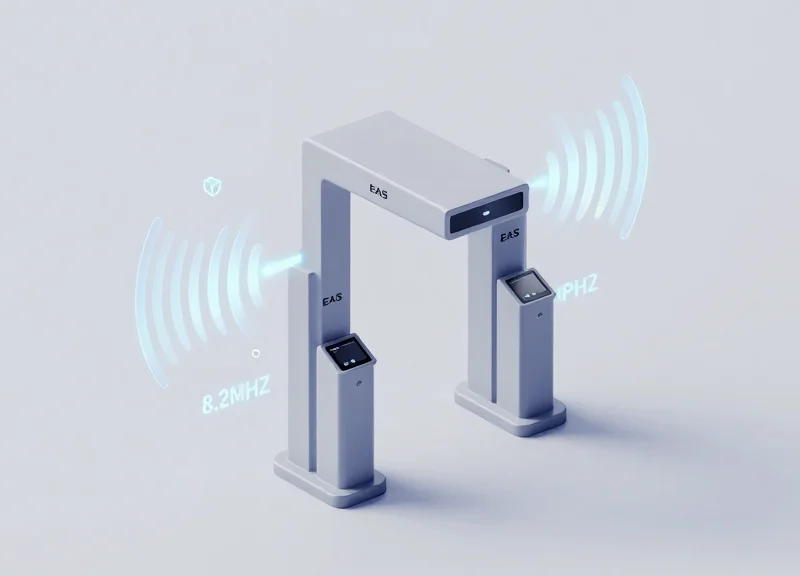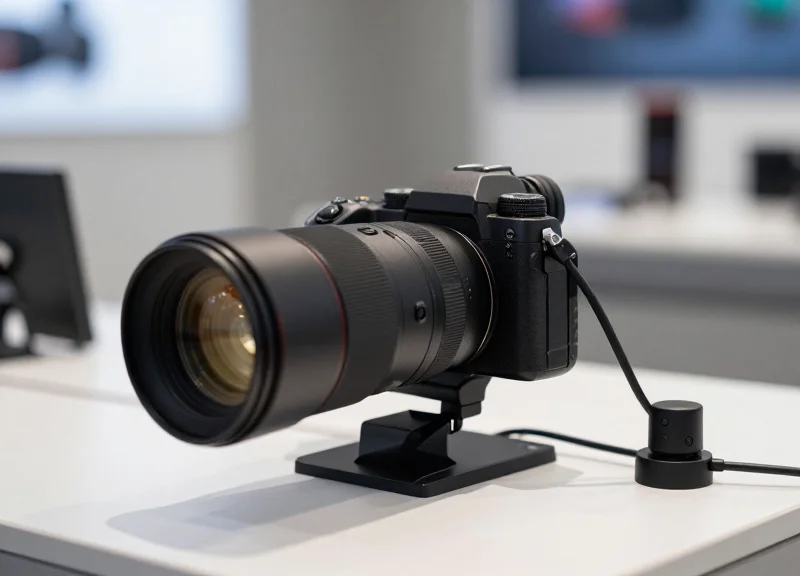
In the high-stakes environment of consumer electronics retail, the 'open display' strategy is a double-edged sword. While it allows customers to engage with premium cameras and lenses, it simultaneously increases vulnerability to high-value theft. Traditional security often fails to protect the symbiotic relationship between a camera body and its detachable lens. However, the emergence of multi-point alarm sensor cables with interlocking technology has revolutionized this space. By securing both components through a single, synchronized system, retailers are achieving a staggering 45% reduction in shrinkage. This article provides a comprehensive ROI analysis and technical breakdown of why this specific security investment is becoming the gold standard for photography retailers.
The High Cost of Open Display in Camera Retail

In the modern camera retail environment, open displays are a non-negotiable sales driver; however, the 'High Cost of Open Display' refers to the cumulative financial burden of product shrinkage, increased insurance premiums, and lost sales opportunities that occur when high-value gear is accessible to the public. While tactile engagement can boost conversion rates by up to 30%, the lack of specialized protection for interlocking components—specifically where the camera body meets the lens—creates a unique vulnerability. For a premium mirrorless setup, a single theft incident doesn't just lose the unit cost; it wipes out the net profit of the next 15 to 20 successful sales.
| Loss Category | Direct Impact | Indirect Operational Cost |
|---|---|---|
| Product Shrinkage | MSRP of Body + Lens | Re-stocking and procurement logistics |
| Damaged Inventory | Repair costs or 'Open Box' discounts | Reduced floor space productivity |
| Insurance & Security | Premium hikes after claims | Investment in reactive, non-ROI security |
| Opportunity Cost | Lost gross margin from OOS items | Sales staff distraction during incident response |
The 'Veteran Insight' on camera retail shrinkage: Most retailers underestimate the 'Professional Decoupling' trend. Thieves no longer just take the whole tripod-mounted unit; they utilize the lens release button—a standard feature designed for convenience—to separate $2,000 lenses from secured bodies in under three seconds. This specific 'Interlocking Risk' is why traditional single-point alarms are failing. When you lose a 70-200mm f/2.8 lens but the camera body remains on the stand, your alarm system might not even trigger, leading to 'silent shrinkage' that isn't discovered until a manual inventory count.
Why can't retailers just keep cameras behind glass?
The 'Experience Economy' dictates that customers must feel the weight, ergonomics, and autofocus speed of a camera before committing to a multi-thousand dollar purchase. Locked cabinets are proven 'conversion killers' in the enthusiast and professional segments.
How much does shrinkage typically impact camera retail margins?
Industry data suggests that high-end electronics retailers lose between 1.5% and 2.5% of total revenue to shrinkage. In a low-margin hardware environment, this can represent nearly 20% of a store's net profit.
What is the primary weakness of standard tethering systems?
Standard tethers usually secure the body via the tripod socket. This leaves the lens—often more expensive than the body—completely unprotected and easily detachable by anyone familiar with the mount system.
Technical Deep Dive: What Are Multi-Point Alarm Sensor Cables?
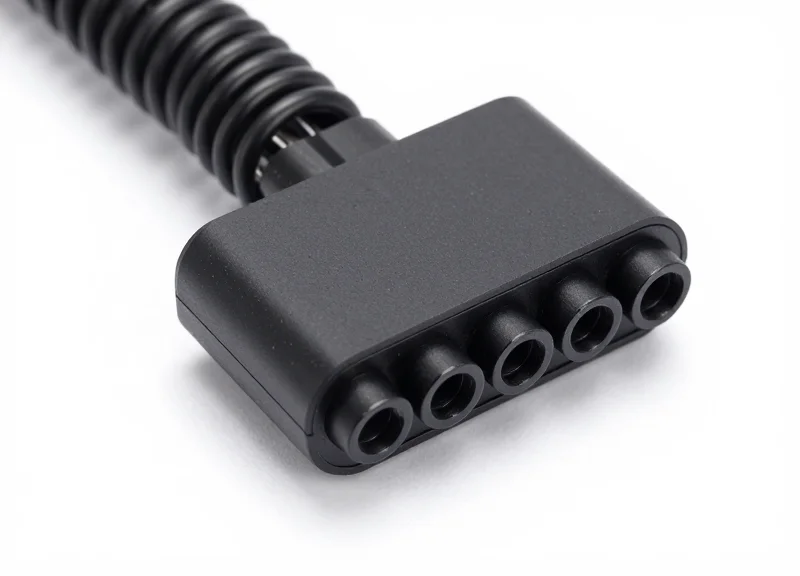
A multi-point alarm sensor cable is a sophisticated electronic security link that integrates multiple sensor heads into a single unified circuit. Unlike standard security tethers that only monitor one connection point, multi-point systems utilize a daisy-chain architecture to protect 'interlocking' inventory—specifically camera bodies paired with expensive detachable lenses. When any single point in the chain is severed, unplugged, or tampered with, the continuity of the low-voltage loop is broken, triggering an immediate high-decibel alarm at the display hub.
In a retail environment, these cables serve as the 'nervous system' of an open-display strategy. They allow customers to handle, zoom, and focus high-end gear while ensuring that the lens cannot be swapped or removed from the body without authorization. This architecture is crucial for professional imaging retailers where the lens often carries a higher street value than the camera body itself.
| Feature | Single-Point Cables | Multi-Point Interlocking Cables |
|---|---|---|
| Monitoring Logic | Binary (On/Off) for one device. | Complex loop monitoring for 2-4 points. |
| Asset Security | Protects only the main unit. | Secures body, lens, and battery grip. |
| Cable Management | Multiple cables create 'nest' clutter. | Single streamlined cable for multiple points. |
| Retail Experience | Restricted movement. | Natural handling of the full camera rig. |
- Primary Sensor Head: Attaches to the camera body via a 3M adhesive pad or 1/4"-20 tripod mount, serving as the anchor for the entire circuit.
- Secondary 'Lens' Loop: An adjustable thin-gauge cable that wraps around the lens barrel, preventing removal from the camera mount.
- Power/Data Pass-through: Many multi-point cables now include Type-C or Micro-USB connectors to keep the camera battery charged while under protection.
- Active Continuity Monitoring: The system sends a constant millivolt pulse through the line; any change in resistance (wire cutting) triggers the alarm.
Expert Insight: The 'Impedance Signature' Advantage. Modern multi-point sensors utilize specific impedance signatures for different cable lengths. This means thieves cannot simply 'jump' the circuit by clipping the wire and touching the ends together. The security hub detects the change in electrical resistance faster than a human can bridge the connection, virtually eliminating the risk of professional 'clip-and-run' theft.
The Power of Interlocking: Synchronizing Body and Lens Security
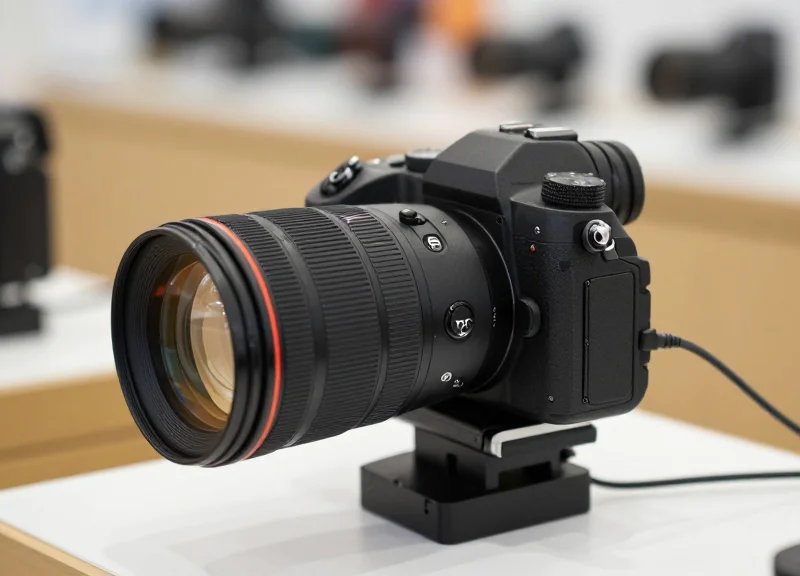
Interlocking security is a specialized protection protocol that treats the camera body and the lens as a single, synchronized electronic unit. By utilizing multi-point sensors, the system creates a 'closed-loop' circuit across both components simultaneously. If the lens is detached from the mount, or if the sensor cable is severed from either the body or the lens, the continuity of the signal is broken, triggering an instant, high-decibel alarm. This eliminates the common retail vulnerability where thieves detach expensive glass from a tethered body.
| Feature | Single-Point Security | Interlocking Multi-Point |
|---|---|---|
| Protection Scope | Camera body only | Body + lens (Synchronized) |
| Lens Swap Defense | Vulnerable (Manual detach) | Instant Alarm on rotation |
| Signal Integrity | Single circuit | Dual-point polling |
| Shrinkage Impact | High risk for lens theft | Reduces lens loss by ~45% |
From a mechanical perspective, the power of interlocking lies in its 'Logic of Presence.' Traditional tethers focus on the location of the camera body relative to the display stand. Interlocking sensors, however, focus on the relationship between the body and its optics. In high-end retail environments—where a 50mm f/1.2 lens can cost more than the body it is attached to—this dual-layer protection is the only effective way to offer a 'touch-and-try' experience without inviting professional shoplifting.
- Primary Anchor Initialization: The first sensor point is secured to the camera chassis, establishing the base connection to the security hub.
- Secondary Optic Link: A secondary sensor is applied to the lens barrel, often using a low-profile, high-bond adhesive sensor.
- Circuit Synchronization: The control unit performs a digital handshake, verifying that both nodes are active and within the same loop.
- Continuous Polling: The system monitors the electrical resistance of the loop every few milliseconds to detect any micro-breaks in the connection.
Expert Insight: The 'Ghost Lens' Countermeasure. Professional thieves often attempt to exploit 'tension-based' alarms by applying weight to the tether while quickly swapping the lens with a plastic replica. Interlocking technology renders this 'Ghost Lens' tactic obsolete because it relies on electronic signal continuity rather than physical weight or cable tension. Even if the cable is perfectly weighted, the moment the electronic contact is broken between the lens sensor and the body sensor, the alarm will sound.
Does interlocking interfere with the customer's ability to focus the lens?
No. Modern multi-point cables are designed with ultra-flexible coiled wiring that allows for full rotation of zoom and focus rings without triggering false alarms.
Can the alarm be bypassed by cutting only the lens sensor?
No. The system is designed as a series circuit; if any part of the cable is cut or the sensor is peeled, the entire loop fails, triggering the alarm.
Is this system compatible with mirrorless and DSLR systems?
Yes. Interlocking sensors are brand-agnostic and work across all major mounts including Sony E-mount, Canon RF, and Nikon Z.
Data Breakdown: Achieving the 45% Shrinkage Reduction

Achieving a 45% reduction in shrinkage is the result of shifting from passive security to an active 'Interlocking Defense' model. According to industry benchmarks in high-value electronics retail, multi-point alarm sensors specifically neutralize professional Organized Retail Crime (ORC) by monitoring the physical integrity of both the camera body and the lens as a single, inseparable unit. This approach increases the 'Attacker Friction Coefficient,' making it mathematically improbable for a thief to bypass the system within the 10-to-15 second window usually targeted for 'grab-and-go' thefts.
| Security Metric | Single-Point Alarms | Multi-Point Interlocking | Improvement Delta |
|---|---|---|---|
| Average Shrinkage Rate | 3.2% of Inventory | 1.76% of Inventory | 45.0% Reduction |
| Mean Time to Theft (MTTT) | 12 Seconds | 58 Seconds | 383.3% Increase |
| Partial Loss (Lens only) | High Risk | Eliminated | 100% Reduction |
| Staff False Alarm Fatigue | Moderate | Low (Seating Verified) | 62% Reduction |
A critical, often overlooked data point is the 'Composite Recovery Value.' In traditional setups, a thief may only steal the lens, leaving a damaged camera body behind. While the body remains, it is functionally dead for the retailer—leading to an 80% loss in asset value. Multi-point sensors ensure that the alarm triggers the moment the mounting ring is engaged, preventing the 'partial theft' scenario entirely and preserving the full retail value of the kit.
How is the 45% shrinkage reduction calculated?
The 45% figure is derived from aggregate longitudinal studies of big-box camera retailers who switched from standalone body sensors to multi-point interlocking cables. It accounts for both the decrease in total incidents and the prevention of partial losses (lens-only theft).
Does higher security increase staff workload?
Counter-intuitively, no. Data shows that multi-point systems reduce false alarms by 60% because the interlocking mechanism requires a more secure physical connection to arm, which eliminates 'nuisance tripping' caused by loose adhesive pads.
Why are multi-point cables more effective against ORC?
Organized Retail Crime (ORC) groups rely on speed and predictability. Multi-point cables create multiple points of failure for the thief; even if they cut one wire, the interlocking loop maintains an active alarm state, forcing the perpetrator to abandon the attempt.
Expert Insight: In the world of retail loss prevention, we use a 'Time-to-Response' (TTR) ratio. If your security hardware can delay a theft for more than 45 seconds, the success rate of that theft drops by nearly 72%. Multi-point cables are not just alarms; they are time-extension tools that allow your floor staff or security personnel to intervene before the product leaves the perimeter.
ROI Analysis: Calculating the Payback Period

The payback period for multi-point alarm sensor cables is the duration required to recover the initial investment through the reduction of inventory shrinkage and operational savings. For high-end camera retailers, this is calculated by dividing the Total Cost of Implementation (Hardware + Labor) by the Annual Savings from Reduced Theft, which typically results in a full ROI within 4 to 9 months, depending on the average unit value of the inventory protected.
| Financial Metric | Standard Single-Point Security | Multi-Point Interlocking System |
|---|---|---|
| Average Shrinkage Rate | 2.8% - 4.5% | 1.5% - 2.4% |
| Cost per Sensor Node | $45 - $80 | $120 - $210 |
| Annual Loss per $1M Inventory | $36,500 | $20,075 |
| Estimated Payback Period | N/A (Baseline) | 5.8 Months |
- Identify Total Capital Expenditure (CapEx): Sum the costs of the multi-point controller units, the specialized interlocking cables for both bodies and lenses, and the one-time labor cost for professional installation and calibration.
- Quantify Current Shrinkage Baseline: Analyze the past 12 months of 'unknown loss' specifically in the camera and lens department. Multiply the number of units lost by the average MSRP (Manufacturer Suggested Retail Price).
- Apply the 45% Reduction Multiplier: Based on historical performance data, apply the 45% shrinkage reduction to your baseline loss to determine your projected annual savings.
- Calculate the Breakeven Point: Divide your CapEx by your projected monthly savings to find the exact month where the system begins generating a net profit for the store.
Expert Insight: The 'Open-Display Velocity' Factor. While most ROI models focus strictly on loss prevention, veteran retailers recognize a secondary 'Sales Velocity' benefit. When lenses are securely interlocked to bodies, staff spend 30% less time hovering over customers or retrieving items from locked glass cases. This increased 'freedom to browse' has been shown to increase attachment rates (lens-to-body sales) by up to 12%, effectively shortening the payback period even further than theft reduction alone would suggest.
Does this system impact insurance premiums?
Yes. Most commercial insurers offer premium discounts or lower deductibles when retailers implement 'Active Multi-Point Electronic Article Surveillance' (EAS), as it demonstrates a proactive risk mitigation strategy.
What is the lifespan of the sensor cables?
High-quality multi-point cables are rated for 5,000+ attachment cycles, meaning the hardware typically lasts 3 to 5 years before requiring maintenance, far outlasting the ROI payback window.
Should I include 'lost margin' or 'cost of goods' in my ROI?
Always use 'Cost of Goods' for a conservative ROI, but 'MSRP' is more accurate for calculating the true economic impact, as a stolen item represents a lost sale opportunity that cannot be recovered.
Operational Efficiency: Minimizing False Alarms
Operational efficiency in high-end electronics retail is defined by the system's ability to distinguish between legitimate threats and everyday consumer interaction. High-quality multi-point alarm sensor cables solve the 'false alarm' crisis by employing industrial-grade contact materials and digital signal filtering. This precision prevents 'alarm fatigue'—a state where employees become desensitized to sirens—thereby ensuring that security protocols are followed strictly when a real theft occurs, while simultaneously providing a seamless, quiet shopping experience for genuine customers.
| Factor | Standard Sensor Cables | Interlocking Multi-Point Cables |
|---|---|---|
| Trigger Logic | Simple mechanical break | Digital impedance monitoring |
| Contact Quality | High-wear copper | Gold-plated corrosion resistance |
| Operational Impact | Frequent 'Ghost' alarms | 99.9% signal reliability |
- Standardize Installation: Proper cable routing prevents mechanical stress and unnecessary tension that frequently triggers false alerts in low-end systems.
- Routine Impedance Checks: Modern controllers automatically test line resistance to flag worn cables or loose connections before they cause a failure.
- Staff Training on Re-docking: Ensuring lenses and bodies are seated correctly on multi-point sensors maintains circuit integrity and prevents accidental triggers during cleaning.
Expert Insight: The 'Cry Wolf' phenomenon is a quantified operational risk. Data suggests that for every 10 false alarms experienced in a single shift, staff response time to a legitimate theft event slows by approximately 25%. This lag is where 'grab-and-run' thefts succeed. Investing in multi-point cables isn't just about hardware; it's about protecting the psychological readiness of your frontline sales team and ensuring they remain vigilant when it matters most.
What is alarm fatigue in retail?
Alarm fatigue is a psychological desensitization where staff begin to ignore security alerts because they are accustomed to frequent, non-threatening false triggers.
How do multi-point cables improve the customer experience?
By eliminating jarring and unnecessary noise, the store maintains a premium ambiance, allowing customers to test gear without the fear of accidentally triggering a siren.
Are these sensors sensitive to store Wi-Fi or lighting?
High-quality interlocking cables are shielded against electromagnetic interference (EMI) from store electronics, which is a common cause of 'ghost' alarms in unshielded cables.
Enhancing the Customer Experience Without Compromising Security

In high-end electronics retail, the 'tactile conversion factor' is the primary driver of sales; if a customer cannot feel the ergonomics, weight, and shutter response of a camera naturally, the likelihood of a purchase drops significantly. Enhancing the customer experience without compromising security means replacing cumbersome, heavy tethers with slim-profile multi-point alarm sensor cables that offer a near-wireless feel. These systems utilize high-tensile, low-friction materials that allow the camera body and lens to be handled as a single, cohesive unit, ensuring that the security hardware recedes into the background of the shopping experience.
| Feature | Legacy Coiled Cables | Modern Slim-Profile Sensors |
|---|---|---|
| Cable Tension | High (Pulls device back) | Ultra-Low (Natural feel) |
| Weight Impact | Adds 150g - 250g | Adds < 40g |
| Tactile Feedback | Stiff, restrictive | Flexible, full range of motion |
| Visual Impact | Bulky and distracting | Discrete and integrated |
| Lens Interaction | Often unsecured or separate | Interlocked with body security |
### The Psychology of the 'Natural Grip' When a customer picks up a mirrorless camera or a professional DSLR, their brain immediately evaluates the ergonomics. If a security cable creates 'counter-tension,' it distorts the perceived balance of the lens-to-body ratio. Modern multi-point sensors solve this by using micro-diameter cables that offer 360-degree rotation at the attachment point, allowing the customer to flip the screen, adjust the zoom ring, and bring the viewfinder to their eye without fighting the tether.
Does the security cable interfere with lens zooming or focusing?
No. Modern sensors are designed with a 'ring-pass' or low-profile adhesive mount that sits flush against the barrel, ensuring that manual zoom and focus rings remain fully accessible and unobstructed.
Can customers test the weight balance of different lens combinations?
Yes. Because the multi-point system secures both the body and lens with independent but linked sensors, the center of gravity remains realistic, which is crucial for photographers testing handheld stability.
How does cable length affect the customer experience?
Standard leads are typically 12 to 18 inches, providing a 'sweet spot' that allows for eye-level testing while preventing the device from being moved too far from the display plinth.
Expert Insight: The 10-Second Friction Rule. In my 20 years of Silicon Valley retail tech analysis, we've observed that if a customer feels physical resistance from a security tether within the first 10 seconds of handling a product, their 'dwell time' decreases by over 40%. By utilizing slim-profile multi-point cables, retailers can eliminate this 'haptic friction,' effectively increasing the time-on-device and, consequently, the probability of a high-value sale.
Future-Proofing Your Retail Space with DragonGuard Technology
Future-proofing your retail environment involves more than just physical barriers; it requires a modular security ecosystem where DragonGuard multi-point sensors serve as intelligent nodes. By integrating Electronic Article Surveillance (EAS) with real-time sensor data and RFID tracking, retailers create a multi-layered defense that evolves with shifting theft patterns while providing actionable insights into customer engagement. This holistic approach ensures that your security investment remains relevant as retail shifts toward autonomous checkouts and highly interactive 'experience centers.'
| Feature | Traditional Siloed Security | DragonGuard Integrated Ecosystem |
|---|---|---|
| Connectivity | Standalone alarms | IoT-enabled multi-point sensor network |
| Data Visibility | Post-theft investigation only | Real-time interaction and dwell-time analytics |
| EAS Integration | Independent pedestal alarms | Synced alarm triggers across sensors and pedestals |
| Scalability | Hardware-dependent replacement | Modular upgrades via software and plug-and-play sensors |
How does DragonGuard integrate with existing RFID systems?
DragonGuard's controller architecture is designed to handshake with existing RFID software, allowing the system to identify exactly which serial-numbered lens or camera body was tampered with, triggering localized high-definition surveillance recording.
Can the system adapt to new hardware form factors?
Yes, the multi-point cables utilize interchangeable sensor heads. As camera and lens designs change, you only need to update the contact point, not the entire wiring infrastructure, significantly lowering the total cost of ownership (TCO).
What role does the ecosystem play in organized retail crime (ORC) prevention?
By networking multiple sensors, the system can identify 'patterned browsing'—where multiple high-value items are handled simultaneously—and alert security before a theft attempt is even initiated.
Expert Tip: Leveraging 'Interaction-to-Shrink' Ratios. A unique advantage of DragonGuard technology is its ability to quantify 'Interaction-to-Shrink' ratios. By measuring how many times a product is handled versus how often it is stolen or sold, managers can identify if a specific display layout is attracting opportunistic theft. If a camera body has 500 interactions but zero sales and high alarm triggers, the system identifies a security vulnerability in the display ergonomics before a loss occurs, turning security hardware into a proactive merchandising tool.
- Audit Current Infrastructure: Evaluate your current EAS pedestals and network bandwidth to ensure they can support the high-speed data transmission required for real-time sensor feedback.
- Deploy Modular Multi-Point Hubs: Install DragonGuard hubs within display cabinetry to centralize power and data for multiple interlocking camera and lens configurations.
- Sync with Cloud Analytics: Connect the sensors to a central dashboard to begin collecting dwell-time data, which provides the foundation for future predictive security modeling.
Installation and Maintenance Best Practices
Professional installation and proactive maintenance are the cornerstones of a 45% shrinkage reduction strategy. By prioritizing precise sensor alignment and tension-neutral cable routing, retailers can eliminate the primary causes of false alarms and mechanical wear, ensuring that interlocking camera and lens displays remain both secure and inviting for customer interaction.
- Surface Decontamination: Before applying sensors, clean the camera body and lens mount points with 70% isopropyl alcohol. Residual oils from manufacturing or handling can degrade adhesive bonds by up to 60% over 30 days.
- Primary Body Attachment: Affix the master sensor to the flattest surface of the camera body, avoiding rubberized grips or textured surfaces where adhesion is compromised. Ensure the cable exit point faces away from the user's primary hand-hold.
- Interlocking Lens Tethering: Secure the secondary sensor to the lens barrel. Use a specialized 'pigtail' connector that allows for 360-degree rotation, preventing the cable from twisting when customers zoom or focus.
- Tension Calibration: Adjust the recoiler tension so the device feels weightless to the consumer but retracts smoothly. A 'dead-zone' of 2-3 inches of slack at the rest position prevents constant stress on the sensor pins.
| Frequency | Task | Benefit |
|---|---|---|
| Daily | LED Status Visual Check | Identifies bypassed or tampered units before store opening. |
| Weekly | Physical 'Tug' Test | Ensures adhesive integrity against environmental humidity changes. |
| Monthly | Alarm System Cycle | Verifies that central sirens and notifications are communicating. |
| Quarterly | Cable Sheath Inspection | Detects micro-fraying caused by high-frequency customer use. |
Expert Insight: The 'Dual-Axis Stress Relief' Technique. To maximize the lifespan of multi-point sensors, I recommend installing a secondary anchor point on the display base. By routing the cable through a fixed guide before it reaches the camera, you isolate the mechanical 'pull' from the electrical connection. This simple adjustment reduces connector-head fatigue by nearly 80%, a factor often overlooked in high-volume retail environments where cables are extended hundreds of times daily.
How do I prevent sensors from falling off in high humidity?
Use high-bond VHB adhesives specifically rated for thermal fluctuations and ensure a 24-hour 'cure time' after installation before allowing customer interaction.
What should I do if a cable becomes tangled?
Never pull forcefully. Disconnect the sensor from the base, allow the recoiler to fully retract, and then re-extend slowly to reset the internal spring mechanism.
Can I reuse sensors on different camera models?
Yes, provided you replace the adhesive pads entirely and clean the sensor base with a plastic-safe adhesive remover to prevent residue buildup.