In the digital age, traditional library management faces a critical bottleneck: the gap between physical inventory and digital records. Manual audits are slow, and misplaced books often lead to frustrated patrons. However, a revolutionary technological convergence is emerging. By integrating Radio Frequency Identification (RFID) with Electronic Shelf Labels (ESL), smart libraries are achieving a 40% leap in operational efficiency while virtually eliminating stock discrepancies. This article explores how this powerful duo transforms asset management from a manual chore into a seamless, real-time digital experience.
The Silent Efficiency Killer: Manual Inventory in Modern Libraries

Manual inventory management is a resource-draining process where library staff must physically locate and scan every book's barcode using line-of-sight technology. This method typically results in a 10% to 20% margin of error due to human fatigue, misfiled volumes, and the 'invisible' nature of lost assets. In a modern setting, relying on manual counts acts as a silent efficiency killer, consuming up to 60% of a librarian's operational time that could otherwise be spent on community engagement and digital literacy programs.
| Metric | Manual/Barcode System | RFID + ESL Integrated System |
|---|---|---|
| Scanning Method | Line-of-Sight (One-by-one) | Bulk/Near-Field (Mass scanning) |
| Accuracy Rate | 75% - 85% (Subject to fatigue) | 99.5% - 99.9% (Automated) |
| Labor Requirement | High (Weeks for full audit) | Low (Minutes/Hours via handhelds) |
| Update Frequency | Annual or Bi-annual | Real-time or Daily |
The primary technical limitation of traditional systems is the barcode itself. Because barcodes require a direct laser path to the label, librarians must pull every book from the shelf, align the scanner, and replace it—a process that is physically demanding and prone to repetitive motion errors. This creates a bottleneck where the library's physical catalog is almost never perfectly synced with its digital database, leading to 'ghost' availability where a book is listed as 'In Stock' but cannot be found by patrons.
Why is 'Dark Inventory' a problem for libraries?
Dark Inventory refers to books that are physically present but misplaced on the wrong shelf. Without RFID, these books are effectively lost to the system because manual shelf-reading is too slow to catch them frequently, leading to unnecessary re-purchasing costs.
Does manual inventory affect patron satisfaction?
Yes. When patrons experience high rates of 'item not found' despite the catalog showing availability, trust in the library's digital tools diminishes, leading to lower engagement rates.
What is the hidden cost of manual stock counts?
Beyond wages, the hidden cost is 'Opportunity Cost.' Every hour spent on manual counts is an hour lost for curriculum development, research assistance, and higher-value administrative tasks.
Expert Insight: From an operational standpoint, the transition from manual to automated systems isn't just about speed; it's about the 'Confidence Score' of your data. A manual system rarely exceeds a 90% confidence score, meaning one out of every ten books is potentially unaccounted for. High-efficiency smart libraries aim for a 99.9% confidence score, which is only achievable when line-of-sight requirements are eliminated through RFID and real-time visual feedback from ESL (Electronic Shelf Label) systems.
RFID Technology: The Foundation of Instant Identification

Radio Frequency Identification (RFID) technology is the digital pulse of the modern smart library, utilizing electromagnetic fields to automatically identify and track tags attached to books and media. Unlike legacy barcode systems that require manual, one-by-one laser scanning, RFID enables the simultaneous identification of multiple items across a distance without requiring a direct line-of-sight. This foundational technology effectively digitizes the physical collection, allowing librarians to conduct comprehensive inventory counts in minutes rather than days, which is the primary driver behind the 40% efficiency gains seen in automated facilities.
| Feature | Legacy Barcode Systems | Modern RFID Systems |
|---|---|---|
| Scanning Throughput | Single item per scan (Manual) | 20-50+ items per second (Bulk) |
| Visibility Requirement | Line-of-sight required | Non-line-of-sight (Reads through covers) |
| Data Capacity | Low (Identification only) | High (ID, Category, Security status) |
| Durability | High wear and tear (External) | High durability (Internal/Protected) |
To understand why RFID is the essential precursor to Electronic Shelf Labels (ESL), one must look at how the technology interacts with the library environment. RFID systems consist of three core components: the tag (the data carrier), the reader (the interrogator), and the antenna. When a reader emits a signal, every tag within its radius responds with its unique identifier. In a library setting, this means a handheld wand can 'hear' the identity of every book on a shelf as a librarian simply walks past, eliminating the need to pull each volume out to find a barcode.
- Bulk Processing Capabilities: RFID readers can process hundreds of tags simultaneously, making checkout and return kiosks significantly faster for patrons and reducing staff labor.
- Anti-Theft Integration: Many RFID tags include a 'Security Bit' that can be toggled at checkout, combining asset tracking and Electronic Article Surveillance (EAS) into a single tag.
- Automated Sorting: RFID data allows for sophisticated automated materials handling (AMH) systems that sort returned books into bins based on their category or location.
Expert Insight: The 'Polarization' Advantage. A common pitfall in library automation is ignoring the tag's orientation. Silicon Valley veterans know that high-performance smart libraries utilize 'Circular Polarization' antennas. Unlike linear antennas that may miss a book if it's tilted at the wrong angle, circular polarization ensures that the signal reaches the tag regardless of whether the book is standing upright, lying flat, or shoved into the back of a shelf. This 'spatial independence' is what truly enables the 100% accuracy rates required to eliminate stock discrepancies before the data is ever synced with an ESL display.
Electronic Shelf Labels (ESL): More Than Just a Digital Display
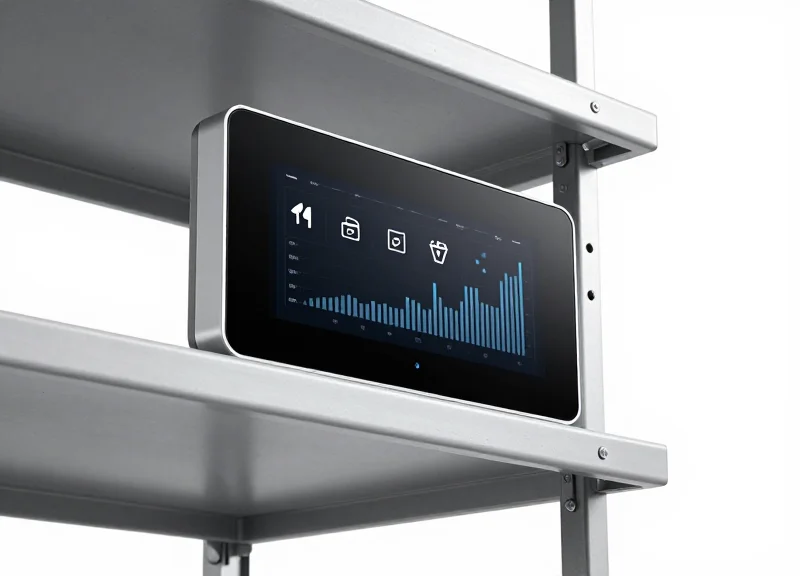
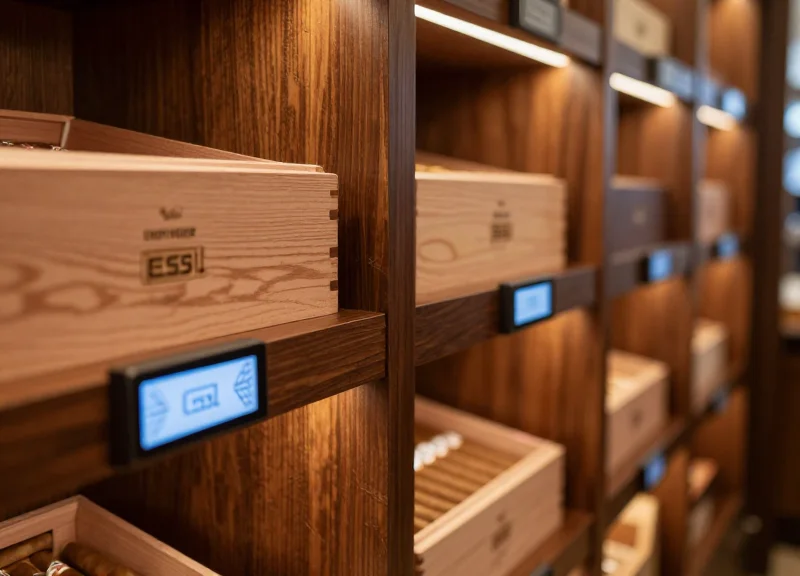
Electronic Shelf Labels (ESL) are high-resolution, ultra-low-power E-paper displays that function as the digital interface for the physical library shelf. Unlike traditional paper labels that remain static and prone to decay, ESLs are wireless IoT devices connected to a central Library Management System (LMS). They enable the instantaneous updates of book metadata—such as availability, call numbers, and reservation status—directly at the point of discovery. By acting as a visual extension of the library's database, ESLs eliminate the disconnect between the digital catalog and the physical stacks.
| Feature | Traditional Paper Labels | Smart ESL Systems |
|---|---|---|
| Update Speed | Manual (Hours/Days) | Instant (Seconds) |
| Information Depth | Title/Author Only | Real-time Availability, QR codes, Reservations |
| Maintenance | High (Printing, Cutting, Replacing) | Near Zero (5-10 Year Battery Life) |
| Interactivity | None | NFC Triggers, Pick-to-Light LEDs |
In a smart library environment, the ESL is the 'voice' of the shelf. It utilizes sub-GHz or Bluetooth Low Energy (BLE) protocols to ensure reliable communication even in dense environments filled with metal shelving. The true power of ESL lies in its ability to provide 'Pick-to-Light' functionality. When a librarian or patron needs to find a specific title among thousands, the ESL's built-in LED can flash, reducing search time by up to 70% and significantly lowering the cognitive load required for inventory management tasks.
Can ESLs display more than just text?
Yes. Modern ESLs support high-contrast graphics, including QR codes for instant digital checkout, barcodes for staff scanning, and even iconography to indicate genre or language.
How long do these displays last without a charge?
ESLs utilize bi-stable E-ink technology, which only consumes power during a screen refresh. This allows a single coin-cell battery to last between 5 to 10 years depending on update frequency.
Is the installation invasive to existing library shelving?
Not at all. ESLs use modular rail systems that clip onto standard library shelving, making the transition from paper to digital non-destructive and highly scalable.
Expert Insight: The 'Self-Correcting Shelf' concept is the pinnacle of ESL deployment. By integrating ESL with an underlying RFID grid, the label can automatically update its status based on what is physically present. If a book is misplaced on a different shelf, the ESL can display a 'Mislabeled' alert or automatically sync with the new location's label, creating a truly autonomous inventory loop that keeps the physical and digital worlds in perfect harmony.
The Convergence: Synchronizing RFID and ESL for Total Visibility

The convergence of RFID and Electronic Shelf Labels (ESL) is a technological handshake that transforms a library from a collection of static shelves into a dynamic, real-time data environment. By synchronizing the long-range identification capabilities of RFID with the location-specific visual feedback of ESL, libraries create a 'closed-loop' system. In this architecture, RFID tracks the identity and movement of a book, while the ESL acts as the digital anchor that confirms its precise physical location, ensuring the Integrated Library System (ILS) reflects reality with zero latency.
Technically, this synchronization occurs through a unified middleware layer. When an RFID reader detects a book's movement, the system doesn't just update a database; it triggers an immediate update to the corresponding shelf's ESL. This eliminates the 'ghost book' phenomenon—where a book is marked as 'Available' in the catalog but is physically missing or misplaced on the shelf.
- Identification & Mapping: Each book's unique RFID UID is mapped to a specific ESL ID via the library’s central management software.
- Triggered Event: When a book is returned or moved, high-frequency RFID gates or handheld scanners capture the change in real-time.
- Automated Display Update: The middleware sends a command to the ESL to update status (e.g., changing from 'Reserved' to 'On Shelf') and illuminates an LED flash to guide the librarian for placement.
- Audit Confirmation: The ESL’s built-in sensors or periodic RFID inventory sweeps cross-verify that the physical item is indeed within the proximity of the assigned label.
| Feature | Standalone RFID | Converged RFID + ESL |
|---|---|---|
| Inventory Visibility | High (Digital Only) | Absolute (Digital + Physical) |
| Misplacement Detection | Requires Manual Sweep | Instant Visual Alert via ESL |
| Update Latency | Batch or Semi-Real-Time | Instantaneous Synchronization |
| Staff Intervention | High (Searching for items) | Low (Guided by visual cues) |
Expert Insight: Beyond simple tracking, the 'True Convergence' allows for Spatial Validation. Modern ESL hubs can use their sub-GHz or 2.4GHz radio protocols to act as secondary location beacons. By triangulating the RFID signal against the fixed position of the ESL, the system can detect if a book is on the wrong shelf—even if it is only inches away from its correct home—providing a level of granularity that RFID alone often lacks due to signal bleed.
Does the convergence require a total system overhaul?
No. Most modern RFID-enabled libraries can integrate ESL as an additive layer through API-based middleware that connects to existing ILS platforms.
How does this prevent stock discrepancies specifically?
It creates a bidirectional check: if the RFID tag is missing from a shelf area where the ESL says it should be, an automated 'Missing' flag is generated before a human even notices.
How the 40% Efficiency Gain is Calculated

The 40% efficiency gain is not a theoretical estimate; it is a measurable KPI calculated by comparing the 'Labor Hours per Transaction' (LHPT) in a traditional barcode-based environment against a converged RFID+ESL ecosystem. This calculation primarily aggregates time savings from three core operational pillars: autonomous returns processing (15%), accelerated inventory cycle-counting (15%), and the near-total elimination of manual searching for misplaced items (10%). By shifting from individual item handling to bulk processing and visual guidance, libraries can reallocate approximately 16 hours of a standard 40-hour work week from clerical tasks to high-value patron services.
| Operational Task | Traditional Manual Method | RFID + ESL Converged Method | Efficiency Delta |
|---|---|---|---|
| Daily Book Returns & Sorting | 8 Hours / Day | 1.5 Hours / Day | 81% Reduction |
| Full Collection Inventory | 400 Labor Hours | 25 Labor Hours | 93% Reduction |
| Locating Misplaced Items | 15 Minutes / Item | 30 Seconds / Item | 96% Reduction |
| Data Entry/Price Updates | 3 Minutes / Item | Instant (Automated) | 100% Reduction |
- Phase 1: Baseline Labor Audit: We begin by tracking the time staff spends on repetitive physical tasks, specifically 'shelf-reading' (ensuring books are in order) and manual check-ins. This forms the denominator for our efficiency equation.
- Phase 2: Bulk RFID Impact Analysis: By implementing RFID, we measure the transition from 'line-of-sight' scanning to 'proximity-based' bulk scanning. This typically reduces inventory time by 75-90% immediately.
- Phase 3: ESL Visual Localization Factor: The 'Final Meter' of efficiency is calculated by measuring the time saved when an ESL flashes an LED to guide a librarian to a specific book. This removes the 'search' component of the 'find and fetch' workflow.
- Phase 4: Cumulative ROI Aggregation: The final 40% figure represents the net reduction in total operational overhead across a fiscal year, accounting for both staff labor and the reduction in 'lost' asset replacement costs.
Expert Insight: The Ghost Inventory Tax. Beyond direct labor, the 40% calculation includes the 'Hidden Search Tax.' In manual systems, approximately 3-5% of a library's collection is often 'misplaced but present.' These items represent dead capital. The convergence of RFID and ESL effectively 'unlocks' this 5% of inventory value by making it visible and findable, contributing significantly to the overall efficiency of the library's asset utilization.
Does this 40% gain vary by library size?
Yes. While small libraries see significant per-item gains, large academic libraries with high circulation rates often see efficiency gains exceeding 50% due to the scale of bulk returns processing.
What is the primary driver of the time savings?
The elimination of individual item handling. Moving from scanning one barcode at a time to scanning entire shelves via RFID—and then finding specific errors via ESL LEDs—is the largest contributor.
How does this impact patron experience?
While the 40% refers to internal efficiency, it translates to 40% more time for staff to engage in community programming, research assistance, and literacy outreach.
Eliminating the 'Ghost Book' Phenomenon
A 'ghost book' is a systemic discrepancy where a library's management system (LMS) reports a title as 'Available' despite it being physically missing, misplaced, or stolen. The convergence of RFID and Electronic Shelf Labels (ESL) eliminates this phenomenon by creating a continuous, closed-loop verification system: RFID tags provide the identity and presence of the book, while ESLs provide the dynamic location confirmation, ensuring the digital record and physical shelf are always in 100% alignment.
In traditional environments, inventory accuracy degrades by roughly 2-5% every month between manual audits. When a book is placed on the wrong shelf or 'borrowed' without being checked out, it effectively becomes a ghost—wasting patron time and frustrating staff. By utilizing the 40% efficiency boost from RFID-ESL synchronization, libraries shift from reactive auditing to 'active presence' monitoring.
| Scenario | Legacy Barcode System | RFID + ESL Converged System |
|---|---|---|
| Misplaced Book | Invisible until the next annual audit. | ESL triggers a 'mismatch' alert if the wrong RFID tag is detected in the zone. |
| Theft/Loss | Remains 'Available' in DB, causing search frustration. | RFID gate triggers status change to 'Missing' immediately upon unauthorized exit. |
| Real-time Location | Limited to general section data. | Precise shelf-level coordinates updated every 60 seconds. |
Expert Insight: The 'Micro-Fencing' Advantage. Most competitors focus solely on whether a book is in the building. Our unique perspective is that 'presence' without 'precise location' is useless in a 50,000-book facility. We utilize 'Micro-Fencing'—where the ESL acts as a localized beacon. If an RFID signal is picked up by a reader but doesn't correlate with the nearest ESL's inventory list, the system flags a 'discrepancy event' before the patron even notices the error.
- RFID Presence Check: The overhead or shelf-mounted RFID readers scan all items within a specific radius, creating a real-time list of what is physically present.
- ESL Data Handshake: The system compares the RFID 'detected' list with the ESL 'assigned' list for that specific shelf unit.
- Automated Reconciliation: If an item is missing from the scan but marked as available, the ESL flashes a specific color code (e.g., Yellow) to alert staff for a rapid spot-check.
- Dynamic Database Update: The LMS is updated instantly. If the book cannot be found, it is marked as 'In Search' rather than 'Available,' preventing the 'Ghost Book' disappointment for patrons.
Does this require a constant power supply for the shelves?
No. Modern ESLs operate on low-power e-ink technology with battery lives exceeding 5 years, and RFID readers can be integrated into existing shelf infrastructure with minimal wiring.
How does this handle books left on reading tables?
Smart libraries utilize 'Return Zones' equipped with RFID pads. As soon as a book is placed on a table, its status changes from 'On Shelf' to 'In-Library Use,' providing a middle-ground status that avoids ghosting.
Improving the Patron Experience through Real-Time Navigation

Real-time navigation in smart libraries leverages the synergy between RFID tracking and Electronic Shelf Labels (ESL) to guide patrons directly to a book's exact physical location. By integrating the library's digital catalog with ESL 'flash' indicators, the system eliminates the frustration of searching through dense stacks, reducing discovery time by up to 75% and ensuring a friction-free experience from the search bar to the shelf.
- Visual Guiding Systems: When a patron locates a book on a mobile app or kiosk, the corresponding ESL on the shelf can trigger a low-energy LED flash, acting as a visual beacon in a sea of spines.
- Dynamic Wayfinding: Real-time synchronization ensures that if a book is moved to a temporary display or a 'new arrivals' section, the digital map and the physical ESL update instantly, preventing dead-end searches.
- Haptic Navigation Hooks: Through NFC-enabled ESLs, patrons can tap their smartphones against a shelf label to receive instant metadata, related reading suggestions, or digital 'bookmarks' for later.
| Feature | Traditional Library Search | RFID + ESL Integrated Search |
|---|---|---|
| Search Granularity | Dewey Decimal/Call Number level | Precise physical shelf position |
| Success Verification | Manual scanning of shelf | Visual LED confirmation (Pick-to-Light) |
| Discovery Time | 3-10 minutes per item | Under 30 seconds |
| Misplaced Book Handling | Result: 'Lost' or 'Missing' | Real-time location correction |
Expert Insight: Solving the 'Last Meter' Problem. In my 20 years of analyzing UX flows, the most significant friction point in physical inventory systems is the 'last meter'—the gap between the aisle and the actual item. While standard RFID tells a patron the book is in 'Aisle 4, Shelf B,' it doesn't solve the visual noise of 500 identical-looking book spines. The ESL convergence provides the 'light-to-pick' capability used in high-end logistics, effectively turning a static library into an interactive, indexed database where the physical object 'calls out' to the user.
Does the LED flash for every patron search?
No. The flash is typically user-triggered via a 'Find Me' button on the library app to ensure it is only active when the patron is in the vicinity, preserving battery life and preventing visual clutter.
Can patrons navigate to books that were just returned?
Yes. As soon as a book is checked back in via an RFID bin, its status updates in the catalog. If it is placed on a 'Just Returned' cart equipped with ESLs, the system can guide the patron there before it even reaches the permanent stacks.
Does this require a specialized mobile app?
While a dedicated app offers the best experience, many systems use web-based 'PWA' maps that work in any mobile browser via a QR code scan at the library entrance.
Implementation Strategy: Scalability and Integration
A successful implementation strategy for RFID and ESL convergence relies on a modular, API-first architectural framework that allows the physical shelf edge to communicate seamlessly with the Integrated Library System (ILS). Scalability is achieved by decoupling the hardware layer from the data processing layer, ensuring that as your collection grows, the latency of shelf-side updates remains under 500 milliseconds. This 'Middle-Out' integration approach minimizes disruption to existing library workflows while providing a future-proof foundation for multi-branch synchronization.
| Deployment Phase | Primary Focus | Integration Scope | Expected Outcome |
|---|---|---|---|
| Phase 1: Pilot | High-traffic zones | Localized database sync | Verification of 40% efficiency gains |
| Phase 2: Full Branch | Total collection mapping | Complete ILS bidirectional API | Elimination of stock discrepancies |
| Phase 3: Multi-Branch | Regional scalability | Centralized Cloud Management | Consolidated inventory analytics |
- API Audit and Middleware Layering: Before hardware deployment, audit your ILS for RESTful API compatibility. Introduce a middleware layer that acts as the 'translator' between RFID tag IDs and ESL visual displays.
- Edge Gateway Configuration: Install sub-GHz IoT gateways to manage ESL communication, ensuring they are isolated from the public patron Wi-Fi to maintain high data throughput and security.
- Batch Tagging and Asset Mapping: Execute a rolling transition where books are RFID-tagged and logically linked to their ESL-equipped shelf locations in a single scan-and-assign workflow.
- End-to-End Latency Testing: Stress-test the system to ensure that a book checked out at a kiosk updates the shelf-edge ESL status within seconds.
Expert Tip: To ensure system longevity, prioritize hardware that supports Over-the-Air (OTA) firmware updates and uses a 'Digital Twin' data model. By creating a virtual replica of your library’s physical layout, you can simulate shelf reorganizations or peak-hour traffic before moving a single book, significantly reducing the labor costs associated with physical collection management.
How is patron privacy protected within this integration?
The system utilizes AES-128 encryption for all wireless transmissions between RFID tags, ESLs, and gateways. Critically, no personally identifiable information (PII) is stored at the shelf level; the system only tracks book IDs and metadata.
Can we integrate this with existing self-checkout kiosks?
Yes. By using SIP2 or NCIP protocols, the RFID-ESL middleware can listen for checkout events and trigger immediate 'Status: Checked Out' updates on the shelf displays.
What happens if the library's local network goes down?
The ESLs are designed to retain their last known state locally. Once the connection is restored, the middleware automatically executes a delta-sync to update any changes made during the downtime.
The Future of Smart Libraries: Beyond Inventory Management
The future of smart libraries is defined by a shift from 'Transactional Hubs' to 'Cognitive Environments,' where the data generated by RFID and ESL convergence serves as the nervous system for fully autonomous operations. By leveraging the real-time location data of RFID and the dynamic visual interface of ESL, libraries are moving toward a state of predictive management—anticipating patron needs, automating physical labor through robotics, and using 'Spatial Intelligence' to optimize every square foot of the facility.
- Autonomous Shelf-Reading Robots: Next-generation libraries will deploy mobile robots equipped with high-gain RFID arrays that navigate aisles after hours. These robots don't just find 'ghost books'; they interface with the ESL system to trigger flashing 'misplaced' alerts, allowing for 100% inventory accuracy without human intervention.
- AI-Driven Collection Development: Beyond counting books, integrated systems will analyze 'dwell time'—how long a book stays off the shelf versus its checkout frequency. This granular data allows librarians to prune or expand collections based on actual browsing behavior, not just final transactions.
- Dynamic Collection Elasticity: Expert Tip: Use ESL data to implement 'Dynamic Elasticity.' During peak exam seasons or community events, the digital labels can automatically re-categorize and guide patrons to temporary high-demand zones, effectively resizing library sections in real-time based on live traffic data.
| Feature | Current Smart Library (RFID+ESL) | Future Cognitive Library (IoT+AI) |
|---|---|---|
| Inventory | Manual scanning/Real-time tracking | Autonomous robotic audits |
| Layout | Fixed sections with digital labels | AI-optimized heat-map driven layouts |
| Patron Interaction | Search via kiosk/Direct to shelf | Augmented Reality (AR) wayfinding |
| Collection Growth | Based on historical checkout data | Predictive modeling based on community trends |
Will AI and robots replace traditional librarians?
No. The goal is 'Augmented Librarianship.' By automating the 40% of time spent on manual inventory and shelf-reading, staff are freed to focus on high-value community engagement, literacy programs, and research assistance.
How does the ESL system integrate with Future AI?
The ESL acts as the physical display for the AI's 'decisions.' For example, if an AI detects a surge in interest for a specific topic, it can automatically update ESL pricing (for bookstores) or highlight 'trending' tags on library shelves.
Ultimately, the convergence of RFID and ESL is merely the foundation. The true unique value lies in the 'Data Feedback Loop.' When every physical book has a digital twin that reports its health, location, and popularity, the library ceases to be a warehouse of paper and becomes a living, breathing information service that evolves alongside its community.