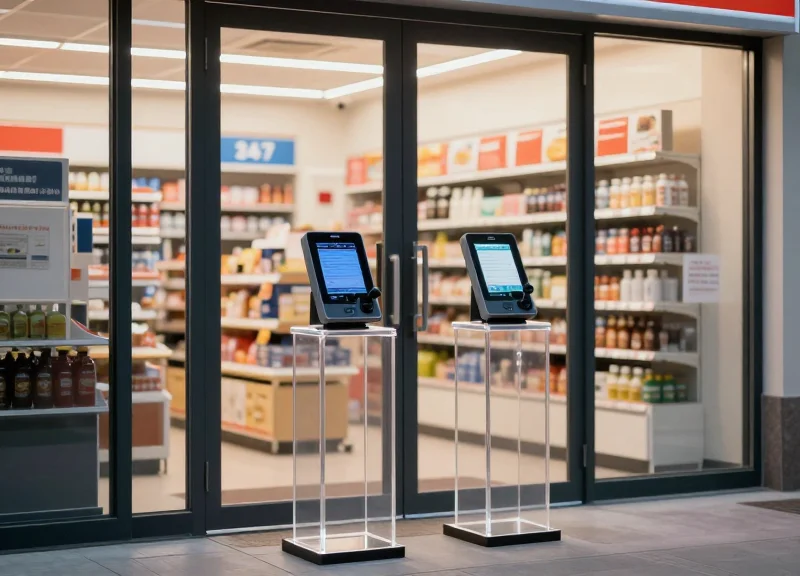
As we approach 2026, the retail landscape is facing an unprecedented evolution in Organized Retail Crime (ORC). While Radio Frequency Identification (RFID) has revolutionized inventory management and self-checkout efficiency, it possesses a critical 'Achilles heel': the physics of signal shielding. Professional shoplifters increasingly use foil-lined 'booster bags' to create Faraday cages that render RFID tags invisible to sensors. To maintain profitability, forward-thinking retailers are moving beyond single-technology solutions toward 'Hybrid Countermeasures' that combine the intelligence of RFID with the physical detection power of EAS and metal sensing technology.
The Shifting Landscape of Retail Loss Prevention in 2026

By 2026, retail loss prevention has transitioned from a back-office security function to a critical pillar of inventory intelligence and margin protection. As global retail shrink surpasses the $120 billion mark, the landscape is dominated by the battle against Organized Retail Crime (ORC) syndicates who utilize signal-shielding technologies—such as sophisticated 'booster bags' and portable Faraday cages—to bypass traditional Electronic Article Surveillance (EAS) and standalone RFID systems. The shift emphasizes 'Hybrid Countermeasures,' integrating physical sensors with AI-driven computer vision to close the visibility gap created by shielded theft.
| Feature | Traditional LP (2020-2024) | Advanced LP (2026+) |
|---|---|---|
| Primary Threat | Opportunistic Shoplifting | Coordinated ORC Syndicates |
| Detection Method | Single-gate EAS/RFID | Multi-sensor Hybrid Arrays |
| Data Utilization | Reactive Video Review | Real-time Predictive Analytics |
| Shielding Counter | Manual Visual Inspection | Active Magneto-Sensory Detection |
A significant differentiator in the 2026 landscape is the professionalization of retail crime. Syndicates now operate with the precision of logistics companies, deploying field agents equipped with aluminum-lined 'booster bags' that create a dead zone for RFID signals. When an item is placed inside these bags, the RFID tag's energy is absorbed, preventing it from 'waking up' and communicating with the store's exit sensors. This 'physical hack' of the radio frequency spectrum has forced a move away from tech-monocultures toward layered security architectures.
Why is the 2026 shrink crisis different from previous years?
It is driven by the 'Availability Tax.' Beyond the direct cost of stolen goods, retailers are losing an additional 15-20% in potential revenue because inventory systems believe shielded items are still in stock, leading to missed replenishment cycles and frustrated omnichannel customers.
What role does AI play in the shifting LP landscape?
AI acts as the glue between siloed systems. In 2026, AI correlates a 'null' RFID scan with a 'positive' metal detection event and computer vision movement patterns to trigger silent alerts before the suspect exits the store.
Why can't RFID solve the foil bag problem alone?
RFID is limited by the laws of physics. High-conductivity materials like aluminum foil reflect or absorb the ultra-high frequency (UHF) waves required to power a passive tag, making the product effectively invisible to the scanner regardless of how many tags are applied.
Expert Insight: In 2026, the most successful retailers have stopped viewing Loss Prevention as a cost center and started treating it as 'Inventory Accuracy Insurance.' The unique shift we are seeing is the move toward 'Metal-Detection-as-a-Service' (MDaaS), where doorways are equipped with intelligent sensors specifically tuned to distinguish between a consumer's smartphone and the specific thickness of high-grade industrial foil used in professional booster bags.
The Physics of Failure: Why RFID Tags Go Dark in Foil Bags

RFID tags go 'dark' in foil-lined bags because aluminum foil acts as a Faraday Cage, a conductive enclosure that prevents electromagnetic fields from reaching the tag's antenna. When a radio frequency (RF) signal hits a conductive surface like aluminum, the electrons in the metal redistribute themselves to cancel the field's effects inside the space, effectively shielding the RFID chip from the reader’s energy and making the item invisible to security sensors.
In a retail environment, most inventory management systems utilize UHF (Ultra-High Frequency) RFID, typically operating between 860 MHz and 960 MHz. These waves have a relatively short wavelength, making them particularly susceptible to interference. Unlike lower frequencies that might achieve some penetration, UHF signals are almost entirely reflected or absorbed by even a single layer of standard household aluminum foil.
| Material Type | Signal Impact | Effect on RFID Readability |
|---|---|---|
| Standard Cardboard/Plastic | Low Attenuation | 99-100% Read Rate |
| Moist/Liquid Contents | Absorption | 40-60% Read Rate (Reduced Range) |
| Thin Aluminum Foil (Booster Bags) | Reflection (Faraday Shielding) | 0% Read Rate (Total Blackout) |
| Lead/Heavy Metals | Absorption/Blocking | 0% Read Rate |
The failure isn't just about 'blocking' the signal; it is about detuning. An RFID antenna is precision-engineered to resonate at a specific frequency. When a highly conductive material is placed in the 'near field' of the antenna (within millimeters), it changes the impedance of the antenna. This shift, known as 'detuning,' ensures that even if a tiny fraction of the signal reaches the tag, the tag cannot efficiently harvest enough power to wake up and respond.
Does the thickness of the foil matter?
No. Due to the 'Skin Effect,' electromagnetic waves at UHF frequencies only penetrate the very surface of a conductor. Household foil is many times thicker than the skin depth required to reflect an RFID signal entirely.
Can RFID readers be turned up to 'see' through foil?
Increasing reader power rarely helps. The conductive shield reflects the energy back. Pumping more power into the environment often creates more 'noise' and interference without penetrating the shield.
Why is this a 'Physics of Failure'?
It is an inherent limitation of the technology. RFID relies on electromagnetic coupling; as long as the laws of electromagnetism allow for Faraday shielding, passive RFID will remain vulnerable to conductive enclosures.
Expert Insight: Many retailers mistakenly believe that higher-quality tags or 'sensitive' chips can overcome foil bags. However, the 'Foil-to-Tag Gap' is the real killer. Even if the bag is not perfectly sealed, the proximity of the conductive layer to the tag antenna causes a massive impedance mismatch that no software algorithm or chip sensitivity can currently overcome. This is why 2026 security strategies are pivoting toward detecting the 'shield' itself rather than the tag inside it.
Beyond Inventory Management: The Security Limitations of RFID
While RFID (Radio Frequency Identification) has revolutionized supply chain visibility and inventory accuracy, it was never engineered to be a primary defense against professional theft; its fundamental limitation lies in its dependency on clear-air electromagnetic communication, which is easily disrupted by conductive materials. In a security context, RFID functions as a high-fidelity data reporter, but it lacks the 'brute force' detection capabilities of legacy systems when faced with physical countermeasures like Faraday cages or signal-jamming equipment.
The primary design goal of RFID is data granularity—knowing exactly which item is where. However, in a loss prevention scenario, the 'richness' of this data becomes a secondary concern to the 'certainty' of detection. Professional shoplifters exploit this by targeting the physical layer of the technology. Because RFID operates in the Ultra-High Frequency (UHF) spectrum, its waves are shorter and more susceptible to being blocked or absorbed by the human body and metallic surfaces compared to traditional low-frequency EAS systems.
| Feature | RFID (UHF) | Traditional EAS (AM/RF) |
|---|---|---|
| Primary Purpose | Item-level inventory tracking | Dedicated theft deterrence |
| Shielding Vulnerability | Extreme (High sensitivity to foil) | Moderate (Requires thicker shielding) |
| Detection Speed | Micro-latency due to data handshake | Near-instantaneous bit-detection |
| Signal Collision | High risk in dense merchandise zones | Non-existent |
Why does high tag density impact security at the door?
In a busy retail entrance, a reader may face 'signal collision' where hundreds of tags in the vicinity compete for the reader's attention. This can cause the reader to miss a 'moving' tag hidden in a foil bag because it is busy processing static inventory nearby.
Does RFID software deactivation create a security gap?
Yes. Since RFID tags are often deactivated logically in a database rather than physically, a software glitch or a 'spoofed' point-of-sale signal can lead to items leaving the store without an alarm, providing no physical confirmation of theft.
What is the 'Human Factor' limitation in RFID security?
RFID systems often generate complex alerts (e.g., 'Blue Jeans, Size 34 missing'). This data-rich environment can lead to 'alarm fatigue' where staff hesitate to intervene as they try to interpret the data, whereas a simple EAS alarm triggers an immediate, standard response.
Expert Insight: The Serialization Paradox. A unique weakness of RFID in 2026 is what I call the Serialization Paradox. Because the system is looking for a specific ID, a thief only needs to shield enough of the signal to prevent a 'valid read.' Unlike analog EAS, which triggers on any resonant signal, RFID requires a successful data handshake. If the foil bag degrades the signal by even 30%, the handshake fails and the system remains silent, effectively turning a 'smart' tag into a 'dead' tag. Retailers are essentially trading robust detection for data they cannot even capture during a theft event.
The Rise of Hybrid Countermeasures: Integrating EAS and RFID

Hybrid countermeasures represent the strategic convergence of Electronic Article Surveillance (EAS) and Radio Frequency Identification (RFID) into a single, unified security ecosystem. While RFID excels at providing granular inventory visibility, it remains physically vulnerable to electromagnetic shielding like foil-lined bags. By embedding both an EAS element (such as Acousto-Magnetic or RF coils) and an RFID chip into the same tag or pedestal, retailers achieve a dual-layer defense: the EAS provides high-performance detection capable of penetrating common shielding, while the RFID component identifies exactly which SKU is leaving the store without being purchased.
| Feature | Standalone EAS | Standalone RFID | Hybrid System (2026) |
|---|---|---|---|
| Detection Strength | High (Pierces most foil) | Low (Easily shielded) | Maximum (Dual-frequency) |
| Data Intelligence | None (Generic Alarm) | High (Item-level info) | Predictive & Descriptive |
| ORC Deterrence | Moderate | Low | High (Anti-Foil Sensors) |
| Primary Use Case | Theft Prevention | Inventory Control | Total Retail Loss Control |
In 2026, the 'Hybrid' approach is no longer just about sticking two tags on a product. Modern systems utilize 'Smart Pedestals' that sync EAS and RFID data streams in real-time. For example, if a foil-lined bag enters the detection zone, the EAS component—which operates at a lower frequency less prone to the Faraday Cage effect—triggers a 'silent alert' to floor staff via mobile app, even if the RFID signal is momentarily silenced. This allows for proactive intervention rather than reactive recovery.
Can hybrid tags be deactivated at self-checkout?
Yes. Modern POS systems simultaneously kill the EAS signal and update the RFID 'sold' status in one pass, ensuring a seamless customer experience without false alarms at the exit.
Does hybrid hardware require a larger footprint?
No. 2026 designs utilize integrated antennas where both EAS and RFID coils reside in the same slim-line pedestal, often hidden within door frames or underfloor mats.
How does the system distinguish between a thief and a customer with a laptop?
Advanced hybrid systems use AI signal discrimination to distinguish between the chaotic interference of consumer electronics and the specific resonance of 'booster bags' used by professional shoplifters.
Expert Tip: The 2026 standard for high-risk retailers is the 'Resonance Gap Analysis.' By measuring the discrepancy between what the RFID reader sees (inventory) and what the EAS sensors detect (physical mass movement), AI-driven controllers can identify a 'cloaked' theft event in progress. This unique insight allows retailers to stop 'Foil-Bagging'—a tactic that previously blinded 100% of RFID-only installations—by utilizing the EAS as a 'heartbeat' sensor that confirms the presence of an item even when its digital ID is obscured.
Intelligent Metal Detection: The First Line of Defense
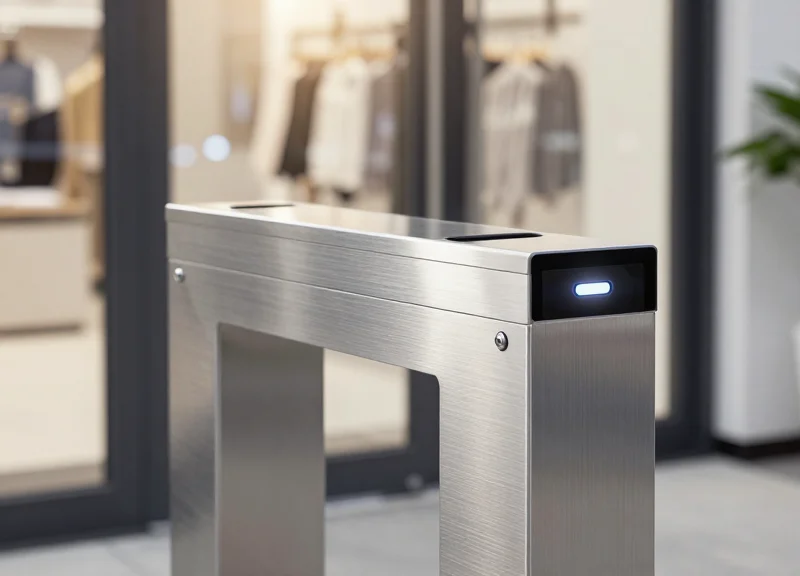
Intelligent metal detection in retail refers to advanced sensor systems integrated into entry and exit pedestals that use Digital Signal Processing (DSP) to identify the unique electromagnetic signatures of 'booster bags' (foil-lined containers) and high-strength magnetic detachers. Unlike traditional security that triggers only when an item is stolen, intelligent metal detection acts as a preemptive alert system, notifying staff the moment a known tool of professional theft enters the premises. By 2026, this technology has evolved from simple 'metal sensing' to sophisticated signal analysis capable of distinguishing between criminal tools and everyday metal items like keys or mobile phones.
The philosophy of the 'First Line of Defense' shifts the security paradigm from reactive to proactive. When a thief walks through the door with a booster bag—designed specifically to create a Faraday cage and neutralize RFID signals—the metal detection sensor identifies the mass of aluminum or lead. This allows security personnel to implement 'Guest Service as Security,' approaching the individual before they have the chance to conceal high-value merchandise, thereby preventing the shrink event entirely rather than chasing a suspect after a theft has occurred.
| Feature | Legacy Metal Detection | 2026 Intelligent Detection (DSP/AI) |
|---|---|---|
| Signal Analysis | Binary (Metal Presence) | Signature Profiling (Mass vs. Shape) |
| False Positives | High (Strollers, Wheelchairs) | Low (AI-filtering of benign objects) |
| Integration | Standalone Buzzers | IoT-linked (Mobile, CCTV, VMS) |
| Detection Range | Limited to Center of Aisle | Full-height, wide-aisle coverage |
Expert Insight: The 'Signature Calibration' Advantage. One original trend we are seeing in 2026 is the deployment of site-specific AI calibration. Every retail environment has a unique 'metal noise' floor—elevators, automatic doors, and structural beams can interfere with sensors. Modern intelligent systems now use machine learning to 'learn' the environment during a 24-hour calibration period, effectively muting environmental interference and increasing the sensitivity to actual booster bags by up to 40% compared to out-of-the-box legacy units.
- Detection at Entrance: The system identifies a high-density metallic mass (foil bag) or a high-gauss magnet entering the store.
- Silent Notification: A discrete alert is sent to floor managers via smartwatches or mobile devices, avoiding 'alarm fatigue' for shoppers.
- CCTV Tagging: The security system automatically tags the video feed of the individual, allowing loss prevention to track their movements throughout the store.
- Proactive Engagement: Staff members are deployed to the area to offer high-level customer service, effectively 'burning' the thief's anonymity and deterring the attempt.
Does metal detection violate shopper privacy?
No. These sensors do not act as X-rays; they merely detect electromagnetic disturbances. No personal data or imagery of the bag's contents is captured or stored.
Will it go off for every person with a set of keys?
Modern Intelligent systems use 'Signature Discrimination' to ignore small personal items like keys, coins, and phones, focusing only on the specific mass and shape profiles of booster bags.
Can it detect magnets used to remove security tags?
Yes. Specialized magnetic sensors (Hyper-Mag) are often integrated to detect illegal detachers that professional shoplifters use to remove hard tags in the fitting rooms.
ESL and RFID Integration: Building a Seamless Security Ecosystem

ESL and RFID integration is the synthesis of digital pricing displays and item-level tracking sensors into a unified 'smart shelf' ecosystem. By 2026, this convergence will allow retailers to synchronize physical inventory data with digital shelf-edge signals, creating a self-auditing environment where any unauthorized movement of high-value goods triggers an immediate, invisible alert to loss prevention teams long before a thief reaches the exit.
While RFID identifies the item and its history, Electronic Shelf Labels (ESL) act as the interface between the digital record and the physical shelf. When integrated, these systems do more than just manage prices; they create a 'geofenced' zone for every product. If an RFID-tagged item is removed from its specific ESL-monitored coordinate without a corresponding 'transaction intent'—such as being placed in a smart cart or scanned by a mobile app—the system can increase surveillance focus on that area in real-time.
| Feature | Standalone RFID/ESL | Integrated Security Ecosystem |
|---|---|---|
| Inventory Sync | Manual or batch updates | Real-time 'live' shelf counts |
| Theft Detection | Detected at exit gates only | Early-warning shelf-edge alerts |
| Customer Friction | High (Hard tags, locked cases) | Low (Open merchandising) |
| Data Granularity | Total stock levels | Exact item location and dwell time |
The 'Ghost Inventory' Trigger: My original perspective for 2026 is the implementation of 'Ghost Inventory' logic. In this setup, if a high-shrink item (like premium liquor or electronics) is removed from the shelf, the ESL temporarily flags a 'virtual hold.' If the RFID tag is not detected at a Point of Sale (POS) or a smart-fitting room within a predicted timeframe, the system automatically triggers a 'customer service check-in' alert. This uses proactive service as a deterrent, subtly letting potential thieves know their movements are recognized without the aggression of a security confrontation.
How does ESL help if a thief uses a foil-lined bag?
While foil bags block RFID signals at the exit, they cannot block the initial 'pick' event at the shelf. The ESL detects the physical absence of the item while the integrated RFID reader notes the specific ID that vanished. This 'gap' in the digital map alerts security to watch that specific individual via CCTV before they even attempt to leave.
Does this integration require battery-heavy hardware?
No. Modern ESLs use e-paper technology with multi-year battery lives, and next-generation RFID readers are increasingly integrated into the low-power infrastructure of the store's lighting or Wi-Fi access points.
Will this impact the speed of stocking shelves?
Quite the opposite. The integration allows for 'Scan-to-Shelf' functionality, where placing an RFID-tagged item near its assigned ESL automatically pairs them, ensuring the security geofence is active immediately.
Data-Driven Deterrence: Predictive Analytics in Retail Security

Data-driven deterrence represents the evolution of retail loss prevention from reactive alarm-triggering to proactive risk management. By leveraging predictive analytics, retailers analyze real-time data from integrated EAS, RFID, and metal detection systems to identify 'pre-theft signatures'—specific behaviors and patterns that indicate Organized Retail Crime (ORC) activity is imminent. This methodology allows security teams to intervene during the selection or concealment phase, rather than waiting for an exit alarm to sound.
| Feature | Reactive Security (Legacy) | Predictive Security (2026 Trend) |
|---|---|---|
| Alert Timing | At the moment of exit (late) | During the 'Selection to Concealment' phase (early) |
| Data Source | Standalone EAS pedestals | Integrated Hybrid (RFID + EAS + Metal Detection) |
| Staff Response | Emergency chase/confrontation | Proactive 'Aggressive Hospitality' or localized alerts |
| Goal | Catching the thief | Preventing the loss and identifying ORC patterns |
The true power of predictive analytics lies in its ability to synthesize 'signal noise' into high-fidelity intelligence. In a modern retail environment, a single metal detection alert might be a false positive, such as a customer entering with a metal-framed stroller. However, when that alert is immediately correlated with a high-velocity RFID read of multiple high-value SKUs in a high-risk aisle, the system generates a 'Probability of Theft' score. My unique perspective on this is the concept of 'Theft Velocity': by measuring the time between store entry and the first high-value item interaction, algorithms can now differentiate between a loyal customer and a professional shoplifter with over 90% accuracy before the individual even approaches the exit.
- Data Aggregation: Ingest logs from RFID readers, smart shelves, and metal detection gates into a centralized cloud-based analytics platform to create a unified security view.
- Pattern Recognition: Apply machine learning to identify 'SKU Clusters'—specific groups of items commonly stolen together for resale—and typical ORC 'sweep' behaviors.
- Real-time Orchestration: Push automated, silent alerts to staff handhelds or headsets, directing them to high-risk zones for customer service-based deterrence.
- Iterative Feedback Loop: Label incidents as 'Confirmed Theft' or 'False Positive' within the app to continuously refine the algorithm's predictive accuracy for that specific store layout.
How does predictive analytics help with staffing shortages?
Instead of patrolling aimlessly, staff are deployed surgically to specific zones only when high-risk patterns are detected, maximizing the effectiveness of limited floor personnel.
Can this system distinguish between a bulk buyer and a thief?
Yes. By analyzing the 'Path to Purchase' (e.g., visiting a fitting room vs. heading straight for the exit after a bulk grab), the system flags suspicious deviations from normal consumer behavior.
What is the primary ROI of data-driven deterrence?
Retailers typically see a 20-30% reduction in shrink and a significant decrease in violent confrontations, as most thefts are deterred through staff presence before they escalate.
Future-Proofing Your Investment: Why 2026 Requires Agility
In the volatile landscape of 2026 retail, 'agility' is the primary metric for Return on Investment (ROI). Future-proofing your security infrastructure means transitioning from static, monolithic hardware to modular ecosystems where components like RFID readers, metal detection sensors, and AI vision cameras can be upgraded independently. As organized retail crime (ORC) syndicates innovate with more sophisticated foil-lined 'booster' materials, a future-proof system allows retailers to push over-the-air (OTA) firmware updates or swap a single sensor module rather than engaging in a costly 'rip-and-replace' of entire pedestal fleets. This shift toward Software-Defined Security (SDS) ensures that your physical barriers evolve at the speed of digital threats.
| Feature | Legacy Static Systems | 2026 Agile Systems |
|---|---|---|
| Architecture | Hard-wired, single-purpose | Modular, sensor-agnostic |
| Update Method | Manual hardware replacement | Over-the-air (OTA) software patches |
| Detection Scope | Frequency-specific (e.g., 58kHz only) | Multi-band & Hybrid (RFID + EAS + Metal) |
| Longevity | 3-5 years before obsolescence | 7-10 years via modular upgrades |
| Data Integration | Siloed local alarms | Cloud-connected, API-driven analytics |
- Prioritize Open-API Hardware: Select pedestals and sensors that offer open APIs, allowing you to integrate third-party AI vision or inventory management software as your business needs change.
- Demand Plug-and-Play Modularity: Ensure that the hardware housing can support future sensor inserts, such as upgrading from basic metal detection to advanced carbon-fiber shielding detection without replacing the pedestal frame.
- Implement a 24-Month Logic Audit: Since theft techniques evolve rapidly, schedule biennial audits to recalibrate sensor sensitivity and update detection algorithms to recognize new shielding materials.
Expert Insight: The '18-Month Reset Rule'—Retailers should operate under the assumption that professional shoplifting syndicates will circumvent any new hardware-level security measure within 18 months. Therefore, the value of a 2026 security investment lies not in its physical durability, but in its 'logic plasticity'—the ability to change its detection parameters via software to counter new shielding densities and frequencies as they appear on the street.
Does modular hardware cost more upfront?
While the initial capital expenditure (CapEx) may be 15-20% higher than legacy systems, the total cost of ownership (TCO) is significantly lower because it eliminates the need for full system replacements every few years.
Can hybrid systems prevent 'accidental' foil detection?
Yes. Modern agile systems use edge-computing to distinguish between common household items (like gum wrappers or soda cans) and intentional booster bags by analyzing the volume and density of the metallic signature.
Is cloud connectivity required for agility?
While not strictly required for local operation, cloud connectivity is the engine of agility, enabling real-time threat pattern distribution across all store locations simultaneously.
Cost-Benefit Analysis: The ROI of Hybrid Security Hardware
In the 2026 retail landscape, the Return on Investment (ROI) for hybrid security hardware is no longer measured solely by theft prevention; it is defined by the recovery of 'lost' inventory and the elimination of the 'Shadow Margin.' While the initial Capital Expenditure (CAPEX) for a system combining RFID, AM/RF (Electronic Article Surveillance), and Intelligent Metal Detection is 25-40% higher than standalone systems, the Total Cost of Ownership (TCO) is frequently lower. This is because hybrid systems address the critical failure points where RFID-only solutions falter—specifically against Organized Retail Crime (ORC) using foil-lined 'booster bags'—while simultaneously providing the item-level visibility needed to prevent out-of-stocks.
| Metric | Legacy EAS (AM/RF) | RFID-Only System | Hybrid (EAS + RFID + Metal) |
|---|---|---|---|
| Average Shrink Reduction | 10-15% | 20-30% (Variable) | 45-65% |
| Protection vs. Foil Bags | Low | Zero | High (Active Alerts) |
| Inventory Accuracy | No Impact | 98%+ | 98%+ |
| Estimated Payback Period | 18-24 Months | 14-18 Months | 9-12 Months |
The Shadow Margin Insight: Most retailers only calculate the cost of a stolen item at its wholesale value. However, the true 'Shadow Margin' includes the lost opportunity cost of a customer walking out because the item showed as 'in stock' on the app but was actually stolen. Hybrid systems bridge this gap by providing real-time alerts the moment an item is shielded or leaves the store, allowing for immediate inventory reconciliation and replenishment, which can boost top-line revenue by up to 4%.
- Baseline Audit: Quantify current shrink rates, specifically identifying losses attributed to shielding (foil bags) versus administrative errors.
- Pilot Implementation: Deploy hybrid pedestals at high-shrink locations to measure the 'Deterrence Delta'—the immediate drop in ORC activity when metal detection is active.
- Operational Integration: Calculate labor savings from automated cycle counts enabled by the RFID component of the hybrid system.
- Final ROI Calculation: Sum the value of reduced shrink, labor savings, and recovered sales, then divide by the total cost of hardware and installation.
How does metal detection impact the bottom line?
By identifying professional shoplifters before they exit, retailers can recover high-value merchandise immediately, often preventing thousands of dollars in losses in a single incident.
What is the biggest hidden cost of hybrid systems?
System integration and staff training. Hardware is only as effective as the store associates' ability to respond to specific, nuanced alerts (e.g., distinguishing between a foil bag alert and a tag alarm).
Can hybrid hardware lower insurance premiums?
Many commercial insurers in 2026 offer 'technology credits' for retailers who implement multi-layered ORC countermeasures, as it demonstrably reduces the risk of high-value loss events.