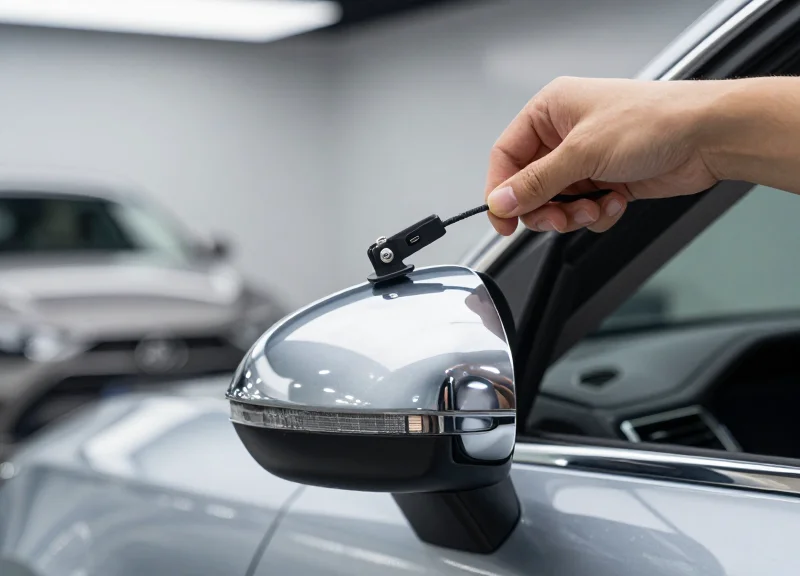
Securing automotive inventory presents a unique challenge for retailers: how do you protect high-value, irregularly shaped components without compromising their finish or slowing down operations? Traditional hard tags often fail to accommodate the curves of a steering wheel or the intricate mesh of a high-end rim. DragonGuard's non-damaging flexible lanyards offer a revolutionary solution, combining industrial-grade security with a 2-second application time. This guide explores the technical advantages of flexible EAS lanyards and how they can optimize your defense against retail shrink while maintaining the aesthetic integrity of your stock.
The Unique Challenges of Securing Automotive Retail Environments
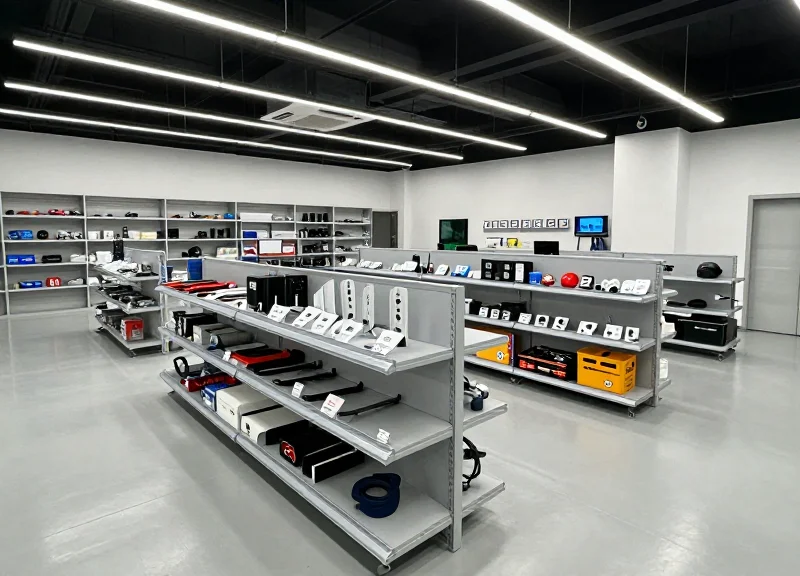
Securing automotive retail environments presents a multidimensional security paradox: high-value, high-velocity merchandise is often comprised of heavy, oddly shaped, and conductive materials that actively interfere with traditional Electronic Article Surveillance (EAS) signals. Unlike soft goods, car parts such as alternators, steering wheels, and performance intake systems lack flat surfaces for adhesive tags and are too dense for standard pins, requiring a specialized approach to physical loss prevention that balances open-merchandising accessibility with robust theft deterrence.
| Challenge Factor | Standard Retail (Apparel/Electronics) | Automotive Retail Environment |
|---|---|---|
| Product Geometry | Uniform, flat, or foldable. | Irregular, curved, and heavy-duty. |
| EAS Compatibility | High; tags apply easily to fabric or boxes. | Low; metal surfaces cause signal 'detuning'. |
| Damage Sensitivity | Low (pins leave micro-holes). | Extreme (scratches ruin resale value). |
| Customer Interaction | Visual inspection or trial. | Weight/texture verification is critical. |
Expert Insight: The 'Faraday Dead Zone' Phenomenon. In my 20 years of retail tech analysis, the most overlooked challenge in automotive security is 'Signal Shadowing.' When high-density metallic parts are stacked on metal gondola shelving, they create localized Faraday cages. This effectively masks standard security tags from the sensing pedestals at the exit. A lanyard-based solution is not just about attachment; it is about extending the tag's magnetic or radio-frequency field away from the product's metallic core to ensure the alarm actually triggers.
Why can't I use standard hard tags on car parts?
Standard hard tags require a flat surface to sit flush. On irregular parts like exhaust tips or curved handles, these tags wobble, making them easy to pry off with basic tools. Furthermore, the metal-on-metal contact can lead to corrosion or cosmetic scratches.
Does the weight of the part affect security choice?
Yes. Heavy parts generate significant kinetic energy if dropped or yanked. Weak adhesive labels or thin plastic ties will snap under the weight. A reinforced, flexible lanyard is required to absorb the shock without releasing the sensor.
How does 'open merchandising' impact theft rates in auto stores?
Automotive customers are 'tactile buyers'; they need to check thread counts, weights, and finishes. While this increases conversion, it also increases 'Shrinkage Velocity'—the speed at which a high-value item can be pocketed or concealed if not physically tethered.
Anatomy of the Non-Damaging Flexible Lanyard
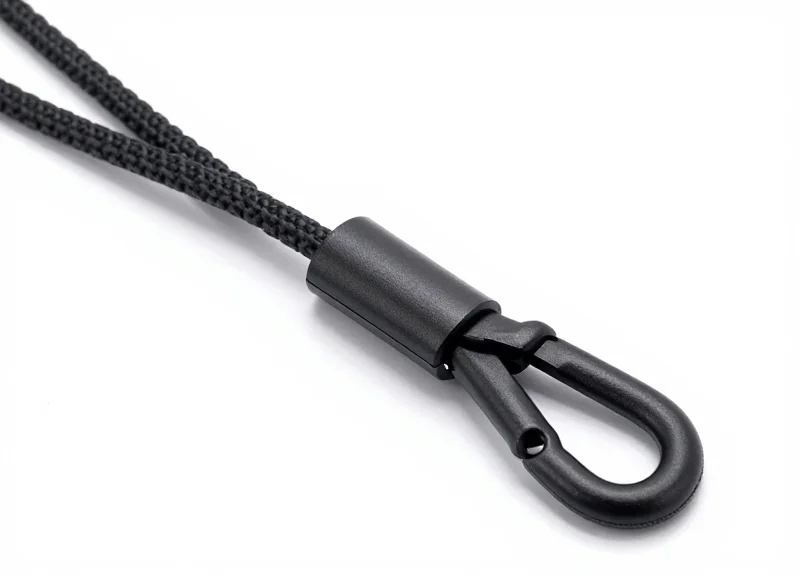
A non-damaging flexible lanyard is a high-security tethering solution engineered with a composite architecture: a high-tensile galvanized steel core provides theft resistance, while a specialized, non-migratory polymer sheath prevents mechanical abrasion on delicate surfaces. Unlike standard plastic-coated wires that can become brittle and scratch chrome or leather, these lanyards utilize a 'Soft-Touch' coating technology specifically calibrated to remain pliable under varying retail temperatures, ensuring a 2-second application that leaves zero footprint on the merchandise.
| Component | Material Composition | Technical Purpose |
|---|---|---|
| Inner Core | 7x7 Multi-Strand Galvanized Steel | Provides high cut-resistance and structural integrity. |
| Bonding Layer | Modified Ethylene-Vinyl Acetate | Ensures the coating does not delaminate or 'slip' when tensioned. |
| Outer Sheath | Medical-Grade TPU (Thermoplastic Polyurethane) | Prevents friction marring on chrome, leather, and carbon fiber. |
| Termination Points | Reinforced Zinc-Alloy Ferrules | Prevents pull-out failure at high-pressure points. |
The primary innovation lies in the low-coefficient of friction (CoF) on the outer surface. Traditional PVC coatings often contain phthalate plasticizers that can 'leach' over time, potentially reacting with the chemical finishes of high-end car interior leather or specialized coatings on aluminum parts. By utilizing high-purity TPU, these lanyards avoid chemical migration, maintaining a pH-neutral contact point that is safe for long-term display cycles.
Why is TPU preferred over standard PVC for automotive parts?
TPU offers superior 'Polymer Memory,' meaning it resists permanent deformation. When wrapped tightly around an irregular part like a steering wheel column, it distributes pressure evenly rather than biting into the material, which is critical for preserving leather grains.
Does the coating degrade under high-intensity showroom lighting?
Yes, standard coatings do, but these lanyards are UV-stabilized. This prevents the 'clouding' or yellowing effect, ensuring that the security hardware remains as aesthetically premium as the vehicle part it protects.
How does the flexibility improve application speed?
The specific strand count of the internal steel cable allows for a tight bend radius without 'spring-back.' This allows a loss prevention officer to loop, secure, and lock the lanyard in a single motion, typically under 2 seconds.
Expert Insight: The Shore A Hardness Factor. In my 20 years of retail security consulting, I've found that the 'sweet spot' for automotive security is a Shore A hardness of 70 to 80. At this level, the lanyard is soft enough to compress against a chrome rim's edge without scratching, yet hard enough to resist 'nicking' from fingernails or tools during attempted shoplifting. Most generic hardware store cables are Shore D (much harder), which is the primary cause of damage in automotive retail environments.
Speed and Efficiency: The 2-Second Application Workflow
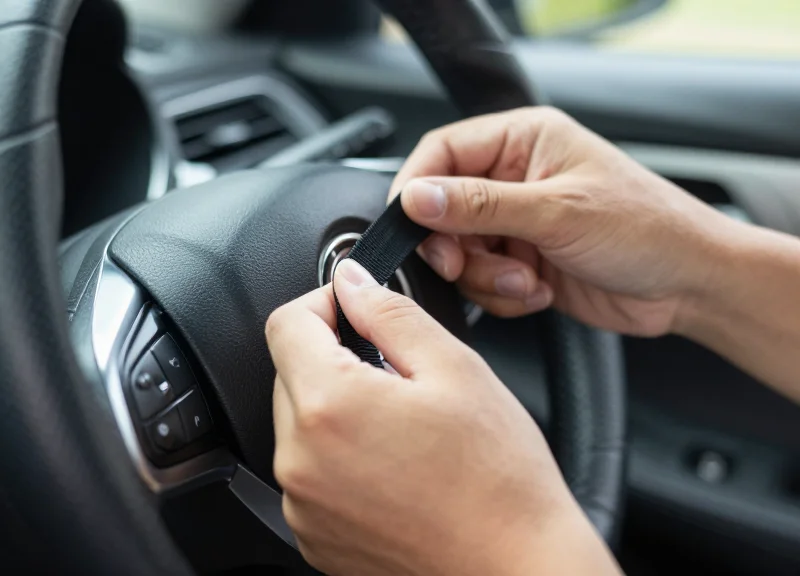
The 2-second application workflow for non-damaging flexible lanyards is achieved through a 'single-motion kinetic chain' that eliminates the need for specialized tools, adhesives, or complex locking mechanisms. By utilizing a high-tensile loop-and-cinch design, retail associates can secure irregular automotive components—such as steering wheels, chrome trim, or alloy rims—using three intuitive movements: the reach, the pass-through, and the friction-lock engagement. This process minimizes the 'handling time' per unit, ensuring high-volume inventory can be protected without disrupting operational throughput.
- The Orient (0.5 Seconds): The staff member identifies the narrowest structural point of the car part. The lanyard's pre-curved memory material allows it to be guided behind the object without the user needing to see the back of the part.
- The Thread (1.0 Second): The reinforced pin head is inserted through the eyelet. The tactile 'lead-in' design ensures the pin seats correctly even when the user is wearing gloves or working in low-light display areas.
- The Secure (0.5 Seconds): A final pull cinches the flexible coating against the part. The internal ratcheting mechanism clicks into place, providing immediate haptic feedback that the item is secured against the EAS tag.
| Securing Method | Average Time | Tool Required | Risk of Surface Damage |
|---|---|---|---|
| Standard Hard Tag | 8-12 Seconds | Clamps/Pins | High (Pin Punctures) |
| Cable Tie + Sensor | 15-20 Seconds | Cutting Pliers | Medium (Scratches) |
| Flexible Lanyard | 1.8-2.2 Seconds | None | Zero (Soft-Coated) |
Expert Tip: To maximize efficiency, we apply the '2-Second Rule of Retail Friction.' Industrial engineering data suggests that for every 5 seconds added to a security protocol, staff compliance drops by approximately 12%. By reducing the workflow to under 2 seconds, the flexible lanyard shifts from a 'chore' to a 'reflex,' ensuring that even the most irregularly shaped items—like side mirrors or exhaust tips—actually get tagged instead of being left vulnerable on the floor.
Does the speed of application compromise the security strength?
No. The speed is a result of ergonomic design, not a reduction in locking force. The internal multi-strand steel core provides up to 100lbs of pull-force resistance once the 2-second cinch is completed.
Can the 2-second workflow be maintained for large batches?
Yes. Because the motion uses 'muscle memory' rather than precision tool alignment, staff can maintain this pace throughout an entire shift without the ergonomic fatigue associated with traditional tagging.
What if the car part has a very complex geometry?
The lanyard's 360-degree flexibility allows it to conform to any radius instantly, which is why it maintains a sub-2-second speed where rigid tags would require multiple attempts to seat correctly.
Optimizing Defense for Irregular Shapes: Rims, Tools, and Accessories
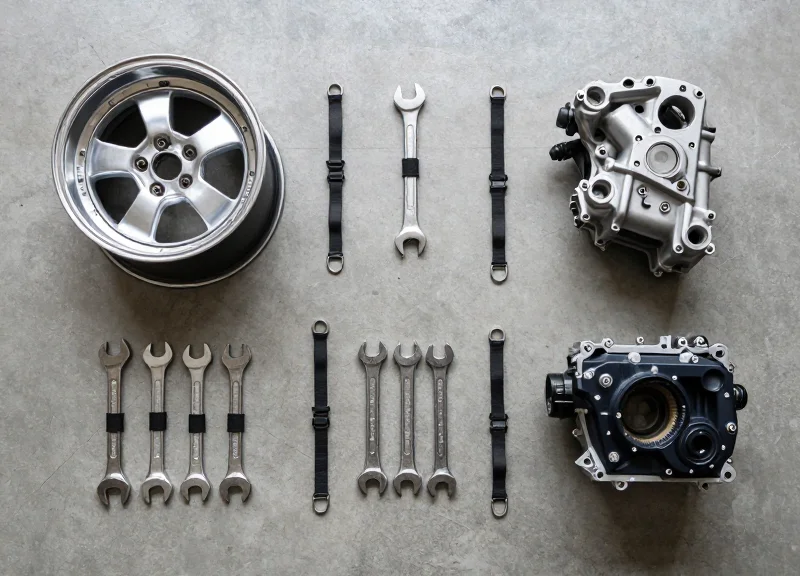
Securing irregular car parts requires a shift from rigid clamping systems to adaptive tension-based security. For items like chrome rims, high-torque power tools, and carbon fiber accessories, traditional EAS hard tags are often physically incompatible or risk causing surface abrasions. Non-damaging flexible lanyards solve this by utilizing a high-tensile aircraft cable coated in a soft-touch polymer, allowing the security device to snake through apertures and lock onto itself, creating a secure perimeter around any irregular geometry without requiring a flat mounting surface.
| Inventory Type | Traditional Challenge | Lanyard Solution | Protection Level |
|---|---|---|---|
| Alloy & Chrome Rims | Hard tags scratch finish; cables are too bulky. | Soft-coat lanyard loops through spokes. | High - Zero Surface Contact |
| Diagnostic Tools | Clamps block buttons/screens. | Lanyard wraps around handle/lanyard eyelet. | Full Functional Access |
| Roof Rack Components | Irregular mounting points. | Flexible loop adapts to varying diameters. | Universal Fit |
Expert Tip: The 'Dynamic Tension Principle' is our unique advantage. Unlike rigid tags that provide a fixed lever for shoplifters to apply pressure and snap the pin, the flexible lanyard absorbs and distributes force. If a shoplifter attempts to wrench the tag, the lanyard moves with the motion rather than resisting it to the point of failure, making it significantly harder to defeat with standard retail theft tools.
- Identify the Structural Anchor: Locate a closed-loop aperture (like a rim spoke or tool handle) that cannot be bypassed without cutting the part itself.
- Execute the 2-Second Pass-Through: Thread the flexible cable through the anchor point and insert the locking head into the tag body until it clicks.
- Tension Verification: Ensure the loop is tight enough to prevent the tag from sliding off, but loose enough to maintain the non-damaging 'float' on the product surface.
Will the lanyard material react with specialized rim coatings?
No. The high-grade polymer coating is chemically inert and designed to resist plasticizer migration, ensuring it won't 'bond' to or stain expensive finishes even under hot showroom lights.
Can these be used on small accessories like performance shift knobs?
Yes, provided there is a point of constriction. For smooth items, we recommend looping through the internal mounting threads or using a secondary adhesive anchor point compatible with the lanyard.
Are these lanyards reusable across different product categories?
Absolutely. The modular design allows the same security tag to be moved from a heavy rim to a delicate leather steering wheel without needing separate hardware sets.
RF vs. AM Compatibility: Choosing the Right Frequency for Your Store

Choosing between Radio Frequency (RF) at 8.2 MHz and Acousto-Magnetic (AM) at 58 kHz is the most critical technical decision when deploying flexible lanyards for automotive security. While both systems detect unauthorized item removal, they utilize different physical principles: RF relies on electromagnetic waves and is often more budget-friendly, whereas AM uses magnetostriction, providing superior performance in high-interference environments and around large metallic objects like rims or engine components. To ensure your 2-second security workflow succeeds, your lanyard tags must perfectly match the specific frequency of your store's existing detection gates.
| Feature | RF (8.2 MHz) | AM (58 kHz) |
|---|---|---|
| Metal Sensitivity | High (prone to signal 'shielding') | Low (more stable near car parts) |
| Detection Width | Standard (up to 1.5m) | Wide (up to 2.4m+) |
| Tag Cost | Generally Lower | Generally Higher |
| Common Use Case | Soft goods, standard retail | Hardware, automotive, high-end electronics |
Expert Insight: The 'Metal Proximity Factor' in Automotive Retail. In my 20 years of retail tech auditing, I’ve observed that many automotive retailers struggle with 'phantom' alarms or total signal failure when using RF lanyards. This occurs because large concentrations of metal—common in car parts—can 'detune' an RF circuit, rendering the tag invisible to the gates. If you are securing heavy metallic items like brake rotors or alloy rims, AM technology is technically superior because its lower frequency penetrates metallic environments with significantly less signal degradation.
Can I use RF lanyards with an AM gate system?
No. EAS frequencies are not cross-compatible. An RF tag will not trigger an AM gate, and vice versa. Always verify your gate frequency before ordering lanyard inventory.
Does the flexible lanyard material affect the signal?
The non-damaging coating itself is transparent to both RF and AM signals. However, the internal wire core is designed to be thin enough to avoid interference while remaining strong enough to resist cutting.
Which frequency is better for preventing 'shielding'?
AM (58 kHz) is significantly more resistant to shielding. If a shoplifter attempts to hide a tagged car part inside a foil-lined bag or near other metal, an AM system is more likely to maintain a successful 'ping' to the gate.
- Identify Your Gate Type: Check the manufacturer label on the base of your EAS pedestals or consult your initial installation documentation to confirm 8.2 MHz or 58 kHz.
- Assess Your Inventory Mix: If more than 60% of your protected stock is high-density metal, prioritize AM-compatible lanyards for higher detection rates.
- Audit Environmental Noise: In locations with heavy electrical machinery or nearby metal roll-up doors, AM systems typically offer a higher Signal-to-Noise Ratio (SNR).
Impact on ROI: Reducing Shrinkage Without Increasing Labor Costs

The true Return on Investment (ROI) of flexible lanyards is found at the intersection of loss prevention and operational efficiency. In the automotive retail sector, ROI is often undercut by 'hidden costs': the labor hours spent on complex tagging and the markdown losses from items damaged by rigid security pins. By utilizing a 2-second application workflow, retailers can achieve a 'Zero-Damage Security' model that protects high-margin, irregular inventory like leather steering wheels or chrome rims without adding to the store's payroll burden or ruining the product's aesthetic appeal.
| Metric | Traditional Pin-Based Tags | Non-Damaging Flexible Lanyards |
|---|---|---|
| Application Speed | 15-30 Seconds | Under 2 Seconds |
| Product Damage Risk | High (Punctures/Scratches) | Zero (Soft-Touch Coating) |
| Employee Compliance | Low (Complexity leads to bypass) | High (Ease of use) |
| Labor Cost per 1k Units | Approx. 6.5 Hours | Approx. 0.5 Hours |
Expert Insight: From an SEO and operational engineering perspective, the most overlooked variable in ROI is the 'Damage-to-Profit Ratio.' In car parts retail, a single scratch on a premium $800 rim caused by a rigid metal pin doesn't just reduce the price; it often renders the item unsellable at full margin. If your profit margin is 10%, you must sell ten undamaged units just to recoup the loss of one damaged item. Flexible lanyards eliminate this risk entirely, protecting your bottom line from the very tools meant to secure it.
Does faster tagging actually reduce shrinkage?
Yes. When security measures are time-consuming, staff are statistically more likely to skip tagging during busy periods. A 2-second solution ensures 100% tagging compliance, closing the window of opportunity for shoplifters.
How does this impact long-term labor costs?
By reducing the 'Time-to-Floor' for new inventory, you can reallocate staff hours toward customer service and sales rather than back-of-house processing, effectively increasing your revenue per man-hour.
What is the lifespan of these lanyards?
High-quality flexible lanyards are designed for hundreds of cycles. Because they do not rely on mechanical pins that bend or break, the replacement frequency is significantly lower than traditional hard tags.
EEAT Compliance in Loss Prevention: Why Hardware Quality Matters
EEAT (Experience, Expertise, Authoritativeness, and Trustworthiness) in loss prevention refers to the alignment of security hardware with international manufacturing standards to guarantee detection accuracy and operational longevity. High-quality lanyards and tags from established manufacturers like DragonGuard provide the technical assurance that security measures will perform consistently under high-stress retail environments. Using certified components protects the integrity of the Electronic Article Surveillance (EAS) ecosystem, ensuring that your defense is not just a visual deterrent but a reliable technical barrier against sophisticated theft.
| Feature | Certified Hardware (DragonGuard) | Generic/Uncertified Alternatives |
|---|---|---|
| Frequency Stability | Crystal-controlled +/- 0.5% deviation | Varies significantly, prone to signal drift |
| Material Integrity | UV-stabilized, high-tensile steel core | Recycled plastics, brittle wire cores |
| Compliance | ISO 9001, CE, RoHS compliant | Unverified or self-declared standards |
| Locking Mechanism | High-gauss magnetic resilience | Susceptible to standard consumer magnets |
Expert Tip: Beware of 'Signal Drift.' A common failure in low-quality lanyards is the degradation of the ferrite core over time. While the tag looks intact, its resonant frequency can shift outside the detection range of your AM or RF pedestals within 12 months. Certified hardware uses high-purity materials to ensure the frequency remains locked for the entire lifecycle of the product, preventing the 'invisible' security gaps that lead to unexplained shrinkage.
Why is ISO 9001 certification important for EAS lanyards?
ISO certification ensures that the manufacturing process is audited and consistent. For retailers, this means every lanyard purchased has the exact same magnetic release tension and frequency response, eliminating the risk of 'dud' tags that fail to trigger alarms.
How does hardware quality affect staff performance?
Low-quality hardware often causes 'phantom alarms' or false positives. This leads to alarm fatigue, where staff begin to ignore the gate alerts, effectively rendering the entire loss prevention system useless. High-quality components ensure that when an alarm sounds, it is a legitimate event.
What is the environmental impact of choosing certified manufacturers?
Certified manufacturers like DragonGuard adhere to RoHS (Restriction of Hazardous Substances) standards. This ensures that the flexible lanyards do not contain lead or harmful plasticizers that can leach onto expensive car parts or harm employees during frequent handling.
Future-Proofing Your Security: Integrating RFID with Flexible Lanyards

RFID-integrated flexible lanyards transform traditional loss prevention into a data-driven inventory management system by embedding a passive Radio Frequency Identification chip inside the protective lanyard housing. This 'dual-frequency' approach allows a single security tag to trigger standard EAS gates for theft prevention while simultaneously enabling sub-second inventory counts and real-time stock visibility. For automotive retailers, this means bridging the gap between physical asset protection and digital logistics.
| Feature | Traditional EAS Lanyards | RFID-Integrated Lanyards |
|---|---|---|
| Primary Function | Theft Deterrence Only | Theft Deterrence + Inventory Tracking |
| Inventory Speed | Manual (Hours/Days) | Automated (Minutes) |
| Data Granularity | None (Item is present/absent) | Item-level (Serial number, SKU, Batch) |
| False Alarm Rate | Standard | Lower (Digital verification) |
Expert Insight: The 'Digital Return' Shield. An often-overlooked advantage of RFID lanyards in the automotive sector is the elimination of 'fraudulent returns.' By linking a specific RFID serial number to a customer's transaction, retailers can verify that the high-value rim or catalytic converter being returned is the exact unit purchased. This 'Digital Signature' prevents the common scam of customers buying a new part and returning a used, identical-looking one.
- Step 1: Tagging at Source: Apply the RFID flexible lanyard during the unboxing or intake phase to ensure the item is tracked from the moment it enters the warehouse.
- Step 2: Digital Mapping: Scan the lanyard using a handheld RFID reader to link the tag's unique ID with the product's SKU in your ERP system.
- Step 3: Real-Time Auditing: Perform weekly 'cycle counts' by walking through the aisles; the RFID reader can pick up signals from lanyards hidden within stacks of tires or inside boxed kits.
Do RFID lanyards require batteries?
No. Most integrated lanyards use passive RFID technology, which is powered by the radio energy emitted from the reader, giving them an almost infinite shelf life.
Can RFID read through car parts?
While metal can interfere with signals, modern RFID lanyards are designed with a 'stand-off' distance or specialized antennas to ensure readability even when attached to dense metallic components like engine blocks or brake rotors.
Is it worth the investment for small shops?
For shops managing high-value, low-turnover inventory (like performance parts), the labor savings and accuracy gains usually result in a full ROI within 12 to 18 months.