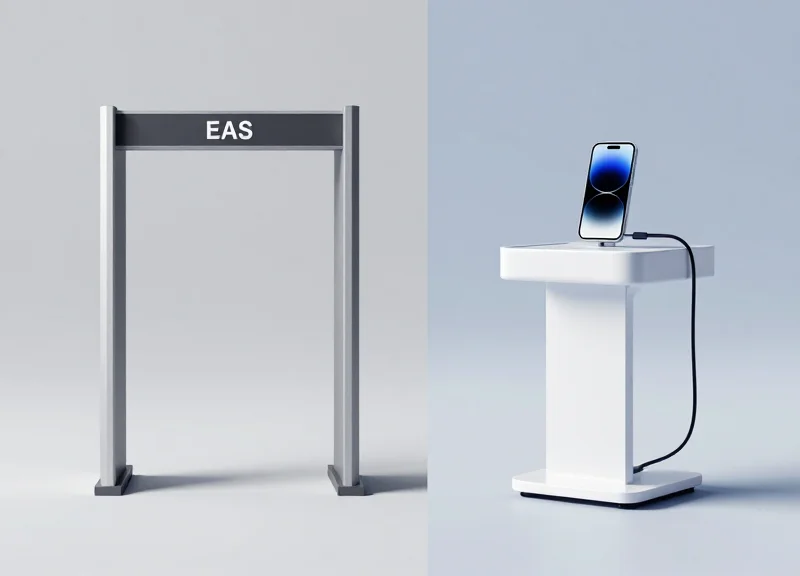
In the modern retail landscape, inventory blind spots are the silent killers of profitability, leading to stockouts, overstocking, and untraceable shrinkage. While Electronic Article Surveillance (EAS) has long protected merchandise, it lacks the data granularity needed for modern supply chains. Conversely, RFID offers incredible visibility but often lacks the robust physical security protocols of traditional EAS. The solution lies in the seamless integration of both technologies. This technical guide explores how dual EAS-RFID systems provide a unified approach to item-level tracking, ensuring every product is accounted for, secured, and visible from the warehouse to the point of sale.
The Evolution of Retail Visibility: Moving Beyond Basic EAS

The evolution of retail visibility marks a shift from reactive loss prevention to proactive inventory intelligence. While traditional Electronic Article Surveillance (EAS) systems served as effective 'binary gatekeepers'—triggering an alarm when an active tag crossed a threshold—they offered no insight into what was being taken or how it affected stock levels. Moving beyond basic EAS involves integrating Radio Frequency Identification (RFID) to create a dual-layered ecosystem that provides item-level granularity. This transformation allows retailers to treat security pedestals not just as theft deterrents, but as critical data nodes that feed real-time analytics into the supply chain.
| Feature | Legacy EAS (AM/RF) | Integrated EAS-RFID |
|---|---|---|
| Primary Function | Loss Prevention (Deterrence) | Inventory Intelligence + Security |
| Data Granularity | Binary (Alarm / No Alarm) | Item-Level (SKU, Color, Size) |
| Visibility Range | Exit Point Only | End-to-End Supply Chain |
| Stock Impact | Manual Reconciliation Required | Automated Real-Time Adjustments |
Expert Insight: The 'Silo Trap' is the biggest hurdle in modern retail. Most organizations treat loss prevention and inventory management as separate departments with separate budgets. However, in a Silicon Valley-grade deployment, these functions merge. By using dual-technology pedestals, a retailer can identify exactly which high-value jacket left the store at 2:00 PM without a transaction, instantly triggering a reorder and updating the 'on-floor' availability count. This eliminates the 'Phantom Inventory' problem—where systems believe an item is in stock because it wasn't scanned out, even though it was stolen.
Why is basic EAS no longer sufficient for modern omnichannel retail?
Basic EAS creates data blind spots. It cannot tell the difference between a $10 t-shirt and a $1,000 designer handbag, nor can it inform the inventory system that a specific SKU is no longer available for 'buy online, pick up in store' (BOPIS) fulfillment.
Does RFID replace EAS entirely?
Not necessarily. While RFID can handle security, many retailers prefer a 'Dual' approach. EAS (specifically Acousto-Magnetic) often performs better near metal or liquids, while RFID provides the rich data. Integrating both ensures 99.9% detection rates alongside 100% item visibility.
What is the primary ROI driver for moving beyond basic EAS?
The primary driver is the reduction of 'Out-of-Stocks.' When security events are tied to item-level data, the system automatically corrects inventory counts, preventing lost sales from customers looking for items that the system wrongly claims are in stock.
Defining the Dual EAS-RFID Architecture

A Dual EAS-RFID architecture is a converged infrastructure that integrates traditional electronic article surveillance (EAS) mechanisms—such as Acousto-Magnetic (AM) or Radio Frequency (RF) technologies—with Ultra-High Frequency (UHF) RFID on a single hardware footprint. This hybrid framework allows retailers to maintain robust loss prevention deterrents while simultaneously capturing real-time, item-level data as products move through transition points, effectively turning a security 'gate' into a sophisticated data ingestion node.
| Component | Function | Technical Specification |
|---|---|---|
| Dual-Technology Tags | Single-point attachment for security and tracking | 58kHz (AM) + 860-960MHz (EPC Gen2) |
| Integrated Reader Gates | Simultaneous theft detection and data capture | Bimodal antennas with high-gain UHF arrays |
| Edge Controller | Localized data filtering and event logic | ARM-based processors with Linux/RTOS |
| Cloud Middleware | Reconciliation of security alarms with inventory | RESTful APIs for ERP and WMS integration |
Expert Insight: The 'Multiplexed Interrogation' Advantage. One major technical hurdle in hybrid systems is the potential for the high-power pulse of an EAS coil to desensitize the sensitive receiver of an RFID reader. Advanced architectures now utilize a 'Multiplexed Interrogation Cycle,' where the firmware coordinates the pulse-timing of the EAS field to occur exactly during the RFID reader's 'dead-time' window. This ensures 99.9% read accuracy even in high-traffic exit environments.
- Phase 1: Tag Harmonization: Select between hard tags for high-shrink apparel or integrated soft-labels that combine both technologies in a single adhesive footprint to reduce application labor.
- Phase 2: Antenna Polarization Tuning: Configure gate antennas with circular polarization to ensure tags are read at any orientation, compensating for the 'body shielding' effect of customers passing through the gate.
- Phase 3: Logic-Level Integration: Establish the software bridge between the EAS alarm trigger and the RFID tag ID. This allows the system to not just beep, but to identify exactly which SKU is leaving the building.
Can I use my existing EAS pedestals for RFID?
While some modern pedestals are 'RFID-ready,' most older systems lack the shielding and mounting internal space required for high-performance UHF antennas. A dedicated hybrid upgrade is typically required for reliable item-level accuracy.
Does this architecture solve 'False Alarms'?
Yes. By correlating an EAS alarm with a 'stale' RFID tag (one not marked as sold in the POS), the system can distinguish between a legitimate theft and a deactivated tag that failed to kill correctly at checkout.
Strategic Advantages of Item-Level Tracking
Item-level tracking is the practice of assigning a unique digital identity to every individual unit of merchandise, allowing retailers to monitor the specific movement, location, and status of every item from the distribution center to the point of sale. Unlike traditional bulk inventory management, which relies on aggregate SKU counts, item-level tracking utilizes serialized data to eliminate the 'black hole' of inventory visibility. This granular approach typically increases inventory accuracy from a retail average of 65% to over 99%, directly reducing out-of-stocks and enabling sophisticated omnichannel fulfillment strategies like BOPIS (Buy Online, Pick Up In Store).
| Capability | Bulk Category Tracking | Item-Level RFID Tracking |
|---|---|---|
| Inventory Accuracy | 60-70% (Estimated) | 98-99.9% (Verified) |
| Stocktaking Speed | Manual / Hours or Days | Automated / Minutes |
| Omnichannel Readiness | Low (High risk of cancelled orders) | High (Real-time stock confidence) |
| Loss Visibility | Known only at year-end audit | Identified instantly at exit |
The most significant strategic shift occurs in the replenishment cycle. In a bulk-tracking environment, a retailer might know they have ten 'Medium Blue Shirts' in the system, but if two are in the fitting room, one is misplaced, and one was stolen, the system fails to trigger a reorder until the shelf is physically empty. I call this the 'Shadow Inventory Paradox': your system says you have stock, but your customer sees an empty shelf. Item-level tracking solves this by providing 'Search-to-Sale' latency reduction. By integrating RFID with EAS, the system knows exactly which serialized unit left the store, allowing for an immediate, automated replenishment trigger that keeps the sales floor optimized without manual intervention.
How does item-level tracking improve the replenishment cycle?
It enables 'smart' replenishment by tracking the exact movement of individual units. When a specific item is scanned at the POS or detected leaving the store via an RFID-EAS gate, the inventory management system updates in real-time, triggering restock alerts based on actual floor depletion rather than estimated averages.
Can item-level tracking reduce shrink more effectively than standard EAS?
Yes. While standard EAS only alerts you that 'something' was taken, item-level tracking tells you exactly what was taken, at what time, and via which exit. This data allows loss prevention teams to identify specific product vulnerabilities and patterns, moving from reactive security to proactive risk management.
What is the impact on labor costs?
Retailers typically see a 75-90% reduction in labor hours dedicated to cycle counting. By using handheld or fixed RFID readers, staff can scan an entire room of inventory in seconds, allowing them to focus on high-value customer service tasks rather than manual counting.
Expert Tip: To maximize ROI, look for 'Cycle Count Velocity.' The true power of item-level tracking isn't just knowing what you have today; it is the ability to perform full-store counts weekly rather than annually. This frequent data heartbeat allows you to identify 'hidden' out-of-stocks—items that are in the store but not on the sales floor—which is the single largest driver of lost revenue in modern retail.
Technical Implementation: Hardware Selection and Placement

Technical implementation of a dual EAS-RFID system requires a strategic balance between the physical robustness of Electronic Article Surveillance (EAS) and the data sensitivity of Radio Frequency Identification (RFID). The hardware selection process must prioritize the 'Interrogation Zone'—the specific volume of space where tags are read—to ensure that item-level data is captured accurately at the point of exit or transition without suffering from signal nulls caused by physical obstructions or RF interference.
| Hardware Type | Primary Function | Best Use Case | Key Consideration |
|---|---|---|---|
| Dual-Tech Hard Tags | Loss Prevention + Inventory | High-value apparel and luxury goods | Requires manual detaching and high durability. |
| RFID-Integrated Labels | Inventory Visibility | Fast-fashion, cosmetics, and boxed goods | Disposable; lower cost but vulnerable to shielding. |
| Bi-Directional Antennas | Movement Directionality | Store entrances and stockroom transitions | Critical for distinguishing sales from theft. |
| Overhead UHF Readers | Wide-area surveillance | High-traffic open floor plans | Higher ceiling clearance required to avoid multipath. |
Expert Insight: The '45-Degree Rule' for Polarization. Most retail RFID antennas use circular polarization to read tags in various orientations. However, for maximum read rates in dual-gate setups, orienting labels at a 45-degree offset relative to the floor significantly reduces 'dead spots' caused by the tag's antenna nulls. This minor adjustment can increase first-pass read rates by up to 15% in high-density environments.
- RF Site Survey and Noise Floor Mapping: Before installation, use a spectrum analyzer to identify ambient noise from existing Wi-Fi, LED lighting drivers, or neighboring systems that might interfere with the 860-960 MHz RFID band.
- Antenna Placement and Beam Steering: Position antennas to create an overlapping field. Use beam-steering techniques to focus energy within the portal, preventing 'false reads' of items located several feet inside the store near the entrance.
- Tag-to-Product Matching: Select tag inlays based on product material. For liquid-based products or metallic packaging, use 'on-metal' or 'spacer' tags to prevent signal absorption or detuning.
- RSSI Threshold Tuning: Configure Received Signal Strength Indicator (RSSI) filters in your middleware to ignore weak signals, ensuring only items physically passing through the gate are logged as 'exited'.
Will metal carts interfere with the RFID read rates?
Yes, metal can reflect or shield RF signals. To mitigate this, antennas should be mounted at multiple heights (low, mid, and high) to ensure waves can reach tags located inside or under metal structures.
How do I prevent 'leakage' where the reader catches tags deep inside the store?
Utilize RF shielding materials (like specialized foil or paint) in the walls surrounding the gate, or more effectively, tune the reader's power output to the minimum level required to cover the door width.
Can I use existing EAS pedestals for RFID?
Some modern pedestals are 'RFID-ready' and allow for internal mounting of antennas. However, older acousto-magnetic (AM) pedestals may require external RFID 'up-fits' or full replacement to avoid interference between the two frequencies.
Software Integration: Syncing RFID Data with ERP and POS

Software integration for dual EAS-RFID systems is the process of translating raw radio-frequency signals into structured business intelligence that updates Enterprise Resource Planning (ERP) and Point of Sale (POS) systems in real-time. This bridge is typically managed by a middleware layer that performs data 'massaging'—filtering out redundant tag reads, deduplicating events, and mapping unique Electronic Product Codes (EPCs) to standard Stock Keeping Units (SKUs). Without this layer, the sheer volume of RFID data would overwhelm enterprise databases, leading to system latency and inaccurate inventory counts.
| Feature | Middleware Layer | ERP / POS System |
|---|---|---|
| Primary Function | Data filtering and device management | Business logic and financial records |
| Data Granularity | Individual EPC (Unique Item ID) | SKU level (Product Category) |
| Update Frequency | Sub-millisecond (Real-time) | Event-driven or Batch updates |
| Integration Goal | Event normalization | Inventory accuracy and transaction logging |
- Edge Filtering: Implement logic at the reader or middleware level to ignore 'stray' reads from items that are not moving through the gate, preventing false inventory deletions.
- API Handshaking: Utilize RESTful APIs or Webhooks to push 'Sold' status from the POS to the RFID database, which simultaneously deactivates the EAS alarm logic for that specific item ID.
- Database Reconciliation: Perform nightly syncs between the RFID 'Source of Truth' and the ERP 'Financial Record' to resolve any discrepancies caused by missed reads or manual overrides.
{
  "event_type": "POS_SALE",
  "timestamp": "2023-10-27T10:15:00Z",
  "epc_list": ["303425789012345678901234"],
  "location_id": "STORE_001",
  "action": "DEACTIVATE_EAS_ALARM",
  "update_inventory": true
}
A common mistake in implementation is attempting to push every 'ping' from an RFID antenna directly into the ERP. This creates 'Data Noise.' My expert recommendation is to implement a 'Change-of-State' logic: only trigger an API call when an item transitions from one zone to another (e.g., Backroom to Sales Floor) or when its status changes (e.g., Available to Sold). This reduces network load by up to 90% while maintaining 99.9% inventory accuracy.
How do we handle 'Ghost Inventory' during sync?
Ghost inventory occurs when the ERP thinks an item is in stock but the RFID reader cannot find it. We solve this by implementing an 'Aging Logic' where an item is marked as 'Missing' after three consecutive failed cycle counts before being officially written off in the ERP.
Can RFID data be used for real-time loss prevention analytics?
Yes. By integrating the EAS alarm event with the RFID middleware, the system can instantly identify exactly which SKU triggered the alarm, allowing security to know the value and nature of the potential theft in real-time.
Overcoming Physical Challenges: Interference and Shielding
In a dual EAS-RFID environment, the primary physical obstacles to 99%+ read accuracy are signal attenuation and detuning caused by 'RF-unfriendly' materials. While traditional EAS operates on low-frequency (AM) or swept-frequency (RF) signals that penetrate most materials, UHF RFID is highly sensitive to liquids, which absorb energy, and metals, which reflect it. To eliminate inventory blind spots, engineers must move beyond basic tag placement and implement advanced shielding and anti-collision strategies that account for the unique dielectric properties of the inventory itself.
| Material/Scenario | Physical Impact | Technical Mitigation Strategy |
|---|---|---|
| High Liquid Content | Signal Absorption (Attenuation) | Use of flag-tags or foam-backed spacers to create an air gap. |
| Metallic Surfaces | Signal Reflection & Detuning | Implementation of 'On-Metal' PCB tags or ferrite-shielded labels. |
| High-Density Displays | Tag-to-Tag Interference | Utilizing 'Slotted Aloha' anti-collision algorithms in firmware. |
| Dense Reader Zones | Reader-to-Reader Crosstalk | Enabling Dense Reader Mode (DRM) and frequency hopping (FHSS). |
Beyond material interference, signal collision occurs when multiple tags respond to a reader simultaneously or when adjacent gates overlap. In a dual-integrated system, the reader must be tuned to utilize 'Dense Reader Mode,' which narrows the channel bandwidth to prevent interference with neighboring gates. This is especially vital in mall environments where your neighbor's RFID system could potentially trigger 'phantom reads' or false EAS alarms at your storefront if the power levels and session parameters are not strictly calibrated.
How do I prevent 'phantom reads' from items near the gate?
Utilize RSSI (Received Signal Strength Indicator) filtering. By setting a minimum power threshold, the system ignores tags that are physically near the gate but lack the signal strength of an item actually passing through the portal.
Can RFID tags be read through metal foil packaging?
Generally no, as metal creates a Faraday cage. The solution is to use 'tag-on-metal' technology or place the tag on a non-metallic part of the packaging, such as a plastic cap or a hang-tab.
Does the EAS signal interfere with the RFID signal?
No, because they operate at vastly different frequencies (e.g., 58kHz or 8.2MHz for EAS vs. 860-960MHz for UHF RFID). However, the physical metal inside a dual-tag must be designed so the EAS coil doesn't act as a shield for the RFID antenna.
Expert Insight: The 5mm Rule. To achieve consistent reads on high-dielectric materials (like glass bottles or liquid containers), always maintain a minimum 5mm 'stand-off' distance between the tag antenna and the product surface. Using an integrated foam spacer or a 'flag' orientation changes the impedance environment enough to prevent the signal from being 'drowned' by the product's moisture content, effectively turning a 'blind' item into a trackable asset.
Optimizing the Customer Experience through ESL and RFID

Optimizing the customer experience through the synergy of Electronic Shelf Labels (ESL) and RFID technology involves bridging the gap between digital data and the physical shelf to provide 100% price accuracy and real-time stock visibility. By leveraging RFID’s item-level tracking and ESL’s dynamic display capabilities, retailers can eliminate 'ghost stock' disappointment, enable frictionless self-checkouts, and provide shoppers with instant, localized product information that mirrors the speed and transparency of online shopping.
In the modern retail landscape, the 'Trust Gap' is the primary killer of customer loyalty. When a shopper sees a price on a shelf that differs from the price at the POS, or when an app says an item is in stock but the shelf is empty, brand equity erodes. Integrating ESLs with an RFID backbone ensures that the physical label on the shelf is a living document, updated automatically as inventory moves or as corporate pricing strategies shift.
| Feature | Legacy Retail Model | RFID + ESL Integrated Model |
|---|---|---|
| Price Accuracy | Manual updates; 5-10% error rate. | Real-time sync with ERP; 0% discrepancy. |
| Stock Visibility | Estimated based on daily sales. | Live shelf-level count via RFID pulses. |
| Omnichannel Sync | Delayed (Hours/Days). | Instantaneous 'Click-and-Collect' updates. |
| Customer Friction | High; requires staff for price checks. | Low; QR codes on ESL provide deep data. |
Expert Insight: The 'Micro-Fencing' Advantage. One unique strategy often overlooked is using RFID to enable Batch-Specific Dynamic Discounting. For example, if RFID data detects that a specific subset of milk cartons is within 48 hours of expiration, the system can automatically trigger a 'Flash Sale' price update to the corresponding ESL only. This minimizes food waste while offering the customer an immediate, tangible value that manual systems simply cannot execute at scale.
- Automated Stock-Out Alerts: RFID readers detect when the 'on-shelf' count drops below a threshold, instantly flashing an alert on the ESL or changing the display to 'Restocking Soon' to manage customer expectations.
- Interactive Product Discovery: Customers can tap their NFC-enabled smartphone to an ESL; the RFID-linked backend then serves personalized recommendations or reviews based on the specific item's SKU.
- Frictionless Self-Checkout Sync: As items are removed from the shelf, the RFID gate recognizes the movement, while the ESL ensures the customer knows the exact price they will be charged, eliminating surprises at the kiosk.
Does ESL integration slow down the RFID network?
No. ESL typically operates on sub-GHz or 2.4GHz proprietary protocols (like Zigbee), while RFID operates in the UHF range (860-960 MHz), ensuring zero signal interference.
Can ESLs show 'Units Remaining' to customers?
Yes, by pulling real-time data from the RFID middleware, ESLs can display 'Only 3 left!' which creates a sense of urgency and assists in inventory transparency.
How does this impact store labor costs?
It significantly reduces them. Staff no longer spend hours swapping paper tags or performing manual cycle counts, allowing them to focus on direct customer service.
Calculating ROI: Shrinkage Reduction vs. Operational Efficiency

Calculating the Return on Investment (ROI) for dual EAS-RFID integration requires a holistic 'Total Value of Ownership' (TVO) approach. While traditional EAS focuses solely on the defensive posture of loss prevention, the dual-layered approach creates a recursive value loop: the RFID component drives 99.5% inventory accuracy, which in turn ensures that the EAS component is protecting the right assets at the right time. The true ROI is the sum of direct savings from reduced shrinkage and the significant margin expansion generated by reclaimed labor hours and increased sales floor availability.
| Metric Category | EAS Contribution (Shrinkage) | RFID Contribution (Efficiency) |
|---|---|---|
| Direct Financial Impact | 15-25% reduction in external/internal theft. | 2-4% sales lift due to improved 'on-shelf' availability. |
| Labor Allocation | Reduced time on manual tag audits. | 90% reduction in cycle counting time. |
| Data Granularity | Binary (Item is present or absent). | Serialized (Knowing exactly which SKU was lost). |
| Stock Optimization | Minimal impact on stock levels. | Reduced safety stock requirements by 10-15%. |
Expert Tip: The Hidden Multiplier Effect. Most CFOs overlook the 'Working Capital Velocity.' By utilizing item-level RFID tracking within your EAS gates, you can identify exactly which items are high-theft targets in real-time. This allows you to reduce safety stock levels for non-target items, freeing up massive amounts of cash flow that was previously trapped in 'just-in-case' inventory buffers. This capital optimization often pays for the hardware infrastructure faster than shrinkage reduction alone.
- Baseline Measurement: Audit current shrinkage rates and labor costs associated with manual inventory counts over a 12-month period to establish a pre-implementation control group.
- Calculate the 'Shadow Loss': Quantify lost sales opportunities caused by Out-of-Stocks (OOS). RFID data reveals items that are 'in the building' but not 'on the floor,' a blind spot traditional EAS cannot address.
- Apply the Efficiency Coefficient: Factor in the reduction of 'dead stock' and markdowns. Accurate item-level data ensures better first-price sell-through rates, directly impacting the bottom line.
Does dual integration increase the 'cost-per-tag' significantly?
While a dual EAS-RFID tag has a higher unit cost than a standard RF label, the labor savings from not having to apply two separate tags, combined with the inventory accuracy gains, typically results in a 30% lower total processing cost per item.
How long is the typical payback period for this technology?
In high-volume retail environments, most enterprises see a full ROI within 12 to 18 months, driven primarily by the combination of reduced labor and the elimination of phantom inventory.
Can RFID help identify the specific source of shrinkage?
Yes. Unlike standard EAS, RFID-enabled gates log the specific serial number of the item passing through. This allows operations to distinguish between organized retail crime (ORC) and administrative errors in the supply chain.
Future-Proofing Your Infrastructure with DragonGuard Solutions
Future-proofing your retail or warehouse infrastructure means investing in hardware and software that can evolve alongside emerging IoT standards without requiring a total 'rip-and-replace' strategy. DragonGuard Solutions achieves this by providing a unified ecosystem where EAS security and RFID data intelligence coexist on a single, modular platform. By utilizing multi-protocol antennas and hybrid tag technology, DragonGuard ensures that your current investment in loss prevention serves as the foundation for tomorrow's real-time supply chain visibility.
| Feature | Legacy Siloed Systems | DragonGuard Integrated Solutions |
|---|---|---|
| Hardware Footprint | Dual pedestals (EAS + RFID separately) | Single-pedestal 'Hybrid' design |
| Scalability | Hardwired and rigid; difficult to upgrade | Modular firmware; OTA (Over-the-Air) updates |
| Data Interoperability | Proprietary silos; no API access | Open API and Middleware-agnostic |
| Tag Longevity | Single-use; limited frequency range | Wide-band UHF + Dual-frequency durability |
A primary challenge in long-term deployment is the 'Technical Debt' incurred by proprietary hardware. DragonGuard mitigates this by focusing on 'Universal Interoperability.' Our hardware is designed to support global standards (ISO/IEC 18000-63 and EPC Gen2v2), ensuring that as global trade regulations or frequency allocations shift, your infrastructure remains compliant. This versatility allows enterprises to start with high-shrink departments and expand to full-store deployments with zero friction.
How does DragonGuard handle hardware obsolescence?
We utilize a modular PCB design. Instead of replacing an entire antenna pedestal, users can swap out communication modules to upgrade from 4G to 5G or update RFID reader sensitivity as chip technology improves.
Can DragonGuard tags withstand harsh industrial environments?
Yes, our specialized 'Hard Shell' tags are engineered with IP67-rated materials, making them resistant to moisture, high temperatures, and high-impact warehouse environments where standard labels fail.
Does the system support third-party cloud platforms?
Absolutely. Our middleware is designed to push data to Azure, AWS, or private clouds, ensuring your inventory data is never locked into a single vendor's ecosystem.
Expert Insight: The 'Ghost-Reserve' Memory Advantage. Unlike generic RFID vendors, DragonGuard's high-end tags incorporate a proprietary 'Ghost-Reserve' memory architecture. This allows retailers to store encrypted blockchain-based provenance data or environmental history (such as maximum temperature exposure) directly on the item-level tag. As consumer demand for transparency and sustainability grows, your infrastructure will already possess the data-carrying capacity to meet these requirements without a hardware overhaul.