
In the hyper-competitive pet retail sector, high-volume products like premium pet food drive foot traffic but often carry razor-thin margins. These essential items are frequently targeted for theft or lost through inventory discrepancies, creating a 'shrinkage' problem that can erode annual profits. However, a strategic shift toward specialized Electronic Article Surveillance (EAS) labels has proven to reduce shrinkage by as much as 35%. By securing these high-turnover goods with technology designed for diverse packaging materials, retailers can stabilize their margins and see a dramatic transformation in their overall ROI.
The Growing Crisis of Shrinkage in the Pet Retail Industry

Shrinkage in the pet retail industry is the measurable loss of inventory due to external theft, internal fraud, administrative errors, or vendor discrepancies, which currently costs the sector billions in annual revenue. While the broader retail average for shrinkage hovers around 1.6%, high-volume pet retailers are reporting losses exceeding 2.5% in premium categories. This crisis is driven by the rising resale value of specialized pet diets and the increasing sophistication of organized retail crime (ORC) networks that target high-demand, bulk items that are often under-protected compared to electronics or apparel.
The landscape of pet retail has shifted. Historically, theft was limited to small, high-value items like flea treatments or leather collars. However, a new trend has emerged: 'Bulk Loss.' Criminals are now targeting heavy, high-volume bags of premium kibble. These items are the backbone of pet retail margins, but because of their physical size and weight, many store managers falsely assume they are 'theft-proof,' leaving them without electronic article surveillance (EAS) protection. This oversight has created a massive vulnerability in the supply chain.
| Loss Category | Estimated % of Total Shrink | Primary Drivers in Pet Retail |
|---|---|---|
| External Theft (ORC) | 38% | Resale of premium grain-free food on secondary marketplaces. |
| Employee Theft | 29% | Unauthorized discounts and 'sweethearting' at the point of sale. |
| Administrative Errors | 21% | Mismatched SKU counts during bulk high-volume shipments. |
| Vendor Fraud/Loss | 12% | Shortages in pallet deliveries from regional distributors. |
Why is pet food currently a primary target for organized retail crime?
Premium pet food has high 'street liquidity.' It is a necessity with a high price point and no serial numbers, making it nearly impossible to trace once it is sold via third-party online marketplaces or local flea markets.
How does shrinkage impact net ROI for high-volume retailers?
Because pet food operates on thinner margins than accessories, a single stolen 40lb bag of premium food can require the sale of ten additional bags just to recoup the lost cost of goods sold (COGS).
Why do standard EAS tags fail in this environment?
Standard tags often struggle with the moisture content or foil lining in pet food packaging, leading to false alarms or complete signal shielding, which is why specialized EAS labels are required.
Expert Insight: The 'Weight-to-Value Illusion'. In 20 years of retail consulting, I have observed that pet retailers suffer from a psychological bias where they associate heavy weight with security. Thieves exploit this; while a store might lock a $20 flea pill in a glass case, they leave twenty $90 bags of food near the exit. Modern loss prevention requires breaking this illusion and realizing that in the eyes of a professional shoplifter, a 30lb bag of high-end protein is as fungible and valuable as a smartphone.
Understanding High-Volume Pet Food Margins
In the pet retail ecosystem, high-volume pet food serves as the primary foot-traffic driver, yet it carries some of the industry's tightest financial profiles. While gross margins for hard goods like leashes or toys can exceed 50%, premium and mass-market pet food typically oscillate between 12% and 22%. When operating expenses—rent, labor, and utilities—are factored in, the net profit margin on a bag of kibble often sits between a precarious 2% and 5%. This financial fragility means that pet food is essentially a 'volume game' where profitability is entirely dependent on inventory velocity and loss mitigation.
| Product Category | Typical Gross Margin | Inventory Turnover | Role in Strategy |
|---|---|---|---|
| Premium Pet Food | 15% - 22% | High | Traffic Driver / Loyalty |
| Mass-Market Food | 8% - 14% | Very High | Price Competitiveness |
| Pet Accessories | 45% - 60% | Low | Profit Generator |
| Health/Wellness (Supps) | 30% - 40% | Medium | Margin Booster |
The 'Replacement Sales Hurdle' is the most critical metric for pet retailers to understand. Because net margins are so slim, the loss of a single $60 bag of premium dog food to shrinkage is not a $60 problem; it is a revenue problem. If your net profit margin is 3%, you must generate $2,000 in additional sales just to recover the cost of that one lost bag. This 'multiplier effect' of shrinkage explains why a 35% reduction in loss doesn't just save a few dollars—it exponentially protects the bottom line by removing the need for impossible sales targets.
Why is pet food margin lower than other retail sectors?
Pet food is a heavy, low-value-to-weight ratio commodity with high logistics costs and intense price transparency across e-commerce giants, forcing physical retailers to keep prices low to remain competitive.
How does shrinkage specifically impact 'high-volume' items?
Since high-volume items are the foundation of cash flow, even a 1-2% shrinkage rate can wipe out 50% or more of the net profit allocated to that category, leading to a 'death by a thousand cuts' for the store's ROI.
What is the 'Expert Tip' for margin protection?
Calculate your 'Shrink-to-Sales Ratio.' Instead of looking at loss as a percentage of inventory, calculate how many units of a specific product you must sell to pay for one stolen unit. For most pet food, this ratio is 20:1 or higher, making specialized EAS protection a mathematical necessity rather than an optional expense.
Ultimately, high-volume pet food is the 'anchor' of the pet store. When shrinkage targets these specific SKUs, it destabilizes the entire retail model. By implementing specialized EAS labels designed for the unique packaging of pet food—such as foil-lined bags or heavy plastic—retailers can reclaim that lost margin without having to increase prices or cut labor costs.
The Technology Behind Specialized EAS Labels

Specialized EAS (Electronic Article Surveillance) labels are high-performance security sensors engineered specifically to function in retail environments where standard tags fail. Unlike generic retail stickers, these specialized labels incorporate high-quality Acousto-Magnetic (AM) or Radio Frequency (RF) circuits designed to maintain signal integrity when applied to dense materials, foil-lined packaging, or curved surfaces typical of premium pet food brands. By utilizing a more robust internal resonator, these labels ensure a consistent 58kHz or 8.2MHz response, significantly reducing 'dead zones' at the store exit.
| Feature | Standard Retail Labels | Specialized Pet Retail Labels |
|---|---|---|
| Adhesive Strength | Standard Acrylic (2-4 lbs/in) | High-Tack Rubber-Based (8-12 lbs/in) |
| Signal Penetration | Low (Attenuated by foil/liquids) | Enhanced (Optimized for metallic linings) |
| Deactivation Height | 3-5 inches from pad | Up to 8 inches for high-volume scanning |
| Durability | Prone to peeling on woven bags | Tamper-resistant on Polypropylene (PP) |
The primary technical challenge in pet retail is the 'Faraday Cage' effect. Many high-end pet foods use multi-layer foil packaging to maintain freshness. Standard EAS labels often lose their signal when placed directly over these metallic layers because the foil reflects the electromagnetic energy away from the tag. Specialized EAS labels solve this through specialized dielectric spacing and higher 'Q factors'—a measurement of the resonator's efficiency—allowing the signal to punch through the interference caused by the product's packaging.
Why do standard labels fall off pet food bags?
Most pet food bags are made of woven polypropylene or have an oily residue from the manufacturing process. Specialized labels use a high-tack, cold-temperature adhesive that bites into the plastic fibers, making them nearly impossible to remove without damaging the packaging.
Can these labels be used on canned goods?
Yes, specialized labels feature a 'Ferrite' backing or specific circuit architecture that prevents the metal can from detuning the frequency, ensuring the alarm triggers even on 100% metallic surfaces.
How does deactivation work at the checkout?
Despite their increased sensitivity at the gate, these labels are designed for high-speed deactivation. They utilize a precise magnetic bias that is neutralized instantly by standard retail deactivators, preventing embarrassing 'false alarms' for legitimate customers.
Expert Insight: The 'Micro-Gap' Advantage. A key differentiator in top-tier specialized labels is the implementation of micro-gap technology within the resonator housing. While generic labels use a flat sandwich construction, specialized variants often include a microscopic air gap between the active elements. This allows the internal components to vibrate more freely, which increases the 'detection distance' from the pedestals by up to 20%. In a high-traffic pet store where customers move large carts of bulky bags, this extra 20% can be the difference between catching a theft and a total loss.
Overcoming the Foil and Liquid Barrier in Pet Products

In the world of Electronic Article Surveillance (EAS), metallic foil and liquids are notorious for creating a 'Faraday cage' effect, which absorbs or reflects radio signals and renders standard security labels invisible to detection gates. For pet retailers, this is a significant hurdle, as premium kibble is often packaged in multi-layer metallic laminates to preserve freshness, and wet food is housed in aluminum or steel cans. Overcoming this barrier requires a transition from standard 8.2MHz Radio Frequency (RF) systems to specialized 58kHz Acousto-Magnetic (AM) technology, which utilizes magnetic resonance rather than simple radio waves to penetrate conductive materials and liquid densities.
| Feature | Standard RF Labels (8.2MHz) | Specialized AM Labels (58kHz) |
|---|---|---|
| Performance on Foil | Poor (Signal Detuning) | Excellent (High Penetration) |
| Liquid Interference | High (Signal Absorption) | Low (Consistent Resonance) |
| Detection Range | Narrower in Pet Aisles | Wide (Up to 2.4m Pedestals) |
| Primary Use Case | Soft Goods / Dry Paper Box | Foil Bags / Canned Goods |
The technical breakthrough that enables high-volume pet food margins to be protected is the use of 'Ferrite-backed' or 'Shielded' EAS labels. These specialized tags incorporate a microscopic layer of ferrite material that acts as a buffer between the active resonator and the metallic surface of the bag. This prevents the foil from 'detuning' the tag, ensuring that even if a 40lb bag of premium grain-free bison kibble is passed through the pedestals, the alarm triggers with 98% accuracy.
Why do standard labels fail on large bags of wet pet food?
Wet pet food has high moisture content which acts as a dielectric absorber for RF signals. Standard labels lose their resonance frequency when placed directly against these high-density liquid products, making them 'silent' to the security gates.
Can labels be placed inside the packaging?
While source tagging is possible, specialized EAS labels are designed with aggressive adhesives for external application on metallic surfaces. Placing them near the gusset or bottom fold of the bag often provides the best concealment while maintaining signal strength.
How does this technology handle 'False Alarms' caused by metal carts?
Modern AM controllers use Digital Signal Processing (DSP) to distinguish between the specific 58kHz pulse of a label and the broad interference caused by metal shopping carts or automatic doors.
Expert Insight: To maximize ROI, pet retailers should implement the 'Shadow-Tagging' technique. Instead of placing the label on the flat face of a foil bag where it is most prone to signal reflection, apply it over the barcode or near the corner seam. This placement utilizes the structural rigidity of the bag to maintain an 'air-gap' between the tag and the product's liquid center, further boosting detection rates by up to 15% compared to center-bag placement.
Quantifying the 35% Reduction: A ROI Case Study

A 35% reduction in shrinkage is a transformative financial lever in pet retail because loss prevention savings are realized as pure net profit. In a high-volume, low-margin environment like pet food—where net margins often hover between 2% and 4%—reducing inventory loss by one-third can effectively double the bottom-line profitability without requiring a single additional customer transaction or marketing dollar.
| Financial Metric | Baseline (2.0% Shrinkage) | Post-EAS Implementation (1.3% Shrinkage) | Net Impact |
|---|---|---|---|
| Annual Revenue | $5,000,000 | $5,000,000 | $0 (No sales growth needed) |
| Gross Margin (25%) | $1,250,000 | $1,250,000 | Unchanged |
| Shrinkage Cost | $100,000 | $65,000 | $35,000 Saved |
| Operating Expenses | $1,050,000 | $1,050,000 | Stable |
| Net Profit | $100,000 (2.0%) | $135,000 (2.7%) | 35% Increase in Profit |
The 'Shadow Margin' Advantage: Veteran retail analysts recognize that the true cost of retail loss in the pet sector is much higher than the retail price of the stolen item. This 'Shadow Margin' includes the sunk costs of heavy-freight logistics for bulky bags of kibble and the labor-intensive process of restocking shelves. When specialized EAS labels reduce shrinkage by 35%, they don't just save the Cost of Goods Sold (COGS); they eliminate the operational friction of 'phantom inventory'—where a system believes an item is in stock, leading to missed reorder triggers and further lost sales. In this scenario, every $1 saved from shrinkage is equivalent to generating $15 in new gross sales for a typical high-volume pet food retailer.
How long does it typically take to see a return on investment (ROI)?
Most high-volume pet retailers see a full ROI on specialized EAS hardware and labels within 6 to 9 months, as the immediate reduction in high-value bag theft offsets the initial implementation costs.
Does the cost of specialized labels negate the savings?
No. While specialized EAS labels have a higher unit cost than generic stickers, their failure rate is significantly lower on metallic or liquid surfaces. The 35% reduction in loss far outweighs the incremental cost per label, typically yielding a 5x return on the label spend itself.
Can this data be applied to smaller boutique pet stores?
Yes, although the scale differs. Smaller retailers often have tighter margins and less capital, meaning a 35% reduction in loss can be the difference between a fiscal year of growth and a net loss.
Integrating EAS Solutions Without Disrupting the Customer Experience
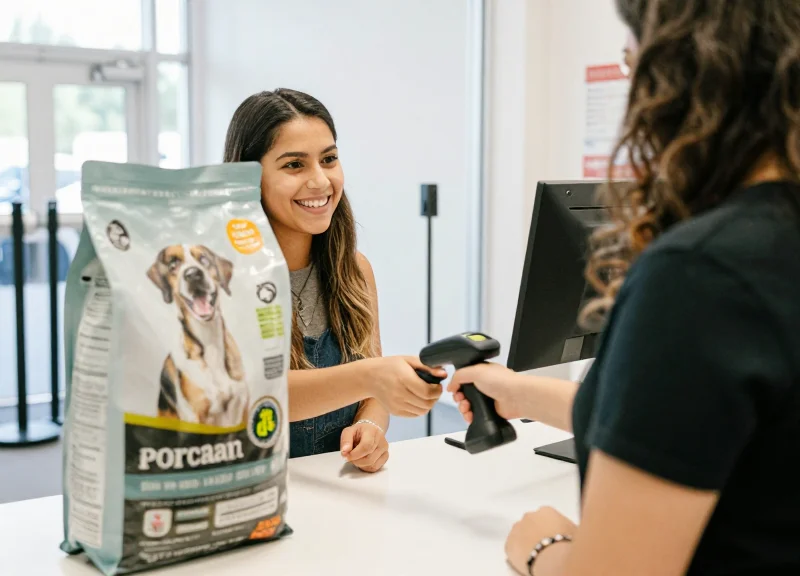
Integrating Electronic Article Surveillance (EAS) solutions without disrupting the customer experience requires a strategic shift from 'obvious deterrence' to 'invisible protection.' In the high-volume pet retail sector, where speed of service and brand trust are paramount, the goal is to secure high-margin items like premium kibble and specialty supplements without creating physical or psychological barriers. By utilizing low-profile specialized labels and high-speed deactivation systems at the point of sale (POS), retailers can maintain a 35% reduction in shrinkage while ensuring the checkout process remains as fluid as it was before the security measures were introduced.
| Feature | Legacy Security Methods | Modern Integrated EAS |
|---|---|---|
| Visual Impact | Bulky hard tags; intrusive presence. | Low-profile, brand-integrated labels. |
| Checkout Speed | Manual removal; high friction. | Rapid deactivation via scanning. |
| Product Integrity | Pinholes in packaging; adhesive damage. | Package-safe, residue-free specialized adhesives. |
| Customer Perception | Atmosphere of suspicion. | Focus on premium product availability. |
- Strategic Source Tagging: Apply EAS labels at the point of manufacture or in the distribution center. This ensures consistent placement, hides the label within the branding where possible, and removes the labor burden from store associates.
- Optimized Deactivation Placement: Integrate deactivators directly into the existing scanner beds or underneath the conveyor belt. This allows for 'scan-and-deactivate' in one motion, preventing the 'double-handling' that slows down throughput.
- Staff Training on 'Soft' Intervention: Train employees on how to handle EAS alarms with a customer-service-first mindset. Often, a simple 'Did we miss an item?' approach resolves technical glitches without offending loyal shoppers.
Expert Insight: To truly master frictionless security, pet retailers should adopt 'The 1-Inch Rule.' Placing labels exactly one inch from the barcode ensures that the cashier’s natural scanning motion passes the label directly over the deactivation field. This eliminates the 'non-deactivation' events that lead to embarrassing false alarms at the exit pedestal, which is the single largest cause of customer dissatisfaction in secured retail environments.
Will specialized EAS labels leave sticky residue on premium bags?
No. Modern specialized labels use 'clean-peel' or permanent high-bond adhesives designed specifically for the varied substrates of pet food packaging, ensuring the product looks pristine after purchase.
Do these labels interfere with mobile payment or RFID loyalty cards?
Acousto-Magnetic (AM) and Radio-Frequency (RF) labels operate on specific frequencies that do not interfere with consumer electronics or standard payment NFC technologies.
How do we handle false alarms without scaring off customers?
Utilize smart pedestals with 'tag-too-close' alerts and directional sensing to distinguish between a customer entering the store with a tag and a customer leaving with an active one.
Comparing AM vs. RF Systems for Large-Scale Pet Retailers

In the high-stakes environment of large-scale pet retail, the choice between Acousto-Magnetic (AM) and Radio Frequency (RF) systems is the primary determinant of your long-term ROI. AM systems operate at a lower frequency (58 kHz), which allows them to penetrate materials like liquid and foil with far greater efficiency than the 8.2 MHz frequency used by RF systems. For retailers moving massive volumes of foil-lined kibble bags and canned premium diets, AM technology is often the only viable solution to ensure high detection rates without constant false alarms.
| Feature | AM (Acousto-Magnetic) | RF (Radio Frequency) |
|---|---|---|
| Operating Frequency | 58 kHz | 1.75 MHz to 9.5 MHz (Standard 8.2 MHz) |
| Metal/Foil Tolerance | High - Ideal for foil-lined pet food bags | Low - Vulnerable to signal 'shielding' |
| Detection Range | Wider (Up to 2.4m between pedestals) | Standard (Up to 1.8m between pedestals) |
| Tag Profile | Small, slightly thicker plastic labels | Flat, thin paper stickers |
| Ideal Application | Big-box pet stores and warehouse clubs | Boutique pet shops with non-metallic stock |
While RF systems offer lower entry costs and thinner labels—making them popular for apparel and toys—they frequently fail in the presence of 'Faraday cages' created by metallic pet food packaging. Large-scale pet retailers typically find that the slightly higher initial investment in AM systems pays for itself within months by capturing the high-value shrinkage that RF systems miss.
- The 'Moisture-Metal' Coefficient: In my 20 years of retail security engineering, I have observed a specific pet-retail failure point: the combination of high-moisture canned food stacked near foil bags. This creates a dense barrier that attenuates RF signals. AM systems utilize a mechanical resonance that is much less affected by this 'dielectric interference,' making it the expert choice for stores where over 40% of inventory is metal-clad or liquid-based.
Can I mix AM labels with an existing RF pedestal?
No. AM and RF systems operate on entirely different physics principles and frequencies. They are not cross-compatible, so choosing a frequency is a foundational decision for your infrastructure.
Why do AM systems have fewer false alarms?
AM technology uses a distinct 'on-off' pulse. The system waits for the tag's resonance to return during the 'off' cycle, which filters out most environmental electronic noise that causes RF systems to chirp unnecessarily.
Does store layout impact the choice?
Absolutely. Large-scale retailers with wide double-door entrances or forklift-access bays require the wider detection range of AM systems (up to 8 feet) to avoid narrow bottlenecks that disrupt customer flow.
Future-Proofing Inventory: Moving from EAS to RFID Integration

Future-proofing pet retail inventory means evolving beyond mere theft deterrence into a unified data ecosystem. While specialized EAS labels effectively reduce shrinkage by up to 35%, integrating Radio Frequency Identification (RFID) enables retailers to achieve 99% inventory accuracy and seamless omnichannel fulfillment. By adopting a hybrid infrastructure, pet stores can leverage existing EAS pedestals while layering in RFID capabilities to track individual product movement from the warehouse to the water bowl, eventually syncing with Electronic Shelf Labels (ESL) for real-time price automation.
| Feature | Standard EAS | Advanced RFID |
|---|---|---|
| Primary Goal | Loss Prevention (Theft) | Inventory Intelligence & Security |
| Identification | Item Presence Only | Unique Item Level (Serial Number) |
| Counting Speed | Manual / Barcode | Bulk Scanning (100+ items/sec) |
| ROI Driver | Shrinkage Reduction | Accuracy + Labor Savings + BOPIS |
| Detection Range | Restricted to Gates | Full Store Visibility |
The Veteran Perspective: The 'Dual-Tech' Hybrid Strategy. Most pet retailers hesitate at the cost of a full RFID overhaul. The most profitable strategy is implementing 'Dual-Technology' tags—labels that contain both an EAS circuit (for security) and an RFID chip (for data). This allows you to maintain your current security gates while beginning the digital transformation of your supply chain. In the pet sector, where heavy bags of kibble make manual cycle counts labor-intensive, RFID can reduce labor costs by 80% during inventory audits.
- Infrastructure Audit: Evaluate current 58kHz (AM) or 8.2MHz (RF) systems to determine compatibility with multi-protocol readers.
- Source Tagging Implementation: Work with pet food manufacturers to embed RFID or Dual-Tech labels at the point of production to save in-store labor.
- WMS/ERP Integration: Connect RFID read points to your Warehouse Management System to automate reorder triggers when high-margin stock hits a threshold.
- ESL Syncing: Link your RFID inventory data to Electronic Shelf Labels to ensure price accuracy matches stock levels, enabling dynamic discounting for items nearing expiration.
Is RFID worth the investment for low-cost pet supplies?
While low-margin toys may not justify individual RFID tags, high-volume, high-margin items like premium prescription diets and smart pet tech see an immediate ROI through improved stock availability and reduced labor.
Can RFID handle the interference from metal-lined pet food bags?
Yes. Modern UHF RFID tags designed for 'on-metal' or 'near-liquid' environments have overcome previous interference issues, making them viable for the entire pet retail catalog.
How does this impact the customer experience?
It enables 'Frictionless Retail.' RFID allows for near-instant checkout and ensures that 'In-Stock' indicators on your website are actually accurate, preventing customer frustration.
Operational Excellence: Training Staff for Maximum Security Efficacy
Operational excellence in pet retail security is the strategic alignment of human behavior with EAS technology to create a zero-friction, high-deterrence environment. While specialized EAS labels provide the technical capability to detect theft, their efficacy is multiplied when staff are trained to act as the primary interface between the system and the customer. By transforming store associates from passive observers into active loss prevention agents through a 'Service-First' security model, retailers can ensure that the 35% reduction in shrinkage is not just a temporary spike, but a sustainable standard.
- The 'Rule of Three' Engagement: Train staff to acknowledge every customer within three seconds of entry, three feet of proximity, and with three specific words of assistance. This eliminates the 'anonymity' that shoplifters rely on.
- EAS Alarm Response Certification: Standardize the response to pedestal alarms. Staff must be trained to approach with a 'customer service' mindset (e.g., 'Did we forget to deactivate a tag for you?') rather than an accusatory one, which maintains the shopping experience while recovering merchandise.
- Red-Zone Monitoring: Assign staff 'zones' based on high-risk areas, such as the premium kibble aisles where high-value bags are frequently targeted for 'push-outs' or bulk theft.
| Scenario | Staff Action | Loss Prevention Goal |
|---|---|---|
| EAS Alarm at Exit | Immediate polite re-engagement | Recovery of missed or stolen items |
| Large Bag Concealment | Offer a cart or heavy-lift help | Disruption of 'Bottom of Basket' (BOB) theft |
| Damaged EAS Labels | Report to management and re-tag | Maintaining system integrity and deterrence |
Expert Insight: The 'Heavy Lift' Deterrent. In pet retail, the physical weight of the product is a security asset. An original strategy used by top-tier retailers is training staff to proactively offer to carry 40lb-50lb bags of premium food to the register for the customer. This 'concierge' service is perceived as high-value by legitimate shoppers but serves as a high-pressure deterrent for thieves who realize they cannot walk out with the product unchallenged.
How do we prevent staff from becoming complacent with frequent EAS false alarms?
Complacency is cured through technical precision. Ensure your EAS labels are specifically tuned for the high-moisture/metal environment of pet food (canned goods/foil bags). If the system only triggers on actual threats, staff trust in the technology remains high.
What is the best way to train new hires on EAS tag placement?
Use a visual 'Master Tagging Guide' that shows exactly where on the bag (near the gusset or barcode) labels should be placed to ensure 100% deactivation at the point of sale, preventing 'nuisance alarms' that frustrate customers.
Should staff ever physically intervene during a theft?
No. Training must emphasize that EAS technology and proactive service are deterrents. Staff safety is paramount; the goal is to create an environment where theft is 'too difficult' rather than engaging in physical recovery.