
Managing chemical storage involves navigating a complex web of safety regulations and operational risks. Manual logs are prone to error, and a single oversight can lead to severe penalties or safety incidents. Radio Frequency Identification (RFID) technology offers a transformative solution by providing real-time, touchless monitoring. This guide explores how to leverage RFID to create automated, immutable audit trails, ensuring your facility remains compliant while maximizing operational efficiency.
The Critical Role of Automation in Chemical Compliance

Automation in chemical compliance is the transition from reactive, manual record-keeping to proactive, real-time monitoring of hazardous materials. By integrating Radio Frequency Identification (RFID) technology, facilities can eliminate human error, ensure 24/7 visibility of volatile assets, and generate legally defensible audit trails automatically. In modern chemical storage, automation acts as a fail-safe that guarantees every movement, shelf-life expiration, and temperature fluctuation is logged without manual intervention, satisfying stringent EPA, OSHA, and REACH requirements.
For decades, the chemical industry relied on 'snapshot compliance'—the practice of performing manual audits once a month or once a quarter. However, this creates significant 'Temporal Compliance Gaps.' Between audits, a facility is effectively blind to misplaced containers, unauthorized access, or environmental breaches. Automation bridges these gaps by providing a continuous narrative of the inventory's lifecycle, turning compliance from a stressful event into a persistent state of operation.
| Feature | Manual Audit Trails | Automated RFID Trails |
|---|---|---|
| Data Accuracy | Subject to human error and transcription gaps | 99.9% accuracy with automated data capture |
| Visibility | Periodic (Monthly/Quarterly) | Real-time (Continuous) |
| Labor Intensity | High; requires significant man-hours | Low; data is collected passively |
| Regulatory Risk | High; records can be lost or falsified | Low; immutable, time-stamped digital logs |
Expert Insight: The Shadow Inventory Risk. One of the most dangerous elements in chemical storage is 'Shadow Inventory'—materials that are physically present but missing from the manual ledger due to clerical errors. RFID automation eliminates this by using ambient scanning; if a container exists in the room, the system knows it. This ensures that emergency responders have a 100% accurate manifest during an incident, potentially saving lives.
Why are manual logs considered insufficient today?
Manual logs are prone to 'lag-time' and intentional or unintentional data manipulation. Modern regulations require proof of custody and storage conditions that manual entry simply cannot provide with the necessary granular detail.
Does automation replace safety officers?
No, it empowers them. Automation removes the administrative burden of data collection, allowing safety professionals to focus on risk mitigation and high-level strategy rather than chasing spreadsheets.
Can RFID operate in chemically volatile environments?
Yes. Specialized intrinsically safe (ATEX/IECEx certified) RFID tags and readers are designed specifically to operate safely in explosive or corrosive atmospheres without risk of ignition.
Understanding Regulatory Requirements (OSHA, EPA, and GHS)
Regulatory compliance in chemical storage is governed by a tripartite framework consisting of OSHA for workplace safety, the EPA for environmental protection, and GHS for global standardization. Together, these regulations mandate that every hazardous substance must be tracked from arrival to disposal, requiring organizations to maintain 'living' audit trails that document location, concentration, and handling history. Failure to provide granular, real-time documentation can lead to severe penalties, including fines exceeding $15,000 per violation day under certain EPA statutes.
| Regulatory Body | Primary Mandate | Required Documentation | Compliance Risk |
|---|---|---|---|
| OSHA | Hazard Communication (29 CFR 1910.1200) | Safety Data Sheets (SDS), training records, and chemical lists. | High: Penalties for inaccessible SDS or inaccurate inventory. |
| EPA | EPCRA / Tier II Reporting | Exact quantities and storage locations of hazardous chemicals. | Very High: Civil penalties for late or inaccurate environmental reporting. |
| GHS | Standardized Classification | Uniform labeling and hazard classification across all containers. | Moderate: Operational delays and cross-border shipping rejections. |
The transition to GHS (Globally Harmonized System) has particularly increased the burden on documentation. It is no longer sufficient to simply have a label; that label must match a specific, updated Safety Data Sheet (SDS) that is accessible to employees within seconds. For facilities managing hundreds of chemicals, manual tracking of SDS revisions and physical label integrity is practically impossible, creating a 'compliance gap' that only automated RFID systems can bridge by linking physical containers directly to digital records.
How often must chemical inventories be audited for EPA Tier II compliance?
While reporting is typically annual, the data must reflect the maximum amount of any hazardous chemical present at any single time during the preceding year. This requires continuous monitoring rather than a single yearly count.
Does OSHA require real-time tracking of chemical locations?
OSHA requires that workers have immediate access to SDS for chemicals in their work area. If a chemical is moved and its documentation does not follow in real-time, the facility is technically out of compliance.
Can digital logs replace physical paper trails for inspections?
Yes, both OSHA and the EPA allow for electronic record-keeping, provided the records are reliable, searchable, and accessible to inspectors and employees during an audit.
Expert Tip: Beware of 'Compliance Drift.' In my 20 years of auditing industrial facilities, I have observed that most violations occur not from a lack of policy, but from the incremental decay of manual records over time. RFID prevents compliance drift by enforcing a 'no-touch' data capture environment; when a drum moves, the audit trail updates automatically. Without this automation, your compliance status is merely a snapshot in time that becomes obsolete the moment a technician forgets to log a transfer.
Step 1: Selecting RFID Tags and Readers for Hazardous Zones
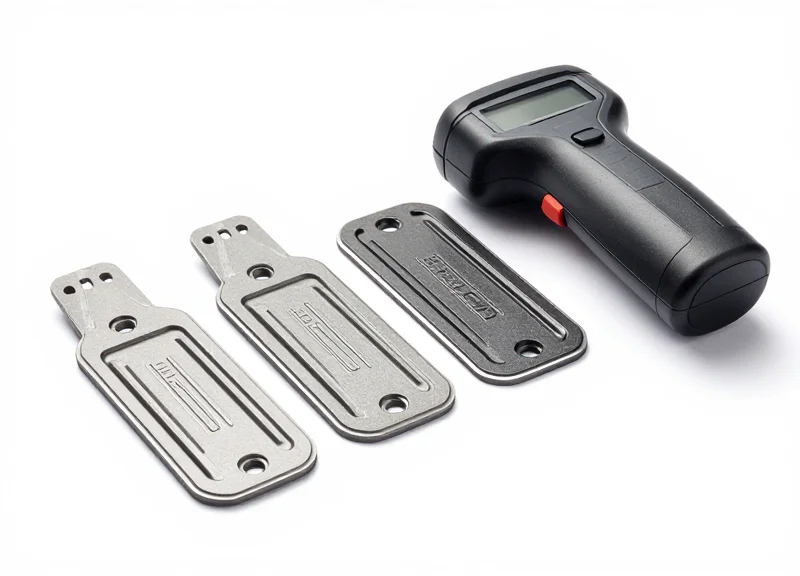
Selecting RFID hardware for hazardous chemical zones necessitates a two-pronged approach: prioritizing ATEX/IECEx certified intrinsically safe readers to prevent ignition risks, and utilizing specialized on-metal UHF tags to overcome signal interference caused by liquid-filled containers and steel shelving. In these environments, standard RFID labels will fail due to the Liquid-Metal Paradox, where liquids absorb radio frequency energy and metal surfaces reflect it, rendering standard tags unreadable.
| Tag Type | Ideal Use Case | Chemical Resistance | Read Range |
|---|---|---|---|
| Ceramic On-Metal Tags | Small metal canisters and valves | High (Acids/Bases) | Up to 5 meters |
| Encapsulated Glass Tags | Small vials and glass containers | Extreme (Solvents) | Short (1-2 cm) |
| Flag Tags | Plastic drums and HDPE bottles | Moderate | Up to 7 meters |
| Ruggedized Hard Tags | Pallets and bulk storage racks | High (Impact/Chemical) | Up to 10+ meters |
When deploying in hazardous zones, the 'Intrinsically Safe' (IS) rating is your most critical filter. For Zone 0 or Zone 1 environments, where flammable gases or vapors are frequently present, your RFID readers must be engineered to operate without generating enough heat or sparks to ignite the atmosphere. Beyond safety, you must account for the physical footprint: chemical storage often involves dense metal racking which can create 'dead zones' for RF signals.
- Verify Certification: Ensure all readers and handhelds carry ATEX (Europe) or Class I, Div 1/2 (USA) certifications for the specific hazardous zone classification of your facility.
- Conduct an RF Site Survey: Map out the storage area to identify interference sources like steel drums and heavy machinery. This determines whether you need high-gain fixed antennas or mobile handheld scanners.
- Select Tag Attachment Methods: Choose chemical-grade adhesives (like 3M 300LSE) or mechanical fasteners. Standard adhesives often dissolve when exposed to solvent vapors, causing tags to drop off and break the audit trail.
- Test with 'Worst-Case' Liquids: Validate read rates when containers are full. Water-based chemicals behave differently than oil-based ones; UHF (Ultra High Frequency) is sensitive to the dielectric constant of the stored liquid.
- What is the 'Liquid-Metal Paradox' in RFID?: It refers to the dual challenge where metal reflects RF energy causing signal multi-pathing, while liquids absorb the signal. Specialized 'on-metal' tags use a spacer or ceramic substrate to create a buffer that allows the antenna to function correctly.
- Can I use active RFID for chemical tracking?: While active RFID (battery-powered) offers longer range, it is rarely used in hazardous zones due to the increased risk of battery-related ignition and the higher cost per tag for high-volume inventory.
- Expert Tip: The 'Antenna Offset' Secret: To maximize reliability, never mount an RFID antenna flush against a metal wall. Using a non-metallic bracket to create a 2-4 inch offset significantly reduces signal interference and expands your 'read zone' by up to 30%.
Step 2: Defining Monitoring Zones and Tagging Protocols

Defining monitoring zones and tagging protocols involves architecting a physical storage space into discrete tracking areas—such as entry points, segregation bays, and processing stations—while establishing standardized placement and data encoding rules for RFID tags on chemical containers. This structural foundation ensures that the automated audit trail captures not just the presence of a chemical, but its specific location and status relative to safety and regulatory boundaries.
A critical, often overlooked aspect of chemical storage is the 'Signal Attenuation Mitigation' strategy. Because liquids and metals—the primary components of chemical storage—absorb or reflect RF energy, your protocol must specify tag placement that minimizes interference. As a veteran in high-stakes tech environments, I recommend a 'Shoulder-Mount' protocol: tags should be placed on the upper curve of the bottle or container, away from the dense liquid mass, to maximize read rates by at least 35% in high-density storage racks.
| Zone Type | Primary Function | Hardware Placement | Audit Trail Impact |
|---|---|---|---|
| Portal/Perimeter | Detection of arrival or departure | Dual side-mounted antennas at doorways | Logs chain of custody transitions |
| Segregation Bays | Monitoring incompatible chemicals | Shelf-integrated antennas | Prevents regulatory violations of GHS mixing |
| Hazardous Workstation | Tracking time-out-of-storage | Desktop or overhead readers | Calculates exposure and degradation windows |
- Conduct a RF Propagation Map: Analyze the facility for metal interference (racking, pipes) and liquid absorption to determine where signal 'dead zones' exist before installing readers.
- Establish the UID Data Schema: Link the RFID Electronic Product Code (EPC) to your existing Chemical Management System (CMS), ensuring the tag triggers a direct lookup to the SDS and expiration data.
- Standardize Container-Specific Placement: Create a visual guide for technicians: plastic bottles get standard flags, while metal drums require specialized 'on-metal' tags placed on the vertical side-wall for optimal fringe radiation.
- Configure 'Logical Gates' in Software: Define software rules that flag an alert if a tag moves from a 'Flammable' zone to an 'Oxidizer' zone, automating safety protocol enforcement.
What is the best way to tag small vials?
For small containers, use 'wrap-around' tags with a tail or flag. This creates a physical distance between the liquid and the antenna, significantly improving readability.
How do I prevent false reads from adjacent zones?
Utilize RSSI (Received Signal Strength Indicator) filtering in your software. By setting a power threshold, you can ensure a tag is only recorded when it is within a specific distance of the reader.
Should I store SDS data directly on the tag?
No. Use the tag as a pointer (UID). Storing large amounts of data on the tag increases read time and complexity; keep the detailed compliance data in the cloud or local server.
Step 3: Configuring the RFID Middleware and Data Capture
RFID middleware serves as the essential architectural layer that translates raw radio signals from hardware into structured, actionable data for your compliance audit trails. In chemical storage environments, this software acts as a sophisticated filter, stripping away 'noise' caused by signal bounce off metal drums while ensuring that every movement of hazardous material is timestamped and mapped to a specific regulatory requirement. Without correctly configured middleware, your system risks data saturation—logging thousands of redundant 'reads' instead of the specific 'entry' or 'exit' events required by OSHA and EPA standards.
- Establish Logical Reader Groups: Organize individual readers into logical zones (e.g., 'Flammables Room A' or 'Loading Dock 4') within the middleware interface. This ensures that the data capture is context-aware, allowing the system to distinguish between a container being moved within a safe zone versus one exiting a restricted perimeter.
- Apply Edge Data Filtering: Configure 'low-level' filters to eliminate duplicate reads. In a typical chemical warehouse, a stationary tag may be read hundreds of times per second; use middleware logic to compress these into a single event record with a clear 'start' and 'stop' time.
- Integrate with Compliance Databases: Link the middleware output to your ERP, LIMS, or specialized Safety Data Sheet (SDS) management system via API or MQTT protocols. This creates the 'handshake' where a physical tag ID is automatically married to its chemical profile and safety documentation.
| Data Capture Mode | Primary Benefit | Recommended Use Case |
|---|---|---|
| Event-Driven (Push) | Low latency, real-time alerts | High-risk zone perimeter monitoring |
| Polling (Pull) | Consistent status snapshots | Weekly or monthly inventory reconciliation |
| Batch Processing | Reduced network load | Historical audit trail generation for archiving |
Expert Tip: Implementing RSSI Thresholding to Combat 'Ghost Reads'. One of the most common failures in chemical RFID implementations is the 'ghost read,' where a high-powered reader picks up a tag from an adjacent room through a thin partition. Silicon Valley specialists recommend using Received Signal Strength Indicator (RSSI) thresholding. By configuring your middleware to ignore any signal below a specific decibel (dBm) level, you ensure that only tags within the immediate physical vicinity of the chemical storage shelf are recorded, maintaining the absolute integrity of your automated audit trail.
How does middleware handle network outages in a chemical facility?
Modern industrial middleware should include 'store-and-forward' capabilities. If the connection to your central server drops, the edge middleware caches the compliance data locally and pushes it to the audit trail once connectivity is restored, preventing gaps in your regulatory history.
Can I use the middleware to trigger physical alarms?
Yes. Most enterprise middleware supports GPIO (General Purpose Input/Output) triggers. For instance, if a corrosive chemical is detected near a zone it is not permitted to enter, the middleware can instantly trigger a visual strobe or audible alarm.
Step 4: Automating Audit Trail Generation and Reporting

Automating audit trail generation is the process of translating raw RFID tag reads into 'Compliance Events' that are recorded in a permanent, tamper-evident database. Instead of a warehouse manager manually signing a logbook, the software logic automatically captures the 'Who, What, Where, and When' of every chemical movement. This ensures that the documentation required for OSHA 1910.1200 or EPA Risk Management Plans is generated in real-time, eliminating the 15-20% margin of error typically found in manual record-keeping.
- Define Event Logic and Thresholds: Configure the middleware to recognize specific sequences as audit-worthy events. For example, a tag read at the 'Flammable Cabinet' entrance followed by no read within the cabinet after 60 seconds should trigger a 'Removal' event for the audit log.
- Map Data to Regulatory Templates: Align captured data fields (Tag ID, Timestamp, Zone) with specific regulatory requirements. Ensure the reporting engine can export directly to Form R for the EPA or internal safety audit formats.
- Establish Immutable Record Protocols: Implement a 'write-once-read-many' (WORM) storage approach for the audit trail. Once a movement is logged and time-stamped, the record should be locked to prevent retroactive editing, ensuring data integrity during inspections.
- Configure Automated Report Distribution: Set up scheduled triggers that email weekly compliance summaries to stakeholders and instant alerts to safety officers whenever a 'high-risk' movement (e.g., incompatible chemicals entering the same zone) occurs.
| Feature | Manual Audit Trails | Automated RFID Audit Trails |
|---|---|---|
| Data Integrity | High risk of human error/omission | High; sensor-based and tamper-evident |
| Latency | Delayed (Hours or Days) | Real-time (Milliseconds) |
| Granularity | Batch-level / Summary | Item-level / Individual container |
| Searchability | Difficult (Physical archives) | Instant (Digital filtering/SQL) |
Expert Insight: The Non-Repudiation Hash. To truly outperform generic compliance setups, implement a 'Cryptographic Signature' for every audit entry. By generating a SHA-256 hash of the transaction data at the moment of capture, you create a digital fingerprint that proves the record hasn't been altered since the event occurred. This level of 'Non-Repudiation' is increasingly becoming the gold standard in high-stakes chemical litigation and federal environmental audits.
How long should RFID audit logs be retained?
For chemical storage, standard industry practice is a minimum of 5 years, though OSHA requires medical and exposure records to be kept for 30 years. Ensure your automated system has a tiered storage strategy for long-term archiving.
Can automated reports satisfy EPA inspectors?
Yes, provided the software maintains a validated audit trail that complies with 21 CFR Part 11 (or equivalent digital record standards), showing a clear chain of custody.
What happens if a reader goes offline?
The system should be configured for 'Edge Logging,' where readers store events locally and sync them to the audit trail immediately upon reconnection to prevent gaps in the reporting.
Step 5: Integration with EHS and Inventory Management Systems

The final stage of a mature RFID compliance strategy is the seamless integration of raw data into Environment, Health, and Safety (EHS) software and Inventory Management Systems (IMS). Integration bridges the gap between physical movements in the warehouse and digital records in the boardroom, creating a 'Single Source of Truth.' By synchronizing these platforms, organizations can automate Safety Data Sheet (SDS) associations, trigger replenishment alerts based on real-time chemical usage, and provide auditors with a comprehensive, end-to-end digital paper trail that requires zero manual intervention.
- Automated SDS Management: Linking an RFID tag to an EHS database allows the system to instantly display the correct Safety Data Sheet when a container is scanned, ensuring immediate accessibility during an inspection or emergency.
- Shelf-Life and Expiry Tracking: Integration enables the inventory system to flag chemicals approaching their expiration date, triggering 'First-In, First-Out' (FIFO) protocols to minimize hazardous waste and disposal costs.
- Dynamic Risk Assessment: As RFID readers detect changes in chemical volume or location, EHS systems can automatically update site-specific risk assessments and maximum allowable quantity (MAQ) thresholds.
| Feature | EHS System Integration | Inventory System (ERP/IMS) Integration |
|---|---|---|
| Primary Objective | Regulatory Compliance & Safety | Operational Efficiency & Cost Control |
| Data Trigger | Movement into restricted zones | Stock level drops or batch changes |
| Outcome | Automated incident reporting & audits | Just-in-time ordering & waste reduction |
Expert Insight: The 'Event-Driven' Advantage. Having spent decades in Silicon Valley, I’ve seen many firms fail by using 'batch processing' for compliance. For chemical safety, you must move to an Event-Driven Architecture (EDA). Instead of your EHS system 'asking' the RFID middleware for updates every hour, use Webhooks to 'push' data instantly the moment a high-risk chemical moves. This reduces network latency and ensures that a compliance violation is flagged in milliseconds, not minutes.
{
  "event": "location_change",
  "tag_id": "3035UR99283",
  "chemical_id": "CH-082",
  "prev_zone": "Cold_Storage_A",
  "new_zone": "Production_Floor_B",
  "timestamp": "2023-10-27T14:30:05Z",
  "alert": "Unscheduled Movement"
}
How do we handle legacy systems that don't have modern APIs?
For older ERP or EHS platforms, we recommend using an RPA (Robotic Process Automation) layer or a middleware bridge that converts RFID MQTT or REST signals into flat files (CSV/XML) that the legacy system can ingest via secure FTP.
Does integration increase the risk of a data breach?
While any connection point requires security, RFID-EHS integration typically uses encrypted TLS tunnels and API keys. By centralizing data, you actually reduce the risk associated with fragmented, unsecured spreadsheets and paper logs.
Operational Benefits: Beyond Compliance to Safety and Efficiency

The primary operational benefit of RFID compliance monitoring is the creation of a 'frictionless audit.' In traditional chemical storage, compliance is a manual tax on productivity, requiring workers to stop their tasks to log movements, check expiry dates, and verify locations. With an automated RFID infrastructure, data capture becomes a background process. By embedding intelligence into the storage environment, organizations shift from reactive 'point-in-time' audits to proactive, continuous oversight that simultaneously slashes labor costs and hardens safety protocols.
| Feature | Manual Management | RFID-Automated Storage |
|---|---|---|
| Inventory Cycle Count | Hours or days of facility downtime | Minutes with zero operational downtime |
| Data Accuracy | 85-92% (prone to human error) | 99.5% (automated timestamping) |
| Worker Chemical Exposure | High (manual scanning near drums) | Low (remote monitoring/gateways) |
| Audit Readiness | Labor-intensive prep periods | Always-on, real-time reporting |
- Labor Reallocation ROI: Automating the audit trail allows skilled lab technicians and EHS officers to focus on high-value safety analysis rather than clerical data entry, effectively increasing 'useful labor' by up to 15%.
- Expiration & Shelf-Life Mitigation: Real-time alerts for nearing expiration dates prevent the costly disposal of stable but expired chemicals, while also ensuring that unstable hazardous chemicals are neutralized before they become a safety risk.
- Instant Hazard Segregation Alerts: Automated systems can trigger immediate alarms if incompatible chemicals (e.g., oxidizers and flammables) are placed in the same storage zone, preventing potential catastrophic reactions.
Unique Expert Insight: The 'Exposure Reduction Factor' (ERF). A critical but often overlooked metric in chemical storage is the time a human must spend in close proximity to hazardous vapors or containers. RFID automation enables a 'Touchless Inventory' model. By reducing the frequency of manual scanning from a daily requirement to an 'exception-only' task, facilities can demonstrably lower the cumulative chemical exposure risk for their workforce, a benefit that directly impacts insurance premiums and long-term health liabilities.
How does RFID improve emergency response?
During a spill or fire, responders can access a real-time digital manifest of exactly what chemicals are in the affected zone, rather than relying on potentially outdated paper logs or memory.
Can RFID help with 'Dead Inventory' costs?
Yes. By tracking usage patterns, facilities can identify chemicals that have been sitting unused for months, allowing for smarter procurement and reducing the footprint of hazardous materials on site.
Maintaining and Scaling Your RFID Compliance System
To maintain and scale an RFID compliance system for chemical storage, organizations must implement a 'Standardized Infrastructure Model' that combines routine hardware health checks with a modular software architecture. Maintenance focuses on ensuring 100% read accuracy through antenna recalibration and tag integrity audits, while scaling involves cloning validated site configurations (templates) to new facilities to ensure seamless, centralized data aggregation across the enterprise.
| Component | Maintenance Frequency | Key Action Item |
|---|---|---|
| Passive RFID Tags | Annually | Physical inspection for chemical degradation or adhesive failure. |
| Fixed Readers | Quarterly | Firmware updates and diagnostic log review for 'missed read' spikes. |
| Antenna Arrays | Bi-Annually | Re-alignment to compensate for facility vibrations or racking shifts. |
| Middleware / Cloud | Monthly | Database indexing and API endpoint security certification. |
Expert Tip: Implement 'Reference Tags' for automated system health monitoring. By placing a permanent RFID tag at a known fixed point within each read zone, the system can self-diagnose performance drops. If the RSSI (Received Signal Strength Indicator) for a reference tag fluctuates, the system triggers an automatic alert for maintenance before actual chemical inventory data is compromised—a proactive approach that prevents audit failures.
- Establish a Global Configuration Template: Document the precise antenna angles, power levels, and filtering logic used in your initial facility to create a 'gold standard' for new sites.
- Leverage Cloud-Native Middleware: Ensure your software layer is decoupled from local hardware, allowing you to manage multiple facilities from a single dashboard without on-site servers.
- Standardize Tagging at the Source: Work with chemical suppliers to apply RFID tags during the manufacturing process (source tagging) to eliminate manual labor as you scale.
- Implement Federated Data Reporting: Configure your EHS integration to allow for both site-specific safety views and enterprise-wide compliance roll-ups.
How do environmental changes affect scaling?
New metal shelving or high-density liquid storage can create 'RF shadows.' Always perform a site survey when reconfiguring storage layouts to adjust antenna placement.
Can we mix different hardware brands as we expand?
Yes, provided you utilize EPCglobal Gen2 compliant hardware and a hardware-agnostic middleware that supports multiple reader protocols.
What is the biggest risk to long-term compliance?
Data rot. Without regular database pruning and tag health checks, the automated audit trail can become cluttered with ghost reads or duplicate entries.