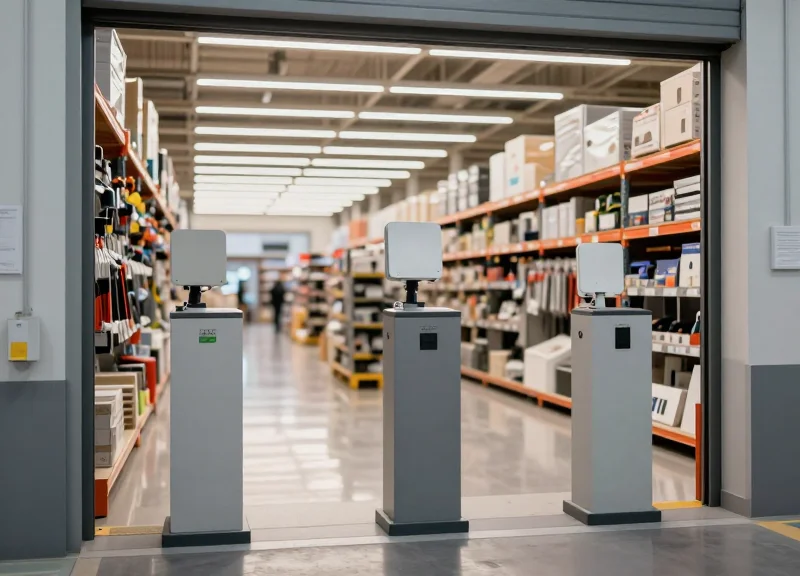
As we approach 2026, the financial sector is facing an unprecedented transformation in physical security. Traditional methods of managing high-value assets within bank vaults are no longer sufficient to meet modern compliance and speed requirements. For decades, barcodes were the industry standard, but they are increasingly viewed as a bottleneck in the pursuit of real-time asset intelligence. This article explores why forward-thinking financial institutions are ditching manual scanning in favor of sophisticated RFID ecosystems to secure the vaults of tomorrow.
The Evolution of Physical Security in the Banking Sector

The evolution of physical security in the banking sector is characterized by a fundamental shift from reactive perimeter defense to proactive, real-time asset intelligence. Historically, bank vault security focused on physical barriers—thick walls and heavy doors. However, as the complexity of high-value assets increased, the industry transitioned through three distinct eras: the Manual Era (paper ledgers), the Digital Era (barcode scanning), and the emerging Autonomous Era (RFID and IoT). In 2026, the benchmark for security is no longer just 'is the vault locked,' but 'where exactly is every asset, and who interacted with it, in real-time without human intervention?'
| Era | Primary Technology | Audit Frequency | Primary Security Risk |
|---|---|---|---|
| The Manual Era (Pre-1990s) | Paper Ledgers & Physical Keys | Annual / Biannual | Human Error & Insider Theft |
| The Digital Era (1990s-2015) | Barcodes & Access Control | Monthly / Weekly | Scanning Gaps & Line-of-Sight Requirements |
| The Intelligence Era (2026+) | RFID & AI Orchestration | Real-time (Sub-second) | Cyber-Physical Integration |
For decades, the banking industry relied on manual ledgers, where security was only as good as the person holding the pen. The introduction of barcodes in the late 20th century provided a necessary digital upgrade, allowing banks to index assets more effectively. However, barcodes created a 'Visibility Gap.' Because a barcode requires a human to manually aim a scanner at a tag, it is impossible to maintain a continuous, 24/7 view of vault contents. This limitation has become the primary driver for the current push toward RFID technology, which allows for bulk scanning and zero-touch auditing.
Why is the banking industry moving away from 'periodic audits'?
Periodic audits (monthly or quarterly) are no longer sufficient for 2026 regulatory compliance. Modern banks require 'continuous auditability,' where the system automatically logs every movement within the vault, reducing the window for undetected theft or misplacement from days to milliseconds.
What is the 'Zero-Touch' security mandate?
The Zero-Touch mandate refers to the industry goal of removing human intervention from the audit process. By using RFID, assets are tracked automatically as they pass through portals or sit on smart shelves, eliminating the errors associated with manual barcode scanning.
What is the expert's 'Visibility Gap' insight?
Silicon Valley security veterans identify the 'Visibility Gap' as the time between scans. If you scan a barcode at 9 AM and again at 5 PM, the asset is effectively 'invisible' for 8 hours. RFID eliminates this gap by providing a heartbeat-like signal that ensures the asset is present and untouched at all times.
Expert Tip: As we approach 2026, the most significant trend is the 'Data-fication' of physical assets. We are seeing a convergence where physical security and cybersecurity teams share a single dashboard. In this new paradigm, an asset that isn't digitally 'pinging' its location is considered a security breach, regardless of whether the vault door is locked. This shift from physical possession to digital confirmation is the hallmark of the next generation of banking security.
Why Barcodes are Reaching Their Technical Limits
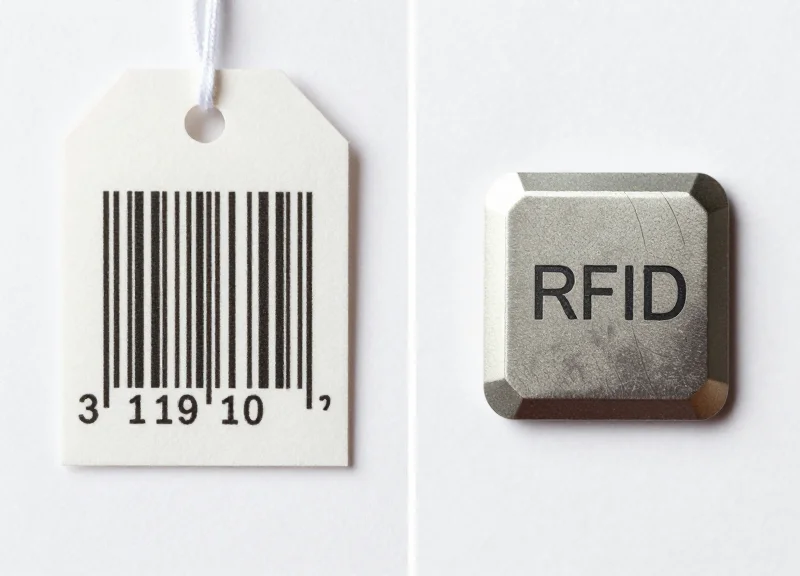
Barcodes are reaching their technical limits because they rely on optical line-of-sight scanning, which creates a 'visibility lag' incompatible with the real-time demands of 2026 bank vault security. Unlike modern radio-frequency solutions, barcodes require manual human intervention to locate, align, and trigger a scan for every individual item, making them a high-friction technology that scales poorly in high-density environments where audit speed and zero-error precision are non-negotiable.
| Constraint | Barcode Limitation | Impact on Vault Operations |
|---|---|---|
| Scanning Method | Optical / Line-of-Sight | Assets must be physically moved or handled to be indexed. |
| Read Throughput | 1:1 (Single asset at a time) | Audits take days rather than minutes, delaying discrepancy detection. |
| Durability | Surface-dependent (Labels) | Damaged, obscured, or peeling labels lead to scan failure and data gaps. |
| Intelligence | Static / Read-only | No ability to detect movement or location changes without a manual scan. |
The primary failure of barcode technology in the vault of the future is its inability to support 'Passive Intelligence.' In a modern banking environment, security officers need to know not just that an asset was there, but that it remains there without having to physically touch it. Barcodes provide a historical snapshot, whereas 2026 standards require a continuous live stream of data.
- The Human Error Variable: Manual scanning is prone to 'skipping' or 'double-scanning,' leading to inaccurate vault records that require expensive manual reconciliation.
- Lack of Simultaneous Auditing: In high-security environments like bullion storage, counting thousands of items individually is labor-intensive and creates a significant security window during the long audit cycle.
- Spoofing and Security Weaknesses: Barcodes are easily photocopied or replicated, offering low resistance to sophisticated internal fraud or 'swap' schemes compared to encrypted digital tags.
A unique insight I've observed in Silicon Valley fintech circles is the 'Ghost Asset Paradox.' In a manual barcode-based audit of 10,000 safety deposit boxes, the time elapsed between scanning the first box and the last box is often several days. This creates a temporal gap where an asset can be moved after it is scanned but before the audit report is finalized. This lag essentially renders the audit data obsolete the moment it is generated, failing the 'Real-Time Compliance' standards now being adopted by global financial regulators.
The RFID Revolution: Non-Line-of-Sight Capabilities

Non-Line-of-Sight (NLOS) capability is the core technical differentiator that allows RFID to surpass legacy systems by using radio waves rather than light to capture data. Unlike barcodes, which require a direct visual path and manual orientation, RFID readers can communicate with hundreds of tags simultaneously through physical obstructions such as plastic bins, cardboard boxes, and even security envelopes. This shift from 'point-and-scan' to 'volumetric capture' is the foundation of 2026 next-gen asset intelligence, allowing banks to achieve 100% inventory accuracy in seconds without ever touching the assets.
| Capability | Legacy Barcode Systems | Next-Gen RFID (2026) |
|---|---|---|
| Visibility Requirement | Direct Line-of-Sight (LOS) | Non-Line-of-Sight (NLOS) |
| Scanning Through Containers | Impossible; requires unboxing | Seamless; reads through barriers |
| Read Throughput | 1 item per 3-5 seconds | 700+ items per second |
| Audit Effort | High (Manual/Labor intensive) | Zero-Touch (Automated/Passive) |
In a high-security vault environment, the ability to track through containers is a game-changer for chain-of-custody protocols. When high-value assets—such as bullion, safety deposit boxes, or sensitive documents—are moved, RFID gateways can log their transition automatically. Because the radio waves penetrate standard storage materials, the system maintains a 'live' digital twin of the vault contents. This eliminates the 'blind spots' that occur during traditional audits where assets remain unverified because opening their tamper-evident packaging would compromise security.
- Bulk Reading Efficiency: RFID readers can interrogate an entire pallet of assets simultaneously, reducing audit times from days to minutes.
- Penetrative Capabilities: UHF RFID signals can pass through non-metallic materials, allowing for the tracking of items hidden inside sealed security bags or wooden crates.
- Passive Surveillance: Fixed readers at vault entry points create an automated 'invisible gate' that logs every asset movement without human intervention.
Expert Insight: By 2026, leading financial institutions will implement what we call 'Dark Audits.' This refers to the ability of a vault’s infrastructure to perform a full inventory reconciliation in total darkness and behind locked doors using overhead RFID arrays. This provides a continuous stream of 'Proof of Presence' data points, transforming security from a reactive process into a proactive intelligence stream. For the first time, bank managers can verify the presence of every gold bar in a vault every 60 seconds without a single employee entering the room.
Can RFID read through metal vault walls?
No, radio waves are blocked by thick metal. However, internal RFID arrays utilize the metallic environment to create 'multipath' reflections, actually improving the read rate inside the vault once the signal is generated within the chamber.
Will signals interfere with other bank electronics?
Modern EPC Gen2 V2 RFID systems operate on regulated UHF bands (860-960 MHz) specifically designed to coexist with standard IT infrastructure and security hardware without interference.
Enhancing Audit Accuracy and Regulatory Compliance
In the high-stakes environment of 2026 banking, enhancing audit accuracy and regulatory compliance means moving from periodic physical counts to real-time, automated asset intelligence. RFID facilitates this by providing a hands-free, non-line-of-sight inventory method that captures every asset within a vault simultaneously, eliminating the 5-10% human error margin typical of barcode and manual systems. This ensures that financial institutions maintain a 100% accurate, time-stamped record of all safe deposit boxes, bullion, and sensitive documents, providing the immutable audit trail required by modern global regulators.
The shift toward Basel IV standards has placed unprecedented pressure on banks to demonstrate operational resilience and rigorous risk management. Manual audit processes are no longer just slow; they are a compliance risk. RFID-enabled vaults allow for 'Continuous Compliance,' where the system can trigger an automated audit report every 60 seconds if necessary. This shift from reactive to proactive monitoring allows compliance officers to detect discrepancies instantly, rather than discovering missing assets months later during a quarterly review.
| Audit Metric | Legacy Barcode/Manual | RFID Next-Gen Intelligence |
|---|---|---|
| Audit Frequency | Quarterly or Annually | Continuous / On-Demand |
| Data Accuracy | 92% - 95% (Human Error) | 99.9% - 100% (Automated) |
| Regulatory Proof | Point-in-time snapshots | Immutable real-time logs |
| Basel III/IV Readiness | Requires manual reconciliation | Native automated reporting |
- Expert Insight: The 'Immutable Digital Twin' Strategy: A unique advantage for 2026 is the integration of RFID with encrypted ledger technology. By assigning each vault asset a 'Digital Twin' in the bank's database, any movement of the physical tag creates an unalterable record. This creates a 'Self-Auditing Vault' where the physical reality and the digital ledger are permanently synchronized, effectively making the concept of a 'scheduled audit' obsolete.
Does RFID comply with strict SEC and Basel reporting standards?
Yes. In fact, regulators increasingly prefer RFID because it removes human subjectivity and intervention from the data collection process, providing a cleaner, more verifiable data set for examiners.
How does RFID handle 'blind spots' during an audit?
Next-gen RFID readers utilize phased-array antennas and high-sensitivity sensors to ensure 360-degree coverage, even in metal-heavy vault environments, ensuring no asset is missed due to shielding.
Can RFID logs be used in legal disputes over safe deposit boxes?
Absolutely. The granular time-stamping provided by RFID—showing exactly when a box was accessed or moved—offers superior forensic evidence compared to manual sign-in sheets or barcode scans.
Real-Time Asset Intelligence: Moving Beyond Simple Tracking

Asset Intelligence in the 2026 banking landscape is defined as the synthesis of high-frequency RFID data streams with machine learning algorithms to create a 'living' map of vault inventory. Unlike traditional tracking, which simply answers 'where' an item is, Asset Intelligence answers 'why' an item is moving, 'who' is most likely to interact with it next, and 'when' a deviation from standard operating procedure indicates a security breach. This shift moves the vault from a passive storage container to an active participant in the bank's digital ecosystem.
| Feature | Legacy Barcode Tracking | 2026 RFID Asset Intelligence |
|---|---|---|
| Data Frequency | Point-in-time (Manual) | Continuous / Real-Time |
| Visibility Layer | Location Only | Contextual Metadata (Temp, Vibration, Proximity) |
| Actionability | Reactive (Post-Audit) | Predictive (Pre-Incident) |
| AI Integration | Static Database | Neural Network Pattern Recognition |
The true power of this technology lies in its ability to predict security vulnerabilities before they manifest. By analyzing the 'dwell time' of specific high-value assets and correlating them with employee access patterns, AI can identify 'Micro-Anomalies'—minor deviations in movement speed or pathing that often precede internal theft or procedural negligence. This creates a proactive security posture where the system flags risks before the vault door is even closed.
How does RFID data feed into AI for predictive security?
RFID readers generate a constant stream of 'pings' that create a behavioral baseline. AI algorithms analyze these patterns to detect 'Pathing Deviations'—if an asset typically moves from Point A to B in 30 seconds but takes 90 seconds, the system triggers an automated inquiry.
Can Asset Intelligence prevent internal collusion?
Yes. By utilizing 'Proximity Logic,' the system monitors the simultaneous presence of specific tags and employee badges. If two individuals with restricted joint-access profiles are near a high-value asset without a logged work order, the system can instantly lock down the sector.
What is 'Digital Twin' vaulting?
This is the creation of a real-time virtual replica of the vault. Every movement in the physical world is mirrored in the digital twin, allowing security teams to run 'what-if' simulations and stress-test vault layouts without moving a single gold bar.
Expert Insight: The 'Vibration-Signature' Correlation. A cutting-edge application for 2026 is the integration of RFID tags with MEMS (Micro-Electro-Mechanical Systems). By layering vibration data over RFID location pings, banks can distinguish between a routine asset move and a potential 'tunneling' or 'drilling' attempt on a safe deposit box. This creates a multi-modal intelligence layer that makes physical tampering nearly impossible to hide.
Synergy with EAS and ESL: A Multi-Layered Security Approach

In high-security bank vault environments, maximum resilience is achieved by integrating Electronic Article Surveillance (EAS) for immediate perimeter defense and Electronic Shelf Labels (ESL) for real-time data visualization. This multi-layered approach creates a unified security fabric where RFID identifies 'what' is moving, while EAS prevents unauthorized exit and ESL provides a dynamic, physical interface for asset status. By layering these technologies, DragonGuard transforms passive storage into an active, intelligent ecosystem that eliminates the 'black holes' common in legacy vault management.
| Technology | Primary Function | Vault Application | Security Value |
|---|---|---|---|
| RFID | Identification & Location | Bulk tracking of gold bars or cash cassettes. | High-speed audit accuracy and asset intelligence. |
| EAS | Perimeter Protection | Detecting unauthorized removal at vault thresholds. | Immediate loss prevention and alarm triggering. |
| ESL | Dynamic Visualization | Digital labeling of lockers and storage bins. | Real-time status updates without manual entry. |
While RFID provides the backend data, EAS acts as the gatekeeper. Modern EAS systems in bank vaults utilize specialized frequencies that can penetrate high-density environments, ensuring that if an RFID-tagged asset moves past a designated checkpoint without an 'authorized' status in the database, an alarm is instantly triggered. This creates a secondary fail-safe that operates independently of the manual audit cycle, providing 24/7 autonomous protection.
Expert Tip: The 'Dark Audit' Strategy. A unique advantage of DragonGuard’s ESL integration is the ability to implement 'Dark Audits.' In this configuration, ESL screens remain blank or display generic codes to prevent visual reconnaissance by staff or visitors. The detailed asset data only populates the screen when an authorized staff member with a specific RFID credential is detected in the immediate vicinity, ensuring that sensitive asset information is only visible during active, authorized workflows.
Can EAS and RFID coexist without interference?
Yes. Modern systems use distinct frequency bands (such as 58kHz for Acousto-Magnetic EAS and 860-960MHz for UHF RFID) to ensure that theft detection and asset tracking function simultaneously without signal collision.
How does ESL improve vault workflow?
ESL eliminates the need for paper labels. If a vault container's contents change, the RFID system updates the central database, which automatically pushes the new 'Asset Intelligence' data to the digital shelf label, reducing human error.
What happens if the network goes down?
DragonGuard systems utilize edge computing. EAS remains locally active to prevent physical theft, and ESL displays retain their last updated state via e-paper technology, ensuring visibility even during power or network interruptions.
Addressing the Challenges of Vault Environments
Bank vault environments are notoriously hostile to wireless technology, acting as a natural 'Faraday Cage' where reinforced concrete and heavy steel plating reflect and absorb radio frequency (RF) signals. To successfully implement RFID for next-gen security, financial institutions must utilize specialized 'On-Metal' tags and high-gain directional antennas that are specifically engineered to mitigate signal attenuation and multi-path interference caused by dense metallic structures.
| Environmental Challenge | Impact on Standard RFID | Vault-Optimized RFID Solution |
|---|---|---|
| Signal Reflection | Multipath interference causing ghost reads. | Circularly polarized antennas to stabilize signal paths. |
| Signal Absorption | Zero read range through concrete/steel. | UHF high-memory tags with ceramic spacers. |
| Dense Metal Storage | RF shielding (Faraday effect) between boxes. | Surface-wave propagation and mesh tag relaying. |
Modern vault security requires a shift from 'searching' for signals to 'engineering' the RF environment. Unlike barcodes, which fail when labels are physically obscured inside a metal locker, RFID can leverage the very metal surfaces that typically hinder it. By using specialized ceramic-based tags, the metal surface acts as a ground plane, effectively extending the antenna's reach rather than blocking it. This transformation of a liability into an asset is what defines 2026-grade security infrastructure.
- RF Mapping & Site Survey: Conduct a heat-map analysis to identify 'dead zones' where steel density is highest, ensuring antenna placement covers all reflection angles.
- Deployment of On-Metal Tags: Utilize tags with a physical spacer (FR4 or ceramic) to prevent the tag's antenna from shorting against the metal asset.
- Integration of Circular Polarization: Use antennas that emit signals in a corkscrew pattern to ensure tags are read regardless of their orientation within safe deposit boxes.
Expert Insight: The Multipath Diversity Advantage. In most environments, signal bouncing (multipath) is a nuisance. However, in 2026 vault designs, we utilize 'Multipath Diversity.' By strategically placing passive reflectors, we can guide RF waves into 'blind' corners of the vault, allowing a single reader to catalog assets that don't have a direct line of sight, something physically impossible for barcode scanners.
Can RFID signals penetrate heavy lead-lined safe boxes?
While signals cannot pass through lead, they can 'leak' through door seams and hinges. High-sensitivity readers in 2026 can detect these peripheral signals to confirm an asset's presence without opening the box.
Will the metal environment cause 'false positives' from outside the vault?
No. The same steel that makes reading difficult also acts as a perfect shield, ensuring that assets outside the vault are never accidentally scanned by the internal system.
The ROI of Modernization: Efficiency vs. Initial Investment
The Return on Investment (ROI) for transitioning from barcode-based vault management to RFID-enabled asset intelligence is realized through the intersection of labor reduction, inventory accuracy, and risk mitigation. While the initial capital expenditure (CAPEX) for RFID infrastructure—including readers, antennas, and specialized metal-mount tags—is higher than legacy barcode systems, the typical bank vault environment achieves a break-even point within 14 to 22 months. This ROI is driven by the elimination of manual line-of-sight scanning, which reduces audit labor costs by up to 95% and virtually eliminates the financial risk associated with misplaced high-value assets.
| Metric | Legacy Barcode Systems | Next-Gen RFID Systems |
|---|---|---|
| Audit Speed (per 1,000 items) | 4 - 6 Hours | 2 - 5 Minutes |
| Data Accuracy Rate | ~85% (Human Error Prone) | 99.9% (Automated) |
| Initial CAPEX | Low (Labels & Handhelds) | Moderate to High (Tags & Infrastructure) |
| Annual OPEX (Labor) | High (Manual Reconciliation) | Ultra-Low (Automated Logging) |
Beyond the immediate reduction in man-hours, the 'Hidden Labor Tax' of legacy systems must be considered. In a barcode-dependent vault, a single misplaced asset can trigger hundreds of hours of manual searching and administrative reporting. RFID’s ability to locate items instantly through 'Geiger-counter' style handheld searches or fixed-portal monitoring effectively deletes this contingency cost from the balance sheet. Furthermore, the integration of RFID data into AI-driven analytics allows for predictive maintenance of security protocols, identifying 'hot zones' where assets are moved too frequently or remain stagnant for too long, optimizing the bank's internal liquidity and compliance posture.
Does the high cost of RFID tags for every asset make sense?
Yes, specifically for high-value vault assets. While an RFID tag may cost 20x more than a barcode label, the cost is negligible compared to the value of the asset and the $200/hour cost of expert audit teams. The 'tag-once' philosophy ensures the asset is trackable throughout its entire lifecycle without further manual intervention.
How does RFID modernization impact insurance premiums?
Many underwriters now offer 'Technology Credits' or reduced premiums for banks that implement real-time asset intelligence. By proving a 99.9% audit accuracy and immediate loss detection, banks lower their risk profile, which directly impacts their annual insurance overhead.
What is the lifespan of the RFID infrastructure?
Modern fixed readers and antennas have an operational lifespan of 7 to 10 years. Because the system is software-defined, updates to the asset intelligence AI can be deployed without replacing hardware, ensuring the investment remains relevant through 2030 and beyond.
Expert Insight: The 'Compliance Dividend' is the most overlooked factor in the ROI equation. As Basel III and IV regulations tighten, the cost of a failed audit or a reporting delay can result in fines exceeding seven figures. RFID doesn't just track assets; it provides a 'Digital Chain of Custody' that is instantly exportable for regulators, transforming security from a cost center into a strategic compliance advantage.