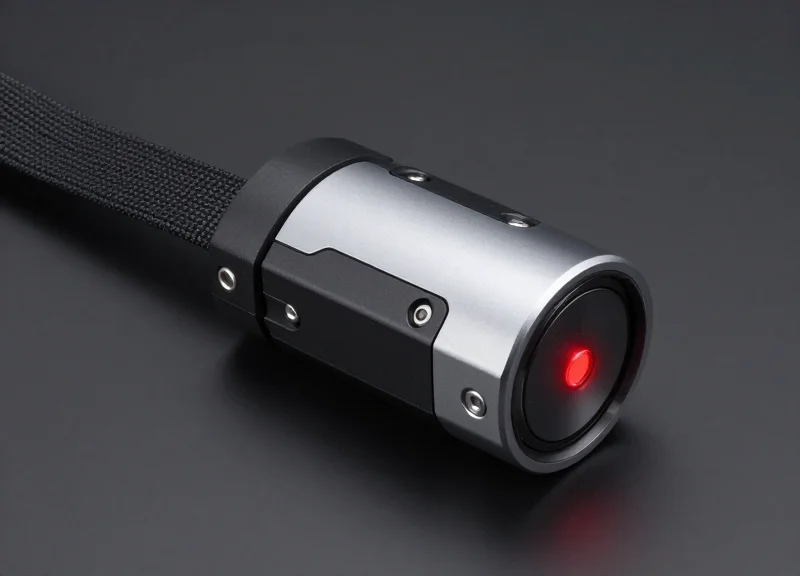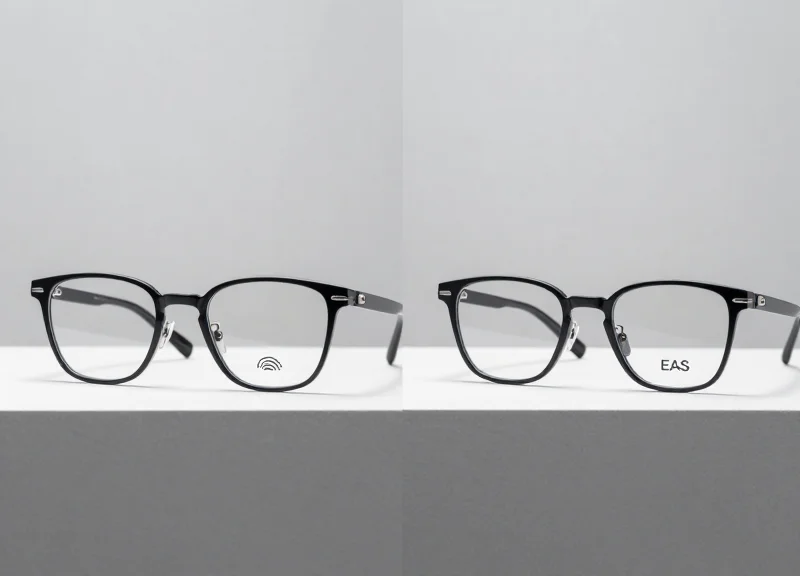
In the world of high-end retail, the balance between loss prevention and product integrity is delicate. For luxury brands dealing with silk, cashmere, and premium leather, a single misplaced security pin can turn a thousand-dollar investment into damaged goods. This guide explores the technical artistry of non-damaging tagging, ensuring your most valuable assets remain secure, pristine, and ready for sale.
The Luxury Dilemma: Loss Prevention vs. Product Integrity

The luxury dilemma represents the inherent conflict between the need to secure high-value merchandise and the necessity of maintaining the flawless physical condition that justifies a premium price point. In luxury retail, a single micro-tear from a standard 1.5mm gauge security needle or a pressure mark on a lambskin handbag can instantly devalue an item by 30% to 70%. This creates a paradox: the very tools designed to protect the store’s bottom line from external theft often cause 'internal shrinkage' through physical degradation of the product's integrity.
| Feature | Standard Tagging Systems | Luxury-Grade Tagging |
|---|---|---|
| Needle Gauge | Thick (1.2mm - 1.6mm) | Ultra-Fine (< 0.8mm) |
| Material Impact | Permanent fiber displacement | Zero-trace penetration |
| Application Speed | High-volume / High-force | Precision-controlled |
| Best Use Case | Denim, Heavy Outerwear | Silk, Cashmere, Fine Leather |
Most retailers overlook 'Shadow Shrinkage'—the loss of margin occurring when damaged goods must be moved to clearance or 'as-is' sections due to tagging accidents. In the high-end sector, where margins are built on exclusivity and perfection, even a 'clean' pin-hole in a $2,000 silk gown is considered a defect. Expert Tip: Move beyond simple theft prevention and calculate your 'Damage-to-Recovery Ratio.' If the cost of markdowns caused by your security tags exceeds 15% of your total shrinkage cost, your current tagging methodology is technically obsolete for your inventory type.
Why do standard security pins ruin designer fabrics?
Standard pins use a blunt-force tip that breaks fabric yarns rather than sliding between them. On high-thread-count luxury fabrics, this causes permanent 'runs' or puckering that cannot be steamed or pressed out.
What is the economic impact of 'tag damage' in high-end boutiques?
Beyond the immediate markdown, tag damage erodes brand trust. Customers paying a premium expect an unblemished product; selling a repaired or tagged-damaged item as new can lead to long-term reputational damage.
Can magnetic clutch tags damage leather accessories?
Yes, high-strength magnetic clutches applied directly to soft leathers can leave permanent indentations or 'bruises' in the grain that do not recover over time, especially if stored under heat or pressure.
Practice 1: Choosing Specialized Ultra-Fine Pin Gauges
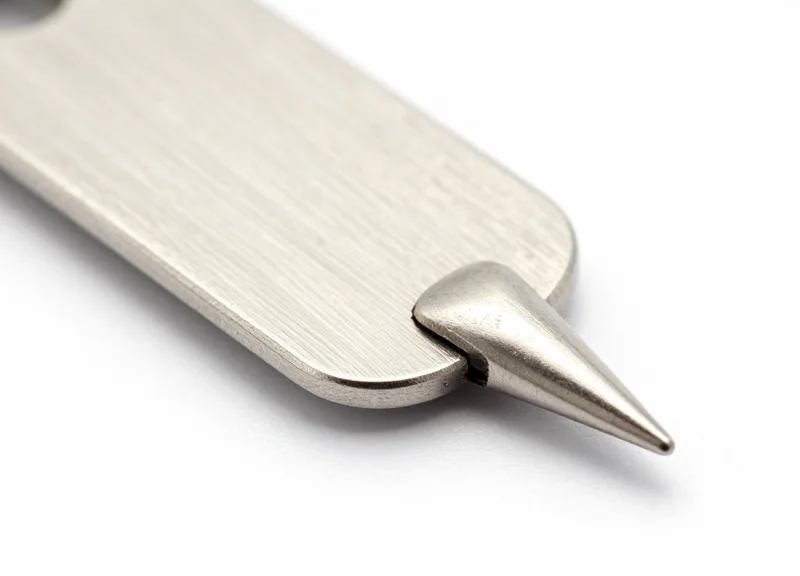
Choosing specialized ultra-fine pin gauges is the technical foundation of non-damaging tagging. Unlike standard retail fasteners, ultra-fine needles feature a diameter of 0.5mm or less, specifically engineered to navigate the interstitial gaps between delicate threads in silk, satin, and high-thread-count cottons. By prioritizing fiber displacement over fiber breakage, these precision tools ensure that once the tag is removed, the fabric weave can naturally 'heal' through simple agitation or steaming, leaving no visible puncture marks.
| Needle Category | Diameter (mm) | Ideal Fabric Applications | Risk Level for Luxury Goods |
|---|---|---|---|
| Standard | 0.9mm - 1.2mm | Denim, Canvas, Heavy Outerwear | High - Permanent Holes |
| Fine-Fabric | 0.7mm - 0.8mm | Standard Cotton, Blended Knits | Moderate - Visible Punctures |
| Ultra-Fine | 0.4mm - 0.5mm | Silk, Organza, Satin, Chiffon | Negligible - Zero Fiber Damage |
The technical distinction lies in the 'Taper-Tip' geometry. Professional-grade ultra-fine needles are not merely thinner; they are ground with a parabolic taper that reduces the insertion force by up to 40%. This is critical because high insertion force often causes 'bunching' or 'snagging,' where the needle catches a single filament and pulls it through the weave. Expert Tip: In the high-end retail tech space, we utilize the '30% Rule'—ensure your needle diameter never exceeds 30% of the average gap between the fabric's warp and weft to guarantee 100% fiber recovery. This prevents the 'memory effect' where the fabric permanently deforms around the puncture site.
How often should ultra-fine needles be replaced in a luxury environment?
To maintain integrity, needles should be replaced every 1,000 to 1,500 tag cycles. Even microscopic burrs or 'hooks' developed through wear can snag delicate silk filaments, turning a non-damaging tool into a liability.
Are ultra-fine pins compatible with standard tagging guns?
No. Ultra-fine pins require specific 'Fine-Fabric' or 'Ultra-Fine' tagging guns designed with a narrower internal channel to prevent the thin needles from bending or jamming during the trigger pull.
Does the needle material matter as much as the gauge?
Absolutely. High-carbon steel with a polished chrome or nickel finish is preferred. The smoother the surface finish (measured in microns), the less friction is generated, further protecting heat-sensitive synthetic luxury fibers.
Practice 2: Utilizing Lanyards and Magnetic Clamps for Leather Goods
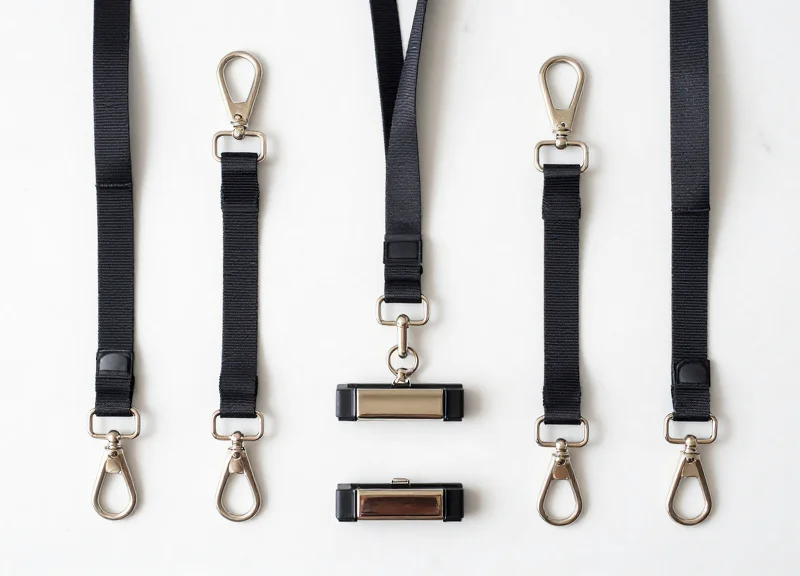
For high-end leather goods like lambskin handbags, exotic skin belts, and calfskin luggage, traditional needle-based tagging is a non-starter because leather has 'memory'—any puncture or significant compression is permanent. Non-invasive tagging utilizes reinforced lanyards and magnetic clamps to loop through existing hardware or securely grip edges using calibrated pressure. These methods ensure the physical integrity of the item remains 100% intact while providing the necessary Electronic Article Surveillance (EAS) security.
| Feature | Reinforced Lanyards | Magnetic/Non-Marking Clamps |
|---|---|---|
| Primary Use Case | Handbag straps, D-rings, zipper pulls | Edge-attachment for belts, wallets, clutches |
| Material | Nylon-coated multi-strand steel cable | High-impact ABS with silicone padding |
| Security Level | High (Cut-resistant) | Medium to High (Tamper-evident) |
| Risk Factor | Friction rub on soft hardware | Pressure indentations (if unpadded) |
The Engineering Behind Reinforced Lanyards: Modern loss prevention utilizes 1.5mm to 2.5mm multi-strand aircraft-grade steel cables coated in UV-stabilized nylon. The coating is critical; it prevents the metal cable from acting as an abrasive against delicate gold-plated or palladium hardware. When looping through a Birkin or Kelly handle, the lanyard acts as a flexible tether that allows the customer to interact with the product naturally without the risk of a hard tag scratching the leather grain.
- Identify a Load-Bearing Point: Select a sturdy piece of hardware such as a buckle, D-ring, or the base of a handle. Avoid tagging through zipper teeth as this can cause misalignment.
- Select Lanyard Length: Use the shortest lanyard possible to prevent the tag from swinging and hitting the leather surface, which can cause 'impact bruising' during shipping or handling.
- Check for Metal-to-Metal Contact: Ensure the hard tag housing itself is not resting directly against a smooth leather surface; if unavoidable, place a small acid-free tissue buffer between them.
Expert Insight: The 'Creep' Factor in Leather Storage. A common mistake in luxury retail is over-tightening magnetic clamps. Leather is a porous, organic material that expands and contracts with boutique humidity levels. If a clamp is applied too tightly, 'mechanical creep' occurs, where the leather fibers permanently displace around the clamp edges. Always specify clamps with a PSI (Pounds per Square Inch) rating of less than 15, and ensure the contact pads are made of medical-grade silicone rather than rubber, as rubber can leach oils that stain lighter-colored leathers (like 'Nata' or 'Beton').
Can magnetic clamps interfere with credit cards inside wallets?
High-quality magnetic tags are shielded; however, it is best practice to clip the tag to the exterior edge of the wallet rather than placing it inside a card slot to avoid stretching the leather or affecting magnetic stripes.
How do you prevent 'lanyard burn' on soft suede?
Suede is particularly susceptible to friction. Use 'soft-touch' lanyards which feature a wider ribbon-like coating to distribute pressure across a larger surface area.
Are lanyards easy for thieves to cut?
Reinforced lanyards contain braided steel cores that require industrial wire cutters. They provide a significant deterrent compared to standard plastic ties.
Practice 3: Strategic Placement—The 'Seam and Hem' Rule
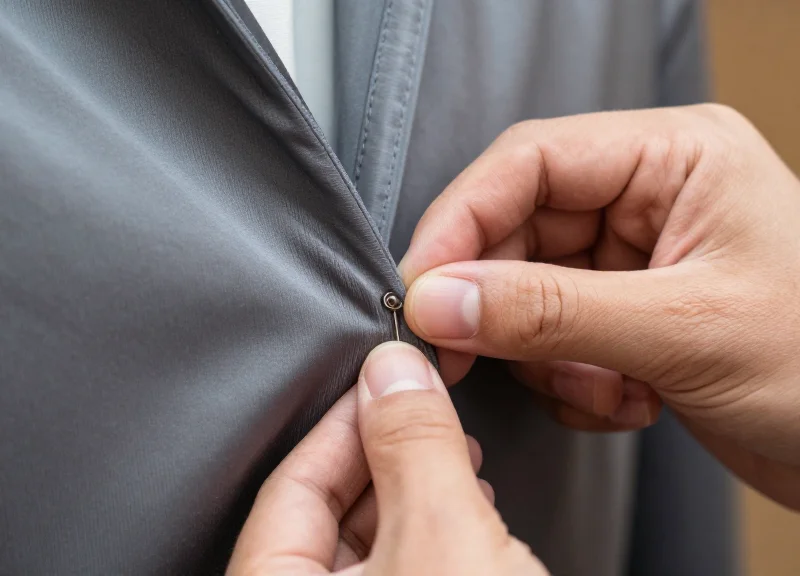
The 'Seam and Hem' Rule is a precision-tagging technique where security fasteners are exclusively inserted through the structural reinforcements of a garment—such as flat-felled seams, bias tape, or hem allowances—rather than the primary body of the fabric. By anchoring the tag where thread density is highest and layers are doubled or tripled, the weight of the security device is distributed across the garment's internal architecture, effectively eliminating 'gravity-sag' and puncture-hole expansion in delicate fibers like chiffon or fine-gauge cashmere.
| Placement Location | Tensional Load Support | Fabric Damage Risk | Ideal For |
|---|---|---|---|
| Main Body Panel | Minimal | Extreme (Tearing/Sagging) | Never recommended for luxury goods |
| Internal Side Seam | High | Low | Dresses, Shirts, Trousers |
| Hem Allowance | Maximum | Negligible | Heavy Coats, Skirts, Denim |
| Intersection 'T-Junction' | Maximum + Stability | Zero (Mechanical Anchor) | Structured Tailoring, Blazers |
To implement this practice effectively, loss prevention teams must look beyond the surface. The goal is to find the 'structural sweet spot' where the garment is naturally reinforced. For instance, tagging through the 'seam allowance' (the extra fabric between the edge and the stitching line) ensures that even if a small puncture occurs, it remains invisible on the exterior of the garment and does not compromise the garment's drape.
- Identify the Structural Anchor: Locate a vertical seam, preferably one reinforced with overlock stitching or bias binding. Avoid horizontal seams that may pull under the weight of the tag.
- Isolate the Seam Allowance: Gently pull the seam apart from the inside to reveal the allowance. Ensure your pin passes through these internal layers only, avoiding the face fabric.
- Execute the 'T-Junction' Anchor: For heavier tags, look for the 'Intersection Anchor'—the point where two seams meet (e.g., where a sleeve seam meets an armscye). This point offers the highest resistance to shearing forces.
Why not just tag the brand label?
While common, brand labels are often only 'tack-stitched' at the corners. The weight of a security tag can easily rip the label off entirely, damaging both the brand's presentation and the garment's resale value.
Does this work for sheer fabrics like organza?
Yes. On sheer fabrics, always tag the French seam or the hem. Because these areas already contain multiple layers of fabric and thread, they can support the pin without causing the 'running' effect seen in single-layer knits.
How does this affect customer fitting?
Placing tags in the side seam at the hip or underarm is generally less intrusive during try-ons than placement in the center-back or shoulder, which can distort the garment's silhouette.
Expert Tip: The Tensional Load Insight. In Silicon Valley's high-end tech-apparel circles, we analyze fabric as a mechanical system. A security tag exerts a 'point load' on a fabric grid. By placing the tag at a 'T-junction' (where a vertical side seam meets a horizontal waistband), you convert that point load into a distributed load across the reinforced stitching of both seams. This is the most technically sound way to prevent the dreaded 'teardrop hole' in high-value silk garments.
Practice 4: Implementing Soft Tag EAS and RFID Solutions

Soft tag EAS (Electronic Article Surveillance) and RFID (Radio Frequency Identification) solutions represent the pinnacle of non-invasive loss prevention. Unlike traditional hard tags that require mechanical locking pins, soft tags utilize ultra-thin, flexible circuits embedded within adhesive-free labels or woven directly into the product's existing branding. This transition from hardware-heavy to digital-first security allows luxury retailers to maintain high detection rates at store exits while completely eliminating the risk of fabric tearing, 'pin-hole memory' in delicate weaves, or the structural strain caused by heavy plastic enclosures.
| Feature | Acousto-Magnetic (AM) Soft Tags | RFID Inlays / Smart Labels |
|---|---|---|
| Primary Purpose | Anti-theft / Exit Detection | Inventory Tracking & Security |
| Form Factor | Thin strips (DR labels) | Paper-thin, flexible chips |
| Mounting Method | Pocket insertion or sewn-on | Integrated into care labels |
| Fabric Impact | Zero (no puncture required) | Zero (virtually weightless) |
Expert Tip: To truly protect designer assets, avoid the common 'peel-and-stick' application. Even high-quality adhesives can undergo chemical breakdown over time, leading to 'adhesive ghosting'—a permanent residue or discoloration on synthetic linings and high-sheen silks. Instead, leverage the 'Encapsulated Pocket' technique. Many high-end garments now include discrete internal pockets within the lining or behind the brand tag specifically designed to house these sensors, ensuring the technology never actually touches the fabric fibers.
- Step 1: Conduct a Substrate Compatibility Audit: Analyze the fabric composition to ensure the tag's placement won't cause localized stiffening. For ultra-lightweight fabrics like organza, use woven-in RFID threads rather than localized chips.
- Step 2: Implement Deactivation-Friendly Workflows: Ensure POS systems are equipped with non-contact deactivators that don't require the garment to be pressed firmly against a hard surface, which can cause 'crush damage' to velvet or delicate knits.
- Step 3: Strategic Concealment in Seams: Insert long-strip soft tags into the structural seams of the garment where the double-layer of fabric provides natural cushioning and concealment without adding bulk.
Do soft tags interfere with the silhouette of designer clothing?
No. Modern RFID inlays and AM soft tags are engineered to be under 0.3mm thick and are flexible enough to follow the natural drape of the garment, making them invisible to the consumer and harmless to the design.
Are these solutions as effective as heavy hard tags?
While they lack the 'visual deterrent' of a large hard tag, their high-frequency detection is often superior in multi-level retail environments and provides much better data for inventory recovery.
Can soft tags be reused?
Generally, soft tags are disposable or integrated into the product lifecycle. However, the cost-benefit analysis favors them in luxury because they eliminate the 2-5% merchandise write-off rate caused by hard tag damage.
Practice 5: Standardizing Precision Detaching Procedures
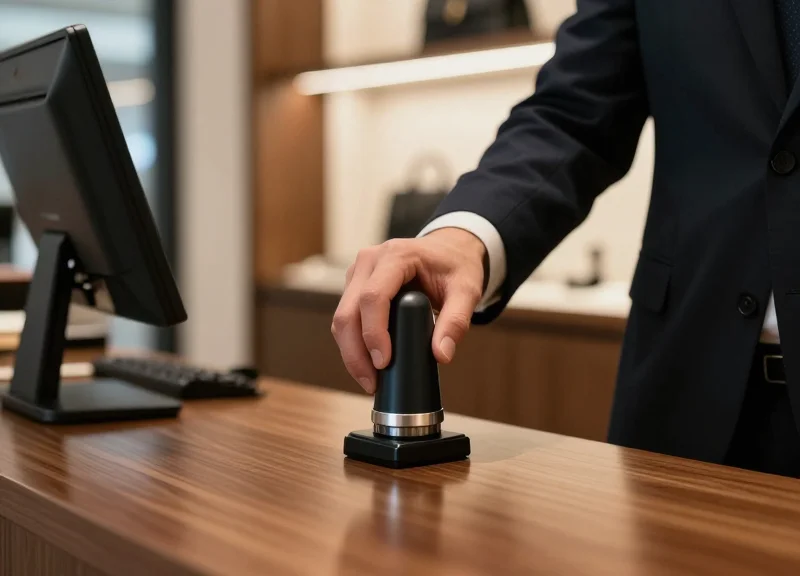
Standardizing precision detaching procedures involves the use of high-strength (≥12,000 Gauss) magnetic decouplers and specific ergonomic motions to release security pins without applying tension to the fabric. By aligning the tag's internal locking mechanism perfectly with the decoupler’s magnetic field, staff can ensure a 'zero-resistance' release, eliminating the risk of mechanical snags or fiber breakage during the checkout process. This technical discipline shifts the focus from speed to garment integrity, protecting the brand's luxury promise at the final touchpoint.
In many luxury retail environments, the most significant damage to delicate fabrics occurs not during the initial tagging, but at the point of sale. If a security pin is forced or pulled before the internal clutch has fully disengaged, it can create a 'run' in silk or a visible puncture in high-gauge knits. A standardized removal protocol serves as the final safeguard for the merchandise's structural integrity.
| Equipment Grade | Magnetic Strength (Gauss) | Application Strategy | Risk Mitigation |
|---|---|---|---|
| Standard Magnetic | 9,000 G | Basic RTW / Denim | Low; requires physical force on thicker fabrics |
| Super Magnetic | 12,000 G | Designer Silks / Cashmere | High; provides instant clutch release |
| Ultra-High Strength | 15,000+ G | Hardened Security Fasteners | Maximum; eliminates pin-drag entirely |
- The Stabilization Phase: Place the garment on a flat, clean surface adjacent to the decoupler. Never allow the weight of the garment to hang from the tag during the removal process, as gravity can cause the pin to pull against the weave.
- Vertical Alignment and 'The Click': Lower the tag vertically onto the decoupler. Wait for the audible 'click' or the tactile sensation of the internal spring releasing before attempting to withdraw the pin.
- The Zero-Tension Withdrawal: Pull the pin straight upward in one continuous motion. If resistance is felt, reseat the tag rather than applying force. For ultra-fine weaves, a slight 1-degree lateral 'micro-wiggle' can help the pin clear the fibers without snagging.
- Post-Removal Fiber Grooming: After the pin is removed, use a specialized soft-bristle garment brush or simply the warmth of a finger to gently massage the area, encouraging the fibers to return to their original orientation.
Expert Technical Tip: Magnetic decouplers lose their flux density over time due to environmental factors and constant use. We recommend a 'Magnetic Calibration Check' every quarter using a Gauss meter. A decoupler that has dropped below its rated strength will not fully retract the internal locking 'fingers,' causing micro-abrasions on the security pin which, in turn, damages the next garment it pierces.
What should I do if a tag is jammed?
Never use pliers or manual force. A jammed tag usually indicates a bent pin or a misaligned clutch. Use a high-power handheld detacher to apply a different magnetic angle, or apply a small drop of dry-film lubricant to the pin entrance to facilitate a smooth slide.
Why is a flat-surface removal better than 'in-air' removal?
Removing tags while the garment is in the air creates an unpredictable tension point. A flat surface ensures the fabric remains relaxed, preventing the pin from catching on individual threads as it exits the material.
How do I train staff on 'tactile resistance'?
Training should include 'blind' removal exercises where staff feel the difference between a clean release and a snagged release on scrap luxury fabric. This builds the muscle memory required to stop pulling the moment resistance is detected.
Material Science: Understanding How Different Fabrics React to Tagging
At its core, non-damaging tagging is an application of material science where the goal is to navigate the garment's 'interstice'—the microscopic gaps between woven or knitted yarns—without fracturing the individual filaments. Whether a fabric survives a security pin depends on its fiber morphology, specifically its tensile strength and elastic recovery. While natural fibers like wool possess a high degree of crimp and elasticity, allowing them to 'self-heal' after a pin is removed, synthetic polymers often exhibit higher structural rigidity, making them prone to permanent 'memory' marks if the tag weight exceeds the material's yield point.
| Fiber Category | Material Examples | Structural Reaction | Tagging Risk Level |
|---|---|---|---|
| Protein (Natural) | Silk, Cashmere | Low elasticity; high risk of fiber splitting or 'runs'. | Critical / High |
| Cellulosic (Natural) | Cotton, Linen | High friction; fibers may fray if the pin is dull. | Moderate |
| Synthetic Polymers | Polyester, Nylon | High tensile strength; prone to heat-set 'memory' holes. | Low to Moderate |
| Elastomers | Spandex, Lycra | High recovery; risk of 'laddering' if a single thread snaps. | High |
The most overlooked variable in luxury retail is the 'Hysteresis Factor'—the lag between the application of stress (the weight of a heavy EAS tag) and the fabric's ability to return to its original shape. In high-gauge knits, leaving a tag in the same position for over 90 days can lead to localized creep, where the fibers permanently reorganize around the pin. This is why rotating inventory or using lightweight, balanced hardware is not just a preference, but a technical necessity for maintaining the garment's MSRP.
Does fabric weight affect the choice of tagging hardware?
Absolutely. Lightweight fabrics (under 100gsm) like chiffon require ultra-fine gauge pins (0.6mm or less) to prevent the pin from acting as a wedge that forces yarns apart permanently.
Why do synthetic blends show 'dimples' even after tag removal?
Synthetics lack the natural moisture-driven recovery of wool or cotton. If a pin is inserted, it creates a physical displacement that often requires professional steaming to realign the polymer chains.
Is leather tagging governed by the same material science?
No. Leather is a non-woven collagen matrix. Unlike fabric, it has no interstices to navigate, meaning any puncture is a permanent severance of the material's structure, which is why non-piercing clamps are mandatory.
Expert Tip: To identify if a fabric is a candidate for standard tagging, perform a 'Recovery Test' on an interior swatch. Stretch the material 5% and release; if it takes longer than three seconds to return to its original dimensions, the fabric has low elastic recovery and should only be tagged via the 'Seam and Hem' rule to avoid visible distortion.
Maintenance and Inspection: Ensuring Tag Quality Control
Maintenance and inspection in high-end retail is the systematic auditing of Electronic Article Surveillance (EAS) hardware to identify physical defects—such as microscopic burrs, bent pins, or fatigued locking springs—before they come into contact with luxury inventory. This proactive quality control layer acts as the final barrier against 'tag scarring,' ensuring that the tools intended to protect your assets do not inadvertently become the primary cause of fabric degradation or structural failure in high-value accessories.
| Component | Defect to Watch For | Risk to Fabric |
|---|---|---|
| Security Pins | Micro-burrs or hooked tips | Irreversible snags and pulled threads |
| Clutch Mechanism | Spring fatigue or internal rust | Crushing of delicate fibers or oil staining |
| Magnetic Detachers | De-magnetization or misalignment | Mechanical stress during forced removal |
| Lanyards | Frayed steel or plastic coating | Abrasive friction on leather and silk |
- The 48-Hour De-Commissioning Rule: Rotate pins out of circulation every 48 hours of floor time to check for structural integrity. A pin that appears straight to the naked eye can have a micro-bend that creates a wider-than-necessary puncture hole in dense weaves.
- Visual Magnification Scans: Use a 10x jeweler's loupe to inspect the tips of new shipments of pins. Manufacturing defects often leave jagged edges at the point of the needle that act like a saw when passing through natural fibers.
- Lubricant-Free Internal Cleaning: Never use oil-based lubricants on sticky tag mechanisms. Instead, use compressed air to clear dust. Residual oils from WD-40 or similar products can seep through the tag casing and cause permanent stains on light-colored silks or suedes.
- Detacher Calibration Testing: Monthly testing of magnetic pull strength ensures that tags release instantly. If a detacher requires 'wiggling' or multiple attempts to release, it creates unnecessary torque on the garment's attachment point.
The 'Microfiber Drag Test' is a unique industry hack for rapid quality control. Simply drag a standard microfiber cloth over the tip of a security pin before application. If the cloth catches even slightly, a microscopic snag point exists, and the pin should be discarded immediately. This test is far more sensitive than a visual inspection and effectively mimics the interaction between the pin and delicate high-thread-count fabrics.
How often should security pins be replaced entirely?
In a luxury environment, pins should be treated as semi-disposables. We recommend a full replacement cycle every 6 to 12 months, regardless of visible damage, to account for metal fatigue and microscopic wear.
Can bent pins be straightened and reused?
Absolutely not. Once the structural integrity of a needle-point pin is compromised, the metal develops micro-fissures. Straightening it does not smooth the surface, and the resulting friction during insertion will likely damage the garment.
What is the best way to store tags when not in use?
Tags should be stored in climate-controlled, dry environments in foam-lined bins. Storing them in bulk 'toss bins' causes the pins to collide, creating the very burrs and scratches that lead to fabric damage.