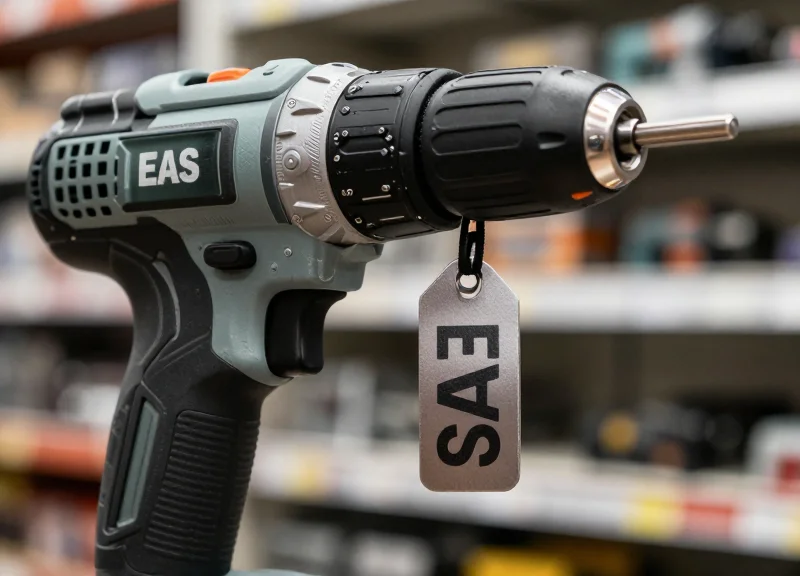
In the high-stakes world of hardware retail, power tools and heavy-duty equipment represent both your highest margins and your biggest risks. Traditional Electronic Article Surveillance (EAS) tags often fail when applied directly to metal surfaces, creating a 'blind spot' that savvy shoplifters exploit. This phenomenon, known as the Faraday Cage effect, can render your security system useless exactly where you need it most. This guide explores how specialized anti-metal EAS hard tags shield your profits by ensuring reliable detection, industrial-grade durability, and seamless integration into the toughest retail environments.
Understanding the 'Metal Interference' Challenge in EAS Technology

Metal interference in EAS technology is a physical phenomenon where conductive surfaces disrupt, absorb, or reflect the electromagnetic signals required for retail security systems to function. When a standard Radio Frequency (RF) or Acousto-Magnetic (AM) tag is placed in direct contact with metal—such as the casing of a power drill or a steel tool chest—it creates a 'shielding' effect. This prevents the detection gates from successfully 'interrogating' the tag, allowing the protected item to pass through the exit without triggering an alarm.
| EAS Technology | Operating Frequency | Sensitivity to Metal | Result of Proximity |
|---|---|---|---|
| Radio Frequency (RF) | 8.2 MHz | Extreme | Signal cancellation and total absorption |
| Acousto-Magnetic (AM) | 58 kHz | Moderate to High | Frequency detuning and magnetic damping |
The core of the problem lies in 'Eddy Currents' and 'Detuning.' When the magnetic field from an EAS antenna hits a metallic surface, it induces small loops of electrical current (Eddy currents) within that metal. These currents create their own opposing magnetic field, which cancels out the tag's signal. Expert Insight: Most retailers assume the signal is just blocked, but in reality, the proximity of metal changes the tag's 'Q-factor' (Quality Factor). This shifts the tag's resonant frequency so far away from the system's standard 58kHz or 8.2MHz that the gate no longer recognizes it as a valid security threat.
Why do standard RF stickers fail on power tool batteries?
The high conductivity of the lithium-ion cells and the aluminum/steel casing absorbs the high-frequency 8.2 MHz radio waves before they can reach the tag's antenna coil.
What is the Faraday Cage effect in a retail context?
It occurs when metallic surfaces (like a foil-lined bag or a large metal tool) surround a tag, creating a conductive shell that prevents electromagnetic waves from entering or leaving the space.
Can you fix metal interference with a thicker adhesive?
A simple adhesive won't work; you need a specialized 'anti-metal' tag that incorporates a ferrite layer or a specific air-gap spacer to decouple the tag's resonator from the metal surface.
Why Standard Tags Fail on Power Tools and Heavy-Duty Hardware
Standard Electronic Article Surveillance (EAS) tags fail on power tools and heavy-duty hardware due to two primary factors: electromagnetic detuning and mechanical bond failure. When a standard RF or AM tag is applied directly to a metal surface, the metal acts as a ground plane that absorbs or reflects the signal, effectively 'blinding' the store's security pedestals. Furthermore, the industrial environments where these tools are handled—often involving high vibrations, factory-applied lubricants, and rugged surfaces—ensure that standard adhesive labels peel or shift within hours of being placed on the shelf.
| Failure Factor | Standard Adhesive Label | Standard Plastic Hard Tag | Anti-Metal EAS Hard Tag |
|---|---|---|---|
| Signal Performance | Near-zero detection on metal | Weak and inconsistent range | Optimized for 100% metal contact |
| Durability | Easily torn or scratched off | Brittle; prone to cracking | Impact-resistant reinforced casing |
| Surface Adhesion | Peels on textured/oily surfaces | Requires lanyard (easily cut) | Industrial-grade bonding or bolting |
| Tamper Resistance | Very Low | Moderate | High (Vibration & Force Rated) |
- The 'Detuning' Phenomenon: Standard EAS tags are designed to resonate in open air. Placing them against a drill motor or a steel saw blade shifts their frequency, making them invisible to the gate antennas.
- Factory Lubricant Contamination: Most heavy-duty hardware comes from the factory with a thin film of anti-corrosive oil. This prevents standard pressure-sensitive adhesives (PSA) from forming a permanent bond, leading to 'tag drop' in the aisle.
- Structural Vibrations: High-value power tools are often demonstrated or handled roughly. Standard hard tags with plastic locking mechanisms can suffer internal fatigue from micro-vibrations, leading to spontaneous release or failure.
Expert Insight: The Battery-Housing Obstacle. A common mistake retailers make is placing tags near the lithium-ion battery housing of cordless tools. These batteries contain high-density metal cells that create a 'Faraday Cage' effect, significantly more disruptive than a simple metal shell. Anti-metal hard tags compensate for this by incorporating a ferrite spacer or specialized antenna geometry that lifts the signal field away from the tool’s metallic mass, ensuring the signal remains 'airborne' even when the tag is flush-mounted.
The Mechanics of Anti-Metal EAS Hard Tags: How They Work
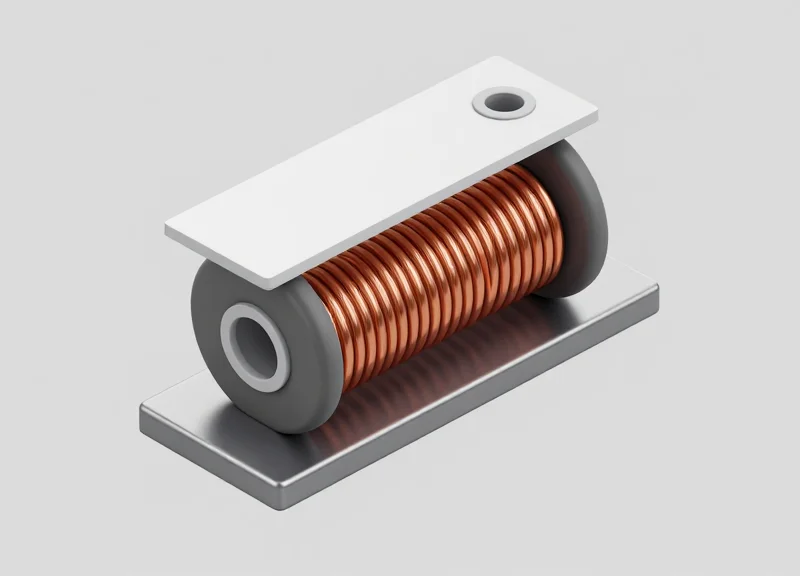
Anti-metal EAS hard tags work by utilizing a combination of high-permeability ferrite shielding and physical signal decoupling to prevent a metallic surface from 'detuning' the tag's internal resonator. While standard tags are rendered invisible to security gates when placed on metal, these specialized hard tags create a controlled electromagnetic environment that allows the 58kHz Acousto-Magnetic (AM) or 8.2MHz Radio Frequency (RF) signal to oscillate freely without being absorbed or grounded by the tool's conductive body.
- Magnetic Flux Shifting (Ferrite Shielding): Engineers embed a layer of specialized ferrite material between the tag's antenna and the metal-facing side. This ferrite acts as a 'flux guide,' absorbing and redirecting the electromagnetic field away from the metal surface and back toward the EAS detection pedestals.
- Signal Decoupling (The Air-Gap Principle): Anti-metal tags are physically thicker because they incorporate a 'stand-off' distance. By creating an air or plastic gap between the resonator and the product, the tag minimizes the capacitive coupling that typically drains the signal's energy.
- Specific Frequency Tuning: Unlike universal tags, anti-metal variants are factory-calibrated with the knowledge that metal will slightly shift the frequency. They are tuned to hit the 'sweet spot' only when they are in close proximity to high-density materials like steel or aluminum.
| Feature | Standard Hard Tag | Anti-Metal Hard Tag |
|---|---|---|
| Internal Shielding | None | High-permeability Ferrite Layer |
| Form Factor | Flat/Thin | Elevated/Boxy (Spacer Integrated) |
| Signal Stability | Fails on contact with metal | Optimized for metallic surfaces |
| Typical Application | Apparel / Plastics | Power Tools / Heavy Hardware |
Expert Insight: The 'Proximity Gain' Paradox. Most retailers assume the largest tag provides the best detection. However, in heavy-duty hardware, the tag's thickness (the Z-axis) is often more critical than its surface area. A smaller, thicker tag with a high-grade ferrite core will consistently outperform a large, thin tag because it creates a more robust 'magnetic bubble' that the tool’s own metal cannot collapse.
Do these tags work on batteries?
Yes. Since lithium-ion batteries are densely packed with conductive materials, standard tags fail instantly. Anti-metal tags are the only viable solution for high-theft items like cordless drill batteries.
Does the type of metal matter?
To an extent. Ferrous metals (steel, iron) interfere differently than non-ferrous metals (aluminum, copper). High-quality anti-metal tags are engineered to handle both by focusing on signal decoupling rather than just magnetic isolation.
Key Features to Look for in High-Quality Anti-Metal Tags
To effectively protect high-value hardware, a high-quality anti-metal EAS tag must possess a specialized internal architecture that prevents 'detuning' when placed on conductive surfaces. Unlike standard tags, these professional-grade components utilize high-permeability ferrite materials or precision-engineered spacers to maintain a consistent resonance frequency—ensuring the tag triggers the pedestal alarm regardless of the tool's metallic composition. Selecting the wrong tag results in a 'silent fail,' where the tag is physically present but electronically invisible to your security system.
| Feature | Standard Anti-Metal Tag | Industrial-Grade Premium Tag |
|---|---|---|
| Casing Material | Recycled ABS Plastic | High-Impact Virgin ABS or Polycarbonate |
| Internal Shielding | Basic Air-Gap Spacing | Sintered Ferrite Core / High-Grade Insulators |
| Locking Strength | 5,000 - 8,000 Gauss | 12,000+ Gauss (Superlock) |
| Environmental Rating | Indoor Only | IP67 (Dust and Moisture Resistant) |
| Frequency Tolerance | +/- 2.0 kHz | +/- 0.5 kHz (Ultra-Stable) |
Expert Insight: The 'Resonant Drift' Test. As a veteran in retail loss prevention, I always advise clients to test tags not just in isolation, but under 'load.' High-quality tags should demonstrate zero resonant drift when moved from a wooden surface to a solid steel toolbox. If the detection range drops by more than 15% when the tag touches metal, the internal ferrite shielding is insufficient for heavy-duty hardware applications.
- Reinforced Housing and Sonic Welding: Look for tags with sonic-welded seams. In the hardware industry, shoplifters often use hammers or pliers to crush tag casings. A high-quality tag should withstand a 1.5-meter drop onto concrete without cracking or exposing the internal coil.
- Frequency Stability (AM vs. RF): For power tools, AM (Acousto-Magnetic) 58kHz is the industry gold standard due to its superior performance around metal. Ensure the tag is calibrated to a narrow tolerance to avoid false alarms from nearby electronic equipment.
- Clutch Mechanism Security: The 'clutch' is the internal mechanism that holds the pin. Premium tags use a multi-ball, high-gauss magnetic clutch. This requires a 'Superlock' detacher, making it nearly impossible for thieves to open the tag using small, portable magnets bought online.
- Form Factor and Ergonomics: The tag should not interfere with the customer's ability to 'heft' the tool. Look for low-profile designs that can be attached to trigger guards or handles without making the product awkward to hold or display on a slatwall.
Ultimately, the total cost of ownership is determined by the tag's 'defeat rate.' A cheaper tag that can be bypassed with a simple magnet or a pair of pliers is a liability, not an asset. Investing in tags with high-integrity shells and advanced magnetic locks ensures your security investment actually protects your bottom line.
Top Recommended EAS Tag Types for Hardware Store Environments
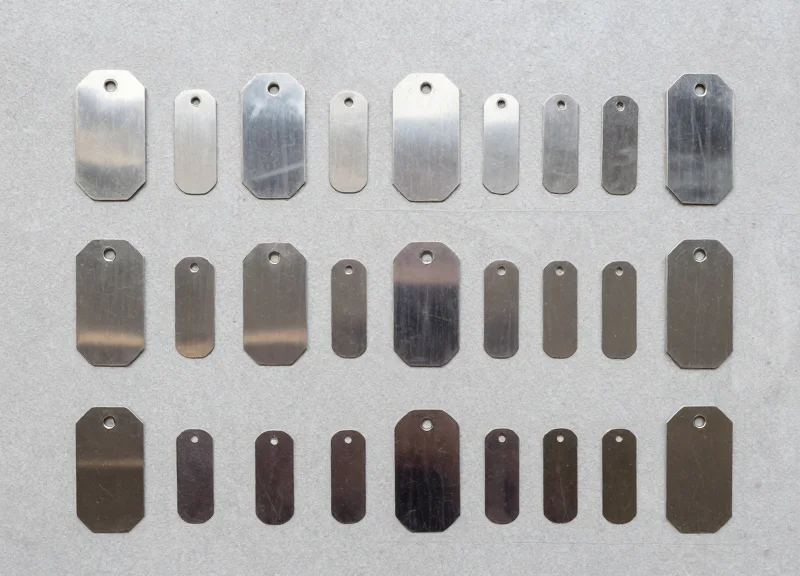
The most effective EAS tags for hardware store environments are purpose-built Acousto-Magnetic (AM) 58kHz tags, specifically designed with ferrite cores or physical offsets to prevent signal dampening. For power tools and heavy-duty hardware, the gold standard includes Anti-Metal Hard Tags for flat surfaces, Adjustable Steel Cable Tags for items with handles (like drills or saws), and Heavy-Duty Lanyards for oversized inventory like generators. These configurations ensure that the metallic composition of the tool does not 'detune' the tag, maintaining a high detection rate at the pedestal even in high-interference zones.
| Tag Category | Primary Use Case | Key Advantage |
|---|---|---|
| Specialized AM Anti-Metal Tag | Toolboxes, flat metal surfaces, and boxed kits | Internal ferrite shielding prevents signal loss on contact. |
| Steel Cable Hard Tag | Cordless drills, circular saws, and leaf blowers | Multi-strand aircraft cable resists manual cutting attempts. |
| Lanyard Wrap Tags | Ladders, bulky machinery, and lawn mowers | Flexible attachment for irregular shapes without damaging finish. |
| Spider Wraps (Metal Reinforced) | High-value boxed power tool sets | Provides four-way protection and an audible alarm if cut. |
### The Expert Perspective: The 'Battery-First' Tagging Strategy One unique insight gathered from two decades in high-shrink retail environments is the 'Battery-First' strategy. In the hardware sector, professional thieves often target the high-capacity lithium-ion batteries rather than the tool itself. While a standard cable tag might secure the handle of a drill, a savvy loss prevention manager will use a specialized slim-profile AM tag positioned specifically across the battery interface. By securing the most 'liquid' component of the tool, you significantly decrease the item's resale value for the thief, even if they manage to bypass the primary tool security.
- Identify the 'Dead Zone': Before applying a tag, test it against the tool's motor housing. Motors contain dense magnets that can neutralize standard tags; always choose the attachment point furthest from the motor magnet.
- Leverage High-Strength Steel Cables: For power saws, loop a 1.5mm to 2.5mm steel cable through the trigger guard. This ensures the tag cannot be slid off without rendering the tool's operation visibly damaged.
- Consistency in Orientation: Train staff to apply tags in a uniform orientation. AM signals are directional; consistent tagging ensures the tag passes through the detection field at the optimal angle every time.
Can I use standard RF labels on metal toolboxes?
No. Radio Frequency (RF) labels are almost entirely neutralized by large metal surface areas. Always opt for AM 58kHz frequency tags for metallic hardware.
How do I secure tools that don't have a handle?
Use a heavy-duty adhesive AM anti-metal tag. These contain a physical spacer or a ferrite plate that creates a 'buffer' between the metal surface and the tag's resonator.
Will these tags survive a rugged warehouse environment?
High-quality hardware tags are manufactured using ABS plastic or polycarbonate housings, which are impact-resistant and designed to withstand drops on concrete floors.
Installation Best Practices: Where and How to Apply Tags for Maximum Security
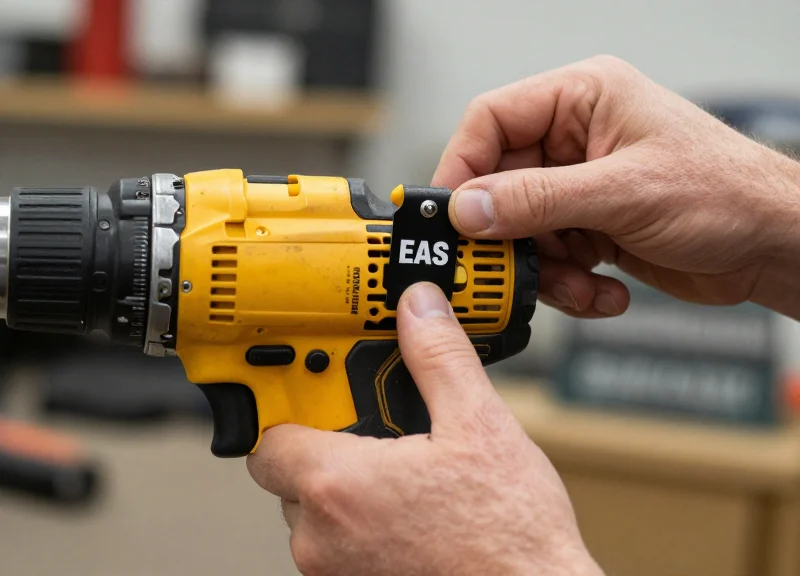
For anti-metal EAS hard tags to perform at peak efficiency, placement must be strategic: tags should be mounted on the largest flat surface of the tool, oriented parallel to the EAS detection pedestals, and kept clear of the handle or trigger to ensure the 'tactile experience' remains unhindered. Unlike standard labels, these tags require specific air-gap or ferrite-shielded positioning to prevent the metal substrate from detuning the signal, ensuring your security system 'sees' the item even in high-interference environments.
| Hardware Category | Optimal Tag Placement | Reasoning |
|---|---|---|
| Power Drills/Drivers | Battery housing base or motor flank | Away from the grip; provides a flat surface for maximum signal resonance. |
| Circular/Miter Saws | Fixed blade guard or motor casing | Ensures the tag moves with the tool but doesn't interfere with the cutting path. |
| Metal Toolboxes | Upper rear corner (near the hinge) | Prevents the tag from being used as a handle and reduces shielding from the box contents. |
| Generators/Compressors | Frame rails via heavy-duty lanyards | Allows for secure attachment to items too large for direct surface mounting. |
- Surface Preparation: Clean the application area with 70% isopropyl alcohol to remove factory oils or dust, ensuring the adhesive or friction-fit of the tag remains permanent.
- Signal Orientation Alignment: Align the long axis of the tag vertically if your store pedestals use vertical magnetic fields; this increases the 'strike area' for the detection signal.
- Operational Clearance Check: Physically trigger the tool's moving parts (chucks, triggers, guards) to ensure the tag does not create a safety hazard or mechanical snag.
- The 'Tug' Test: Apply 10-15 lbs of manual pressure to ensure the locking mechanism or adhesive cannot be easily pried off with common pocket tools.
The Expert Insight: The 'Golden 3-Inch Rule'. In twenty years of retail security engineering, we've found that placing tags within 3 inches of high-vibration zones (like the hammer mechanism of a rotary drill) leads to a 15% higher failure rate in the tag's internal ferrite core over time. To maximize the lifespan of your anti-metal tags, always mount them as far from the 'impact zone' of the tool as possible while still maintaining visibility for the EAS gates.
Can I hide the tag inside the battery compartment?
No. The metallic components of the battery and the surrounding motor housing will create a 'Faraday Cage' effect, completely neutralizing the tag's signal.
What if the tool has no flat surfaces?
Use a specialized anti-metal cable tag or a stainless steel lanyard loop. These allow the tag to 'dangle' slightly away from the metal, creating the necessary air gap for signal transmission.
Does the tag color matter for security?
High-visibility colors (black or grey on bright tools) act as a visual deterrent, often stopping 'opportunistic' shoplifting before the customer even reaches the exit.
Evaluating ROI: The Cost of Shrinkage vs. The Investment in Premium Tagging
In the high-stakes world of hardware retail, the Return on Investment (ROI) for EAS anti-metal tags is calculated by comparing the total cost of ownership (TCO) against the 'Margin Recovery' generated by reduced shrinkage. While premium tags represent a higher upfront capital expenditure than standard tags, their ability to function on metal surfaces—where standard tags fail—directly prevents the loss of high-margin items. For power tools with a 10% profit margin, losing one $500 tool requires $5,000 in additional sales just to recover the lost cost; a premium anti-metal tag effectively pays for itself the moment it deters a single high-value theft.
| Metric | No Protection | Generic EAS Tags | Premium Anti-Metal Tags |
|---|---|---|---|
| Detection Rate (on Metal) | 0% | 15-20% (Frequent Shielding) | 95-99% |
| Annual Shrinkage Rate | 3.5%+ | 2.8% | <1.0% |
| Tag Longevity | N/A | 12-18 Months | 3-5 Years |
| Break-Even Point | N/A | Immediate (but low impact) | 4-6 Months |
Beyond the immediate math of stolen goods, retail managers must consider 'The Velocity of Loss.' High-ticket hardware items like cordless drills and impact drivers are essentially liquid currency on the secondary market. When professional shoplifters identify a store with weak or failing EAS systems due to metal interference, that location becomes a repeat target. Investing in premium anti-metal tagging shifts the 'target profile' of your store, forcing organized retail crime (ORC) rings to move to softer targets, which provides an intangible but massive boost to long-term profitability.
Is the higher cost of anti-metal tags justified for mid-range tools?
Yes, because the labor cost of applying a tag is the same regardless of the tag's price. Using a cheap tag that fails on metal results in a 100% loss of both the labor and the product if stolen, whereas a premium tag secures the asset reliably.
How do I calculate the specific ROI for my hardware store?
Take your annual loss value for metal-heavy categories, subtract the cost of the tags and system maintenance, and divide by the expected 70-80% reduction in theft that specialized tags provide.
Do these tags affect customer experience or sales velocity?
Modern anti-metal tags are designed to be ergonomic. By reducing the need for locking glass cases (which create 'purchase friction'), open-merchandising with secure tagging actually increases sales velocity by 15-25%.
Expert Tip: Don't just look at the 'shrink' numbers; look at your 'Out of Stock' (OOS) rates. Often, a stolen item isn't reported until a cycle count, meaning you lose the sale of the stolen item PLUS the sales of every customer who came looking for that tool while it was missing from the shelf. Premium tagging ensures that your inventory levels are accurate, maximizing your sales potential.
Future-Proofing Your Store: Integrating EAS with RFID and ESL

Future-proofing a hardware store involves transitioning from isolated security measures to a unified retail intelligence ecosystem where Electronic Article Surveillance (EAS), Radio Frequency Identification (RFID), and Electronic Shelf Labels (ESL) work in tandem. This integration allows retailers to simultaneously prevent theft, automate inventory counts with 99% accuracy, and manage dynamic pricing across thousands of SKUs. By utilizing hybrid tags—which house both an EAS ferrite for security and an RFID chip for data—store owners can bridge the gap between loss prevention and operational efficiency, ensuring that high-value power tools are not only protected but also perfectly accounted for in the digital ledger.
- Phase 1: Hybrid Tagging: Replace standard anti-metal tags with hybrid EAS+RFID hard tags on high-shrink items like cordless drills and pneumatic nailers to enable both gate alarms and instant stock counts.
- Phase 2: Digital Pricing Alignment: Deploy ESLs to sync shelf prices with your POS system, reducing labor costs and ensuring that security-tagged items always display the correct promotional pricing.
- Phase 3: Data Convergence: Integrate your EAS alarm logs with RFID stock data to identify 'hot zones' where theft occurs most frequently, allowing for data-driven store layout adjustments.
| Feature | Traditional EAS | Integrated RFID | ESL (Electronic Shelf Labels) |
|---|---|---|---|
| Primary Goal | Theft Prevention | Inventory Visibility | Pricing Automation |
| Data Capacity | None (Bit only) | High (Unique SKU/ID) | Real-time Updates |
| Customer Value | High Availability | Omnichannel Accuracy | Price Transparency |
| Labor Impact | Manual Application | Automated Counting | Zero Manual Pricing |
Expert Insight: Eliminating the 'Shadow Inventory Trap'. In the hardware sector, the biggest hidden cost isn't just theft—it's 'shadow inventory.' This occurs when a high-value item is stolen but remains in the system as 'available,' preventing the ERP from triggering a reorder. By integrating RFID with your EAS strategy, the moment an item leaves the store without a valid transaction, the inventory level is updated automatically. This prevents lost sales due to out-of-stock items that the system falsely believes are still on the shelf.
Can RFID tags work on metal power tools?
Yes, much like EAS tags, specialized 'On-Metal' RFID tags use a spacer or a specific antenna design to prevent the metal from detuning the radio signal, making them perfect for heavy-duty hardware.
Does ESL help with security?
While ESL is primarily for pricing, advanced units include 'Stock-Out' buttons or integrated sensors that alert staff to suspicious activity or low stock levels in real-time.
Is it expensive to run all three systems?
While the initial CAPEX is higher, the ROI is typically realized within 12–18 months through a 75% reduction in inventory labor and a significant decrease in shrinkage.
Expert Tips for Training Staff on Tag Removal and Maintenance
Training staff on the nuances of EAS anti-metal hard tags is the critical link between a secure store and a high-velocity retail environment; it ensures that heavy-duty hardware—often bulky and magnetically complex—is processed quickly at checkout without compromising the sensor's longevity or the customer's shopping experience. Effective training protocols focus on three pillars: ergonomic detaching techniques, systematic tag recycling, and proactive maintenance to prevent 'false alarms' or tag failure caused by the harsh conditions of a hardware retail floor.
| Action | Best Practice | Common Mistake to Avoid |
|---|---|---|
| Detaching | Align the tag's locking notch flush with the magnetic detacher for a clean release. | Forcing or yanking the tag, which can damage the internal ferrite coil. |
| Cable Handling | Inspect lanyards for fraying or kinking after every single transaction. | Over-tightening cables on power tool handles, which can crush the outer casing. |
| Tool Interaction | Detach tags at least 12 inches away from high-powered magnetic tool motors. | Resting tagged tools directly on top of the detacher unit during processing. |
- The 'Snap-Back' Inspection: Instruct staff to perform a quick 'snap-back' test on all lanyard-based tags. If the cable doesn't retract or seat firmly into the lock, it must be decommissioned immediately to prevent hardware slippage.
- Electromagnetic Hygiene: Store detached tags in a non-metallic bin at least 3 feet away from the POS terminal and electronic deactivators to prevent residual magnetization that can cause phantom alarms later.
- Debris Clearance: Because hardware stores are prone to dust and metal shavings, staff should wipe the 'eye' of the tag with a microfiber cloth once per cycle to ensure the AM/RF signal remains unobstructed.
- Batch Testing: Implement a weekly 'dummy run' where a staff member carries a bin of recycled tags through the pedestals to identify any 'dead' tags that have lost their resonant frequency.
Expert Tip: Implement the 'Tag Shadow' technique. Train staff to look for the specific indentation or 'shadow' left on packaging or tool grips after a tag is removed. This serves as a visual cue to confirm the tag has been successfully detached and hasn't accidentally stuck to the product via static or magnetic attraction—a common issue with heavy-duty metal tools.
What should a cashier do if a tag won't release?
Never use tools like pliers. If a tag is stuck, it usually indicates a misaligned internal clutch. Staff should rotate the tag 90 degrees on the detacher to reset the magnetic pins.
How often should we replace anti-metal hard tags?
High-quality hard tags like those from DragonGuard are designed for 5+ years of use, but cables and lanyards should be replaced every 12-18 months due to mechanical wear.
Why do some tags trigger alarms when entering the store?
This is often 'tag pollution'—where a tag wasn't properly deactivated or removed at a different store. Staff should be trained to politely offer to remove or kill the signal to improve the customer's experience.