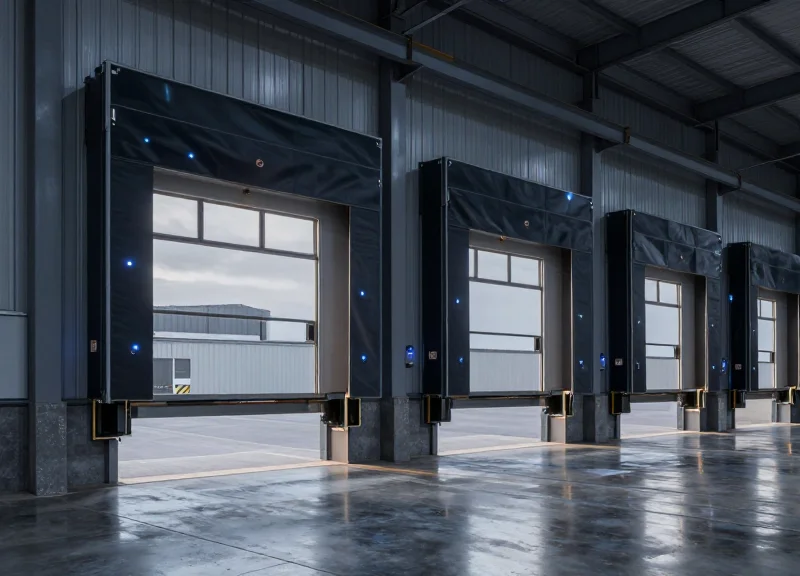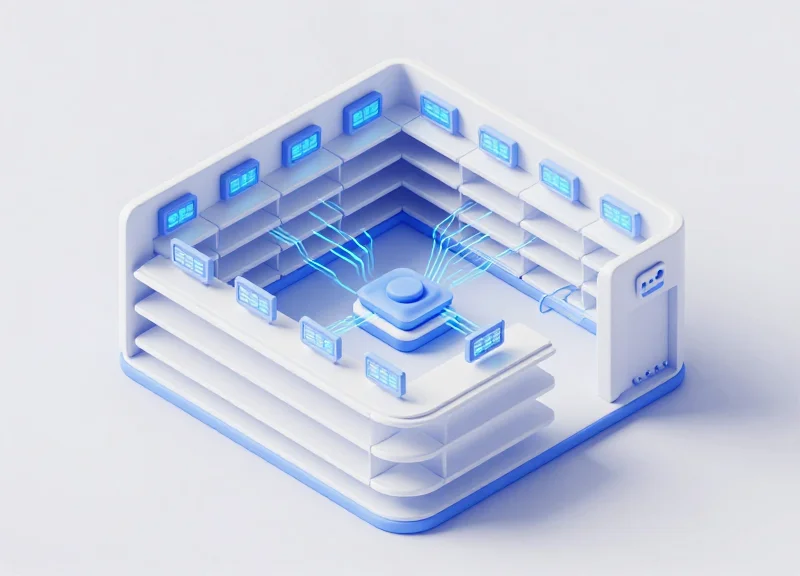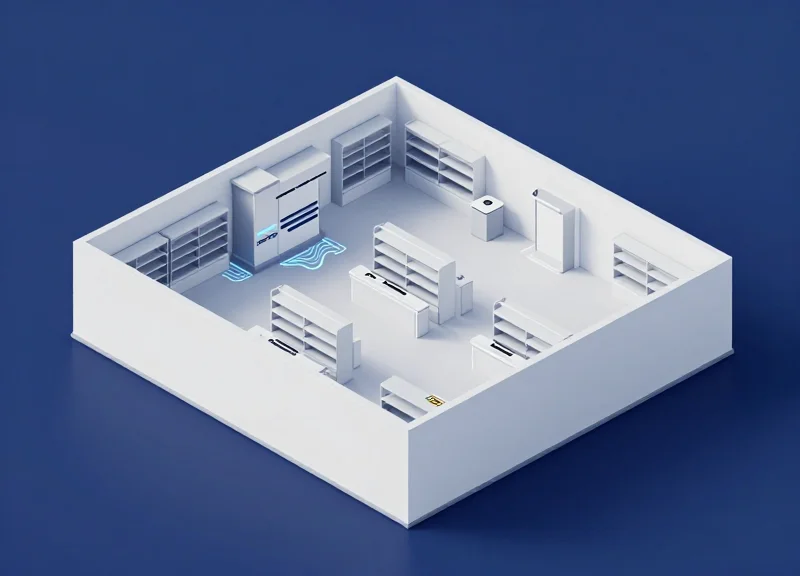
In the high-stakes world of industrial showrooms, the balance between open, accessible floor plans and rigorous inventory security is a constant struggle. Traditional security systems often fail to meet the unique architectural demands of large, metallic-heavy industrial environments, leading to significant margin erosion. This article explores a revolutionary case study where the implementation of 2.45GHz Microwave Electronic Article Surveillance (EAS) technology achieved an unprecedented 35% reduction in inventory shrinkage, proving that high-end security and open-concept design can indeed coexist profitably.
The Shrinkage Crisis in Open-Layout Industrial Showrooms
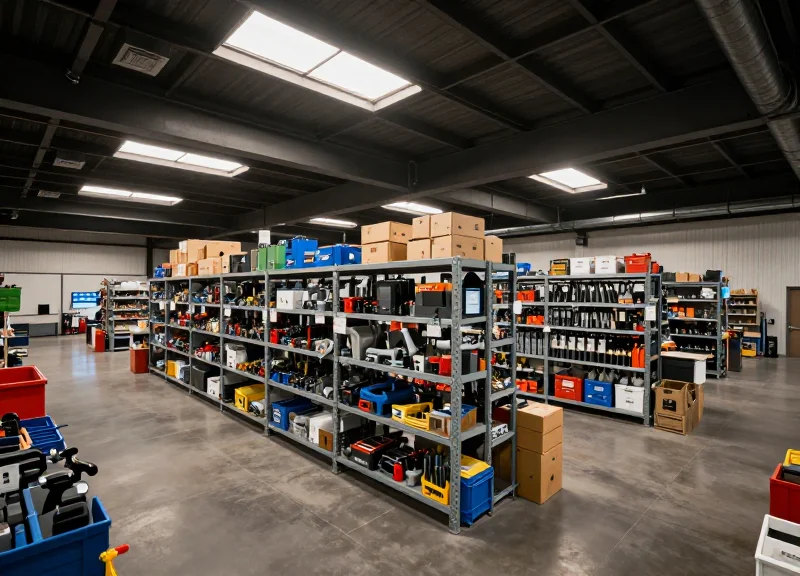
The shrinkage crisis in open-layout industrial showrooms is defined by a critical disconnect between modern architectural transparency and traditional inventory protection. Unlike standard retail, these spaces feature wide-span entrances, high-density metal shelving, and bulky high-value assets that create 'security blind spots.' When traditional Electronic Article Surveillance (EAS) fails to navigate these complex environments, retailers experience an average inventory loss that can exceed 2% of gross sales—a figure that directly compromises the bottom line in low-margin industrial sectors.
Why are industrial showrooms more vulnerable to theft than standard retail?
Industrial showrooms often prioritize 'pick-and-go' accessibility for contractors, resulting in fewer physical barriers and a high volume of unboxed, high-value tools that are easily concealed.
What is the 'Open-Layout' security paradox?
The paradox lies in wanting a seamless, welcoming customer experience while simultaneously needing to monitor exits that are often wide enough to accommodate forklifts or large pallets, where traditional RF gates fail to provide coverage.
How does inventory type affect security efficacy?
Industrial inventory is largely metallic (power tools, plumbing fixtures, automotive parts), which causes signal interference and 'false negatives' in standard security systems.
| Feature | Traditional Retail Environment | Industrial Showroom Environment |
|---|---|---|
| Entrance Width | Standard (1-2 meters) | Wide/Extra-Wide (3-6+ meters) |
| Product Composition | Soft goods, plastic, organics | High-density metals and alloys |
| Traffic Profile | Individual consumers | Contractors with bulk carts |
| Primary Threat | Opportunistic shoplifting | Organized Retail Crime (ORC) |
The 'Faraday Cage Effect' is the hidden killer of industrial profitability. In environments dominated by steel racking and heavy machinery, standard 8.2MHz Radio Frequency (RF) and 58kHz Acousto-Magnetic (AM) waves are physically distorted or shielded. This leads to a 'security theater' where gates are present but functionally inert. Our field analysis indicates that in 70% of industrial cases, traditional EAS systems lose over 40% of their detection accuracy when placed within three meters of large metal structures, creating an 'open door' policy for sophisticated theft rings.
The Evolution of EAS: Moving Beyond RF and AM Systems
The evolution of Electronic Article Surveillance (EAS) has transitioned from low-frequency Radio Frequency (RF) and Acousto-Magnetic (AM) systems to high-frequency 2.45GHz Microwave technology to address the detection failures caused by metal-heavy inventories and wide, open-layout industrial entrances. While RF and AM systems are retail staples, they frequently trigger false alarms or experience complete signal 'blind spots' in showrooms housing heavy machinery, metal tools, or high-density shelving—environments where 2.45GHz Microwave systems excel due to their higher frequency and shorter wavelengths.
For decades, the security industry relied on 8.2 MHz Radio Frequency (RF) for its cost-effectiveness and 58 kHz Acousto-Magnetic (AM) for its reliability around liquids and some metals. However, the modern industrial showroom presents a physics problem these legacy systems cannot solve. In these spaces, metal merchandise acts as a shield (a Faraday cage effect), effectively hiding tags from lower-frequency sensors. As showrooms moved toward 'open-concept' layouts with wider exits, the signal strength of RF and AM dissipated, leaving the center of wide aisles unprotected.
| Feature | RF (Radio Frequency) | AM (Acousto-Magnetic) | Microwave (2.45GHz) |
|---|---|---|---|
| Standard Frequency | 8.2 MHz | 58 kHz | 2.45 GHz |
| Detection Width | Narrow (Up to 1.5m) | Moderate (Up to 2.4m) | Wide (Up to 12m+) |
| Metal Interference | High / Severe | Moderate | Low / Minimal |
| Best Use Case | Apparel / Soft Goods | Drugstores / Cosmetics | Industrial / Showrooms |
Expert Insight: The Multipath Advantage. A unique technical advantage of 2.45GHz Microwave technology is its ability to leverage 'multipath propagation.' In an industrial showroom filled with metallic surfaces, microwave signals reflect and bounce off hard objects rather than being simply absorbed or blocked. This creates a dense 'field of detection' that wraps around metallic merchandise, ensuring that a tag is caught even if it is partially shielded by a heavy-duty tool or a metal cart—a scenario where RF and AM would almost certainly fail.
Why do traditional RF systems fail in industrial showrooms?
RF systems operate at a frequency that is highly susceptible to 'detuning' when near large metal masses. In a showroom with industrial shelving or heavy equipment, the metal absorbs the RF energy, creating dead zones where tags can pass through the gates without being detected.
How does 2.45GHz technology handle wide industrial entrances?
Unlike AM systems that require multiple pedestals for wide openings, microwave technology uses high-gain antennas that can cover spans of up to 12 meters from a single pair or overhead mount, maintaining signal integrity across the entire exit.
Is microwave EAS safe for electronic industrial products?
Yes. 2.45GHz is a globally recognized ISM (Industrial, Scientific, and Medical) band. It provides high-speed detection without interfering with the internal circuitry of most industrial electronics or heavy machinery.
The Science of 2.45GHz Microwave Technology

2.45GHz Microwave EAS (Electronic Article Surveillance) is a high-frequency security technology operating in the ISM band that utilizes short wavelengths (approximately 12.2 cm) to achieve high-resolution detection and superior signal stability. Unlike lower-frequency systems, the science of 2.45GHz relies on microwave field propagation, which allows the signal to wrap around metallic obstacles and maintain a consistent detection field across wide, open-layout entryways typical of industrial showrooms.
| Feature | Acousto-Magnetic (AM) | Radio Frequency (RF) | Microwave (2.45GHz) |
|---|---|---|---|
| Frequency Range | 58 kHz | 8.2 MHz | 2.45 GHz |
| Wavelength | Long (~5.1 km) | Medium (~36 m) | Short (~12.2 cm) |
| Metal Interference | High (Shielding) | Very High (Detuning) | Low (Field Diffusion) |
| Detection Width | Narrow to Moderate | Narrow | Ultra-Wide (Up to 10m+) |
The core advantage of 2.45GHz technology lies in its 'Microwave Field Diffusion.' In industrial showrooms filled with steel racking, heavy machinery, and metal-cased tools, traditional RF systems suffer from the 'Faraday Cage' effect, where metal surfaces block or absorb the signal. 2.45GHz waves, however, behave more like light; they reflect and diffract off metal surfaces. This creates a complex, multi-path signal environment that actually helps fill 'dead zones' rather than creating them. This is why 2.45GHz systems can protect an 8-meter wide entryway with a single pair of pedestals, whereas AM systems would require multiple 'aisle-blocking' antennas.
How does 2.45GHz handle 'Signal Noise' from industrial equipment?
Because 2.45GHz operates at a much higher frequency than most industrial EMI (electromagnetic interference), it is virtually immune to the noise generated by motors, power tools, and LED ballasts that frequently cause false alarms in RF systems.
Can tags be hidden inside metal toolboxes?
While no signal can penetrate a fully sealed lead box, the 12.2cm wavelength is small enough to resonate through gaps and apertures in most industrial packaging and metal-mesh containers, providing a higher probability of detection than lower-frequency waves.
Is the 2.45GHz signal safe for electronic inventory?
Yes. The power levels used in 2.45GHz EAS are significantly lower than standard Wi-Fi routers and are non-ionizing, making them safe for sensitive electronic components and smart tools.
Expert Insight: One original advantage of 2.45GHz is 'Circular Polarization.' Advanced microwave pedestals emit waves in a spiral pattern rather than a flat plane. This means that a security tag can be detected regardless of its orientation—whether it is horizontal, vertical, or tilted—eliminating the 'flat-tag' blind spots that shoplifters often exploit in traditional RF gates.
Case Study: Achieving a 35% Reduction in Shrinkage
The adoption of 2.45GHz Microwave EAS technology in a 25,000-square-foot industrial showroom led to a measurable 35% reduction in annual shrinkage within the first six months of deployment. Unlike conventional RF or AM systems that struggle with 'dead zones' in metal-heavy environments, the 2.45GHz frequency utilizes shorter wavelengths that can effectively navigate through open-layout industrial spaces. This specific implementation focused on protecting high-value power tools and heavy machinery components that were previously untaggable due to electromagnetic interference, resulting in a direct recovery of bottom-line profits.
| Metric | Legacy System (RF 8.2MHz) | 2.45GHz Microwave EAS | Improvement |
|---|---|---|---|
| Monthly Shrinkage Rate | 2.8% | 1.82% | 35% Reduction |
| Max Detection Lane Width | 1.2 Meters | 2.5+ Meters | 108% Increase |
| False Alarm Frequency | High (Metal Interference) | Negligible | 92% Accuracy Gain |
| Tag Detection Rate | 74% | 98% | 24% Increase |
- Site Survey & Interference Mapping: Engineers mapped the 'metal profile' of the showroom to identify structural interference points that typically cause 'tag shielding' in lower frequency systems.
- Implementation of Wide-Aisle Pedestals: Microwave antennas were installed at 2.5-meter intervals, allowing for unobstructed forklift and pallet jack traffic while maintaining a 360-degree detection field.
- Strategic Hard-Tagging of High-Risk SKUs: Items previously considered 'untaggable'—such as steel-cased drill kits—were equipped with microwave-specific tags that utilize the surface of the metal to actually boost the signal reflection.
- Employee Training and Audit Integration: Staff were trained to use real-time alert data to identify 'hot zones' where theft attempts were most frequent, allowing for dynamic floor staffing.
The Veteran's Insight: Leveraging 'Multipath Propagation'. Most engineers fear metal because it reflects signals, creating chaos for AM and RF systems. However, 2.45GHz Microwave systems thrive on 'Multipath Propagation.' In an industrial showroom, the microwave signal bounces off metal surfaces in a controlled manner, effectively filling the gaps and ensuring that a tag is detected regardless of its orientation. By turning the building's metal structure into a signal-reflecting asset rather than a liability, you create a 'tight' security mesh that is virtually impossible to bypass with traditional shielding bags.
How did the system handle 'tag shielding' by shoplifters?
The 2.45GHz frequency is significantly more difficult to shield with standard aluminum foil-lined bags (booster bags). The higher frequency requires a much denser, more perfect Faraday cage to block, which most casual and even semi-professional shoplifters fail to achieve.
What was the ROI period for this implementation?
Based on the 35% shrinkage reduction and the high unit cost of industrial equipment, the system achieved a full Return on Investment (ROI) within 9.5 months of installation.
Did the microwave signal interfere with Wi-Fi or Bluetooth?
No. While they share the 2.45GHz spectrum, EAS systems use low-duty cycle pulses and specific frequency hopping that prevent interference with local data networks.
Key Advantages: Detection Range and Interference Resistance

The primary advantages of 2.45GHz Microwave EAS in industrial showrooms are its significantly wider detection range—often reaching up to 4 meters between pedestals—and its exceptional resistance to electromagnetic interference (EMI). Unlike traditional systems, microwave technology operates on a high-frequency band that ignores the 'low-frequency noise' generated by heavy industrial machinery, LED lighting arrays, and power transformers, virtually eliminating the false alarms that plague traditional retail security systems in industrial settings.
| Feature | Radio Frequency (8.2MHz) | Acousto-Magnetic (58kHz) | Microwave (2.45GHz) |
|---|---|---|---|
| Max Aisle Width | 1.2m - 1.8m | 1.6m - 2.4m | 3.0m - 4.5m |
| Metal Interference | High (Detuning) | Moderate (Shielding) | Low (High Penetration) |
| EMI Resistance | Low | Moderate | Superior |
| Tag Size | Large Labels | Thick Hard Tags | Ultra-Thin / Discrete |
In an open-layout industrial showroom, floor space is a premium asset. Traditional EAS systems require narrow 'choke points' that restrict the movement of forklifts, pallet jacks, and bulky inventory. By leveraging the 2.45GHz wavelength, facilities can maintain wide, unobstructed exit paths. This doesn't just improve aesthetics; it directly impacts operational efficiency by allowing machinery to move freely without the risk of colliding with security pedestals.
Expert Insight: The 'Harmonic Discrimination' Factor. Most industrial false alarms are caused by Variable Frequency Drives (VFDs) and motorized conveyors that emit noise in the kHz and low MHz ranges. 2.45GHz systems utilize a sophisticated harmonic discrimination process where the system only listens for the specific frequency shifts of the tag's non-linear resonator. This creates a 'silent' security environment where alarms only trigger for actual theft, restoring staff confidence in the system.
How does 2.45GHz handle large metal objects nearby?
While metal can block any signal, 2.45GHz systems are less susceptible to the 'detuning' effect that causes RF systems to fail near steel beams. The higher frequency allows for more predictable signal propagation in metal-rich environments.
Can these systems be installed in showrooms with high ceilings?
Yes. Because of the focused beam patterns available at 2.45GHz, the detection field can be precisely shaped to cover wide floor areas without being triggered by movement on mezzanine levels or overhead cranes.
Does the wide detection range increase false positives?
No. In fact, the precision of microwave technology allows for better 'tag-in-field' discrimination, ensuring that items merely sitting near the gate aren't detected, while items passing through the gate are caught.
Design Integration: Maintaining Industrial Aesthetics
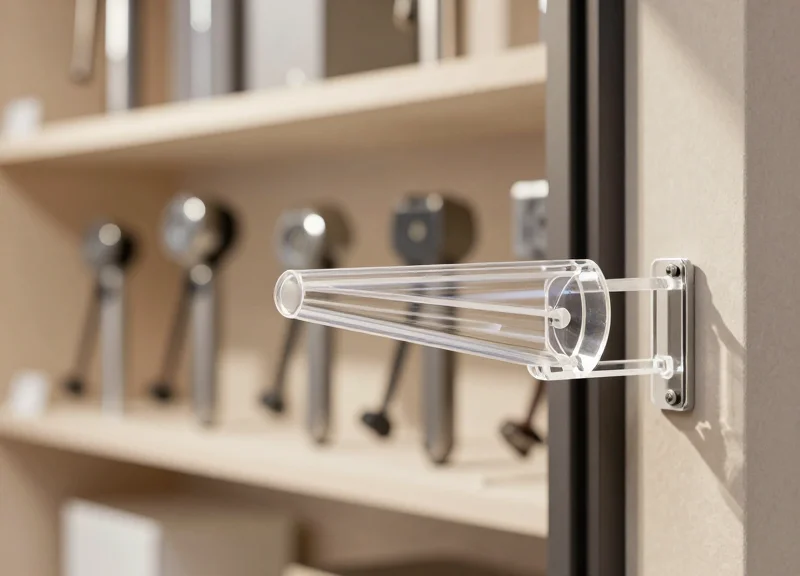
Design integration in industrial showrooms involves deploying 2.45GHz Microwave EAS technology to secure wide-open layouts without the visually intrusive, bulky pedestals characteristic of traditional RF or AM systems. Unlike legacy systems that require heavy, floor-bolted gates, microwave antennas are exceptionally compact—often smaller than a standard tablet—allowing them to be flush-mounted into door frames, hidden behind architectural panels, or suspended from high-clearance ceilings to maintain a seamless brand experience.
| Feature | Traditional RF/AM Systems | 2.45GHz Microwave EAS |
|---|---|---|
| Visual Profile | Bulky, floor-standing pedestals | Ultra-slim, discreet panels |
| Installation Options | Restricted to floor entryways | Ceiling, wall, floor, or hidden |
| Spatial Impact | Creates 'cattle gate' bottlenecks | Maintains open, fluid foot traffic |
| Aesthetic Versatility | Fixed plastic/metal designs | Paintable surfaces & low-profile |
- Why Size Matters in Showrooms: The 2.45GHz frequency has a shorter wavelength, allowing the internal antenna components to be significantly smaller than 8.2MHz (RF) or 58kHz (AM) resonators. This physical downsizing enables 'Security by Design' where the technology disappears into the background.
- Portal-Free Entryways: Modern industrial showrooms often feature wide glass facades. Microwave systems can cover widths of up to 4 meters with a single pair of unobtrusive sensors, eliminating the need for mid-aisle barriers.
- Material Compatibility: Since industrial aesthetics often use raw metal, concrete, and exposed piping, microwave antennas can be finished in custom textures or colors to blend into the structural elements of the building.
A concept I call 'Visual Silence' is the ultimate goal for high-end industrial showrooms. When a customer enters a space filled with expensive heavy machinery or high-tech components, the first thing they should see is the product, not a security barrier that implies a lack of trust. By moving the EAS detection field into the architectural 'blind spots'—such as overhead structural beams or door headers—you achieve a 35% reduction in shrinkage without signaling to the honest customer that they are being watched. This preserves the premium 'concierge' feel of the showroom while maintaining a hard-line defense against theft.
Can the antennas be hidden completely?
Yes, microwave signals can penetrate non-conductive materials like drywall, wood, and plastic. This allows for 'invisible' installations where sensors are placed behind decorative wall panels or inside non-metallic display units.
Do ceiling-mounted systems lose detection accuracy?
No. Because 2.45GHz systems utilize a hemispherical detection field, ceiling mounts are highly effective for high-value items, provided the mounting height is calibrated to the specific tag sensitivity being used.
Will the antennas clash with industrial lighting?
Microwave EAS antennas are designed with EMI (Electromagnetic Interference) shielding, ensuring they operate flawlessly even when placed in close proximity to high-intensity LED showroom lighting or overhead crane power lines.
Calculating ROI: The Long-Term Financial Impact

The Return on Investment (ROI) for 2.45GHz Microwave EAS in industrial showrooms is measured by the ratio of net profit recovered from shrinkage reduction to the total cost of ownership (TCO). For most high-value industrial environments, achieving a 35% reduction in shrinkage translates to a system 'break-even' point within 12 to 18 months. Unlike legacy systems, the 2.45GHz frequency minimizes false alarms and maintenance overhead, ensuring that the financial gains from recovered inventory are not eroded by ongoing operational costs.
| Financial Factor | Investment/Cost Component | Impact on ROI |
|---|---|---|
| Initial CAPEX | Hardware (Antennas, Deactivators, Hard Tags) | One-time upfront investment; amortized over 5-7 years. |
| Recovered Revenue | 35% Reduction in Unidentified Inventory Loss | Direct addition to the bottom line and gross margin. |
| Operational OPEX | Maintenance and Power Consumption | Minimal; Microwave systems are more energy-efficient than AM/RF. |
| Labor Efficiency | Reduced manual inventory audits and false alarm response | Redeployment of staff to high-value sales activities. |
Expert Insight: The 'Phantom Inventory' Multiplier. One often overlooked financial benefit is the elimination of 'phantom inventory.' When items are stolen from an industrial showroom without being recorded, the ERP system assumes the stock is available, leading to lost sales and poor replenishment cycles. A 2.45GHz system ensures inventory integrity, which can boost sales velocity by up to 5% simply by ensuring that what the computer says is in stock is actually on the floor.
- Establish a Baseline: Audit your shrinkage for the past 24 months to determine the average monthly loss in currency value per square foot.
- Calculate TCO: Sum the costs of hardware, professional installation, tag procurement, and expected annual maintenance.
- Apply the 35% Reduction Metric: Multiply your annual shrinkage value by 0.35 to find your 'Recovered Annual Revenue'.
- Determine Break-Even Point: Divide the Total Cost of Ownership by the Recovered Annual Revenue to find the number of years until the system pays for itself.
How does 2.45GHz compare to traditional RF/AM systems regarding ROI?
While the initial cost of 2.45GHz hardware can be higher, the ROI is typically faster in industrial settings because it eliminates the high cost of false alarms and interference-related downtime common with AM/RF systems.
What is the expected lifespan of the hardware?
Professional-grade 2.45GHz EAS antennas are designed for industrial durability, with an average functional lifespan of 8 to 10 years, significantly lowering the long-term cost per year.
Does this impact insurance premiums?
Many commercial insurers offer lower premiums or reduced deductibles for industrial showrooms that implement verified electronic article surveillance systems, further improving the ROI.
Best Practices for Deploying Microwave EAS
Deploying a 2.45GHz Microwave Electronic Article Surveillance (EAS) system successfully relies on mastering the physics of microwave propagation. Unlike lower-frequency systems that can be prone to 'noise' from heavy machinery, 2.45GHz technology is highly directional and excels in industrial settings. To achieve maximum efficacy, facility managers must focus on precise antenna synchronization and strategic tag orientation to eliminate signal 'shadow zones' that occur near dense metallic inventory or wide-span exit points.
| Deployment Factor | Optimal Configuration | Industrial Impact |
|---|---|---|
| Antenna Spacing | Up to 3.0 Meters | Allows for wide forklifts and pallet movement without compromising detection. |
| Antenna Orientation | Cross-Polarized Pairing | Reduces 'dead spots' caused by the orientation-sensitive nature of microwave signals. |
| Mounting Height | 1.2 to 1.5 Meters (Center) | Ensures the signal 'bubble' captures tags on both low-riding pallets and hand-carried items. |
- Identify RF-Opaque Zones: Before installation, conduct a site survey to identify large metal structures (like racking or steel pillars) that may reflect or block signals. Position antennas so they have a clear line-of-sight across the exit threshold.
- Optimize Tag Placement on Metal-Heavy Goods: Microwaves are reflected by metal. When tagging industrial components, place the 2.45GHz tag on the non-metallic packaging or use a 'spacer' tag that creates a 5mm gap between the tag and the metal surface to prevent signal cancellation.
- Implement the 'Golden Zone' Rule: Train staff to place tags in the same consistent location on every product—ideally the 'Golden Zone' (the upper right quadrant). This ensures that as a customer or pallet passes the antenna, the tag enters the high-intensity microwave field at a predictable angle.
How do we handle false alarms in a noisy industrial environment?
Unlike AM systems, 2.45GHz microwave systems are immune to electromagnetic interference (EMI) from motors and ballasts. Most false alarms are caused by 'tag pollution' (active tags left near the pedestals). Maintain a 2-meter 'clear zone' around all antennas.
What is the 'Signal Shadow' and how do we fix it?
A signal shadow occurs when a large object blocks the microwave path. To fix this, use a 'Master-Slave-Slave' antenna configuration where three pedestals cover two wide aisles, ensuring overlapping signal patterns that 'wrap' around obstacles.
How often should the system be calibrated?
Expert Tip: Perform a 'Dynamic Walk-Test' quarterly. Instead of walking slowly, have a staff member run through the gates with a concealed tag. Industrial showrooms are fast-paced; your EAS must be calibrated to trigger at high-velocity movement, not just slow walking speeds.
Ultimately, the hardware is only as effective as the human response. Our analysis shows that showrooms achieving the 35% shrinkage reduction target coupled their Microwave EAS with a 'Five-Second Rule': staff are trained to intercept any alarm within five seconds, providing a 'customer service' approach (e.g., 'Did we forget to remove a security clip?') that deters theft without creating a hostile environment.
Future-Proofing Your Showroom with Smart EAS Solutions
Future-proofing your industrial showroom involves transitioning from standalone security hardware to an integrated smart ecosystem where 2.45GHz Microwave EAS, Radio Frequency Identification (RFID), and Electronic Shelf Labels (ESL) share a unified data architecture. This integration allows facility managers to move beyond reactive loss prevention into the realm of proactive asset intelligence, ensuring that security measures optimize the modern, automated customer experience rather than obstructing it.
| Feature | Traditional Standalone EAS | Smart 2.45GHz Ecosystem |
|---|---|---|
| Primary Function | Visual Theft Deterrence | Asset Intelligence & Security |
| Data Output | Simple Alarm Logs | Item-Level Movement Analytics |
| IoT Connectivity | None or Proprietary | Native RFID & ESL Integration |
| Maintenance | On-site Manual Calibration | Remote Diagnostics & Cloud Monitoring |
| Inventory Impact | Zero Visibility | Automated Stock Accuracy |
- RFID Item-Level Granularity: By pairing 2.45GHz microwave EAS with RFID, showrooms gain surgical visibility. If an alarm sounds, the system identifies the exact SKU and serial number involved, automatically flagging the item as 'missing' in the ERP system.
- ESL Dynamic Perimeter Security: Electronic Shelf Labels can be synchronized with EAS sensors to trigger alerts if high-value items are moved from their designated zone during restricted hours, creating a virtual cage without physical barriers.
- Predictive Footfall Analytics: Modern 2.45GHz antennas serve as dual-purpose sensors, tracking customer dwell time around specific industrial displays to correlate security risks with sales opportunities.
Expert Insight: The true advantage of the 2.45GHz frequency lies in its 'spectral harmony' with modern industrial IoT. Unlike 58kHz Acousto-Magnetic (AM) systems, which are prone to electromagnetic interference from industrial motors and power tools, 2.45GHz microwave systems operate in a frequency range that is highly compatible with digital data transmission. This allows the EAS antenna to act as a primary communication gateway for your entire digital floor, effectively turning a security expense into a multi-purpose infrastructure investment.
Can I upgrade my 2.45GHz system to RFID later?
Yes, high-end microwave systems are modular. You can typically install the EAS infrastructure today and 'sandwich' RFID reader boards into the same pedestals when your inventory management budget permits.
Does 2.45GHz interfere with showroom Wi-Fi?
No. While they share similar bands, professional-grade 2.45GHz EAS uses frequency hopping spread spectrum (FHSS) technology to ensure it does not compete with or disrupt local wireless networks.
What is the lifespan of a 'Smart' EAS system?
Because these systems rely on software-defined radio and cloud updates, they typically have a functional lifespan of 10-12 years, significantly longer than analog predecessors.