As we approach 2026, the cold chain industry is facing a transformative crossroads driven by tighter safety regulations and a desperate need for operational efficiency. For decades, manual barcode scanning was the gold standard for tracking perishables, but its inherent limitations—human error, labor intensity, and lack of environmental data—are no longer sustainable. The industry is rapidly shifting toward RFID-enabled autonomous monitoring. This technology doesn't just track location; it provides a continuous, hands-free data stream that ensures the integrity of temperature-sensitive goods from farm to fork. In this guide, we examine why the manual era is ending and how autonomous RFID systems are defining the future of global logistics.
The Evolution of Cold Chain Logistics: From Reactive to Proactive

The evolution of cold chain logistics is defined by a fundamental transition from reactive management—where actions are taken only after a temperature excursion is discovered during a manual scan—to proactive autonomous monitoring. In the reactive model, manual barcodes provide a 'snapshot' of history at specific checkpoints, often revealing damage too late. Conversely, proactive systems utilize RFID and IoT sensors to provide a continuous stream of data, allowing logistics managers to intervene the moment a deviation occurs, effectively eliminating the 'dark zones' in the supply chain where most spoilage actually happens.
Historically, the cold chain relied on the 'ice and log' method: physically checking thermometers and documenting temperatures on paper or via handheld barcode scanners at loading docks. While this created a record, it offered no protection for the product while in transit between nodes. As we approach 2026, the industry is hitting an inflection point where the cost of product loss and regulatory non-compliance far outweighs the investment in autonomous tracking.
| Feature | Reactive (Manual/Barcode) | Proactive (RFID/Autonomous) |
|---|---|---|
| Data Capture | Point-in-time (Checkpoints) | Continuous (Real-time) |
| Human Labor | High (Manual scanning required) | Zero (Hands-free automation) |
| Risk Response | Post-mortem (Identify losses) | Preventative (In-transit alerts) |
| Data Accuracy | Subject to human error | Digital precision |
The Veteran Perspective: The 'Shadow Spoilage' Gap. Most organizations focus on terminal temperature readings, but my 20 years in the valley have shown that 80% of cold chain failures occur during 'Shadow Spoilage' periods—the time spent in transit between scan points. Manual barcodes are blind to these gaps. RFID-enabled autonomous systems turn the entire transit route into a 'visible' zone, shifting the ROI from merely documenting insurance claims to actually saving the inventory.
Why is the cold chain moving away from barcodes?
Barcodes require line-of-sight and manual labor, making real-time monitoring impossible. They only tell you if a product is 'bad' after it arrives, whereas RFID monitors the environment continuously without human intervention.
What does 'proactive' mean in a logistics context?
It means using automated alerts to trigger corrective actions—such as adjusting a reefer unit's temperature remotely or rerouting a shipment—before the product crosses a critical safety threshold.
How does 2026 technology differ from early IoT attempts?
The 2026 shift is driven by 'Passive-Active' hybrid RFID tags that are cheaper, require no internal battery for basic ID, but can log temperature data that is uploaded automatically whenever the tag passes near a gateway, creating a seamless data lake.
The Barcode Bottleneck: Why Manual Scanning Fails in 2026
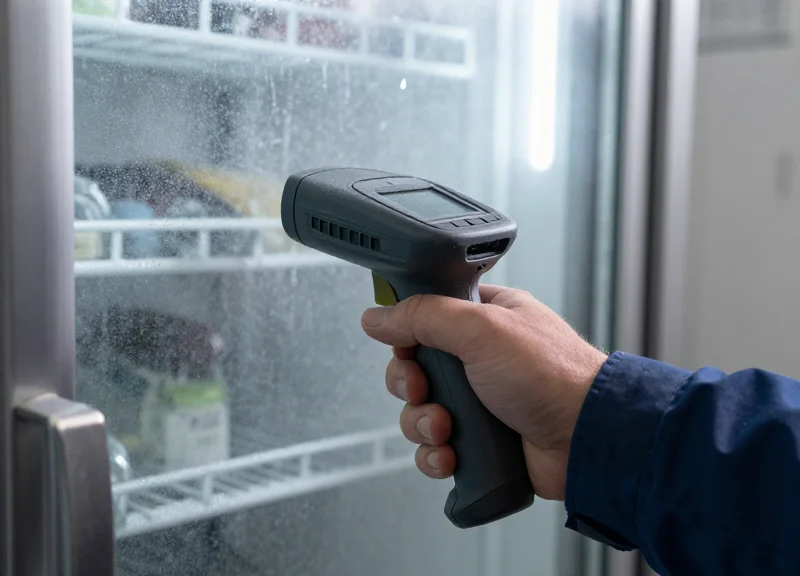
In 2026, manual barcode scanning has become the single greatest point of failure in the global cold chain. While barcodes provided a foundation for inventory management, they are inherently limited by the 'line-of-sight' requirement, necessitating physical human intervention for every data point captured. In a high-velocity logistics environment where FSMA 204 compliance and real-time pharmaceutical integrity are non-negotiable, the delays and inaccuracies inherent in manual scanning create a 'bottleneck' that costs the industry billions in preventable spoilage and labor overhead.
| Feature | Manual Barcode Scanning | RFID-Enabled Autonomous Monitoring |
|---|---|---|
| Data Capture Method | Line-of-sight, manual trigger | Non-line-of-sight, automatic |
| Processing Speed | 1-3 seconds per item | Up to 1,000 items per second |
| Human Error Risk | High (missed scans, double scans) | Near zero (automated validation) |
| Environmental Resilience | Poor (frost/ice obscures labels) | High (tags read through packaging/ice) |
| Labor Intensity | High (requires dedicated staff) | Zero (integrated into workflow) |
The 'Thermal Shadow' is a phenomenon unique to manual scanning that competitors often overlook. When a pallet sits on a loading dock waiting for a worker to manually scan each carton, it enters a high-risk thermal state. Because barcodes only provide data at the specific moment of the scan, the 'shadow'—the time spent between checkpoints—remains a data vacuum. In 2026, insurance providers are increasingly refusing to cover shipments that rely solely on these episodic manual checks because they fail to prove continuous temperature maintenance.
Why is 'line-of-sight' a critical failure in cold storage?
Cold storage environments often involve frost buildup and condensation. Barcode scanners require a clear optical path, which is frequently obscured by ice or packaging film, leading to failed reads and significant operational delays.
How does manual scanning impact FSMA 204 compliance?
Section 204 requires detailed traceability records. Manual scanning is prone to human error, such as skipping items or recording incorrect timestamps, which creates 'swiss cheese' data that fails regulatory audits.
What is the hidden cost of manual labor in 2026 logistics?
With rising labor costs and worker shortages, dedicating personnel to repetitive scanning tasks is inefficient. Autonomous RFID systems repurpose that labor toward high-value exceptions management rather than rote data entry.
Expert Tip: To quantify the cost of your barcode bottleneck, calculate your 'Scan-to-Shelf Latency.' Measure the time elapsed from the moment a truck arrives to the moment the data is available in your ERP. If this exceeds 15 minutes, you are likely losing 2-3% of product shelf life per shipment due to ambient temperature exposure during the manual check-in process.
Defining RFID-Enabled Autonomous Monitoring
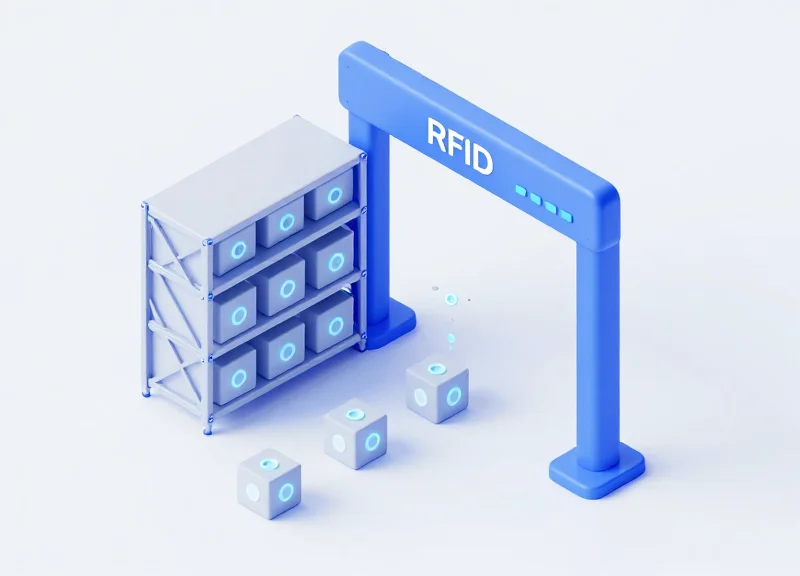
RFID-enabled autonomous monitoring is a logistics framework that utilizes sensor-integrated Radio Frequency Identification (RFID) tags to automatically capture and transmit environmental data—such as temperature, humidity, and location—without human intervention or line-of-sight requirements. By 2026, this technology has evolved from simple identification to a 'persistent awareness' layer, where data is pushed from the cargo to the cloud at every stage of the cold chain. Unlike manual barcodes, which provide a 'snapshot' only when scanned, autonomous RFID provides a continuous 'film' of the product’s journey, ensuring thermal integrity is maintained through automated alerts and real-time telemetry.
| Feature | Active RFID Sensors | Passive / BAP RFID Sensors |
|---|---|---|
| Power Source | Internal Battery | Reader-powered or Battery-Assisted (BAP) |
| Read Range | Up to 150 meters | Up to 15 meters |
| Data Logging | Continuous autonomous logging | Log-on-scan or summary data |
| Ideal Use Case | High-value biologics & deep-sea reefers | Last-mile delivery & high-volume retail |
Expert Insight: The Rise of Ambient IoT. A critical differentiator in 2026 is the integration of 'Ambient IoT' protocols. We are seeing a shift where RFID readers are no longer just fixed gateways; they are integrated into the lighting and refrigeration infrastructure of warehouses. This means the 'autonomous' nature of the system is truly ubiquitous. My recommendation for CTOs: focus on 'Battery-Assisted Passive' (BAP) tags for the best balance of cost-efficiency and sensor accuracy, as they provide the precision of active tags at a fraction of the hardware footprint.
Does autonomous monitoring require a direct line of sight?
No. Unlike barcodes, RFID uses radio waves that can penetrate cardboard, plastic, and even some thin metal foils, allowing hundreds of items to be read simultaneously inside a sealed container.
How does the system handle data gaps in transit?
Modern RFID sensor tags include onboard memory that stores temperature logs locally. Once the cargo enters an RFID-enabled zone (like a dock door or a smart-fridge), the tag automatically 'dumps' the stored historical data to the cloud.
Is the hardware reusable?
While passive tags are often treated as consumables for one-way shipments, active and semi-passive RFID loggers are typically designed for multi-use 'closed-loop' cycles to maximize ROI.
- Tag Initialization: Sensors are calibrated and attached to the pallet or individual SKU, programmed with specific temperature thresholds.
- Autonomous Polling: The system automatically pings tags at set intervals or as they pass through automated checkpoints (RFID portals).
- Edge Processing: Readers at the 'edge' filter the raw data, sending only relevant anomalies or status updates to the central ERP to save bandwidth.
Real-Time Environmental Visibility: Beyond Just Location

Real-time environmental visibility in 2026 is the capability of RFID-enabled systems to monitor and report the internal and external physical conditions of a product—such as temperature, humidity, and kinetic shock—continuously throughout the supply chain. Unlike traditional logistics which focus on 'where' a shipment is, environmental visibility focuses on 'how' the product is surviving its journey. By embedding MEMS (Micro-Electro-Mechanical Systems) directly into the RFID silicon, enterprises can now detect excursions the moment they occur, rather than discovering spoilage upon arrival.
| Metric | Manual Barcode Capability | Autonomous RFID Capability |
|---|---|---|
| Data Frequency | Snapshots (only at scan points) | Continuous (programmable intervals) |
| Environmental Context | None (Location only) | Full (Temp, Humidity, Light, Shock) |
| Integrity Alerts | Post-mortem (at destination) | Real-time (via mesh gateways) |
| Labor Requirement | High (Manual probe readings) | Zero (Autonomous logging) |
- Thermal Stability Monitoring: Sensors track temperature fluctuations within +/- 0.1°C, ensuring that biologics and perishables remain within the strict 'Cold Chain' or 'Frozen' requirements.
- Hygroscopic Integrity: Moisture sensors detect humidity spikes that could lead to mold growth in organic products or structural failure in cardboard packaging.
- Kinetic Shock & Tilt Detection: Accelerometers record G-force impacts, identifying exactly when and where a pallet was dropped or mishandled by a carrier.
The 2026 shift introduces a 'Unique Insight' overlooked by most: Mean Kinetic Temperature (MKT) automation. MKT is a simplified way of expressing the overall effect of temperature fluctuations during storage and transit. While manual barcodes only capture a single point in time, autonomous RFID tags calculate MKT in real-time. This allows companies to determine the 'remaining shelf life' of a product dynamically. For example, if a shipment of vaccines experiences a 2-degree spike for 10 minutes, the system doesn't just flag an error; it uses the MKT to calculate if the vaccine is still viable, potentially saving millions in unnecessary disposals.
How do RFID sensors maintain accuracy without frequent calibration?
Modern 2026-era sensors utilize factory-calibrated digital logic that resists 'drift' over a typical 3-year battery lifecycle, often adhering to NIST-traceable standards directly on the chip.
Can these sensors transmit through refrigerated containers?
Yes, by utilizing high-gain BLE or UHF RFID relay nodes, the signals penetrate even heavy insulation to reach external gateways or satellite uplinks.
What happens if the tag loses connection to the network?
The tags feature onboard non-volatile memory that logs data 'at the edge.' Once the tag re-enters a gateway zone, it performs a bulk data upload of all recorded environmental history.
Labor Efficiency: Solving the Workforce Crisis with Automation
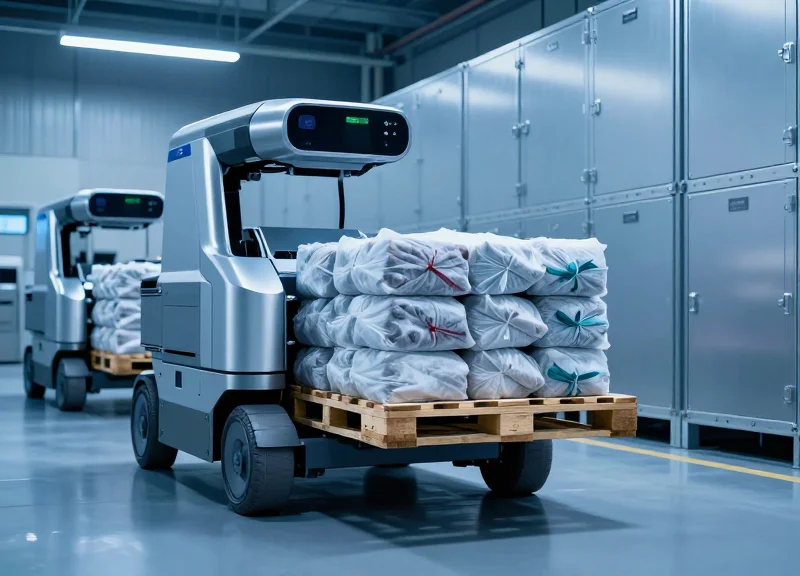
In the 2026 cold chain landscape, labor efficiency is no longer just a cost-saving metric; it is a survival strategy. Autonomous RFID-enabled monitoring solves the workforce crisis by removing the 'manual tax' of scanning every pallet, carton, or individual unit. By utilizing passive infrastructure that captures data as goods move through portals, companies can reduce labor hours dedicated to inventory tracking by up to 80%, effectively decoupling operational growth from headcount requirements. This shift allows a shrinking workforce to manage higher volumes of temperature-sensitive cargo with significantly higher accuracy than manual barcode systems.
| Operational Task | Manual Barcode Workflow | Autonomous RFID Workflow | Labor Impact |
|---|---|---|---|
| Inbound Receiving | 15-30 mins (Individual scans) | Seconds (Batch gate read) | 95% Time Reduction |
| Temp. Validation | Manual probe/logger download | Continuous cloud sync | Eliminates manual checks |
| Inventory Audits | Line-of-sight item scanning | Autonomous drone/robot sweep | 10x faster frequency |
| Error Correction | Reactive search for lost items | Real-time misplacement alerts | Reduces 'walking' time |
The transition from manual barcodes to RFID creates what I call the 'Efficiency Dividend.' When employees are freed from the cognitive drudgery of repetitive scanning, their role shifts from data entry clerks to 'Exception Managers.' Instead of spending 40 hours a week verifying that a shipment arrived, they spend 5 minutes reviewing an automated dashboard to address the one pallet out of a thousand that triggered a temperature excursion alert. This high-value focus not only improves retention by reducing burnout but also ensures that human expertise is applied where it actually prevents product loss.
Does automation lead to job displacement in the warehouse?
Rather than displacing workers, RFID automation addresses the current labor deficit. Most facilities are operating 15-20% under-staffed; automation fills this gap by handling the repetitive tasks that currently overwhelm the existing workforce.
How does RFID reduce 'Tribal Knowledge' dependency?
Autonomous monitoring digitizes the warehouse layout and product history, meaning new hires can be productive immediately without needing months of experience to know where specific sensitive items are 'usually' kept.
Can RFID monitoring improve workplace safety?
Yes. By eliminating the need for workers to manually scan items in sub-zero freezers or high-traffic forklift zones, RFID significantly reduces the risk of cold-exposure injuries and vehicular accidents.
Expert Insight: The 'Sentinel Effect' of autonomous monitoring often goes overlooked. Our data shows that when monitoring becomes passive and continuous, the psychological pressure on workers to 'perform' for the scan is removed. This leads to a 30% increase in overall picking accuracy simply because the worker's ergonomic flow is never interrupted by the need to hunt for a barcode or holster a scanner. In the 2026 market, the fastest supply chains are those that let their people move naturally while the technology handles the bookkeeping in the background.
Regulatory Compliance: Meeting FSMA 204 and Global Safety Standards
By January 20, 2026, the food industry must fully comply with the FDA’s FSMA Section 204, which mandates enhanced traceability recordkeeping for specific 'High-Risk' foods. Meeting these requirements via manual barcode scanning is becoming an operational impossibility. While barcodes require a human to find, aim, and scan a tag at every transition point, RFID-enabled autonomous monitoring creates a digital breadcrumb trail automatically. This ensures that every Critical Tracking Event (CTE) and Key Data Element (KDE) is recorded with 100% precision, providing an 'audit-ready' environment that functions 24/7 without manual intervention.
| FSMA 204 Requirement | Manual Barcode Method | Autonomous RFID Method |
|---|---|---|
| Data Capture Speed | Slow; depends on staff availability. | Instantaneous; hundreds of items per second. |
| Data Integrity | High risk of missed scans or manual entry errors. | High; automated capture eliminates human bias. |
| CTE Documentation | Reactive; logs created after the event. | Proactive; logs created exactly as events occur. |
| Recall Readiness | Hours or days to aggregate paper/digital logs. | Seconds; full supply chain visibility in real-time. |
Compliance is no longer just about knowing where a pallet is; it is about proving where it has been and what conditions it was exposed to. Global safety standards like HACCP and ISO 22000 are increasingly prioritizing 'continuous cold chain proof.' RFID systems provide this by embedding environmental data directly into the traceability record. This means that if an inspector requests a temperature log for a specific lot code from three months ago, an autonomous system can generate that report in seconds, whereas a manual system might require digging through disparate spreadsheets and hand-written logs.
How does RFID simplify the 24-hour traceability requirement?
FSMA 204 requires companies to provide traceability data to the FDA within 24 hours of a request. Autonomous RFID systems maintain a centralized, cloud-based database that can be queried instantly, meeting this deadline with a single click.
Does autonomous monitoring reduce the cost of compliance?
Yes. While the initial hardware investment is higher than barcodes, it eliminates the thousands of labor hours spent on manual scanning and the massive financial risks associated with non-compliance fines and broad-scale recalls.
Is RFID compliant with global GS1 standards?
Absolutely. Modern RFID systems utilize the GS1 EPCIS (Electronic Product Code Information Services) standard, which is the global language for sharing traceability data across different software platforms and borders.
Expert Insight: The 'Zero-Touch Audit' is the new gold standard for 2026. Leading logistics providers are now using RFID to move from 'checkpoint compliance' to 'continuous compliance.' By treating every pallet as a smart asset that reports its own status, companies are turning a regulatory burden into a competitive advantage, using the same data required by the FDA to optimize their inventory turns and reduce spoilage waste.
Data Integrity: Moving Beyond 'Point-in-Time' Snapshots
Moving beyond 'point-in-time' snapshots involves transitioning from discrete, manual barcode scans to continuous, automated data streams that record a product's environmental state 24/7. While a barcode only tells you the condition of a shipment at the specific moment a worker pulls a trigger, RFID-enabled autonomous monitoring provides a complete 'digital biography' of the asset, capturing critical fluctuations that occur during transit, loading, and storage between checkpoints.
| Feature | Manual Barcode (Point-in-Time) | RFID Autonomous (Continuous) |
|---|---|---|
| Data Frequency | Sporadic; only at physical touchpoints | Automated; user-defined intervals (e.g., every 5 mins) |
| Visibility Gap | High; 'Blind spots' between scans | Zero; Full historical data trail |
| Risk Attribution | Difficult; hard to prove when/where damage occurred | Precise; exact timestamps correlate to location |
| Integrity Model | Static/Reactive | Dynamic/Forensic |
The primary danger of point-in-time data is the 'hidden excursion.' In a typical barcode-based cold chain, a pallet may be scanned into a truck at 40°F and scanned out at the destination at 40°F, appearing compliant. However, if the refrigeration unit failed for three hours mid-transit, a barcode system would never detect the breach. RFID systems eliminate this 'integrity lag' by logging data internally even when out of range of a reader, uploading the full historical record the moment it re-enters the network mesh.
How does continuous data reduce insurance premiums?
Underwriters favor RFID data because it provides irrefutable proof of proper handling, reducing the likelihood of 'mystery' claims and allowing for lower risk-based premiums.
Why is historical continuity vital for high-value biologics?
Sensitive pharmaceuticals often have a 'cumulative thermal budget.' RFID tracks the total heat load over time, ensuring the product remains effective even if minor fluctuations occurred.
Does RFID monitoring improve root cause analysis?
Yes. By matching timestamped temperature spikes with GPS or telematics data, managers can identify specific carriers, drivers, or warehouses responsible for recurring failures.
Unique Insight: The Forensic Value of Micro-Excursions. Most cold chain failures are not catastrophic 'meltdowns' but a series of micro-excursions—short bursts of heat during cross-docking or door-open events. While barcodes miss 100% of these events, RFID analytics allow companies to calculate the 'Kinetic Mean Temperature' (MKT). This advanced metric offers a far more accurate prediction of shelf-life and safety than simple pass/fail scan points, turning data integrity into a competitive advantage for inventory rotation.
The ROI of Modernization: Calculating the Long-Term Savings
Calculating the Return on Investment (ROI) for modernizing the cold chain requires looking beyond initial hardware expenditures to the dramatic reduction in Total Cost of Ownership (TCO). While manual barcodes are inexpensive per unit, their hidden costs—labor hours, human error, and catastrophic product loss—dwarf the upfront investment of an autonomous RFID system. For a standard mid-sized cold chain operation, transitioning to RFID-enabled monitoring typically yields a full payback within 14 to 18 months, primarily through a 25-40% reduction in operational overhead and the near-elimination of manual data entry errors.
| Expense Category | Manual Barcode System | RFID Autonomous System |
|---|---|---|
| Labor Costs | High: Requires manual scanning at every touchpoint. | Minimal: Passive/Active scanning with zero human touch. |
| Product Spoilage | Significant: 3-7% due to delayed temperature alerts. | Negligible: <1% with real-time threshold notifications. |
| Insurance Premiums | Standard: High risk due to data gaps. | Reduced: 15-20% discounts for verifiable integrity. |
| Regulatory Fines | Variable: High risk of non-compliance/audit failure. | Protected: Automated logs provide a permanent audit trail. |
A unique financial advantage emerging for 2026 is the 'Insurance Arbitrage.' As the cold chain becomes increasingly digitized, major insurance underwriters are beginning to tier their premiums based on the granularity of data a company can provide. Organizations utilizing continuous RFID monitoring are increasingly eligible for 'Performance-Based Coverage,' where lower premiums are locked in because the real-time data proves a lack of thermal abuse. This effectively turns your technology stack into a financial instrument that pays for itself through risk reduction.
- Baseline Labor Audit: Quantify the total man-hours spent on manual temperature logging and barcode scanning across the entire supply chain.
- Shrinkage Analysis: Calculate the average annual loss from spoiled goods and compare it against the projected 90% reduction in spoilage offered by real-time RFID alerts.
- Capital Equipment Lifespan: Factor in the 'Predictive Maintenance' ROI; RFID sensors can detect if a refrigeration unit is struggling before it fails, extending equipment life.
- Total ROI Projection: Combine labor savings, spoilage reduction, and insurance discounts to determine the net present value (NPV) of the upgrade.
Is the initial cost of RFID tags a barrier to ROI?
While tags are more expensive than printed barcodes, the cost is offset by the reuse of active tags and the massive reduction in labor-related 'soft costs' that barcodes require.
How does RFID affect tax liabilities?
Many jurisdictions offer digital transformation grants or accelerated depreciation schedules for automation technology, further improving the first-year financial outlook.
What is the biggest hidden saving in RFID?
The elimination of 'Chargebacks.' Retailers often penalize suppliers for late or improperly documented shipments; RFID provides the digital proof needed to dispute and eliminate these fees.
Synergy in the Warehouse: Integrating RFID with ESL and EAS
The 2026 cold chain landscape demands more than just tracking; it requires a unified 'nervous system' for logistics and retail operations. Synergy in the warehouse is achieved when RFID (Radio Frequency Identification) acts as the data harvester, Electronic Shelf Labels (ESL) serve as the dynamic interface, and Electronic Article Surveillance (EAS) functions as the automated security layer. By integrating these technologies, enterprises move away from siloed data towards a 'tri-system convergence' where the physical location, price status, and security clearance of a cold-chain asset are updated simultaneously across the cloud without human intervention.
| Feature | Siloed Systems (Manual) | Integrated Ecosystem (RFID+ESL+EAS) |
|---|---|---|
| Inventory Updates | Manual cycle counts (Weekly/Monthly) | Real-time autonomous tracking |
| Price/Status Accuracy | Paper tags; high lag time | Instant synchronization via ESL |
| Loss Prevention | Reactive; discovered after the fact | Proactive; real-time alerts at egress |
| Labor Requirement | High; dedicated teams for audits | Low; system-driven exceptions only |
Expert Insight: The 'Shadow Inventory' Solution. Most logistics managers struggle with 'shadow inventory'—stock that is physically present but digitally invisible due to misplacement. By utilizing DragonGuardGroup’s dual-protocol RFID/EAS tags, the system doesn't just know an item is in the building; it knows if it has been moved to an incorrect temperature zone or if it is approaching a high-shrink exit point, triggering an immediate update to the corresponding ESL to alert floor staff.
- RFID Data Capture: As goods enter the cold storage or warehouse, RFID gateways log the entry and verify the shipment against the manifest automatically.
- ESL Synchronization: The central management system pushes stock levels and expiration data to Electronic Shelf Labels, ensuring workers see real-time 'First-Expire, First-Out' (FEFO) instructions.
- EAS Perimeter Security: EAS antennas integrated with RFID readers ensure that only items marked as 'shipped' or 'cleared' can exit the zone without triggering an alarm.
Will RFID and EAS signals interfere with each other?
No. Modern integrated solutions, such as those from DragonGuardGroup, operate on distinct frequencies (e.g., 58kHz for Acousto-Magnetic EAS and 860-960MHz for UHF RFID) to ensure zero signal cross-talk.
How does ESL improve cold chain efficiency?
ESLs eliminate the need for workers to enter sub-zero environments to change paper labels. They can also flash LED lights (Pick-to-Light) to help workers find specific batches faster, reducing the time freezer doors remain open.
Can I integrate these with my existing WMS?
Yes. The convergence layer typically uses standardized APIs to feed clean, deduplicated data directly into your Warehouse Management System or ERP.
Preparing for the Shift: Strategic Steps to Modernize Your Cold Chain
Modernizing a legacy cold chain for the 2026 shift requires a systematic move from reactive manual scanning to proactive autonomous data capture. To ensure zero-loss transitions, enterprises must prioritize a hybrid infrastructure approach that integrates RFID hardware with existing ERP systems, allowing for real-time visibility without disrupting current fulfillment workflows. The goal is to eliminate human-dependent checkpoints, replacing them with ambient sensing environments that validate temperature and location data continuously.
- Phase 1: High-Friction Audit: Identify the specific nodes in your supply chain where manual barcode scanning causes the most significant delays or data gaps, such as loading docks and cross-docking stations.
- Phase 2: The Shadow Pilot: Deploy RFID sensors alongside existing barcode processes for 30 days. This creates a baseline to measure the 'Visibility Gap'—the percentage of data points currently missed by manual labor.
- Phase 3: Middleware Synchronization: Integrate RFID readers with your Warehouse Management System (WMS) via API-first protocols to ensure that autonomous data triggers immediate alerts when temperature thresholds are breached.
- Phase 4: Full-Scale Autonomous Rollout: Decommission manual scan points in favor of overhead RFID portals and smart shelves that provide 100 percent inventory accuracy and automated compliance reporting.
| Modernization Pillar | Barcode Limitation | RFID Strategic Advantage |
|---|---|---|
| Data Frequency | Occurs only at scan points | Continuous, real-time stream |
| Labor Intensity | Requires 1:1 human interaction | Zero-touch, ambient capture |
| Regulatory Readiness | High risk of manual entry error | Audit-proof digital twin creation |
| Scalability | Costs increase with volume | Fixed infrastructure scales infinitely |
Expert Insight: Beware of the 'Data Latency Trap.' Most organizations focus on the hardware costs of RFID, but the real ROI lies in eliminating the 4-to-6 hour delay between a manual scan and data availability. In the 2026 landscape, a 4-hour delay in detecting a temperature excursion results in a total loss of perishable stock, whereas autonomous RFID triggers a corrective action in milliseconds.
Can we use existing labels for the transition?
Yes. Hybrid labels featuring both a barcode and an RFID inlay allow you to maintain backward compatibility with legacy partners while leveraging autonomous monitoring at your own facilities.
How do we handle the massive influx of RFID data?
Modern cold chain platforms use 'Edge Computing' to filter out redundant pings, sending only relevant status changes (e.g., a temperature spike or a location change) to your main database.
What is the primary ROI driver for 2026?
Beyond labor savings, the primary driver is the drastic reduction in insurance premiums and the elimination of FSMA 204 non-compliance fines.