In the rapidly evolving landscape of biotechnology and clinical research, manual inventory tracking is becoming a liability. As we look toward 2026, the integration of RFID technology into laboratory procurement is no longer a luxury—it is a necessity for precision and compliance. From the delicate glass of a microscope to the chemically volatile environment of reagent bottles, choosing the right RFID tag is critical. This guide provides an authoritative roadmap to navigating the technical specifications and environmental challenges of modern lab asset management.
The Evolution of Lab Procurement: Why RFID is Non-Negotiable in 2026

By 2026, lab procurement has evolved into a fully integrated digital ecosystem where RFID (Radio Frequency Identification) is no longer optional. Modern laboratories utilize RFID tags on reagent bottles and microscopes to enable autonomous inventory tracking, real-time usage monitoring, and automated reordering cycles. This shift replaces error-prone manual logging with a 'Smart Lab' infrastructure that guarantees data accuracy, maximizes instrument uptime, and ensures that critical supplies are never out of stock during sensitive experiments.
The journey from handwritten ledgers to the current state of RFID-enabled automation represents a fundamental shift in scientific operations. While barcodes improved tracking speed, they still required manual intervention and direct line-of-sight. In contrast, 2026 standards prioritize passive and active RFID solutions that allow for bulk scanning of reagents inside cabinets and the instantaneous identification of high-value assets like microscopes across different facility zones.
| Feature | Manual/Legacy Systems | Barcode Scanning | 2026 RFID Ecosystem |
|---|---|---|---|
| Inventory Speed | Hours/Days | Minutes/Hours | Seconds (Real-time) |
| Line of Sight | Required | Strictly Required | Not Required |
| Data Integrity | Low (Human Error) | Moderate | High (Automated) |
| Procurement Trigger | Reactive | Semi-Automated | Proactive/AI-Driven |
Why is RFID mandatory for reagent management in 2026?
Reagents often have strict shelf lives and storage requirements. RFID tags now include integrated sensors that monitor temperature and chemical stability, automatically notifying procurement when a bottle is nearing expiration or has been compromised.
How does RFID streamline microscope procurement and maintenance?
Microscopes are high-value capital assets. RFID tags track their usage frequency and calibration history, allowing procurement teams to make data-driven decisions on when to purchase new units or schedule preventative maintenance to avoid costly downtime.
What role does RFID play in regulatory compliance?
In 2026, global standards like ISO/IEC 18000 require a digital audit trail. RFID provides a tamper-proof record of custody and usage, which is essential for laboratories undergoing rigorous certification audits.
Expert Insight: The 'Zero-Touch' Audit. In my two decades observing lab tech trends, the most significant breakthrough for 2026 is the 'Zero-Touch' inventory audit. By embedding specialized UHF RFID tags on every bottle and microscope, labs can now perform a 100% accurate facility-wide inventory count in under five minutes using overhead readers. This eliminates 'ghost assets'—items that are paid for and insured but don't actually exist in the lab—saving mid-sized facilities an average of $45,000 annually in procurement waste.
Understanding RFID Frequencies: Choosing Between HF and UHF for Lab Environments
In laboratory procurement, the choice between High Frequency (HF) and Ultra-High Frequency (UHF) RFID is determined by the physical properties of the items being tracked. HF RFID (13.56 MHz) is the industry standard for short-range, interference-resistant tracking, ideal for individual reagent bottles. In contrast, UHF RFID (860-960 MHz) offers long-range detection and rapid bulk scanning, making it the preferred choice for inventory management across entire storage rooms, provided the tags are specifically tuned for liquid or metal environments.
| Feature | High Frequency (HF / NFC) | Ultra-High Frequency (UHF) |
|---|---|---|
| Typical Read Range | 1 cm to 10 cm | 1 meter to 10+ meters |
| Data Transfer Rate | Slower (Moderate) | Very Fast (High) |
| Liquid Performance | Excellent (Low absorption) | Poor without specialized 'Flag' tags |
| Metal Performance | Good with ferrite shielding | Requires 'On-Metal' spacers |
| Primary Use Case | Manual bottle verification | Automated room-wide inventory |
Expert Insight for 2026: The Rise of Dielectric-Tuned Tags. Historically, UHF was avoided for reagent tracking because water absorbs UHF energy, 'killing' the signal. However, the 2026 standard has shifted toward dielectric-tuned UHF tags. These tags leverage the liquid inside the bottle as part of the antenna structure itself, effectively turning a previous weakness into a range-extending strength. When procuring for 2026, do not automatically dismiss UHF for liquids; instead, specify 'liquid-aware' broadband antennas that maintain a 98% read rate even in high-humidity cold storage.
- Assess the 'Line of Sight' Needs: If your workflows require scanning a microscope's serial number without opening a cabinet, UHF is mandatory. If you need a technician to 'tap' a reagent bottle to confirm usage on a tablet, HF (NFC) is safer and more intuitive.
- Evaluate the Material Substrate: Microscopes are high-density metal objects. Standard UHF stickers will fail. You must procure 'On-Metal' UHF tags which utilize a ceramic or foam spacer to prevent the metal from detuning the antenna.
- Consider Batch Processing Requirements: If you need to check in a delivery of 500 reagents simultaneously, UHF’s anti-collision algorithms are superior, allowing hundreds of tags to be read per second.
Will UHF tags work on refrigerated reagents?
Yes, but you must ensure the adhesive is 'cryo-grade.' The frequency itself handles the cold well, but condensation can interfere with signal reflection if the tag is not properly encapsulated.
Can I use both HF and UHF in the same lab?
Absolutely. Many modern labs utilize 'Dual-Frequency' tags on high-value equipment like microscopes, allowing for long-range asset tracking via UHF and secure, close-range maintenance logging via a smartphone's HF/NFC reader.
Is HF more secure than UHF?
Generally, yes. Because HF requires close proximity (inches), it is much harder for an unauthorized party to 'sniff' the tag data from a distance, making it ideal for proprietary chemical tracking.
Tagging Reagent Bottles: Overcoming Chemical Exposure and Liquid Interference
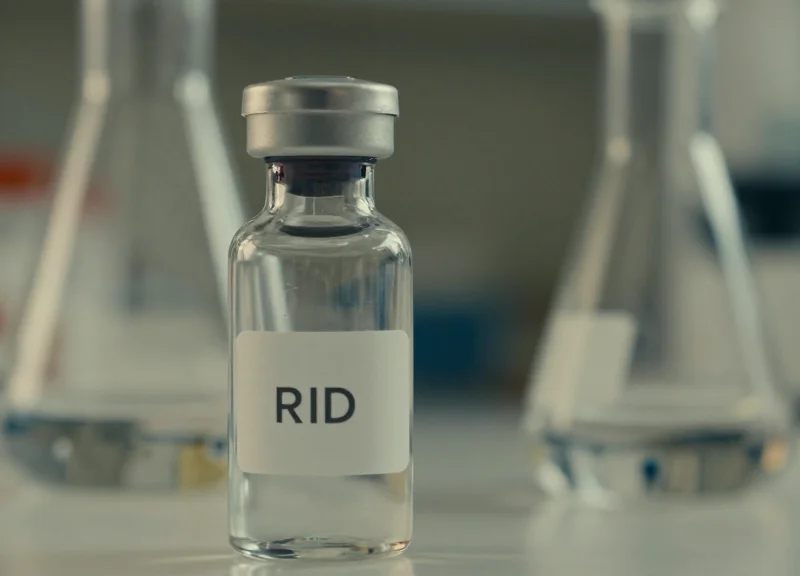
Tagging reagent bottles involves solving two critical physics challenges: chemical degradation of the tag material and signal attenuation (absorption) caused by liquid contents. In 2026, the standard for laboratory procurement centers on 'Flag Tags' or 'On-Metal/On-Liquid' tags that utilize a physical spacer or a specialized antenna design to create a dielectric gap between the tag and the fluid. This ensures that the electromagnetic field is not dampened by the high water or chemical content of the reagent, while high-performance polymers like Polyimide and PEEK protect the internal IC from corrosive vapors and extreme temperatures.
| Challenge Factor | Recommended Material/Feature | Survival Threshold |
|---|---|---|
| Solvent Exposure (Ethanol/Xylene) | Polyimide or PEEK Overlaminate | Continuous 24h immersion |
| Cryogenic Storage | Modified Acrylic Adhesives | -196°C (Liquid Nitrogen) |
| Aqueous/Saline Interference | Ferrite-backed or Flag Design | 99.9% read rate at 2m |
| Autoclave Sterilization | Thermoset Resin Encapsulation | 134°C at 2.1 bar |
Expert Insight: The 'Cap-Integration' Shift. We are seeing a major pivot in 2026 toward embedding RFID tags into the bottle cap rather than the bottle body. Since the cap is typically distal from the bulk liquid volume and less likely to be contacted by spills during pouring, cap-embedded tags reduce the need for bulky 'on-liquid' spacers and allow for a smaller, more aesthetically integrated footprint. If you are ordering custom reagents, ask your supplier about Cap-In-Mold (CIM) RFID solutions.
- Identify the Chemical Profile: Determine if the reagent is acidic, basic, or solvent-based to select a compatible tag top-layer (e.g., Polyester for general use, PEEK for harsh acids).
- Determine the Liquid Volume: Bottles over 500ml require larger antennas or 'flag' orientations to ensure the UHF signal can penetrate the dense liquid field.
- Select the Adhesive Grade: Ensure the adhesive is 'low-outgassing' to prevent contamination of the reagent and 'high-tack' to bond with low-surface-energy plastics like HDPE.
Can I use standard paper RFID labels for reagents?
No. Standard paper labels will disintegrate upon contact with condensation or minor chemical spills. Synthetic labels with specialized top-coats are mandatory for lab longevity.
How do I deal with 'Shadowing' in storage cabinets?
When many liquid-filled bottles are stored together, use circular-polarized readers and ensure tags are placed on the 'shoulder' of the bottle to maximize visibility to the reader antenna.
What is the best way to tag very small vials?
For vials under 10ml, use 'Wing' tags that wrap around the circumference but have a protruding tab that acts as a flag, effectively separating the antenna from the liquid interference.
Precision Tracking for Microscopes: Managing High-Value Optical Assets

Precision tracking for microscopes involves the application of specialized RFID tags to manage high-value optical assets, providing real-time location visibility and digitized maintenance logs without compromising the instrument's ergonomic design or optical performance. Unlike generic asset tagging, microscope RFID integration requires a focus on 'non-interference'—ensuring that the tag's placement does not obstruct focus knobs, interfere with light paths, or add unnecessary bulk to the operator's workspace.
| Tag Category | Best Use Case | Recommended Placement | Key Benefit |
|---|---|---|---|
| UHF On-Metal Tags | Fleet Inventory Management | Microscope Base (Rear) | Long-range scanning for multi-room audits. |
| NFC/HF Slim Inlays | Maintenance & Calibration | Under-Stage or Side Panel | Tap-to-record service history via smartphone. |
| Anti-Tamper Tags | Security & Asset Protection | Internal Chassis/Frame | Alerts system if the tag is removed or compromised. |
Expert Insight: The 'Shadow Usage' Metric. In 2026, leading labs are moving beyond simple inventory tracking to 'Shadow Usage' analysis. By placing RFID readers at specific workstations, you can correlate which microscope units are being moved and utilized most frequently. This data allows procurement officers to identify underutilized assets that can be redeployed, potentially saving tens of thousands of dollars in unnecessary new equipment purchases.
- Identify Non-Operational Zones: Select a placement area that is away from the light path, oculars, and ergonomic touchpoints like the coarse/fine focus knobs or stage controls.
- Surface Material Assessment: Most high-end microscopes feature die-cast metal frames. Standard adhesive tags will fail here; you must use specialized 'On-Metal' RFID tags that include a spacer to prevent the metal from detuning the antenna.
- Calibration-Linked Tagging: Link the unique ID of the RFID tag to your Laboratory Information Management System (LIMS) to trigger automated alerts when the specific optical unit is due for professional cleaning or recalibration.
Will RFID signals interfere with digital imaging components?
No. Passive RFID tags only emit a signal when energized by a reader, and the low-power RF burst does not interfere with the CCD/CMOS sensors used in modern microscope cameras.
Can I use the same tags for reagent bottles and microscopes?
Generally, no. Microscopes require durable on-metal tags, whereas reagent bottles need chemical-resistant tags optimized for liquid environments. Using the wrong tag will result in 'blind spots' during scanning.
What is the best way to prevent tag peeling on textured surfaces?
High-end microscopes often have a powder-coated finish. Use tags with a high-tack acrylic adhesive (like 3M 300LSE) specifically designed for low-surface-energy plastics and textured metals.
Form Factor Considerations: Designing Tags for Vials, Slides, and Large Equipment
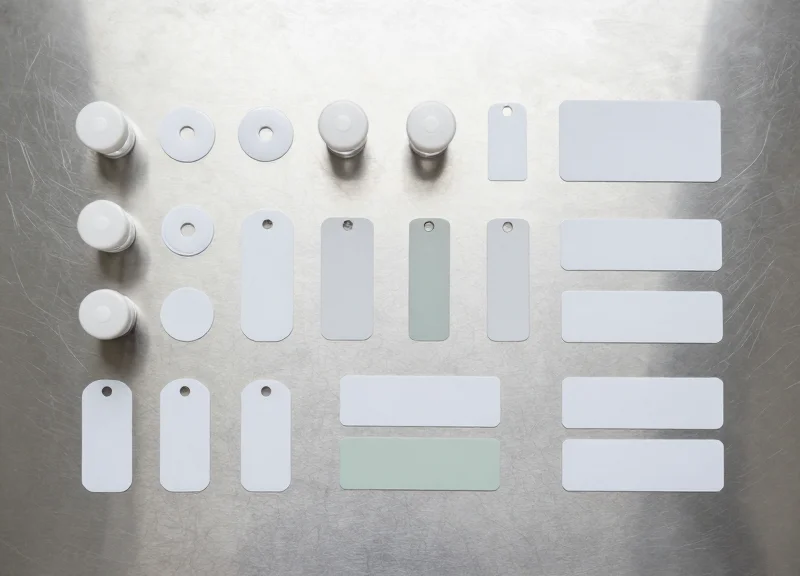
The 'form factor' of an RFID tag refers to its physical shape, size, and material construction, which must be meticulously matched to the laboratory asset's geometry and operational environment. In 2026, procurement focuses on 'interference-free integration,' where tags for micro-vials, glass slides, and heavy machinery are designed to survive high-speed centrifuges, cryogenic storage, and chemical sterilization while maintaining a footprint that does not obstruct the user or robotic grippers.
| Asset Type | Recommended Form Factor | Typical Dimensions | Primary Design Constraint |
|---|---|---|---|
| Cryo-Vials (0.5ml - 2.0ml) | Flexible Wrap-around / Flag Tag | 12mm x 25mm (wrap) | Curvature & Frost Resistance |
| Microscope Slides | Ultra-Thin Transparent Inlay | 5mm x 10mm | Optical Path Clearance |
| Centrifuges / Incubators | Ruggedized On-Metal Hard Tag | 30mm x 30mm+ | Electromagnetic Interference |
| Pipettes / Small Tools | Miniature Ceramic Tag | 3mm x 3mm | Ergonomic Balance |
- Miniaturization vs. Read Range: As assets get smaller (like PCR tubes), the antenna size must shrink. 2026 designs utilize high-permittivity ceramic substrates to maintain a 1-2 meter read range even with a footprint smaller than a fingernail.
- Adhesive Integrity: For vials and slides, the adhesive is as important as the chip. Modern tags use medical-grade acrylic adhesives that prevent 'flagging' (peeling edges) during expansion/contraction in thermal cycles.
- Surface Agnosticism: Large equipment is often metallic, which detunes standard RFID antennas. Form factors for these assets include a built-in spacer or 'on-metal' shielding to create a functional air gap.
Expert Insight: The Shift to 'Flush-Mount' Embedded RFID. A significant trend for 2026 is the move away from aftermarket stickers toward 'embedded' form factors. Leading labware manufacturers are now 'co-molding' RFID chips directly into the plastic base of vials and slide carriers. This 'Zero-Footprint' approach eliminates the risk of tags falling off in liquid nitrogen and ensures that the tag never interferes with the mechanical tolerances of automated liquid handlers.
Will RFID tags make my microscope slides too thick for automated loaders?
No. 2026-spec 'Ultra-Thin' inlays are approximately 50-80 microns thick, which is less than the variance allowed in standard glass slide manufacturing, ensuring compatibility with all major slide scanners.
How do I tag curved surfaces without the tag popping off?
Use 'Flag Tags' or wrap-around labels with a specialized 'tail' that acts as the antenna. This allows the adhesive part to bond securely to the curved vial while the antenna extends slightly to catch the RF signal more effectively.
Can large equipment tags survive autoclave sterilization?
Yes, but you must specify IP68 or IP69K rated 'hard tags' encapsulated in PPS (Polyphenylene Sulfide) or PEEK plastic, which can withstand high-pressure steam and temperatures up to 150 degrees Celsius.
Data Integrity and Regulatory Compliance: Meeting 2026 Safety Standards
In 2026, regulatory bodies like the FDA and EMA have moved beyond simple record-keeping to demanding 'Data Integrity by Design.' RFID technology serves as the foundational layer for this requirement by automating the ALCOA+ (Attributable, Legible, Contemporaneous, Original, Accurate) principles. By embedding identity directly into reagent bottles and microscopes, labs eliminate the human error inherent in manual entry, ensuring that every interaction—from a reagent being uncapped to a microscope being calibrated—is recorded with a cryptographic timestamp and a specific user ID.
| Compliance Metric | Manual/Barcode Entry | 2026 RFID Standard |
|---|---|---|
| Audit Trail Speed | Hours/Days (Logbooks) | Instantaneous (Real-time) |
| Data Accuracy | ~92-95% (Human Error) | >99.9% (Automated Capture) |
| Chain of Custody | Fragmented | Immutable & Continuous |
| Safety Warnings | Passive (Label Reading) | Active (Auto-alerts at Cabinet) |
For laboratories handling hazardous materials or sensitive research equipment, the 'Passive Witness' capability of RFID is transformative. When a reagent bottle is removed from a smart cabinet, the system doesn't just record the movement; it cross-references the user's training credentials and the bottle's expiration date in real-time. If a researcher attempts to use an expired solvent or a microscope that has missed its biennial calibration, the system can trigger an immediate lockout or alert, effectively preventing a compliance breach before it occurs.
How does RFID support 21 CFR Part 11 compliance in 2026?
RFID systems provide the electronic signatures and time-stamped audit trails required by 21 CFR Part 11. By linking physical assets to digital logs automatically, they prevent back-dating and unauthorized data alteration, which are common red flags during audits.
Can RFID help with EHS (Environmental Health and Safety) reporting?
Yes. RFID tags on reagent bottles allow for automated 'cradle-to-grave' tracking. This provides precise data for waste disposal documentation and hazardous material volume reporting, reducing the administrative burden on EHS officers.
Does the RFID data storage comply with global privacy standards?
Modern 2026 RFID implementations use encrypted identifiers that contain no Personal Identifiable Information (PII). The tag only contains a unique ID that links to a secure, permissioned database (LIMS/ERP), ensuring data privacy and security.
Expert Tip: Implement 'Double-Factor Validation' at the Point of Use. To reach the gold standard of 2026 compliance, configure your RFID readers to require both the item tag (the reagent) and the personnel tag (the researcher's badge) to be present within the field simultaneously to 'authorize' an experiment. This creates an airtight, non-repudiable record of exactly who handled what material, providing an unbeatable defense during high-stakes regulatory inspections.
Integration Strategy: Syncing RFID Hardware with LIMS Software
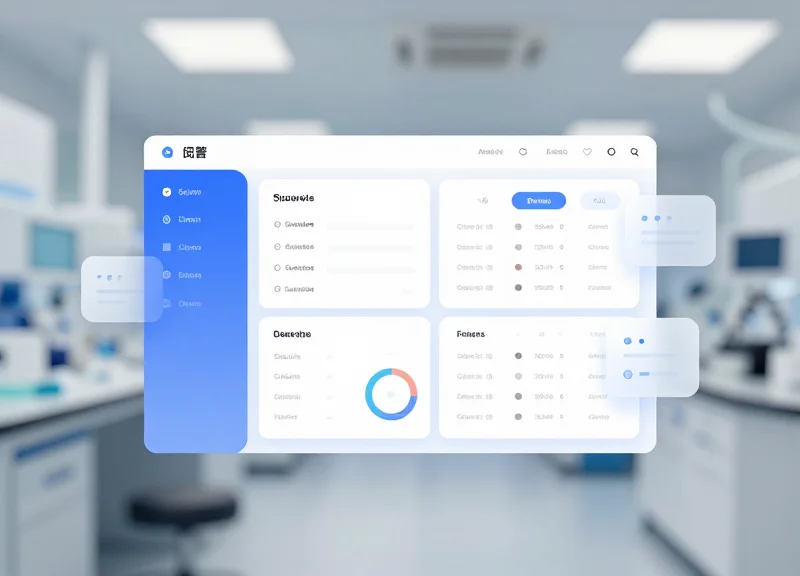
To achieve a seamless digital thread in the modern laboratory, the integration between physical RFID hardware and a Laboratory Information Management System (LIMS) must move beyond basic plug-and-play connectivity. In 2026, top-tier integration strategies rely on a 'Middleware-First' approach, where an intermediate software layer orchestrates the raw data streams from reagents and microscopes, filters out noise from overlapping signals, and delivers clean, validated JSON payloads to the LIMS via RESTful APIs or Webhooks. This ensures that your system of record remains uncluttered while maintaining real-time visibility into asset movement and chemical consumption.
- Identify Communication Protocols: Ensure your RFID readers support modern industrial protocols like LLRP (Low Level Reader Protocol) or MQTT for IoT-friendly data transmission, which are more resilient than traditional serial connections.
- Define Data Mapping Schema: Map unique Electronic Product Codes (EPCs) to specific LIMS fields such as Reagent Lot Number, Expiration Date, or Microscope Service History to ensure contextual relevance.
- Configure Edge Filtering: Set up the reader's internal logic to ignore duplicate reads from the same tag within a specific timeframe (e.g., 500ms) to prevent database bloat within the LIMS.
- Establish Secure API Handshakes: Implement OAuth2 or API key authentication between the RFID gateway and the LIMS to protect sensitive research data and maintain 21 CFR Part 11 compliance.
| Integration Method | Latency | Complexity | Best Use Case |
|---|---|---|---|
| REST API | Moderate | Low | Standard reagent tracking and manual inventory checks. |
| MQTT (Pub/Sub) | Low | Medium | Real-time monitoring of microscope usage and high-traffic labs. |
| Direct Database Write | Ultra-Low | High | Legacy systems where middleware abstraction is not possible. |
| Edge Computing (AI) | Low | High | Predictive maintenance for optics based on usage patterns. |
Expert Insight: By 2026, the 'Data Gravity' problem—where moving massive amounts of raw RFID data to the cloud causes latency—will be solved by 'Logic-at-the-Edge.' Modern readers now perform local verification: if a reagent bottle is placed in a cabinet it shouldn't be in, the reader triggers a local alarm before the LIMS even records the error. This decentralized intelligence prevents costly compliance breaches in real-time.
{
  "event": "tag_read",
  "timestamp": "2026-05-14T10:30:00Z",
  "reader_id": "LAB_NORTH_GATE_01",
  "payload": {
    "epc": "E28011912000000203AD4567",
    "asset_type": "reagent_bottle",
    "rssi": "-55dBm",
    "action": "inventory_check_in"
  }
}
How do I handle RFID 'Ghost Reads' in my LIMS?
Use RSSI (Received Signal Strength Indicator) thresholds in your middleware to filter out tags that are physically distant but still within the reader's reach, ensuring only items on the workbench are registered.
Can RFID hardware work with legacy LIMS that lack APIs?
Yes, through 'Keyboard Wedge' software that emulates human typing, though this is less secure and slower than direct API integration.
Is a specialized server required for RFID-LIMS syncing?
While many modern readers are 'smart' enough to push data directly to the cloud, a local gateway or edge server is recommended for large-scale labs to manage hardware health and local caching during internet outages.
Cost-Benefit Analysis: Measuring the ROI of Automated Asset Management

The Return on Investment (ROI) for automated asset management in a laboratory setting is defined by the delta between the total cost of ownership (TCO) of RFID infrastructure and the cumulative savings gained from reduced inventory shrinkage, labor optimization, and procurement accuracy. In 2026, high-efficiency labs are seeing a typical ROI of 200-300% within the first 24 months, primarily driven by the elimination of manual stock-counts and a 40% reduction in reagent waste due to automated expiration alerts.
| Metric | Manual Management | RFID-Automated Management | Financial Impact |
|---|---|---|---|
| Inventory Audit Time | 40-80 staff hours/month | 2-4 staff hours/month | ~95% Labor Cost Reduction |
| Reagent Expiration Waste | 15% - 22% annual loss | Under 3% annual loss | Direct Procurement Savings |
| Asset Search Time | 15 mins per item/avg | Real-time location data | Increased Research Throughput |
| Equipment Maintenance | Reactive / Scheduled | Usage-based / Predictive | Extended Microscope Lifespan |
Beyond the immediate reduction in 'silent shrinkage'—the loss of expensive reagents that go missing or expire unnoticed—the most significant financial lever is the optimization of the procurement budget. By analyzing RFID-generated data, labs can move from a 'just-in-case' ordering model to a 'just-in-time' model, freeing up significant capital previously tied up in excess inventory sitting on shelves.
How does RFID prevent 'Ghost Inventory' costs?
Ghost inventory occurs when the LIMS shows stock that isn't physically available. RFID eliminates this by providing real-time visibility, preventing emergency high-cost overnight shipping and project delays.
What is the ROI on tagging high-value microscopes?
For microscopes, the ROI is found in asset utilization. Tracking usage patterns allows labs to reallocate underused equipment, potentially deferring a $50,000 capital expenditure by utilizing existing fleet capacity more effectively.
Can RFID help with grant compliance costs?
Yes. Automated tracking provides an immutable audit trail for materials purchased with specific grant funds, reducing the administrative labor and financial risk associated with federal or private audits.
Expert Insight: The 'Opportunity Cost of Research Downtime'. Most ROI models overlook the value of researcher time. In top-tier facilities, a lead scientist spending 30 minutes a day searching for a specific reagent bottle or a calibrated microscope objective represents a loss of roughly $12,000 per year in professional productivity. When scaled across a department of 50 researchers, the 'recovered' time alone pays for the entire RFID infrastructure in less than six months.
Selecting the Right Vendor: Why DragonGuardGroup Leads in Lab RFID Solutions
Selecting a vendor for laboratory RFID systems is no longer just about sourcing hardware; it is about finding a strategic partner capable of navigating the high-stakes environment of reagent management and sensitive equipment tracking. In 2026, the industry standard has shifted from generic 'off-the-shelf' tags to precision-engineered components that can withstand cryogenic temperatures, autoclave sterilization, and corrosive chemical exposure. DragonGuardGroup distinguishes itself by offering a comprehensive ecosystem where high-frequency (HF) and ultra-high-frequency (UHF) technologies are tailored specifically for the rigorous demands of modern life sciences and industrial research.
| Selection Criteria | Generic RFID Vendors | DragonGuardGroup Solutions |
|---|---|---|
| Material Durability | Standard PVC or PET (Low chemical resistance) | Advanced PPS and Epoxy encapsulation (Acid/Base proof) |
| Form Factor Variety | Limited to standard stickers or large tags | Sub-5mm micro-tags for microscope slides and vials |
| Read-Range Precision | Broad-spectrum (Prone to cross-talk in labs) | Defined near-field zones to prevent multi-read errors |
| R&D Customization | Minimal or mass-production only | Bespoke antenna design for specific metal/liquid contents |
- The 'Chemical Fingerprint' Insight: A critical, often overlooked factor is adhesive leaching. DragonGuardGroup utilizes medical-grade, low-outgassing adhesives that ensure the tag remains bonded to reagent bottles without the risk of chemical migration through plastic containers, which could otherwise compromise sensitive biological samples.
- Interference Mitigation: With the density of metal and electronic equipment in labs, signal bounce is a major hurdle. Our engineering team specializes in 'Metal-Mount' optimization, allowing tags on microscopes and centrifuges to maintain 99.9% read accuracy despite the reflective environment.
- Global Compliance Support: Beyond ISO 18000-6C, we provide full documentation for GxP environments, ensuring that your procurement process satisfies both internal efficiency goals and external regulatory audits.
Ultimately, the value of DragonGuardGroup lies in our deep vertical integration. We don't just sell tags; we provide a bridge between physical inventory and digital intelligence. By prioritizing the structural integrity of the tag alongside the reliability of the data packet, we help labs eliminate the 'silent failures'—tags that stop working after three months in a freezer—that plague lower-tier procurement strategies.
Does DragonGuardGroup offer trial kits for pilot programs?
Yes, we provide specialized lab evaluation kits containing a variety of form factors specifically curated for reagent bottles and high-value optics.
Can your tags be pre-printed with 2D barcodes?
Absolutely. We offer dual-layer identification, combining the digital ease of RFID with the visual redundancy of human-readable text or QR codes for hybrid workflows.
What is the typical lead time for custom tag designs?
While standard orders ship within days, bespoke antenna or material designs typically move from concept to prototype in 3-4 weeks, the fastest turnaround in the industrial RFID sector.