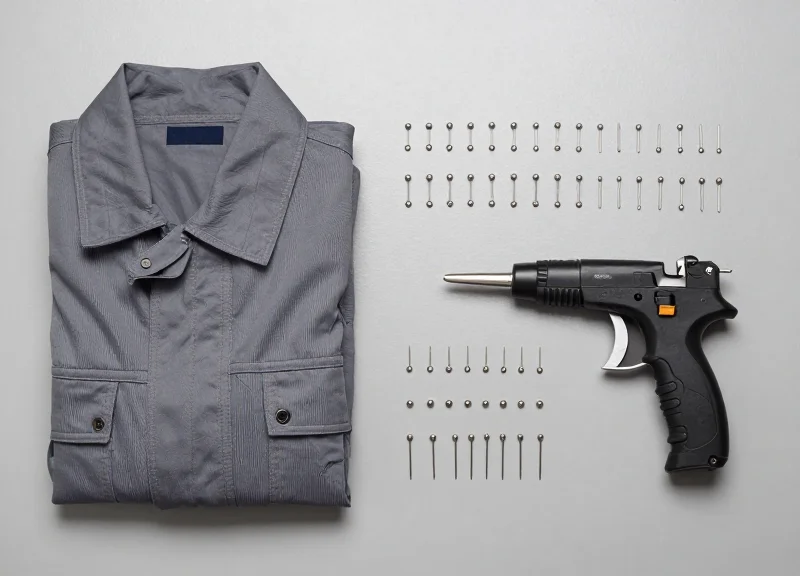
Protecting high-value Flame-Retardant (FR) workwear poses a significant technical challenge: how to implement robust anti-theft measures without compromising the protective integrity of the fabric. Traditional security tags often leave unsightly holes or create micro-tears that can weaken the garment's resistance to heat and flame. As industry experts at DragonGuardGroup, we understand that maintaining the safety rating of your gear is as important as preventing shrink. This guide provides an authoritative look at utilizing 15mm precision pins—a specialized solution designed to offer maximum security while ensuring zero structural damage to high-performance textiles.
The Unique Vulnerabilities of Flame-Retardant Fabrics
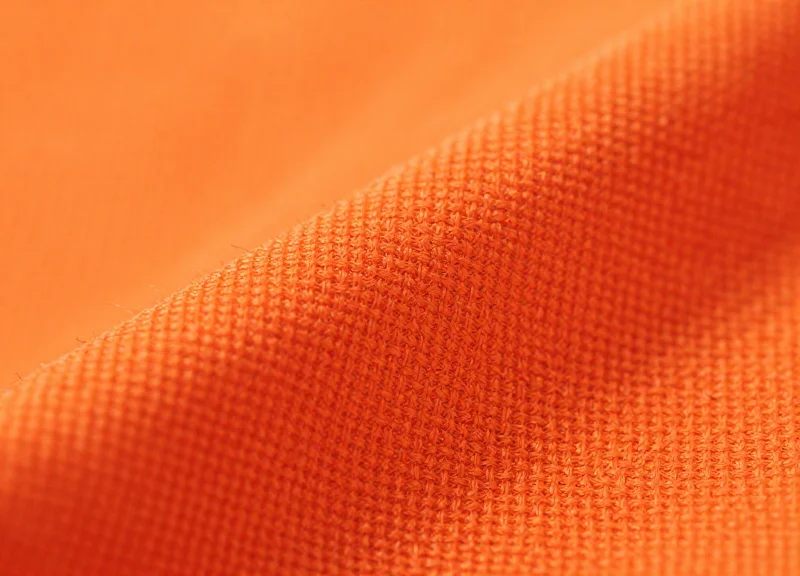
Flame-retardant (FR) fabrics are engineered textiles designed to self-extinguish or resist ignition, but their protective capability depends entirely on the integrity of their molecular or chemical structure. Unlike standard retail cotton or polyester, FR materials like Nomex, Kevlar, and treated cotton blends are uniquely vulnerable to mechanical punctures; even a small, imprecise piercing can create a 'thermal bridge' or cause fiber delamination, effectively compromising the garment's ability to shield the wearer from second and third-degree burns.
| Fabric Type | Primary Material | Vulnerability Level | Impact of Fiber Damage |
|---|---|---|---|
| Inherent FR | Aramid (Nomex/Kevlar) | High | Structural weakening and heat transfer through broken polymer chains. |
| Treated FR | Cotton/Nylon blends | Moderate | Localized removal of chemical finish; potential for 'wicking' of flammable substances. |
| Modacrylic Blends | Synthetic Copolymer | High | Loss of dimensional stability and increased risk of char-hole expansion. |
Why is needle gauge critical for FR garments?
Standard tagging needles often exceed 2mm in diameter, which can sever the tightly woven aramid fibers in Nomex. Using a 15mm precision pin with a fine-gauge needle ensures the tool displaces fibers rather than cutting them, preserving the fabric's tensile strength.
Does a small hole really affect flame resistance?
Yes. In the industry, we call this the 'Oxygen Tunnel' effect. A puncture creates a micro-pathway where oxygen can reach the underside of the fabric, potentially fueling a flash fire and allowing heat to bypass the protective barrier.
Can tagging cause chemical degradation?
In treated fabrics, mechanical damage can expose the non-treated core of the yarn. This makes the area susceptible to absorbing oils or flammable contaminants that the surface treatment would otherwise repel.
Expert Insight: The Micro-Structural Compromise. In my 20 years of analyzing industrial PPE, I’ve observed that the most common failure point isn't the material itself, but 'stress risers' created by improper tagging. When a heavy-duty tag is forced through an FR weave, it creates a permanent distortion in the knit. Under the extreme thermal stress of an arc flash, these distorted areas expand faster than the surrounding fabric, leading to premature 'break-open' and exposing the wearer to direct flame.
Why Standard Security Pins Fail the Safety Test
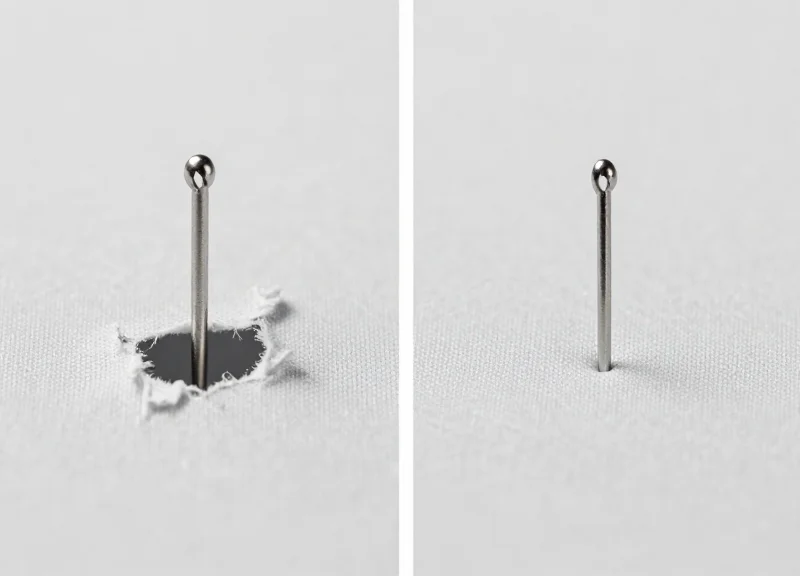
Standard security pins fail the safety test because their large diameter and blunt needle tips cause permanent fiber displacement and yarn severance in specialized weaves. Unlike traditional retail garments, flame-retardant (FR) workwear relies on a continuous protective barrier; even a small puncture from a standard 21mm pin can create a 'thermal bridge,' allowing heat and flames to bypass the fabric's protective surface and potentially voiding NFPA 2112 or EN ISO 11612 compliance certifications.
| Feature | Standard Retail Pins | 15mm Precision Pins |
|---|---|---|
| Needle Diameter | 1.2mm - 1.5mm | 0.6mm - 0.8mm |
| Tip Geometry | Rounded/Blunt | Tapered/Acute |
| Fabric Impact | Fiber Severance | Fiber Separation |
| Safety Compliance | Risk of Non-Compliance | Maintains FR Integrity |
The primary technical failure occurs through a process known as 'yarn fracturing.' Standard pins are designed for density, not delicacy. When forced through high-performance blends like Nomex® or Modacrylic, the blunt tip does not slide between fibers; it shears them. In an industrial flash fire or arc flash event, these fractured zones become weak points. My expert observation from two decades in safety logistics: these punctures act as 'stress risers,' where the sudden thermal expansion of air trapped in the puncture hole can cause the fabric to tear open prematurely, exposing the worker to direct flame.
Does a single pinhole really void NFPA 2112?
While a single hole might not immediately fail the entire garment, repeated tagging in the same area creates a 'perforation line' that reduces the fabric's tensile strength and thermal protective performance (TPP) rating below the required safety thresholds.
Why is pin length (15mm vs 21mm) significant?
Longer pins allow for more 'leveraged movement.' When a garment is handled, a longer pin acts as a lever, widening the entry and exit holes through mechanical friction, whereas a 15mm pin remains snug, minimizing internal abrasion.
Can standard pins cause arc flash hazards?
Yes. If a standard pin uses a highly conductive metal alloy and creates a large enough hole, it can potentially facilitate an electrical arc path through the garment, increasing the risk of internal burns.
The Engineering Behind 15mm Precision Pins
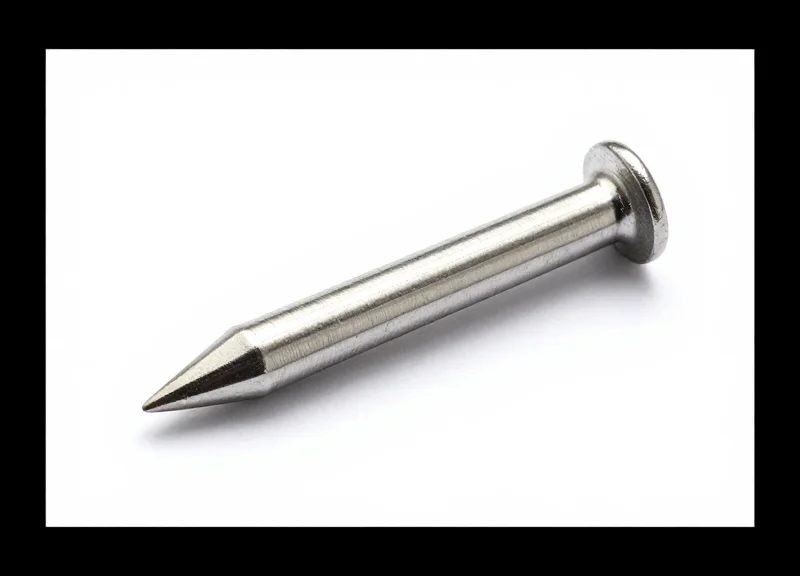
The engineering behind 15mm precision pins centers on a high-tensile 0.6mm gauge diameter and a parabolic tip profile designed specifically to navigate the tight lattice of flame-retardant (FR) weaves. Unlike standard security fasteners that rely on force to pierce material, precision pins leverage 'fiber displacement' technology. By utilizing a specific length-to-width ratio, these pins can bypass individual Kevlar or Nomex threads without severing the synthetic polymers, ensuring the garment's protective barrier and NFPA compliance remain fully intact.
| Specification | Standard Security Pin | 15mm Precision Pin |
|---|---|---|
| Shaft Diameter | 1.2mm - 1.5mm | 0.6mm - 0.8mm |
| Tip Geometry | Chisel or Blunt | Parabolic / Tapered |
| Material | Nickel-Plated Steel | 316L Surgical Stainless Steel |
| Fiber Impact | Shearing/Cutting | Elastic Displacement |
The 15mm length is not an arbitrary choice; it is the 'Goldilocks' zone for industrial applications. It is long enough to penetrate thick multi-layer FR winter wear (such as 40 cal/cm2 arc flash suits) while remaining short enough to prevent 'pin-bend'—a common failure point in longer pins that leads to jagged exits and fabric tears. Furthermore, the metallurgical composition is critical. High-grade 316L stainless steel provides the necessary stiffness to prevent deflection while maintaining a micro-polished surface finish that reduces frictional heat during insertion.
- The 'Slip-Stream' Effect: Expert Tip: High-end 15mm pins undergo an electro-polishing process that removes microscopic burrs. This creates a 'slip-stream' effect where the friction coefficient is reduced by up to 45%, allowing the pin to slide between high-density aramid fibers like a needle through silk.
- Vickers Hardness (HV): Precision pins are engineered to a Vickers hardness of 450-500 HV. This ensures the tip does not dull after repeated use, preventing the 'hooking' effect that occurs when a blunted pin pulls threads out of the weave upon removal.
Why is a parabolic tip better than a sharp needle point?
A needle point can still split a fiber if it hits it directly. A parabolic tip (slightly rounded at a microscopic level) is designed to hit a fiber and 'roll' into the adjacent gap, ensuring zero structural damage to the yarn.
Does the 15mm length affect the security of the tag?
No. When paired with a matching clutch or magnetic lock, the 15mm depth provides optimal engagement with the locking mechanism, making it virtually impossible to remove without the proper detacher, despite the thinner gauge.
Can these pins withstand industrial laundering?
Yes. Because they are made from 316L stainless steel, they are resistant to the high-heat chemicals and moisture typical of industrial FR cleaning cycles, preventing rust stains on expensive PPE.
Step-by-Step Guide to Non-Damaging Tag Application
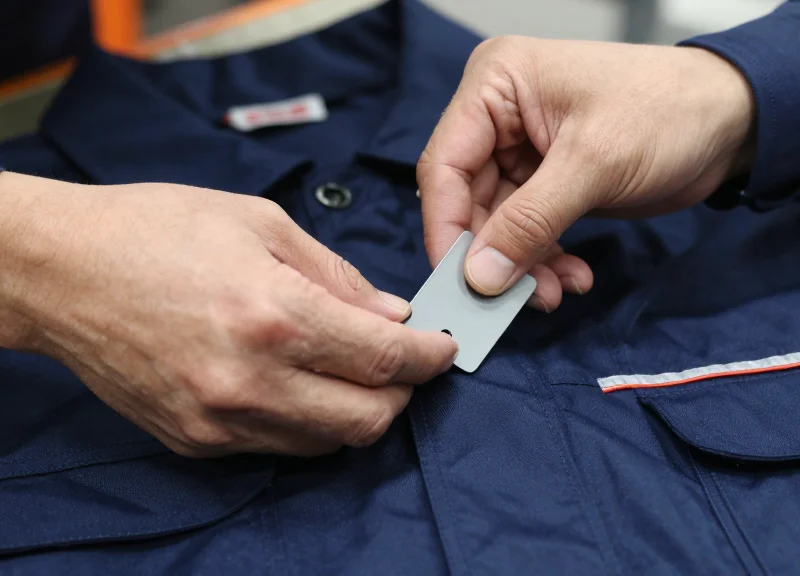
Applying security tags to Flame-Retardant (FR) workwear requires a 'precision-first' methodology where 15mm pins are guided through the interstitial gaps of the fabric weave rather than piercing the fibers themselves. By targeting reinforced structural points like flat-felled seams and utilizing a vertical insertion technique, you ensure the garment maintains its NFPA 2112 or EN ISO 11612 safety ratings while providing maximum inventory security.
- Identify the Structural Anchor Point: Locate a double-stitched seam or a hemmed edge. These areas have higher thread density and multiple layers of fabric, which distribute the weight of the tag and prevent the 15mm pin from creating a 'sag' point that could catch during industrial movement.
- Neutralize Fabric Tension: Ensure the garment is flat and under zero tension. Pulling the fabric taut while inserting the pin can cause the weave to distort around the needle, leading to permanent 'eyeletting' once the tension is released.
- Execute the 90-Degree Vertical Insertion: Position the 15mm precision pin perpendicular to the fabric. Slowly guide the pin through the interstitial space between the warp and weft. If you feel significant resistance, do not force it; micro-adjust the position by 0.5mm to find a natural gap in the weave.
- Engage the Locking Clutch: Slide the security tag onto the pin until it clicks firmly into the clutch. Ensure there is roughly 1-2mm of 'play' between the tag and the fabric to allow for air circulation and to prevent the tag from rubbing against the FR coating.
- Post-Application Calibration: Gently rotate the tag 360 degrees. If the fabric bunches or twists, the pin has likely snagged a fiber. Re-seat the pin to ensure the garment remains fluid and the protective barrier is uncompromised.
| Application Zone | Suitability | Technical Reason |
|---|---|---|
| Flat-Felled Seams | Optimal | High structural density prevents fiber migration and 'hole' expansion. |
| Pocket Flaps | Acceptable | Lower stress area, though slightly higher risk of snagging during work. |
| Main Chest/Back Panels | Forbidden | Single-layer areas are prone to tearing and compromising the arc-flash rating. |
| Cuff Hems | High Risk | Frequent movement leads to mechanical wear around the pin entry point. |
Expert Insight: The 'Shadow Test' for Integrity. After tagging a batch of FR gear, perform a back-lit inspection. Place a high-lumen LED light behind the pinned area. If you see light 'leaking' through a gap larger than the pin diameter itself, the fabric has suffered structural dilation. Using a 15mm precision pin correctly should result in zero visible light leakage once the pin is removed, proving the fibers have successfully returned to their original protective orientation.
Can these pins be used on multi-hazard PPE?
Yes. The 15mm precision pin is specifically designed for high-denier fabrics like Nomex and Modacrylic blends, ensuring the moisture-wicking and flame-resistant properties remain intact.
What should I do if a pin feels 'blunt'?
Discard it immediately. A blunt or burred tip will slice through the polymer chains of FR fibers, permanently weakening the garment's thermal protection zone.
Does the 15mm length affect comfort?
No. The 15mm length is the 'Goldilocks' zone—long enough to clear heavy seams but short enough to sit flush against the tag, preventing skin irritation for the wearer.
Leveraging EAS and RFID for Dual-Layer Protection

Dual-layer protection for flame-retardant (FR) workwear refers to the simultaneous integration of Electronic Article Surveillance (EAS) for real-time loss prevention and Radio Frequency Identification (RFID) for automated inventory tracking and safety lifecycle management. While EAS focuses on immediate theft deterrence at exits, RFID provides granular data visibility, allowing facilities to monitor garment usage, washing cycles, and safety compliance without manual inspection, ensuring that every piece of high-value FR apparel is both present and protected.
In the context of industrial workwear, the 'Dual-Layer' approach addresses two distinct financial risks: external shrinkage (theft) and internal asset mismanagement. High-performance FR garments, often costing five times more than standard cotton uniforms, represent a significant capital investment. By using 15mm precision pins to attach unified EAS/RFID hard tags, enterprises can secure these assets without compromising the fabric's protective integrity or the wearer's safety. This synergy transforms a simple security measure into a robust data-gathering tool.
| Feature | EAS (Security Layer) | RFID (Intelligence Layer) | Combined Dual-Layer |
|---|---|---|---|
| Primary Purpose | Theft Deterrence | Inventory & Lifecycle Tracking | Asset Security & Compliance |
| Detection Range | 1-2 Meters (Gateways) | Up to 10 Meters (Mobile/Fixed) | Comprehensive Site Coverage |
| Data Capacity | Simple 1-bit (On/Off) | Unique EPC Identification | Unique Identity + Security Status |
| FR Compliance | Minimal Impact | Automated Wash-Cycle Logs | Proactive Safety Verification |
Expert Insight: The 'Wash-Count' Compliance Factor. One of the most critical, yet overlooked, benefits of RFID in FR workwear is tracking the 'effective life' of the garment. Flame-retardant properties in certain treated fabrics can degrade after 50 to 100 industrial wash cycles. By integrating RFID, companies can automate the tracking of every wash, triggering a 'retirement' alert before the garment fails NFPA 2112 or EN ISO 11612 standards. This ensures that your security tagging system isn't just protecting the garment from theft, but protecting the worker from a failure in fabric performance.
Can RFID tags survive industrial laundering and autoclaving?
Yes, specialized UHF RFID tags used in workwear are encapsulated in high-grade PPS or silicone, designed to withstand the high temperatures (up to 200°C), pressure, and chemicals typical of industrial laundry processes.
Does the 15mm precision pin interfere with RFID signal strength?
No. The stainless steel used in precision pins is non-ferromagnetic and too small to create a 'Faraday cage' effect, meaning it has zero impact on the readability of the RFID chip inside the tag housing.
Is it possible to upgrade existing EAS systems to Dual-Layer?
Most modern facilities can upgrade by replacing standard EAS hard tags with 'Dual-Tech' tags that house both an EAS ferrite and an RFID inlay. This avoids the need to purchase two separate tagging devices.
Maintenance and Durability in Industrial Laundering

Ensuring the durability of 15mm precision pins in industrial laundering requires a synergy between metallurgical resilience and low-profile mechanical design. Unlike standard fasteners, these precision pins are engineered to withstand the mechanical shear forces of high-speed centrifugal extraction and the thermal stress of tunnel finishers. By minimizing the surface area exposed to agitators, the 15mm pin reduces the 'lever effect' that typically causes larger tags to tear through flame-retardant (FR) fibers during the heavy-duty wash cycles used in industrial hygiene.
| Laundering Factor | Impact on Standard Tags | 15mm Precision Pin Performance |
|---|---|---|
| Mechanical Action | High snag risk; likely to create 'keyhole' tears. | Low-profile design glides through drum perforations. |
| Thermal Exposure | Expansion causes localized fiber stretching. | Minimal thermal mass prevents heat-sink damage. |
| Chemical Resistance | Corrosion leads to fabric staining. | High-grade stainless steel or polymer coating resists pH extremes. |
| Centrifugal Force | High mass leads to ejection or dislodgement. | Ultra-lightweight (0.2g) remains seated in fabric weave. |
Expert Insight: The Concept of 'Thermal Equilibrium Sync'. One of the most overlooked aspects of garment longevity is the rate at which an attachment heats and cools compared to the host fabric. Large metal tags act as heat sinks, staying hot longer than the FR fabric during the cooling phase of a drying cycle, which can cause 'scorching' or brittle zones at the puncture point. The 15mm precision pin reaches thermal equilibrium almost simultaneously with the textile, effectively eliminating localized heat-induced degradation.
- Load Optimization: Maintain a load factor of 80% to provide enough cushion, reducing direct impact between the precision pins and the internal ribs of the wash wheel.
- pH Management: Ensure wash chemistry remains between 5.5 and 10.5 pH. While the pins are corrosion-resistant, extreme alkalinity can weaken the surrounding FR treated fibers.
- Temperature Control: Limit wash temperatures to 160°F (71°C) as per standard FR guidelines to protect the integrity of both the pin housing and the fabric's protective coating.
- Post-Wash Audit: Utilize automated RFID scanning gates to verify tag presence post-laundry, ensuring no garments have lost their tracking capabilities during the cycle.
Can these pins withstand tunnel finishers?
Yes, 15mm precision pins are designed to survive temperatures up to 200°C for short durations, making them compatible with most steam and infrared tunnel finishers.
Will the pins rust after multiple washes?
No, professional-grade precision pins use 316-grade stainless steel or specialized non-ferrous alloys to prevent oxidation and rust-spotting on expensive FR workwear.
Does the 15mm size affect high-speed extraction?
Actually, the smaller size is an advantage. At 1000+ RPM extraction speeds, the lower mass of the 15mm pin creates significantly less G-force stress on the fabric entry point compared to 30mm pins.
Compliance Audit: Ensuring Tagging Meets Safety Regulations
A compliance audit for flame-retardant (FR) workwear is a formal verification process designed to prove that the mechanical integration of security hardware—specifically 15mm precision pins—does not degrade the protective properties of the fabric. To remain compliant with standards such as NFPA 2112 or EN ISO 11612, the tagging process must demonstrate that it does not sever the structural yarns of the weave, thereby preventing the creation of 'weak points' where thermal energy could penetrate. A successful audit provides a documented trail showing that the garment's Arc Thermal Performance Value (ATPV) remains unchanged after tagging.
| Regulatory Standard | Primary Compliance Requirement | Impact of 15mm Precision Pins |
|---|---|---|
| NFPA 2112 | No holes or gaps in fabric exceeding 2mm diameter. | 15mm pins typically utilize a 0.8mm smooth shank, well within the safety margin. |
| ASTM F1506 | Material must remain non-conductive and flame resistant. | Stainless steel or polymer-coated pins prevent electrical arcing risks. |
| EN ISO 11612 | Dimensional stability and heat resistance maintenance. | Precision tips slide between fibers, maintaining original fabric density. |
| OSHA 1910.269 | Employer must ensure FR clothing is not compromised. | Standardized auditing provides 'Due Diligence' documentation for inspectors. |
Expert Tip: The 'Back-Light' Integrity Test. An original method used by top-tier compliance officers involves placing a high-intensity LED light source behind the tagged area after the pin is removed. If the light dispersion is uniform and no 'beaming' occurs, the fiber memory has successfully closed the gap, proving the 15mm pin operated non-destructively. This is a faster, more cost-effective alternative to lab-based tensile testing for monthly internal audits.
- Baseline Tensile Assessment: Before mass tagging, perform a tensile strength test on a control garment to establish a safety benchmark.
- Sacrificial Sample Burn Test: Apply a tag to a sample swatch and subject it to a vertical flame test to ensure no ignition occurs at the entry point.
- Magnification Inspection (20x): Use a digital microscope to verify that the 15mm pin has displaced rather than cut the warp and weft threads.
- Warranty Reconciliation: Obtain a 'Letter of Compatibility' from the garment manufacturer confirming that non-piercing pins do not void the FR warranty.
- Digital Logging: Record the batch number, date of tagging, and auditor ID in a centralized HSE (Health, Safety, and Environment) management system.
Will using these tags void my NFPA certification?
Generally, no. Certification is based on fabric performance. As long as the 15mm pin is 'smooth-shank' and does not leave a permanent hole larger than the manufacturer's allowance, the garment remains compliant.
How often should compliance audits be performed?
We recommend a full audit annually, with spot checks performed every 50 industrial wash cycles to ensure the fabric hasn't thinned around the tag site.
Can I tag the same spot twice?
Compliance best practices dictate staggering the tag placement by at least 5mm during re-tagging to avoid cumulative fiber fatigue in a localized area.
Selecting the Right Tagging Hardware for Your Fleet
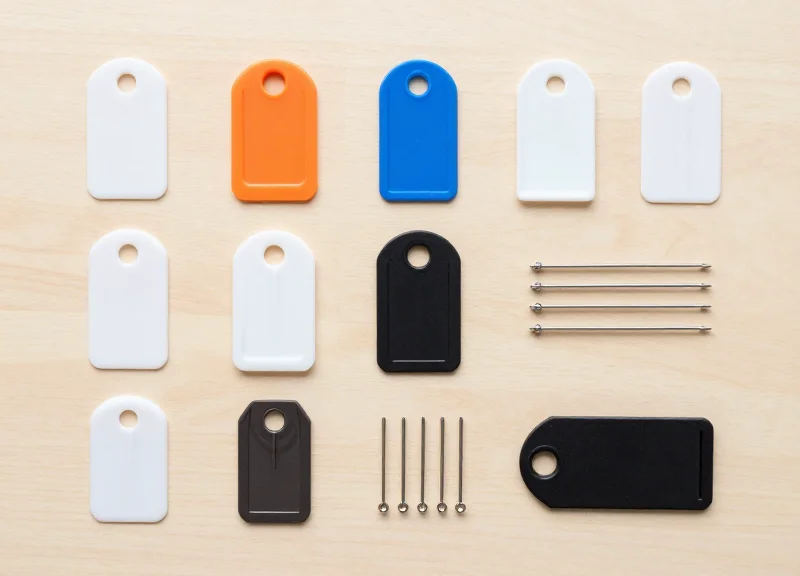
Selecting the right tagging hardware for a flame-retardant (FR) fleet involves prioritizing 15mm precision stainless steel pins paired with heat-stabilized, high-impact ABS or polycarbonate tag housings. The ideal hardware must offer a 'Zero-Bore' profile, ensuring that the pin displaces fabric fibers rather than cutting them, thereby maintaining the garment's Arc Thermal Performance Value (ATPV) or Flash Fire protection rating. For industrial sectors like Oil & Gas or Electrical Utilities, hardware should be selected based on its ability to withstand temperatures exceeding 150°F (65°C) during commercial drying cycles without warping or compromising the internal locking mechanism.
| Hardware Model | Primary Sector | Key Feature | Pin Compatibility |
|---|---|---|---|
| DragonGuard Vulcan-I | Oil & Gas / Refining | Chemical-Resistant Shell | 15mm Precision S3 |
| DragonGuard Tesla-RFID | Electrical Utility | Non-Conductive Finish | 15mm Insulated Pin |
| DragonGuard SlimLine-HD | General Manufacturing | Ultra-Lightweight (8g) | Standard 15mm Steel |
| DragonGuard Titan-Dual | Logistics & Multi-Hazard | EAS + RFID Hybrid | 15mm Precision S3 |
Expert Insight: Thermal Inertia Matching. A common failure point in industrial tagging is 'pin-creep,' where pins loosen over time. To prevent this, ensure your hardware utilizes Thermal Inertia Matching. This means the internal clutch mechanism is engineered with a thermal expansion coefficient similar to the 15mm stainless steel pin. When the garment enters a high-heat industrial dryer, both the pin and the lock expand at the same rate, preventing the microscopic 'breathing' that leads to mechanical failure and lost tags.
Does the weight of the tag damage FR fabric?
No, provided the tag is under 12 grams and uses a 15mm precision pin. Heavier tags can cause 'necking'—a localized stretching of the weave—but DragonGuard's industrial fleet solutions are weighted to ensure the center of gravity sits flush against the fabric reinforcement zones.
Can these tags withstand hydrocarbon exposure?
The Vulcan-I series is specifically designed with a sealed, non-porous polymer shell that prevents hydrocarbons from seeping into the locking clutch, which would otherwise cause the mechanism to seize or degrade.
How do I choose between EAS and RFID hardware?
EAS is for immediate theft deterrence at exit points, while RFID is for lifecycle management and inventory accuracy. For large fleets, we recommend 'Hybrid' hardware that contains both chips to maximize ROI throughout the garment's three-year lifespan.