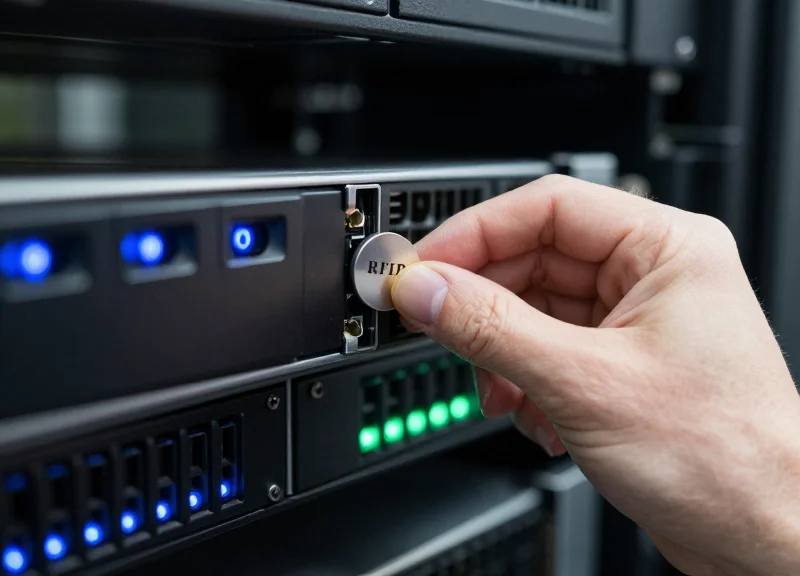
In the complex landscape of modern supply chains and retail environments, the phenomenon of 'stray reads'—where RFID tags outside a target area are inadvertently captured—remains a significant barrier to operational efficiency. As high-density tag environments become the norm, simply installing a reader is no longer sufficient. This guide provides a sophisticated engineering framework to architect a 'shielded' RFID zone. By leveraging advanced beam shaping and dynamic power calibration, engineers can ensure that RF energy is strictly confined, maximizing data integrity while minimizing interference and false positives.
The Engineering Challenge: Mitigating RF Overflow in Dense Environments
RF overflow, commonly known as signal 'bleed' or 'stray reads,' is the phenomenon where electromagnetic energy from an RFID reader propagates beyond the defined physical boundaries of a read zone, causing the system to capture data from unintended tags. In dense industrial environments, this lack of spatial selectivity leads to ghost reads, cross-talk between adjacent dock doors, and catastrophic failures in automated sorting logic, requiring sophisticated beam shaping and power calibration to rectify.
| Metric | Optimized RF Zone | Overflow-Prone RF Zone |
|---|---|---|
| Read Accuracy | 99.9% within 1m radius | 85-90% due to interference |
| Data Latency | Low (Specific tag targeting) | High (Filtering noise takes CPU cycles) |
| Signal Boundary | Defined by Fresnel zone shaping | Circular/Omnidirectional leakage |
| Inventory Logic | Deterministic (Location-aware) | Probabilistic (Requires heavy filtering) |
Why does signal leakage occur in metallic environments?
Metallic surfaces act as RF reflectors, creating multipath propagation where the signal 'bounces' into areas it was never intended to reach. This effectively extends the read range unpredictably.
What is the primary risk of high-gain antennas?
While high-gain antennas provide better range, they often create a 'hot spot' that penetrates thin walls or flooring, capturing tags from the floor above or the trailer next door.
How does signal bleed affect WMS logic?
If a Warehouse Management System (WMS) receives a tag read from Portal A and Portal B simultaneously due to overflow, it creates a 'logic collision' where the system cannot determine the actual location of the asset.
A unique insight often overlooked by junior engineers is the 'False Positive Feedback Loop.' When a system experiences signal overflow, the immediate reaction is often to increase the RSSI (Received Signal Strength Indicator) filter threshold. However, in dense environments, this can actually decrease system reliability by ignoring valid tags with low backscatter power caused by destructive interference. The real engineering solution is not just software-side filtering, but physical 'RF Containment' through beam shaping—shaping the electromagnetic field so that the nulls in the radiation pattern are strategically placed toward neighboring zones.
The Science of Beam Shaping: Sculpting the Interrogation Zone

Beam shaping in RFID is the strategic manipulation of an antenna's radiation pattern to concentrate electromagnetic energy into a defined spatial envelope, known as the interrogation zone. Unlike omnidirectional broadcasting, beam shaping leverages principles of interference and phase shift to 'sculpt' the field, ensuring that RF energy is directed precisely where tags are expected while creating sharp 'drop-off' zones to prevent unintended reads in adjacent lanes or storage racks.
| Antenna Type | Beam Characteristics | Best Use Case |
|---|---|---|
| Linear Polarized | Narrow, high-gain concentrated beam | High-speed conveyor belts with fixed tag orientation |
| Circular Polarized | Wide, helical field distribution | General portals where tag orientation is unknown |
| Phased Array | Electronically steerable and dynamic | Complex environments requiring real-time zone adjustment |
At the core of advanced beam shaping is the Phased Array principle. By arranging multiple antenna elements in a grid and slightly shifting the phase of the signal sent to each, engineers can create constructive interference in a specific direction and destructive interference elsewhere. This essentially 'steers' the beam without moving the physical hardware. For the Silicon Valley engineer, this is the difference between using a floodlight and a laser-guided spotlight. By controlling the 'half-power beamwidth' (HPBW), we can define the exact point where the signal strength falls below the threshold required to wake up a passive tag.
Does a higher gain antenna always provide better zone control?
No. While high-gain antennas focus energy further, they often narrow the beamwidth so significantly that they create 'blind spots' at close range. Proper shaping requires balancing gain with the required aperture width.
How does mounting height affect the sculpted zone?
Mounting height dictates the 'footprint' of the beam. As height increases, the area covered expands, but the power density (W/m2) decreases, requiring a tighter beam shape to maintain read reliability.
What role does the Front-to-Back ratio play?
The Front-to-Back (F/B) ratio is critical for shielding. A high F/B ratio ensures that energy does not leak behind the antenna, which is the primary cause of 'ghost reads' from tags located in the aisle behind the reader.
Expert Engineering Tip: Don't just focus on the main lobe. In dense RF environments, the 'Sidelobe Suppression' level is your most important metric. Sidelobes are parasitic energy peaks that extend outside your primary beam. When sculpting a zone, ensure your antenna has at least -15dB to -20dB of sidelobe suppression; otherwise, you will experience intermittent 'overflow' reads that software calibration alone cannot fix.
Antenna Selection Strategies: Circular vs. Linear Polarization
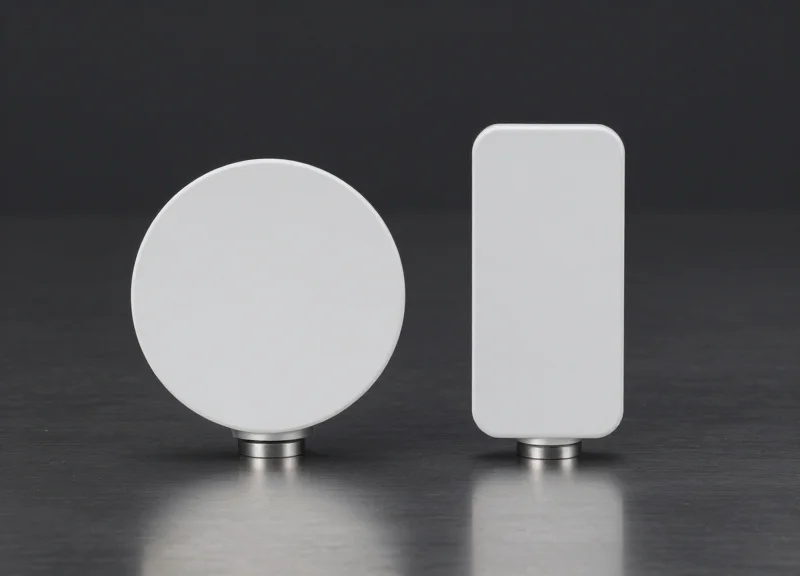
Antenna polarization—the geometric orientation of the electric field's oscillation—is a fundamental lever in RFID zone control. In dense engineering environments, linear polarization concentrates energy into a single horizontal or vertical plane, offering higher gain and longer read distances but requiring precise tag alignment. Conversely, circular polarization rotates the electric field in a 360-degree spiral, providing orientation-agnostic tag reading at the cost of reduced range and higher susceptibility to multipath interference. For shielding purposes, the choice between these two determines whether your RF envelope remains contained or leaks into adjacent lanes through environmental reflections.
| Feature | Linear Polarization | Circular Polarization |
|---|---|---|
| Tag Orientation | Must match antenna plane | Insensitive (360-degree coverage) |
| Effective Range | High (Focused energy) | Moderate (Energy split across planes) |
| Multipath Risk | Lower (Predictable bounce) | Higher (Complex reflection patterns) |
| Best Application | Portal/Choke points with fixed tags | Bin tracking/Randomly oriented items |
| Leakage Profile | Narrow, directional spill | Wide, volumetric spill |
Expert Insight: The Cross-Polarization Nulling Strategy. To achieve maximum isolation between two adjacent RFID zones without physical shielding, veteran engineers employ 'Orthogonal Isolation.' By installing a vertically polarized antenna in Zone A and a horizontally polarized antenna in Zone B, you can achieve up to 20dB of isolation for tags that are orientation-fixed. This utilizes the physics of cross-polarization rejection to ensure that even if a signal 'leaks' into the neighboring zone, the energy is insufficient to energize the tag, effectively creating a virtual RF wall through polarization mismatch.
- Analyze Tag Path and Variance: Determine if your assets move through the zone in a consistent orientation. If tags are always horizontal on a conveyor, linear polarization is superior for containment.
- Assess the Reflection Environment: In metallic environments, circular polarization can create unpredictable 'hot spots' due to phase shifts during reflection. Linear polarization is often easier to model and shield in high-reflectivity zones.
- Calculate the Polarization Loss Factor (PLF): Account for the 3dB loss inherent in circular antennas. If your power budget is tight, linear antennas provide more 'punch' per watt, allowing you to lower the overall power and reduce the leakage footprint.
Can I use circular antennas to reduce multipath interference?
Generally, no. Circular antennas are more prone to reading reflections because they can pick up tags from any angle. To reduce multipath, linear antennas with specific tilt angles are usually preferred.
Does polarization affect the speed of the read?
Indirectly, yes. Circular polarization provides a more consistent 'hit rate' for moving tags with random orientations, which can be perceived as a faster read in dynamic environments.
What is the best antenna for a ceiling-mount 'overhead' application?
Circular polarization is almost always the standard for overhead installs because tags on people or assets moving underneath can be at any horizontal angle relative to the reader.
Implementing Dynamic Power Calibration: The 'Less is More' Approach
Dynamic Power Calibration (DPC) is a software-driven technique that adjusts an RFID reader's transmit power in real-time to the lowest possible decibel-milliwatts (dBm) required to achieve a successful read. Unlike static configurations that blast signals at maximum legal limits—often causing reflections and stray reads—DPC utilizes a feedback loop. By analyzing the Received Signal Strength Indicator (RSSI) of incoming tag responses, the system intelligently scales energy down to the 'operational floor,' effectively shrinking the RF footprint to the exact dimensions of the target zone.
| Feature | Static Power Configuration | Dynamic Power Calibration |
|---|---|---|
| Signal Boundary | Fixed and often bleeds into adjacent zones. | Tight, adaptive boundary based on tag distance. |
| Multipath Interference | High; excess energy reflects off metal/liquid. | Low; minimal energy reduces bounce-back. |
| Read Accuracy | Variable; high risk of 'false positives'. | High; focuses exclusively on intended targets. |
| Hardware Longevity | Lower due to constant heat dissipation. | Higher; reduced thermal load on the RF front-end. |
- Establish the Minimum RSSI Baseline: Identify the target tags within the zone and measure their RSSI at various power levels. Determine the threshold where tags are consistently read with a 99.9% success rate.
- Implement the 'Staircase' Search Algorithm: Configure the reader to start at a low power setting and increment by 1dBm steps until the required tag population is identified. This ensures you never use more energy than the environment currently demands.
- Apply a Hysteresis Buffer: Once the minimum power is found, add a small 'safety buffer' (typically 1.5 to 2 dBm). This prevents signal 'flapping' or dropped reads caused by minor environmental shifts or tag orientation changes.
- Continuous Environmental Re-scanning: Periodically reset the power to a lower baseline to check if environmental obstructions (like a moving forklift) have cleared, allowing for further power reduction.
def calibrate_rf_power(reader, target_tags):
    power_level = 10 # Start at 10 dBm
    max_power = 30
    buffer = 2

    while power_level <= max_power:
        reader.set_power(power_level)
        found_tags = reader.inventory()

        if set(target_tags).issubset(set(found_tags)):
            optimized_power = power_level + buffer
            return min(optimized_power, max_power)

        power_level += 1
    return max_power
Expert Insight: The RSSI-Gradient Trap. Be wary of relying solely on the highest RSSI values. In dense environments, a tag reflecting off a metal ceiling might exhibit a stronger RSSI than a line-of-sight tag at the edge of your zone. Always pair your power calibration with 'Read-Rate Filtering'—if a tag is seen at high power but disappears at mid-power, it is likely a stray reflection from outside your intended shielding zone.
How often should I recalibrate power?
In dynamic environments like warehouses, recalibration should occur every 5-10 minutes or when the read rate drops below a defined KPI. In static shelving, once daily is sufficient.
Does dynamic power affect tag response time?
Slightly. The initial sweep adds a few milliseconds of latency, but once the optimized power level is locked, the response time is identical to static power.
Can DPC replace physical shielding?
DPC is a powerful supplement but not a total replacement for high-density environments. It works best when combined with the beam shaping techniques discussed in Section 2.
Step 1: Conducting a Comprehensive RF Site Survey

A comprehensive RF site survey is the systematic process of mapping the existing electromagnetic environment to identify signal propagation characteristics, noise floor levels, and potential sources of interference. In the context of RFID shielding, this phase is critical because it moves the project from theoretical antenna patterns to empirical data. By utilizing spectrum analyzers and heat mapping software, engineers can visualize 'bleed zones' where RF energy escapes the intended interrogation area, as well as 'null zones' caused by destructive multipath interference.
| Survey Component | Primary Tool | Primary Objective |
|---|---|---|
| Spectrum Analysis | Portable Spectrum Analyzer | Identify ambient 900MHz noise and rogue transmitters. |
| Spatial Heat Mapping | RSS-Enabled Tag Arrays | Visualize RSSI gradients and signal decay at zone boundaries. |
| Multipath Profiling | Vector Network Analyzer (VNA) | Measure reflection coefficients from metal surfaces and racking. |
Expert Insight: The 'Dynamic Metal Load' Factor. Most engineers perform surveys in empty or static environments. However, a 'Silicon Valley' grade survey accounts for the dynamic metal load—the movement of forklifts, opening of bay doors, and fluctuating inventory levels. These variables significantly shift the reflection coefficients of the room. We recommend conducting a 'Delta-Survey' where measurements are taken during peak operational hours to capture the worst-case multipath scenarios.
- Establish the Noise Floor: Scan the 860MHz to 960MHz range (region-specific) with all RFID readers powered off to identify background interference from non-RFID sources like industrial motors or cellular boosters.
- Map the 3dB and 10dB Roll-off: Power on your primary reader and use a reference tag to find where signal strength drops by 3dB and 10dB. These contours define your physical 'Shield Zone'.
- Identify Multipath Hotspots: Locate areas where signal strength spikes unexpectedly due to constructive interference from metal walls or shelving, which can cause 'ghost reads' outside the intended zone.
Can I use a standard RFID reader for the site survey?
While basic, a reader can provide RSSI data, but it lacks the sensitivity of a spectrum analyzer to detect non-RFID interference that may desensitize your receivers.
How do I mitigate signal bleed through thin warehouse walls?
Identify the leakage via the heat map, then apply RF-absorptive materials or adjust the beam-width of your antennas to minimize side-lobe emission toward the wall.
What is the most common mistake in RF surveys?
Neglecting the Z-axis. Signal leakage often occurs vertically, triggering reads from floor-to-floor in multi-story facilities; always map in 3D.
Step 2: Configuring Hardware for Phase-Array Beam Control

Hardware configuration for phase-array beam control is the process of physically positioning multiple RFID antennas and electronically modulating their signal timing to create a steerable interrogation zone. By precisely controlling the relative phase shift between adjacent antenna elements, engineers can utilize constructive interference to amplify the signal in a specific direction while employing destructive interference to create 'null zones' that effectively silence signal leakage beyond a defined perimeter.
- Calculate Optimal Element Spacing: To prevent grating lobes (unwanted secondary beams), space your antennas at approximately one-half wavelength (λ/2) of your center frequency. For a standard 915 MHz UHF system, this equates to a spacing of roughly 16.4 centimeters center-to-center.
- Interconnect with Low-Loss Phase-Matched Cables: Use high-quality coaxial cables with identical lengths and impedance ratings. Even a few millimeters of difference in cable length can introduce unintended phase shifts that distort the beam pattern before it ever reaches the antenna.
- Integrate the Phase-Shifter or Multi-Port Controller: Connect the antennas to a reader or an external beamformer capable of individual port phase control. This hardware must allow for incremental phase adjustments (typically in 5.6 to 22.5-degree steps) to steer the beam dynamically.
- Synchronize Clock Cycles: Ensure the RFID reader's local oscillator is providing a stable, common frequency reference to all ports to maintain phase coherence across the entire array.
| Antenna Spacing | Resulting Beam Width | Sidelobe Risk | Primary Use Case |
|---|---|---|---|
| 0.5 λ (Half-Wave) | Wide to Moderate | Very Low | Standard zone containment |
| 0.75 λ | Narrow/Focused | Moderate | Long-range directional tracking |
| 1.0 λ (Full-Wave) | Ultra-Narrow | High | High-precision 'Gate' triggers |
Expert Tip: To achieve a truly 'hard' edge at your boundary, implement Phase-Symmetric Tapering. Instead of driving all antennas in the array at the same power level, reduce the amplitude of the outermost antennas. This 'tapering' reduces the magnitude of side lobes by up to 15dB, preventing the common issue where a focused beam still accidentally triggers tags located 30 degrees off-center.
Can I use standard patch antennas for a phased array?
Yes, provided they are identical in model and gain characteristics. Mixing antenna types will cause impedance mismatches that ruin the phase coherence necessary for beam shaping.
How do I verify the null zones are working?
Use a field probe or a reference tag placed exactly at the desired cut-off line. Rotate the phase settings until the tag RSSI drops below the reader's sensitivity threshold while the primary zone tags remain at peak signal.
Does hardware mounting material matter?
Critically. Use non-conductive mounting brackets (like high-density plastics or treated wood) to avoid parasitic reflections that can shift the phase of individual elements and 'smear' the beam edge.
Step 3: Fine-Tuning RSSI Filtering and Sensitivity Thresholds
RSSI filtering is the process of setting a logical signal strength floor—typically measured in dBm—below which the RFID reader will ignore any incoming tag data. While beam shaping physically restricts the RF field, RSSI (Received Signal Strength Indicator) filtering acts as a digital safety net, ensuring that low-energy 'stray' reads originating from the periphery or via multipath reflections are discarded before they reach your application layer. By calibrating sensitivity thresholds, engineers can define a 'logical zone' that is even tighter than the physical radiation pattern of the antenna.
- Establish the RSSI Baseline: Place a reference tag at the furthest acceptable boundary of your read zone. Record the average RSSI over 100 reads to determine your 'Edge Strength'. Note that RSSI values are negative; -55 dBm is a stronger signal than -70 dBm.
- Map the Interference Floor: Place tags 24 inches outside your desired zone. If these tags are still readable, note their RSSI. This is your 'Interference Floor'. Your filter must be set higher than this value.
- Configure Hardware Sensitivity: Adjust the reader’s internal sensitivity (Receive Sensitivity). If your reader supports it, set the sensitivity to -60 dBm or -65 dBm to hardware-reject weak signals, reducing the processing load on your middleware.
- Apply a Hysteresis Offset: To prevent 'flickering' tags (tags that bounce in and out of the filter range), implement a 2-3 dBm buffer between the activation threshold and the deactivation threshold.
| Environment Type | Typical RSSI Range | Recommended Threshold | Filtering Strictness |
|---|---|---|---|
| Conveyor/Narrow Portal | -40 to -55 dBm | -60 dBm | High |
| Handheld Inventory | -50 to -75 dBm | -80 dBm | Low |
| Workstation/Desktop | -35 to -50 dBm | -55 dBm | Very High |
Expert Tip: Avoid 'Static Threshold Paralysis.' In environments with high metal content or moving machinery, RSSI can fluctuate by 5-10 dBm due to destructive interference. Instead of a hard static threshold, implement a 'Sliding Window Average.' Calculate the mean RSSI over the last 5 reads of a specific EPC. Only validate the tag if the average meets your criteria. This filters out momentary 'hot spots' caused by signal bouncing off moving forklifts or doors.
if (tag.rssi > threshold_dbm) {
  if (count_in_window(tag.epc) > 3) {
    process_tag(tag);
  }
} else {
  discard_tag(tag);
}
Does lowering transmit power do the same thing as RSSI filtering?
No. Lowering transmit power reduces the energy reaching the tag, which may prevent it from waking up. RSSI filtering happens after the tag is already powered and responding, allowing you to ignore tags that have enough power to respond but are outside your specific interest zone.
Why do some tags show high RSSI even when they are far away?
This is usually caused by multipath gain, where the RF signal reflects off metal surfaces and constructively interferes, creating a 'hot spot.' Beam shaping is the primary cure for this, while RSSI filtering is the secondary mitigation.
Can I filter by tag count instead of RSSI?
Yes, often called 'Read Count Filtering.' A tag outside the zone may only be read once or twice per second, whereas a tag in the center of the beam may be read 50 times. Combining Read Count and RSSI filters provides the highest level of zone integrity.
Utilizing RF Absorbers and Shielding Materials
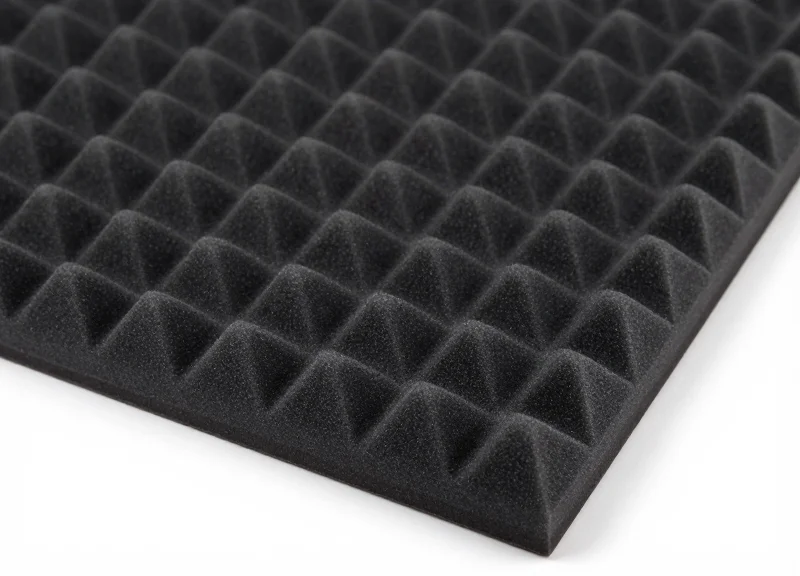
While beam shaping and power calibration provide logical control over your RFID zone, physical RF absorbers and shielding materials provide the absolute physical boundaries required for zero-leakage environments. RF shielding uses conductive materials like aluminum or copper to reflect signals back into the zone, whereas RF absorbers, such as carbon-loaded foam or ferrite tiles, convert electromagnetic energy into heat. In high-density warehouse environments, using these materials at the 'choke point' transition zones ensures that tags just inches outside the read window do not trigger false positives, effectively sharpening the 'RF edge' of your system.
| Material Type | Primary Function | Best Use Case | Attenuation Profile |
|---|---|---|---|
| Ferrite Tiles | Absorption (Magnetic) | Thin-profile applications on metal surfaces | High attenuation at low frequencies/HF |
| Carbon-Loaded Foam | Absorption (Dielectric) | Surrounding antennas to reduce side-lobes | Broadband absorption; high-frequency UHF |
| Aluminum/Copper Foil | Reflection (Shielding) | Creating Faraday zones or hard boundaries | 90dB+ reflection; no energy dissipation |
| Composite Fabrics | Hybrid (Shield/Absorb) | Flexible curtains for portal transitions | Variable based on mesh density |
Expert Insight: The 'Diffraction Edge' Phenomenon. Engineers often make the mistake of using only flat metal plates for shielding. However, RF waves tend to 'creep' or diffract around the sharp edges of metal sheets, potentially reaching tags behind the shield. My Silicon Valley 'secret sauce' for mission-critical portals is to apply a 2-inch strip of pyramidal foam or carbon-impregnated tape along the perimeter of your metal shields. This 'tapers' the impedance transition, significantly reducing edge diffraction and ensuring your beam-shaping geometry remains pristine without unintended signal leakage.
When should I choose absorbers over metal shielding?
Use absorbers when you need to eliminate reflections that cause multipath interference. Use metal shielding when you simply need to block a signal and the reflected energy won't interfere with other readers.
Does material thickness matter for RFID (UHF)?
Yes. For carbon-loaded foam, the thickness should generally be at least 1/4 of the wavelength (roughly 8-10cm for 900MHz) to achieve maximum effectiveness, though thinner ferrite sheets are available for space-constrained mounts.
Can I paint over RF shielding materials?
Standard latex paint is usually fine, but avoid metallic-based paints or finishes that contain carbon black, as these can alter the surface impedance and performance of the absorber.
- Identify Reflection Points: Use a signal sniffer to find 'hot spots' on nearby metal pillars or conveyors that reflect your beam outside the intended zone.
- Select the Impedance Match: Choose a material rated for the 860-960 MHz range (UHF RFID) to ensure the energy is actually absorbed rather than just passing through.
- Mechanical Fastening: Secure materials using non-conductive adhesives. Metal screws can act as tiny antennas (re-radiators) if they penetrate through a shielding layer.
Validation and Testing: The 'Zero Leakage' Protocol
The 'Zero Leakage' Protocol represents the gold standard in RFID site validation, focusing on the categorical elimination of stray reads in high-density environments. Unlike standard testing which only confirms read rates inside the zone, this protocol mandates 'negative space validation'—proving where the system cannot read. By combining physical boundary probes with software-level RSSI (Received Signal Strength Indicator) analysis, engineers can ensure that the transition from a 'hot' read zone to a 'null' zone occurs within a narrow 5-centimeter tolerance, preventing cross-reads from adjacent conveyor lines or storage racks.
- Phase 1: Static Perimeter Probing: Map the 'Read/No-Read' boundary by moving a standard tag in 2cm increments away from the antenna center. Record the exact RSSI at which the tag falls off to establish your digital threshold.
- Phase 2: Ghost Tag Injection: Place 'decoy' tags in known bleed areas (e.g., across the aisle). Run the system at full power; any detection of these tags indicates a failure in beam shaping or shielding.
- Phase 3: High-Velocity Stress Testing: Move tags through the zone at maximum operational speed. Ensure that the 'Time-on-Target' is sufficient for the reader to execute the Dynamic Power Calibration logic without losing the tag.
- Phase 4: Multi-Path Reflection Sweep: Introduce metallic obstructions near the zone to simulate environmental changes and verify that the beam doesn't 'bounce' into unintended areas.
| Validation Metric | Target Threshold | Verification Method |
|---|---|---|
| Out-of-Zone Leakage Rate | < 0.01% | Long-duration 'Decoy' tag monitoring |
| Boundary Sharpness (Delta) | > 15 dBm | RSSI comparison at boundary edge vs. 10cm out |
| In-Zone Read Accuracy | 99.99% | 1,000-pass high-speed cycle test |
Expert Tip: Utilize 'RSSI Fingerprinting' during your validation. In high-stakes engineering, don't just rely on a pass/fail binary. Instead, map the average signal strength of every successful read. If the standard deviation of RSSI for 'Valid' tags is higher than 5dB, you likely have an unstable multipath environment that will eventually lead to leakage, regardless of your current beam settings.
def validate_leakage(tag_reads, boundary_rssi_limit):
    # Filter logic to identify potential 'stray' tags
    for tag in tag_reads:
        if tag.rssi < boundary_rssi_limit:
            print(f"ALERT: Potential Leakage - Tag {tag.id} read at {tag.rssi}dBm")
            return False
    return True
What is the most common cause of protocol failure?
The 'Fresnel Zone' encroachment—objects entering the signal's elliptical path that cause unexpected diffraction, effectively widening the beam beyond the calibrated software limits.
Can software alone achieve zero leakage?
Rarely. While dynamic power calibration is powerful, physics usually requires a 'Hybrid Approach' involving physical shielding (ferrite/absorbers) to truly truncate the side-lobes of an antenna beam.
How often should validation be repeated?
Quarterly, or whenever the physical layout of the facility changes. Even moving a metal shelf 3 meters away can shift the RF multipath profile of the zone.
The Future of Smart RFID Zones: AI-Driven Auto-Calibration

AI-driven auto-calibration is the next frontier in RFID engineering, replacing static, manual configuration with intelligent, self-healing networks. By integrating Edge AI chips directly into RFID readers, systems can now analyze 'RF noise' patterns and signal reflections in real-time. Instead of a human technician recalibrating thresholds every time a metal rack is moved or humidity levels spike, the system uses reinforcement learning to dynamically adjust beam steering and power output to maintain a 'zero-leakage' perimeter.
| Feature | Traditional Manual Calibration | AI-Driven Auto-Calibration |
|---|---|---|
| Adjustment Frequency | Periodic / Reactive | Continuous / Proactive |
| Environmental Adaptability | Low (Fixed settings) | High (Adapts to physical shifts) |
| Labor Requirement | High (On-site RF engineers) | Low (Automated software cycles) |
| Accuracy Target | Static Thresholds | Context-Aware Probabilistic Logic |
One unique insight from the Silicon Valley hardware front is the adoption of 'Neural RF Fingerprinting.' This technique allows the system to distinguish between a tag that is legitimately within the zone and a 'ghost tag' reflecting off a distant forklift. By training a neural network on the specific multipath signatures of your facility, the RFID zone becomes a spatial-aware entity rather than just a signal strength bubble.
- Step 1: Environmental Baseline Acquisition: The AI monitors the ambient RF environment for 24-48 hours to establish a baseline of 'normal' interference and reflection patterns.
- Step 2: Predictive Beam Modeling: Using a Digital Twin of the warehouse, the system simulates how different antenna phase shifts will affect coverage before applying them physically.
- Step 3: Real-Time Optimization: As assets move, the AI fine-tunes the RSSI cut-off and beam angle in millisecond intervals to compensate for new obstructions.
{
  "auto_calibration": true,
  "mode": "reinforcement_learning",
  "target_precision": 0.999,
  "environment_feedback_loop": "enabled",
  "max_power_drift_dbm": 2.0
}
Can AI calibration work with existing Gen2 tags?
Yes, AI auto-calibration happens at the reader and antenna level, meaning standard passive tags benefit from increased accuracy without hardware upgrades.
What happens if the AI makes a mistake?
Modern systems utilize 'Guardrail Thresholds,' which are hard-coded limits set by engineers to prevent the AI from exceeding safe power levels or shrinking the zone too aggressively.
Does this require a constant cloud connection?
Ideally, no. Most advanced implementations use Edge AI, processing the calibration logic locally to ensure zero latency and high security.