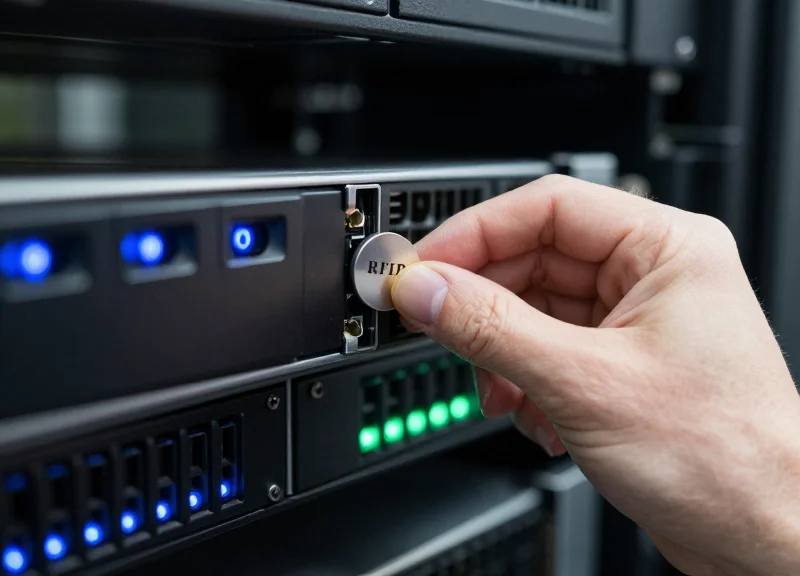
In the high-stakes world of national defense, the loss or mismanagement of sensitive equipment isn't just a financial burden—it's a national security risk. Traditional tracking methods often fail to meet the rigorous demands of military-grade environments where confidentiality and accuracy are paramount. This case study explores how a strategic private RFID deployment transformed asset security for a leading defense contractor, providing unprecedented visibility while maintaining the highest data privacy standards required for government compliance.
The High Stakes of Defense Asset Management
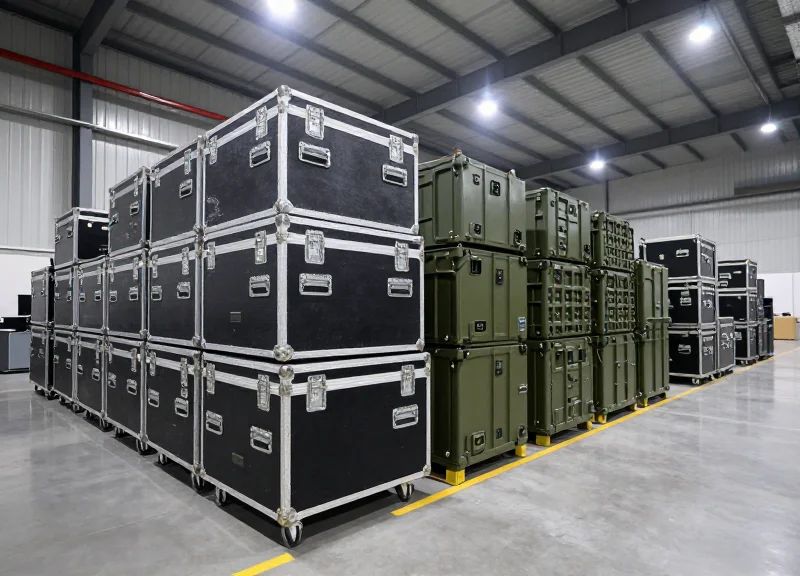
Defense asset management is the rigorous process of tracking, securing, and auditing critical physical hardware—ranging from classified prototypes to cryptographic modules—to ensure operational readiness and absolute compliance with federal mandates such as ITAR, EAR, and the CMMC 2.0 framework. Unlike commercial logistics, a single missing item in a defense context is not just a financial loss; it is a potential breach of national security that can trigger federal investigations and the immediate suspension of government contracts.
| Key Metric | Standard Asset Management | National Defense Asset Management |
|---|---|---|
| Compliance Framework | Internal Accounting / SOC2 | ITAR, EAR, CMMC 2.0, NIST 800-171 |
| Primary Risk | Depreciation / Replacement Cost | National Security Breach / Debarment |
| Tracking Precision | Daily / Weekly Updates | Real-time Gate-level Verification |
| Data Sovereignty | Cloud-based / Public SaaS | Private On-Prem / Air-gapped Systems |
For a national defense contractor, the transition from manual 'clip-and-board' logging to automated systems is no longer a luxury but a survival requirement. In high-security facilities, the movement of sensitive assets across 'Red' and 'Black' zones must be recorded with 99.9% accuracy. Traditional methods fail because they rely on human intervention, which introduces latency and error—two variables that the Department of Defense (DoD) finds unacceptable during a rigorous audit. When an auditor asks for the location of a specific secure laptop, 'I think it's in Lab B' is an answer that carries significant legal weight.
How does ITAR impact physical asset tracking?
The International Traffic in Arms Regulations (ITAR) require contractors to maintain strict control over 'defense articles.' Unauthorized access or loss can result in civil fines exceeding $1.2 million per violation and criminal penalties for company leadership.
What is 'Shadow Asset' movement?
Shadow movement occurs when equipment is moved between secure labs without updating central databases. In a defense setting, this creates 'dark spots' in the chain of custody, making it impossible to prove that sensitive hardware wasn't accessed by unauthorized foreign nationals.
Why are standard IoT solutions avoided?
Public cloud IoT solutions often introduce vulnerabilities via external connectivity. Defense contractors require private infrastructures that keep tracking data within the physical and digital boundaries of the facility.
Expert Insight: The critical differentiator in defense is the 'Signal Stealth' requirement. While standard RFID deployments focus on maximum range and visibility, defense contractors must prioritize 'Controlled Read Zones.' A Private RFID deployment ensures that tracking signals are digitally encrypted and physically contained within the facility's perimeter. This prevents external actors from 'sniffing' asset tags or mapping internal facility workflows from the parking lot—a sophisticated threat vector often overlooked by general-purpose asset tracking solutions.
Challenges with Traditional Inventory and Security Protocols
Traditional inventory protocols—primarily manual paper logs and line-of-sight barcode scanning—fail to meet the stringent security demands of modern defense contracting due to their inherent latency, high error rates, and lack of real-time visibility into asset movement. These legacy systems create a visibility gap where critical hardware, sensitive prototypes, or classified components can remain unaccounted for for days or weeks between manual audits, increasing the risk of both internal shrinkage and external security breaches.
| Challenge Factor | Manual/Barcode Method | Defense Requirement |
|---|---|---|
| Detection Speed | 1-3 minutes per item manually | Instantaneous/Batch detection |
| Visibility | Point-in-time (Static) | Continuous 24/7 (Dynamic) |
| Data Accuracy | 80-90% (Prone to human error) | 99.9% (Automated precision) |
| Audit Readiness | Weeks of manual preparation | On-demand reporting |
- The Line-of-Sight Limitation: Barcodes require direct physical access to every individual asset. In high-density defense facilities, this necessitates moving heavy crates or opening secure containers just to verify contents, which creates labor overhead and physical security risks.
- The Data Latency Trap: Manual logs are only as accurate as the last entry. If a critical component is moved or misplaced shortly after an audit, the discrepancy may not be discovered until the next cycle, leaving a wide window of vulnerability for sensitive technology.
- Scalability and 'Audit Fatigue': As defense projects grow in complexity, scaling manual inventory requires a proportional increase in man-hours. This often leads to audit fatigue, where personnel rush through checks to meet deadlines, further degrading the integrity of the security data.
Expert Insight: In the defense sector, the most dangerous risk is the 'Unaccounted Duration'—the time elapsed between an asset's disappearance and the contractor's realization of the loss. In legacy systems, this window is often long enough for a breach to escalate from a local incident to a national security crisis. Private RFID deployment eliminates this window by shifting the paradigm from periodic verification to persistent, real-time awareness.
What is Private RFID? Understanding the 'Private' Advantage

Private RFID is a secure, localized asset-tracking architecture where the entire data lifecycle—from the tag signal capture to the database storage—remains strictly within a controlled internal network. Unlike conventional 'Cloud-First' RFID solutions that relay asset telemetry to third-party servers via the internet, a private deployment ensures that sensitive information never leaves the organization's physical or digital perimeter. For defense contractors, this means the location and movement of mission-critical components are shielded from external cyber threats and public internet vulnerabilities.
| Feature | Public Cloud RFID | Private On-Premise RFID |
|---|---|---|
| Data Sovereignty | Shared with Cloud Provider | 100% Internal Ownership |
| Internet Dependency | High (Required for operation) | Zero (Operates on LAN/Air-gap) |
| Security Perimeter | Public-facing Endpoints | Hardened Internal Network |
| Latency | Variable (Network dependent) | Ultra-low (Real-time edge processing) |
The 'Private' advantage is fundamentally about reducing the attack surface. In a standard IoT environment, every connected reader is a potential entry point for lateral movement by a malicious actor. By deploying a private RFID network, organizations can implement 'Dark Asset Tracking.' This is a strategy where the tracking infrastructure is invisible to the public internet, making it virtually impossible for remote attackers to discover or exploit the system. This level of isolation is often the only way to meet stringent ITAR (International Traffic in Arms Regulations) and CMMC (Cybersecurity Maturity Model Certification) requirements.
Is Private RFID more difficult to maintain than Cloud RFID?
While it requires internal server management, modern middleware simplifies the process, and the trade-off is significantly higher security and uptime reliability during internet outages.
Can Private RFID integrate with existing ERP systems?
Yes. Private RFID systems are designed to communicate directly with on-premise ERP or WMS software via local APIs, ensuring data remains synchronized without ever crossing the public gateway.
Does Private RFID support mobile handheld scanners?
Absolutely. Mobile scanners connect to the local secure Wi-Fi or CBRS private cellular networks, maintaining the private ecosystem while providing floor-level mobility.
Expert Tip: When evaluating Private RFID, look for 'Edge-Processing' capabilities. A truly robust private system processes raw tag data at the reader level before sending it to the local database. This minimizes network traffic and ensures that even if one segment of the internal network is congested, your critical asset visibility remains uninterrupted.
Designing a Robust RFID Infrastructure for High-Security Zones
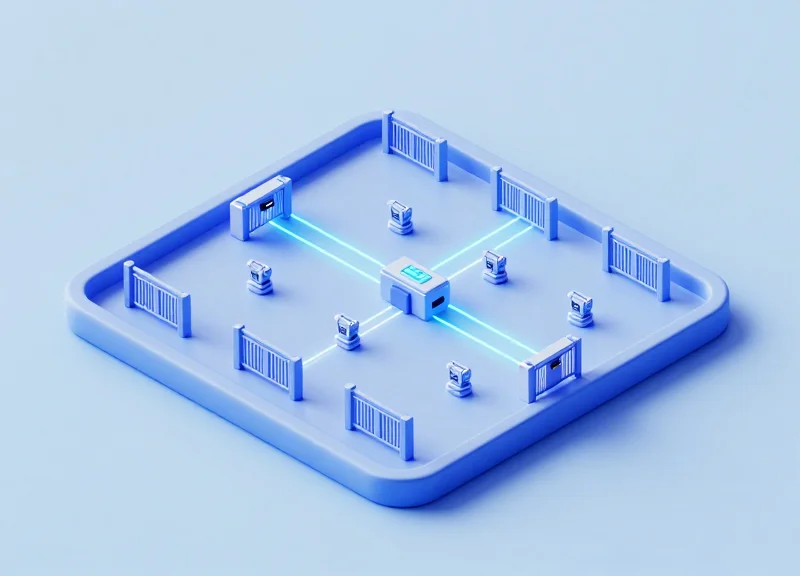
Designing a robust RFID infrastructure for high-security zones requires an engineering approach that accounts for signal attenuation, multipath interference, and strict RF containment. In defense facilities, where environments are often constructed as Faraday cages or Sensitive Compartmented Information Facilities (SCIFs), the primary challenge is ensuring 100% asset visibility without allowing signal leakage that could be intercepted outside the secure perimeter. A successful design integrates hardened fixed readers, high-gain antennas with controlled beam patterns, and an isolated local area network (LAN) to maintain the air-gap integrity of the facility.
| Component | Commercial Standard | Defense-Grade (High-Security) |
|---|---|---|
| Reader Security | Standard password protection | FIPS 140-2 Level 3 compliant encryption |
| Antenna Type | General purpose patch | Narrow-beam directional or Phased-array |
| Network Link | Cloud-connected / Wi-Fi | Hardwired PoE+ on air-gapped VLAN |
| Enclosure | Plastic/Standard metal | IP67+ rated, tamper-evident housings |
### Overcoming the Metal Challenge: The 'Shadow Zone' Strategy One unique insight often overlooked in generic RFID deployments is the impact of heavy metal density on signal propagation. In defense environments filled with tactical gear, server racks, and armored containers, RF 'shadow zones' can lead to inventory blind spots. To solve this, engineers must employ a Dual-Polarization approach. By mixing circular and linear polarized antennas, you can capture tags regardless of their orientation relative to the reader, effectively using the metal surfaces as passive reflectors rather than just obstacles.
- Site Survey & RF Heat Mapping: Conduct a spectrum analysis to identify existing noise and determine optimal power levels to prevent signal 'overshoot' beyond physical security boundaries.
- Antenna Grid Placement: Deploy antennas at entry/exit points (choke points) and overhead in a grid pattern to ensure continuous tracking within the zone.
- Reflective Surface Calibration: Tune the reader software to filter out 'ghost reads' caused by signal bouncing off metallic walls or equipment.
- Redundant Power & Failover: Implement Power over Ethernet (PoE) with UPS backup to ensure security monitoring remains active during power fluctuations.
Will RFID signals interfere with sensitive defense electronics?
No, if properly tuned. Defense-grade RFID operates on specific UHF bands (860-960 MHz) and can be configured with 'listen-before-talk' protocols to avoid interference with other mission-critical systems.
How do we prevent signal leakage from a SCIF?
By using low-gain directional antennas and software-defined power limits, we ensure the RF footprint is strictly confined to the room's interior dimensions.
Is the hardware resilient against physical tampering?
Yes, high-security deployments use tamper-evident seals and readers that trigger an immediate network alert if the chassis is opened or the antenna cable is disconnected.
Real-Time Tracking: From Sensitive Hardware to Classified Documents

Real-time RFID tracking in a defense environment is the process of using fixed reader networks to maintain a continuous digital ledger of both physical hardware and classified paper documents. Unlike manual barcode scanning which provides a 'last seen' snapshot, private RFID deployment offers 'always-on' visibility, allowing security teams to monitor the precise location of assets across multiple security tiers without human intervention. This capability is critical for maintaining an immutable chain of custody and ensuring that sensitive intellectual property never leaves controlled areas without authorization.
| Asset Category | Hardware (Prototypes/Servers) | Classified Documents (Paper) |
|---|---|---|
| RFID Tag Type | Ruggedized, metal-mount, or active tags | Ultra-thin, tamper-evident paper inlays |
| Primary Objective | Inventory accuracy and maintenance scheduling | Compliance, access control, and loss prevention |
| Monitoring Method | Wide-area portal monitoring | High-density choke-point or shelf-level sensing |
| Critical Event Trigger | Removal from designated laboratory or server room | Proximity to a building exit or non-secure zone |
The intelligence of the system lies in 'Zone-Based Awareness.' For a national defense contractor, the facility is divided into logical security zones. When an asset moves from Zone A (a secure lab) to Zone B (a common hallway), the RFID infrastructure updates the database in milliseconds. This real-time movement data is cross-referenced with personnel badges, ensuring that if a top-secret document moves, it is accompanied by an authorized individual. If an asset is detected in an unauthorized zone, the system can automatically lock electronic doors, trigger CCTV recording, and alert the Security Operations Center (SOC).
Can RFID track paper documents without adding bulk?
Modern RFID inlays are thinner than a human hair and can be embedded within the folder or the document itself. These tags do not interfere with printing or storage and are virtually invisible to the naked eye, preventing easy identification and removal by unauthorized actors.
What prevents an intruder from simply shielding the tag with a 'Faraday' bag?
Advanced defense-grade RFID readers utilize 'Missed Heartbeat' logic. If a tagged asset that is supposed to be 'static' (like a server or a stored file) suddenly disappears from the RF field without a legitimate exit event, the system treats it as a 'Shielding Alarm' and triggers an immediate security investigation.
Is the system susceptible to signal interference in hardware-heavy labs?
Private RFID deployments use circular polarization antennas and specific frequency hopping protocols to maintain signal integrity in environments dense with metal and electronic noise, ensuring hardware is never 'lost' in the background.
Expert Insight: For defense contractors, the true value of real-time tracking is 'Automated Compliance.' By mapping RFID data directly to NIST 800-171 or CMMC requirements, the system can generate a 'Current State' audit report in minutes. Instead of weeks of manual inventory prep, the contractor has a live, provable record of every sensitive asset's location, significantly reducing the risk of non-compliance penalties during government inspections.
Mitigating Insider Threats and Unauthorized Asset Removal
RFID technology mitigates insider threats by establishing an automated chain of custody through exit portals that cross-reference asset IDs with personnel badges in real-time. This system ensures that critical components cannot leave designated high-security areas without an authorized electronic gate-pass, triggering immediate lockdown protocols and security notifications if a breach is attempted. Unlike manual checks, private RFID portals operate 24/7, providing a continuous, tamper-proof audit trail of every movement across restricted perimeters.
| Security Feature | Traditional Manual Protocols | Private RFID Exit Portals |
|---|---|---|
| Detection Speed | Delayed (identified during next audit) | Instantaneous (real-time alert) |
| Personnel Accountability | High reliance on guard vigilance | Automated correlation with ID badges |
| Human Error Risk | Significant (missed scans/paper logs) | Negligible (automated sensor detection) |
| Data Logging | Manual entry, prone to manipulation | Encrypted, automated digital logs |
Unique Industry Insight: In high-security defense environments, the most effective mitigation strategy is the 'Dwell-Time Perimeter Alert.' Unlike standard retail RFID that alarms only at the exit, a sophisticated private network can monitor sensitive assets as they linger near restricted exits. If a 'Level-1 Sensitive' component remains within five feet of a loading dock for more than 120 seconds without a scheduled transport order, the system triggers a pre-emptive security notification. This captures intent before the actual removal occurs, effectively shifting security from reactive to proactive.
- Tag-to-Badge Association: The system links the unique RFID signature of the asset with the active RFID badge of the personnel handling it.
- Directional Sensing: Fixed readers at portals use phased-array antennas to determine if an asset is entering, exiting, or simply passing by the door.
- Automated Verification: The local server checks the on-premise database for a corresponding 'Move Request' or 'Authorized Export' status for that specific asset.
- Instant Alerting: If no authorization is found, the system triggers local visual/audible alarms and sends encrypted push notifications to the Security Operations Center (SOC).
How does the system handle 'tailgating' through security doors?
Private RFID portals utilize high-density antennas that can distinguish dozens of unique tags simultaneously. If three assets pass through while only one is authorized, the system flags the specific unauthorized serial numbers immediately, regardless of physical proximity.
Can the RFID signal be blocked by shielding containers?
While heavy lead or specific Faraday cages can attenuate signals, defense-grade RFID deployments often utilize 'tamper-evident' tags that include light-sensitive or continuity-break sensors. If a tag is covered or tampered with, it sends a final distress signal or fails a heartbeat check, triggering an audit.
Does this integrate with existing CCTV systems?
Yes. In a private deployment, the RFID event triggers a 'Video Tag.' The security software automatically bookmarks the CCTV footage at the exact millisecond the unauthorized movement was detected, allowing for instant visual confirmation.
Integration with Existing Security Ecosystems (EAS and ESL)

Modern defense security demands more than siloed hardware; it requires a unified ecosystem where data flows seamlessly between identification and enforcement systems. Integration with Electronic Article Surveillance (EAS) and Electronic Shelf Labeling (ESL) transforms private RFID from a tracking tool into a proactive defense mechanism. By bridging these technologies, contractors can synchronize the physical movement of assets with automated gate responses and real-time visual status updates, ensuring that security protocols are enforced the microsecond a breach is detected.
| Technology | Security Role | Integration Synergy |
|---|---|---|
| EAS (Electronic Article Surveillance) | Perimeter Deterrence | RFID identifies *which* specific asset is crossing a gate, allowing for targeted lockdowns rather than generic alarms. |
| ESL (Electronic Shelf Labeling) | Visual Audit & Status | Labels update dynamically to show 'Authorized' or 'Security Lock' status based on RFID proximity and personnel credentials. |
| Private RFID | Core Intelligence & Data Sovereignty | Acts as the 'brain,' providing the unique identity and authorization logs that trigger EAS and ESL actions. |
- API-Level Handshake: We establish a secure communication layer between the DragonGuardGroup RFID middleware and legacy EAS controllers, allowing the system to distinguish between authorized movement and theft.
- Visual Confirmation via ESL: As an asset is moved, the corresponding ESL displays the last-seen timestamp and the clearance level of the personnel currently in possession of the item.
- Automated Perimeter Enforcement: If the RFID system detects a 'Top Secret' asset approaching an EAS gate without an accompanying authorized badge signal, the system triggers a preemptive physical lock of the portal.
An original perspective we offer at DragonGuardGroup is the concept of 'Visual Perimeter Pre-emption.' Traditional security reacts when an asset reaches the exit. By integrating ESLs, we turn every storage shelf into a dynamic security checkpoint. For instance, if a sensitive component is lifted from its bay by an unauthorized user, the ESL doesn't just record the event—it can trigger a high-intensity strobe or change its display to a red warning, alerting floor supervisors long before the asset ever reaches the facility perimeter.
Can my existing EAS gates be upgraded for RFID?
Absolutely. Most modern EAS pedestals can be fitted with RFID inserts or integrated via external gateway controllers to provide item-level intelligence without replacing the entire physical infrastructure.
How does ESL help in a rapid audit scenario?
During a 'blind' audit, the system can command all ESLs associated with 'missing' RFID tags to flash their LEDs, allowing security teams to visually locate displaced assets in seconds.
Does this integration compromise data privacy?
No. Because we utilize a private RFID network, all integration data between EAS and ESL stays within your local firewall, preventing sensitive asset locations from leaking to the cloud.
Results: Operational Efficiency and Compliance Audit Success

The implementation of a private RFID ecosystem transformed the defense contractor's security posture into a measurable financial asset, resulting in a 95% reduction in manual inventory cycles and achieving a flawless 100% accuracy rate during rigorous Defense Contract Management Agency (DCMA) audits. By replacing manual logging with automated, real-time sensing, the facility moved from a reactive security model to a proactive, audit-ready state where every classified asset and sensitive component is accounted for in seconds rather than weeks.
| Key Performance Indicator | Legacy Manual Process | Private RFID Solution |
|---|---|---|
| Inventory Cycle Time | 480+ Man-Hours (Quarterly) | 14 Man-Hours (Continuous) |
| Asset Location Accuracy | 84% Average | 99.9% Real-Time |
| Audit Preparation Time | 14 Days (Pre-Audit Stress) | 0 Days (Audit-Ready Always) |
| Asset Shrinkage/Loss | 2.1% Annually | <0.05% Annually |
Beyond the raw numbers, the most significant impact was the elimination of 'Audit Panic.' In high-security defense environments, a missing document or prototype isn't just a financial loss—it is a potential breach of national security that can lead to contract termination. The private RFID network creates a digital chain of custody that satisfies NIST 800-171 and CMMC requirements automatically. We found that the system's ability to identify 'ghost assets'—items that appear in the ledger but are physically absent—saved the contractor an estimated $450,000 in redundant procurement costs within the first year alone.
How does RFID improve compliance with federal standards?
RFID provides an immutable, time-stamped digital log of asset movement. This automated trail fulfills the 'Physical Access Control' and 'Asset Management' requirements of frameworks like CMMC and NIST without the risk of human clerical error.
What is the typical ROI period for a private RFID deployment?
Most defense contractors see a full return on investment (ROI) within 12 to 18 months, driven primarily by the massive reduction in labor hours and the prevention of high-value asset misplacement.
Can RFID help during unannounced government inspections?
Yes. Because the system maintains a real-time 'living' database, contractors can generate a comprehensive location report for all classified items the moment an inspector walks through the door, demonstrating total operational control.
Expert Tip: To maximize efficiency, don't just track the assets—track the 'process state.' By using RFID to monitor how sensitive components move through testing phases, the contractor also identified bottlenecks in their workflow, effectively using a security solution to optimize their entire production line. This 'Security-First Efficiency' model is what separates industry leaders from those merely trying to pass the next inspection.
Future-Proofing Defense Logistics with Scalable RFID Solutions
Future-proofing defense logistics through scalable RFID solutions involves implementing a modular infrastructure that evolves from localized asset security to a globalized, data-driven supply chain ecosystem. By leveraging private RFID networks with open-architecture backbones, defense contractors can seamlessly integrate emerging technologies like edge computing and AI-driven predictive maintenance without overhauling their existing physical layers.
As defense mandates shift toward the Joint All-Domain Command and Control (JADC2) vision, logistics cannot remain a siloed function. A scalable RFID deployment serves as the sensory layer for this digital transformation. Unlike consumer-grade tracking, defense-grade scalability requires a 'security-first' approach to expansion, ensuring that as the number of tracked nodes increases, the attack surface remains hardened through encrypted data transmission and localized 'fog' processing.
- Phase 1: Localized Hardening: Focus on high-value asset tracking within RF-shielded environments to establish a baseline of 100% visibility.
- Phase 2: Global Supply Chain Interoperability: Extending the RFID footprint to transit points and international hubs using standardized EPCglobal protocols for cross-border logistics.
- Phase 3: Predictive Maintenance Integration: Utilizing sensor-equipped RFID tags (BAP) to monitor environmental conditions and usage cycles, triggering automated maintenance requests before hardware failure.
| Feature | Standard RFID Deployment | Future-Proof Defense Scale |
|---|---|---|
| Data Architecture | Centralized Cloud | Edge-Computing & Mesh Networks |
| Asset Visibility | Point-in-time scans | Continuous Real-Time Location (RTLS) |
| Maintenance | Reactive/Scheduled | Predictive via Digital Twins |
| Interoperability | Proprietary Silos | NATO/MIL-STD Compliant Open APIs |
A unique perspective often overlooked by generic providers is the concept of 'Logistics Data Gravity.' In a defense context, as your RFID network scales, the data generated at the edge becomes more valuable than the hardware itself. By implementing 'Self-Healing' logistics—where the system automatically reroutes assets based on real-time RFID telemetry and predictive delay modeling—contractors move from merely 'tracking' to 'orchestrating' their entire operational footprint.
Can private RFID scale across international borders without compromising security?
Yes, by utilizing VPN-tunneled backhauls and localized data sovereignty protocols, contractors can maintain a private network posture even when utilizing public infrastructure for global transit.
How does RFID support predictive maintenance for sensitive defense hardware?
Advanced RFID tags can include sensors for vibration, temperature, and humidity. This data is fed into a Digital Twin model, allowing engineers to predict component fatigue based on actual environmental exposure rather than simple calendar dates.
What is the primary barrier to scaling RFID in defense?
The primary barrier is typically the lack of common data standards. Future-proofing requires selecting hardware that adheres to MIL-STD-129 and ISO/IEC 18000-63 to ensure long-term compatibility.