As we approach 2026, the cosmetics industry is undergoing a radical shift toward flexible, squeezable packaging driven by consumer demand for portability and sustainability. However, protecting these products from theft without compromising their tactile appeal presents a unique challenge for retailers. This article evaluates the evolving roles of Electronic Article Surveillance (EAS) and Radio Frequency Identification (RFID) in securing next-gen squeezable cosmetic packaging, helping brands decide which technology will define their security strategy in the coming years.
The Evolution of Cosmetic Packaging: The Rise of Squeezables

Squeezable cosmetic packaging—comprising flexible tubes, laminate pouches, and silicone dispensers—has evolved from a budget-friendly utility to the primary format for luxury skincare and clinical beauty brands. By 2026, the rise of squeezables is driven by consumer demand for 'last-drop' product evacuation, portability, and the industry's shift toward Post-Consumer Recycled (PCR) materials that require less energy to produce than traditional glass or rigid plastic. This transition, however, creates a unique security paradox: the very flexibility that makes these products desirable also makes them difficult to protect using conventional anti-theft hardware.
| Feature | Traditional Rigid Packaging | Next-Gen Squeezable Packaging |
|---|---|---|
| Primary Materials | Glass, Heavy-walled PET/PP | LDPE, HDPE, Laminate Foils, PCR |
| Consumer Benefit | Premium Weight, Aesthetic | Portability, Precision Dosing, 98% Evacuation |
| Security Challenge | Large flat surfaces for easy tagging | Curvature and deformation cause tag delamination |
| Sustainability | Heavy carbon footprint in shipping | Lightweight, reduced material volume |
As we approach 2026, the 'Squeezable Revolution' is moving beyond simple tubes into multi-layered airless pouches. These structures are designed to protect active ingredients from oxidation, but their complex material compositions can interfere with radio frequency (RF) signals. For loss prevention engineers, this means that a 'one-size-fits-all' security sticker no longer suffices. The security solution must now be as flexible as the substrate it is adhered to, maintaining integrity even after repeated compression and temperature fluctuations.
Why is security harder for squeezable formats?
Traditional EAS and RFID tags are often rigid. When applied to a squeezable tube, the mechanical stress of the user squeezing the product can cause the adhesive bond to fail or the internal antenna of the tag to crack, rendering the security feature useless.
Does the material of the tube affect signal strength?
Yes. Many high-end squeezables use metallic laminate layers to protect formulas. These layers can act as a Faraday cage, detuning RFID chips or shielding EAS signals unless specialized 'on-metal' or high-dielectric spacers are used.
What is the 'Memory Effect' in flexible tagging?
Expert Insight: 'Memory Effect' refers to a material's tendency to return to its original shape. If a security tag's adhesive is stronger than the tube's outer layer, repeated squeezing can cause 'tunneling'—small air gaps between the tag and the tube—which leads to moisture ingress and tag failure.
The transition to squeezables isn't just an aesthetic choice; it is a response to the e-commerce boom and the need for 'shippable' packaging that doesn't break. In the retail environment, these high-value, small-footprint items are prime targets for organized retail crime (ORC). To protect them, brands are now forced to evaluate whether to embed security features inside the laminate layers during manufacturing or apply advanced external tags that can withstand the rigors of the 'squeeze'.
The Squeezable Challenge: Why Traditional Hard Tags Fail
Traditional hard tags are structurally incompatible with modern flexible cosmetic packaging because they rely on rigid mechanical attachment points—typically pins or high-friction clamps—that clash with the malleable nature of Polyethylene (PE) and Polypropylene (PP) tubes. While these tags worked for rigid glass or PET bottles, applying them to 'squeezables' creates a failure point where the security device actively degrades the packaging integrity, leading to product spoilage and inventory loss through 'silent leakage' rather than theft.
| Feature | Traditional Hard Tags | Squeezable Packaging Needs |
|---|---|---|
| Structural Profile | Rigid & Non-yielding | Malleable & Ergonomic |
| Attachment Method | Mechanical Pin/Clutch | Adhesive/Integrated |
| Risk Factor | Puncture & Micro-fissures | Contamination & Leakage |
| Consumer UX | High Friction/Bulky | Seamless/Tactile |
The 'Hydraulic Puncture' Phenomenon: A unique insight often overlooked by retail managers is the role of internal pressure. When a consumer or warehouse worker grips a squeezable tube equipped with a pinned hard tag, they create localized hydraulic pressure. Unlike a rigid bottle, the flexible walls transfer this force directly to the pin site. This results in 'Micro-fissures'—tiny tears that allow air into the product, oxidizing active ingredients (like Retinol or Vitamin C) or causing slow-motion leaks that ruin entire shelf displays. This isn't just a loss-prevention issue; it's a product stability crisis.
Why do pins cause more damage on tubes than on apparel?
Fabric is porous and fibers can shift around a pin. Plastic laminates used in cosmetic tubes are non-porous and under tension; a pin hole creates a permanent stress-concentration point that expands every time the tube is handled.
Does the weight of hard tags affect squeezable inventory?
Yes. Squeezable tubes are often top-heavy or designed to stand on their caps. The asymmetrical weight of a traditional EAS hard tag shifts the center of gravity, leading to 'shelf-slumping' and a chaotic, unappealing brand presentation.
Can adhesive hard tags solve this better than pinned tags?
While adhesive versions avoid punctures, they still create 'stiffness zones.' If the tag doesn't flex with the tube, it will delaminate (peel off) when the tube is squeezed, leaving the product unprotected exactly when it is most vulnerable.
By 2026, the industry is moving toward 'Invisible Security' because the physical footprint of the hard tag has become a liability. Retailers are finding that the cost of damaged goods and 'unsellables' caused by inappropriate tagging is beginning to outweigh the shrinkage prevented, necessitating a shift toward low-profile, flexible RFID or EAS inlay solutions.
EAS in 2026: Optimized Loss Prevention for High-Volume Goods
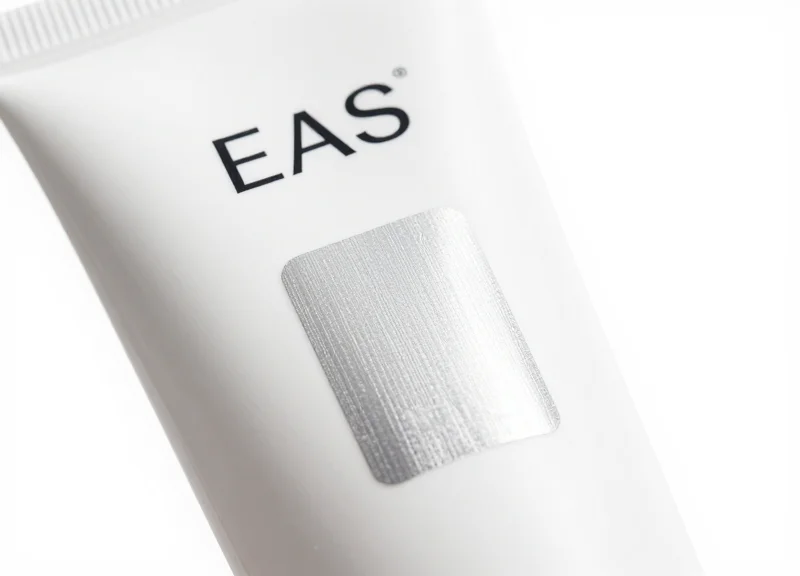
In 2026, Electronic Article Surveillance (EAS) remains the most cost-effective loss prevention standard for high-volume squeezable cosmetics, such as mass-market cleansers and hand creams. While RFID gains ground for inventory management, EAS Acousto-Magnetic (AM) and Radio Frequency (RF) systems provide a high-performance, low-cost deterrent focused strictly on exit-gate security. The trend has shifted toward 'Source Tagging,' where ultra-thin, flexible labels are applied during the packaging manufacturing process, ensuring that security is invisible to the consumer and integrated directly into the tube's crimp or behind the back-panel label.
| Feature | AM (Acousto-Magnetic) 2026 | RF (Radio Frequency) 2026 |
|---|---|---|
| Frequency | 58 kHz | 8.2 MHz |
| Liquid Compatibility | Excellent; minimal interference from high-viscosity formulas | Good; now optimized with foil-shielding layers |
| Label Profile | Slightly thicker (3D), often hidden in tube crimps | Ultra-flat (2D), ideal for under-label application |
| Cost Efficiency | High (Optimized for premium volume) | Highest (Lowest cost per unit for mass market) |
Why choose EAS over RFID for squeezable tubes in 2026?
For mass-market cosmetics retailing under $20, the unit cost of RFID can still be prohibitive. EAS labels cost a fraction of a cent, making them the logical choice for high-volume items where 'shrink' protection is the primary goal rather than item-level tracking.
Does the squeezing action damage the EAS circuit?
Next-gen 2026 labels utilize flexible metallic alloys and conductive inks that withstand the mechanical stress of repetitive squeezing, preventing 'false negatives' at the exit pedestal.
Can EAS labels be recycled with the plastic tube?
Advancements in 2026 focus on 'clean-peel' adhesives or water-soluble circuits that allow the security components to be easily separated during the plastic regrind process, supporting circular economy goals.
Expert Insight: The 'Static Shield' Risk in 2026 Packaging. As cosmetic brands adopt high-barrier squeezable materials like EVOH (Ethylene Vinyl Alcohol) to extend shelf life, they inadvertently create a static environment that can de-tune standard RF labels. My Silicon Valley recommendation: When implementing EAS on high-barrier flexible tubes, always specify 'Wide-Band' labels or AM technology. AM systems are significantly less susceptible to the capacitive effects of moisture-rich cosmetic formulas and specialized barrier films, ensuring a 98% detection rate even in dense retail environments.
RFID Revolution: Beyond Theft to Real-Time Inventory Intelligence

In 2026, the shift from Electronic Article Surveillance (EAS) to Radio Frequency Identification (RFID) marks the transition from 'gatekeeping' to 'data-harvesting.' While EAS is designed to prevent a product from leaving a store without payment, RFID provides a digital twin for every individual squeeze tube and pouch. This revolution enables retailers to maintain 99.8% inventory accuracy and real-time visibility across the entire supply chain. For squeezable cosmetics—where shelf life and batch integrity are paramount—RFID allows for automated 'First-In, First-Out' (FIFO) management, ensuring that products are sold before their active ingredients degrade.
| Feature | Traditional EAS | Next-Gen RFID (2026) |
|---|---|---|
| Primary Function | Theft Deterrence | Inventory Intelligence + Security |
| Data Granularity | Binary (On/Off) | Item-Level (Unique Serial ID) |
| Read Range | Physical Exit Gates | Up to 10 Meters (Bulk Scanning) |
| Shelf Life Management | None | Automated Expiration Alerts |
| Omnichannel Support | Manual counts required | Real-time BOPIS accuracy |
The true power of RFID in the squeezable sector lies in its ability to handle 'Blind Spots' in the supply chain. Because flexible packaging is often stacked or bundled in ways that make visual counting difficult, RFID’s non-line-of-sight reading capability allows an entire pallet of 500 face wash tubes to be scanned in seconds. This eliminates the 'Phantom Inventory' problem—where a system thinks a product is in stock, but it is actually lost in the backroom or misplaced on a different shelf—which currently costs the beauty industry billions in lost sales annually.
How does RFID handle the metallic content in some cosmetic tubes?
Modern 2026 RFID inlay designs utilize 'on-metal' spacer technology or specific antenna tuning to maintain high read rates even when applied to squeezable tubes with metallic foils or high-moisture contents.
Can RFID track temperature-sensitive cosmetic formulas?
Yes, high-end RFID tags for 2026 can be integrated with passive temperature sensors to log if a squeezable product was exposed to heat that might destabilize the emulsion.
Is RFID cost-effective for lower-priced squeezables?
While more expensive than EAS labels, the ROI is found in labor reduction and sales lift. Most brands see a break-even point within 12-18 months due to reduced out-of-stocks.
Expert Insight: The Hybrid Inlay Strategy. For brands not ready to commit to a full RFID infrastructure, 2026 is seeing the rise of 'Hybrid Labels' that contain both an EAS element (for legacy gate security) and an RFID chip (for inventory). This allows brands to secure their squeezables in high-theft environments while simultaneously building the data architecture for future full-scale RFID deployment. Furthermore, by utilizing 'Dual-Frequency' (UHF + NFC) chips, brands can use one tag for warehouse logistics and consumer engagement—allowing a customer to tap their phone on a squeeze tube to see usage tutorials or verify authenticity.
Signal Reliability: Navigating Liquid and Cream Interference

Signal reliability in squeezable cosmetic packaging is determined by how electromagnetic waves interact with a product's dielectric properties; while Acousto-Magnetic (AM) EAS systems are largely immune to liquid interference, standard UHF RFID signals are often absorbed or detuned by the high water and oil content in creams. Achieving 100% read rates in 2026 requires a strategic selection between the magnetic resilience of EAS and the sophisticated 'on-liquid' antenna designs of next-gen RFID tags that mitigate signal attenuation.
| Technology | Operating Frequency | Liquid Interference Level | Performance on Viscous Creams | Primary Failure Mode |
|---|---|---|---|---|
| AM EAS | 58 kHz | Negligible | Excellent | Shielding by foil/metal liners |
| RF EAS | 8.2 MHz | Moderate | Good | Detuning due to capacitance changes |
| UHF RFID | 860-960 MHz | High | Variable (requires tuning) | Absorption and signal reflection |
The physics of interference in squeezable packaging is unique because the container's shape changes during handling, shifting the liquid mass relative to the security tag. For water-based foundations or hydrating serums, the high dielectric constant of the liquid acts as a 'sink' for UHF energy. However, 2026 innovations in 'Flag Tags' and 'Spaced Inlays' have introduced a physical air gap between the RFID antenna and the tube surface, effectively neutralizing the detuning effect of the internal cream.
Does the viscosity of a cream affect the security signal?
Viscosity itself does not block signals, but the chemical composition—specifically metallic pigments like titanium dioxide or high water content—will absorb RF energy. Thicker creams often contain more dense mineral content which can increase signal refraction.
Why does AM EAS outperform RFID in liquid environments?
AM technology operates at a much lower frequency (58 kHz) and relies on magnetic fields rather than electric fields. Magnetic fields pass through liquids and human tissue with minimal energy loss, making it the most reliable choice for high-moisture products.
Can RFID tags be placed inside the squeezable tube?
While technically possible, placing tags inside the product (submersion) is not recommended for 2026 standards due to chemical leaching risks and near-total signal absorption by the surrounding liquid.
Expert Tip for 2026: When deploying RFID on squeezable tubes, look for 'Wide-Band' antenna designs. Unlike traditional narrowband tags that fail the moment they are placed near a liquid-filled pouch, wide-band antennas are engineered to 'shift' their resonant frequency without losing communication with the reader. This ensures that even if a customer's hand covers the tube, the signal remains viable for inventory and loss prevention.
The Aesthetics of Security: Soft Labels and Integrated Antennas
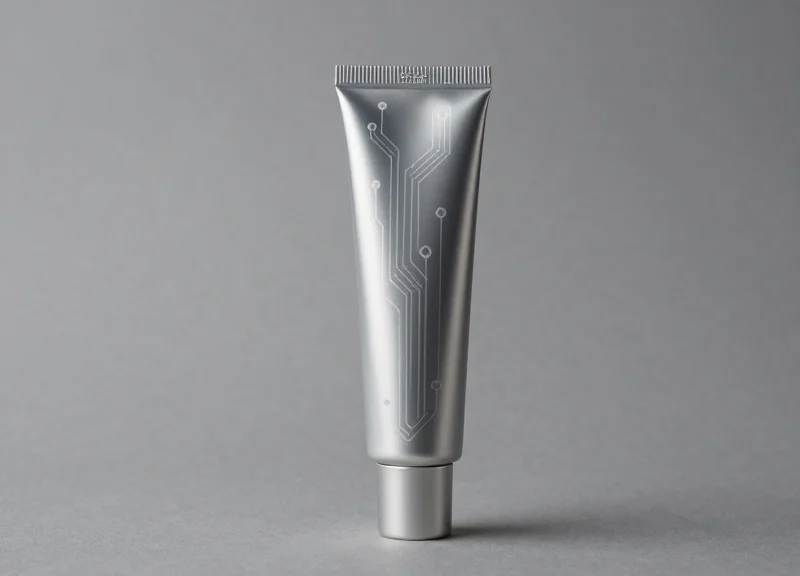
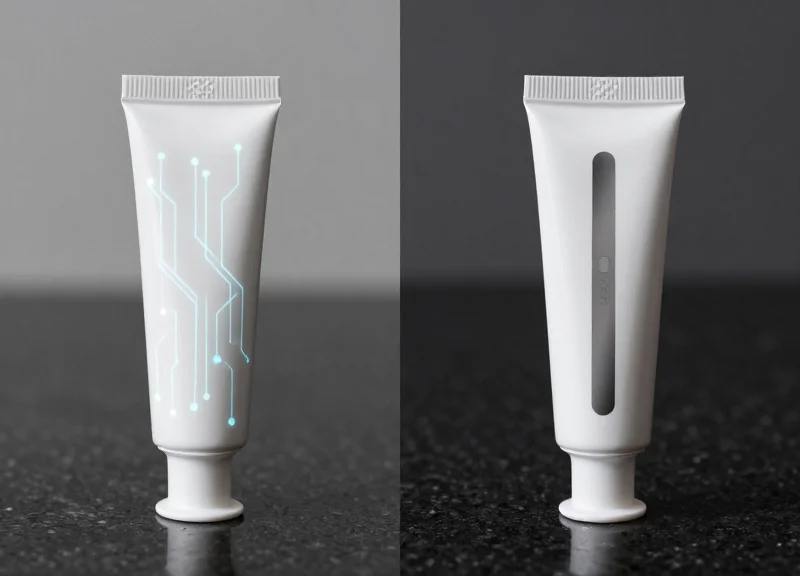
In 2026, the aesthetics of security for squeezable cosmetics transition from 'applied' to 'embedded,' where ultra-thin soft labels and flexible integrated antennas are fused directly within the multi-layer laminate of the packaging. This 'invisible' approach eliminates the visual clutter of external stickers and prevents consumers from peeling off security tags, maintaining the premium tactile feel and visual integrity required for high-end cosmetic branding. By leveraging advancements in flexible electronics, manufacturers can now sandwich security components between the barrier and structural layers of the tube, ensuring that loss prevention is a core feature of the packaging architecture rather than a secondary addition.
| Feature | Traditional Surface Labels | Integrated Subsurface Antennas |
|---|---|---|
| Visual Impact | Obstructs branding/graphics | 100% Invisible to the consumer |
| Durability | Prone to peeling or moisture damage | Protected by laminate layers |
| Tamper Resistance | Easily removed by shoplifters | Impossible to remove without destroying the tube |
| Tactile Experience | Adds a 'bump' or uneven surface | Seamless, smooth hand-feel |
The technical shift is centered on 'Security-by-Design' workflows. Rather than applying a tag post-filling, the RFID inlay or EAS resonator is placed during the web-conversion stage of laminate production. This is particularly effective for PBL (Plastic Barrier Laminate) and ABL (Aluminum Barrier Laminate) structures. Modern flex-circuitry allows the antenna to be as thin as 20 microns, which does not interfere with the tube's ability to collapse or 'squeeze,' ensuring that the user experience remains uncompromised throughout the product life cycle.
Does embedding security tags affect the recyclability of the tube?
Leading 2026 designs utilize mono-material antennas and water-soluble conductive inks that are compatible with PE recycling streams, meeting the 'Circular Economy' standards for beauty packaging.
Can these integrated antennas survive the tube-sealing process?
Yes. Advanced induction and ultrasonic sealing techniques are now calibrated to bypass the specific frequency zones of the embedded tags, preventing circuit burn-out during the heat-sealing of the tube tail.
How does this impact the cost per unit?
While the initial laminate cost increases by 8-12%, the removal of manual tag application labor and the reduction in 'shrink' from tag-tampering often result in a net ROI within 18 months.
Expert Tip: For 2026, look toward 'Functional Graphic Integration.' Instead of hiding the antenna, brands are beginning to use conductive metallic inks to print the brand logo itself, which doubles as the functional RFID antenna. This fusion of brand identity and loss prevention technology represents the pinnacle of aesthetic security, turning a technical requirement into a design asset.
Sustainability and the Circular Economy in Cosmetic Security
Sustainability in cosmetic security refers to the integration of anti-theft technologies that do not hinder the recyclability of the primary packaging, focusing on materials that can be safely processed in circular waste streams. As we approach 2026, the industry is moving away from 'blind' disposable tags toward 'smart' sustainable security that supports the Digital Product Passport (DPP) requirements. This shift ensures that the security element—whether RFID or EAS—contributes to the product's lifecycle data rather than simply ending up as landfill waste.
| Sustainability Metric | Legacy EAS Labels | 2026 Next-Gen RFID |
|---|---|---|
| Primary Substrate | Non-recyclable PET/Plastic | FSC-Certified Paper or Bio-Polymer |
| Antenna Material | Thick Copper/Aluminum | Printed Graphene or Ultra-Thin Alum |
| Recycling Compatibility | High Contamination Risk | Wash-off Adhesives for Clean Separation |
| Carbon Footprint | High (Single-use focus) | Neutral (Offset by supply chain efficiency) |
A critical breakthrough for 2026 is the adoption of 'de-bonding' adhesives for squeezable tubes. Historically, the adhesive used to secure EAS labels would contaminate the plastic recycling stream, leading to lower-quality PCR (Post-Consumer Recycled) resin. The next generation of security labels utilizes heat-sensitive or water-soluble adhesives. These allow the security tag to detach cleanly during the industrial washing phase of the recycling process, ensuring the LDPE or HDPE tube material remains pure and high-value for reuse. This 'clean-peel' technology is becoming a requirement for brands aiming for 'Gold' status in circularity certifications.
How does RFID support the Circular Economy?
Beyond theft prevention, RFID acts as a digital carrier for the product's history. In 2026, these tags help recyclers identify the exact plastic resin and chemical composition of cosmetic tubes, enabling more precise sorting and higher-quality recycled output.
Are 'Plastic-Free' security tags a reality?
Yes. New manufacturing techniques allow for 'Antenna on Paper' RFID, which eliminates the plastic carrier film entirely. These tags are compostable and represent the pinnacle of sustainable security for eco-conscious cosmetic brands.
What is the environmental impact of EAS ferrite cores?
Traditional AM EAS tags contain ferrite (metal) strips that are difficult to recover. 2026 trends show a move toward thinner, organic-polymer based acoustic resonators that offer similar security with a 40% reduction in mineral extraction impact.
Expert Insight: The 'Hidden Carbon' of EAS vs. the 'Circular Lift' of RFID. While EAS labels often have a lower initial manufacturing carbon footprint, RFID provides what we call a 'Circular Lift.' By enabling item-level inventory accuracy of 99%, RFID significantly reduces overproduction and the carbon waste associated with unsold products expiring on shelves. In the 2026 landscape, the most sustainable security choice is the one that prevents the waste of the product itself, not just the one with the greenest label.
- Material Audit: Evaluate current security labels for PET content and switch to paper-based or bio-acetate substrates.
- Adhesive Transition: Implement wash-off adhesives that meet APR (Association of Plastic Recyclers) guidelines for clean separation.
- Data Integration: Program RFID tags with recycling instructions to assist end-of-life processing as part of the Digital Product Passport.
Strategic ROI: Balancing Initial Cost against Long-term Data Value
The strategic Return on Investment (ROI) for cosmetic packaging security is determined by the intersection of 'Cost-per-Tag' and 'Actionable Data Value.' While Electronic Article Surveillance (EAS) remains the budget-friendly leader for pure theft deterrence—costing pennies per unit—Radio Frequency Identification (RFID) transforms the security tag into a profit-generating asset. For squeezable cosmetic packaging, the ROI calculation must account for the high churn rate and the complexity of liquid-filled inventory, where RFID’s ability to automate cycle counts and expiration tracking often offsets its 3x-5x higher unit cost compared to traditional acousto-magnetic (AM) labels.
| Financial Metric | EAS (Traditional) | RFID (Next-Gen) |
|---|---|---|
| Average Tag Cost (2026 Est.) | $0.015 - $0.03 | $0.05 - $0.09 |
| Infrastructure Capex | Low (Pedestals only) | Moderate to High (Readers/Cloud) |
| Labor Efficiency | Neutral (Manual checks required) | High (99% automated accuracy) |
| Primary Value Driver | Shrinkage Reduction | Inventory Intelligence & CX |
A critical, often overlooked factor in the 2026 landscape is the 'Shadow Inventory Tax.' For high-end squeezable products like peptide creams or metallic-pigment primers, manual inventory counting is notoriously prone to error. Expert Tip: By switching to RFID, brands typically see a 2% to 5% uplift in top-line revenue simply by eliminating 'out-of-stock' scenarios that occur when store systems believe a product is on the shelf, but it has actually been misplaced or stolen. This 'hidden' revenue boost often pays for the entire RFID infrastructure within the first 14 months of deployment.
Is EAS still viable for low-margin squeezables?
Yes. For mass-market products under $15, the data utility of RFID rarely justifies the unit cost. EAS remains the gold standard for high-volume, low-margin items where theft prevention is the sole objective.
What is the 'Hybrid Approach' to ROI?
Many retailers are adopting a 'Source Tagging' strategy where manufacturers embed EAS for security but use QR-based serialized data for tracking, creating a middle-ground ROI without full RFID reader deployment.
How does liquid content affect the financial risk?
Liquid interference can lead to false negatives in RFID. Investing in 'Flag' tags or 'Liquid-Safe' inlays is more expensive, but the cost of a failed read (and subsequent manual labor) is significantly higher than the premium for specialized tags.
Ultimately, the transition from EAS to RFID is less about security and more about the digital transformation of the supply chain. In an era where 'Omnichannel' is the baseline, knowing exactly which tube of serum is in which store, in real-time, provides a competitive advantage that a simple anti-theft buzzer cannot match. The 2026 winner won't be the brand with the lowest security spend, but the one with the most accurate inventory data.
Hybrid Solutions: The Best of Both Worlds?
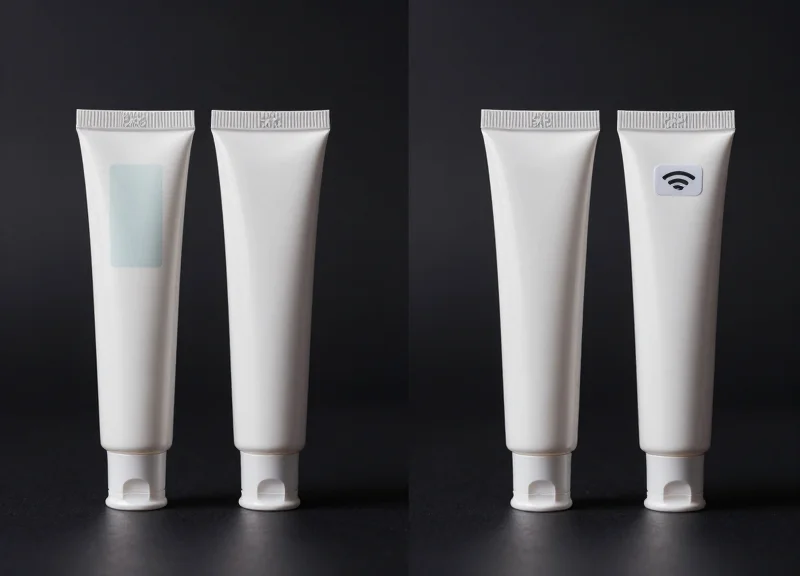
Hybrid security solutions represent the pinnacle of 2026 loss prevention strategy by integrating Electronic Article Surveillance (EAS) and Radio Frequency Identification (RFID) into a single, unified tag. For squeezable cosmetic packaging, this dual-technology approach provides an immediate transition path: retailers can maintain high-decibel theft deterrence using their existing AM or RF pedestals while simultaneously capturing item-level data via RFID. This 'best of both worlds' methodology ensures that high-value creams and serums are protected from shrink while providing the granular supply chain visibility required for modern omnichannel retail.
| Feature | Standard EAS | Pure RFID | Hybrid EAS-RFID |
|---|---|---|---|
| Primary Use | Theft Deterrence | Inventory Management | Deterrence + Data |
| Gate Compatibility | High (Legacy Gates) | Requires New Hardware | Universal |
| Item-Level Insights | None | Full Visibility | Full Visibility |
| Form Factor | Bulky Labels | Thin Inlays | Integrated Slim-Profile |
The true innovation for 2026 lies in the 'Single Point of Application.' Previously, brands had to apply two separate labels, which cluttered the limited surface area of squeezable tubes and doubled the labor cost. Modern hybrid inlays are now thin enough to be embedded directly into the tube's laminate or hidden behind the back-panel label. This is a game-changer for 'pre-tailing'—the process of tagging products at the point of manufacture. By using a hybrid tag, a brand ensures the product is 'floor-ready' for any retailer, regardless of whether that retailer utilizes legacy EAS gates or state-of-the-art RFID tunnels.
Can hybrid tags survive the squeezing of cosmetic tubes?
Yes, 2026-gen hybrid tags use flexible substrates and 'crack-free' antenna designs that maintain conductivity even after repeated deformation of the tube.
Is the cost of hybrid tags prohibitive for mass-market products?
While unit costs are higher than EAS alone, the ROI is realized through a 40% reduction in label application labor and a significant decrease in out-of-stock incidents.
Do hybrid tags interfere with liquid contents?
Modern hybrid designs use specific frequency decoupling to ensure the EAS resonator and RFID chip do not interfere with each other or the viscous liquids inside.
Expert Tip: To maximize ROI, look for 'Dual-Deactivation' hardware at the Point of Sale (POS). In 2026, the leading scanners can simultaneously kill the EAS signal and update the RFID cloud status to 'Sold' in a single swipe. This eliminates the 'false alarms' that often plague beauty retailers when legacy tags aren't properly deactivated, preserving a premium customer experience.