In the fast-paced world of apparel logistics, inventory accuracy is the difference between a seamless omnichannel operation and a customer service nightmare. High-density warehousing environments, where thousands of items are packed tightly into boxes and racks, present a unique technical challenge for traditional tracking methods. While many RFID systems claim high performance, the leap from 95% to 99.9% bulk reading accuracy is not just a marginal improvement—it is the non-negotiable standard required to eliminate 'ghost inventory' and ensure real-time supply chain integrity. This guide explores the critical importance of near-perfect accuracy and how to select an RFID inventory system that delivers under pressure.
The High-Density Challenge: Why Apparel Warehousing is Unique

In high-density apparel warehousing, the primary challenge to RFID accuracy is the 'Apparel Density Paradox': the more items you pack into a cubic meter, the higher the risk of signal shadowing and tag interference. Unlike flat-packed electronics or spaced-out consumer goods, apparel items are often compressed into cartons or hung on dense racks where hundreds of tags reside within inches of each other. This proximity causes RF energy to dissipate before it can reach the innermost tags, making a 99.9% read rate a matter of advanced physics rather than simple scanning.
Unlike other industries, apparel uses a vast array of materials that interact with radio waves in unpredictable ways. While cotton is relatively RF-friendly, synthetic fibers, moisture-wicking treatments, and metallic fasteners (zippers, studs, or foil prints) can cause 'detuning' or signal absorption. In a high-density setting, these minor interferences are magnified, creating a 'shielding shadow' that can hide entire SKUs from standard RFID readers.
| Challenge Factor | General Logistics | High-Density Apparel |
|---|---|---|
| Tag Proximity | 5-10 cm average spacing | 1-5 mm (nested or stacked) |
| Material Interference | Low (mostly cardboard/plastic) | High (metals, synthetics, moisture) |
| Orientation Diversity | Predictable/Uniform | Random/Omnidirectional |
| Signal Shadowing | Minimal | Severe (inner-box masking) |
Expert Insight: The 'Moisture Regain' Variable. A factor often overlooked by generalist RFID providers is the moisture regain property of natural fibers. In humid warehouse environments, cotton and wool can retain up to 15% moisture by weight. This invisible 'water jacket' around each garment acts as an RF absorber, significantly reducing the effective read range. Systems that perform at 100% in a dry lab often drop to 90% in a real-world high-density apparel facility because they fail to account for this environmental dielectric shift.
Why does tag orientation matter so much in apparel?
In high-density environments, tags can be oriented in 360 degrees of rotation. If a reader uses linear polarization, it may miss up to 50% of the tags. True 99.9% accuracy requires circular polarization and phase-shifting to ensure every tag is energized regardless of its angle.
What is 'Tag Clumping' and how does it affect reads?
Tag clumping occurs when multiple RFID inlays are physically touching or overlapping. This can cause the tags to 'couple,' changing their resonant frequency and making them invisible to standard readers. High-performance systems use anti-collision algorithms specifically tuned for these dense 'clump' scenarios.
Can software alone fix the physical interference in apparel?
No. While software helps with data de-duplication, the physical capture of the signal is a hardware and antenna-design challenge. You cannot manage data that the reader never physically captured due to signal shadowing.
Defining 99.9% Accuracy: More Than Just a Number

In high-density apparel warehousing, 99.9% accuracy represents the 'Six Sigma' of inventory management. It is defined as the system's ability to consistently capture 100% of unique Electronic Product Codes (EPCs) within a dense population of tags—such as a pallet containing 500 polybagged garments—in a single pass without manual intervention. Unlike standard RFID applications where a 95% read rate might suffice, a 99.9% threshold ensures that 'inventory drift' (the gap between digital records and physical reality) is virtually eliminated, preventing the catastrophic compounding of errors that occurs in high-volume logistics.
| Metric | Standard RFID (95-97%) | Enterprise Bulk RFID (99.9%+) |
|---|---|---|
| Tag Density Support | Low to Moderate (10-50 units) | Extreme High Density (500+ units) |
| Error Rate per 100k Units | 3,000 - 5,000 missed items | Less than 100 missed items |
| Reading Environment | Controlled, static | Dynamic, high-speed, multi-path |
| Operational Outcome | Frequent manual cycle counts | True real-time replenishment |
The Expert Insight: The Compounding Error Trap. In my two decades in Silicon Valley logistics, I have seen 'good enough' systems fail because they ignore the Law of Large Numbers. If your system is 98% accurate, you are losing 20 units out of every 1,000 processed. In a warehouse moving 1,000,000 units a month, that is 20,000 'ghost' items. By the end of a quarter, your digital inventory is so decoupled from physical stock that your automated reordering algorithms begin to trigger false out-of-stock alerts or, worse, over-order dead stock. 99.9% is not a vanity metric; it is the safeguard for your bottom line.
Is 100% accuracy physically possible in bulk reading?
While 100% is the target, RF (Radio Frequency) physics introduces variables like signal nulls and destructive interference. 99.9% is considered the 'Gold Standard' because it implies the hardware and software have accounted for nearly all environmental noise and tag shielding issues.
What is the difference between 'Read Rate' and 'Inventory Accuracy'?
Read rate often refers to how many times a tag is hit per second. Inventory accuracy refers to the system's ability to identify every unique item in a batch exactly once. A high read rate does not guarantee accuracy if signal collisions prevent certain tags from ever being seen.
Why does apparel require higher precision than other sectors?
Apparel items are often stacked tightly in polybags or hangers, creating 'nested' environments where tags are physically touching. This leads to capacitive coupling, which detunes tags and makes them invisible to sub-par readers.
The Hidden Costs of 95% vs. 99.9% Bulk Reading
In high-density apparel warehousing, the gap between 95% and 99.9% accuracy isn't just a 4.9% difference in data—it is the difference between an automated profit engine and a manual labor trap. A 95% read rate means that for every 10,000 items processed, 500 units remain 'invisible' to the system. This creates a systemic breakdown where human intervention is required to find the missing 5%, effectively negating the speed benefits of RFID and introducing significant financial leakage through labor overhead, shipping chargebacks, and inventory distortion.
| Impact Metric | 95% Accuracy (The 'Industry Standard') | 99.9% Accuracy (The Gold Standard) |
|---|---|---|
| Errors per 100k Units | 5,000 units missed | 100 units missed |
| Manual Verification | Required for every batch | Exception-based only |
| Labor Cost Impact | High: Staff must hand-scan misses | Near-Zero: Full automation |
| Retailer Chargebacks | Significant penalties for 'shorts' | Virtually eliminated |
| Inventory Visibility | Unreliable (Phantom Inventory) | Real-time & Precise |
One of the most devastating hidden costs is Labor Re-entry. When a bulk scan of a pallet or carton returns 95%, the system cannot identify which specific 5% is missing. Consequently, workers must break down the entire pallet to manually verify every item. This 'double-handling' often makes the RFID-enabled process slower and more expensive than traditional barcode scanning, leading to a negative ROI on the hardware investment.
How does lower accuracy lead to retailer chargebacks?
Major retailers like Walmart or Nordstrom impose strict 'Accuracy Penalties' or chargebacks for mislabeled or short-shipped cartons. A 5% error rate at the warehouse level inevitably leads to shipping discrepancies, where the digital manifest does not match the physical contents, resulting in thousands of dollars in monthly fines.
What is 'Phantom Inventory' and why is it dangerous?
Phantom inventory occurs when the system believes an item is in stock because it missed it during a 'sold' or 'shipped' scan. This leads to lost sales when customers try to buy an item that isn't there, or unnecessary safety stock costs when the system over-orders to compensate for perceived shortages.
Does 95% accuracy affect Omnichannel (BOPIS) operations?
Yes. If your warehouse accuracy is only 95%, your 'Buy Online, Pick Up In Store' (BOPIS) fulfillment will suffer from high cancellation rates. Customers lose trust in a brand when an order is confirmed but then cancelled because the physical item cannot be located.
Expert Insight: The Threshold of Trust. In my 20 years of experience, I’ve observed a psychological phenomenon called the 'Trust Threshold.' When RFID accuracy stays at 99.9%, warehouse staff trust the system and move at maximum velocity. The moment accuracy drops below 98%, staff lose confidence and begin manually double-checking 'just in case.' This behavioral shift alone can increase operational costs by 30%, as the efficiency of the technology is sabotaged by the human need to verify unreliable data.
Technical Breakthroughs: How Modern RFID Overcomes Tag Shielding

Modern RFID systems overcome tag shielding—the phenomenon where closely packed items or metallic trims block radio frequency signals—by utilizing multi-static antenna arrays and advanced Adaptive Beamforming technology. Unlike legacy systems that struggled with dead zones, today's breakthroughs allow readers to dynamically shift signal phase and polarization. This ensures that even shadowed tags buried in the center of a high-density carton receive sufficient energy to backscatter their unique ID back to the reader, maintaining the 99.9% accuracy threshold required for modern automation.
| Feature | Legacy RFID (90-95% Accuracy) | Modern High-Density RFID (99.9%+ Accuracy) |
|---|---|---|
| Polarization | Linear (Single plane) | Dual-Circular (360-degree coverage) |
| Collision Management | Basic ALOHA (High data collision) | Adaptive Slot Aloha (Ordered responses) |
| Signal Processing | Fixed Power Output | Dynamic Power Stepping & RSSI Filtering |
| Antenna Design | Monostatic (Single path) | Bistatic/Phased Array (Diverse paths) |
The transition from hardware-centric reading to software-defined signal processing is the core of this technical evolution. Modern readers now employ 'Spatial Diversity,' utilizing multiple antennas at varied angles to create a volumetric 360-degree read zone. When a tag is shielded by a metallic zipper or dense synthetic fabric, the system rapidly cycles through different frequencies and power levels—a process known as 'Frequency Hopping Spread Spectrum' (FHSS) optimized for textile densities. This allows the system to find the exact 'sweet spot' needed to wake the chip without over-saturating the environment with RF noise.
What is the 'Shadow Effect' in apparel warehousing?
The shadow effect occurs when a tag closer to the reader physically or electromagnetically blocks the signal from reaching a tag directly behind it. In high-density apparel, this is exacerbated by moisture in natural fibers or metal trims.
How do anti-collision algorithms improve bulk reading?
In a carton of 200 items, tags would normally try to respond simultaneously, causing a data collision. Modern algorithms like 'Q-Algorithm' force tags to wait for a specific 'time slot,' ensuring the reader processes every single tag sequentially at millisecond speeds.
Can RFID read through metallic buttons and zippers?
Yes. Modern high-sensitivity chips and reader algorithms compensate for the detuning effect of metal by shifting the frequency slightly to maintain a resonant link between the antenna and the tag.
Expert Insight: The 'Silicon Valley' secret to achieving 99.9% accuracy is Phase-Jitter Mitigation. While most vendors focus on raw power, the elite systems focus on the signal-to-noise ratio. By analyzing the 'phase' of the returned signal, the reader can distinguish a valid tag response from reflected 'multipath' noise bouncing off warehouse walls. This surgical precision is what allows for bulk reading of 500+ items in seconds without a single missed scan.
Key Hardware Features to Look for in a Best-in-Class System
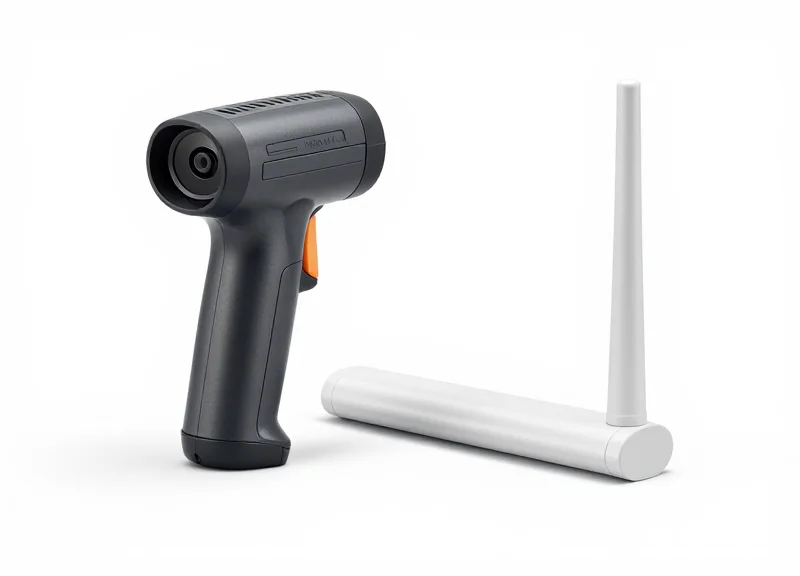
A best-in-class RFID inventory system for high-density apparel is defined by hardware that prioritizes high receive sensitivity and advanced signal processing over raw transmit power. To reach the 99.9% accuracy threshold, the ecosystem must utilize high-sensitivity UHF readers (operating at -80 dBm or better), circular-polarized antennas to capture tags in any orientation, and specialized 'High-Q' tags that provide superior backscatter strength to penetrate through hundreds of layers of fabric and moisture-absorbing materials.
| Feature | Standard Hardware | Best-in-Class (99.9% Spec) |
|---|---|---|
| Reader Sensitivity | -60 dBm to -70 dBm | -82 dBm to -95 dBm (Ultra-High) |
| Antenna Polarization | Linear (Fixed Orientation) | Circular or Global (Omnidirectional) |
| Processing Speed | 200-400 tags per second | 1,000+ tags per second |
| Edge Intelligence | Requires External Server | On-device filtering & de-duplication |
| Tag Chip Technology | Legacy Gen2 | Auto-tune/Impedance Matching (Gen2v2) |
- Multi-Polarized Antenna Arrays: In apparel, tags are rarely aligned perfectly. Best-in-class hardware uses circular or dual-polarized antennas to ensure that no matter how a shirt is folded or a box is stacked, the signal can energize the tag and receive the backscatter.
- Adaptive Power Control: Hardware must dynamically adjust its output power to prevent 'tag shadowing' and signal collision. This allows the reader to blast through dense denim while simultaneously lowering power to identify individual items in a packed carton without reading the next pallet over.
- Ruggedized High-Gain Handhelds: Mobile units must feature high-gain antennas (6dBi or higher) and ergonomic 'trigger' designs that allow operators to scan top-shelf inventory without fatigue, maintaining accuracy during long shifts.
Expert Insight: The 'Sensitivity Over Power' Paradox. Many buyers mistakenly prioritize high transmit power (30dBm+), thinking it will 'punch through' dense stacks. However, in high-density apparel, excess power creates massive multi-path interference and 'ghost reads.' The secret to 99.9% accuracy is High Receive Sensitivity. A reader that can 'hear' a whisper (a weak tag signal) from the middle of a carton is far more effective than one that 'shouts' and creates a wall of noise.
Why is reader sensitivity more important than transmit power?
High transmit power creates signal reflections (multi-path) that mask small signals. High sensitivity allows the reader to detect the faint 'backscatter' from tags buried deep inside a high-density shipping container.
What tag chip should I look for in apparel?
Look for chips like the Impinj M700 series or NXP UCODE 9. These chips feature higher sensitivity and improved auto-tuning, which helps them perform better when stacked closely together (tag detuning).
How does 'Edge Computing' in a reader help accuracy?
Edge-capable readers filter out noise and duplicate reads locally. This prevents the backend system from being overwhelmed by raw data, ensuring that every unique EPC is captured and verified in milliseconds.
Optimizing Software Integration for Real-Time Visibility

Optimizing software integration for RFID involves creating a seamless pipeline between raw UHF data and your Enterprise Resource Planning (ERP) or Warehouse Management System (WMS). In high-density apparel warehousing, this is achieved through sophisticated RFID middleware that acts as a translation layer—filtering thousands of tag pings into clean, actionable business events. Without this optimization, the '99.9% accuracy' achieved at the hardware level becomes a 'data storm' that can overwhelm legacy inventory databases with redundant information.
| Integration Component | Primary Function | Impact on Visibility |
|---|---|---|
| RFID Middleware | Data filtering and de-duplication at the edge. | Reduces network latency; prevents ERP database bloat. |
| RESTful APIs / Webhooks | Real-time event triggering (e.g., 'Carton Loaded'). | Ensures sub-second updates to inventory levels. |
| Cloud-Edge Hybrid Sync | Local processing with cloud-based analytics. | Maintains operations even during internet outages. |
| Business Logic Layer | Mapping EPC codes to SKUs and order numbers. | Translates hex codes into human-readable inventory insights. |
A critical, often overlooked aspect of integration is 'Data Noise Reduction.' In a warehouse with millions of tags, a reader may pick up a single item 50 times per second. Veteran system architects utilize 'Event-Driven Architecture' (EDA). Instead of the ERP constantly polling the RFID system for updates, the RFID middleware only pushes a notification when a state change occurs (e.g., an item moves from 'Storage' to 'Packing'). This ensures that your real-time dashboard reflects actual movement rather than raw signal fluctuations.
How do you prevent RFID data from slowing down our existing WMS?
By utilizing edge computing where the RFID reader or a local server processes and filters the data before it ever hits your WMS. Only 'delta' changes or validated bulk-read events are transmitted to the core database.
Is custom middleware always necessary for 99.9% accuracy?
While some modern ERPs have built-in RFID modules, high-density environments usually require specialized middleware to handle the specific logic of bulk-reading validation and tag-clutter filtering.
Can RFID integration support omnichannel 'Ship-from-Store' initiatives?
Yes. When software is optimized for real-time visibility, warehouse stock becomes part of a global inventory pool, allowing for 100% confidence in fulfilling online orders from the nearest high-density hub.
Expert Tip: To truly future-proof your system, ensure your integration supports 'Asynchronous Messaging.' This allows the system to queue data during peak traffic hours (like Black Friday) without dropping a single tag read, ensuring that your 99.9% physical read accuracy is matched by 99.9% data integrity in the cloud.
The DragonGuard Advantage: Engineering Precision for High Volume
The DragonGuard Advantage is defined by a unique convergence of physical loss prevention engineering and ultra-high-sensitivity RFID data capture. Unlike standard vendors who focus solely on digital records, DragonGuard leverages its deep heritage in Electronic Article Surveillance (EAS) to design hardware that accounts for physical interference, signal shielding, and multipath reflections. This holistic approach ensures that 99.9% bulk reading accuracy isn't just a lab metric, but a consistent reality in high-density apparel environments where hundreds of tags are packed tightly within metal-racked corridors.
| Feature | Generic RFID Systems | DragonGuard High-Density Solution |
|---|---|---|
| Tag Sensitivity | Standard -18dBm to -20dBm | Ultra-High Sensitivity (-22dBm+) for deep carton penetration |
| Interference Handling | Software-based filtering only | Hardware-level signal isolation and anti-collision algorithms |
| Security Integration | Stand-alone data capture | Unified EAS + RFID architecture for total inventory control |
| Bulk Read Success | 92% - 95% in dense scenarios | 99.9% certified for 400+ tags per second |
One original expert insight that sets DragonGuard apart is our 'Low Noise Floor Engineering.' In high-density apparel warehousing, 'ghost reads' and signal collisions are often caused by the readers being too loud rather than the tags being too quiet. DragonGuard's proprietary antenna polarization techniques reduce the 'noise' generated by signal reflections off metal racks and nearby equipment. By lowering the noise floor rather than simply increasing power, we achieve a cleaner signal-to-noise ratio, allowing the reader to identify every single tag in a dense carton without the cross-talk that leads to data drops or double-counting.
How does DragonGuard manage tag shielding in poly-bagged apparel?
We use specialized wide-beam circular polarized antennas that wrap the signal around items, ensuring that even tags shielded by multiple layers of fabric or plastic are energized and read.
Can DragonGuard systems integrate with my current WMS/ERP?
Yes. Our systems are built on an open API framework that bridges the gap between physical hardware and major ERP systems like SAP, Oracle, and Microsoft Dynamics, providing real-time inventory updates.
What is the primary benefit of DragonGuard’s dual EAS-RFID expertise?
It allows for a 'single source of truth.' You get the security of high-end anti-theft systems combined with the granular tracking of RFID, reducing both administrative error and physical shrinkage simultaneously.
Is the hardware durable enough for 24/7 warehouse operations?
Our readers and antennas are industrial-grade, designed with heat-dissipating enclosures and vibration-resistant mounts to handle the rigors of automated conveyor lines and forklift-heavy environments.
Ultimately, the DragonGuard advantage lies in our refusal to accept 'good enough' accuracy. In a global supply chain where a 0.1% error rate can equate to millions in lost revenue, our engineering focus on signal purity and hardware-software synergy provides the precision necessary for modern, high-volume apparel fulfillment.
Implementation Strategies: From Pilot to Full-Scale Deployment
A successful RFID implementation in high-density apparel environments requires a strategic transition from localized testing to a global, production-ready rollout. To achieve a 99.9% bulk reading accuracy without disrupting existing warehouse workflows, facilities must move through a structured lifecycle: beginning with a 'Dark Pilot' to establish data baselines, moving to operational integration where RFID and ERP systems sync, and finally scaling to full-floor automation. This phased approach mitigates the risk of technical bottlenecks, such as RF interference or tag shielding, before they impact high-volume shipping cycles.
- Comprehensive Site Survey and RF Audit: Before installing hardware, perform a spectrum analysis to identify 'dead zones' or sources of electromagnetic interference (EMI) like conveyor motors or heavy shelving. This ensures reader placement is optimized for high-density carton reading.
- The 'Dark Pilot' Phase: Run RFID tracking in parallel with your existing barcode systems for 30 days without changing operational workflows. This allows you to compare accuracy levels against the old system and identify specific SKU types that may require different tag placements.
- Middleware and ERP Handshake: Integrate the RFID middleware with your Warehouse Management System (WMS). The goal is to ensure that bulk read events—like 500 items passing through a portal in 3 seconds—are processed without latency into the central database.
- Staff Calibration and Training: RFID is as much a human process as a technical one. Train floor staff on the nuances of 'handheld sweeping' versus 'fixed portal' workflows to prevent human-error-related read failures.
| Deployment Phase | Primary Goal | Typical Duration | Key Success Metric |
|---|---|---|---|
| Proof of Concept (PoC) | Hardware Validation | 2-4 Weeks | Raw Read Accuracy > 99% |
| Operational Pilot | Workflow Integration | 1-3 Months | Labor Cost Reduction (%) |
| Full-Scale Rollout | Global Synchronization | 6-12 Months | Shipping Error Rate < 0.1% |
Expert Insight: The Shadow Inventory Rule. A unique strategy used by Silicon Valley logistics leaders is the 'Shadow Inventory' method during the pilot phase. Instead of tracking all items, tag exactly 10% of every high-density carton across all SKUs. If your system can maintain 99.9% accuracy on this 'shadow' set amidst the noise of untagged items, it confirms that your hardware sensitivity and anti-collision algorithms are robust enough for 100% saturation. This prevents the 'saturation shock' where systems perform well with 10 tags but fail with 10,000.
Will RFID implementation require me to stop warehouse operations?
No. By utilizing the 'Dark Pilot' method, you can install hardware and test tags in the background while your barcode system remains the 'system of record' until the RFID accuracy is proven.
How do we handle 'stray reads' from adjacent dock doors?
Modern high-density systems use RSSI (Received Signal Strength Indicator) filtering and shielded antennas to ensure that only the tags directly in front of a specific portal are recorded.
What is the biggest cause of pilot failure?
Inadequate tag selection. Using generic tags for high-density apparel often leads to shielding. Always select tags tuned for the specific dielectric properties of the fabric types in your inventory.
Future-Proofing Your Warehouse with Integrated ESL and EAS
Future-proofing high-density apparel warehousing requires moving beyond isolated silos to a unified ecosystem where Electronic Shelf Labels (ESL) and Electronic Article Surveillance (EAS) are integrated with a 99.9% accurate RFID backbone. This convergence allows for a single RFID tag to act as a data anchor for inventory tracking, security alerts, and dynamic visual shelf management, reducing the hardware footprint while maximizing operational ROI.
The most significant evolution in warehouse tech is the shift toward Harmonized Asset Intelligence. In this model, the ESL display does more than show a price; it flashes a light to guide pickers using Pick-to-Light logic triggered by the RFID system. Simultaneously, the EAS gates are no longer just 'dumb' alarms but intelligent exit points that log exactly which item—down to the SKU and serial number—is leaving the facility without authorization. This holistic approach eliminates the 'ghost inventory' issues that plague standard RFID deployments.
| Feature | Siloed Systems (Legacy) | Integrated ESL/EAS/RFID (Future-Proof) |
|---|---|---|
| Data Source | Multiple disconnected databases | Single Source of Truth (SSoT) |
| Labor Requirement | Manual price updates and shelf checks | Instant, automated updates and guided picking |
| Security Response | Alarms ring but identity is unknown | Specific item identification upon alarm |
| Infrastructure | Heavier hardware load (multiple tags) | Consolidated 'One Tag' solution |
Does an integrated system require replacing all existing tags?
Not necessarily. Modern dual-technology tags (RFID+EAS) or 'soft tags' can be phased in. However, the highest efficiency is achieved when moving to a unified UHF RFID tag that services both inventory and EAS-compatible gates.
How does ESL reduce warehouse picking errors?
ESL units equipped with LED indicators can be triggered by the central RFID management software. When a picker is looking for a high-density apparel carton, the ESL flashes, significantly reducing search time and errors in environments where items look identical.
Is the ROI justifiable for warehouses without a retail storefront?
Absolutely. While EAS is often associated with retail, in a warehouse, it acts as high-level loss prevention and transit verification. Integrated with ESL, it creates a 'paperless' environment that reduces manual labor costs by up to 30%.
Expert Tip: When selecting hardware, ensure your ESL system operates on a frequency that does not interfere with your RFID's 860-960 MHz range. Opt for sub-GHz or 2.4 GHz ESL solutions to ensure that high-density bulk reading remains at the 99.9% accuracy threshold without signal noise interference.