In an era of rising wages and persistent labor shortages, hospitality and healthcare organizations are under immense pressure to optimize every operational facet. Manual linen sorting remains one of the most labor-intensive and error-prone tasks in commercial laundry management. However, a technological shift is occurring. By leveraging RFID automated linen sorting, businesses are not just tracking inventory; they are fundamentally restructuring their labor requirements. This guide explores how transitioning from manual counting to automated RFID systems can bolster your bottom line by reducing labor costs by as much as 40%.
The High Cost of Manual Linen Management

Manual linen management is a legacy operational model characterized by labor-intensive sorting, counting, and tracking, often consuming up to 50% of a laundry facility's total operating budget due to human inefficiencies and the physical limitations of manual processing. In high-volume environments like hospitality and healthcare, the reliance on manual labor creates a 'productivity ceiling' where costs scale linearly with volume, preventing facilities from achieving true economies of scale. These hidden expenses manifest as overtime pay, high recruitment costs for repetitive manual roles, and the financial ripple effect of inventory inaccuracies.
| Cost Factor | Manual Workflow Impact | Economic Consequence |
|---|---|---|
| Labor Intensity | 3-5 physical touches per item | High wage expenditure per pound processed |
| Staff Turnover | Annual rates often exceed 30% | Continuous recruitment and training overhead |
| Sorting Accuracy | Average 3-7% error rate in manual sorting | Re-wash costs and damaged linen replacement |
| Safety & Health | Repetitive strain and biohazard exposure | Increased workers' comp and insurance premiums |
Why is staff turnover so high in manual linen management?
The repetitive, physically demanding nature of manual sorting leads to high burnout. When employees must manually handle thousands of pounds of soiled linen daily, fatigue sets in, leading to decreased morale and a constant cycle of hiring and retraining that drains management resources.
How does human error impact the bottom line directly?
Miscounting and mis-sorting lead to inventory imbalances. If linens are sent to the wrong department or discarded prematurely due to misidentification, the facility must purchase replacements, which is significantly more expensive than the labor cost of the sort itself.
What are the indirect costs of manual tracking?
The 'Shadow Cost' of manual tracking includes the time management spends resolving disputes over lost items and the administrative hours required to manually enter data into inventory systems, which is prone to transcription errors.
Expert Insight: Beyond the obvious wage costs, the most damaging factor in manual systems is what I call the 'Linen Shrinkage Tax.' Without RFID automation, most facilities experience an annual inventory loss of 15-25% that remains unexplained. This is rarely due to theft; it is almost always the result of items being trapped in the wrong workflow or discarded because staff lack the data to identify an item's remaining life cycle. In a manual system, you aren't just paying for labor; you are paying a premium for the lack of visibility into your own assets.
Decoding RFID Technology in the Textile Industry
RFID (Radio Frequency Identification) in the textile industry is a wireless technology that utilizes Ultra-High Frequency (UHF) electromagnetic fields to automatically identify and track tags attached to linens, towels, and uniforms. Unlike traditional barcodes, UHF RFID does not require a direct line-of-sight and can read hundreds of items simultaneously at distances of up to 6 meters. In industrial laundry environments, this technology acts as the 'digital nervous system,' providing real-time data on item location, wash counts, and inventory aging, even when items are soiled and bundled in large carts.
| Feature | Standard Retail RFID | Industrial Laundry UHF RFID |
|---|---|---|
| Durability | Low (Paper/Plastic) | Extreme (PPS or Silicone Encapsulation) |
| Temperature Resistance | Up to 50°C | Up to 200°C (Tunnel Finishers) |
| Chemical Resistance | None | Resistant to Acids, Alkalis, and Bleach |
| Pressure Resistance | Minimal | Withstands 60-Bar Extraction Presses |
| Read Capability | Single/Low Volume | Bulk Reading (400+ items per second) |
- Tagging and Encoding: Flexible, heat-resistant RFID tags are sewn into the hem or heat-sealed onto the fabric. Each tag contains a unique Electronic Product Code (EPC) that links the physical item to its digital twin in the database.
- Automated Data Capture: As linens pass through 'reading zones'—such as portals at the loading dock or scanners on a conveyor belt—UHF readers trigger the tags to broadcast their ID via radio waves.
- Edge Processing: The reader filters the raw signal to prevent 'stray reads' from nearby carts and sends the verified data to a cloud-based management platform.
- Actionable Analytics: The software updates inventory levels, tracks life-cycle usage, and flags items for replacement, providing a complete audit trail without human intervention.
Unique Expert Insight: The 'Floating Chip' Advantage. The primary cause of RFID failure in laundry is not the wash cycle, but the mechanical extraction phase where linens are subjected to up to 60 bars of pressure. Top-tier industrial tags now utilize a 'Silicon-on-Flex' architecture where the chip is not rigidly bonded to the antenna. This allows the tag to bend and compress without micro-cracking the silicon, ensuring a lifespan of 200+ wash cycles—often outlasting the fabric itself.
Can RFID tags survive industrial chemicals and bleach?
Yes. High-grade laundry tags are encapsulated in Polyphenylene Sulfide (PPS) or specialized epoxy, which are chemically inert and protect the internal circuitry from pH levels ranging from 2 to 12.
How many items can be scanned at once?
Modern UHF RFID tunnels can accurately scan an entire cart containing 400 to 700 items in less than 5 seconds with 99.9% accuracy, a task that would take a human hours to count manually.
Does moisture affect the read range?
While water absorbs RF energy, modern industrial readers use 'circular polarization' and high-sensitivity antennas to penetrate wet linens, ensuring consistent data capture regardless of the items' moisture content.
The Mechanics of Automated Sorting: Speed and Accuracy

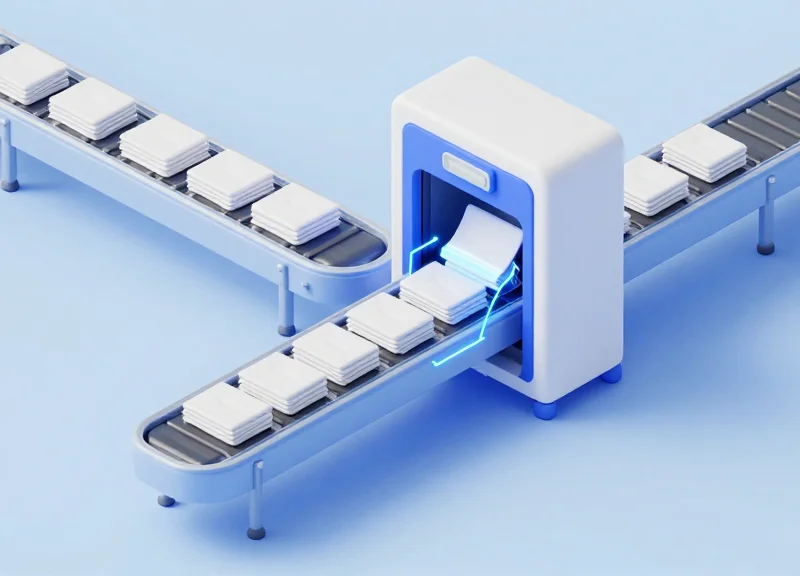
Automated linen sorting replaces the traditional, labor-intensive process of manual piece-by-piece inspection with high-speed RFID tunnels and portals that can identify hundreds of items simultaneously. By utilizing Ultra-High Frequency (UHF) waves, these systems capture data from every tagged item in a bulk load—whether it is in a laundry cage, on a conveyor, or bagged—in less than three seconds, effectively eliminating the human error inherent in manual counting and logging.
| Performance Metric | Manual Sorting Process | RFID Automated Sorting |
|---|---|---|
| Processing Speed | 300 - 500 items per hour | 15,000+ items per hour |
| Data Accuracy Rate | 92% - 95% (Human Error) | 99.9% (Digital Verification) |
| Labor Required | 3-5 FTEs per shift | 0.5 - 1 FTE (Monitoring only) |
| Throughput Method | Individual/Serial | Bulk/Parallel |
- Bulk Ingress: Soiled or clean linen carts are pushed through an RFID portal or placed on a conveyor belt moving through an RFID tunnel.
- Instantaneous Interrogation: The RFID reader sends a signal that wakes up all tags within the zone, which then broadcast their unique IDs back to the system.
- Real-Time Validation: The software compares the scanned items against the expected manifest or customer order to identify discrepancies immediately.
- Automated Routing: Based on the tag data, the system triggers mechanical sorters or alerts staff to move the load to the specific washing, drying, or folding station required.
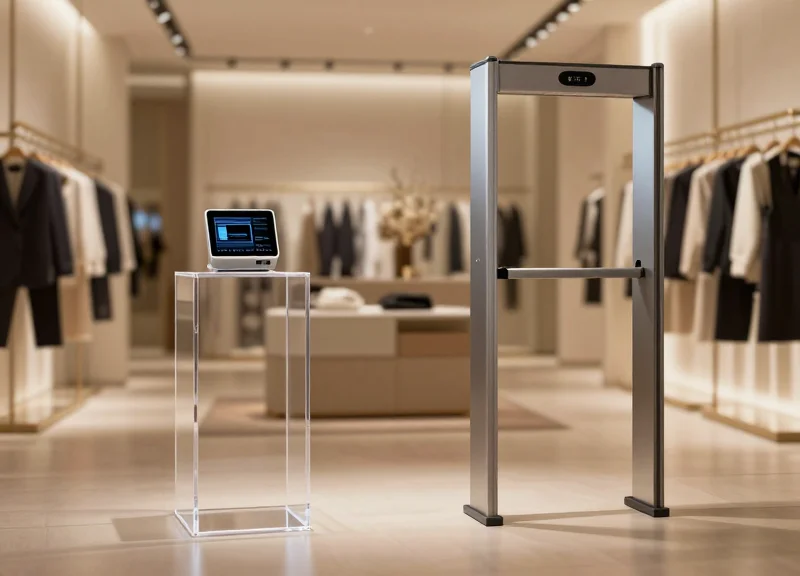
The primary hardware components—portals and tunnels—serve distinct roles. Portals are large, door-frame-like structures designed for scanning entire rolling carts or pallets at once. Tunnels are enclosed units integrated into conveyor lines, providing a controlled electromagnetic environment that prevents 'stray reads' from nearby tags. This physical isolation is what allows for such high accuracy even in dense industrial environments.
Can RFID scan items inside thick bags?
Yes, UHF RFID signals pass through plastic, fabric, and most non-metallic materials, allowing for accurate counts of bagged linen without opening them.
What happens if a tag is damaged?
Industrial laundry tags are designed for 200+ cycles of high-pressure washing and heat. In the rare event of a failure, the system flags the missing data point for manual verification.
How does the system handle high-density loads?
Advanced algorithms manage 'anti-collision' protocols, ensuring the reader can distinguish and record every individual tag signal even when hundreds are clustered together.
Expert Insight: The Power of Polarization Diversity. To achieve near-100% accuracy, Silicon Valley engineers utilize circular polarization in RFID antennas. Unlike linear antennas that require tags to be oriented in a specific direction, circular polarization allows the reader to catch tags at any angle or orientation within a cart. This 'spatial independence' is the secret sauce that enables high-speed bulk scanning without requiring staff to neatly align linen before processing.
The 40% Reduction: Quantifying Labor Savings

The 40% reduction in labor costs is not a theoretical projection but a mathematical certainty derived from shifting from sequential to parallel processing. In a manual environment, labor scales linearly with volume; to sort twice as many linens, you typically need twice the man-hours. RFID automation breaks this correlation by allowing hundreds of items to be identified, counted, and logged in seconds without a single human touch. By eliminating the need for manual scanning, hand-sorting by soil type, and physical inventory counts, facilities can reallocate or reduce headcount significantly while increasing throughput.
| Process Stage | Manual Time (per 100 items) | RFID Time (per 100 items) | Labor Savings % |
|---|---|---|---|
| Soiled Intake/Counting | 15 - 20 Minutes | Under 30 Seconds | 97% |
| Soil Sorting (by category) | 25 - 30 Minutes | 8 - 10 Minutes | 65% |
| Inventory Validation | 45 Minutes | 2 Minutes | 95% |
| Pack-out & Shipping | 12 Minutes | 3 Minutes | 75% |
The Expert Perspective: The 'Ghost Labor' Factor. Most managers only calculate active sorting time, but 15-20% of laundry labor is actually 'Ghost Labor'—the time spent searching for lost items, resolving customer disputes over missing inventory, and manually correcting data entry errors. RFID provides an immutable digital record that eliminates these administrative overheads entirely. When you remove both the active handling time and the reactive administrative time, the 40% bottom-line improvement becomes the conservative floor, not the ceiling.
- Phase 1: Soil-Side Bulk Reception: Dirty linens arrive in bulk carts. Instead of workers pulling items out one-by-one to identify them, the entire cart passes through an RFID tunnel. This captures 100% of the data instantly, slashing intake labor by nearly 90%.
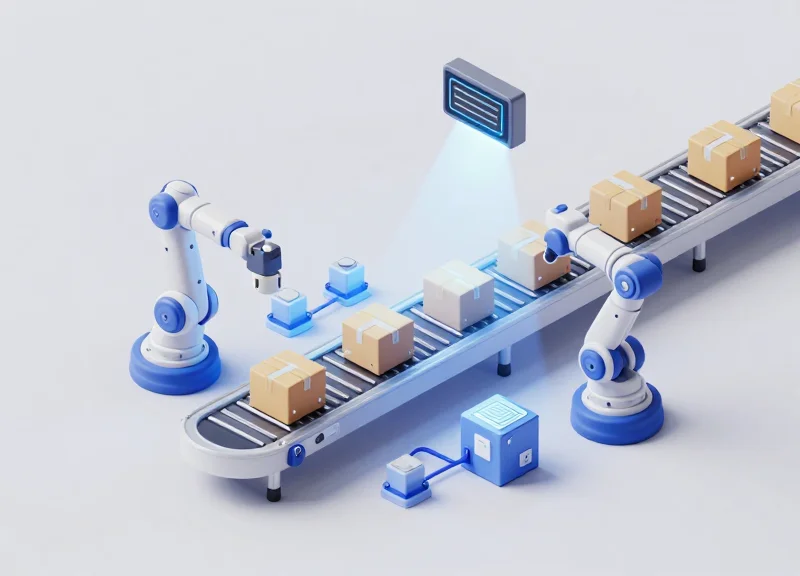
- Phase 2: Automated Sortation Logic: As items move on conveyors, RFID gates trigger pneumatic arms or chutes that divert items into specific bins based on pre-programmed logic (e.g., towels vs. sheets). This removes the cognitive load and physical fatigue from the sorting staff.
- Phase 3: Error-Free Dispatch: Before clean linens leave the facility, RFID portals verify the outgoing load against the customer's order. This prevents over-shipping or under-shipping, eliminating the labor cost of 're-runs' or emergency deliveries.
Can RFID really replace manual counting in high-volume plants?
Yes. While manual counting has an average error rate of 3-5% due to fatigue, RFID systems maintain 99.9% accuracy regardless of shift length, directly reducing the labor spent on inventory reconciliation.
How does this impact employee retention and indirect costs?
By automating the most repetitive and physically demanding tasks, facilities see lower turnover rates and fewer worker's compensation claims related to repetitive motion, further bolstering the bottom line beyond direct hourly wages.
Is the 40% saving immediate?
Most facilities realize the 40% labor efficiency within the first 60-90 days of full integration as staff transition from 'movers and counters' to 'system supervisors'.
Eliminating Human Error and Inventory Shrinkage
Automated RFID systems eliminate human error and inventory shrinkage by replacing manual, subjective piece-by-piece counting with high-speed bulk scanning that offers 99.9% accuracy. By creating a digital record for every item, facilities transition from 'estimated' inventory to real-time asset management, effectively stopping the financial leak caused by lost or misplaced linens. In a typical manual environment, error rates for counting soiled linens can reach 10–15%; RFID reduces this to near-zero, ensuring that what goes out to the laundry is exactly what comes back.
| Metric | Manual Management | RFID-Automated System |
|---|---|---|
| Counting Accuracy | 85% - 92% (variable) | 99.9% (consistent) |
| Shrinkage Rate | 15% - 25% annual loss | Less than 3% annual loss |
| Data Reliability | Anecdotal / Log-sheet based | Real-time digital audit trail |
| Loss Detection | End of quarter audits | Instantaneous at every gate |
Unique Insight: Solving the 'Ghost Inventory' Phenomenon. Most managers assume inventory shrinkage is primarily due to theft or discarding of damaged items. However, a significant portion of labor cost is actually wasted on 'Ghost Inventory'—items that are stuck in transit, hidden in storage closets, or misrouted. RFID doesn't just count; it localizes. By identifying where items 'stagnate' for more than 48 hours, facilities can reallocate existing stock instead of prematurely ordering expensive replacements, a move that often saves hospitals and hotels tens of thousands in unnecessary CAPEX annually.
How does RFID prevent 'accidental' theft by staff or guests?
RFID readers at exit points can trigger alerts or log timestamps when an item leaves a designated zone. This creates a 'Culture of Accountability' where staff are aware that every piece of linen is tracked to its last known location.
Can the system differentiate between discarded and lost items?
Yes. By using a 'Reject' or 'End-of-Life' portal scan, staff can officially retire a rag or damaged sheet. This removes the item from active inventory, ensuring your dashboard reflects only useable stock.
What is the impact on vendor disputes?
RFID provides an indisputable digital receipt. If a laundry service claims they returned 500 units but the RFID tunnel only registered 460, the facility has the data-driven proof needed to settle discrepancies immediately.
- Arrival & Authentication: Soiled linens pass through an RFID tunnel; the system automatically reconciles the load against the outgoing clean shipment.
- Automated Sorting: Items are sorted by type, fabric, or owner without human intervention, removing the risk of misclassification.
- Stagnation Alerts: The system flags bins that have not moved into the wash cycle within a set timeframe, preventing mildew and 'lost' bins.
- Final Verification: Clean linens are scanned before dispatch, confirming 100% order fulfillment for every department or client.
Choosing High-Durability RFID Tags for Commercial Use
To achieve a 40% reduction in labor costs, your automated sorting system requires 100% data integrity, which starts with selecting industrial-grade RFID tags designed for the 'Industrial Gauntlet.' Unlike standard retail tags, commercial laundry transponders must withstand the thermal shock of drying (up to 200°C), the mechanical crush of extraction presses (up to 60 bars), and prolonged exposure to high-pH detergents and bleaching agents without losing their read range or physical bond to the textile.
| Environmental Factor | Consumer-Grade Tag | Industrial Laundry RFID Tag |
|---|---|---|
| Temperature Tolerance | Up to 60°C | Up to 200°C (Short duration/Ironing) |
| Mechanical Pressure | Minimal | 60 Bars (High-pressure extraction) |
| Chemical Resistance | Low | Full resistance to pH 12+ and Oxidizers |
| Typical Lifespan | Single use or <10 washes | 200+ Industrial Wash Cycles |
The Veteran's Insight: The 'Total Cost of Ownership' (TCO) Trap. In my 20 years of Silicon Valley supply chain consulting, I've seen enterprises fail by prioritizing a $0.10 cheaper tag. In industrial laundry, if a tag fails at 50 cycles instead of 200, your hardware replacement costs quadruple, but the real 'hidden' cost is the manual labor required to re-tag the item and the data gap created in your inventory analytics. Always calculate your ROI based on 'Cost per Wash Cycle,' not 'Unit Price per Tag.'
- Validate Encapsulation Quality: Ensure the tag uses PPS (polyphenylene sulfide) or high-grade silicone encapsulation. This protects the internal antenna and microchip from water ingress and chemical corrosion.
- Test for Mechanical Flex: Commercial linens are folded, pressed, and tumbled. Choose a flexible tag that can bend without snapping the internal antenna connection.
- Verify Read-Range Consistency: The tag must maintain a consistent read range (typically 2-6 meters depending on the antenna) even after 100 washes to ensure the sorting tunnels don't miss items.
Can I use adhesive tags for commercial laundry?
No. Adhesives almost always fail in high-temperature industrial dryers. Commercial tags must be sewn into the hem or attached via heat-seal patches for permanent bonding.
Does the tag size affect the automated sorting speed?
Generally, larger antennas provide better read rates in bulk (stacked) environments, but modern 'Small Form Factor' tags have advanced enough to allow for rapid sorting without compromising accuracy.
What happens if a tag fails during the wash?
A failed tag turns a 'smart' asset back into a 'dumb' asset, requiring manual identification. Quality tags include parity checks and robust memory to prevent data corruption during wash cycles.
Integration Strategy: Connecting RFID with Your Existing ERP
An effective RFID integration strategy bridges the gap between physical laundry movements and digital record-keeping by utilizing middleware or APIs to pipe real-time scan data directly into your Enterprise Resource Planning (ERP) system. This connection eliminates manual data entry, providing a single source of truth for inventory levels, linen life cycles, and customer billing. By automating the data flow from RFID tunnels to the ERP, facilities can transition from reactive management to proactive, data-driven decision-making that sustains the 40% labor cost reduction achieved through hardware automation.
- Assessment of ERP Compatibility: Evaluate your current ERP's ability to ingest high-frequency data. Most modern systems support RESTful APIs or Webhooks, which are essential for handling the thousands of data points generated by bulk RFID scans.
- Middleware Implementation: Deploy an 'Edge' software layer that filters raw RFID tag reads. This prevents your ERP from being overwhelmed by redundant pings and ensures only relevant 'event' data (e.g., 'In-Wash', 'Out-for-Delivery') is synced.
- Field Mapping and Logic Configuration: Align RFID data fields—such as Tag ID, Laundry Type, and Timestamp—with your ERP's inventory and billing modules to ensure seamless financial reporting.
- End-to-End Validation: Conduct stress tests by scanning high-volume batches to verify that data latency is minimal and that the ERP reflects physical inventory changes in near real-time.
| Feature | Legacy Manual ERP Entry | RFID-Integrated ERP |
|---|---|---|
| Data Accuracy | 85-90% (Human Error) | 99.9% (Automated) |
| Inventory Visibility | Periodic (Monthly Audits) | Real-Time (Per-Wash Cycle) |
| Loss Detection | Reactive / Estimated | Immediate / Precise |
| Labor Requirement | High (Dedicated Clerks) | Near-Zero (Auto-Sync) |
Expert Insight: The 'Micro-Retirement' Trigger. A unique advantage of deep ERP integration is the ability to set automated 'Micro-Retirement' triggers. Instead of waiting for a manual inspection to find a hole in a sheet, the ERP can track the exact number of wash cycles and chemical exposures per individual item. Once a specific linen reaches its 80th wash—the statistically proven threshold for fabric failure in industrial settings—the ERP can automatically flag that item for replacement during the next sort, preventing poor-quality linens from ever reaching your customer's doorstep.
Can RFID integrate with older legacy ERP systems?
Yes, typically through a flat-file exchange (CSV/XML) via SFTP. While not real-time, it still automates the batch processing of sorting data every hour.
Does integration require a custom API developer?
Many RFID hardware providers now offer pre-built 'connectors' for popular laundry ERPs like LinenMaster or Bundle, significantly reducing custom coding needs.
How does integration prevent inventory shrinkage?
By comparing 'scanned-in' counts against 'scanned-out' counts in the ERP, the system generates immediate discrepancy reports, allowing managers to bill for lost items instantly.
ROI Analysis: Payback Period for RFID Automation

Determining the ROI for RFID automated linen sorting involves a comprehensive comparison between the initial Capital Expenditure (CAPEX)—including tags, readers, and software integration—and the sustained reduction in Operating Expenses (OPEX). For most high-volume commercial laundries and hospitality groups, the payback period ranges from 12 to 18 months. This rapid break-even is driven by the 'triple-threat' of savings: a 40% reduction in manual sorting labor, a 90% decrease in inventory loss (shrinkage), and increased throughput capacity that allows for business scaling without additional headcount.
| Financial Factor | Manual Operations (Annual) | RFID Automated (Annual) | Net Impact |
|---|---|---|---|
| Sorting & Handling Labor | $450,000 | $270,000 | 40% Savings |
| Linen Replacement (Loss) | $85,000 | $8,500 | 90% Reduction |
| Administrative Tracking | $30,000 | $5,000 | 83% Efficiency Gain |
| Total OPEX | $565,000 | $283,500 | $281,500 Annual Gain |
- Baseline Audit: Quantify your current 'Man-Hours per Kilogram' (MHK) and your annual linen replacement rate to establish a pre-automation cost baseline.
- CAPEX Valuation: Factor in the cost of high-durability tags, hardware (portals, hand-helds, table readers), and the software subscription or licensing fees.
- Labor Reallocation Analysis: Apply the 40% labor reduction to your specific wage tiers, including payroll taxes and benefits, to see the direct cash-flow impact.
- Break-Even Calculation: Divide the total implementation cost by the monthly savings. Most facilities find the 'cross-over point' occurs between month 12 and month 18.
Expert Insight: The 'Inventory Float' Advantage. Beyond direct labor, the most overlooked financial benefit is the reduction of the 'Inventory Float.' In manual systems, facilities often over-purchase linen by 15-20% to account for 'dark' inventory—items lost in the system or sitting idle. RFID provides real-time visibility that allows you to operate with leaner stock levels, freeing up thousands of dollars in working capital that would otherwise be tied up in excess textile storage.
Does the ROI account for tag failure?
Yes. Modern commercial-grade tags have a failure rate of less than 1% over 200 wash cycles. The cost of tag replacement is negligible compared to the 90% reduction in lost inventory.
How does throughput affect the payback period?
High-volume facilities see a faster ROI. Because RFID allows for bulk scanning of 200+ items in seconds, the more linen you process, the faster the hardware pays for itself through time-savings.
Are there hidden costs in the integration phase?
The primary 'hidden' cost is staff training and process change management. However, because RFID simplifies the sorting task (removing the need for visual identification), training time is usually 50% shorter than manual sorting training.
Operational Resilience: Future-Proofing Your Business
Operational resilience in linen management is the capacity to maintain high-quality service levels despite labor market volatility, achieved by replacing manual, high-turnover sorting roles with RFID automation. This technology future-proofs commercial laundries and healthcare facilities by decoupling operational throughput from headcount, allowing businesses to absorb significant volume spikes without the need for immediate hiring or expensive overtime. By shifting from a labor-dependent model to a tech-driven one, organizations insulate themselves against rising minimum wages and the high costs associated with recruitment and training in a competitive talent market.
| Operational Variable | Manual Sorting Environment | RFID-Automated Environment |
|---|---|---|
| Labor Market Volatility | High risk; staff shortages lead to immediate production delays. | Low risk; core operations continue with minimal supervision. |
| Scalability | Linear; scaling requires hiring more people at higher costs. | Exponential; existing system handles more volume by extending uptime. |
| Training & Onboarding | Slow; weeks to reach peak efficiency and accuracy. | Instant; software-guided systems require minutes of instruction. |
| Cost Predictability | Unpredictable; subject to wage hikes and overtime premiums. | Fixed; predictable amortization and maintenance costs. |
The most significant hurdle to growth in the industrial laundry sector is no longer machine capacity, but human availability. When a business relies on manual sorting, its growth is capped by the local labor pool. RFID automation provides what we call 'Elastic Capacity'—the ability to expand or contract operations based on demand without the friction of the hiring cycle. This elasticity allows facilities to aggressively bid on larger contracts, such as hotel chains or regional hospital networks, with the absolute certainty that their infrastructure can handle the increased volume on day one.
How does RFID automation mitigate the risk of a high turnover rate?
Automated sorting removes the most physically taxing and repetitive tasks from the workflow. By improving the work environment and reducing physical strain, facilities often see higher retention rates for their remaining skilled technical staff.
Can RFID systems help in maintaining compliance during a crisis?
Yes. In scenarios like public health crises where labor may be scarce or restricted, automated systems ensure that infection control and linen categorization protocols are followed perfectly without needing constant human oversight.
What is the 'hidden' benefit of future-proofing with RFID?
Data continuity. As your business grows, the RFID system maintains a historical record of every item's life cycle. This data becomes an asset for long-term strategic planning that manual systems simply cannot replicate.
Unique Industry Insight: Beyond simple labor savings, the ultimate future-proofing strategy lies in 'Predictive Maintenance for Inventory.' Advanced RFID sorting systems can be configured to alert managers when a specific linen batch is nearing the end of its projected life cycle based on wash counts. This allows for proactive procurement, preventing the 'inventory shock' that occurs when a large portion of stock fails simultaneously, ensuring your operation remains resilient against supply chain delays.