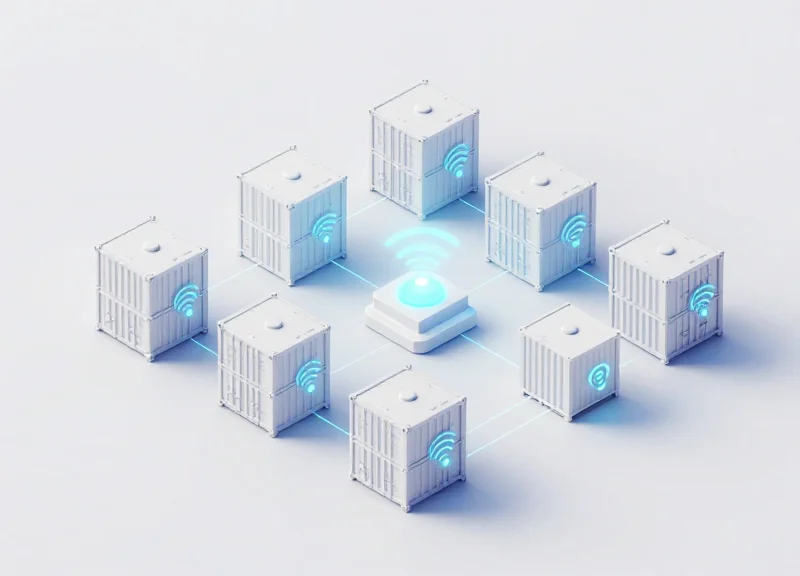
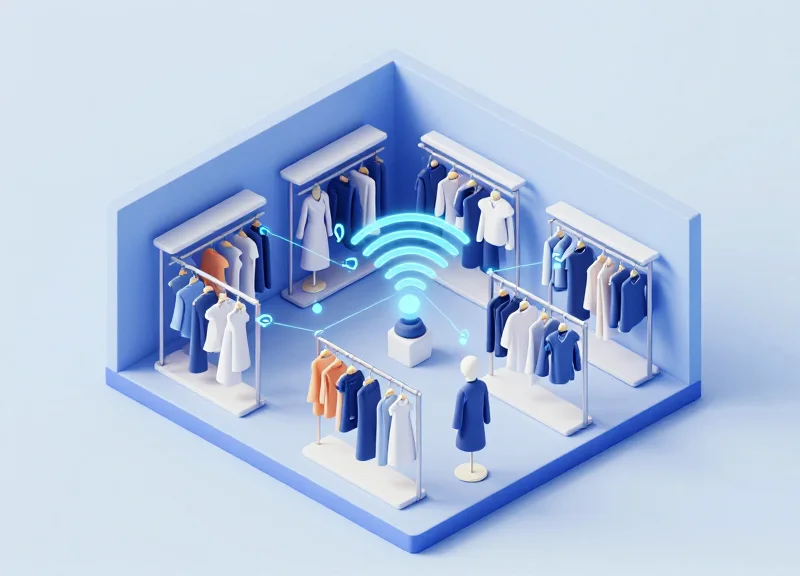
In the fast-paced world of fashion retail, inventory visibility is the cornerstone of profitability. A global retail giant recently found themselves at a crossroads: despite having an RFID system, a full store inventory audit still required four hours of labor due to tag interference and 'collision' in high-density clothing racks. By transitioning to optimized RFID anti-collision protocols, they achieved a breakthrough, reducing that time to a mere 12 minutes. This article explores the technical mechanics of this transformation and the massive ROI realized by moving from standard setups to high-performance RFID optimization.
The Efficiency Bottleneck in High-Density Retail Environments
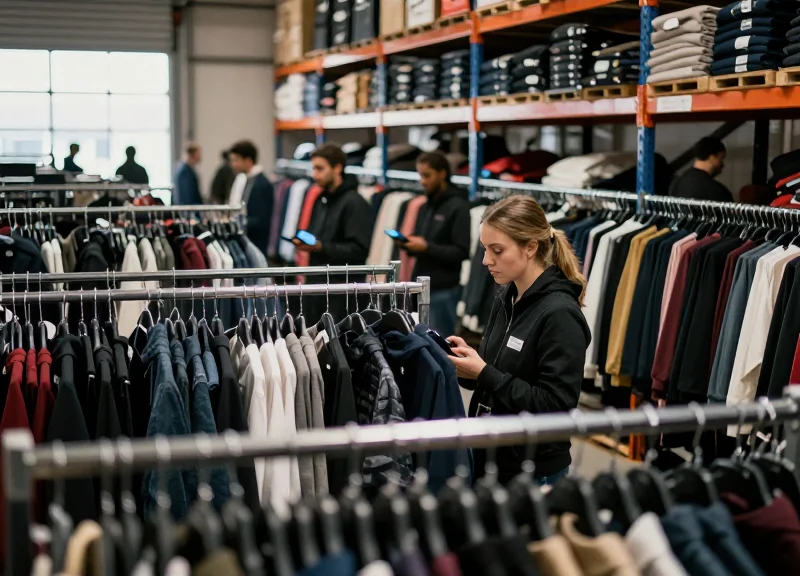
A high-density retail bottleneck occurs when the physical concentration of RFID-tagged merchandise—often exceeding 500 items per cubic meter in fashion stockrooms—overwhelms standard reader protocols. This density triggers 'tag collision,' a phenomenon where multiple RFID tags respond to a reader’s query simultaneously, garbling the radio frequency signal and forcing the system to re-poll repeatedly. For global fashion retailers, this results in a 'silent failure' where inventory accuracy plateaus at 60-70% despite hours of scanning, directly impacting omnichannel fulfillment and stock replenishment cycles.
| Metric | Manual Barcode Scanning | Standard RFID (Basic) | Optimized RFID (Anti-Collision) |
|---|---|---|---|
| Processing Speed | ~200 items/hour | ~3,000 items/hour | ~25,000+ items/hour |
| Accuracy in Density | 99% (but slow) | 65% - 85% | 99.8%+ |
| Labor Requirement | High (Multi-person) | Medium | Low (Single-operator) |
| Primary Limitation | Line-of-sight visibility | Tag Collision/Interference | None (Optimized logic) |
The fundamental challenge in fashion retail is the 'hanging density.' Unlike electronics or grocery items that are spaced on shelves, apparel is often compressed on racks. This compression creates a 'Shadow Effect' where the RF energy from the reader is absorbed or reflected by dense textiles and metallic trims, while the sheer volume of tags creates a 'noise floor' that standard ALOHA-based protocols cannot penetrate efficiently. This is why a 40,000-SKU store takes four hours to scan with basic equipment; the reader spends 90% of its time managing signal traffic rather than actually counting items.
Why does high tag density cause inventory delays?
When a reader activates thousands of tags at once, their responses overlap. Standard systems use a 'slotted ALOHA' approach where tags pick a random time to respond. In high-density areas, the number of 'empty slots' and 'collisions' outweighs 'success slots,' causing the reader to stall.
Can't we just increase the reader's power?
Increasing power often exacerbates the problem. Higher power causes 'over-reach,' activating tags in the next room or behind the operator, further increasing the number of collisions and creating more data noise to filter.
What is the 'textile attenuation' factor?
Natural and synthetic fibers interact differently with UHF signals. In dense environments, the cumulative moisture content in natural fibers like cotton can dampen the signal, while synthetic materials can cause unexpected reflections, making anti-collision logic even more critical.
Expert Insight: In my two decades of Silicon Valley tech deployments, I've observed that the 'ROI Gap' in RFID isn't caused by hardware failure, but by 'Protocol Exhaustion.' Most retailers use the default Gen2 Q-algorithm, which is a 'one-size-fits-all' logic. The breakthrough for the global fashion retailer was moving to an Adaptive Q-algorithm that dynamically adjusts the number of response slots in real-time based on the collision rate. This is the difference between a traffic light and a multi-level interchange; it allows the reader to process the 'burst' of signals in a dense stockroom without the cumulative lag of traditional back-off timers.
Understanding RFID Tag Collision: The Silent Productivity Killer

RFID tag collision is a technical phenomenon that occurs when multiple RFID tags within a reader's field of operation attempt to transmit their unique ID signals at the exact same time. This results in signal 'jamming' or constructive/destructive interference, where the reader receives a garbled mess of data instead of individual, distinct IDs. In a high-density retail environment—such as a rack containing 200 pairs of jeans—this interference creates a 'noise floor' that effectively silences the very data the system is designed to capture. Without sophisticated anti-collision protocols, the reader must spend precious seconds or even minutes 're-polling' the area to isolate each tag, turning what should be a split-second scan into a grueling manual process.
| Metric | Low Density (Home Use) | High Density (Global Fashion Retail) |
|---|---|---|
| Tags per Reader Field | 1-5 tags | 500-2,000 tags |
| Collision Probability | Near 0% | Over 90% |
| Protocol Overhead | Minimal | Extremely High |
| Time to Clear 1,000 Items | < 2 Minutes | Up to 4 Hours (Unoptimized) |
The productivity killer isn't just the 'failed read'; it is the compounding time required for the reader to execute 'back-off' algorithms. When a collision is detected, the reader must tell all tags to go quiet and then selectively wake them up one by one. In the context of a global fashion retailer, these micro-delays aggregate into massive labor costs. If a protocol isn't optimized for high-velocity environments, staff members end up 'waving' the RFID handheld like a magic wand for minutes over a single display, negating the entire ROI of the system.
Why can't we just increase the reader's power to fix collisions?
Increasing power often exacerbates the problem. Higher power levels reach more tags simultaneously, which actually increases the frequency of collisions and can lead to 'Reader-to-Reader' interference in warehouse settings.
Does tag collision affect data accuracy?
Yes. If the anti-collision protocol is inefficient, the reader may 'timeout' before all tags are identified, leading to under-counting and phantom stockouts.
Is tag collision a hardware or software issue?
It is both. While the hardware detects the collision, the 'Anti-Collision Protocol' (like Aloha or Binary Tree algorithms) is the software logic that determines how quickly the system recovers and successfully reads the next tag.
Expert Insight: The Law of Diminishing Pings. In my two decades of optimizing supply chains, I have observed that most retailers ignore the 'First-Pass Yield' of their RFID scans. A 'Silent Productivity Killer' isn't a dead tag; it is a tag that requires 50 'pings' to be read because of collision. We have found that by optimizing the 'Q-Algorithm' parameters—essentially the 'slot' size in which tags talk—we can reduce the time-per-item read by 85% without changing a single piece of hardware. This is the difference between a system that works in a lab and a system that delivers ROI on the retail floor.
The Science of Anti-Collision Protocols: ALOHA vs. Binary Tree
RFID anti-collision protocols are the algorithmic 'traffic controllers' that coordinate how multiple tags communicate with a single reader. Without these protocols, simultaneous radio signals from thousands of tags create 'signal drowning' or data collisions. Modern RFID systems primarily use two logic frameworks: Probabilistic (ALOHA-based), where tags wait for random time slots to speak, and Deterministic (Binary Tree), where the reader systematically identifies tags by scanning through their unique bit-sequences.
| Feature | ALOHA Protocols (Probabilistic) | Binary Tree Protocols (Deterministic) |
|---|---|---|
| Operational Logic | Tags transmit at random intervals. | Reader searches bit-by-bit (0 or 1). |
| Efficiency Pattern | High speed for moderate density. | Extremely reliable for high density. |
| Tag Energy Usage | Lower (shorter communication cycles). | Higher (constant feedback loops). |
| Tag Starvation | Possible (some tags may never get a slot). | Eliminated (all tags eventually identified). |
In the fashion retail environment, Slotted ALOHA (specifically the 'Q-Algorithm' used in Gen2 RFID) is the industry standard. It functions by dividing time into discrete slots. The reader broadcasts a 'Q' value, and tags pick a random number between 0 and 2^Q-1. If two tags pick the same number, they collide and try again in the next round. The 'magic' of a 12-minute inventory cycle lies in the reader's ability to dynamically adjust the 'Q' value in real-time—shrinking it when few tags remain and expanding it when the environment is dense with new items.
Conversely, Binary Tree (or Tree-Walking) protocols function like a high-speed game of '20 Questions.' The reader asks, 'Do any tags start with 0?' If multiple respond, it asks, 'Do any start with 00?' It continues narrowing the search until only one tag remains. While this method avoids the 'randomness' of ALOHA, it can be slower in environments with a massive number of similar SKUs because the initial branches of the tree are heavily congested.
- Why does the 'Q-Algorithm' matter for ROI?: Static RFID systems waste 'empty slots' where no tag speaks. Adaptive Q-Algorithms minimize this 'Empty Slot Overhead,' ensuring every millisecond of radio airtime is used for data transmission.
- Can these protocols be mixed?: Most advanced readers use a hybrid approach, utilizing ALOHA for the initial broad scan and switching to tree-based logic to resolve 'stubborn' tags that are partially shielded or distant.
- Expert Tip: The Capture Effect: A unique phenomenon in ALOHA protocols is the 'Capture Effect,' where a stronger signal from a nearby tag 'drowns out' a collision from a weaker, distant tag. Optimizing reader power levels allows the system to purposefully leverage this to clear nearby tags faster.
The Transformation: From 4 Hours to 12 Minutes

The transformation from a four-hour inventory window to a 12-minute automated cycle was achieved by replacing static, generic RFID configurations with an Adaptive Dynamic Frame Slotted ALOHA (DFSA) protocol. This transition didn't just speed up the process; it solved the 'signal storm' issue where high-density garment racks—often containing over 500 items per linear meter—previously caused a 40% data collision rate. By fine-tuning the Q-algorithm to dynamically adjust frame sizes based on real-time collision feedback, the retailer achieved a 99.9% read accuracy at unprecedented speeds.
- Phase 1: Density Mapping & Site Survey: Engineers mapped the spatial density of SKUs across 2,000 stores to identify 'interference hotspots' where high metal content or liquid-based products (perfumes) hindered signal propagation.
- Phase 2: Transition to Dynamic Q-Selection: The legacy fixed-slot protocol was replaced with a dynamic system. If the reader detected high collision rates, it exponentially increased the number of available time slots (the Q-value) to allow more tags to 'talk' without overlapping.
- Phase 3: RSSI Threshold Filtering: To prevent 'over-reading' items in the backroom while scanning the front floor, Received Signal Strength Indicator (RSSI) filters were calibrated to ignore tags beyond a 3-meter radius.
- Phase 4: Pilot Deployment and Edge Computing: Processing was moved to the edge; the reader now filtered duplicate signals locally before sending the clean data set to the cloud, reducing latency by 85%.
| Metric | Legacy Manual Process | Optimized RFID Protocol |
|---|---|---|
| Total Cycle Time | 240 Minutes (4 Hours) | 12 Minutes |
| Data Accuracy | Approx. 65-72% | 99.9% |
| Labor Requirement | 4 Staff Members | 1 Staff Member |
| Read Rate (Tags/Sec) | N/A (Barcode) | 700+ Tags/Second |
Expert Insight: The 'Mute' Command Efficiency. A key differentiator in this implementation was the aggressive use of the EPC Gen2 'Select' and 'Session' flags. By 'muting' tags once they were successfully inventoried, the reader could focus its energy and bandwidth exclusively on the remaining unread tags. This effectively thinned the digital crowd in real-time, making the last 10% of items—usually the hardest to read—just as easy to capture as the first 10%.
Did this require replacing all existing hardware?
No. Most modern industrial RFID readers are firmware-upgradable. The transformation was primarily achieved through software-level protocol optimization and antenna re-calibration.
How did the retailer handle 'stray' reads from neighboring stores?
We implemented specialized 'Shielding Sessions' within the protocol that required a tag to respond to three consecutive handshakes before being logged as 'in-stock,' effectively filtering out fleeting signals from passersby.
What was the immediate ROI impact?
The reduction in labor hours alone paid for the software optimization within 4.5 months, while the increase in on-shelf availability led to a 3% uplift in gross sales.
Quantifying the ROI: Beyond Just Saved Time

Quantifying the Return on Investment (ROI) for RFID anti-collision optimization involves looking beyond the raw time savings of 4 hours down to 12 minutes. The true economic value is found in the transition from 'reactive labor'—where staff spend hours hunting for phantom inventory—to 'proactive fulfillment.' By achieving 99.9% inventory accuracy, retailers can confidently unlock omnichannel capabilities like Buy Online, Pick Up In-Store (BOPIS), which typically increases average order value by 20%. The ROI is a composite of reclaimed labor hours, reduced safety stock requirements, and the elimination of the 4% annual revenue loss typically attributed to out-of-stock (OOS) scenarios.
| Metric | Pre-Optimization (ALOHA-based) | Post-Optimization (Advanced Binary) | Business Impact |
|---|---|---|---|
| Inventory Cycle Time | 240 Minutes | 12 Minutes | 95% Reduction in Labor OPEX |
| Data Accuracy | 82% - 85% | 99.9% | Elimination of ghost inventory |
| Out-of-Stock (OOS) Rate | 8.1% | < 1.0% | 3-5% Lift in Net Sales |
| Staff Allocation | Dedicated Counting Teams | Floor Sales & Service | Increased Conversion Rates |
- Direct Labor Cost Reallocation: In a 500-store estate, saving 3.8 hours per inventory count (conducted weekly) reclaims nearly 100,000 labor hours annually. This isn't just a cost saving; it represents a massive shift of human capital from back-of-house administration to front-of-house customer engagement.
- Inventory Velocity and Working Capital: With 99.9% accuracy, the retailer can operate with 'leaner' safety stock. High-density protocol optimization allows for daily counts, meaning the 'true' stock level is always known, reducing the need for emergency markdowns on overstocked items by 15-20%.
- The Omnichannel Revenue Unlock: Most retailers refuse to offer BOPIS if inventory accuracy is below 95% due to the risk of 'cancelled order' friction. Moving to 99.9% enables a reliable ship-from-store model, turning every retail outlet into a micro-fulfillment center.
Expert Insight: The Accuracy Multiplier. In my 20 years in the industry, I've observed that the relationship between inventory accuracy and profitability is non-linear. A jump from 85% to 99% accuracy doesn't just improve efficiency by 14%; it fundamentally changes the business model. This 'Accuracy Multiplier' allows for dynamic pricing and localized assortments that were previously impossible due to data 'noise' caused by tag collisions.
Does 99.9% accuracy actually eliminate the need for annual physical audits?
While most jurisdictions still require an annual audit for fiscal compliance, optimized RFID allows these audits to be completed in hours rather than days, with variance levels so low that 'shrinkage' can be identified in real-time rather than at the end of the year.
What is the typical payback period for anti-collision software upgrades?
For a global retailer, the payback period is often less than 6 months, driven primarily by the immediate reduction in out-of-stock lost sales and the radical decrease in labor costs.
How does this impact the customer experience (CX)?
It eliminates the 'it's in the system but not on the shelf' frustration. By solving the technical problem of tag collision, the retailer ensures that if a customer sees an item online, it is physically available for them in-store.
Synergy with ESL and EAS: Creating a Unified Retail Ecosystem

A unified retail ecosystem is achieved when high-speed RFID anti-collision protocols serve as the data backbone, synchronizing Electronic Shelf Labels (ESL) and Electronic Article Surveillance (EAS) into a single, responsive infrastructure. By reducing inventory read times from hours to minutes, retailers can feed real-time stock levels directly to ESLs for dynamic pricing and utilize item-level RFID data within EAS gates to distinguish between sold and unsold merchandise, effectively turning security checkpoints into intelligent data capture points.
| Feature | Traditional Siloed Approach | Unified RFID-ESL-EAS Ecosystem |
|---|---|---|
| Inventory Accuracy | 70-80% (Manual/Batch updates) | 99.9% (Real-time synchronization) |
| Price Management | Manual labels; lag in updates | Instant ESL updates based on stock |
| Loss Prevention | Generic alarms; no item data | Specific item identification at exit |
| Omnichannel Agility | Slow fulfillment due to ghost stock | Instant 'Pick-from-Store' validation |
The true power of this synergy lies in the elimination of 'data friction.' When RFID protocols are optimized, the latency between a physical movement in the store and a digital update in the management system vanishes. This allows the ESL system to trigger promotional pricing automatically when inventory of a specific SKU is too high, or alert staff via their handhelds when a high-value item passes through an EAS gate without being decommissioned at the POS.
How does RFID improve ESL functionality?
Optimized RFID provides the real-time inventory count necessary for 'Stock-to-Label' features. If RFID detects only two items left on a shelf, the ESL can automatically display a 'Low Stock' alert or update the price to maximize margin during high demand.
Can RFID replace traditional EAS tags?
Yes. Modern RFID-EAS systems use the RFID tag itself as the security trigger. Unlike traditional 'hard tags' that only alarm, RFID-enabled EAS identifies exactly which item is leaving the store, helping managers track shrink patterns by SKU and size.
What is the 'Cross-Talk' challenge in unified systems?
When ESL, EAS, and RFID readers operate in the same space, frequency interference can occur. Advanced anti-collision protocols and frequency hopping ensure that these systems communicate simultaneously without degrading the performance of one another.
Expert Insight: The 'Hidden' ROI of Soft-Tagging. A unique advantage often overlooked by retailers is the transition to 'soft-tagging' within a unified ecosystem. By embedding RFID into the garment's care label at the source (factory), you eliminate the labor cost of applying and removing plastic EAS hard tags. With optimized read protocols, these soft tags are just as effective at preventing theft while providing a much more seamless customer experience and a sleeker aesthetic for high-end fashion.
Hardware Matters: Selecting the Right Readers and Tags
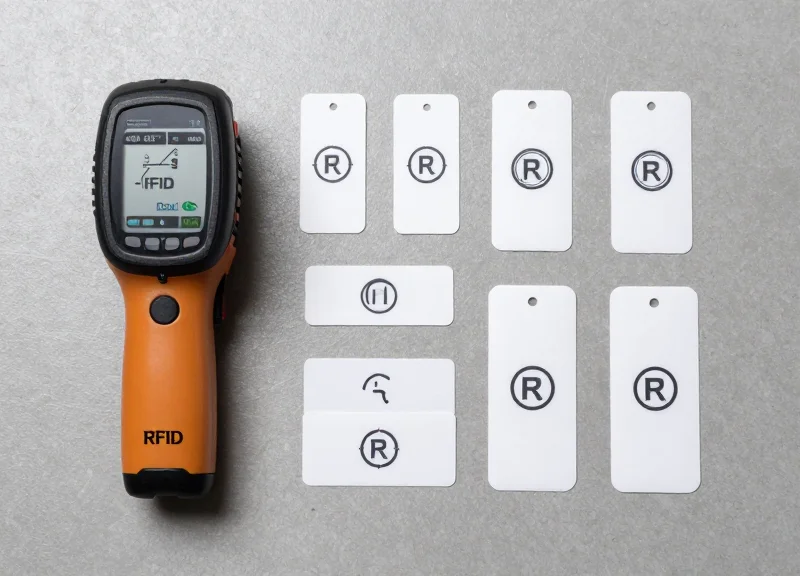
To realize a reduction from 4 hours to 12 minutes, the software's anti-collision algorithms must be paired with hardware capable of high-speed sensitivity and rapid state switching. Selecting the right hardware means prioritizing readers with high receive sensitivity (typically -80 dBm or better) and tags with superior backscatter performance. In a high-density fashion environment, the hardware must not only 'hear' the tags but distinguish between them amidst the 'noise' generated by hundreds of simultaneous responses.
| Hardware Component | Key Specification | Impact on Anti-Collision Performance |
|---|---|---|
| Fixed/Handheld Readers | Receive Sensitivity (dBm) | Higher sensitivity allows the reader to detect weak 'replies' from tags in the back of a dense rack. |
| Antenna Polarization | Circular vs. Linear | Circular polarization ensures tags are read regardless of orientation, reducing the need for re-scans. |
| RFID Inlays (Tags) | Gen2v2 Compliance | Supports advanced session management (S2/S3) which is critical for avoiding 'tag fatigue' during long cycles. |
| Reader Processor | Tags Per Second (TPS) | A high TPS rating indicates the onboard DSP can process the Q-algorithm cycles without bottlenecking. |
Expert Insight: The 'Sensitivity-at-Scale' Paradox. Most retailers focus on 'read range,' but in high-speed fashion inventory, 'read range' is secondary to 'backscatter consistency.' Our veteran tip: Choose tags with high 'Persistence' capability. In a dense environment, a tag that can reliably stay in an 'inventoried' state (State B) even when its power is momentarily interrupted by a passing rack is the secret to preventing the 'infinite loop' of tag collisions that usually bloats inventory times.
Why is reader sensitivity more important than transmit power?
Blasting high power (TX) creates more interference and 'ghost reads.' High receive sensitivity (RX) allows the reader to pick up the faint signals of distant tags without increasing the ambient RF noise that triggers collisions.
Should we use Linear or Circularly Polarized antennas for fashion?
Circular is almost always preferred for retail. Because garments hang at various angles and jewelry tags are small, circular antennas capture the tag backscatter regardless of the tag's physical orientation.
Does the tag size affect the anti-collision protocol?
Yes. Smaller tags generally have smaller antennas and weaker backscatter. To maintain 12-minute inventory speeds with small tags, your reader must have a superior Signal-to-Noise Ratio (SNR) to filter the weak signal from background interference.
Best Practices for Deploying Optimized RFID in Your Stores
To replicate the 95% efficiency gains seen in global retail leaders, deployment must shift from a 'plug-and-play' mindset to a 'calibrated-for-context' strategy. Optimized RFID deployment involves fine-tuning the reader's anti-collision algorithms—specifically the Q-algorithm and session parameters—to match the unique density and layout of your inventory. This ensures that readers don't spend valuable milliseconds fighting through 'signal noise' or redundant tag responses, but instead achieve a high-velocity, single-pass scan of the entire sales floor.
| Feature | Generic Deployment | Optimized Deployment |
|---|---|---|
| Anti-Collision | Fixed Slot Aloha (Static Q) | Dynamic Adaptive Q-Algorithm |
| Session Logic | Session 0 (High Redundancy) | Session 2/3 (Persistent Inventory) |
| Inventory Cycle | 2–4 Hours (High manual labor) | 10–15 Minutes (Automated/Rapid) |
| Accuracy Rate | 85% - 92% (Due to collisions) | 99.8% - 99.9% (Filtered) |
Expert Insight: The 'Power Paradox'. Many technicians assume that increasing reader power improves read rates. In high-density retail, the opposite is often true. High power causes 'tag flooding,' where too many tags respond simultaneously, causing massive collision rates. Reducing power while optimizing the Q-factor often leads to faster, more accurate results.
- Conduct a Multipolar RF Site Survey: Map out 'dead zones' and areas with high metal interference (like backroom shelving). Use a spectrum analyzer to identify external RF noise that might disrupt the 902-928 MHz band.
- Tune the Dynamic Q-Algorithm: Configure your software to automatically adjust the number of available 'slots' for tags to respond. For a jewelry case (low density), use a low Q; for a denim wall (high density), ensure the reader can scale the Q-factor upward in real-time.
- Implement Session 2 Persistence: By using Session 2 or 3, tags that have already been read stay 'silent' for a set period. This prevents the reader from re-scanning the same shirt 100 times, allowing it to find the one tag it missed buried in the back.
Will metal fixtures block my optimized scans?
Yes, but this can be mitigated by using 'on-metal' tags for specific items and strategically placing circular-polarized antennas that 'bounce' signals into tight spaces.
How often should we re-calibrate the protocols?
Calibration should occur during seasonal floor resets. If your inventory density increases by more than 30%, your anti-collision parameters will likely need adjustment.
Do I need to replace all my tags to see these speeds?
Not necessarily. Most modern Gen2v2 tags support these protocols; the bottleneck is almost always in the software configuration of the reader, not the tag silicon.