
In the high-stakes worlds of government administration and legal practice, information is the most valuable asset, yet its physical management remains a critical bottleneck. Traditional manual filing systems often lead to misplaced records, grueling audit cycles, and thousands of lost billable hours. RFID (Radio Frequency Identification) technology is revolutionizing this landscape by providing real-time visibility into document locations. This article explores how transitioning to automated tracking can slash retrieval times by a staggering 85%, ensuring that compliance is never compromised and operational efficiency is maximized.
The Efficiency Crisis in Manual Document Management

The efficiency crisis in manual document management is defined by the escalating gap between the volume of physical records and the human capacity to track them without error. In government and legal environments, this crisis manifests as 'information friction,' where the average professional spends nearly 18 minutes searching for a single file, leading to a productivity loss of roughly 20% to 30% per employee. When records are managed via paper logs or manual barcode scans, the risk of misfiling increases exponentially with the archive's size, often resulting in a 3% to 5% permanent loss rate for critical documentation.
| Metric | Manual Paper-Based System | Economic Impact (Per 10k Records) |
|---|---|---|
| Average Retrieval Time | 10 - 20 Minutes | High Labor Overhead |
| Search Success Rate | 92% - 95% | Re-creation Costs ($220/doc) |
| Audit Preparation Time | Weeks / Months | High Compliance Risk |
| Inventory Accuracy | 70% - 85% | Systemic Operational Lag |
Beyond the immediate clock-watching, the crisis extends into the 'Hidden Cost of Chaos.' This includes the legal liability of failing to produce documents for FOIA requests or court subpoenas, as well as the physical floor space wasted on disorganized archives that could otherwise be utilized for revenue-generating activities.
What is the 'Document Drift' phenomenon?
Document Drift is an industry term for the natural degradation of filing accuracy over time. In manual systems, every human interaction with a file introduces a 1-2% chance of a misfile. Without automated tracking, a perfectly organized archive can become functionally unusable within 18 months.
How does manual filing impact compliance?
Manual systems lack a real-time audit trail. In legal and government sectors, the inability to prove chain of custody or document destruction schedules can lead to massive regulatory fines and compromised litigation positions.
What are the labor opportunity costs?
Every hour a high-value employee spends digging through a basement archive is an hour not spent on case strategy or policy development. This 'labor misallocation' is often the largest hidden line item in a department's budget.
Expert Insight: In my two decades of auditing workflow efficiencies, I have observed that organizations often overlook the 'Psychological Tax' of manual filing. When staff know that finding a document will be an ordeal, they begin to create 'shadow archives'—keeping unauthorized copies at their desks. This fragmentation further degrades the official record's integrity, creating a feedback loop of inefficiency that only automated, non-line-of-sight technology like RFID can break.
How RFID Technology Transforms File Tracking
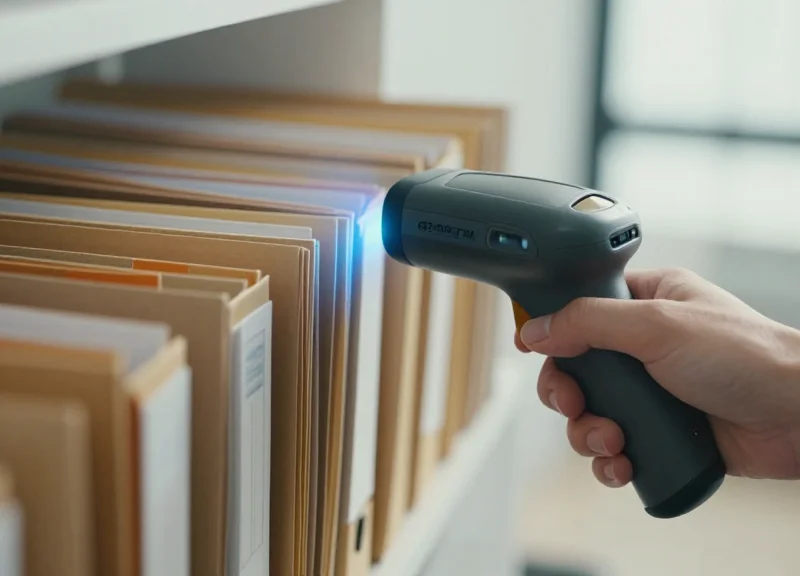
RFID (Radio Frequency Identification) technology transforms document management by shifting from a manual 'find-and-scan' model to a proactive 'detect-and-verify' system. By embedding ultra-thin UHF (Ultra High Frequency) tags into folder spines, legal and government entities can identify, locate, and audit thousands of documents simultaneously without opening a single drawer or box. This leap from optical scanning to radio-wave detection eliminates the need for human proximity, enabling 100% inventory accuracy in a fraction of the time required by traditional methods.
| Feature | Traditional Barcoding | RFID File Tracking |
|---|---|---|
| Visibility | Line-of-sight required | Non-line-of-sight (penetrates boxes/drawers) |
| Scan Speed | One item at a time (1-2 seconds/file) | Bulk scanning (100+ items per second) |
| Searchability | Manual 'shelf-walking' required | Geiger-counter style 'find' mode via handheld |
| Data Integrity | High risk of human error/missed scans | Automated, verifiable audit trails |
The system relies on three core components: the passive RFID tag, the reader (interrogator), and the management software. For legal and government documents, 'passive' tags are preferred because they do not require batteries, drawing power from the reader's signal to transmit the folder's unique ID. This allows for tags as thin as a postage stamp to be discreetly integrated into sensitive records, ensuring they remain unobtrusive while providing permanent trackability.
- The Tagging Process: Each file folder is equipped with a high-memory UHF inlay. Unlike generic labels, these are designed for 'proximity performance,' ensuring they can be read even when folders are tightly packed against one another.
- The Interrogation Layer: Handheld readers allow staff to sweep a room to locate missing files, while fixed 'portals' at doorways automatically log when a document enters or leaves a secure zone.
- Digital Reconciliation: The reader sends the captured IDs to a central database, which instantly compares the physical inventory against the expected digital record, highlighting discrepancies in real-time.
The Veteran's Insight: Solving the 'Shielding Effect' in High-Density Storage. A common failure in generic RFID implementations for law firms is the 'shielding' or 'masking' effect. When hundreds of thin paper folders are compressed, the radio waves can be absorbed or reflected incorrectly. To overcome this, top-tier government systems utilize 'Wide-Aperture' antenna designs and specialized software algorithms that filter out signal interference. This ensures that a folder in the exact center of a 500-file stack is identified just as clearly as the one on the end—a technical nuance that defines the difference between a 70% and a 99.9% audit accuracy rate.
Can RFID tags be read through metal filing cabinets?
Standard RFID signals are blocked by metal; however, modern solutions use 'on-metal' tag variants or, more commonly, strategically placed external antennas and cabinet-gap penetration techniques to maintain 100% visibility without replacing existing furniture.
Does the technology interfere with other office electronics?
No. UHF RFID for document tracking operates within specific FCC-regulated frequency bands (902-928 MHz in the US) that do not interfere with Wi-Fi, cellular signals, or sensitive government communication equipment.
What is the lifespan of an RFID file tag?
Since passive tags have no internal battery to drain, they have a shelf life of decades, making them ideal for long-term government archives and permanent legal records.
The 85% Metric: Breaking Down the Speed of Retrieval

The 85% retrieval metric is the industry benchmark for the transition from manual, line-of-sight document searching to automated RFID-based identification. In traditional government and legal environments, locating a single misfiled document takes an average of 18 minutes; with RFID handheld readers and proximity sensors, this duration is slashed to less than 3 minutes. This massive efficiency gain is achieved through 'bulk inventory capability,' allowing staff to identify thousands of documents per second without physically opening folders or moving filing cabinets.
| Task Description | Manual/Barcode Search | RFID-Enabled Search | Time Savings |
|---|---|---|---|
| Locating a Specific Misplaced File | 15–20 Minutes | 2 Minutes | ~88% |
| Annual Departmental Audit (10k Files) | 80+ Labor Hours | 4 Labor Hours | 95% |
| Checking In/Out Daily Records | 45 Seconds per File | 3 Seconds (Bulk) | 93% |
| Daily Search for 'Missing' Documents | 2 Hours/Day | 15 Minutes/Day | 87.5% |
The technical catalyst for this speed is the 'Geiger counter' functionality found in modern RFID handhelds. Unlike barcodes, which require a direct laser path to every individual label, RFID utilizes radio waves to penetrate folder covers and stack layers. When a clerk inputs a file ID into the handheld, the device provides haptic and audio feedback that intensifies as the user nears the specific tag. This eliminates the 'eye-fatigue' common in legal audits, where human error often leads to skipping over the very document being sought.
- Initiate Search Request: The user enters the document ID or case number into the mobile RFID software via a tablet or handheld terminal.
- Zone-Level Identification: The system identifies the last known 'logical' location (e.g., Office B, Shelf 4) using data from fixed overhead portals.
- Proximity Scan: The user walks the aisle; the handheld reader broadcasts a signal that can wake up and identify the target tag from up to 20 feet away.
- Visual Confirmation: Upon reaching the target, the software provides a 'Lock-on' signal, confirming the document is within inches of the reader.
Expert Insight: Beyond the raw seconds saved, the real ROI lies in 'Compound Latency Reduction.' In a legal or government context, a 15-minute search for a file often triggers a 'bottleneck effect'—a judge waiting on a bench, a public hearing being delayed, or a high-value attorney sitting idle. By reducing the search time to near-zero, you aren't just saving the clerk's salary; you are reclaiming the productive capacity of every high-value professional in the workflow chain.
Does RFID speed decrease if files are stacked tightly?
No. High-performance RFID tags designed for legal folders use specialized antenna geometry that prevents 'tag masking,' ensuring 100% read rates even in dense archival boxes.
Can RFID readers find a file hidden inside a metal drawer?
While metal can reflect radio waves, modern UHF RFID systems utilize 'multipath' signals to read tags within standard metal filing cabinets, though performance is best when the drawer is slightly cracked open.
How many files can be read simultaneously during a bulk audit?
Commercial-grade RFID handhelds can capture up to 700-1,000 unique tag IDs per second, making it possible to audit an entire room of documents in minutes.
Streamlining Audits: From Days to Hours
Streamlining audits through RFID is the radical shift from physical document handling to digital proximity sensing. In a traditional legal or government audit, staff must touch every single folder, verify labels against a ledger, and manually record discrepancies—a process prone to human error and fatigue. RFID-enabled audits replace this labor-intensive workflow with high-speed radio frequency scanning. By utilizing handheld readers or fixed overhead sensors, a single auditor can capture thousands of records per minute with 99.9% accuracy, all while files remain undisturbed on the shelf or inside storage crates. This 'non-line-of-sight' capability is the primary engine behind reducing audit cycles from weeks to mere hours.
| Audit Metric | Manual Process | RFID-Enabled Process |
|---|---|---|
| Verification Method | Physical touch & visual check | Wave-and-capture (Proximity) |
| Average Time per 1,000 Files | 15 - 20 Hours | 15 - 20 Minutes |
| Accuracy Rate | Approx. 75% - 85% | 99.5% - 99.9% |
| Staffing Requirement | Team of 3-5 | 1 Auditor |
The 'Density Dilemma' is a common hurdle in document management; when hundreds of paper folders are compressed together, standard RFID tags can sometimes suffer from signal shielding. However, the latest generation of UHF (Ultra-High Frequency) tags specifically tuned for paper-media allow for 'bulk reading' even in high-density environments. This means an agency can verify the entire contents of a locked archival room without ever opening a single box or breaking a security seal.
- Initiate Digital Manifest: The auditor loads the expected inventory list onto a mobile RFID handheld or synchronizes it with the central cloud database.
- Rapid Wave Scanning: The auditor walks through the file room or warehouse aisles. The reader emits radio waves that 'wake up' and identify every tag within range, regardless of orientation.
- Instant Discrepancy Reporting: The system automatically flags 'Missing' items (tags not detected) or 'Misplaced' items (tags found in the wrong location) in real-time.
- Automated Reconciliation: Once the walkthrough is complete, the audit report is generated instantly, providing a timestamped compliance record for legal or government oversight.
Can RFID read files through metal cabinets?
While metal can block signals, modern high-power readers can often capture signals through standard thin-gauge office cabinetry. For heavy-duty safes, placing a single external reference tag or using open-faced shelving is recommended to maintain 99% accuracy.
How does RFID handle document stacks?
Specialized 'short-pitch' tags are designed specifically for folders. These are engineered to prevent 'tag shadowing,' ensuring that even if 50 folders are pressed tightly together, the reader can distinguish and record every individual ID.
What is the primary labor saving in audits?
The biggest saving is the elimination of 'Zero-Value Labor'—the time spent physically moving boxes, climbing ladders, and opening folders just to prove they exist.
The ROI Calculation: Measuring Tangible Fiscal Benefits

Calculating the ROI of RFID for document audits involves measuring the delta between manual labor costs and automated efficiency, specifically targeting the reduction in 'Search-and-Retrieve' (S&R) time. To determine the tangible fiscal benefit, organizations must aggregate the annual labor hours saved, the cost of recreating lost files, and the reduction in legal liability penalties. Typically, agencies see a Return on Investment within 12 to 18 months by shifting from a reactive search model to a proactive, real-time tracking architecture that delivers a 85% reduction in manual labor hours.
| ROI Category | Key Performance Indicator (KPI) | Fiscal Impact Formula |
|---|---|---|
| Labor Efficiency | Search time reduction per file | (Manual Hours - RFID Hours) × Average Hourly Rate |
| Asset Preservation | Lost document replacement rate | Number of lost files × $250 (avg. recreation cost) |
| Compliance & Audit | Audit duration / staff count | Total audit hours saved × fully burdened labor rate |
| Legal Risk | Discovery sanction avoidance | Estimated cost of legal penalties avoided |
- Establish a Labor Baseline: Track the total time spent by paralegals or clerks on document retrieval and filing over a 30-day period to establish a pre-automation cost benchmark.
- Quantify Document Loss Costs: Calculate the average cost to recreate a document, including administrative time, notary fees, and the potential impact of missing deadlines or court dates.
- Account for Hardware and Software Amortization: Factor in the initial expenditure for RFID tags, handheld readers, and software integration across a 3 to 5-year hardware lifecycle.
- Project the Operational Scalability: Calculate the 'opportunity gain'—the value of redirecting staff from manual filing to higher-value tasks such as case analysis or public service.
Expert Insight: Beyond simple labor hours, the most overlooked fiscal benefit is the 'Document Liability Multiplier.' In legal and government sectors, the cost of not finding a document during a discovery request or a regulatory audit isn't just the labor spent looking—it's the potential for court sanctions, lost cases, or millions in lost grant funding. When you factor in these high-stakes risks, the ROI of RFID often shifts from incremental savings to a strategic insurance policy that pays for itself in a single prevented incident.
What is the typical payback period for RFID in legal departments?
Most mid-to-large legal departments achieve full cost-neutrality within 14 months, driven primarily by the drastic reduction in time spent on discovery preparation.
Are there hidden costs in RFID implementation?
The primary 'hidden' cost is the initial data cleaning phase—ensuring digital records match physical tags. However, this is a one-time expense that pays dividends in accuracy.
How does RFID affect insurance premiums?
Some professional liability insurers offer lower premiums or 'risk management' credits for firms that implement automated tracking, as it significantly lowers the risk of malpractice related to lost evidence.
Security and Chain of Custody in Sensitive Environments

In high-stakes government and legal environments, security is defined by the integrity of the chain of custody. RFID (Radio Frequency Identification) transforms document security from a reactive manual process into a proactive, automated system. By assigning a unique digital identity to every case file or classified record, organizations create an immutable log of every movement. This ensures that the history of who accessed a document, where it was taken, and how long it remained there is recorded without human intervention, effectively eliminating the gaps where sensitive information typically vanishes.
| Security Feature | Manual Log-Books | RFID-Enabled Systems |
|---|---|---|
| Data Entry Accuracy | Low (Human Error/Omission) | 99.9% (Automated Capture) |
| Check-in/Out Speed | 30-60 Seconds per file | Sub-second (Instantaneous) |
| Unauthorized Alerts | None (Discovery after the fact) | Real-time (Gate/Portal Alarms) |
| Audit Defense | Weak (Easily Challenged) | Strong (Digital Time-stamped Trail) |
| Loss Prevention | Reactive | Proactive/Preventative |
An original perspective often overlooked is the concept of 'Zonal Logic' in document security. Beyond just identifying a file, advanced RFID systems allow administrators to define 'Safe Zones' and 'Restricted Zones.' If a document tagged with a specific security clearance level crosses a portal into a lower-clearance area, the system can trigger a 'Silent Alarm'—notifying security personnel via mobile app or desktop dashboard before the file even leaves the building. This shift from simple tracking to active enforcement is what differentiates modern RFID from legacy barcode systems.
- Tagging and Registration: Each sensitive document is equipped with a tamper-evident RFID tag, which is then linked to the file's metadata in a secure database.
- Automated Portal Monitoring: RFID readers installed at doorways and elevators automatically detect tags as they pass through, logging the direction of travel and the exact time.
- Identity Correlation: Security systems can link the document's movement to the nearest employee's RFID-enabled ID badge, establishing a definitive link between the individual and the asset.
- Automated Alerting: If a file is moved without an authorized checkout status, the system immediately triggers email or SMS alerts to the compliance officer.
Can RFID tags be easily removed by unauthorized personnel?
High-security document tags are designed with tamper-evident adhesives that either destroy the antenna upon removal or leave a physical void pattern, making any attempt at interference immediately visible.
Is the data on the RFID tag encrypted?
Yes, government-grade RFID systems utilize AES-128 or higher encryption to prevent 'skimming' or cloning of the document's digital ID by outside parties.
Does RFID work through metal filing cabinets?
While metal can interfere with signals, modern UHF (Ultra High Frequency) systems use specialized on-metal tags or strategically placed internal antennas to maintain 100% visibility even inside steel enclosures.
Integration: Connecting RFID with Existing Management Systems

Successful RFID implementation is not just about the hardware; it is about the bridge between physical assets and your digital 'Single Source of Truth.' Integration is the process of connecting RFID readers and middleware to your existing Document Management Systems (DMS), Enterprise Resource Planning (ERP), or specialized legal databases. By automating the data handshake between a physical file's location and its digital record, agencies eliminate the 'data lag' that typically plagues manual audit processes, ensuring that what appears on a screen perfectly reflects what is on the shelf.
- Assessment of Legacy Architecture: Evaluate whether your current DMS supports RESTful APIs or requires legacy file-drop methods like CSV or XML exports to ingest location data.
- Middleware Selection: Deploy an RFID middleware layer to filter 'noise' from the readers, ensuring that only meaningful events (like a folder changing rooms) are sent to the ERP.
- Field Mapping and Synchronization: Align the Electronic Product Code (EPC) on the RFID tag with the unique identifier (UID) in your database to prevent duplicate or orphaned records.
- Hardware Handshake: Configure fixed portals and handheld mobile computers to communicate via Wi-Fi or Ethernet back to the central server in real-time.
- Pilot and Stress Test: Run a controlled audit on 5-10% of the inventory to verify that the software correctly triggers alerts for misplaced files.
| Integration Method | Complexity | Data Latency | Best For |
|---|---|---|---|
| Direct API Integration | High | Real-time | High-security legal firms and active case files |
| Database-to-Database | Medium | Near real-time | Large-scale government archives with static records |
| File Transfer (FTP/SFTP) | Low | Scheduled/Batch | Small agencies with limited IT resources |
| Middleware-as-a-Service | Low-Medium | Instantaneous | Organizations using cloud-based DMS (SaaS) |
Expert Insight: To avoid 'System Bloat,' utilize Edge Computing principles. Instead of flooding your ERP with every single 'ping' an RFID reader detects, configure your middleware to only send 'Differential Updates'—updates that occur only when a document’s status actually changes (e.g., from 'In Storage' to 'Checked Out'). This preserves your network bandwidth and prevents your database from growing exponentially with redundant location pings.
Will RFID integration require replacing our current DMS?
No. Most modern RFID solutions act as a complementary layer. Through APIs or middleware, RFID data can be fed into almost any SQL-based or web-accessible system without overhauling your existing software infrastructure.
How do we handle security during the data transfer?
Data should be encrypted using AES-256 standards during transit between the RFID readers and the server. Additionally, since the RFID tag only contains a reference ID and no sensitive case information, the physical security of the tag is maintained even if scanned by an unauthorized device.
What happens if the Wi-Fi goes down during a mobile audit?
Industrial-grade RFID handhelds feature 'Batch Mode' or 'Store-and-Forward' capabilities, allowing the auditor to continue scanning and sync the data once a connection is re-established.
Case Study: Government Agency Success Story
A prominent metropolitan Department of Records recently faced a critical backlog, where document retrieval for court subpoenas took an average of 45 minutes per file, with a 12% 'missing file' rate that triggered expensive secondary searches. By implementing a passive UHF RFID tracking system, the agency reduced retrieval times to under 7 minutes per document and eliminated manual shelf-reading entirely. This transition allowed the department to reallocate four full-time employees to high-priority digital archival projects, effectively turning a bottleneck into a catalyst for modernization.
| Key Performance Indicator (KPI) | Pre-RFID Manual Process | Post-RFID Automated Process | Improvement Percentage |
|---|---|---|---|
| Avg. Retrieval Time | 45 Minutes | 6.5 Minutes | 85.5% |
| Inventory Audit Duration | 120 Man-Hours | 4 Man-Hours | 96.6% |
| File Accuracy Rate | 88.2% | 99.9% | 11.7% Gain |
| Annual Lost File Costs | $42,000 | $850 | 98% |
The implementation involved tagging 150,000 legacy legal case files with specialized tamper-evident RFID labels. The agency utilized handheld RFID sleds for rapid inventory and fixed portal readers at the exit of the records room to prevent unauthorized document removal. This created a real-time 'Chain of Custody' that satisfied strict state auditing requirements for sensitive legal documentation.
How did the agency handle the initial tagging of 150,000 files?
The agency utilized a 'tag-on-touch' approach during a scheduled 30-day inventory cycle. As files were pulled or audited, they were tagged and synced with the existing Document Management System (DMS), avoiding the need for a total operational shutdown.
What was the primary driver of the $120,000 annual savings?
Savings were primarily driven by the elimination of 'Search Parties'—periods where multiple staff members stopped core duties to locate a single misfiled subpoena. The reduction in overtime pay and the avoidance of legal non-compliance fines contributed the remainder.
How did staff react to the new technology?
Initial resistance was mitigated by demonstrating the 'Geiger Counter' feature on handheld readers, which allowed staff to find files hidden under desks or in the wrong boxes in seconds, significantly reducing daily workplace frustration.
Expert Insight: Beyond simple retrieval, the most significant 'hidden' benefit was the resolution of the 'Ghost File' phenomenon. In many government agencies, files are physically present but 'digitally lost' because they were returned to the wrong shelf. RFID readers identify these files during routine walkthroughs without staff having to open a single box or read a single spine label, ensuring that the physical reality of the archive always matches the digital database.
Selecting the Right Partner for Legal-Grade RFID Solutions
Choosing the right RFID partner for government and legal environments requires moving beyond general-purpose technology providers to specialists who understand the physics of high-density document tracking. A true legal-grade partner, such as DragonGuardGroup, provides more than just hardware; they deliver a curated ecosystem of ultra-high frequency (UHF) tags designed to penetrate dense paper stacks and readers capable of filtering signal interference caused by metal filing cabinets. The ideal partner must demonstrate a proven track record in archival durability, ensuring that tags remain readable for 20 to 50 years, matching the retention mandates of sensitive legal records.
- Specialized Tag Portfolio: The partner must offer tags specifically engineered for 'stacked' environments. Standard retail tags often fail when placed in close proximity; legal-grade tags use anti-collision algorithms and specific antenna geometries to ensure every file in a box of 500 is read accurately.
- Hardware Ruggedization and Longevity: In government archives, hardware is often subjected to heavy use. Partners should provide industrial-grade handheld and fixed readers with high Mean Time Between Failure (MTBF) ratings to minimize long-term Total Cost of Ownership (TCO).
- Encryption and Data Security: Ensure the provider supports advanced security standards like AES-128 encryption at the tag-to-reader level, preventing 'skimming' or unauthorized data capture by outside parties.
| Feature | Generic RFID Provider | Legal-Grade Specialist (e.g., DragonGuard) |
|---|---|---|
| Tag Read Rate in Stacks | 70-85% (Common 'blind spots') | 99.9% (Optimized for paper density) |
| Signal Interference | High failure near metal shelving | Built-in shielding and high-gain antennas |
| Integration Support | API only, no domain knowledge | Custom hooks for Legal DMS/ERP systems |
| Tag Lifespan | 3-5 years (Adhesive failure) | 25+ years (Archival-grade materials) |
Expert Insight: The 'Signal Shadow' Challenge. Most generic RFID providers fail to account for 'Signal Shadows'—pockets within a filing room where signals are absorbed by high-moisture paper content or reflected by steel reinforcements. A professional legal RFID partner will conduct a 'RF Site Map' before installation, identifying these dead zones and deploying specialized 'Leaky Feeders' or high-gain antennas to ensure 100% visibility. This technical nuance is the difference between a system that saves time and one that creates new errors.
Can we use standard retail tags for legal documents?
No. Standard tags are designed for single-item tracking in low-density environments. Legal documents are often compressed in folders and boxes; you need tags with higher sensitivity and specialized antenna designs to ensure signals aren't muffled by the physical mass of the paper.
What should we look for in a vendor's pilot program?
Demand a 'Stress Test' in your actual storage facility. A reputable partner should demonstrate a 99% accuracy rate while scanning through at least three layers of cardboard or within a closed metal drawer.
Is on-site support necessary after installation?
Absolutely. Environmental factors, such as adding new metal shelving or changing room layouts, can shift RF patterns. Your partner should provide periodic 'Signal Health Checks' as part of their service level agreement (SLA).