In the hyper-competitive landscape of 2026 fast fashion, agility is no longer just a luxury—it is a survival requirement. High-volume retailers face the daunting challenge of managing massive SKU counts and rapid turnover cycles that traditional barcode systems simply cannot handle. RFID (Radio Frequency Identification) technology has evolved from an emerging innovation into the strategic backbone of modern retail operations. This guide explores how to select an RFID inventory system that offers the precision, speed, and scalability needed to master the complexities of modern apparel supply chains and stay ahead of the curve.
The Evolution of RFID in 2026 Fast Fashion

In 2026, RFID technology in fast fashion has reached a critical inflection point, moving beyond simple 'tap-and-count' inventory checks to become the central nervous system of the retail enterprise. This evolution is defined by the integration of Ambient IoT and AI-driven predictive analytics, allowing brands to achieve 99% inventory accuracy while simultaneously managing complex sustainability mandates like the Digital Product Passport (DPP). The technology has shifted from a back-office utility to a front-end strategic driver that informs everything from hyper-local merchandising to the automation of circular resale markets. For high-volume retailers, this means the difference between reactive stock management and a proactive, autonomous supply chain.
| Capability | Traditional RFID (Pre-2022) | Next-Gen RFID (2026+) |
|---|---|---|
| Primary Use Case | Manual Stock Audits | Autonomous Real-Time Intelligence |
| Scanning Method | Handheld Readers/Portals | Ambient IoT / Continuous Sensing |
| Data Depth | SKU and Location | Item Lifecycle, Carbon, & Resale History |
| AI Integration | None / Post-Processing | Native Real-Time Predictive Restocking |
| Cost Focus | Tag Unit Cost Reduction | Total Ecosystem Value & Sustainability |
The most significant technological shift is the widespread adoption of 'Ambient IoT.' Unlike previous iterations that required human intervention or fixed portals to pull data, 2026 systems utilize low-cost, battery-free sensors and existing enterprise Wi-Fi/Bluetooth infrastructure to 'push' data continuously. For high-volume fast fashion, this means a SKU can be tracked from the factory floor to the recycling bin without a single manual scan. This 'zero-touch' environment is what allows retailers to keep up with the 48-hour design-to-shelf cycles that now define industry leaders. Furthermore, the integration of Chipless RFID for entry-level basics has finally made 100% tagging economically viable for even the lowest-margin items.
What is the role of RFID in the Circular Economy?
In 2026, RFID tags serve as the 'Digital Product Passport' (DPP), storing repair instructions, material composition for recycling, and proof of authenticity for the booming secondary resale market.
How does 2026 RFID handle high-density metal or liquid environments?
Advances in Wave-Deflecting tagging and specialized UHF frequencies have finally solved the interference issues common with embellished garments or liquid-based beauty products, ensuring 100% read rates.
Is the ROI still focused on labor savings?
While labor reduction remains a benefit, the primary ROI in 2026 is 'Opportunity Cost Recovery'—preventing the 15-20% revenue loss typically caused by out-of-stock items and inefficient markdowns.
Why High-Volume Retailers Need Specialized RFID Solutions

In the hyper-accelerated landscape of 2026 fast fashion, generic RFID solutions often collapse under the weight of 'Item-Level Velocity.' High-volume retailers manage millions of individual units that move from factory to floor in days, not months. Specialized RFID systems are no longer a luxury but a fundamental requirement to eliminate the 'Inventory Entropy' that occurs when stock turnover exceeds the processing capacity of standard readers and legacy software. Without a system engineered for massive concurrency and sub-second cloud synchronization, high-volume retailers face a direct hit to their bottom line through phantom stockouts and fulfillment delays.
| Feature | Generic RFID System | Specialized High-Volume Solution (2026) |
|---|---|---|
| Read Rate Capacity | 200-400 items per second | 1,200+ items per second (Continuous) |
| Data Latency | Batch or 5-10 minute sync | Real-time Edge-to-Cloud (<1 second) |
| Accuracy Threshold | 92% - 95% | 99.8% guaranteed at scale |
| AI Integration | Basic Reporting | Predictive Restock & Loss Prevention AI |
- Extreme SKU Complexity: Fast fashion involves thousands of unique SKUs across various sizes and colors. Specialized systems use advanced filtering to distinguish between 'noise' and actual inventory movement, preventing data bloat.
- Omnichannel Fulfillment Pressure: With 2026 consumers demanding 'Buy Online, Pick Up In-Store' (BOPIS) within 30 minutes, a 1% error in inventory visibility can lead to thousands of cancelled orders and lost brand loyalty.
- High-Density Read Environments: Massive distribution centers and crowded backrooms create RF interference. Specialized systems utilize adaptive beam-forming technology to accurately read tags even when tightly packed.
Expert Tip: The 'Inventory Entropy' Concept. In high-velocity retail, inventory accuracy degrades by approximately 2% to 3% per week without constant auditing. Generic systems rely on manual cycle counts, whereas specialized 2026 solutions utilize 'Continuous Overhead Sensing' to auto-correct inventory drift in real-time. This transition from reactive counting to proactive visibility is the single biggest differentiator for market leaders today.
Why is 99% accuracy the 'Magic Number' for fast fashion?
In high-volume environments, anything less than 99% accuracy makes automated fulfillment systems unreliable. At 95% accuracy, one out of every twenty online orders will fail, leading to significant customer dissatisfaction and reverse logistics costs.
Can standard RFID hardware be upgraded with specialized software?
While some hardware is cross-compatible, high-volume environments usually require specialized readers with higher processing power (Edge Computing) to handle the data load before it even reaches the cloud.
Key Technical Specifications for High-Speed Environments
In high-volume fast fashion, the technical threshold for an effective RFID system is defined by its ability to process over 1,000 unique Electronic Product Codes (EPCs) per second with 99.9% accuracy. For 2026 environments, this requires a synergy between 'Dense Reader Mode' (DRM) capabilities and specialized anti-collision algorithms that prevent signal interference in warehouses where thousands of tagged garments are packed into tight, mobile racks. A high-speed RFID environment is no longer just about power; it is about the precision of signal isolation and the speed of data backhaul to edge-computing nodes.
| Specification | Legacy Requirement (2022) | High-Speed Standard (2026) |
|---|---|---|
| Read Rate (Tags/Sec) | 200 - 400 | 1,200+ |
| Anti-Collision Algorithm | Slotted Aloha | Adaptive Q-Algorithm (Dynamic) |
| Reader Sensitivity | -75 dBm to -80 dBm | -90 dBm or lower |
| Connectivity | Wi-Fi 5 / Ethernet | Wi-Fi 6E / Private 5G / PoE++ |
| Signal Processing | Cloud-based | On-device Edge AI Filtering |
Signal penetration is the biggest hurdle for high-speed fashion retail. Metallic fibers, moisture-laden fabrics, and dense layering in 'hanging garment' shipments can cause signal attenuation. To counter this, 2026-spec readers must utilize Circularly Polarized Antennas. Unlike linear polarization, which requires a specific tag orientation, circular polarization ensures the reader captures the signal regardless of whether a garment is sideways, upside down, or buried in the center of a dense rack.
- Expert Tip: The 2026 'Ghost-Read' Threshold: As reader sensitivity increases, systems often pick up 'ghost reads' from adjacent rooms or passing trucks. Ensure your system supports RSSI (Received Signal Strength Indicator) filtering and Time-of-Flight (ToF) logic. This allows the system to ignore any tag that doesn't meet a specific proximity and movement velocity profile, preventing phantom inventory bloat.
How does an 'Adaptive Q-Algorithm' improve fashion inventory?
In dense fashion environments, tags often 'talk' over each other. The Adaptive Q-Algorithm dynamically adjusts the number of time slots available for tags to respond. If the reader detects a massive influx of tags (like a pallet arrival), it expands the slots instantly to prevent collisions; if only a few tags are present, it shrinks them to maintain high-speed throughput.
Why is -90 dBm sensitivity necessary?
High-speed sorting belts move items at several meters per second. A higher sensitivity (lower dBm value) allows the reader to catch the 'whisper' of a tag that is only in the read zone for a fraction of a second, ensuring no item passes through the supply chain unrecorded.
Does 5G connectivity matter for RFID readers?
Absolutely. In high-speed environments, any latency in sending tag data to the ERP system can cause bottlenecks on the conveyor line. Private 5G provides the ultra-low latency and high bandwidth required to sync thousands of reads per second without the interference common in congested 2.4GHz Wi-Fi bands.
Seamless Integration: Connecting RFID with ERP and ESL Systems

Seamless integration in 2026 fast fashion involves creating an event-driven architecture where RFID-captured inventory movements automatically trigger updates across the entire enterprise stack. By connecting RFID middleware with Enterprise Resource Planning (ERP) and Electronic Shelf Labeling (ESL) systems, retailers eliminate data silos, ensuring that the 'digital twin' of their inventory matches the physical reality in real-time. This connectivity allows for automated replenishment, dynamic pricing based on stock density, and 99% accuracy in omnichannel fulfillment.
| Integration Layer | Primary Function | Key Data Point (2026 Standard) |
|---|---|---|
| RFID to ERP | Inventory Reconciliation | Real-time Stock Accuracy (EPCIS 2.0) |
| ERP to ESL | Dynamic Pricing | Promotional Price Synchronization |
| RFID to ESL | On-Shelf Availability | Low-Stock Alerts & 'Find My Item' Triggers |
Expert Insight: The 'Feedback Loop' Advantage. By 2026, the most successful retailers aren't just pushing data from RFID to the ERP; they are using ESLs as visual indicators for staff. For example, when an RFID scan detects a high-demand item is in the backroom but missing from the floor, the system can flash a specific LED color on the ESL to alert floor runners for immediate restocking. This reduces 'hidden out-of-stocks' by up to 45% compared to non-integrated systems.
- Establish an API-First Middleware: Utilize RESTful APIs or GraphQL to bridge the gap between high-frequency RFID tag reads and the transactional database of your ERP.
- Implement EPCIS 2.0 Standards: Ensure your data exchange follows the Electronic Product Code Information Services (EPCIS) 2.0 standard to allow for granular visibility of 'what, where, when, and why' for every garment.
- Synchronize ESL Hubs with RFID Zones: Map your ESL locations to specific RFID reader zones to enable location-aware pricing and inventory alerts.
- Automate Exception Logic: Configure your ERP to automatically flag discrepancies between RFID counts and POS sales, triggering an audit rather than a manual stock-take.
Can RFID integration work with legacy ERP systems?
Yes, but it usually requires a robust middleware layer that can aggregate 'noisy' raw RFID data into clean, batch-ready updates or modern micro-service hooks.
Does real-time ESL updating drain battery life?
Modern 2026 ESLs use low-energy E-ink and sub-GHz wireless protocols, allowing for thousands of RFID-triggered updates over a 5-10 year battery lifespan.
What is the biggest risk in integration?
Latency. In high-volume fast fashion, a 15-minute delay in data synchronization can lead to overselling on e-commerce platforms while a customer is holding the last physical item in-store.
Hardware Selection: Tags, Fixed Readers, and Mobile Handhelds
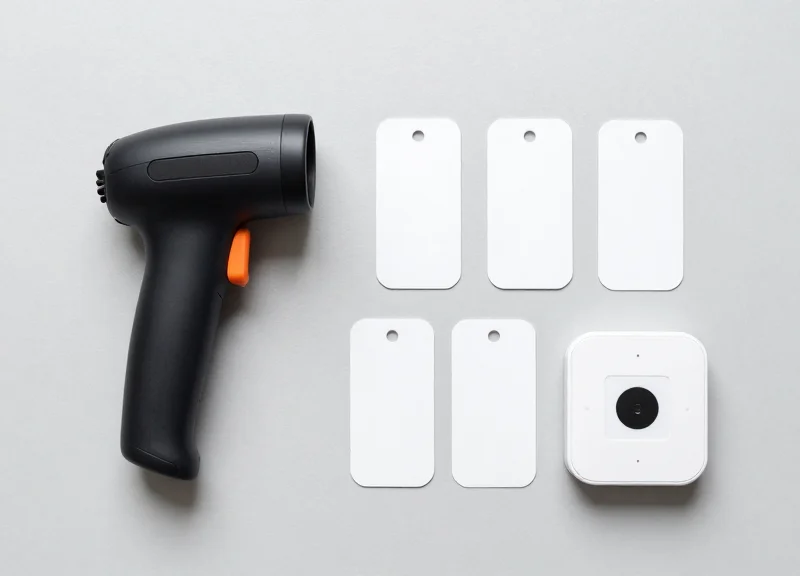
In 2026, choosing RFID hardware for fast fashion is no longer about simple detection; it is about high-fidelity data capture in 'noisy' electromagnetic environments. Successful hardware selection requires a triad approach: specialized tags that resist detuning near diverse fabrics, fixed readers with integrated edge computing for real-time filtering, and ergonomic mobile handhelds capable of processing 1,000+ items per second. For high-volume retailers, the goal is to eliminate 'null zones'—areas where inventory remains invisible due to poor signal penetration or hardware latency.
| Component | Critical 2026 Specification | Fast Fashion Benefit |
|---|---|---|
| RFID Inlays/Tags | Eco-friendly Paper Antennas | Reduces plastic waste while maintaining 10m+ read range. |
| Fixed Readers | PoE+ with Beam-Steering | Automated directional sensing for hands-free portal tracking. |
| Mobile Handhelds | Wi-Fi 6E/7 Integration | Near-zero latency sync with cloud-native inventory platforms. |
| Smart Portals | 99.9% Read Accuracy at 5mph | Enables rapid bulk-scanning of inbound pallets/trolleys. |
Expert Insight: The 'Shadow Tag' Problem. In dense fast-fashion racks, 'shadowing' occurs when tags are so tightly packed they shield one another. By 2026, we recommend '3D' or 'Omni-Directional' antenna designs for tags. Unlike traditional linear inlays, these are orientation-insensitive, ensuring a 25% higher first-pass read rate on circular hangers and compressed shipping cartons.
Why is 'Sensitivity' more important than 'Power' in 2026 readers?
Modern readers prioritize receiver sensitivity (down to -90dBm) rather than raw transmit power. High sensitivity allows the reader to pick up weak backscatter from distant or obstructed tags without causing interference with other nearby readers in a dense store environment.
Should we choose ruggedized or lightweight handhelds?
In the high-speed fashion environment, ergonomics are king. Look for 'pistol-grip' designs weighing under 450g but featuring a MIL-STD-810H drop rating. If the tool is too heavy, staff usage drops, leading to data decay.
Are sustainable tags worth the investment?
Yes. Beyond ESG compliance, 2026-gen paper-based tags are easier to recycle and have reached cost parity with traditional PET tags, making them the standard for global apparel brands.
Finally, ensure all hardware supports the latest Gen2v3 protocols. This 2026 standard includes enhanced cryptographic authentication, which prevents 'tag cloning'—a growing concern as luxury fast-fashion brands combat sophisticated counterfeiters in the secondary market.
Software Intelligence: Real-Time Analytics and Cloud Scalability

In high-volume fast fashion, software intelligence is the layer that converts raw electromagnetic signals into actionable business logic. For 2026, the gold standard involves a hybrid architecture where Edge Computing handles the 'Data Tsunami' of millions of tag reads at the store level, while Cloud Scalability enables global inventory synchronization and predictive analytics. This ensures that massive data bursts—typical during flash sales or seasonal transitions—do not crash local networks or create data lag in omnichannel platforms.
| Feature | Edge Computing (Local) | Cloud Analytics (Global) |
|---|---|---|
| Primary Role | Real-time filtering and de-duplication of tag reads. | Long-term trend analysis and inventory forecasting. |
| Latency | Ultra-low (<10ms); critical for POS and security gates. | Variable; used for non-time-critical reporting. |
| Data Volume | Processes raw data packets locally. | Aggregates 'Events' (e.g., item sold, item moved). |
| Offline Capability | High; functions during internet outages. | None; requires active connectivity. |
The 2026 Unique Insight: The Event-Driven Intelligence Gap. Most retailers focus on 'State' data—knowing what is currently in stock. However, market leaders in 2026 are shifting to 'Event-Driven Architecture' (EDA). Instead of periodic inventory counts, software intelligence now treats every RFID tag movement as a micro-event. Expert Tip: Look for systems that offer 'Automated Inventory Rebalancing'—AI-driven software that detects a localized trend spike in one store and automatically triggers a stock transfer from a nearby low-velocity location before a human manager even spots the discrepancy.
How does software handle 'Read Overkill'?
Modern middleware uses sophisticated RSSI (Received Signal Strength Indicator) filtering. It ignores tags that are static for long periods and only processes 'delta' changes, preventing the cloud database from being overwhelmed by redundant pings.
What is the importance of API-First Design in 2026?
For fast fashion, your RFID software must be a 'headless' service. It should push data via webhooks to your TikTok Shop, mobile app, and ERP simultaneously to ensure that a customer doesn't buy the last 'Medium' shirt that was just sold in-store five seconds ago.
Can RFID software help with sustainability goals?
Yes. By utilizing 'Digital Product Passports' (DPP) within the cloud software, retailers can track the entire lifecycle of a garment from fiber to recycling, satisfying 2026 EU transparency regulations.
Ultimately, the best RFID software is invisible. It should integrate so deeply with your existing tech stack that it feels like a native upgrade to your ERP. Scalability is non-negotiable; your platform must be capable of scaling from 100,000 tags to 100 million tags without requiring a re-architecture of your data schemas or increasing per-tag processing costs linearly.
Total Cost of Ownership (TCO) vs. ROI Analysis
The Total Cost of Ownership (TCO) for an RFID system in high-volume fast fashion represents the comprehensive sum of initial capital expenditures (CAPEX) and ongoing operational expenses (OPEX) over a typical five-year lifecycle. While Return on Investment (ROI) is frequently achieved within 12 to 18 months through a 2-4% increase in top-line sales and a 90% reduction in labor hours for cycle counts, the true financial performance is determined by the system's ability to drive 'Gross Margin Return on Investment' (GMROI) by ensuring the right product is always available at the right location.
| Cost Category | Percentage of 5-Year TCO | Key Drivers |
|---|---|---|
| RFID Tags/Consumables | 60-70% | Unit volume, inlay type, and source-tagging labor. |
| Software & Cloud SaaS | 15-20% | License fees, API integrations, and edge data processing. |
| Hardware Infrastructure | 10-15% | Fixed readers, handhelds, and point-of-sale upgrades. |
| Training & Maintenance | 5-10% | Staff onboarding, firmware updates, and support desk. |
In 2026, the 'Cost per Tagged Unit' remains the most critical metric for fast fashion. As production volumes hit millions of units, even a half-cent reduction in tag price or a 5% improvement in tagging efficiency at the manufacturing source significantly alters the TCO. Conversely, ROI is no longer just about labor savings; it is increasingly driven by 'Omnichannel Yield,' where RFID-enabled inventory accuracy allows retailers to fulfill online orders from store stock with 99% confidence, eliminating the need for safety stock buffers.
How long does it typically take to see a positive ROI?
Most high-volume retailers see a break-even point within 12 to 18 months. This is primarily fueled by a 15-30% reduction in out-of-stocks and a dramatic decrease in annual shrinkage.
What is the biggest 'hidden' cost in an RFID rollout?
Data management and integration. While hardware is visible, the cost of cleaning legacy ERP data to sync with real-time RFID streams often exceeds initial software estimates.
Can RFID reduce the cost of returns?
Yes. By accurately tracking the lifecycle of a garment, RFID reduces fraudulent returns and allows for faster re-processing of returned items back into the 'available-to-sell' inventory.
Expert Tip: The 2026 'Residual Value Capture' Insight. Beyond traditional ROI, forward-thinking brands are now factoring in the 'Digital Product Passport' (DPP) value. By 2026, RFID tags will serve as the foundation for the circular economy. By using the original RFID tag to authenticate items for resale or recycling, brands can capture secondary market revenue or meet sustainability regulations that would otherwise require separate, costly labeling processes. This effectively transforms the RFID tag from a one-time operational expense into a multi-cycle asset.
Sustainability in RFID: Eco-Friendly Tagging for 2026

In 2026, sustainability in RFID is no longer optional for high-volume fast fashion; it is a regulatory requirement driven by the Digital Product Passport (DPP) mandates. Eco-friendly tagging utilizes plastic-free paper substrates and additive antenna manufacturing—such as printed conductive inks—to replace traditional chemical-etched aluminum on PET plastic. This shift reduces the carbon footprint of tag production by up to 50% and ensures that tags are fully compatible with textile recycling streams, preventing millions of micro-inlays from contaminating the circular supply chain.
| Feature | Traditional PET RFID | Eco-Friendly Paper RFID |
|---|---|---|
| Substrate Material | Plastic (PET/PVC) | FSC-Certified Paper |
| Antenna Process | Chemical Acid Etching | Laser-cut or Printed Ink |
| Carbon Footprint | High (Significant Chemical Waste) | Low (50% Average Reduction) |
| End-of-Life | Landfill/Incineration | Repulpable / Paper-Stream Recyclable |
A critical 2026 innovation is the adoption of 'hidden' sustainable antennas. Previously, eco-friendly tags were thicker and prone to tearing in high-speed sorting centers. New wood-fiber reinforcements have made paper-based tags just as durable as plastic, allowing them to survive the rigorous journey from overseas manufacturing hubs to local retail floors without losing data integrity.
Does eco-friendly tagging affect read performance in dense racks?
No. By 2026, advancements in impedance matching for paper substrates ensure that eco-friendly tags maintain the same 10-12 meter read range and sensitivity as their plastic-based counterparts, even when garments are packed tightly.
Are sustainable tags more expensive for high-volume fast fashion?
The 'green premium' has narrowed significantly. For orders exceeding 10 million units, the cost difference is now less than 3%, a cost easily recovered through reduced plastic taxes and improved brand equity among Gen Z consumers.
How do these tags facilitate the EU Digital Product Passport (DPP)?
Sustainable RFID tags act as the primary data carrier for the DPP, providing a non-visual link to a garment’s entire lifecycle data—from raw material origin to repair instructions—accessible via simple smartphone or warehouse scans.
Expert Tip: When selecting a vendor in 2026, prioritize those who utilize 'Additive Antenna Manufacturing.' Unlike traditional etching which wastes up to 60% of the copper or aluminum used, additive processes only apply the metal where the antenna circuit exists, drastically reducing material waste and water usage during the manufacturing phase.
Security and Loss Prevention: Leveraging RFID for EAS
In 2026, the convergence of inventory management and loss prevention is no longer a luxury—it is a baseline requirement for high-volume fast fashion. Leveraging RFID for Electronic Article Surveillance (EAS) allows retailers to move beyond the binary 'alarm or no alarm' logic of legacy systems. By utilizing the unique Electronic Product Code (EPC) data already present on inventory tags, retailers can identify exactly which SKU is exiting the store, enabling immediate inventory reconciliation and precise shrinkage analytics that were previously impossible with traditional AM or RF systems.
| Feature | Traditional EAS (AM/RF) | RFID-Based EAS |
|---|---|---|
| Item Identification | None (Generic Alarm) | Specific (SKU, Color, Size) |
| Detection Accuracy | High False Alarm Rate | Directional Intelligence |
| Aesthetics | Bulky Floor Pedestals | Invisible Overhead Sensors |
| Labor Cost | Double Tagging Required | Single Tag for Inventory & Security |
The most significant advancement in 2026 is the 'Invisible Gateway'—overhead RFID readers that replace bulky floor-mounted pedestals. These systems use directional beamforming to distinguish between an item being browsed near the entrance and an item actually crossing the threshold. This eliminates 'dead zones' and allows for wider, more inviting store entrances without compromising on security. Furthermore, because the system knows what has been stolen, it can automatically trigger a 'restock' request to the backroom, ensuring that theft does not result in a secondary loss of legitimate sales due to out-of-stock scenarios.
Expert Insight: Preventing 'The Ghost Return'. A major leak in fast-fashion profitability is the return of stolen goods for store credit. Modern RFID-EAS integrations stop this by flagging specific EPCs as 'not sold' in the POS database. When a thief attempts to return a stolen item, the system alerts the clerk that the item never legally left a storefront, effectively neutralizing the financial incentive for professional shoplifting rings.
Can RFID tags be shielded by 'booster bags'?
While aluminum-lined bags can interfere with any radio signal, 2026-era RFID sensors include 'shielding detection' algorithms that alert security to the presence of metallic interference at the entrance, a feature traditional EAS lacks.
Does RFID replace the need for security guards?
No, but it makes them significantly more effective. Instead of chasing every false alarm, security personnel receive a notification on their mobile device showing the image and description of the specific item leaving the store.
Is 'source tagging' necessary for RFID security?
Absolutely. For high-volume fashion, the RFID chip must be embedded in the hangtag or care label at the factory. This ensures 100% security coverage from the moment the garment enters the supply chain.
Checklist for Selecting Your 2026 RFID Technology Partner
In 2026, selecting an RFID technology partner for fast fashion is no longer just about hardware; it is about finding a strategic ally capable of orchestrating a complex, global data ecosystem. An ideal partner must provide a hardware-agnostic software platform that delivers 99.9% read accuracy at high velocity while integrating seamlessly with existing ERP and WMS systems to support the Digital Product Passport (DPP) mandates. Your choice should be predicated on a vendor's ability to scale across thousands of locations while maintaining real-time edge processing capabilities that prevent data latency during peak seasonal surges.
| Selection Criteria | Minimum 2026 Requirement | Fast Fashion Impact |
|---|---|---|
| Read Velocity | 1,000+ items per minute | Ensures intake speed matches conveyor velocity. |
| Data Integration | RESTful APIs / GraphQL | Enables real-time inventory sync across omnichannel. |
| Global Support | 24/7 in 3+ continents | Critical for brands with distributed supply chains. |
| Sustainability | DPP-compliant tagging | Meets EU regulatory requirements for circularity. |
- Proven High-Volume Performance: Verify that the vendor has successfully deployed systems in environments processing over 50 million tags annually with no performance degradation.
- Hardware-Agnostic Software Architecture: Ensure the software can manage readers and tags from multiple manufacturers to avoid vendor lock-in and supply chain bottlenecks.
- Edge Computing Capabilities: The system must process tag data locally at the store or warehouse level to ensure zero-latency operation even during internet outages.
- Seamless ERP/WMS Integration: The vendor must provide pre-built connectors for major platforms like SAP, Oracle, or specialized fashion PLMs.
- Digital Product Passport (DPP) Readiness: The partner must support the encoding and management of unique item identifiers required by 2026 sustainability regulations.
- Predictive Analytics Engine: Beyond counting, the software should use AI to predict stockouts and recommend localized replenishment strategies.
- Cybersecurity & Data Privacy: The vendor must be SOC 2 Type II compliant and offer end-to-end encryption for all tag-to-cloud communications.
- Rapid Deployment Methodology: Choose a partner with a 'Store-in-a-Box' deployment model that allows for full activation in less than 48 hours per location.
- Financial Viability and R&D Spend: Evaluate the vendor's financial stability and their commitment to reinvesting in next-gen sensor fusion and battery-less IoT technology.
- Comprehensive Training & Adoption: Ensure they provide multilingual, gamified training modules for retail associates to maximize system utilization and compliance.
Expert Tip: The 'Agility Coefficient' is your most vital metric for 2026. Ask vendors to demonstrate their API response times under simulated peak loads and their ability to push OTA (Over-the-Air) firmware updates to 1,000+ readers simultaneously. If a vendor cannot update their global fleet in under 60 minutes, they will become a bottleneck for your digital transformation efforts during critical peak seasons like Black Friday.
Should we prioritize a single-source vendor for tags and readers?
No. In 2026, the risk of supply chain disruption is too high. Opt for a software partner that supports an open hardware ecosystem to ensure you can pivot hardware sources if needed.
How do we measure a vendor's ROI commitment?
Demand a 'Value Realization' phase in the contract where a portion of the payment is tied to achieving specific KPIs, such as a 15% reduction in out-of-stocks within the first six months.
What is the biggest red flag in a 2026 RFID vendor?
A lack of 'Offline-First' functionality. If the system requires a constant cloud connection to function at the point of sale, it is a liability for high-traffic retail environments.