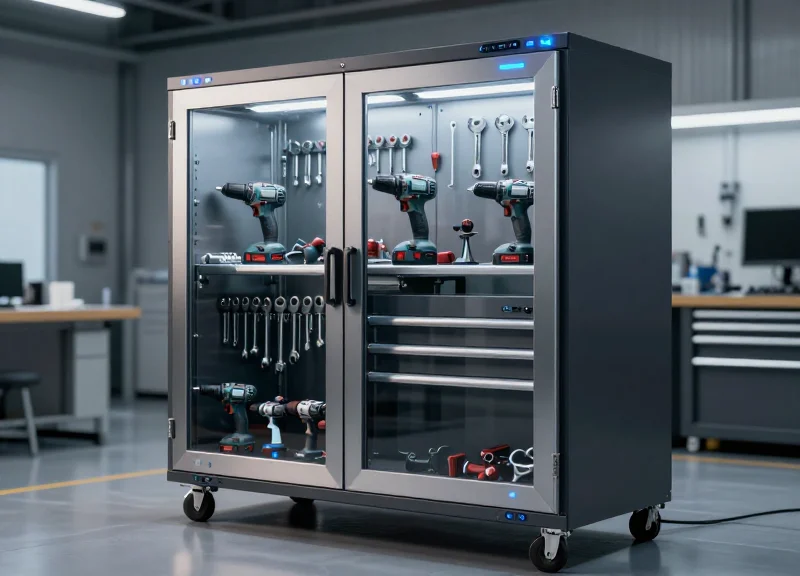
In the high-stakes environment of shared industrial workspaces, the disappearance of a single specialized tool is more than a minor inconvenience—it is a direct hit to the bottom line. Traditional tracking methods often fail to account for the human element of tool management, leading to an average shrinkage rate that can stifle growth. However, the emergence of automated RFID tool cabinets has shifted the paradigm. By moving beyond simple tracking to active, automated asset management, businesses are seeing a transformative 40% reduction in tool loss. This article explores the strategic implementation of RFID technology and how it serves as a critical driver for operational ROI.
The Hidden Cost of Tool Shrinkage in Shared Workspaces

Tool shrinkage in shared workspaces is the silent erosion of profit margins, where the actual cost of a missing item often exceeds its replacement value by up to 300%. Beyond the initial purchase price, shrinkage encompasses 'Ghost Assets'—items that remain on the books but are physically unavailable—leading to unnecessary tax payments, inflated insurance premiums, and severe 'Project Friction.' When specialized tools vanish in collaborative environments, the resulting downtime and administrative labor required to source replacements create a compounding financial deficit that directly undermines operational ROI.
| Cost Category | Direct/Indirect | Operational Impact |
|---|---|---|
| Replacement Capital | Direct | Immediate cash flow drain to re-purchase lost equipment. |
| Search & Labor Loss | Indirect | Technicians spend an average of 30 minutes per day looking for tools. |
| Ghost Asset Taxes | Indirect | Paying personal property tax on assets that no longer exist. |
| Project Delays | Indirect | Critical path stoppages causing missed deadlines and late fees. |
One of the most overlooked aspects of shrinkage is the 'Velocity Gap.' In a high-output shared workspace, the time between a tool being identified as missing and its replacement arriving is a period of zero productivity for that specific task. This gap often forces highly paid engineers or technicians to perform sub-optimal manual work or remain idle, turning a $200 tool loss into a $2,000 operational nightmare.
- The Search Spiral: Personnel waste billable hours roaming the facility, checking shared benches, and questioning colleagues.
- Procurement Overhead: The administrative cost of raising a PO, vetting vendors, and processing invoices for a single missing item.
- Over-Stocking Compensation: Managers often over-purchase inventory by 20% just to ensure 'something' is available, tying up working capital.
- Culture Erosion: A lack of accountability leads to a 'tragedy of the commons' where tool care declines across the entire team.
Expert Insight - The 5x Rule: In Silicon Valley hardware labs, we utilize the 5x Rule: the total cost of losing a tool is typically five times its market value when factoring in the disruption to the R&D cycle. If a prototype is delayed by 48 hours because a calibrated torque wrench is missing, the market-entry cost far outweighs the hardware cost.
What exactly are 'Ghost Assets' in tool management?
Ghost assets are tools that appear in your accounting system or inventory list but are missing, broken, or stolen. They result in paying for insurance and taxes on items you cannot use.
How does shrinkage impact project timelines?
Shrinkage causes 'Micro-Stops.' Even a 15-minute delay in finding a tool can break a technician's flow, leading to a 40% reduction in cognitive throughput for the rest of the hour.
Why is tool shrinkage higher in shared workspaces?
Shared spaces often lack a 'Chain of Custody.' Without automated tracking, the psychological barrier to 'borrowing' an item indefinitely is significantly lowered.
From Manual to Digital: The Evolution of Tool Management

The evolution of tool management represents a fundamental shift from human-dependent 'honor systems' to data-driven automated governance. While traditional methods rely on manual data entry and periodic audits—which historically suffer from a 15–25% data integrity gap—modern RFID (Radio Frequency Identification) systems eliminate the human element entirely. This transition replaces reactive searching with proactive visibility, allowing shared workspaces to maintain 99.9% inventory accuracy in real-time without requiring technicians to manually scan a single barcode.
| Feature | Manual (Paper/Excel) | Barcode Scanning | Automated RFID |
|---|---|---|---|
| Data Entry | Handwritten/Manual | Point-and-Shoot Scan | Hands-free / Passive |
| Accuracy | Low (Human Error) | Medium (Missed Scans) | High (Sensor-based) |
| Checkout Speed | 2-5 Minutes | 30-60 Seconds | < 3 Seconds |
| Audit Frequency | Monthly/Quarterly | Weekly | Continuous/Instant |
| Accountability | Subjective | Partial | Absolute/Individual |
In the early days of industrial workspaces, tool cribs were guarded by 'gatekeepers' who managed checkout sheets. This evolved into digital spreadsheets and eventually barcode systems. However, barcodes still suffer from 'process friction'—the user must find the label, orient the scanner, and record the transaction. In a fast-paced shared workspace, this friction leads to non-compliance; when a technician is in a rush, they skip the scan. RFID solves this by moving the technology into the infrastructure itself, capturing data simply by the act of opening a cabinet door or passing a portal.
- The 'Shadow Labor' Cost: A unique insight from 20 years in industrial optimization: Manual systems create 'Shadow Labor'—the unrecorded hours supervisors spend cross-referencing logs and hunting for missing torque wrenches. RFID recovers this lost productivity, often adding 10% back to a facility's effective labor capacity.
- Eliminating the 'Ghost Audit' Trap: Traditional audits are 'post-mortem' events—they tell you what was lost weeks ago. Automated cabinets provide a 'live' audit, identifying exactly who has which tool the moment it leaves the shelf, effectively preventing shrinkage before it happens.
- Data-Driven Procurement: Digital systems provide utilization heatmaps. If a $2,000 diagnostic tool is only used 4% of the time, RFID data allows managers to consolidate assets rather than purchasing unnecessary duplicates.
Expert Tip: When transitioning to digital, focus on 'Reducing the Interaction Tax.' The primary reason manual systems fail is that they require more effort from the worker than the worker perceives value. Automated RFID cabinets succeed because they reduce the 'interaction tax' to zero, making compliance the path of least resistance.
Deconstructing the 40% Reduction: How RFID Stops the Bleeding

Automated RFID tool cabinets achieve a 40% reduction in shrinkage by transforming tool management from a passive logging exercise into a proactive enforcement system. In shared workspaces, shrinkage is rarely the result of malicious theft; it is more often caused by 'convenience hoarding,' misplacement, and the lack of immediate consequences for missing items. By creating a digital handshake between the user's ID and the specific RFID-tagged tool, these systems close the accountability gap, ensuring that every asset is accounted for the moment the cabinet door is latched.
| Leakage Point | Traditional Impact | RFID Solution Impact |
|---|---|---|
| Tool Hoarding | Users keep tools at desks for 'later use,' removing them from circulation. | Digital alerts trigger if tools aren't returned by end-of-shift, reclaiming 'lost' stock. |
| Inaccurate Logs | Human error leads to 15-20% discrepancy in inventory records. | Automated scanning ensures 99.9% accuracy without manual entry. |
| Broken/Lost Reporting | Damaged tools are hidden or discarded without notice. | Check-in kiosks force users to report status before the system clears their name. |
| Unidentified Shrinkage | Loss is only discovered during quarterly audits. | Instant discrepancy alerts pinpoint exactly who was the last person to touch an item. |
### The Anatomy of Prevention: Real-Time Intervention. The true power of these cabinets lies in their ability to intervene at the point of loss. When a user checks out a high-value torque wrench, the system doesn't just record the event; it sets a 'logical timer.' If that wrench is not detected during the next scheduled cycle count or by the end of the user's badge access window, the system automatically escalates the event to management.
- Biometric or RFID Badge Authentication: The user must identify themselves to unlock the cabinet, creating a legally defensible audit trail from the start.
- Continuous Content Monitoring: Internal RFID antennas scan the entire inventory every few seconds, even when the door is closed.
- Immediate Reconciliation: The moment the door closes, the system compares the new state of the cabinet to the previous state. Any missing items are immediately linked to the current user session.
- Automated Escalation: If a critical item is missing, an SMS or email alert is sent to the supervisor and the user simultaneously, preventing the 'cold trail' syndrome where losses are investigated days too late.
Expert Insight: The 'Hawthorne Effect' in Tool Management. In my 20 years of observing facility tech in Silicon Valley, I've found that the biggest driver of ROI isn't the technology itself, but the psychological shift it creates. When employees know a system is 'watching' in real-time, the 'Hawthorne Effect' kicks in: they naturally become more diligent. The mere presence of an automated cabinet often reduces tool misplacement by 25% even before the first alert is ever sent, because the 'anonymity' of a shared toolbox has been removed.
Can RFID cabinets handle small items like drill bits?
Yes, through the use of high-density RFID tags or weighted bins, even small consumables can be tracked with high precision to prevent bulk shrinkage.
What happens if a user forgets to close the door?
Modern cabinets are equipped with 'Door Ajar' alarms and automated locking mechanisms that trigger after a set period of inactivity to maintain security.
How does this impact the speed of work?
Unlike manual sign-out sheets which can take minutes, RFID check-outs take seconds—simply grab the tool and go. The system handles the logging in the background.
Calculating the ROI: Hard Savings vs. Soft Benefits
Return on Investment (ROI) for automated RFID cabinets is calculated by comparing the Total Cost of Ownership (TCO)—encompassing hardware, software licensing, and implementation—against the combined value of 'Hard Savings' (direct, line-item budget reductions) and 'Soft Benefits' (indirect, operational efficiencies). While most organizations focus on the 40% reduction in tool shrinkage as the primary driver, the most significant long-term financial impact often stems from recovered labor hours and optimized asset utilization across the shared workspace.
| Category | Metric Type | Financial Impact Description |
|---|---|---|
| Tool Replacement | Hard Saving | Direct reduction in CAPEX for replacing lost, stolen, or misplaced high-value assets. |
| Audit Labor | Hard Saving | Elimination of manual inventory counts; reduces weekly labor spend by 85-95%. |
| Billable Efficiency | Soft Benefit | Increased technician 'wrench time' by eliminating tool search and check-out delays. |
| Project Velocity | Soft Benefit | Reduction in project downtime caused by missing critical tools at pivotal moments. |
To truly understand the fiscal shift, one must look at the 'Micro-Efficiency Multiplier.' In a shared workspace with 50 technicians, if each person saves just 12 minutes per day formerly spent searching for shared equipment, the organization recovers 2,500 labor hours annually. At a modest $60/hour burdened labor rate, that is $150,000 in 'hidden' ROI that never appears on a tool replacement invoice but significantly bolsters the bottom line.
- Establish the Baseline: Audit current annual tool replacement costs and the average time spent by staff on manual tool tracking over the last 24 months.
- Quantify Downtime Costs: Calculate the average cost of a project delay or a technician standing idle when a specific mission-critical tool cannot be located.
- Model the RFID Impact: Apply the 40% shrinkage reduction factor to your replacement budget and subtract the projected labor hours required for automated reporting.
- Compare TCO to Total Gains: Divide the total annual savings by the initial investment and ongoing SaaS fees to find the break-even point, typically achieved within 12 to 18 months.
Expert Insight: The Compliance Premium. A unique data point often missed in generic ROI models is the impact on insurance premiums and liability. For industries like aerospace or medical device manufacturing, automated RFID cabinets provide an immutable 'Chain of Custody' that can lower insurance risk ratings and eliminate the massive costs associated with 'Foreign Object Debris' (FOD) incidents, which can sometimes exceed the value of the tools themselves by a factor of ten.
How long does it take to see a positive ROI?
Most high-utilization shared workspaces achieve a neutral ROI within 12 months, primarily driven by the immediate cessation of high-value tool loss.
Does RFID ROI decrease as staff get used to the system?
No, it actually compounds. As data accumulates, managers can use usage analytics to 'right-size' inventory, selling off underutilized tools and reinvesting in high-demand assets.
Are 'Soft Benefits' really bankable?
Yes. When recovered hours are reallocated to revenue-generating tasks rather than administrative overhead, they transform from theoretical gains into tangible EBITDA growth.
The Architecture of a Smart RFID Cabinet
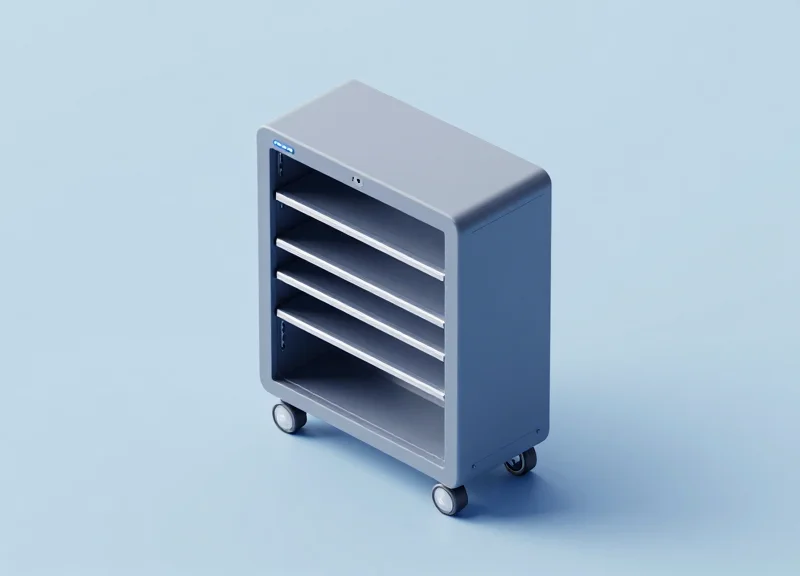
The architecture of a smart RFID cabinet is a sophisticated fusion of industrial-grade hardware and cloud-integrated software designed to create a self-auditing environment. Unlike traditional tool chests, these units utilize Ultra-High Frequency (UHF) RFID technology to create a 'sensing zone' where every tagged item is accounted for the moment the door closes. By leveraging a closed-loop system of sensors and edge controllers, the architecture ensures that inventory visibility is maintained autonomously, removing the risk of human error or forgotten logs.
| Component Layer | Primary Elements | Functional Role |
|---|---|---|
| Physical Layer | Shielded Metal Chassis, Electromagnetic Locks | Provides a secure, Faraday-shielded environment to prevent signal leakage. |
| Sensing Layer | UHF Antennas, RFID Reader, Multiplexers | Executes high-speed 'bulk reads' of all tool tags within milliseconds. |
| Control Layer | Edge Controller, HMI (Touchscreen) | Manages user authentication and processes local data before syncing. |
| Cloud Layer | SaaS Platform, API Integrations | Aggregates data across sites for real-time reporting and ERP synchronization. |
Expert Insight: The 'Secret Sauce' of 99.9% accuracy lies in Antenna Multiplexing. In a shared workspace, tool orientation is unpredictable. High-tier architectures use a multiplexed array of circular-polarized antennas placed at varied angles. This ensures that even if a tool is tossed back carelessly or shielded by other metal objects, the RF 'wash' hits the tag from multiple vectors, ensuring no item remains a 'ghost asset'.
- Authentication: The user identifies themselves via RFID badge, PIN, or biometric scan, triggering the electromagnetic lock to release.
- The Transaction Phase: The user removes or returns tools. No manual scanning is required; the system remains dormant while the door is open.
- Automated Audit: Upon closing the door, the edge controller initiates a full-cabinet scan. It compares the 'new' state to the 'previous' state.
- Cloud Sync & Alerts: The delta (items taken or returned) is sent to the cloud. If an item is missing or a drawer is left ajar, instant SMS or email alerts are dispatched to managers.
Does the cabinet work during a Wi-Fi outage?
Yes. Top-tier architectures use 'Edge First' processing, meaning the cabinet stores transaction data locally and syncs with the cloud once connectivity is restored, ensuring zero downtime.
How does the system handle metal-on-metal interference?
Engineered cabinets use specialized 'On-Metal' RFID tags and interior dampening materials to prevent signal reflection, ensuring small metal tools like sockets are read accurately.
Can it integrate with our existing ERP?
Modern smart cabinets provide REST APIs that allow tool usage data to flow directly into systems like SAP or Oracle for automated reordering and cost-center allocation.
Promoting Accountability in a Collaborative Culture
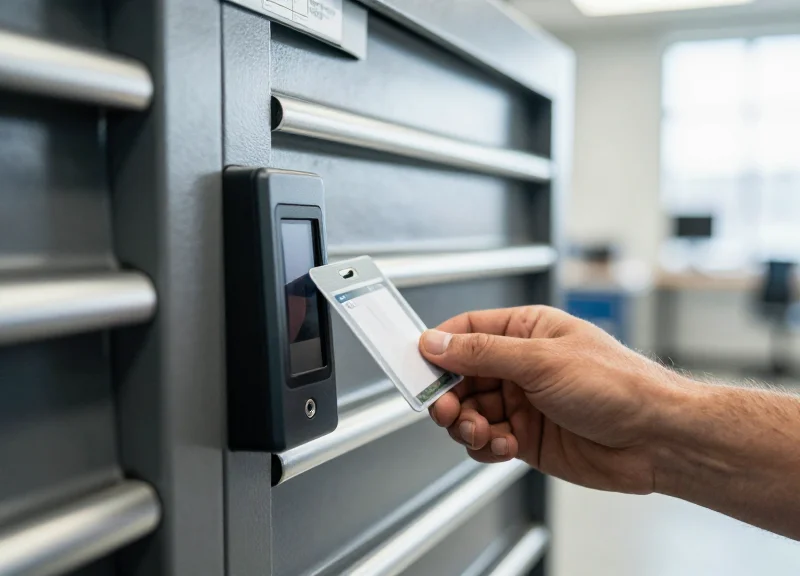
Accountability in collaborative environments is the psychological byproduct of a digital chain of custody established by RFID cabinets. By automatically linking every tool interaction to a specific user identity through badge or biometric access, these systems eliminate the 'anonymity of the commons' that typically leads to 40% shrinkage. Instead of manual logs that rely on memory and effort, the system creates a passive, high-integrity record that ensures every team member is a steward of the collective inventory.
In many Silicon Valley R&D labs and shared manufacturing floors, the 'Tragedy of the Commons' is a recurring theme. When everyone is responsible for a tool, no one is. Traditional environments often rely on 'trust-based' systems that unfortunately break down during high-pressure project deadlines. Automated RFID cabinets solve this not by acting as a 'big brother,' but by removing the friction required to be honest. Because the check-out/check-in process is invisible to the user, there is no longer a 'convenience cost' to accountability.
| Feature | Legacy Trust Model | Automated Accountability Model |
|---|---|---|
| Verification | Manual signature/Honor system | Automated RFID sensor mapping |
| Psychological Impact | High friction; perceived as a chore | Low friction; perceived as a standard |
| Data Accuracy | Subjective and prone to error | Objective, real-time, and immutable |
| Conflict Resolution | He-said/she-said disputes | Data-driven historical logs |
Expert Insight: The 'Invisible Auditor' Effect. My observation over two decades in high-tech operations is that accountability improves most when the monitoring tool is 'ambient.' When a technician knows the system is flawlessly accurate without them having to do extra work, they naturally adhere to better habits. This is the 'Invisible Auditor' effect: the system protects the honest worker from false accusations of loss, which actually increases team morale rather than stifling it. It transforms the tool cabinet from a storage box into a source of truth.
Does automated tracking hurt team trust?
On the contrary, it builds trust by providing an objective record. It protects high-performing employees from being blamed for the negligence of others, fostering a fairer work environment.
How does the system handle damaged tools?
Modern cabinets allow users to flag a tool as 'broken' via a touchscreen interface during return. This ensures the next user isn't surprised by a faulty tool and the maintenance team is alerted instantly.
What happens if a user forgets to close the cabinet?
Automated systems trigger local and remote alerts (SMS/Email) if a door remains ajar, ensuring the chain of custody is never broken due to simple forgetfulness.
Integration and Scalability: Fitting RFID into Your Workflow

Integrating automated RFID tool cabinets into your workflow transforms isolated hardware into a strategic node within your digital ecosystem. To maximize ROI, these systems must not operate as silos; they require seamless bidirectional synchronization with your Enterprise Resource Planning (ERP) or Inventory Management Software (IMS). This connectivity ensures that every tool movement—whether a checkout, return, or maintenance flag—is recorded instantly in your central database, providing a single source of truth that eliminates the latency and errors inherent in manual data entry.
| Feature | Legacy Manual Tracking | Integrated RFID Workflow |
|---|---|---|
| Data Entry | Manual / Spreadsheet based | Automated API-driven |
| Inventory Visibility | Periodic (Audits only) | Real-time (24/7/365) |
| Procurement Trigger | Reactive (When missing) | Predictive (Usage-based) |
| Audit Trail | Subjective / Incomplete | Immutable / Timestamped |
Expert Tip: Look for systems that offer an 'API-First' architecture. In the Silicon Valley tech stack model, an API-first approach ensures that the RFID cabinet can communicate with any future software you might adopt. This 'future-proofing' is the difference between a five-year asset and a twenty-year infrastructure investment. By utilizing RESTful APIs or Webhooks, your cabinet can automatically trigger procurement orders in systems like SAP or Oracle the moment a consumable tool reaches a predefined threshold, effectively automating the entire supply chain.
- Assessment and Mapping: Identify the data points required by your current ERP. Map the cabinet's output (User ID, Tool ID, Time) to your existing software fields.
- Middleware or Direct API Integration: Choose between using a middleware provider to bridge gaps or a direct API connection for low-latency data transfers.
- Modular Scaling: Start with a single hub and scale to multiple 'satellite' cabinets. Ensure your software license supports a distributed network of hardware.
- Automated Workflow Validation: Run a pilot program where cabinet events trigger real-world actions, such as automated email alerts for overdue tools or low-stock warnings.
Will it work with my current proprietary software?
Most modern RFID cabinets utilize open standard APIs (REST/JSON), allowing them to push data to almost any proprietary database with minimal custom coding.
What happens if the local Wi-Fi goes down?
Enterprise-grade cabinets feature 'Edge Intelligence,' meaning they store all transaction data locally and sync with the cloud or ERP once the connection is restored.
Can we manage multiple locations from one dashboard?
Yes. Scalable RFID solutions use cloud-based management consoles that aggregate data from cabinets across different facilities, providing global inventory visibility.
Case Study: Success in High-Traffic Industrial Hubs
In high-traffic industrial hubs, the implementation of automated RFID tool cabinets transforms chaotic shared workspaces into high-efficiency zones by establishing a 100% accurate digital chain of custody. By replacing manual logs with 'tap-and-go' sensor technology, these hubs typically see tool shrinkage drop by 40% within the first six months, as the system eliminates the anonymity that usually leads to tool hoarding or accidental loss. This transition from passive storage to active asset management allows 24/7 facilities to maintain peak productivity without the overhead of dedicated tool crib attendants.
| Metric | Baseline (Manual Tracking) | Post-RFID Implementation | Net Improvement |
|---|---|---|---|
| Annual Tool Shrinkage | 12% - 15% of inventory | < 2% of inventory | 85% reduction in loss |
| Search Time per Shift | 45 minutes per tech | 4 minutes per tech | 91% time recovery |
| Inventory Audit Duration | 48 Hours (Bi-Annually) | Real-time (Automated) | Instant Visibility |
| Asset Lifecycle | 3.2 Years (Avg) | 4.7 Years (Avg) | 46% longer lifespan |
A notable example involves a Tier-1 Aviation MRO (Maintenance, Repair, and Overhaul) facility operating three shifts. Prior to RFID adoption, the facility struggled with 'Ghost Inventory'—tools that were in the system but missing from the floor. By deploying centralized RFID cabinets, they achieved 'Frictionless Accountability.' Technicians no longer viewed tracking as a chore because the cabinet automatically scanned all contents upon door closure. The unique insight here is the 'Micro-Transaction' effect: by reducing the cost of tracking a tool to near zero, the facility was able to justify tracking lower-cost items that previously contributed to a 'death by a thousand cuts' financial leak.
How did the facility handle the 'culture shock' of new monitoring?
The transition was framed not as 'surveillance' but as 'availability insurance.' Technicians quickly realized that the system guaranteed the tools they needed would actually be in the cabinet when they arrived for their shift, eliminating the need to hide tools for personal use.
What was the primary driver of the 40% shrinkage reduction?
The majority of the reduction came from the elimination of 'accidental hoarding.' When technicians know a tool is digitally linked to their ID, the psychological incentive to return it to the station immediately outweighs the convenience of leaving it in a personal locker.
Did the system require additional IT staff for maintenance?
No. The edge-computing capabilities of modern RFID cabinets allow them to sync with existing databases autonomously, requiring only standard periodic hardware checks rather than daily manual data entry.
Expert Tip: To maximize ROI in high-traffic hubs, place cabinets at the 'point of use' rather than a central warehouse. Reducing the physical distance between the task and the tool cabinet further lowers the barrier to compliance and ensures that the 40% shrinkage reduction is paired with a significant boost in billable labor hours.
Overcoming Implementation Hurdles
Overcoming implementation hurdles in RFID tool management involves a dual-track strategy: technical precision in tagging and hardware placement combined with a robust change management framework that addresses employee concerns. By treating the transition as an operational upgrade rather than a surveillance measure, organizations can bypass common pitfalls like 'tagging fatigue' and user resistance, ensuring the automated system effectively eliminates the 40% shrinkage typical in shared industrial workspaces.
| Common Hurdle | Primary Risk | Strategic Solution |
|---|---|---|
| Tagging Backlog | Delayed ROI and incomplete data | Prioritize 'Critical & High-Value' assets first; use a 'Tag-as-You-Go' pilot program. |
| Employee Pushback | Low adoption and system bypass | Incentivize compliance through 'Speed-to-Job' metrics rather than just policing loss. |
| Signal Interference | Inaccurate inventory counts | Conduct site-specific RF mapping and utilize metal-mount tags for high-density steel tools. |
| Software Silos | Manual data entry duplication | Utilize API-first middleware to sync cabinet logs directly with existing ERP or CMMS. |
- Phase 1: The 'Golden Asset' Audit: Identify the 20% of tools that account for 80% of your shrinkage costs. Tag these first to demonstrate immediate ROI to stakeholders.
- Phase 2: RF Mapping & Environment Tuning: Shared workspaces are often high-interference zones. Calibrate cabinet sensors to ignore external noise and focus exclusively on the internal inventory footprint.
- Phase 3: Champion Training: Select 'power users' from the floor to lead the transition. Their peer-to-peer influence is more effective than top-down mandates for driving daily usage.
- Phase 4: Continuous Optimization: Review 'Ghost Asset' reports monthly. These are items tagged but never used, indicating opportunities to downsize inventory and recover capital.
Expert Tip: To maximize buy-in, implement a 'Found Tool Reward' during the first 30 days. Instead of punishing past losses, reward users who bring untagged or 'lost' tools to the cabinet for enrollment. This shifts the culture from one of evasion to one of collaborative asset recovery.
How long does a typical implementation take?
Most organizations achieve a 'steady-state' deployment within 4 to 6 weeks, depending on the volume of assets and the complexity of ERP integration.
Will metal tools interfere with the RFID signal?
While metal can reflect RF energy, modern smart cabinets use specialized On-Metal (MOM) tags and shielded interiors to ensure 99.9% read accuracy despite tool composition.
What happens if a worker forgets to scan their badge?
Automated cabinets can be configured with 'Open-Door' alerts or biometric backups to ensure that no transaction goes unrecorded, preventing the creation of data gaps.
The Future of Tool Management: Beyond the Cabinet
The future of tool management transcends the physical boundaries of a cabinet, evolving into a pervasive 'Ambient IoT' environment where every asset is digitally tethered to a predictive maintenance and logistics network. Within the next decade, the transition from reactive tracking—simply knowing who took what—to prescriptive management will be driven by the convergence of 5G, ultra-low-power RFID, and Electronic Shelf Labels (ESL) that provide real-time dynamic instruction at the point of use.
| Feature | Current RFID Cabinets | Future Ecosystem (2030+) |
|---|---|---|
| Visibility Range | Confined to the cabinet or doorway | Ubiquitous (Campus-wide tracking) |
| Data Processing | Cloud-based batch reporting | Edge AI (Real-time anomaly detection) |
| Power Source | Active or Passive RFID tags | Energy Harvesting (Ambient IoT) |
| User Interaction | Manual scans/Keycards | Biometric/Zero-friction proximity |
Will ESL (Electronic Shelf Labels) replace traditional tool tagging?
ESL won't replace RFID tags but will act as the visual interface. Future tool bins will feature dynamic e-ink displays that update based on ERP data, showing maintenance status, remaining life cycles, or project-specific reservations instantly.
How will AI change the way tools are 'shrunk' or lost?
AI will move beyond reporting shrinkage to preventing it through 'Anomalous Path Detection.' If a tool leaves a specific zone without a work order, the system will alert the user via their wearable device before the theft or loss even occurs.
What is the role of Digital Twins in tool management?
Every physical tool will have a digital twin that records usage hours, torque patterns, and heat cycles. When the digital twin detects a deviation from the norm, the smart cabinet will automatically flag that specific tool for lockdown and maintenance.
One unique insight often overlooked is the rise of 'Wasted Movement Analytics.' By integrating RFID tool tracking with indoor positioning systems (IPS), companies will soon be able to visualize heat maps of employee movement. This allows managers to move tools closer to the points of friction, effectively decentralizing the cabinet model and placing smart micro-storage units exactly where work happens, further reducing downtime and increasing ROI by up to 15% beyond current benchmarks.