In the high-stakes environment of transfusion medicine, there is zero room for error. Traditional manual barcode systems, while better than paper, still leave blood banks vulnerable to human error, inventory spoilage, and logistical bottlenecks. This technical blueprint outlines the transition to a 99.9% reliable RFID-based tracking system. By leveraging advanced radio frequency identification, healthcare providers can achieve unprecedented visibility into their blood supply chain, ensuring that the right blood reaches the right patient at the right time, every single time.
The Critical Role of 99.9% Reliability in Blood Safety

In the context of transfusion medicine, a 99.9% reliability rate in blood bag tracking represents the 'Three Nines' of safety, ensuring that the right blood reaches the right patient at the right time. Unlike consumer logistics where a 1% error rate might result in a delayed package, a 0.1% error in blood tracking can lead to ABO-incompatible transfusions, which are often fatal. By implementing high-fidelity RFID (Radio Frequency Identification) protocols, healthcare facilities can automate the verification of blood type, expiration, and cross-match data, effectively neutralizing the 'Wrong Blood in Tube' (WBIT) errors that plague manual environments.
| Metric | Legacy Manual/Barcode Systems | 99.9% Reliable RFID Ecosystem |
|---|---|---|
| Data Entry Speed | 3-5 seconds per scan (line-of-sight) | < 100ms for bulk identification |
| Error Susceptibility | High (Human fatigue, missed scans) | Near-Zero (Automated gate-checks) |
| Inventory Visibility | Periodic/Snapshot based | Real-time/Continuous |
| Cold Chain Integrity | Intermittent manual logging | Continuous sensor-linked tracking |
The limitations of legacy systems are often found in the 'human-in-the-loop' requirement. Barcoding, while a step up from handwriting, still requires a staff member to physically locate and scan a label. In high-pressure environments like Level 1 Trauma Centers, these manual steps are the primary points of failure. A 99.9% reliable RFID system moves the burden of proof from the clinician to the infrastructure, utilizing localized mesh networks and shielded cabinets to ensure that no blood unit remains invisible to the central Blood Management System (BMS).
Why is 99% reliability insufficient for blood tracking?
In a hospital processing 100,000 units a year, a 99% reliability rate leaves 1,000 units at risk of being mismanaged or lost. 99.9% reduces that risk profile by an order of magnitude, aligning with Six Sigma safety standards required for high-risk clinical workflows.
How does RFID prevent 'Ghost Inventory'?
Ghost inventory occurs when blood is moved without being scanned. RFID's non-line-of-sight capability ensures that if a bag is moved from a central bank to a surgical fridge, the system updates automatically, maintaining 99.9% data accuracy.
Does 99.9% reliability include temperature tracking?
Yes. Modern technical blueprints integrate passive RFID with temperature-sensitive indicators to ensure that the blood has not only been tracked but has remained clinically viable throughout its journey.
Expert Insight: Most organizations view reliability solely through the lens of patient safety. However, 99.9% reliability acts as a massive driver for 'Inventory Liquidity.' When tracking reaches this level of precision, hospitals can safely operate with 15-20% less safety stock because the 'lost' or 'unaccounted' margin is virtually eliminated. This prevents unnecessary blood expiration (wastage) and ensures that rare blood types are always exactly where the system says they are, effectively turning a cost center into a high-efficiency supply chain.
Anatomy of an RFID Blood Tracking System
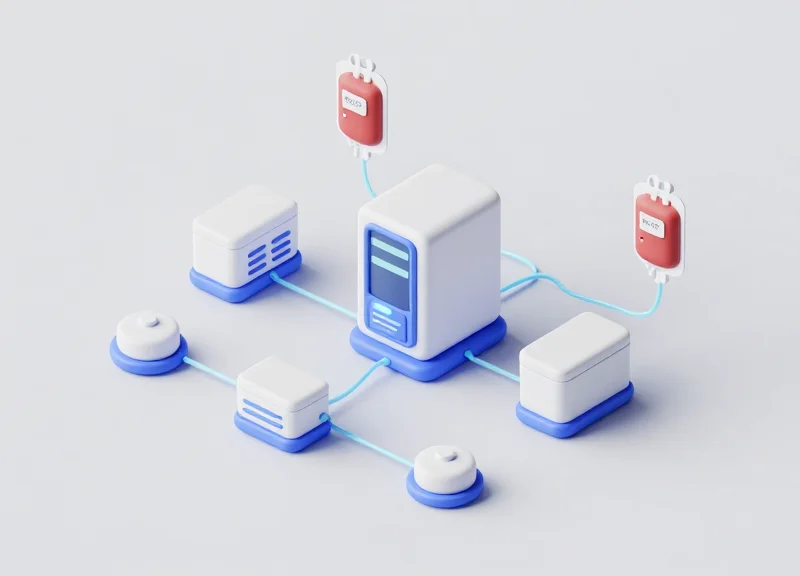
The anatomy of an RFID blood tracking system is a sophisticated multi-layered architecture comprising specialized high-performance tags, strategic reader networks, and intelligent middleware designed to overcome the physical challenges of liquid-heavy environments. Unlike generic retail RFID, a blood-safe system requires high-specification hardware that maintains 99.9% read rates despite the high dielectric constant of blood, ensuring every unit is accounted for from the donor center to the point of care.
| Component | Technical Requirement | Role in 99.9% Reliability |
|---|---|---|
| RFID Inlays/Tags | UHF Gen2 (ISO 18000-6C) with liquid-compensating design | Ensures signal penetration and prevents detuning when placed directly on blood bags. |
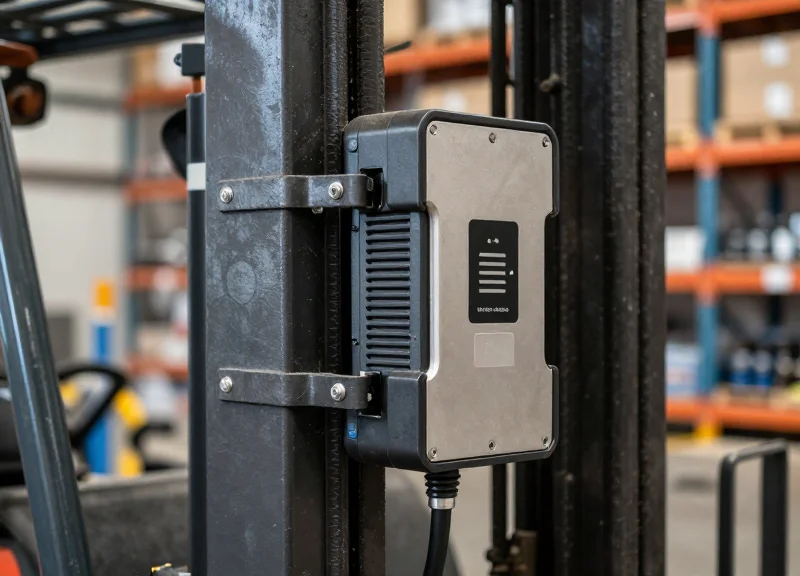
| Fixed & Mobile Readers | PoE-enabled fixed portals and rugged IP67 handhelds | Provides continuous monitoring at facility chokepoints and flexible manual inventory audits. |
| Antenna Arrays | Circularly polarized with high-gain (9dBic+) | Captures tags regardless of bag orientation, eliminating blind spots in dense storage. |
| Edge Middleware | Low-latency data filtering and de-duplication | Reduces signal noise and prevents data collisions for a clean, real-time data stream. |
Expert Insight: The 'Shadow Zone' Mitigation Strategy. In blood tracking, the primary failure point is rarely the software; it is the 'Shadow Zone' created by the blood's high water content which absorbs RF energy. To achieve 99.9% reliability, engineers must utilize 'Flag Tags' or specialized spacers. These physical offsets create a 3mm to 5mm air gap between the tag inlay and the bag surface, preventing the liquid from 'clamping' the signal and increasing the effective read range from centimeters to several meters.
Why is UHF preferred over HF for large-scale blood tracking?
While HF (NFC) is reliable for proximity checks, UHF (Ultra-High Frequency) allows for bulk reading of hundreds of bags simultaneously inside a storage refrigerator, which is critical for rapid emergency inventory audits.
Can RFID tags survive cryogenic storage or plasma freezing?
Yes, medical-grade RFID tags are encased in biocompatible, cryogenic-safe materials that remain functional at -80°C, ensuring the digital identity remains intact throughout the specialized storage lifecycle.
How does the antenna setup prevent 'false reads' from nearby rooms?
By utilizing RSSI (Received Signal Strength Indicator) filtering in the middleware, the system can distinguish between a bag sitting at the portal and one simply passing through a nearby hallway.
Selecting the Right RFID Hardware for Cold Chain Environments
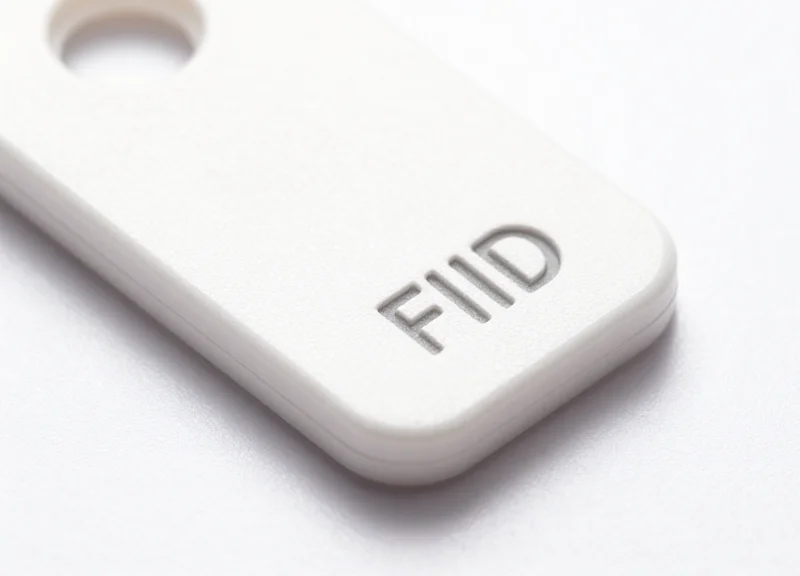
To achieve 99.9% reliability in blood tracking, hardware must be rated for 'Cold Chain Class' environments, featuring UHF passive tags with specialized cryogenic adhesives that prevent 'flagging' (peeling) at temperatures as low as -196°C. Selecting the right hardware is not just about the silicon chip; it is about the interplay between high-frequency signal penetration through liquid and the physical integrity of the tag material when transitioning from ambient to freezing temperatures. Unlike standard logistics tags, blood-specific RFID hardware must be designed to withstand frost accumulation and high moisture without significant signal attenuation.
| Feature | Standard RFID Tags | Medical-Grade Cold Chain Tags |
|---|---|---|
| Temperature Range | -20°C to +70°C | -196°C to +120°C (Cryogenic) |
| Adhesive Type | General Purpose Acrylic | Permanent Cryogenic Acrylic (FDA 21 CFR 175.105) |
| Moisture Resistance | Low to Moderate | High (IP68 Rated / Vapor Proof) |
| Flexibility | Rigid/Semi-rigid | Pliable (Conforms to curved blood bag surfaces) |
| Signal Performance | Standard UHF | Optimized for high-dielectric (liquid) environments |
The Veteran's Insight: The 'Bonding Lag' Rule. A common failure point in blood tracking is applying a tag to a cold bag or freezing a bag immediately after tagging. For 99.9% reliability, you must utilize a 'Bonding Lag' protocol: adhesives require a minimum of 30 to 60 minutes at room temperature to achieve full molecular cross-linking with the plastic substrate of the blood bag. If frozen before this bond stabilizes, the thermal contraction of the bag will cause the tag to delaminate (flag), leading to immediate read failure during the first thaw cycle.
Why are UHF tags preferred over HF/NFC for blood tracking?
UHF (Ultra-High Frequency) allows for bulk reading of an entire refrigerator or shipping container at once (up to 1,000 tags per second), whereas HF/NFC requires close-range, near-field proximity which is inefficient for high-volume blood bank operations.
Does the liquid in blood bags interfere with RFID signals?
Yes, blood is a high-dielectric liquid that absorbs RF energy. This is why specialized 'on-liquid' or 'liquid-tuned' UHF tag designs are required to maintain a high read range and prevent signal 'detuning' caused by the water content in the blood.
Are these tags safe for the blood components?
Yes, but they must be specifically certified. Adhesives must be non-leaching and compliant with medical standards to ensure that chemicals do not migrate through the plastic bag and contaminate the blood products.
- Identify Storage Extremes: Determine if the hardware will face standard refrigeration (4°C), plasma freezing (-30°C), or cryogenic stem cell storage (-196°C).
- Test for 'Frost Penetration': Verify that your RFID readers and antennas have the sensitivity to read through heavy frost or condensation layers that naturally form on bags during the retrieval process.
- Execute a Pull-Test: Validate the adhesive performance by performing standardized peel tests after multiple freeze-thaw cycles to ensure no edge-lifting occurs.
Technical Blueprint: Strategic Antenna Placement
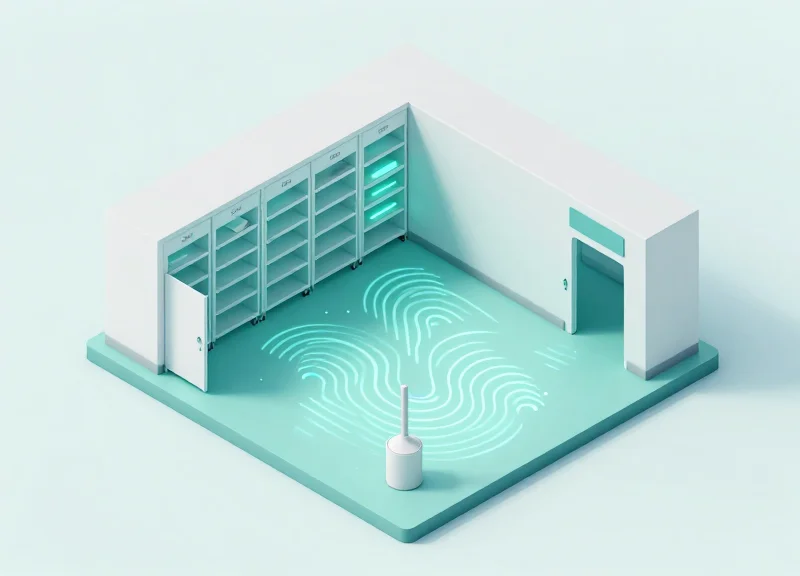
To achieve 99.9% reliability in blood bag tracking, strategic antenna placement must account for the high dielectric constant of blood, which absorbs Ultra-High Frequency (UHF) signals. The optimal technical blueprint utilizes circular polarization to maintain signal integrity regardless of tag orientation and leverages spatial diversity—placing antennas at multiple angles—to eliminate the 'shadow zones' created by the liquid-filled containers themselves. Successful deployment requires balancing antenna gain with localized RSSI (Received Signal Strength Indicator) thresholds to prevent cross-reads while ensuring every unit in the 'interrogation zone' is captured.
In a blood bank environment, the primary challenge is the 'Liquid Effect.' Water and saline content in blood are parasitic to RF energy. If an antenna is placed directly facing a dense stack of blood bags without proper calibration, the bags closest to the antenna will absorb the energy, leaving the bags in the rear invisible. This is known as signal attenuation.
| Antenna Type | Polarization | Best Use Case in Blood Banks | Reliability Score |
|---|---|---|---|
| Linear Patch | Horizontal or Vertical | Fixed-path conveyors where tag orientation is strictly controlled. | Low to Medium |
| Circular Patch | Omni-directional | General storage, refrigerators, and high-density shelf environments. | High |
| Near-Field Antenna | Magnetic Induction | Individual unit verification or close-proximity scanning at check-out. | Very High |
| Phased Array | Dynamic Beamforming | Large portals or high-traffic corridors with moving carts. | High |
- Conduct a Multipath Propagation Survey: Map the storage area for metallic interference. Stainless steel refrigerators act as Faraday cages; antennas should be mounted internally or use specialized RF-transparent doors.
- Implement Spatial Diversity: Position antennas at 45-degree opposing angles. This ensures that even if one tag is 'shadowed' by the liquid in a bag, the second antenna can catch the reflected signal from a different vector.
- Optimize Antenna Gain and Tilt: Set antenna power levels (typically between 27dBm and 30dBm) to cover the specific shelf width. A downward tilt of 15-20 degrees often reduces signal 'bleed' into adjacent aisles.
- Calibrate RSSI Filters: Configure the software to ignore any tag with an RSSI below a specific threshold (e.g., -65dBm) to ensure you are only reading bags within the designated zone.
Expert Insight: The 'Liquid Gap' Rule. To significantly increase read rates, never pack blood bags flush against each other. Implementing a 5mm 'air gap' between bags using plastic spacers or specialized racking allows RF waves to diffract around the liquid volumes, effectively 'lighting up' the tags in the center of a stack that would otherwise be shielded.
How does the temperature of the blood affect RFID reads?
Cold or frozen blood has slightly different dielectric properties than room-temperature blood, but the primary factor remains the moisture. Properly tuned circular antennas are generally effective across standard blood storage temperatures (-30C to +4C).
Why can't I just use a higher-gain antenna for better penetration?
Simply increasing gain often backfires by creating 'ghost reads'—picking up tags in the next room or through walls. Precision placement and polarization are always superior to raw power.
What is the ideal distance between the antenna and the blood bags?
For high-density storage, a distance of 0.5 to 1.5 meters is ideal. This provides a wide enough 'cone' of coverage while maintaining enough energy density to penetrate the first few layers of liquid.
Software Integration and Real-Time Inventory Visibility
Software integration for RFID blood tracking is the digital bridge that converts physical tag detections into actionable clinical data within Hospital Information Systems (HIS) and Laboratory Information Management Systems (LIMS). To maintain a 99.9% reliability rate, the software must act as an intelligent middleware layer that filters raw RFID telemetry, eliminates 'noise' from stray reads, and ensures that the blood unit's 'Digital Twin' reflects its exact physical state across the entire cold chain and transfusion cycle.
From a Silicon Valley engineering perspective, the gold standard for this integration is an event-driven architecture. Rather than traditional polling—where the HIS asks the RFID system for updates—the RFID middleware 'pushes' state changes (e.g., 'Unit X exited Refrigerator Y') instantly. This reduces network overhead and ensures that inventory visibility is truly real-time, preventing the dangerous 'ghost inventory' scenarios where clinicians search for blood units that have already been moved or issued.
- HL7 and FHIR Standardization: Utilize Health Level Seven (HL7) or Fast Healthcare Interoperability Resources (FHIR) protocols to ensure the RFID data is parsed correctly by clinical software, maintaining patient safety and regulatory compliance.
- Middleware Logic Layer: Deploy an intermediate software layer to handle bulk tag processing, deduplication, and signal smoothing before sending a single, clean 'Inventory Update' message to the HIS.
- Bi-Directional Data Sync: Ensure the system works both ways: if a blood unit is marked as 'expired' in the LIMS, the RFID reader at the refrigerator should trigger a visual or audible alert if that specific unit is scanned for removal.
- Edge Computing for Offline Resilience: Implement local processing at the reader level so that if the hospital's central network goes down, RFID events are cached and synchronized once connectivity is restored.
| Integration Method | Latency | Reliability | Use Case |
|---|---|---|---|
| RESTful APIs (JSON) | Low | High | Modern web-based HIS/LIMS platforms |
| HL7 v2.x Messaging | Medium | Very High | Legacy enterprise clinical environments |
| Webhooks / Pub-Sub | Real-time | Medium | Instant alert triggers and dashboard updates |
| Database Staging | High | High | Batch processing for end-of-day reporting |
Expert Tip: The 'Shadow Inventory' Reconciliation Logic. Most off-the-shelf RFID systems fail because they don't account for 'missed' departure events. A 99.9% reliable blueprint must include an algorithmic reconciliation step: if a tag is seen at the Operating Room (OR) reader but was never 'seen' leaving the Blood Bank, the software must automatically correct the inventory status of the Blood Bank and flag the logic gap for audit. This 'self-healing' data approach is what separates a pilot project from a mission-critical safety system.
Will RFID integration slow down our existing HIS?
No. By using a middleware layer to process thousands of tag pings locally and only sending 'state changes' to the HIS, the impact on hospital network performance is negligible.
Can RFID track blood units across different hospital branches?
Yes, provided the software utilizes a cloud-based or centralized enterprise database where RFID reader IDs are mapped to specific geographical locations.
What happens if the RFID software loses its connection to the LIMS?
A robust system uses 'Store-and-Forward' logic, where the readers continue to log events locally and sync them the moment the connection to the LIMS is re-established.
Ensuring Compliance with ISBT 128 Standards
Ensuring compliance with ISBT 128 standards in an RFID-enabled environment involves more than just printing a label; it requires mapping the globally unique Donation Identification Number (DIN), Product Code, and Blood Group information directly into the RFID tag's Electronic Product Code (EPC) memory. Because ISBT 128 is the international language for the identification and transfer of medical products of human origin, an RFID implementation must serve as a high-speed digital mirror of the physical barcode, allowing for universal readability and regulatory auditability across global supply chains.
| ISBT 128 Data Element | Standard Definition | RFID Mapping Strategy |
|---|---|---|
| Donation Identification Number (DIN) | 13-character unique identifier for the donation event. | Stored in the primary EPC memory bank for instant identification. |
| Product Code | Identifies the specific blood component and its processing. | Encoded as a secondary data string to trigger logic-based alerts. |
| Blood Group (ABO/Rh) | The critical patient-matching data point. | Mandatory read-only verification before release to clinical floors. |
| Expiration Date/Time | The chronological limit for product safety. | Used by RFID readers to automate 'First-Expiring-First-Out' (FEFO) logic. |
- ICCBBA Registration: Ensure your facility is registered with the ICCBBA (International Council for Commonality in Blood Banking Automation) to obtain a unique Facility Identification Number (FIN).
- Data Concatenation Logic: Configure your RFID encoding software to use the 'ISBT 128 Data Structure 001' format. This prevents data fragmentation and ensures the reader interprets the 13-digit DIN correctly.
- Check Digit Verification: Implement software-side validation that calculates the ISBT 128 check digit during every RFID scan to eliminate 'phantom reads' or bit-flipping errors.
- Redundant Labeling Strategy: Maintain the physical ISBT 128 barcode on the tag surface to provide a manual fall-back mechanism in case of hardware failure or regional interoperability needs.
Expert Insight: The 'Immutable Link' Requirement. A common pitfall in RFID implementation is treating the RFID tag and the ISBT 128 barcode as two separate data records. To achieve true 99.9% reliability, your system must treat them as an immutable link. We recommend a 'Synchronous Write' process: the RFID tag should only be encoded at the exact moment the ISBT 128 barcode is verified by a secondary optical scanner. This 'Double-Key' validation ensures that the digital and physical identities of the blood bag can never drift apart, providing an ironclad audit trail for regulatory bodies like the FDA or EMA.
Can RFID replace the ISBT 128 barcode entirely?
No. Per ICCBBA and international regulatory guidelines, the physical ISBT 128 barcode remains the primary requirement for safety and redundancy. RFID is considered a 'Data Carrier' that enhances efficiency and visibility but does not supersede the visual barcode.
What is the biggest compliance risk when using RFID with ISBT 128?
The greatest risk is 'Data Truncation.' If the RFID tag's memory is improperly partitioned, the full 13-digit DIN or the complex Product Code may be shortened, leading to misidentification. Always use Gen2v2 tags with sufficient user memory to hold the full ISBT 128 data strings.
How does ISBT 128 compliance impact international shipping?
Standardized ISBT 128 encoding ensures that a blood bag tracked via RFID in one country can be instantly recognized and validated by any compliant system globally, eliminating the need for re-labeling or manual data entry at border crossings.
Operational Workflow: From Donation to Transfusion
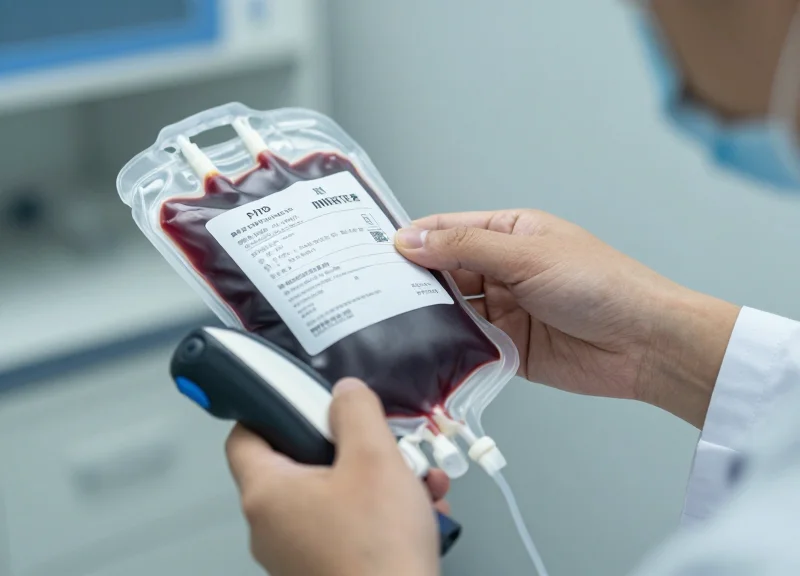
An RFID-enabled operational workflow for blood management replaces manual, error-prone scanning with an automated 'continuous custody' model. By embedding intelligence directly onto the blood bag, the system tracks every state change—from the moment of collection and component separation to temperature-controlled storage and final bedside cross-matching—eliminating the 'blind spots' inherent in traditional barcode-based systems.
- Phase 1: Intelligent Collection & Tagging: Upon donation, a high-durability RFID tag is applied. Initial donor data and the unique unit ID are encoded. Unlike barcodes, this tag can be read through cryo-wraps and biohazard bags without direct line-of-sight.
- Phase 2: Automated Component Processing: As bags move through centrifuges and separators, RFID portals track the transition from whole blood to plasma, platelets, or RBCs. The system automatically updates the 'product type' metadata on the tag and in the LIMS.
- Phase 3: Dynamic Inventory & Cold Chain Audit: Bags are placed in RFID-enabled refrigerators. The system performs a 'heartbeat' inventory count every 30 seconds. If a unit is misplaced or the temperature threshold is breached, the system triggers an immediate alert.
- Phase 4: Digital Cross-Matching & Dispatch: When a transfusion is ordered, the system 'lights up' the specific unit via an LED-tag or localized reader. The dispatch is recorded digitally, linking the unit to the transport courier's ID.
- Phase 5: Bedside 'Final Handshake' Verification: Before transfusion, the clinician uses a handheld RFID reader to scan the patient's wristband and the blood bag. The system performs a real-time 'handshake' to ensure 100% compatibility before the administration is authorized.
| Workflow Stage | Legacy Barcode Process | RFID-Optimized Process |
|---|---|---|
| Inventory Count | Manual scan of every bag (4-6 hours) | Automated real-time scan (30 seconds) |
| Search & Retrieval | Visual search by expiration date | Pick-to-light/Proximity guidance |
| Error Detection | Reactive (found after the error) | Proactive (alert triggered upon misplacement) |
| Data Capacity | Limited to ID number | Stores ID, Temp logs, and Status |
Expert Insight: The 'Shadow Audit' Advantage. A common pitfall in blood logistics is the 'ghost unit'—a bag that exists in the software but is physically missing. We recommend implementing a 'Shadow Audit' protocol where the RFID middleware constantly compares the physical shelf-state against the LIMS database. If a bag is removed without an active 'Issue' command, the system flags a 'Chain of Custody Violation' within seconds, preventing unauthorized movement or accidental wastage before the unit leaves the lab.
Does RFID interfere with blood quality during centrifugation?
No. Extensive studies have shown that passive UHF RFID tags do not emit ionizing radiation and do not affect the biochemical properties or temperature of blood components during high-speed centrifugation.
How does the system handle 'emergency release' protocols?
The workflow includes an 'Emergency Override' mode. The RFID tag is still scanned upon exit to maintain the audit trail, but the software bypasses standard cross-match checks to ensure life-saving speed while still documenting the unit's departure.
Can RFID tags survive -80°C plasma storage?
Yes, provided you use specialized cryogenic adhesives and inlay materials designed for extreme thermal expansion and contraction. Standard retail tags will fail; medical-grade cryo-tags are mandatory.
Mitigating Risks: Overcoming Liquid Interference and Data Security
Mitigating risks in RFID blood tracking requires a dual-pronged approach: neutralizing the 'liquid effect' through specialized tag design and antenna polarization, and hardening the data pipeline via end-to-end encryption to protect sensitive donor-patient links. Because blood consists of approximately 92% water, standard UHF RFID signals are easily absorbed, leading to missed reads; achieving 99.9% reliability necessitates the use of high-dielectric spacers or 'flag-tag' architectures that physically isolate the antenna from the liquid-filled bag. Simultaneously, data integrity must be maintained using ISO-compliant encryption to ensure that the digital twin of the blood product remains tamper-proof and private.
| Risk Category | Technical Challenge | Mitigation Strategy |
|---|---|---|
| Physical Interference | Signal absorption by blood plasma (Dielectric Constant) | Utilize 'Liquid-Flag' tags or spacers (3mm minimum) to create an air gap. |
| Data Privacy | Unauthorized sniffing of donor/patient IDs via air interface | Implement AES-128 bit encryption and Gen2V2 authentication protocols. |
| Data Integrity | Accidental or malicious overwriting of bag data | Locking User Memory banks with unique 32-bit access passwords. |
| Environmental Stress | Signal drift due to cryogenic temperatures (-80°C) | Frequency-tuned ICs specifically calibrated for low-temp conductivity. |
Expert Tip: Dynamic RSSI Thresholding. A common failure point in blood banks is 'leakage' reads from tags behind glass or inside neighboring refrigerators. We recommend implementing Dynamic RSSI (Received Signal Strength Indicator) filtering in the middleware. By analyzing the power return of a tag relative to the liquid volume density, the system can distinguish between a bag being actively processed and one simply existing in the background, significantly reducing 'ghost' inventory errors.
- Select Gen2V2 Compliant Hardware: Ensure all tags and readers support the EPCglobal Gen2V2 standard, which provides the cryptographic framework necessary for secure 'hide' and 'untraceable' commands.
- Implement Pointer-Based Data Architecture: Never store PII (Personally Identifiable Information) directly on the RFID tag. Store only a unique UII (Unique Item Identifier) that acts as a pointer to a secure, encrypted database record within the HIS/LIMS.
- Optimize Antenna Polarization: Use circularly polarized antennas in storage areas to capture tag signals regardless of the bag's orientation, as liquid interference is highly dependent on the angle of incidence.
How does moisture impact read rates?
Moisture creates a conductive path that detunes the RFID antenna. High-quality blood tracking tags use a specialized 'folded dipole' design to maintain resonance even in 100% humidity.
Is RFID data safe from hospital EMI?
Yes, high-end RFID readers use SAW (Surface Acoustic Wave) filters to isolate the 860-960 MHz band, preventing interference from MRI machines or other medical telemetry.
Can RFID tags be hacked?
While basic tags are vulnerable to cloning, using tags with a 'Permalock' feature and encrypted handshakes makes unauthorized duplication virtually impossible in a clinical setting.
ROI Analysis: The Business Case for RFID in Healthcare
The Business Case for RFID in healthcare is defined by a shift from reactive inventory management to proactive asset orchestration. By automating the tracking of blood bags with 99.9% reliability, healthcare facilities can expect a significant Return on Investment (ROI) derived from three primary pillars: a 25-40% reduction in product expiration (wastage), a 60% decrease in manual labor hours dedicated to inventory audits, and a drastic reduction in the Total Cost of Quality (TCoQ) by preventing adverse clinical events.
| Metric | Manual Baseline | RFID-Enabled Performance |
|---|---|---|
| Inventory Accuracy | 70% - 85% | 99.5% - 99.9% |
| Blood Waste Rate | 5% - 10% (Avg) | < 2% (Targeted) |
| Audit Labor Time | 4-6 Hours/Day | 15-30 Minutes/Day |
| Payback Period | N/A | 12 - 18 Months |
Expert Insight: The 'Hidden Capital' Advantage. Most ROI models focus solely on the cost of the tag versus the cost of a blood bag. However, the most significant financial gain often comes from reducing 'Safety Stock.' Because RFID provides real-time visibility, hospitals can safely reduce their on-site inventory buffers by 15% without increasing clinical risk. This release of tied-up capital often covers the initial hardware deployment costs in the first six months alone.
- Quantify Wastage Reduction: Calculate the annual cost of expired blood units. RFID alerts staff to 'first-to-expire' units (FEFO management), typically reducing discard rates by 30% minimum.
- Measure Labor Reallocation: Track the hours nurses and lab techs spend on manual reconciliations. RFID automation allows this high-cost labor to be redirected to direct patient care.
- Assess Liability and Risk Mitigation: Factor in the cost of a single 'wrong-blood-to-patient' event, which can exceed $1M in legal and corrective costs. RFID acts as a digital safety net, lowering insurance premiums.
- Evaluate Supply Chain Visibility: Account for the reduction in emergency 'stat' orders from central blood banks, which carry high courier and processing surcharges.
What is the typical cost per RFID tag in a blood tracking environment?
Specialized liquid-resistant passive UHF tags usually cost between $0.20 and $0.50, depending on volume. While higher than a barcode, the labor savings per scan cycle far outweigh this incremental cost.
Can RFID help with regulatory compliance costs?
Yes. RFID automates the data logging required for ISBT 128 and FDA compliance, reducing the administrative overhead of maintaining audit trails by nearly 90%.
What is the primary driver of CAPEX in an RFID rollout?
The primary costs are infrastructure-related, including fixed portal readers for refrigerators and the middleware required for HIS/LIMS integration. However, these are one-time costs compared to the recurring savings.