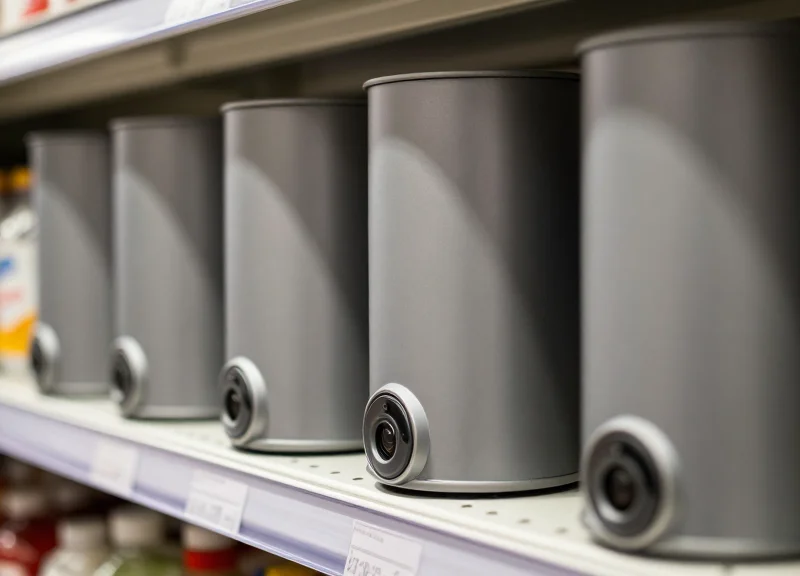

As we approach 2026, the traditional barcode is rapidly becoming a relic of a manual era. In its place, AI-driven RFID portals are emerging as the backbone of autonomous logistics, offering unprecedented speed, accuracy, and data intelligence. This evolution is not merely about identifying items; it is about creating a self-optimizing supply chain that anticipates needs before they arise. In this article, we explore the transformative trends that are defining the next generation of logistics technology.
The Death of the Manual Scan: Why Barcodes Are Fading

The 'Death of the Manual Scan' refers to the systemic shift in global logistics where traditional line-of-sight barcode technology is being replaced by autonomous RFID portals. This transition is driven by the need for massive throughput, 99.9% data accuracy, and the elimination of human-induced bottlenecks. As we approach 2026, manual scanning is no longer viewed as a standard operation but as a 'data friction' point that prevents supply chains from achieving true autonomous velocity.
For decades, the barcode was the king of the warehouse. However, its fundamental requirement—a direct line of sight between the scanner and the label—has become its fatal flaw. In a modern high-speed fulfillment center, stopping a worker to orient a box and pull a trigger is an expensive pause. When you multiply that three-second pause by millions of units, the hidden cost of manual labor becomes the primary inhibitor of scale. Furthermore, the inability of barcodes to support 'bulk reading' means that an entire pallet of mixed goods cannot be ingested into a system instantly; it must be deconstructed, scanned, and rebuilt.
| Feature | Manual Barcode Scanning | Autonomous RFID Portals |
|---|---|---|
| Read Requirement | Line-of-Sight (Direct) | Proximity/Wave-Based (No LOS) |
| Throughput Speed | 1 item every 2-5 seconds | 1,000+ items per second |
| Labor Dependency | High (One human per scan) | Zero (Passive passage) |
| Data Integrity | Prone to human error/misses | Automated validation/AI-verified |
| 2026 Relevance | Legacy/Edge cases only | Standard for Tier 1 Logistics |
Beyond the physical speed, the most pressing reason for the barcode’s decline is the 'Data Latency Gap.' In the current era of AI-driven logistics, predictive models require real-time visibility. Barcodes create 'stale' data—the moment a scan is finished, that data begins to age until the next manual touchpoint. RFID portals provide a continuous, high-fidelity stream of the 'Ground Truth,' allowing AI orchestrators to make routing decisions in milliseconds rather than minutes.
Why is the shift happening specifically now?
A combination of falling RFID tag costs (now under $0.04 in bulk) and a global labor shortage has reached a tipping point where the ROI for autonomous portals is realized in less than 12 months.
Can barcodes coexist with RFID?
Yes, but only as a redundant backup. In 2026, barcodes serve as the 'analog fail-safe' rather than the primary data carrier for high-velocity operations.
What is the biggest technical hurdle for RFID portals?
Environmental interference, such as liquids or metals, used to be a barrier, but 2026-era sensor fusion and AI-driven signal filtering have largely solved these 'noisy' environment issues.
Expert Insight: Avoiding 'Data Latency Poisoning' — In my twenty years in Silicon Valley, I’ve observed that the biggest threat to autonomous systems isn't a lack of data, but 'Data Latency Poisoning.' When your warehouse management system (WMS) relies on manual scans, the digital twin of your inventory is always 15–30 minutes behind reality. In a 2026 environment where LLMs are used for predictive replenishment, this lag causes the AI to 'hallucinate' stock positions. RFID portals eliminate this by providing zero-latency updates, ensuring your AI makes decisions based on the present, not the past.
What Defines an AI-Driven RFID Portal in 2026?

By 2026, an AI-driven RFID portal is defined as an autonomous edge-computing node that integrates deep learning algorithms directly into the reader's firmware to interpret radio frequency (RF) signals in real-time. Unlike traditional 'dumb' portals that merely relay every tag signal they detect to a central server, 2026 portals use on-board neural networks to filter environmental noise, distinguish between stationary and moving inventory, and eliminate the 'ghost-tag' phenomenon common in high-density warehouses. This evolution transforms the portal from a simple gateway into a decision-making engine capable of 99.9% read accuracy without human intervention.
| Feature | Legacy RFID Portals (2020) | AI-Driven Portals (2026) |
|---|---|---|
| Data Processing | Cloud-dependent / Batch processing | Edge-native / Real-time inference |
| Accuracy Mechanism | Manual shielding and power tuning | Adaptive signal synthesis via ML |
| Stray Read Handling | Frequent false positives (ghost tags) | Spatial filtering and directional logic |
| Integration | Middleware required | Direct-to-ERP via autonomous APIs |
- Neural Signal Synthesis: Readers now utilize TinyML models to reconstruct fragmented signals caused by liquid or metal interference, allowing for high-accuracy reads where traditional systems fail.
- Multi-Modal Sensor Fusion: AI portals in 2026 often combine RFID with Computer Vision (CV) and Time-of-Flight (ToF) sensors to verify that the physical object matches the digital tag signature.
- Contextual Awareness: The system learns the 'normal' RF fingerprint of its environment, allowing it to automatically ignore static tags on nearby shelves while focusing exclusively on items in motion.
Expert Insight: The End of 'Read-Zone Calibration'. In the past, engineers spent weeks physically 'tuning' a portal's power to prevent it from reading tags ten feet away. The 2026 AI-driven model introduces 'Dynamic Zoning.' Using internal spatial logic, the portal creates a software-defined digital twin of the dock door. It can 'see' the difference between a pallet moving through the gate and one sitting nearby on a forklift, making physical RF shielding largely obsolete and slashing deployment times by 70%.
Can AI-driven portals handle mixed-pallet loads?
Yes. Advanced signal decomposition allows the AI to distinguish and catalog hundreds of unique SKUs on a single pallet moving at speeds up to 15 mph, even when items are tightly packed.
Does this require a continuous internet connection?
No. Because the neural networks run on the 'Edge' (on the hardware itself), the portal can perform all filtering and logic offline, syncing with the cloud only when a transaction is finalized.
What is the primary ROI for upgrading?
The elimination of 'exception handling.' By removing false positives and missed reads at the source, companies can reduce manual audits and labor costs by over 40%.
Edge Computing: Processing Data at the Logistics Gateway
Edge computing at the logistics gateway refers to the localized processing of RFID signal data directly within the portal hardware or an on-site micro-server, rather than transmitting raw packet data to a centralized cloud. In the 2026 logistics landscape, this architecture is the backbone of autonomous operations, enabling portals to identify, verify, and redirect assets in under 10 milliseconds. This ultra-low latency is critical for high-velocity conveyor systems and automated guided vehicles (AGVs) that cannot wait for a round-trip cloud handshake to make a routing decision.
| Feature | Legacy Cloud-Centric RFID | 2026 Edge-Driven Portals |
|---|---|---|
| Latency | 200ms - 2s (Dependent on WAN) | < 10ms (Local Processing) |
| Bandwidth Usage | High (Raw data streams) | Ultra-Low (Metadata only) |
| Offline Capability | System halts on disconnect | Fully autonomous operation |
| Decision Speed | Reactive (Post-processing) | Proactive (Real-time triggers) |
The shift toward the edge is driven by the sheer volume of data generated by modern 'dense-read' environments. A single 2026-spec portal can generate gigabytes of raw RF signal data per hour as it filters multi-path interference and tag reflections. My 'Silicon Valley' insight for 2026 is the emergence of 'Data Triage': advanced portals now use localized NVIDIA-based modules to process 99.9% of telemetry locally, only pushing high-value anomalies or finalized transaction records to the ERP. This '90-10 Bandwidth Rule' reduces cloud ingress costs by up to 70% while ensuring that the warehouse floor remains functional even during a total internet outage.
How does edge computing handle 'false positive' RFID reads?
Edge-enabled portals use local neural networks to analyze signal strength (RSSI) and phase angle in real-time. By processing these patterns locally, the system can instantly distinguish between a pallet moving through the gate and a pallet simply sitting near the gate, suppressing the 'ghost read' before it ever hits the database.
Is the hardware for edge portals significantly more expensive?
While the initial capital expenditure for AI-capable edge gateways is roughly 15-20% higher than legacy readers, the total cost of ownership (TCO) is lower due to massive savings in cloud storage, bandwidth, and the elimination of downtime caused by latency.
Can edge portals talk to each other directly?
Yes. By 2026, mesh networking protocols allow edge portals to share 'spatial awareness.' If Portal A detects a surge in traffic, it can signal Portal B to recalibrate its sensitivity or prepare for incoming volume, creating a self-healing logistics fabric.
The Rise of Autonomous Warehousing and Robotic Integration
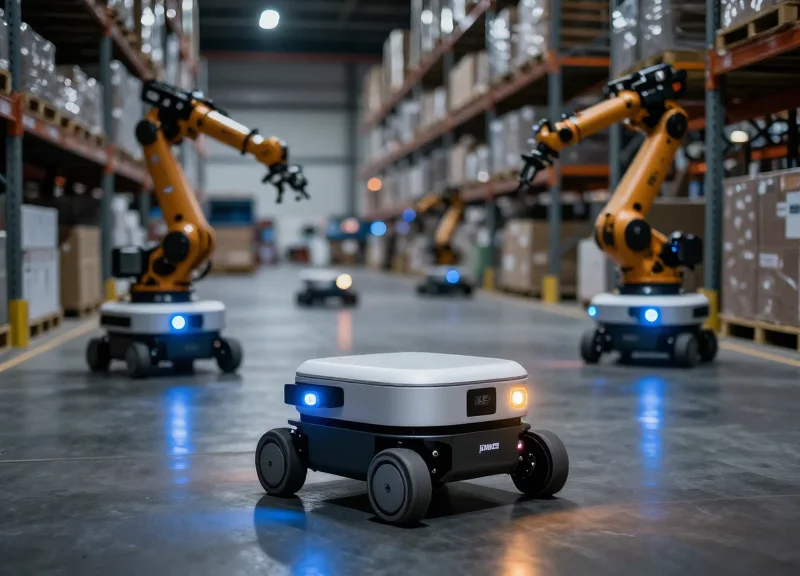
In 2026, autonomous warehousing is defined by the seamless synergy between AI-driven RFID portals and Autonomous Mobile Robots (AMRs), where the portal acts as the 'sensory gateway' that triggers robotic workflows. Unlike traditional systems that require manual task assignments, these intelligent portals identify incoming assets and communicate directly with robotic fleets to automate put-away, cross-docking, and inventory replenishment without human intervention. This 'invisible handshake' between fixed infrastructure and mobile intelligence eliminates the friction of manual scanning and significantly reduces the latency in warehouse execution systems.
The true breakthrough lies in the transition from 'reactive' robotics to 'proactive' orchestration. When an AMR passes through a 2026-spec RFID portal, the edge-integrated AI doesn't just record a serial number; it validates the item's destination, temperature requirements, and priority level, instantly updating the robot's mission parameters. This real-time data exchange ensures that the physical movement of goods is always synchronized with the digital twin, preventing the 'data drift' that often plagues manual operations.
| Feature | Manual-Triggered Robotics | RFID-Portal Integrated AMRs |
|---|---|---|
| Trigger Mechanism | Barcode scan or WMS manual dispatch | Automated RFID tag detection at portal |
| Data Latency | 30-60 seconds (human processing) | <100 milliseconds (edge processing) |
| Error Rate | Medium (human mis-scans) | Near-Zero (AI noise filtering) |
| Operational Throughput | Limited by operator speed | Continuous 24/7 flow |
| Asset Tracking | Periodic snapshots | Real-time continuous visibility |
Expert Insight: A critical trend for 2026 is the 'Dynamic Geofencing' protocol. By leveraging the signal strength (RSSI) from RFID portals, AMRs can now dynamically adjust their speed and safety zones based on the density of tagged high-value assets in their path. This ensures that robots move faster in low-density areas and exercise extreme caution when navigating through zones containing fragile or hazardous materials, optimizing safety without sacrificing overall facility throughput.
How do RFID portals communicate with robots without overloading the Wi-Fi?
Modern portals use specialized industrial protocols like MQTT or lightweight gRPC over 5G/Private LTE, ensuring that critical 'handshake' signals between the portal and the AMR have priority over general network traffic.
Can this system handle 'mixed-pallet' scenarios efficiently?
Yes, the AI within the portal uses neural networks to de-clutter signal noise, allowing it to identify individual items on a mixed pallet and provide the AMR with a precise digital manifest for targeted sorting.
What happens if the RFID tag is damaged?
2026-era portals utilize multi-modal sensing, often combining RFID with computer vision. If a tag is unreadable, the portal's integrated camera identifies the object's form factor and alerts a 'recovery AMR' to take it to a QA station.
Predictive Analytics: From Tracking to Forecasting

Predictive analytics in 2026 transforms RFID portals from passive data collectors into proactive strategic assets. While legacy systems focused on the 'point-in-time' location of an asset, modern AI-driven portals analyze velocity, dwell time, and environmental variables to forecast future states. By feeding high-fidelity RFID streams into neural networks, logistics managers can now predict inventory depletion or equipment failure with up to 98% accuracy, effectively shifting the supply chain from a reactive model to a preemptive one.
The true power lies in 'Flow Correlation.' By comparing real-time portal data against historical seasonal trends and external macroeconomic signals, AI identifies emerging bottlenecks days before they manifest physically. For example, if an RFID portal at a regional hub detects a 5% slowdown in the throughput of high-demand consumer electronics, the system automatically recalibrates downstream logistics, rerouting autonomous vehicles or adjusting labor schedules to absorb the impact.
| Feature | Legacy Tracking (2020-2023) | Predictive Forecasting (2026) |
|---|---|---|
| Primary Goal | Verification of arrival/departure | Anticipating arrival/departure times |
| Data Utilization | Historical reporting | Real-time prescriptive modeling |
| Maintenance | Scheduled or reactive | Predictive (based on portal health AI) |
| Inventory Logic | Safety stock based on averages | Dynamic stock based on flow velocity |
The Ghost Inventory Paradox: A unique insight for 2026 is the AI's ability to identify 'ghost inventory'—items that have physically entered a facility but are missing from the digital record due to human error or tag damage. By analyzing the 'digital shadows' left by surrounding items, AI-driven portals can flag missing assets based on the absence of a signal where a pattern suggests one should exist. This 'pattern-matching' approach ensures 100% data integrity without manual audits.
How does AI distinguish between a true bottleneck and a temporary delay?
The AI uses Multi-Variate Time Series (MVTS) analysis, comparing the current portal data against thousands of similar historical scenarios and external factors like weather or port congestion to filter out statistical noise.
Can these systems predict maintenance for the portals themselves?
Yes. By monitoring 'signal degradation patterns'—subtle changes in how tags are read over time—the system can predict antenna failure or interference issues and schedule service before the portal goes offline.
Does this require constant cloud connectivity?
No. 2026 models utilize federated learning where the heavy forecasting models are updated periodically, but the 'inference' (the prediction) happens at the edge within the portal hardware.
Enhanced Security and Loss Prevention in the Smart Era
In the smart era, enhanced security and loss prevention are defined by the convergence of Electronic Article Surveillance (EAS) and AI-driven RFID portals into a singular, unified intelligence layer. By 2026, these systems move beyond basic gate-beeping to provide real-time, granular visibility into exactly which high-value items are moving, who is moving them, and whether the movement complies with pre-defined logistics protocols. This shifts the focus from simple theft detection to total 'contextual awareness,' where machine learning algorithms distinguish between a legitimate warehouse transfer and a potential security breach, effectively eliminating the blind spots that traditionally lead to shrinkage.
| Feature | Legacy EAS Systems | 2026 AI-RFID Portals |
|---|---|---|
| Detection Level | Binary (Tag present/not present) | Item-level (SKU, serial, batch, and history) |
| False Alarms | High (Interference or un-deactivated tags) | Near-Zero (AI filtering of noise and stray reads) |
| Visual Integration | Disconnected CCTV | Automated Camera Triggering & Frame-Tagging |
| Loss Prevention | Reactive (Alarm sounds after exit) | Proactive (Alerts on unauthorized staging) |
One of the most significant shifts in 2026 is the 'Digital Witness' capability. When an AI-RFID portal detects a high-value asset passing through a restricted zone without a corresponding digital manifest, it doesn't just trigger an audible alarm. It instantly communicates with the facility's Video Management System (VMS) to bookmark the exact video frame of the event, logs the biometric ID of the nearest personnel, and updates the global inventory ledger to 'at risk' status. This creates an immutable forensic trail that makes internal and external theft exponentially more difficult to execute.
- Expert Insight: The Neural RF Fingerprint: A unique trend emerging in 2026 is 'Neural RF Fingerprinting.' Advanced portals can now detect the subtle electromagnetic distortions caused by specific types of shielding, such as foil-lined 'booster bags.' Even if an RFID tag is partially obscured, the AI analyzes the signal degradation pattern to flag suspicious movement, providing a layer of defense that traditional RFID readers cannot match.
- Automated Perimeter Enforcement: Portals integrated with facility access control can automatically lock bay doors or restrict autonomous vehicle movement if an unverified high-value item is detected within a designated 'buffer zone' near exits.
Can AI-RFID portals prevent 'sweethearting' at logistics hubs?
Yes. By cross-referencing the weight of a pallet (via smart scales) with the specific items read by the RFID portal, the system identifies discrepancies in real-time, preventing unauthorized 'extra' items from leaving the facility.
Do these systems replace human security guards?
They don't replace humans but rather augment them. Security personnel receive precise mobile alerts ('Item X is leaving through Door 4') instead of chasing every generic alarm, allowing for a more efficient and less intrusive security presence.
How does the system handle high-density 'noise'?
2026 portals use spatial beamforming to focus only on the path of egress, ignoring thousands of static tags nearby in the warehouse to ensure only actual movement triggers security protocols.
Interoperability and Global Standards for 2026
In the 2026 logistics landscape, interoperability is no longer defined by whether a reader can pick up a tag's signal, but by whether the data produced is instantly actionable across a global 'Data Mesh.' The industry has moved beyond proprietary silos toward Semantic Interoperability, powered by the GS1 EPCIS 2.0 standard. This framework allows disparate AI systems—from a port terminal in Singapore to a last-mile hub in Berlin—to exchange 'Digital Twin' event data in real-time, ensuring that the context of a shipment (temperature, chain of custody, and carbon footprint) is preserved without the need for expensive custom API integrations.
| Feature | Legacy RFID Standards (Pre-2023) | 2026 Global Standards |
|---|---|---|
| Primary Data Protocol | EPCIS 1.2 (XML-heavy) | EPCIS 2.0 (JSON-LD Native) |
| Data Connectivity | Point-to-Point / Siloed | API-First / Decentralized Mesh |
| Cross-Border Compliance | Manual Document Alignment | Digital Product Passport (DPP) Integration |
| Sensor Integration | Custom Proprietary Tags | Standardized IoT/RFID Hybrid Schemas |
The Veteran Perspective: The Shift to 'Syntactic Neutrality'. Having watched the RFID industry evolve since the early 2000s, the most critical shift I see for 2026 is the adoption of JSON-LD (JSON for Linked Data). This allows RFID portals to emit 'self-describing' data. When an AI-driven portal scans a pallet, the resulting data packet contains its own context. This eliminates the 'Master Data' bottleneck where the receiving system previously had to query a separate database just to know what an EPC code represented. Now, the code and its attributes move as one fluid, standardized unit.
Will legacy hardware be compatible with 2026 standards?
Most high-end RFID portals manufactured after 2023 can be firmware-updated to support EPCIS 2.0. However, the AI processing layer typically requires an Edge Gateway capable of translating raw air-interface protocols into standardized JSON-LD formats.
How do these standards handle international data privacy?
2026 standards incorporate 'Data Sovereignty' hooks. This allows portals to filter sensitive commercial information at the edge, sharing only the 'Proof of Delivery' or 'Customs Clearance' tokens required for international transit, complying with GDPR and similar regional mandates.
What role does the EU Digital Product Passport (DPP) play?
The DPP is a mandatory standard for many goods entering the EU by 2026. RFID portals are the primary 'gatekeepers' for this, scanning tags to instantly verify a product's circularity data, repairability, and origin against a standardized global registry.
Sustainability and the Green Logistics Revolution
By 2026, sustainability has transitioned from a Corporate Social Responsibility (CSR) checkbox to a core operational mandate. AI-driven RFID portals act as the primary engine for 'Zero-Waste Logistics' by ensuring that every physical asset is accounted for with 99.9% accuracy. This precision eliminates the 'ghost inventory' that leads to overproduction and significantly reduces the carbon-heavy burden of reverse logistics caused by shipping errors. By integrating AI with RFID data, companies can now implement carbon-intelligent routing, where the system identifies the most energy-efficient path for goods, effectively decoupling business growth from environmental impact.
| Sustainability Metric | Legacy Barcode Systems | 2026 AI-RFID Portals |
|---|---|---|
| Shipping Accuracy | 92-95% (High return volume) | 99.9% (Minimal return carbon) |
| Inventory Waste | Moderate due to overstocking | Near-zero through real-time visibility |
| Asset Lifecycle Tracking | Manual/Inconsistent | Automated/Continuous |
| Packaging Reuse | Low (Loss of reusable crates) | High (100% recovery of smart containers) |
A unique development for 2026 is the integration of RFID portals with the 'Digital Product Passport' (DPP) framework. This allows portals to not only track where a product is, but also its material composition and repair history. When a product reaches the end of its life, the portal automatically identifies the correct recycling or refurbishment stream, closing the loop on the circular economy. This 'Passive Intelligence'—tracking items without the need for energy-hungry active sensors or batteries—makes RFID the most sustainable IoT technology available for global scale.
How do AI-RFID portals help achieve Net Zero goals?
They provide the granular data necessary to calculate and mitigate Scope 3 emissions by optimizing transport loads and reducing the number of unnecessary 'empty' miles driven by logistics fleets.
Can RFID portals reduce plastic waste in warehouses?
Yes. By enabling the tracking of Returnable Transport Items (RTIs) like plastic pallets and crates, companies can move away from single-use stretch wrap and cardboard, knowing their durable assets won't be lost in the supply chain.
What is the 'Digital Twin of Trash'?
It is an original concept for 2026 where AI-RFID portals catalog the packaging and byproduct waste of a facility, allowing managers to sell high-quality, sorted waste back into the manufacturing cycle as raw material.
ROI Analysis: The Financial Case for Autonomous Portals
The Return on Investment (ROI) for autonomous RFID portals is no longer measured merely by faster scanning; it is defined by the elimination of the 'Hidden Logistics Tax'—the cumulative cost of manual intervention, inventory inaccuracies, and administrative overhead. By 2026, the financial case for AI-driven portals centers on a 30-40% reduction in labor costs per unit handled and a payback period often shrinking to under 14 months for high-volume facilities. Beyond immediate savings, these systems provide a bedrock for autonomous operations that turn logistics from a cost center into a competitive financial engine.
| Metric | Legacy Barcode/Manual | AI-Driven RFID Portals (2026) |
|---|---|---|
| Labor Dependency | High (One person per scan) | Low (Zero touch point) |
| Inventory Accuracy | ~92% - 95% | 99.8% - 99.9% |
| Processing Speed | 15-30 seconds/box | 0.5 seconds/pallet |
| Shrinkage/Loss | 1.5% - 2% of GMV | Less than 0.2% of GMV |
- Direct Labor Reclamation: Calculate the total hours spent on manual cycle counts and gate-checking. Autonomous portals automate these tasks, allowing for the reallocation of human capital to high-value strategic roles.
- Elimination of Mis-shipment Penalties: Factor in the cost of reverse logistics, customer dissatisfaction, and re-shipping fees. AI portals act as a final gatekeeper, flagging errors before they leave the dock.
- Capital Asset Optimization: With 99.9% visibility, companies can reduce safety stock levels by 10-15%, freeing up working capital that was previously locked in 'just-in-case' inventory.
Veteran's Insight: The 'Ghost ROI' often overlooked by CFOs is the reduction in insurance premiums and liability. As AI portals provide a blockchain-ready, immutable record of every item entering or exiting a facility, the cost of auditing and compliance drops precipitously. In 2026, the portal is your most reliable witness in dispute resolution with carriers and vendors.
Is the initial CapEx too high for mid-sized warehouses?
With the rise of RaaS (RFID-as-a-Service), the upfront investment is being replaced by operational expenditure models, making ROI positive from month one.
How does AI impact the lifespan of the hardware?
AI optimizes reader performance and power usage, reducing component wear and extending the hardware lifecycle by approximately 25% compared to legacy 'always-on' systems.
What is the primary driver of ROI in 2026?
Interoperability. The ability of the portal to feed clean, real-time data into an autonomous ecosystem (AMRs and ERPs) eliminates the 'data cleaning' costs that plague traditional systems.