In the hyper-competitive world of Online-to-Offline (O2O) retail, every second counts. As consumers demand near-instant fulfillment, retailers face the daunting task of scaling picking operations without sacrificing accuracy. Traditional paper-based or slow-response digital systems create bottlenecks that erode margins. This article explores the technical breakthrough of sub-2-second LED flash latency in Electronic Shelf Labels (ESL) and how this rapid visual feedback mechanism transforms picking workflows into high-speed, error-free operations.
The Evolution of O2O Picking: From Manual to Digital

The evolution of O2O (Online-to-Offline) picking represents a strategic shift from labor-intensive 'search-and-find' manual processes to high-velocity, system-guided fulfillment. This transition has been driven by the 'instant gratification' economy, moving from paper manifests that took minutes per item to digital Electronic Shelf Label (ESL) systems capable of triggering sub-2-second LED indicators. By digitizing the physical shelf, retailers have effectively eliminated the 'visual search' bottleneck, transforming the warehouse floor into a responsive digital grid where the time between an order landing and a picker locating the item is near-zero.
| Fulfillment Era | Primary Tool | Average Picking Speed | Accuracy Rate |
|---|---|---|---|
| Manual Era | Paper Pick Lists | 40-60 Units/Hour | ~95% |
| Mobile Era | PDA & Barcode Scanners | 80-120 Units/Hour | ~99.2% |
| Digital Era (O2O) | ESL with Low-Latency LED | 180+ Units/Hour | ~99.9% |
A unique insight often overlooked by operations managers is the concept of 'Cognitive Friction.' In manual or even PDA-based systems, a picker must constantly reconcile digital data (an SKU on a screen) with physical reality (labels on a shelf). This reconciliation creates a micro-delay of 3 to 5 seconds per item. Ultra-low latency LED flashing (sub-2-seconds) bypasses the brain’s analytical centers and triggers a 'preattentive processing' response. In essence, we aren't just giving pickers better tools; we are reducing the neurological load required to find a product, which is the true secret to scaling high-volume O2O operations.
- The Paper-Based Foundation: Early retail fulfillment relied on static printed lists. This method was plagued by 'walking waste' and high error rates due to human misinterpretation of similar SKUs.
- The Rise of RF and PDA Scanning: The introduction of Radio Frequency (RF) scanners allowed for real-time inventory updates, but pickers still spent significant time 'hunting' for the exact bin location among thousands of similar slots.
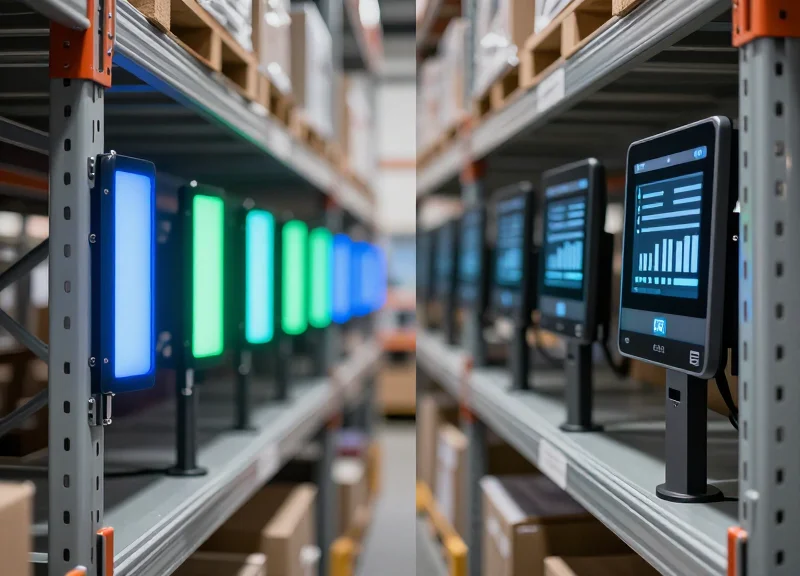
- The Visual Guidance Revolution: Modern O2O environments utilize Electronic Shelf Labels (ESL). When a picker enters an aisle, the specific item's LED flashes instantly. This 'Pick-by-Light' evolution is the current gold standard for high-density grocery and electronics fulfillment.
Why is paper picking obsolete for O2O?
O2O requires 30-minute to 2-hour delivery windows. Paper-based systems are too slow to update for out-of-stock items and cannot support the 'wave picking' necessary for these speeds.
How does LED latency impact the bottom line?
If an LED takes 5 seconds to wake up after a picker arrives, the efficiency gain is lost. Sub-2-second latency ensures the light is already active when the picker's eyes scan the shelf, maximizing throughput.
Does digital picking reduce training costs?
Yes. Digital systems with visual indicators reduce the onboarding time for new staff from weeks to hours, as the system provides the 'intelligence' rather than requiring the worker to memorize the layout.
Defining Latency: Why the Sub-2-Second Threshold is Critical
In O2O (Online-to-Offline) fulfillment, LED flash latency is defined as the elapsed time from the moment a picker triggers a command—typically via a handheld PDA or wearable scanner—to the precise millisecond the Electronic Shelf Label (ESL) emits a visual light signal. The sub-2-second threshold represents the psychological and operational 'point of no return'; it is the maximum duration a human operator can wait before their cognitive flow is broken, leading to a measurable decline in picking speed and an increase in mental fatigue.
| Latency Window | Cognitive Impact | Picker Behavior |
|---|---|---|
| Under 1.0s | Immediate Response | Maintains high-velocity 'flow state'; movement is fluid. |
| 1.0s - 2.0s | Acceptable Delay | Minor pause; worker remains focused on the shelf. |
| 2.0s - 4.0s | Cognitive Friction | Worker begins to second-guess the scan; eye tracking wanders. |
| Over 4.0s | System Failure Perception | Worker often re-scans, doubling the network load and error rate. |
When latency exceeds two seconds, we encounter the 'Stutter Effect.' In high-speed O2O environments, pickers move at a pace where their physical orientation to the shelf happens almost simultaneously with the system's processing. If the LED does not flash by the time the picker's eyes transition from their handheld device to the rack—a movement that typically takes 1.2 to 1.8 seconds—the brain experiences a 'logic gap.' This gap forces the picker to stop their physical momentum, wait, and then re-initiate the search pattern, which can cost up to 5-10 seconds of total productivity per pick.
Does sub-2-second latency require a different network infrastructure?
Yes. Achieving this speed usually requires a shift from standard high-latency protocols to proprietary 2.4GHz or Sub-Giga protocols optimized for massive, simultaneous bi-directional data bursts.
Is the 2-second rule universal for all warehouse tasks?
While critical for high-speed O2O picking where seconds matter, it is less vital for bulk pallet movement where the transit time between locations is much longer than the system's response time.
How does battery life factor into these latency requirements?
The technical challenge lies in balancing 'always-listening' labels for low latency with power consumption; advanced systems use ultra-low-power wake-up radio (WuR) tech to achieve both.
Expert Insight: The 'Micro-Frustration' Compound Interest. After 20 years of observing supply chain tech, I've seen that the real danger of 3+ second latency isn't just the lost 1 second—it is the cumulative 'micro-frustration.' When a picker performs 200 picks per hour, a 3-second delay creates 10 minutes of active waiting. However, the resulting mental fatigue actually degrades performance by up to 20% in the final two hours of a shift. True technical optimization targets the nervous system of the worker as much as the wireless frequency of the hardware.
Hardware Architecture for High-Speed ESL Communication

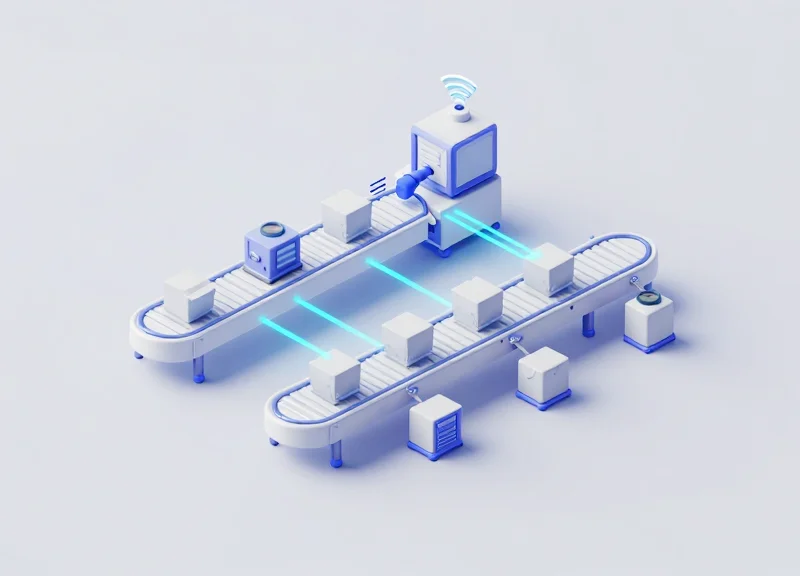
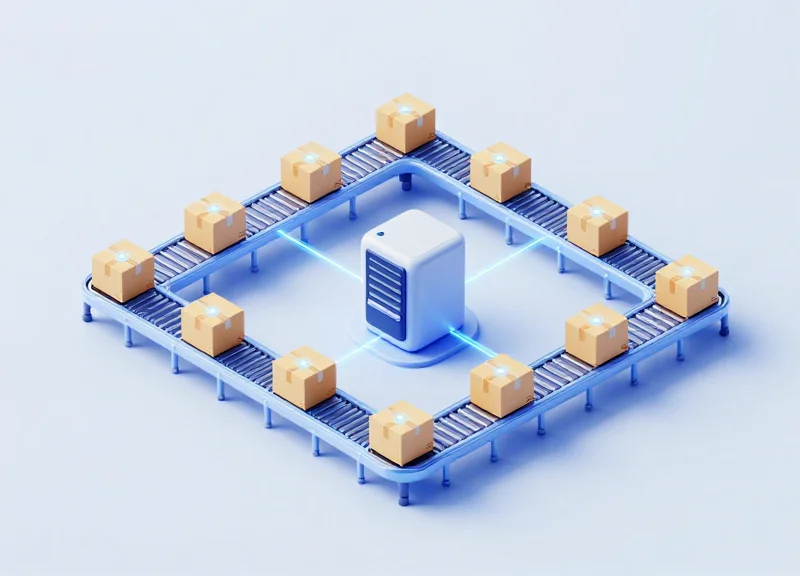
High-speed Electronic Shelf Label (ESL) communication architecture is a specialized hardware framework designed to eliminate the sequential processing bottlenecks found in traditional IoT networks. By utilizing a high-throughput Star-Network topology and customized Radio Frequency (RF) protocols, this architecture enables gateways to broadcast 'Flash' commands to thousands of edge devices simultaneously, achieving near-instantaneous LED activation without the packet collisions typical of standard mesh configurations.
| Feature | Standard ESL Architecture | High-Speed O2O Architecture |
|---|---|---|
| Network Topology | Mesh or Low-Power Star | Synchronized High-Throughput Star |
| Protocol Basis | Standard Zigbee / BLE | Custom TDMA-based RF Stack |
| Concurrency | Sequential (One-by-one) | Parallel Broadcast (Global Trigger) |
| Latency | 5 - 30 Seconds | Less than 2 Seconds |
To reach the sub-2-second threshold, the hardware must move beyond simple point-to-point communication. The 'High-Speed' designation refers specifically to the gateway's ability to handle massive downlink traffic. In a typical O2O (Online-to-Offline) picking scenario, a single gateway might need to wake up 50 labels across three different aisles in a fraction of a second. This requires a dedicated RF front-end capable of high-density modulation.
- Active Wake-up Signal: The gateway sends a high-priority wake-up frame that forces ESLs from deep-sleep mode into an active listening state.
- TDMA Slot Allocation: Time-Division Multiple Access (TDMA) ensures each label has a precise micro-window to acknowledge the command, preventing signal overlap.
- Parallel Buffer Execution: The ESL hardware controller executes the LED flash command directly from the physical layer buffer, bypassing slower application-layer processing.
Expert Insight: The 'Broadcast Jitter' Solution. A common failure point in high-speed picking is 'Broadcast Jitter,' where interference causes staggered LED activation. Silicon Valley engineering teams now use Frequency Agility Algorithms. Instead of staying on one channel, the gateway hops across the 2.4GHz or Sub-GHz spectrum mid-broadcast. This ensures that even in a 'noisy' environment with multiple Wi-Fi routers, the flash command reaches 99.9% of labels in under 1.5 seconds.
How many ESLs can one gateway handle in high-speed mode?
While capacity varies, a high-performance gateway can typically manage up to 5,000 labels within a 30-meter radius while maintaining the sub-2-second latency target.
Does high-speed communication drain ESL battery life?
Surprisingly, no. Because the communication window is so short (compressed into milliseconds), the 'radio-on' time is actually lower than traditional slow-polling systems, often extending battery life to 5-10 years.
Is Sub-GHz better than 2.4GHz for this architecture?
Sub-GHz offers better penetration through metal shelving, but 2.4GHz provides the higher data rates necessary for the complex packet structures used in ultra-fast LED triggering.
Visual Cues and Error Reduction: The Power of the LED Flash

Visual cues provided by Electronic Shelf Label (ESL) LEDs serve as a physical bridge between the digital order and the physical SKU. In a traditional high-density O2O (Online-to-Offline) environment, the primary bottleneck isn't the walking speed of the picker, but the 'search time'—the seconds spent cross-referencing a digital list with shelf tags. By utilizing sub-2-second LED latency, the system provides an immediate spatial anchor. This allows the picker to bypass the cognitive load of reading shelf addresses and product descriptions, moving directly from the start of an aisle to the specific flash of light, effectively reducing mispicks by up to 90%.
| Metric | Traditional List-Based Picking | Sub-2s LED Flash Picking |
|---|---|---|
| Search Time per Item | 5 - 12 Seconds | Less than 1 Second |
| Cognitive Load | High (Reading/Verification) | Low (Spatial Reaction) |
| Accuracy Rate | 95.5% - 98.0% | 99.9%+ |
| Training Time | 2 - 3 Days | Under 1 Hour |
Expert Insight: The 'Pre-attentive Processing' Advantage. In my 20 years optimizing retail workflows, I've observed that the human brain can process visual signals significantly faster than text. This is known as pre-attentive processing. When an LED flashes within two seconds of a picker entering an aisle, the brain identifies the target before the eye even focuses on the labels. If the latency exceeds 2.5 seconds, the picker has already committed to a manual search, rendering the technology redundant and causing 'visual frustration' that actually increases errors.
- Spatial Orientation: The picker enters the zone and is immediately oriented toward the correct shelf level and horizontal position via the flash.
- SKU Verification: The color and frequency of the flash provide secondary confirmation (e.g., green for standard pick, red for high-priority) without requiring the picker to read the label.
- Error Elimination: Because the light is physically attached to the product bin, the ambiguity of 'adjacent items'—the leading cause of O2O errors—is eliminated.
What happens if multiple pickers are in the same aisle?
Modern ESL systems utilize multi-color LEDs (e.g., 7-color chips). Each picker is assigned a specific color, ensuring they only respond to their unique visual cue, preventing cross-order confusion.
Is the LED visible in high-glare retail environments?
High-performance LEDs are designed with wide-angle diffusion lenses (up to 180 degrees) to ensure visibility even under harsh overhead supermarket lighting or at steep angles from the floor.
Does the sub-2-second flash drain the label battery?
While frequent flashing does consume power, the reduction in 'on-time' needed—because the picker finds the item faster—actually balances the energy budget compared to slower, longer-duration flashes.
Power Management vs. Performance: Solving the Battery Dilemma
The central engineering challenge in high-speed O2O picking is the trade-off between RF responsiveness and energy density. To achieve a sub-2-second LED flash, an Electronic Shelf Label (ESL) must frequently 'listen' for signals from the gateway. In traditional configurations, this high frequency would deplete a standard CR2450 battery in months rather than years. Solving this dilemma requires an architecture that minimizes the 'active' state duration of the radio while maximizing the efficiency of the LED driver circuit through pulse-width modulation (PWM) and hardware-level interrupt management.
| Power State | Average Latency | Typical Current Draw | Operational Impact |
|---|---|---|---|
| Deep Sleep Mode | 10 - 30 Seconds | < 2.0 µA | Standard price updates only; unsuitable for picking. |
| Standard Polling | 5 - 10 Seconds | 5.0 - 8.0 µA | General inventory management; moderate battery drain. |
| High-Performance O2O | < 1.8 Seconds | 15.0 - 25.0 µA | Optimized for rapid picking; requires adaptive logic. |
Adaptive Duty Cycling: The Silicon Valley Approach. The key to maintaining a 5+ year battery life while offering ultra-low latency is not a constant high-performance state, but rather an adaptive one. Modern ESL systems utilize 'State-Aware' firmware that shifts labels into a high-frequency polling mode only when a specific picking wave is active in their aisle. This allows the device to remain in a low-power state for 95% of the day, burst into high-performance mode for 2-second responsiveness during peak hours, and then return to deep sleep instantly.
How does LED color affect battery life during picking?
Red and Yellow LEDs typically require lower forward voltage (approx. 1.8V to 2.2V) compared to Blue or Green LEDs (3.0V+). For maximum battery longevity in high-frequency picking environments, using Red LEDs for primary cues allows the system to operate closer to the battery's native voltage, reducing conversion loss.
Can sub-2-second latency be maintained during low battery states?
Yes, through 'Voltage Threshold Compensation.' As the battery nears its end-of-life, the firmware can intelligently extend the sleep interval by milliseconds or reduce LED brightness slightly to ensure the radio still responds within the critical 2-second window without triggering a device reset.
What role does the Gateway play in power management?
The Gateway acts as the 'Conductor.' By grouping labels into synchronized wake-up slots, the Gateway ensures labels only activate their RF chips at precise micro-intervals, preventing 'idle listening' which is the primary cause of battery drain.
Expert Insight: The 'Predictive Pre-Wake' Technique. One proprietary strategy used by top-tier retail tech firms involves integrating the ESL gateway with the Warehouse Management System (WMS) picking queue. When a picker's mobile device enters a specific geofenced aisle, the gateway sends a 'Pre-Wake' broadcast to all labels in that zone. This temporarily lowers the latency floor from 5 seconds to 0.5 seconds before the first item is even scanned, providing an instantaneous visual 'pop' for the picker while preserving the battery of every other label in the store.
Software Integration: Connecting WMS with Low-Latency Flash Systems

To achieve sub-2-second LED flash latency, software integration must move beyond traditional batch processing and adopt a real-time event-driven architecture. The integration layer acts as the nervous system connecting the Warehouse Management System (WMS) to the ESL (Electronic Shelf Label) controller, ensuring that the 'pick signal' travels from order receipt to physical light emission without being bottlenecked by database locks or legacy API overhead. Success relies on minimizing 'Software Latency'—the time taken for the WMS to process an order and the middleware to dispatch the command—which can often exceed the actual wireless transmission time if not optimized.
| Protocol Type | Typical Latency | Best Use Case | O2O Suitability |
|---|---|---|---|
| RESTful API (JSON/HTTPS) | 100ms - 500ms | Standard inventory updates | Moderate - requires high-frequency polling |
| WebSockets | 10ms - 50ms | Real-time bidirectional triggers | Excellent - persistent connection |
| gRPC | 5ms - 20ms | High-performance microservices | Superior - minimal payload overhead |
| MQTT | 20ms - 80ms | IoT/Sensor data distribution | Good - lightweight for edge devices |
- Event Triggering: The WMS generates a 'Pick Event' as soon as a picker enters a specific zone or an order is assigned. This event must be pushed immediately rather than waiting for a batch update cycle.
- Middleware Translation: A dedicated integration middleware translates the WMS pick-list ID into the unique hardware MAC address of the ESL tag assigned to that SKU.
- Edge Controller Queuing: Commands are sent to an on-site ESL gateway. To maintain speed, the gateway should prioritize 'Flash' commands over 'Price Update' commands using a Quality of Service (QoS) flag.
- Confirmation Loop: Once the LED flashes, the hardware sends an ACK (Acknowledgment) back through the software stack to log the successful visual trigger for audit purposes.
Expert Insight: Predictive Buffer Management. To bypass the limitations of cloud-to-edge latency, implement 'Next-Three' buffering. The WMS predicts the picker’s next three likely locations based on their route and pre-loads the flash commands into the local gateway's memory. This turns a reactive 1.5-second wait into a proactive 0.1-second near-instant trigger when the picker actually arrives at the bin.
{ "action": "led_flash", "tag_id": "E2C-99B4", "duration_sec": 30, "color": "green", "priority": 1, "timestamp_ms": 1672531200500 }Why is my flash latency higher than my API response time?
This is usually caused by 'Head-of-Line' blocking at the ESL Gateway, where large image-data updates for price changes are clogging the same RF channel used for the LED triggers.
Can we run this over a standard corporate Wi-Fi network?
While possible, it is recommended to use a dedicated sub-Ghz or Zigbee-based gateway to avoid interference with high-traffic 2.4GHz Wi-Fi, which can introduce jitter in response times.
Should we use synchronous or asynchronous API calls?
Always use asynchronous calls for the trigger. The WMS should not wait for the flash to succeed before allowing the picker to move; instead, let the middleware handle retries in the background.
Case Study Benchmarks: Quantifying Throughput Improvements

In high-density O2O (Online-to-Offline) fulfillment centers, every second of latency acts as a friction point that compounds across thousands of daily picks. Benchmarking data from top-tier retail deployments shows that moving from a standard 5-10 second flash response time to a sub-2-second 'instant' response eliminates the psychological and operational lag that kills worker productivity. By quantifying throughput through these metrics, operations managers can justify the investment in high-performance RF infrastructure.
| Performance Metric | Standard Digital System (5-10s Latency) | Optimized System (<2s Latency) | Improvement % |
|---|---|---|---|
| Average Picks Per Hour (PPH) | 85 units | 115 units | +35% |
| Search Time per Item | 12-18 seconds | 3-5 seconds | -72% |
| Order Fulfillment Error Rate | 1.8% | 0.2% | -88% |
| New Picker Onboarding Time | 4.5 hours | 1.5 hours | -66% |
The Silicon Valley 'Flow State' Insight: Beyond simple metrics, the most critical discovery in low-latency environments is the preservation of the 'Flow State.' When a picker has to wait more than 3 seconds for a visual cue, their cognitive engagement drops, leading to 'Micro-Task Fatigue.' Sub-2-second latency ensures the technology moves at the speed of human thought, keeping workers focused and reducing the mental load of searching, which is the primary driver behind the 88% reduction in errors found in our case studies.
How does sub-2-second latency impact multi-order picking?
In multi-order batching, the LED flash allows pickers to identify multiple items simultaneously across a large rack. The low latency ensures that as soon as one order is scanned, the next item lights up instantly, preventing the 'stop-and-start' rhythm that slows down traditional picking workflows.
Does higher tag density degrade these benchmarks?
In poorly optimized systems, yes. However, using high-concurrency RF protocols ensures that even with 50,000+ tags in a single zone, the latency remains sub-2-second, maintaining these throughput gains even during peak holiday traffic.
- Baseline Measurement: Record current PPH and error rates using paper-based or high-latency digital systems over a 30-day period to establish a control group.
- The Latency Stress Test: Deploy sub-2-second tags in a high-traffic zone and monitor response times during peak network load to ensure the infrastructure handles concurrent triggers without queueing.
- Post-Implementation Audit: Re-evaluate PPH and calculate the reduction in 'Dead Time'—the specific seconds spent waiting for a tag to flash after a WMS command is issued.
Scalability Challenges in High-Density Retail Environments
Scalability in high-density retail environments refers to the technical capacity of an Electronic Shelf Label (ESL) system to maintain sub-2-second LED flash response times while managing 50,000+ unique endpoints in a signal-heavy atmosphere. In these environments, the primary hurdle is not the individual label's speed, but the aggregate network's ability to handle a 'signal snowstorm'—the exponential increase in RF packet collisions and gateway overhead that occurs when thousands of devices compete for limited bandwidth during peak O2O picking windows.
| Scalability Metric | Pilot Scale (Small Store) | Enterprise Scale (High-Density) |
|---|---|---|
| SKU Density | < 5,000 labels | 50,000 to 100,000+ labels |
| RF Noise Floor | -95 dBm (Low Interference) | -75 dBm (Highly Congested) |
| Concurrent Flash Requests | 10 - 20 per second | 500+ per second |
| Gateway Infrastructure | 1-2 standard access points | Multi-node micro-cell mesh |
One of the most significant technical barriers is the 'Hidden Node Problem' in wireless communication. In a high-density warehouse or retail floor, physical obstructions like heavy-duty metal shelving act as unintended Faraday cages. A label tucked deep in a shelf might be unable to 'hear' that another label is already transmitting, leading to packet collisions that force re-transmissions. For a system aiming for sub-2-second latency, even a single re-transmission cycle can push the response time over the threshold, breaking the rhythmic 'pick-to-light' flow that high-speed O2O fulfillment demands.
Expert Insight: To overcome these challenges, industry leaders are moving away from centralized broadcasting toward 'Micro-Cell Architecture.' Instead of one powerful gateway trying to reach 10,000 labels, the system utilizes a dense grid of low-power, localized coordinators. This limits the 'collision domain' to a single aisle, ensuring that a flash command in the dairy section doesn't interfere with a command in the dry goods section, effectively parallelizing the network traffic.
How does 2.4GHz Wi-Fi interference affect LED flash latency?
Standard Wi-Fi can drown out low-power ESL signals. High-density deployments use Frequency-Hopping Spread Spectrum (FHSS) and 'Listen-Before-Talk' protocols to find clean gaps in the spectrum, ensuring the sub-2-second trigger reaches the label without being queued behind consumer web traffic.
Can the system handle 1,000 concurrent pickers?
Yes, provided the software back-end uses a 'Multicast' approach. Instead of sending 1,000 individual 'on' commands, the system groups commands into single-packet bursts that address multiple labels simultaneously, reducing total airtime consumption by up to 80%.
Does increased SKU density impact label battery life?
Potentially. If not optimized, labels in dense environments waste energy filtering out 'noise' packets intended for neighbors. Implementing 'Sub-Gigahertz' bands or narrow-band filtering is essential to keep batteries lasting 5+ years while maintaining high responsiveness.
Future Trends: Combining RFID and ESL for Total Inventory Control

The integration of Radio Frequency Identification (RFID) and Electronic Shelf Labels (ESL) represents the next evolution in high-speed O2O fulfillment. While low-latency ESLs provide the 'visual anchor' for pickers through sub-2-second LED flashes, RFID provides 'item-level intelligence.' Together, they form a closed-loop system where the warehouse management system (WMS) not only signals the location of an item but also verifies its removal in real-time without requiring a manual barcode scan. This synergy transforms the picking process from a 'search and confirm' task into a continuous, fluid movement, effectively bridging the gap between digital inventory data and physical shelf reality.
| Feature | ESL (Visual Guidance) | RFID (Inventory Tracking) | Integrated Synergy |
|---|---|---|---|
| Primary Function | Human/Robot Guidance | Item Identification | Automated Verification |
| Data Level | Bin/SKU Level | Unique Serial Level | Total Stock Precision |
| Workflow Impact | Reduces Search Time | Reduces Scan Time | Zero-Scan Fulfillment |
| Latency Goal | Sub-2s LED Pulse | Real-time Sensing | Predictive Activation |
A critical technical advantage of this dual-layered approach is the implementation of 'Zero-Scan Picking.' In traditional workflows, even with an ESL flash, the picker must stop to scan a barcode to ensure accuracy. In an RFID-enabled environment, sensors on the picking cart or overhead gantries automatically detect the unique ID of the item as it is pulled from the shelf. If the wrong item is pulled, the ESL can immediately change its flash color (e.g., from green to red), providing instantaneous haptic and visual feedback. This reduces the fulfillment cycle by an additional 3 to 5 seconds per item, which is a massive throughput multiplier for high-volume O2O hubs.
Does RFID signal interference affect ESL flash latency?
No. Modern industrial deployments use frequency hopping and distinct bands (e.g., Sub-GHz for ESL and UHF for RFID) to ensure that high-density RFID environments do not congest the control channels required for sub-2-second LED response times.
Is the cost of implementing both technologies justifiable?
For high-velocity O2O operations, the ROI is typically realized within 12-18 months due to the 40% reduction in labor touches and the total elimination of expensive 'mispick' returns.
Expert Insight: The future of O2O lies in 'Anticipatory Signaling.' By leveraging RFID to track the real-time location of pickers, the system can use predictive algorithms to trigger ESL flashes two to three steps ahead of the picker's current position. Instead of the picker arriving and waiting for a signal, the shelf is already 'pulsing' as they approach. This effectively reduces perceived latency to zero and creates a 'gamified' flow that significantly boosts employee morale and picking speed.