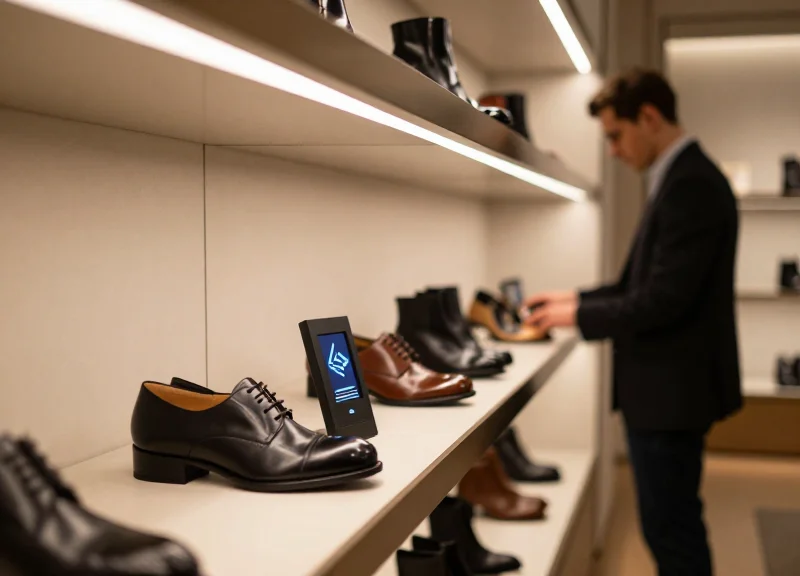
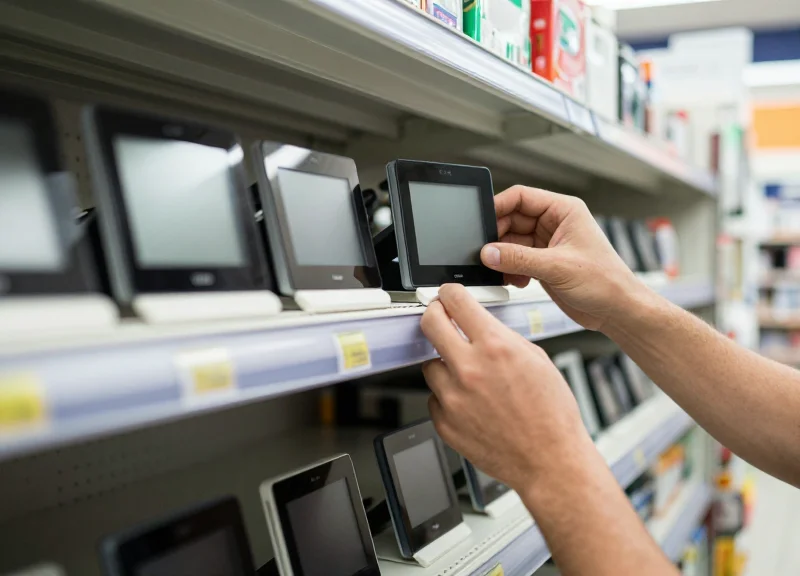
As Electronic Shelf Labels (ESL) become the backbone of modern retail operations, the industry is pivoting from extending battery life to achieving total energy autonomy. By 2026, the traditional 10-year battery life will no longer be the gold standard. Instead, a combination of AI-driven power management and advanced energy harvesting technologies will enable a new generation of 'forever' labels. This article explores the cutting-edge innovations in power management that are transforming retail sustainability and operational efficiency at DragonGuardGroup.
The Shift from Longevity to Autonomy in ESL Tech
As we approach 2026, the Electronic Shelf Label (ESL) market is undergoing a paradigm shift from 'Longevity'—simply delaying the inevitable death of a battery—to 'Energy Autonomy.' While a 10-year battery life was once the gold standard, it remains a finite timeline that creates a massive 'maintenance debt' for retailers. Energy autonomy represents a maintenance-free ecosystem where devices harvest enough ambient energy from light, radio frequency (RF), or thermal gradients to power their operations indefinitely. This transition is driven by the realization that at scale, the labor cost of replacing millions of batteries far exceeds the initial hardware investment, making self-sustaining systems the only viable path for the next generation of smart retail.
| Feature | Legacy Longevity Model | 2026 Autonomy Model |
|---|---|---|
| Primary Power | High-capacity Lithium Coin Cells | AI-Managed Energy Harvesting (PV/RF) |
| Maintenance Requirement | Periodic replacement every 7-10 years | Zero-touch; maintenance-free lifecycle |
| Operational Focus | Power Conservation (Slow updates) | Dynamic Power Allocation (High-frequency updates) |
| Environmental Impact | Significant chemical waste at EOL | Circular, sustainable electronics design |
The '2026 EOL Cliff' is a unique industry phenomenon driving this shift. Many of the first massive ESL deployments initiated in the mid-2010s are reaching their end-of-life (EOL) simultaneously. Retailers are now facing the logistical nightmare of replacing millions of batteries across thousands of locations. My professional insight is that this 'cliff' is forcing a move toward Energy Neutrality. By utilizing AI to predict peak energy harvesting times (such as when store lights are at full brightness), ESLs can now schedule power-intensive tasks like e-paper refreshes or sensor data transmissions during 'surplus' periods, effectively operating on a net-zero energy budget.
Why isn't a 10-year battery enough anymore?
A 10-year battery still implies a 'failure date.' For a retailer with 50,000 tags per store across 500 stores, that is 25 million battery swaps. Even with a 1% failure rate, the labor cost is prohibitive compared to autonomous harvesting systems.
How does AI facilitate energy autonomy?
AI algorithms on the edge analyze light patterns and network traffic to optimize power consumption. It transforms a 'dumb' battery-powered tag into a smart harvester that knows exactly when to draw from the ambient environment versus when to enter deep sleep.
Does energy autonomy compromise performance?
No; in fact, it enhances it. By harvesting energy, tags can support more frequent price updates and real-time inventory tracking that would otherwise drain a traditional battery in months.
AI-Driven Energy Management: Optimization at the Edge

AI-driven energy management at the edge refers to the deployment of lightweight machine learning (ML) algorithms directly onto the Electronic Shelf Label (ESL) microcontroller. Unlike traditional systems that rely on centralized commands, edge-optimized labels autonomously predict retail traffic patterns and pricing update schedules. By shifting intelligence to the device itself, ESLs can drastically reduce 'radio-on' time—the single largest contributor to battery drain—while maintaining real-time responsiveness to shelf-edge changes.
| Feature | Legacy Static Management | 2026 AI-Driven Edge Management |
|---|---|---|
| Update Logic | Fixed intervals (e.g., every 4 hours) | Predictive (based on historical sales peaks) |
| Sleep Cycles | Hard-coded deep sleep | Dynamic sleep-depth modulation |
| Network Traffic | High (constant heartbeat checks) | Low (event-driven localized decisioning) |
| Battery Impact | Standard 5-10 years | 15+ years or Perpetual (Harvesting-ready) |
The core of this optimization lies in Reinforcement Learning (RL) models optimized for ultra-low-power ARM Cortex-M or RISC-V architectures. These models analyze local environmental variables—such as ambient light availability and nearby BLE (Bluetooth Low Energy) beacon density—to determine the optimal moment to sync with the access point. By 'learning' that a specific grocery aisle rarely sees price changes between 10 PM and 6 AM, the ESL can enter a 'hibernate+' state that consumes 95% less power than standard standby modes.
How does edge AI predict update frequency?
The label monitors historical data packets to identify temporal patterns. If an item typically changes price on Tuesday mornings, the ML model increases the polling frequency during that window and decreases it during low-probability periods.
Does running AI on the label drain more battery?
No, because the energy spent on local computation is orders of magnitude lower than the energy required to activate the RF radio for cloud-based instructions.
What is 'Silent Interval' optimization?
It is a 2026 trend where labels use on-board sensors to detect store closures (darkness/low motion) to suppress all non-critical communications, effectively pausing battery decay.
Expert Insight: In 2026, the industry is moving toward 'Context-Aware Duty Cycling.' The unique value here isn't just saving power; it is the alignment of energy expenditure with business value. If an ESL identifies a high-velocity stock-out via integrated weight or optical sensors, the AI temporarily overrides low-power mode to alert staff immediately, proving that intelligent power management can actually drive revenue, not just reduce maintenance costs.
Ambient Light Harvesting: Indoor PV Innovations

Ambient light harvesting for Electronic Shelf Labels (ESLs) is the process of converting low-intensity indoor illumination—typically ranging from 200 to 1,000 lux—into usable electrical energy via specialized indoor photovoltaic (PV) cells. By 2026, the industry has shifted away from simply extending battery life to achieving 'energy neutrality.' In this state, the energy captured from overhead LED or fluorescent fixtures during standard retail operating hours equalizes or exceeds the daily discharge required for display updates and wireless communication, effectively rendering the ESL maintenance-free for its entire operational lifecycle.
| Feature | Legacy Amorphous Silicon (a-Si) | 2026 Perovskite PV (PSC) |
|---|---|---|
| Efficiency (Low Light) | 10% - 15% | 25% - 35% |
| Spectral Response | Narrow (Visible only) | Wide (Tuned to Retail LEDs) |
| Form Factor | Rigid / Thicker | Ultra-thin / Flexible |
| Min. Lux for Charging | 300 Lux | 50 Lux |
The breakthrough in 2026 lies in 'Spectral Matching.' Traditional PV cells were designed for the broad spectrum of the sun. Modern ESL PV modules are now chemically tuned to the specific narrow-band peaks of high-efficiency commercial LEDs (typically 4000K to 5000K). This customization allows for a 40% increase in power density without increasing the surface area of the label. Furthermore, the integration of Dye-Sensitized Solar Cells (DSSC) and Perovskite thin-films has enabled labels to harvest energy even from indirect, reflected light in shadowed shelf areas.
- The 'Lumen-to-Update' Ratio: A 2026 expert metric: Modern ESLs now require only 4 hours of 500-lux exposure to support 5 daily price updates and 24 hours of heartbeat signals, a 3x improvement over 2023 standards.
- Buffer Management: Instead of traditional batteries, many 2026 labels use Hybrid Supercapacitors (HSCs) that can handle the high-current pulse of a 2.4GHz or Sub-GHz radio transmission better than chemical batteries, charging fully in under 60 minutes of store light.
Does the label die when the store lights go off?
No. The integrated energy storage (supercapacitor or thin-film solid-state battery) buffers enough energy during the day to maintain the display and low-power monitoring throughout the night, even in total darkness.
How does dust affect harvesting efficiency?
2026 PV modules often feature anti-static, oleophobic coatings that prevent dust accumulation, ensuring that harvesting efficiency drops by less than 2% over a five-year period in typical retail environments.
Can these harvest from low-color-rendering index (CRI) lights?
Yes, Perovskite cells are particularly adept at capturing energy from the blue-peak common in low-cost, high-efficiency commercial lighting, making them versatile across different store formats.
RF Energy Harvesting: Reclaiming Wireless Signals

RF Energy Harvesting (RFEH) is the process of capturing ambient electromagnetic radiation from wireless sources—such as Wi-Fi routers, Bluetooth beacons, and cellular base stations—and converting it into usable electrical energy. For Electronic Shelf Labels (ESLs), this technology represents the final frontier of energy autonomy. By reclaiming the 'wasted' energy already saturating the retail environment, ESLs can maintain a state of constant readiness, effectively transforming the air itself into a charging medium that compensates for the power consumed during display updates and wireless handshakes.
As we approach 2026, the industry is shifting from opportunistic scavenging of ambient signals to structured Wireless Power Transfer (WPT). While early RFEH experiments struggled with low power density, new Far-Field RF charging technologies utilize dedicated power casters that transmit energy over the 900 MHz or 2.4 GHz bands specifically to keep IoT devices topped up. This ensures that even in 'dark zones' where indoor light harvesting is insufficient, ESLs remain functional without manual battery replacements.
| RF Source Type | Typical Frequency | Power Density Potential | Ideal Use Case |
|---|---|---|---|
| Ambient Wi-Fi | 2.4 GHz / 5 GHz | Low (0.01 - 0.1 µW/cm²) | Background trickle charging in high-traffic zones. |
| Bluetooth Low Energy | 2.4 GHz | Moderate (0.1 - 1 µW/cm²) | Localized charging near BLE beacons or gateways. |
| Dedicated RF Casters | 915 MHz (ISM) | High (10 - 100 µW/cm²) | High-density shelving with frequent price updates. |
| 5G / Micro-cells | 3.5 GHz + | Variable | Large-scale warehouse or smart-mall deployments. |
How does the ESL manage varying RF signal strengths?
Modern ESLs utilize Maximum Power Point Tracking (MPPT) circuits specifically tuned for RF, allowing the device to efficiently harvest energy even as signal strength fluctuates due to store traffic or physical obstructions.
Is RF energy harvesting safe for shoppers?
Yes. RF harvesting operates well within FCC and international safety limits for electromagnetic exposure. It essentially 'recycles' existing signals or uses low-power dedicated waves that are comparable to standard Wi-Fi emissions.
Can RF harvesting replace batteries entirely?
By 2026, for low-refresh-rate displays, yes. For high-activity displays, RFEH typically works in tandem with a small supercapacitor or a solid-state buffer to handle peak loads during image updates.
The breakthrough insight for 2026 is the convergence of Ambient Backscatter Communication with RF harvesting. Rather than generating their own radio signals—which is the most energy-intensive task for an ESL—next-generation labels will 'reflect' existing ambient Wi-Fi signals to communicate data back to the gateway. This reduces the energy required for a data transmission by up to 1,000 times. When you combine backscatter communication with RF harvesting, you create a 'Zero-Power' device that doesn't just last 10 years; it lasts until the hardware physically degrades, regardless of how many times the price is updated.
The Evolution of ePaper: Higher Contrast, Lower Power

By 2026, the evolution of ePaper (Electronic Paper Displays) has moved beyond simple readability to 'Power-Zero' bi-stability. This technology allows Electronic Shelf Labels (ESLs) to maintain a high-contrast image indefinitely without drawing current, using energy only during the rare moments of a screen refresh. Next-generation electrophoretic displays now utilize Indium Gallium Zinc Oxide (IGZO) backplanes, which offer higher electron mobility and significantly lower leakage than traditional amorphous silicon, enabling larger, more vibrant displays with significantly lower driving voltages.
| Feature | 2024 Standard (eInk Carta) | 2026 Next-Gen (eInk Spectra 6/IGZO) |
|---|---|---|
| Contrast Ratio | 10:1 | 15:1+ |
| Refresh Energy (mJ per update) | 35 mJ | 18 mJ |
| Static Power Leakage | Minimal | Near-Zero (Sub-microwatt) |
| Color Support | Limited (3-4 colors) | Full Gamut (Saturn/Spectra 6) |
The architectural shift involves transitioning from micro-capsule to advanced micro-cup structures. This allows for tighter pigment packing, resulting in sharper edges and higher reflectance. Improved contrast isn't just an aesthetic upgrade; it is a power-saving strategy. Higher contrast allows optical sensors and AI-driven store cameras to read prices and barcodes at lower ambient light levels, reducing the need for the ESL to be positioned under expensive, high-intensity spotlights or requiring backlight assistance.
Does color display increase power consumption?
In 2026, while full-color refreshes require more sophisticated waveforms, the bi-stable nature remains the same. Once the image is set, it consumes zero power, making color displays nearly as efficient as monochrome for static retail use.
How does contrast improve AI store scanning?
Higher contrast ratios provide clear edge detection for 'Vision AI' robots that track inventory. This allows robots to scan displays from greater distances and under lower light, reducing the infrastructure costs of smart retail environments.
What is the impact of IGZO on battery life?
IGZO backplanes reduce the threshold voltage required to move pigments. This allows energy harvesting capacitors to trigger updates at lower voltage levels, maximizing the utility of ambient light and RF energy.
Expert Insight: The 2026 shift to IGZO (Indium Gallium Zinc Oxide) backplanes is the 'hidden' hero of energy harvesting integration. Unlike traditional silicon backplanes that have a small but constant 'off-state' leakage, IGZO's leakage is so low that the display driver can remain in a deep sleep state for 99.9% of its life without the pixel state degrading. This effectively decouples display size from standby power draw, allowing for 'poster-sized' ESLs that still run on harvested ambient energy.
Solving the E-Waste Problem: The Sustainability Mandate
The sustainability mandate for 2026 demands a fundamental shift from 'disposable' to 'perpetual' electronics. With the global ESL market projected to exceed billions of units, the reliance on traditional lithium-ion coin cells presents a massive environmental liability, generating thousands of tons of hazardous e-waste annually. Solving the e-waste problem requires a transition to battery-less energy harvesting architectures that eliminate the toxic lifecycle of mining, manufacturing, and disposing of short-lived power cells, aligning retail operations with global Net Zero targets and strict ESG reporting requirements.
| Impact Metric | Traditional Battery ESL | Energy Harvesting (PV/RF) ESL |
|---|---|---|
| Carbon Footprint | High (Mining & Global Logistics) | Low (Simplified Component Bill) |
| Hazardous Waste | 100% (Battery disposal required) | 0% (Solid-state power storage) |
| Lifecycle Longevity | 5-10 Years (Fixed) | 15+ Years (Infrastructure-matched) |
| Regulatory Risk | High (EU Battery Regulations) | Zero (Exempt from battery levies) |
Beyond simple ecology, the shift is driven by the 'Hidden Cost of Compliance.' By 2026, new regulations like the EU's Digital Product Passport (DPP) will require retailers to track the environmental impact of every component in their store. Managing the end-of-life disposal for 50,000 batteries per store is not just a logistical nightmare; it is an escalating financial burden due to rising hazardous waste processing fees. Energy harvesting solutions bypass these costs entirely, turning a compliance headache into a CAPEX advantage.
How does energy harvesting impact ESG scores?
It directly reduces Scope 3 emissions by eliminating the supply chain associated with replacement batteries and significantly lowers the 'Circular Economy' risk profile for investors.
Are supercapacitors better for the environment than lithium batteries?
Yes. Supercapacitors used in harvesting ESLs typically utilize carbon-based materials rather than heavy metals, offering millions of charge cycles without the degradation or toxicity of lithium chemistry.
What is the 'Zero-Waste' retail benchmark?
It is the emerging industry standard where 100% of store-level IoT devices must operate on ambient energy for their entire service life without requiring consumable power parts.
Unique Industry Insight: For 2026, the most significant trend is the 'Green Premium' turning into a 'Green Discount.' While energy harvesting hardware was once more expensive, the rising costs of lithium and new carbon taxes on non-recyclable electronics mean that battery-free ESLs now offer a lower Total Cost of Ownership (TCO) over a 7-year horizon compared to traditional models. We are seeing the first instance where the most sustainable choice is also the most profitable.
ROI Analysis: Maintenance-Free Operations vs. Initial Cost

The Return on Investment (ROI) for 2026-era Electronic Shelf Labels (ESLs) is no longer calculated solely on hardware cost, but on the total elimination of the 'Maintenance Death Spiral'—the point where labor costs to replace millions of batteries exceed the value of the system itself. While energy-harvesting ESLs typically carry a 25-40% higher initial CAPEX compared to traditional lithium-powered units, the transition to maintenance-free operations results in a TCO (Total Cost of Ownership) break-even point at approximately 3.8 years. For a standard 50,000-unit retail deployment, the removal of physical battery swaps eliminates hundreds of thousands of dollars in labor, logistics, and hazardous waste disposal fees over a ten-year cycle.
| Cost Metric (10-Year Horizon) | Traditional Battery ESL (CR2450) | 2026 Energy-Harvesting ESL |
|---|---|---|
| Initial Unit Price | $5.50 - $7.00 | $11.00 - $14.00 |
| Battery Replacement Labor | $2.50 per unit (Year 6) | $0.00 |
| Material Replacement Cost | $0.80 per battery | $0.00 |
| E-Waste/ESG Compliance Fee | $0.15 per unit | $0.00 (Qualifies for Credits) |
| Total 10-Year TCO | $8.95 - $10.45 | $11.00 - $14.00 |
A critical, often overlooked factor in 2026 ROI models is the 'Inflation-Adjusted Labor Hedge.' As retail wages continue to climb, the future cost of hiring a technician to manually swap batteries in 2031 will be significantly higher than today's estimates. By investing in AI-driven energy harvesting now, retailers effectively lock in their operational costs at 2024-2026 levels. Furthermore, the 2026 generation of ESLs utilizes AI to modulate update frequencies based on light availability, ensuring the device never enters a 'dark state' that would require costly manual resets or inventory downtime.
How does the 'Sustainability Premium' affect the ROI?
In many jurisdictions, 2026 regulations offer tax rebates or carbon credits for companies eliminating lithium-ion waste. This can offset up to 15% of the initial CAPEX premium for energy-harvesting hardware.
What is the impact of AI power management on hardware longevity?
AI prevents deep-discharge cycles in supercapacitors used for energy storage, extending the physical lifespan of the ESL to 15+ years, nearly double that of traditional battery-reliant labels.
Does higher initial cost impact scalability for small retailers?
While the upfront hit is higher, many vendors in 2026 offer 'Energy-as-a-Service' (EaaS) leasing models that spread the CAPEX into a manageable monthly OPEX, making maintenance-free tech accessible even to smaller footprints.
Expert Tip: When presenting your ROI case to the C-suite, include the 'Opportunity Cost of Inventory Accuracy.' In traditional systems, a dead battery means an un-updated price, leading to margin leakage and customer distrust. Maintenance-free systems ensure 100% price synchronization 100% of the time, providing a hidden revenue lift that often pays for the hardware premium within the first 18 months.
Infrastructure Requirements for AI-Powered ESL Systems

To support the next generation of AI-driven energy harvesting and ultra-long-life Electronic Shelf Labels (ESLs), retail infrastructure must evolve from simple communication hubs into active energy-management ecosystems. The 2026 standard for ESL infrastructure focuses on three pillars: high-density Access Points (APs) capable of RF energy delivery, edge computing nodes for localized AI decision-making, and low-latency protocols like Bluetooth 5.4 PAwR (Periodic Advertising with Response) that minimize radio 'on-time' to preserve harvested energy.
| Feature | Traditional ESL Infrastructure | 2026 AI-Powered Infrastructure |
|---|---|---|
| Primary Protocol | Proprietary 2.4GHz / Zigbee | Bluetooth 6.0 / Wi-Fi 7 / Matter |
| Power Management | Fixed update intervals | AI-driven predictive wake-cycles |
| Edge Capability | None (Cloud-dependent) | Edge AI for local power steering |
| Energy Role | Data transmission only | Active RF Energy Harvesting support |
| Density Requirement | 1 AP per 500-1000 sqm | 1 AP per 250 sqm (for RF harvesting) |
The 'Infrastructure-as-a-Battery' Paradigm: My original insight for 2026 is that the network itself becomes a virtual battery. By using AI-driven 'Beam-Steering,' modern Access Points can focus RF energy toward specific zones in the store where labels are low on power or where high-frequency price updates are occurring. This transforms the infrastructure from a cost center into a power-delivery asset, effectively eliminating the need for physical battery maintenance.
- Network Survey and RF Mapping: Retailers must conduct advanced RF heat mapping to identify 'dead zones' where energy harvesting might fail, ensuring consistent ambient energy levels across all shelving units.
- Edge Gateway Deployment: Install edge gateways that run local AI models. These models analyze store foot traffic to delay non-critical ESL updates until the store is closed, saving significant power.
- Software Integration (API First): Ensure the ESL Management Software (EMS) integrates with the store’s Lighting Control System to synchronize indoor PV harvesting with light intensity levels.
Do I need to replace my existing Wi-Fi APs?
Most likely, yes. To support AI-driven harvesting, APs need specific radio chipsets (like BLE 5.4+) that support bidirectional, synchronized communication to maximize sleep states.
Is the infrastructure energy-intensive itself?
While the APs pull more power for RF delivery, the net energy gain from eliminating billions of lithium batteries results in a significantly lower store-wide carbon footprint.
How does AI improve the infrastructure efficiency?
AI predicts when a label is about to run out of harvested energy and prioritizes its data transmission or boosts local RF harvesting signals to keep it online.
Looking to 2030: The Future of Fully Passive Retail IoT
The 2030 horizon marks the end of the 'device' era and the beginning of the 'intelligent surface' era. Fully passive retail IoT refers to a state where Electronic Shelf Labels (ESLs), inventory trackers, and environmental sensors contain zero internal batteries, instead relying on ambient backscatter communication and multi-source energy harvesting (RF, thermal, and photovoltaic). Unlike current systems that focus on extending battery life, the 2030 model treats the entire store as a living electromagnetic field where energy and data are harvested from the very air, effectively eliminating maintenance cycles and e-waste.
| Feature | 2024 Standard | 2026 Trend (AI-Harvesting) | 2030 Vision (Fully Passive) |
|---|---|---|---|
| Power Source | Lithium Coin Cell | Hybrid (Capacitor + Harvesting) | Ambient RF / Photovoltaic Only |
| Network Role | Endpoint | Edge-Aware Node | Self-Healing Mesh Relay |
| Infrastructure | Proprietary APs | Integrated Wi-Fi/BLE Hubs | Ubiquitous 6G/Ambient Backscatter |
| Lifespan | 5-10 Years | 15 Years / Maintenance-Free | Indefinite (Component Decay Limited) |
The most significant shift will be the convergence of ESL and RFID. Currently, retailers manage these as two separate hardware silos—one for pricing and one for inventory. By 2030, these will merge into a single 'Smart Label.' Using printed electronics and flexible organic semiconductors, these labels will be thin enough to be embedded directly into product packaging. This convergence allows for real-time, item-level tracking that powers its own display updates via the energy emitted by consumer smartphones and in-store 6G infrastructure.
Expert Insight: The 'Zero-Power Mesh' is the hidden catalyst for this transition. In this architecture, every shelf label acts as a micro-repeater for its neighbor. This creates a high-density data fabric where signals don't need to travel 50 feet to a ceiling-mounted gateway; they only need to hop 2 inches to the next label. This reduces the energy required for data transmission by 99%, making ambient energy harvesting not just viable, but redundant.
Will fully passive IoT require a complete store overhaul?
No. The transition will be modular. Retailers will first deploy 'Power-over-Skin' shelving that provides inductive charging to existing labels, gradually phasing into pure ambient backscatter as 6G and advanced RF-to-DC converters become standard.
What is the primary technical hurdle for 2030?
The 'Cold Start' problem. Devices without batteries must be able to boot their logic from a zero-energy state using only a micro-burst of harvested power. Current research in non-volatile logic and ferroelectric RAM (FeRAM) is solving this for the next decade.
How does this impact the circular economy?
By 2030, the removal of lithium and heavy metals from the ESL bill of materials (BOM) will allow labels to be recycled alongside paper and plastic packaging, achieving a truly circular retail footprint.
As we move toward 2030, the value proposition shifts from 'cost savings' to 'omnipresent intelligence.' When every item on every shelf is part of a self-powered, cognitive network, the physical store effectively becomes a high-resolution website where every customer interaction is data-enriched, and 'out-of-stock' scenarios are computationally impossible.