As we look toward 2026, the retail sector is undergoing a profound transformation where the physical shelf is no longer just a display unit but a sophisticated data hub. At the heart of this revolution is the evolution of Electronic Shelf Label (ESL) systems. Moving beyond simple digital price tags, the industry is shifting toward modular ESL rails that serve as the backbone for intelligent smart shelving infrastructure. This transition addresses critical retail pain points, including labor shortages, pricing inaccuracies, and the need for real-time inventory visibility, creating a seamless bridge between physical and digital commerce.
The Paradigm Shift: From Static Labels to Intelligent Infrastructure

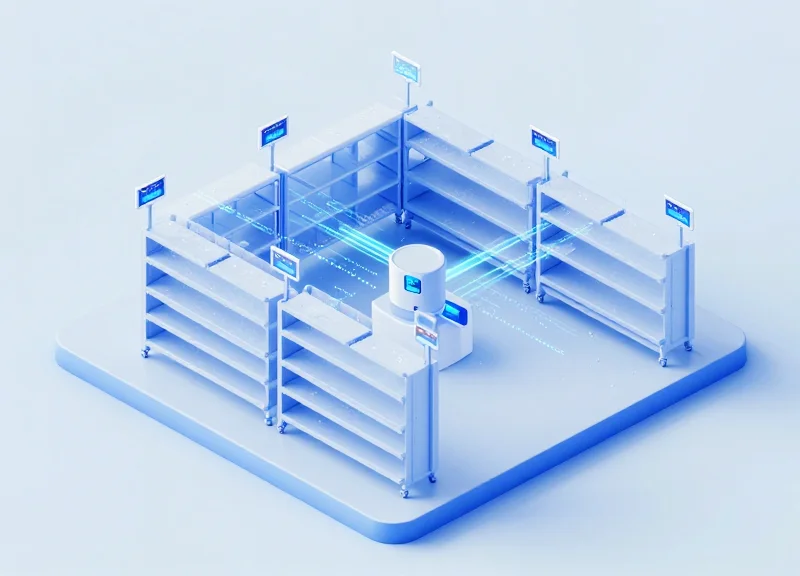
The evolution from static Electronic Shelf Labels (ESL) to intelligent smart shelving infrastructure represents a fundamental move from 'displays' to 'ecosystems.' While traditional ESLs focused solely on automating price updates, 2026-era intelligent infrastructure utilizes modular rails as a power and data 'backplane' for the entire shelf edge. This shift enables retailers to integrate computer vision, weight sensors, and localized AI without the logistical nightmare of managing thousands of individual batteries or proprietary mounting hardware.
| Feature | Legacy ESL (2015-2022) | Intelligent Infrastructure (2026+) |
|---|---|---|
| Primary Purpose | Dynamic Pricing | Real-time Inventory & Customer Analytics |
| Power Source | Internal Coin Cell Batteries | Inductive or Bus-Powered Modular Rails |
| Data Capacity | One-way/Low-bandwidth (Zigbee/IR) | High-bandwidth Bi-directional (WiFi 6/7 / Sub-GHz) |
| Sensor Integration | None (Standalone Display) | Modular (Cameras, Lidar, Weight, Scent) |
Expert Insight: The Rise of the 'Power Bus' at the Edge. The critical differentiator in 2026 is the standardization of the rail as a power delivery system. By treating the shelf rail like a USB hub for the physical store, retailers can hot-swap modules—switching a high-resolution promotional screen for an Out-of-Stock (OOS) sensor in seconds. This 'infrastructure-as-a-service' model reduces long-term CAPEX by 40% compared to siloed hardware deployments.
Why is the shift happening now?
Labor shortages and the demand for omnichannel accuracy mean retailers can no longer rely on manual audits; they need 'eyes on the shelf' 24/7.
Does this replace traditional ESLs?
It doesn't replace them; it absorbs them. The ESL becomes one of many 'apps' running on the smart rail infrastructure.
What is the primary ROI driver?
The reduction in 'Shrink' and 'Out-of-Stock' events. Intelligent shelves can alert staff the moment a product is misplaced or depleted, ensuring 99.9% inventory accuracy.
Why Modularity is the Gold Standard for 2026 Retail Agility
Modularity in 2026 retail infrastructure is defined by the decoupling of physical mounting systems from electronic components, allowing for 'plug-and-play' updates to Electronic Shelf Labels (ESLs) and IoT sensors without requiring specialized technical labor. This approach ensures that as store layouts evolve—driven by AI-optimized pathing or seasonal shifts—the digital layer can be reconfigured in minutes rather than days, making it the bedrock of operational agility and a critical safeguard against hardware obsolescence.
| Feature | Legacy Fixed ESL Rails | 2026 Modular Smart Rails |
|---|---|---|
| Installation Logic | Hard-wired, static positions | Click-and-connect power bus |
| Sensor Integration | Requires separate cabling | Shared rail power/data channel |
| Maintenance | Full rail replacement on failure | Hot-swappable individual segments |
| Reconfiguration Speed | Days/Weeks (Requires contractors) | Minutes/Hours (Store-level staff) |
By 2026, the 'Lego-brick' approach to retail IT will be mandatory. As retailers shift toward micro-fulfillment centers and hybrid store models, the ability to shift shelf heights and locations without rewiring is no longer a luxury—it is a survival requirement. Modular rails act as a universal interface, effectively becoming the 'USB-C of the shelf' for every digital touchpoint in the aisle.
Why is 'Hot-Swappability' critical for 2026 retail?
Hot-swappability allows staff to replace or upgrade specific modules—like a high-resolution label or a shelf-edge camera—without powering down the entire aisle or affecting surrounding units, ensuring zero downtime for customer-facing displays.
How does modularity reduce Total Cost of Ownership (TCO)?
It shifts capital expenditure from a 5-year replacement cycle to a continuous improvement model. Instead of tearing out old rails to support new tech, retailers simply swap the module, reducing labor costs by up to 70% and material waste by 50%.
Can modular rails support AI vision and weight sensors?
Yes. Modern modular rails are designed with high-bandwidth power paths that can support everything from simple price tags to power-hungry AI optical sensors and load cells for real-time inventory tracking.
Expert Insight: In the Silicon Valley of retail tech, we are seeing the rise of 'Infrastructure as a Service' (IaaS) for the physical floor. The most successful retailers aren't buying ESLs; they are investing in a persistent modular power-and-data backbone. This allows them to pilot new technologies, like haptic shelf buttons or localized 'flash-to-find' picking lights, in a single afternoon. My advice: View the rail as your permanent digital real estate and the ESL as a temporary resident.
The Convergence of ESL, RFID, and Computer Vision

The convergence of Electronic Shelf Labels (ESL), Radio Frequency Identification (RFID), and Computer Vision (CV) represents the shift from isolated data silos to a 'sensor fusion' ecosystem. In 2026, the modular rail acts as the central nervous system of the retail shelf, providing the power and high-bandwidth data connectivity required to combine these three technologies into a single, cohesive intelligent infrastructure. This integration allows retailers to achieve 360-degree visibility, reconciling what the system thinks is in stock (ESL/ERP), what is physically present (RFID), and what is actually visible to the customer (Computer Vision).
| Technology | Primary Role on the Rail | Unique Data Contribution |
|---|---|---|
| ESL | Interaction & Communication Hub | Dynamic pricing, stock status alerts, and QR code consumer engagement. |
| RFID | Precision Inventory Tracking | Real-time item-level location, bulk scanning, and automated stock replenishment triggers. |
| Computer Vision | Visual & Behavioral Validation | Planogram compliance, out-of-stock visual detection, and shopper interaction heatmaps. |
The true innovation lies in the 'Dynamic Orchestration Layer.' Instead of streaming massive amounts of raw video or RFID data to the cloud, the 2026 modular rail utilizes edge computing to cross-reference data points locally. For example, if an RFID sensor detects a product has been moved but the Computer Vision camera sees the shelf is still 'visually full' (perhaps by a misplaced item), the system flags a 'hidden misplacement' error to staff. This level of granular accuracy reduces shrink and maximizes sales velocity in ways that standalone technologies never could.
Does integrating these technologies require a complete shelf overhaul?
No. The modular nature of 2026 rail designs allows for 'hot-swapping' modules. You can start with ESLs for pricing and later snap in RFID readers or CV camera modules as budget and operational needs evolve.
How does this convergence improve loss prevention?
By correlating CV visual data with RFID movement, the system can detect 'sweethearting' or bulk shelf sweeps in real-time, instantly notifying security via the same IoT infrastructure used for pricing.
What is the impact on battery life for these devices?
Modular rails provide direct power to high-drain components like CV cameras and active RFID readers, eliminating the battery replacement cycle that previously hindered large-scale deployments.
Expert Insight: In 2026, the most successful retailers will treat their shelving infrastructure not as furniture, but as a high-density compute environment. By leveraging 'Selective Sampling'—where Computer Vision only triggers when RFID detects a change in signal—stores can reduce data processing costs by up to 40% while maintaining 99.9% inventory accuracy. This synchronized 'wake-on-motion' architecture is the key to sustainable, large-scale smart store operations.
Powering the Future: Advanced Energy Solutions in Smart Rails
By 2026, the retail industry is moving away from standalone battery-operated tags toward integrated power delivery systems within the shelf rail itself. Advanced energy solutions in smart rails provide continuous electricity to Electronic Shelf Labels (ESLs), sensors, and cameras, eliminating the maintenance overhead of replacing thousands of coin-cell batteries while enabling high-performance features like full-color video displays and real-time inventory tracking that were previously power-prohibitive.
The shift toward 'permanent power' is driven by the increasing energy demands of next-generation IoT devices. While traditional ESLs could survive for years on a single battery by only updating once or twice a day, modern retail strategies require constant data transmission and dynamic price fluctuations. A modular rail with a built-in power bus allows for a 'plug-and-play' ecosystem where any device clipped onto the rail is instantly energized.
| Feature | Legacy Battery ESLs | 2026 Smart Rail Infrastructure |
|---|---|---|
| Power Source | Individual CR2450/CR2032 batteries | Continuous DC Power Bus via Rail |
| Update Frequency | Limited (to preserve battery life) | Real-time / Unlimited |
| Device Support | Static E-ink labels only | ESLs, LED strips, Sensors, AI Cameras |
| Sustainability | High hazardous waste (lithium) | Circular / Low waste |
| Labor Cost | Significant (manual replacement cycles) | Near Zero (maintenance-free power) |
How do smart rails deliver power safely to the shelf edge?
Modern smart rails utilize low-voltage DC power (typically 12V or 24V) delivered through recessed conductive tracks. This ensures the system is safe for both customers and staff while providing enough wattage to power a full row of high-definition displays and sensors.
Is inductive charging used in smart shelving?
While contact-based rails are currently more cost-effective for 2026, inductive (wireless) power transfer is emerging for premium displays, allowing devices to draw power without any exposed metal contacts, further increasing durability in harsh environments like grocery freezers.
What happens during a power outage?
Smart rail controllers are typically backed up by centralized Uninterruptible Power Supplies (UPS) at the store-wide level. This allows the digital infrastructure to remain operational and synchronized even during local grid failures.
Expert Insight: The Shift to Energy-as-a-Service (EaaS). As an industry veteran, I see the most significant 2026 trend being the decoupling of the device from the power source. Historically, retailers bought a 'label' that happened to have a battery. Now, we are seeing the rise of 'Energy-as-a-Service' models where the shelving infrastructure is treated as a permanent utility grid. This allows retailers to upgrade their AI sensors or displays every two years without ever worrying about the underlying power delivery, effectively future-proofing the physical store against the next decade of technological hardware cycles.
Real-Time Analytics: Turning Shelves into Actionable Data Sources

Real-time shelf analytics in 2026 represents the transformation of physical retail space into a high-resolution data stream. By utilizing modular ESL rails as the primary connectivity layer, retailers can capture granular interactions—such as product lift-off events, dwell times, and stock depletion—directly at the shelf edge. This evolution allows the 'Intelligent Shelf' to function as a localized IoT hub, converting raw physical signals into actionable intelligence that drives automated replenishment and hyper-personalized customer engagement.
| Data Category | Legacy Retail Approach | 2026 Smart Shelf Approach |
|---|---|---|
| Inventory Status | Manual cycle counts or POS estimation. | Real-time weight/optical sensing via rails. |
| Customer Behavior | Aggregated store-wide heatmaps. | Specific product interaction & engagement metrics. |
| Stockout Prevention | Reactive ordering after shelf is empty. | Predictive alerts based on depletion velocity. |
| Pricing Logic | Weekly or daily batch updates. | Instant micro-fluctuations based on local demand. |
The true power of this infrastructure lies in 'Cognitive Merchandising.' Unlike traditional systems that rely on historical sales data, smart shelving in 2026 uses edge computing to process data locally on the rail. This enables the system to detect 'phantom inventory'—items that are in the store but misplaced—and immediately notify staff. Furthermore, by correlating shelf-edge data with local events (like a sudden rainstorm or a nearby sporting event), the system can autonomously adjust promotional content on the ESLs to match the immediate psychological state of the local shopper.
How does the shelf protect customer privacy while collecting data?
Modern smart rails focus on anonymous telemetry rather than facial recognition. They track silhouettes, hand movements, and product displacement, ensuring GDPR and CCPA compliance by never associating data with a specific identity until a voluntary loyalty check-in occurs.
What is the 'Latency Threshold' for actionable shelf data?
In 2026, the industry standard for actionable data is sub-five seconds. If a shelf detects an out-of-stock item, the alert must reach the backroom or an automated robot within this window to prevent a lost sale.
Can these analytics integrate with existing ERP systems?
Yes, modular rails utilize standardized APIs (often via MQTT or Matter protocols) to feed real-time analytics directly into legacy ERP and Warehouse Management Systems, bridging the gap between physical reality and digital records.
Expert Tip: To maximize ROI in 2026, don't just use shelf data for inventory; use it for 'Negotiated Placement.' Retailers can now sell 'Digital Shelf Attention' data back to CPG brands, proving exactly how many people looked at or touched a product, creating a new high-margin revenue stream through retail media networks.
Enhancing the Omnichannel Customer Experience

By 2026, the 'omnichannel' experience will no longer be a secondary feature but the core operating model of the physical store. Intelligent modular ESL rails act as the nervous system for this evolution, facilitating a seamless blend of digital convenience and physical immediacy. These rails provide the infrastructure for high-accuracy 'Pick-to-Light' systems that slash Buy Online Pick Up In Store (BOPIS) fulfillment times and enable hyper-localized, context-aware engagement that speaks directly to a consumer's digital profile as they walk the aisle.
| Feature | Legacy Retail Environment | 2026 Smart Rail Infrastructure |
|---|---|---|
| BOPIS Fulfillment | Manual searching; high error rates. | LED-guided 'Pick-to-Light' navigation. |
| In-Aisle Marketing | Static, generic paper signage. | Dynamic, personalized digital triggers. |
| Product Discovery | Limited to physical shelf space. | Digital 'Endless Aisle' via QR/NFC integration. |
| Staff Efficiency | High labor cost per order picked. | 40-60% faster picking via rail signaling. |
The true power of modular rails lies in their ability to bridge the 'Information Gap' at the shelf edge. When a customer stands in front of a product, the intelligent rail can push personalized discounts or recipe suggestions directly to their smartphone via Bluetooth Low Energy (BLE) or use the ESL display to show real-time stock levels for other colors or sizes available online. This eliminates the friction that traditionally leads to showrooming and lost sales.
How do modular rails reduce BOPIS fulfillment errors?
The rails integrate RGB-LED indicators that flash specific colors for store associates, guiding them to the exact product location. This 'Pick-to-Light' functionality ensures 99% accuracy and allows multiple orders to be picked simultaneously by different staff members using distinct color codes.
Can smart rails help with 'Endless Aisle' strategies?
Yes. By utilizing the power and data connectivity of the rail, retailers can embed high-speed NFC or QR interaction points. If a shelf is empty, the customer can scan the rail to immediately order the item for home delivery, capturing the sale before the customer leaves the store.
Do these systems respect consumer privacy?
Modern 2026 systems utilize 'Opt-in Proximity.' Engagement only occurs when a customer's loyalty app interacts with the rail's BLE beacon, ensuring that personalized marketing is both permission-based and highly relevant to the shopper's current location.
Expert Insight: The 'Ghost Picker' Optimization. A unique advantage of modular smart rails is the ability to manage 'Ghost Pickers'—automated robots or staff picking orders during off-hours. By using infrared signaling embedded in the rail, stores can automate the navigation of robotic pickers without needing expensive LIDAR mapping updates every time a shelf is moved. The rail itself becomes the map, making the physical store a dynamic warehouse that never sleeps.
Operational Efficiency: Overcoming Labor Challenges through Automation
By 2026, the primary driver for modular ESL rail adoption has shifted from simple 'digital signage' to a comprehensive strategy for 'Labor Elasticity.' In an era of rising minimum wages and shrinking talent pools, intelligent shelving infrastructure serves as a force multiplier, automating the two most labor-intensive tasks in brick-and-mortar retail: price maintenance and shelf auditing. This evolution allows store managers to transition their workforce from 'stockers' to 'brand ambassadors,' focusing on high-margin customer interactions rather than manual data entry.
| Operational Task | Manual Process Time | Smart Rail Automation Time | ROI Impact |
|---|---|---|---|
| Store-Wide Price Updates | 40-60 Hours / Week | Instant (Scheduled) | 100% Labor Reduction |
| Stock-Out Identification | 15-20 Hours / Week | Real-Time Alerts | 3-5% Sales Increase |
| Planogram Audits | 10 Hours / Month | Continuous Verification | Reduced Shrinkage |
| Promotional Tagging | 12 Hours / Promotion | Instant Synchronization | Higher Campaign Agility |
The integration of Out-of-Stock (OOS) sensors directly into the modular rail infrastructure creates a closed-loop system for replenishment. Instead of employees patrolling aisles to find 'holes' on shelves, the intelligent rail sends a push notification to a handheld device the moment a SKU drops below a specific threshold. This predictive replenishment logic ensures that high-velocity items are always available, maximizing the productivity of the existing floor staff.
Expert Insight: In 2026, the most successful retailers are moving toward 'Shadow-Tasking.' This involves using the ESL rail's built-in LED indicators to guide employees during night shifts or BOPIS picking. By flashing specific colors to indicate the next item on a pick-list, the rail reduces 'search time' by up to 40%, effectively turning every new hire into an expert-level picker on their first day.
How does automated price updating directly impact the bottom line?
Automated price updates eliminate the human error associated with mislabeling, which often leads to price-check delays at checkout and potential regulatory fines. By ensuring shelf-to-register parity, retailers see an immediate improvement in customer trust and throughput speeds.
Can modular rails help with employee retention?
Yes. By automating the most tedious and repetitive tasks—such as scraping old stickers and manual counting—retailers improve the daily work experience, leading to higher job satisfaction and lower turnover rates in a competitive labor market.
What is the typical 'break-even' point for smart rail investment?
Most tier-1 retailers report a full ROI within 14 to 18 months, primarily driven by labor savings, decreased food waste in grocery (via dynamic markdown), and significantly reduced OOS instances.
Sustainability and the Circular Economy in Retail Technology

Sustainability in retail technology has evolved from simple paper reduction to a comprehensive circular economy model. By 2026, the transition to modular ESL rails will allow retailers to move away from the 'linear' consumption of single-use paper labels and fixed-life electronic units. Instead, they are adopting infrastructure designed for longevity, where individual components—such as power strips, sensors, or display modules—can be updated or repaired without replacing the entire shelf ecosystem. This shift addresses the growing regulatory pressure on e-waste while simultaneously reducing the carbon footprint associated with the logistics of paper supply chains.
| Sustainability Metric | Paper-Based Systems | Legacy ESL (Fixed) | Modular Smart Rails (2026) |
|---|---|---|---|
| Waste Profile | High (Constant Disposal) | Moderate (E-waste at EOL) | Low (Modular Replacement) |
| Energy Efficiency | None (Manual Labor) | Battery Dependent | Direct Rail Power/Harvesting |
| Operational Lifecycle | Short (Days/Weeks) | Medium (5-7 Years) | Long (10-15 Years) |
| Circular Compatibility | Low | Low | High (Repairable/Upcyclable) |
One original perspective for 2026 is the 'Net-Positive Inventory' concept. Smart shelving doesn't just save paper; it utilizes real-time data to prevent overstocking and food spoilage. By aligning stock levels perfectly with consumer demand through intelligent rail sensors, retailers can reduce waste at the source—the products themselves. This secondary sustainability benefit often outweighs the primary carbon savings of the hardware, creating a 'Carbon-Positive' ROI for the infrastructure.
How do modular rails contribute to the circular economy?
Modular rails are designed with standardized connectors and interchangeable parts. This means when a display technology improves or a battery fails, only that specific component is replaced, effectively ending the cycle of mass hardware disposal.
Is the energy consumption of smart rails a sustainability concern?
No. By 2026, smart rails will utilize ultra-low-power e-paper and integrated power delivery, which is more energy-efficient than the combined carbon cost of manufacturing, printing, and transporting billions of paper labels globally.
What is the role of repairability in retail tech?
Repairability is the cornerstone of the circular economy. Modular systems allow for 'hot-swapping' of components by store staff, extending the hardware's life by years and reducing the need for specialized technicians and frequent shipping of replacement units.
Overcoming Implementation Barriers for Smart Shelving Infrastructure
Transitioning from traditional shelving to intelligent modular ESL rails represents a significant structural digital transformation. The primary implementation barriers in 2026 are no longer just about hardware durability, but rather about data interoperability, initial CAPEX hurdles, and the 'technical debt' of legacy Point of Sale (POS) systems. To overcome these, retailers must adopt a 'Retrofit-First' philosophy—integrating smart rails onto existing fixtures to minimize waste while ensuring the underlying software architecture is hardware-agnostic and API-driven.
| Implementation Barrier | Primary Challenge | Strategic Solution (2026 Best Practice) |
|---|---|---|
| Legacy Interoperability | Older POS and ERP systems cannot communicate with real-time rail sensors. | Deploying microservices-based middleware to translate edge data into standard JSON/REST APIs. |
| Infrastructure Cost | High upfront investment for full-store digital overhaul. | Tiered rollout focusing on high-velocity categories (e.g., Electronics, Fresh) to prove ROI before expansion. |
| Network Congestion | Thousands of ESLs and sensors saturating 2.4GHz Wi-Fi bands. | Utilizing Sub-GHz frequencies or BLE Mesh networks to offload traffic from critical store Wi-Fi. |
| Installation Labor | High cost of manual rail mounting and cable management. | Adopting magnetic 'snap-and-play' modular rails that utilize existing shelf power tracks. |
Expert Insight: The 'Shadow ROI' of Employee Retention. A common mistake is calculating ROI solely on labor hours saved from price changes. In the 2026 labor market, the true value lies in 'Frictionless Tasking.' By automating the most tedious aspects of inventory management through smart rails, retailers reduce employee burnout and turnover—costs that are often 1.5x an employee's annual salary. Infrastructure that empowers staff, rather than just monitoring them, sees 40% higher successful adoption rates.
How do we handle power delivery without massive rewiring?
Modern modular rails utilize low-voltage 'Power-over-Rail' technology. By installing a single power drop at one end of a gondola, the entire rail system can share energy, eliminating the need for individual batteries in every ESL unit.
What is the biggest risk to a multi-store rollout?
Data Silos. If the smart shelving software isn't integrated into the centralized merchandising dashboard, the insights remain trapped at the store level. Ensure your vendor supports centralized cloud-to-edge management.
How should we approach employee training for smart shelves?
Move away from manual PDFs. Use the smart rails themselves to guide employees via 'pick-to-light' or 'stock-to-light' features, turning the shelving infrastructure into a real-time training tool.
- Phase 1: Audit & Bridge: Evaluate current shelf fixtures and network capacity. Identify the middleware needed to bridge existing ERP data with the new rail sensors.
- Phase 2: The 'High-Velocity' Pilot: Implement smart shelving in 3-5 aisles with high price volatility or frequent stock-outs to measure immediate sales lift.
- Phase 3: Operational Integration: Update standard operating procedures (SOPs) to include real-time data alerts for store associates, shifting from reactive to proactive stocking.
Conclusion: Choosing the Right Partner for Your Smart Retail Journey
To successfully navigate the 2026 retail landscape, choosing a partner requires looking beyond simple hardware vendors to find a strategic ally capable of delivering 'Future-Proofed Infrastructure.' This means selecting a provider whose modular ESL rails and smart shelving systems are designed for high power-data throughput and seamless integration with emerging AI and IoT ecosystems. The ideal partner doesn't just sell components; they provide a scalable foundation that allows retailers to transition from basic price automation to a fully responsive, data-driven physical storefront.
| Selection Criteria | Traditional Vendor Focus | Strategic Partner (DragonGuardGroup) |
|---|---|---|
| Infrastructure Design | Proprietary, static rails | Universal modularity for 2026+ standards |
| Data Integration | Simple API hooks | Deep-level sensor & AI analytics integration |
| Sustainability | Replaceable units | Circular economy-focused hardware longevity |
| Implementation | Standard installation | Strategic roadmap & change management support |
As a global leader in retail security and display solutions, DragonGuardGroup stands at the intersection of physical durability and digital intelligence. Our evolution from traditional ESL mounting to advanced intelligent shelving rails is driven by over two decades of understanding the rigors of the retail floor. We offer the unique 'Total Cost of Ecosystem' (TCOE) advantage: our systems are engineered to house the next three generations of sensor technology without requiring a rip-and-replace of the primary rail infrastructure. This foresight ensures that your investment today remains the backbone of your store in 2030 and beyond.
Why is modularity more important than ever in 2026?
As hardware cycles accelerate, modularity prevents 'technology debt' by allowing retailers to upgrade sensors, cameras, or ESL modules independently of the main power and mounting rail.
How does DragonGuardGroup support omnichannel strategies?
Our rails integrate with real-time stock-out sensors and picking LEDs, drastically reducing the time required for BOPIS fulfillment and in-aisle navigation for staff.
What should be the first step in a smart shelving pilot?
We recommend a 'Modular Audit' to identify high-traffic zones where real-time data and dynamic pricing will offer the highest immediate ROI before a full-store rollout.
The transition to intelligent smart shelving is not just a technological upgrade; it is a fundamental shift in how physical space generates value. Partnering with DragonGuardGroup ensures that your retail environment is prepared to meet the consumer of 2026 with agility, intelligence, and unmatched operational efficiency.