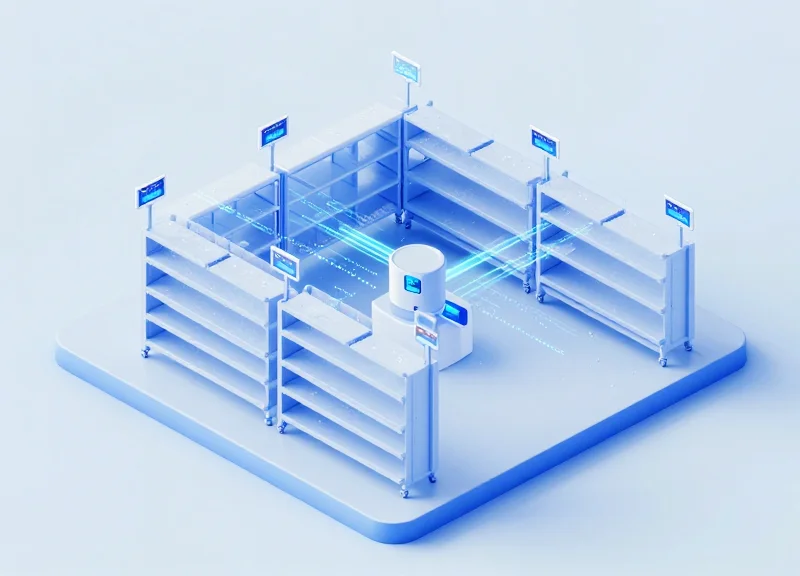
As healthcare facilities face mounting pressure to optimize costs and prevent equipment loss, the limitations of legacy Electronic Article Surveillance (EAS) gates are becoming impossible to ignore. In 2026, the shift toward RFID-EAS hybrid systems represents more than just a security upgrade; it is a fundamental transformation in how hospitals track, secure, and manage high-value medical assets in real-time. This article explores the technological convergence driving this change and why traditional gates are no longer sufficient for modern clinical workflows.
The Evolution of Hospital Security: From Passive Deterrence to Active Intelligence

The evolution of hospital security represents a fundamental shift from 'passive deterrence'—where systems simply sounded an alarm at an exit—to 'active intelligence,' where every medical asset is a data-generating node. By 2026, the industry standard has moved beyond preventing theft toward a holistic model of asset orchestration. Modern hospital environments now leverage hybrid RFID-EAS systems that combine the high-security threshold of Electronic Article Surveillance with the granular, real-time tracking capabilities of Radio Frequency Identification, turning exit points into data-capture hubs rather than just physical barriers.
| Feature | Legacy Passive Deterrence (EAS) | Modern Active Intelligence (RFID-EAS) |
|---|---|---|
| Primary Goal | Theft Prevention (Shrinkage) | Asset Visibility & Workflow Optimization |
| Data Granularity | Binary (Alarm or No Alarm) | Item-level (What, When, Where, Who) |
| Response Type | Reactive (Alarm sounds after event) | Proactive (Predictive alerts & tracking) |
| Clinical Value | Zero (Security department only) | High (Reduces 'search time' for nurses) |
For decades, hospitals relied on Electronic Article Surveillance (EAS) gates that operated on a 'gatekeeper' philosophy. If an item passed through a portal without being deactivated, it triggered a siren. However, this approach offered no insight into what was being taken, how many items were lost, or where those items were located five minutes before the alarm. This lack of data led to the 'Ghost Asset' phenomenon, where equipment appears on the balance sheet but cannot be found in the clinical setting.
What is the primary driver for switching to RFID-EAS hybrid systems?
The primary driver is the need for operational efficiency. While EAS stops theft, RFID allows hospitals to automate inventory counts, track maintenance schedules, and ensure that high-value mobile assets like infusion pumps are always available for patient care.
How does active intelligence impact the nursing staff?
It significantly reduces 'search fatigue.' Studies show nurses can spend up to 40 minutes per shift looking for equipment; active intelligence systems provide the exact location of assets, returning that time to patient bedside care.
Is the transition from legacy systems expensive?
While the initial hardware investment is higher than traditional gates, the ROI is typically realized within 12-18 months through reduced asset loss and eliminated over-provisioning of equipment.
Expert Insight: The 'Clinical Velocity' Metric. Beyond simple security, the shift to active intelligence introduces a new KPI: Clinical Velocity. This measures the speed at which a piece of equipment can be moved from sterilization or storage to a patient's room. Hybrid RFID systems enable 'Zero-Search' environments, which is the gold standard for hospital operational excellence in 2026. If you are only stopping theft, you are missing 90% of the value of your infrastructure.
Why Traditional EAS Gates Fall Short in Modern Clinical Environments
Traditional Electronic Article Surveillance (EAS) gates fall short in modern clinical environments because they operate on a binary 'alarm or no alarm' logic that cannot differentiate between a $5,000 infusion pump and a discarded security tag. While effective for basic retail theft prevention, legacy EAS systems lack the data granularity, interference resistance, and integration capabilities necessary to manage high-value medical assets in complex, metal-heavy hospital corridors.
| Feature | Legacy EAS Gates | Modern Clinical Requirements |
|---|---|---|
| Identification | Anonymous (Beep only) | Unique Asset ID (Serial Number/Type) |
| Data Directionality | Unknown | Inbound vs. Outbound Tracking |
| False Alarm Rate | High (Interference from medical tech) | Low (Filtered via digital signature) |
| Inventory Integration | None | Real-time ERP/CMMS Synchronization |
- The 'Identity Gap' Problem: EAS systems tell you something is leaving, but not what. In a hospital, security needs to know if the alarm is a life-critical ventilator or a low-value linen. Without unique IDs, staff experience 'alarm fatigue' and eventually ignore the gates entirely.
- Electromagnetic Interference (EMI): Modern hospitals are dense with EMI from MRI machines, telemetry systems, and mobile imaging units. Legacy EAS frequencies often suffer from 'phantom alarms' or dead zones caused by the high concentration of stainless steel and electronic shielding in clinical architecture.
- Lack of Directional Intelligence: Traditional gates cannot distinguish between an asset entering the ER for maintenance and one being stolen. This leads to redundant security checks and bottlenecking at high-traffic egress points.
Expert Insight: The Clinical Noise Correlation. A major hidden cost of traditional EAS is its contribution to the overall 'noise floor' of the hospital. Studies show that non-actionable alarms—like those from legacy EAS gates—contribute to clinician burnout. By 2026, hospital administrators are prioritizing 'Silent Security'—systems that only alert personnel via handheld devices when a specific, high-value asset is confirmed to be leaving the premises without authorization, rather than triggering an audible siren that disturbs patient recovery.
The Mechanics of Hybrid RFID-EAS Technology: The Best of Both Worlds
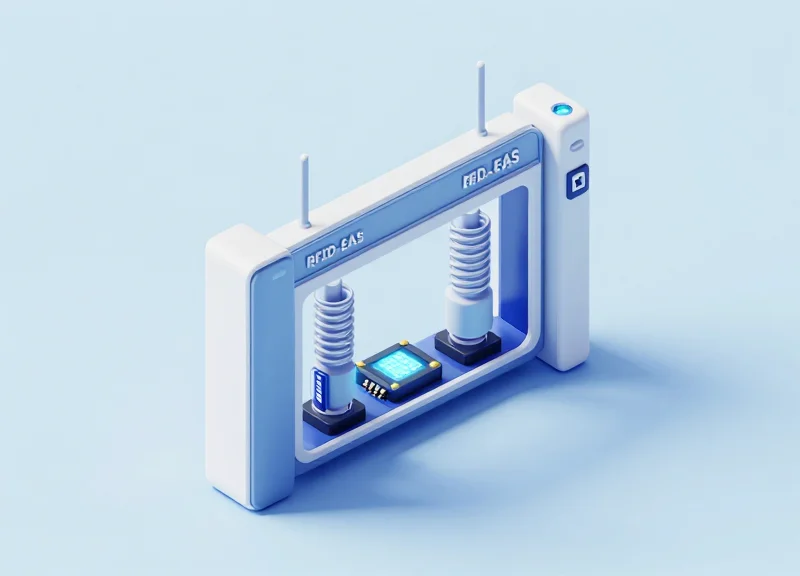
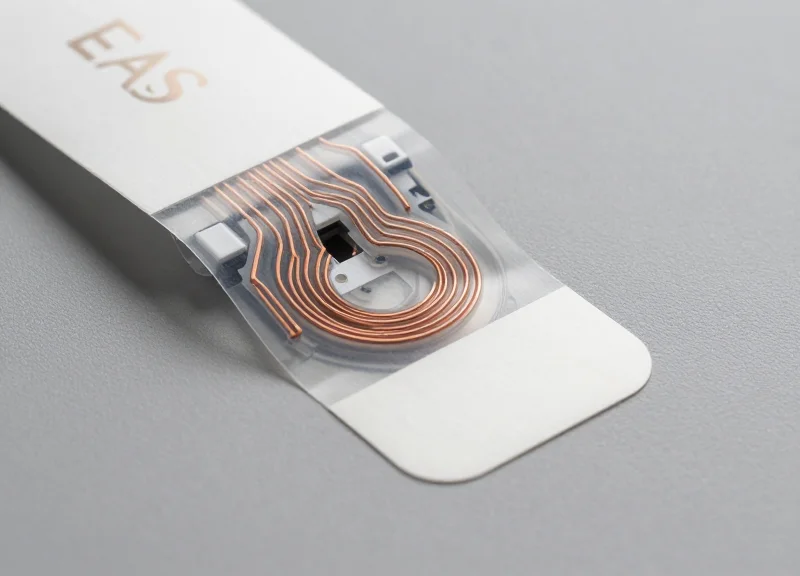
A hybrid RFID-EAS system is a dual-layered security architecture that integrates the high-performance deterrence of Electronic Article Surveillance (EAS) with the unique serialized identification of Ultra-High Frequency (UHF) RFID. While traditional EAS gates can only trigger an alarm based on the presence of a tag, the hybrid mechanic identifies exactly which item—down to its serial number, manufacture date, and maintenance status—is passing through the threshold. This transition from 'binary detection' (alarm/no-alarm) to 'item-level intelligence' is the core driver behind the 2026 hospital technology shift.
| Feature | EAS (AM 58kHz / RF 8.2MHz) | UHF RFID (860-960MHz) | Hybrid Integration |
|---|---|---|---|
| Primary Purpose | Loss Prevention / Deterrence | Inventory / Asset Tracking | Intelligent Protection |
| Data Capacity | None (Bit-only) | High (96-bit to 512-bit EPC) | Dual (Security + Serial ID) |
| Detection Range | Wide (Up to 2.4m) | Long Range (Up to 12m+) | Optimized Precision |
| Clinical Value | Anti-theft only | Asset location & lifecycle | Real-time theft forensic data |
The synergy between these frequencies solves the 'blind spot' problem in hospital management. EAS remains the gold standard for wide-aisle detection and signal penetration through liquids or near metals—common in clinical environments—while RFID provides the 'Who, What, and When' that modern compliance and inventory teams require.
- Detection & Resonance: As an asset approaches the portal, the EAS component (typically 58kHz Acousto-Magnetic) creates a surveillance zone that detects the physical tag resonance, ensuring a high-catch rate for security.
- Instant Identification: Simultaneously, the UHF RFID reader captures the tag’s Electronic Product Code (EPC). The system queries the hospital's Asset Management System (AMS) to identify the specific pump, monitor, or wheelchair.
- Contextual Logic Filtering: The system applies 'Business Logic.' If an infusion pump is flagged for maintenance or has not been checked out, the gate triggers an alarm. If it is a scheduled transfer, the gate logs the movement silently.
- Automated Inventory Update: The database is updated in milliseconds, reflecting the asset’s new location without requiring manual scanning by clinical staff.
Expert Insight: The Rise of 'Silicon-on-Metal' Hybrid Tags. In 2026, we are seeing a pivot toward specialized hybrid tags that utilize the asset's own metal chassis as an antenna extension. This 'Shadow Infrastructure' approach allows hospitals to tag high-value surgical kits and telemetry monitors that were previously difficult to track, effectively turning the entire hospital inventory into a self-reporting neural network.
Do hybrid systems cause interference with sensitive medical equipment?
No. Modern RFID-EAS systems operate on globally recognized medical-safe frequencies and comply with IEC 60601-1-2 standards for electromagnetic compatibility, ensuring no interference with pacemakers or ventilators.
Can I upgrade existing EAS gates to Hybrid?
In many cases, yes. Leading 2026 hardware providers offer 'RFID-Ready' EAS pedestals that allow for the insertion of RFID reader modules and antennas without replacing the entire physical gate structure.
What happens if the RFID tag is shielded?
This is where the hybrid mechanic excels. If the RFID signal is shielded, the EAS component still triggers a physical alarm, ensuring that security is never compromised even when data visibility is limited.
Real-Time Asset Visibility: Beyond Just Preventing Theft

Real-time asset visibility in modern healthcare refers to the ability to monitor the precise location, status, and movement of medical equipment throughout a facility using a synchronized data layer. Unlike traditional Electronic Article Surveillance (EAS), which only acts as a binary 'pass/fail' alarm at an exit, RFID-EAS hybrid systems turn every security gate into an intelligent data portal. By capturing unique Item Level Intelligence (ILI) as equipment passes through transition zones, hospitals move from reactive loss prevention to proactive clinical resource management.
| Feature | Traditional EAS Gates | RFID-EAS Hybrid Systems |
|---|---|---|
| Data Granularity | Binary (Alarm/No Alarm) | Specific Item ID, Model, and Batch |
| Directional Intelligence | None (Assumes exit) | Detects entry vs. exit movement |
| Inventory Integration | Isolated Security Tool | Syncs with ERP/Asset Management Software |
| Staff Response | Investigation of 'Buzzer' | Actionable task-based notifications |
The true ROI of a hybrid system lies in its ability to eliminate 'equipment hoarding'—a common practice where clinical staff hide infusion pumps or telemetry monitors to ensure they have them for the next shift. When the system tracks the movement of these assets between departments in real-time, the hospital can maintain higher utilization rates with less total inventory, directly reducing capital expenditure (CAPEX).
How does real-time visibility improve patient safety?
It ensures that recalled or unsterilized equipment is flagged immediately if it moves toward a patient care area, preventing use before a device is cleared by clinical engineering.
Can hybrid systems help with Joint Commission compliance?
Yes. By logging the movement and 'dwell time' of assets, hospitals can provide automated audit trails for preventative maintenance and sterilization cycles, replacing manual logs.
Does this replace the need for a full RTLS system?
Hybrid systems offer a 'Check-point RTLS' which is significantly more cost-effective for hospitals that need transition-zone visibility without the high cost of room-level ultrasound or Wi-Fi triangulation.
Expert Insight: The 'Inventory Velocity' Metric. In 2026, the most efficient hospitals will stop measuring success by 'loss rates' and start measuring 'Inventory Velocity.' This refers to how quickly a piece of equipment moves from the sterile processing department to the bedside and back. Hybrid systems provide the timestamp data necessary to identify bottlenecks in this cycle, such as equipment sitting idle in soiled utility rooms for days, effectively increasing your available fleet without buying a single new device.
Solving the Alarm Fatigue Crisis in Healthcare Facilities
In a modern clinical setting, alarm fatigue occurs when staff become desensitized to safety alerts due to a high volume of false positives, leading to delayed response times and increased patient risk. Hybrid RFID-EAS systems solve this crisis by adding 'contextual intelligence' to security gates. Unlike traditional systems that trigger for any tagged item, hybrid technology uses RFID metadata to verify if an item is checked out, assigned to a specific patient, or undergoing maintenance, ensuring that audible alarms only sound when a genuine security breach is detected.
| Feature | Traditional EAS Gates | Hybrid RFID-EAS Systems |
|---|---|---|
| Alarm Trigger | Presence of any active tag. | Unauthorized tag state + Directional movement. |
| False Positive Rate | High (Interference, non-deactivated tags). | Ultra-Low (Filtering out 'safe' IDs). |
| Staff Reaction | Desensitization ('The Cry Wolf Effect'). | High-urgency response to valid alerts. |
| Clinical Environment | Noisy, stressful, disruptive. | Quiet, healing-focused, automated. |
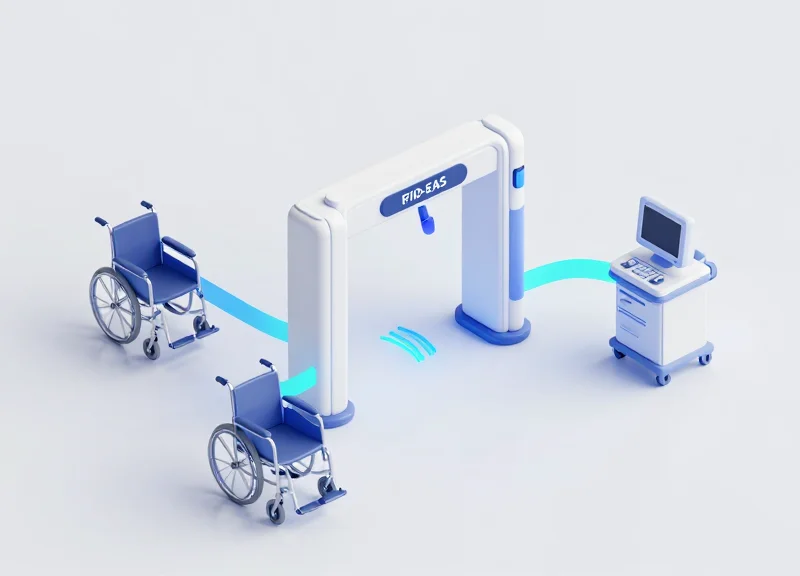
The intelligence of these systems lies in 'Logic Filtering.' For example, if a wheelchair passes through a main entrance, a traditional EAS gate would scream regardless of the context. A hybrid system, however, queries the RFID database: Is this wheelchair assigned to a discharged patient? Is a staff member accompanying it? If the 'workflow' data matches the physical movement, the system remains silent, logging the location without disturbing the peace.
- Unique Insight: The 'Silent Shift' to Wearable Notifications: By 2026, the most advanced hospitals are moving toward 'Zero Audible Alarms' in patient-facing corridors. Hybrid systems enable security alerts to bypass loud floor chimes entirely, instead pushing discrete, actionable data directly to staff wearables or mobile platforms like Epic Rover or Zebra devices. This transforms a public security event into a private clinical workflow task.
- Identify Asset Metadata: The RFID reader captures the unique Electronic Product Code (EPC) as the asset enters the gate's field.
- Cross-Reference Authorization: The system instantly checks the Asset Management Software to see if the item is 'In-Transit' or 'Unauthorized'.
- Execute Intelligent Response: If unauthorized, the system triggers a silent notification or an audible chime based on the specific risk profile of the exit.
Does reducing alarms actually improve patient outcomes?
Yes. Studies show that a quieter hospital environment reduces patient cortisol levels and improves sleep quality, which is directly linked to faster recovery times and higher HCAHPS scores.
Can these systems distinguish between people and assets?
Absolutely. Hybrid systems use directional sensing and signal strength analysis to ensure that personal belongings or staff badges don't trigger alarms intended for high-value medical equipment.
Integration with IoT and Cloud-Based Asset Management Platforms
By 2026, the value of a hospital security system is no longer measured by the volume of its alarms, but by the depth of its data integration. Modern RFID-EAS hybrid systems function as sophisticated IoT edge nodes that stream real-time asset telemetry directly into cloud-based Computerized Maintenance Management Systems (CMMS) and Enterprise Resource Planning (ERP) platforms. This integration enables a 'Single Source of Truth' for every medical device, allowing hospital administrators to automate the transition from reactive loss prevention to proactive, data-driven lifecycle management.
- Interoperability via REST APIs: Modern systems use standardized API protocols to sync movement data with existing hospital software, ensuring that when an infusion pump passes a gate, its status is updated globally in milliseconds.
- Automated Regulatory Compliance: Hybrid systems automatically log the presence and movement of sterilized or calibrated equipment, generating audit-ready reports for the Joint Commission (JCAHO) without manual scanning.
- Real-Time Cloud Dashboards: Centralized cloud platforms aggregate data from multiple facility entrances, providing a holistic view of asset distribution across entire healthcare networks.
| Feature | Legacy Standalone Gates | 2026 Cloud-Integrated Hybrid |
|---|---|---|
| Data Connectivity | Local/Siloed | Cloud-Native / API-First |
| Maintenance | Manual Schedule | Usage-Based Predictive Triggers |
| Asset Visibility | Presence/Absence only | Granular ID, Location, & Status |
| Update Frequency | Hardware Dependent | Over-the-Air (OTA) Updates |
Expert Insight: The Shift to 'Digital Twin' Asset Management. In 2026, we are seeing elite healthcare facilities move beyond simple tracking to 'Digital Twin' modeling. By integrating hybrid RFID-EAS data with cloud AI, hospitals can create a virtual replica of their asset flow. This allows administrators to run simulations on equipment utilization and predict 'theft hotspots' or 'hoarding zones' before they impact patient care—a capability that traditional, non-integrated gates simply cannot provide.
How does cloud integration handle hospital data privacy?
Systems utilize AES-256 encryption and SOC2-compliant cloud environments, ensuring that while asset metadata is tracked, no sensitive Patient Health Information (PHI) is ever exposed or stored within the tracking layer.
Can these systems integrate with existing Wi-Fi or BLE networks?
Yes, 2026 hybrid systems are designed to be 'network agnostic,' often acting as a bridge that consolidates RFID, BLE, and Wi-Fi data into a single unified cloud dashboard for streamlined management.
Does integration require a total overhaul of hospital IT?
No. Modern hybrid platforms are built on modular microservices, allowing hospitals to layer RFID-EAS data over existing infrastructure via standard webhooks and middleware.
ROI Analysis: Calculating the Long-Term Value of Hybrid Upgrades
Calculating the Return on Investment (ROI) for a hybrid RFID-EAS system requires moving beyond the 'security gate' mindset and adopting a Total Value of Ownership (TVO) framework. In 2026, the financial justification for these systems is driven by three primary levers: the near-elimination of equipment shrinkage, a 70-80% reduction in labor hours dedicated to manual inventory audits, and the optimization of procurement cycles by identifying underutilized 'ghost assets.' While legacy systems are a sunk cost, hybrid upgrades typically achieve a break-even point in 14 to 22 months by converting lost capital into operational liquidity.
| Financial Metric | Legacy EAS (Traditional) | Hybrid RFID-EAS (2026 Standard) |
|---|---|---|
| Shrinkage Mitigation | Detection only; no item ID | 99.9% identification and recovery |
| Inventory Labor Costs | High (Manual scanning/searching) | Low (Automated real-time counts) |
| Asset Utilization | Unknown (0-40% accuracy) | High (95%+ accuracy) |
| Procurement Savings | High over-provisioning (20%+) | Just-in-time procurement (5% buffer) |
- Phase 1: Shrinkage Baseline Assessment: Audit the last 24 months of equipment replacement costs for high-value items like infusion pumps, telemetry packs, and wheelchairs. Hybrid systems typically reduce this cost by 90% by identifying exactly when and where an item left a zone.
- Phase 2: Labor Redirection Valuation: Calculate the hourly rate of clinical staff spent 'hunting' for equipment. Reducing this search time by 15 minutes per shift across a 500-bed facility can save over $400,000 annually in reclaimed productivity.
- Phase 3: Rental and Procurement Optimization: Analyze the 'buffer stock' of equipment. Hybrid visibility allows hospitals to reduce their total asset pool by 15% because they no longer need to over-purchase to compensate for lost or misplaced items.
A unique insight for 2026: The 'Hidden ROI' of Hybrid Systems is found in Preventative Maintenance (PM) compliance. Because hybrid systems track the exact location and usage hours of assets, they ensure 100% of equipment is found and serviced on schedule. This avoids the massive litigation risks and regulatory fines associated with missing PM windows on life-critical devices—a financial safeguard that traditional EAS gates simply cannot provide.
Does the system require a complete rip-and-replace of existing infrastructure?
Not necessarily. Many 2026 hybrid solutions are designed to retrofit into existing pedestals or utilize PoE (Power over Ethernet) to minimize installation costs, significantly lowering the initial CapEx.
What is the impact on insurance premiums?
Many healthcare liability insurers are beginning to offer 'Risk Mitigation Discounts' for facilities that implement item-level tracking, as it directly reduces the risk of equipment-related medical errors.
How does the tag cost factor into long-term ROI?
While hybrid tags are more expensive than basic EAS stickers, their multi-year lifespan and ability to store maintenance data mean the cost per use is actually lower over a 3-year horizon.
Strategic Implementation: Navigating the Transition from Legacy Systems
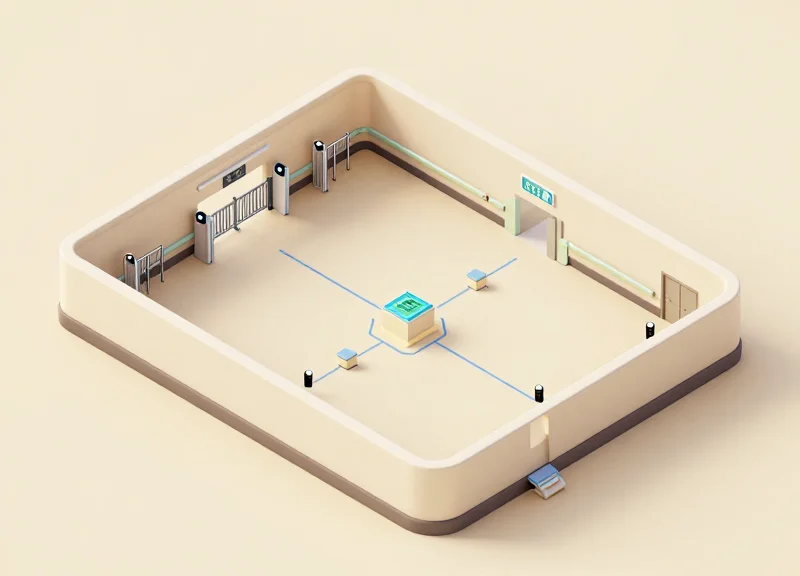
Transitioning from legacy Electronic Article Surveillance (EAS) to a hybrid RFID-EAS ecosystem is a strategic shift toward data-driven asset intelligence rather than a mere hardware replacement. By 2026, the industry standard for hospital implementation centers on 'Parallel Path Migration.' This strategy allows existing 58kHz or 8.2MHz security protocols to operate simultaneously with Ultra-High Frequency (UHF) RFID tracking. This dual-layered approach ensures that high-value mobile medical equipment remains protected by legacy sensors while the facility scales up its granular tracking capabilities, effectively eliminating security blind spots during the technical cutover.
- Phase 1: Ecosystem Audit and Spectrum Mapping: Identify all existing legacy gate locations and perform an RF site survey to ensure that the 860-960MHz RFID signals will not experience interference from existing hospital telemetry or Wi-Fi 7 deployments.
- Phase 2: The 'Hybrid-Ready' Tagging Initiative: Begin tagging all new inventory with dual-technology tags (EAS+RFID). This creates a 'forward-compatible' asset pool before the first hybrid reader is even installed.
- Phase 3: High-Value Zone Pilot: Deploy hybrid readers in high-traffic transition points, such as the Sterile Processing Department (SPD) or Emergency Room exits, to validate data accuracy without disrupting the entire facility.
- Phase 4: Middleware Integration: Connect the hybrid hardware to the hospital’s ERP or CMMS (Computerized Maintenance Management System) to automate asset history and compliance logging.
- Phase 5: Legacy Decommissioning: Once the RFID database achieves 99.9% accuracy, remove the standalone legacy gates and shift security alerts entirely to the hybrid management console.
| Feature | Legacy 'Rip and Replace' | Phased Hybrid Transition |
|---|---|---|
| Clinical Downtime | High (Exits blocked during install) | Near-Zero (Parallel installation) |
| Capital Expenditure | Massive upfront cost | Distributed over 18-24 months |
| Data Continuity | Historical gaps during swap | Continuous tracking throughout |
| Security Risk | High during system 'blackouts' | Low (Redundant systems active) |
Expert Tip: To maximize ROI, prioritize 'Chokepoint Virtualization.' By 2026, advanced hybrid systems can use beam-forming antennas to create virtual gates in hallways where physical pedestals were previously impossible to install due to fire codes or stretcher clearance requirements. This allows for a much more comprehensive tracking grid than legacy systems ever permitted.
Will hybrid RFID systems interfere with sensitive medical imaging equipment?
Modern hybrid systems are engineered for EMC (Electromagnetic Compatibility) compliance. By using passive RFID and directional antennas, the RF footprint is tightly controlled, making them safe for use near MRI suites and bedside monitors.
How do we handle existing legacy tags already on thousands of items?
The hybrid gates are specifically designed to trigger alarms for legacy EAS tags while simultaneously reading the data on new RFID tags. You do not need to re-tag your entire inventory immediately.
Is cloud connectivity required for the system to function?
While local security alerts function offline, cloud integration is essential for the predictive analytics and cross-departmental visibility that define the 2026 asset management standard.
Future-Proofing Your Facility: DragonGuard's Vision for 2026 and Beyond
Future-proofing a healthcare facility in 2026 requires moving beyond static checkpoints toward Invisible Security Ecosystems. DragonGuard’s vision centers on the 'Zero-Friction Hospital,' where RFID-EAS hybrid systems no longer act as physical barriers but as intelligent nodes in a facility-wide neural network. By integrating ultra-low-profile sensors into architectural elements, DragonGuard ensures that life-saving equipment remains secure and tracked without compromising the speed of clinical workflows or the aesthetics of modern patient-centered design.
| Feature | Traditional Legacy Systems | DragonGuard 2026 Vision |
|---|---|---|
| Detection Method | Hard-gated physical pedestals | Overhead 'Invisible' phased-array sensors |
| Data Granularity | Binary (In/Out) alarm triggers | Directional intent & high-fidelity ID |
| AI Integration | None (Reactive) | Predictive Asset Migration (Proactive) |
| Interoperability | Proprietary/Siloed | Open API & Matter-enabled IoT standards |
Expert Insight: The Shift to Cognitive Perimeters. While competitors focus on making gates smaller, DragonGuard is pioneering 'Cognitive Perimeters.' This technology uses edge computing to analyze the velocity and pattern of an asset's movement. For example, if a defibrillator moves toward an exit at a running pace during a code blue, the system recognizes the clinical urgency and suppresses the alarm; conversely, if it moves slowly toward a loading dock at 3:00 AM, security is instantly alerted. This contextual intelligence is what separates a smart hospital from a merely connected one.
How does DragonGuard ensure long-term hardware relevance?
We utilize Software-Defined Radio (SDR) technology in our 2026 hybrid readers, allowing for remote firmware updates that can support new RFID protocols or frequency adjustments without hardware replacement.
What role does sustainability play in the 2026 roadmap?
DragonGuard is transitioning to energy-harvesting sensors that reduce reliance on batteries, alongside modular hardware designs that allow for component-level upgrades, significantly lowering the Total Cost of Ownership (TCO) and electronic waste.
How will DragonGuard handle data privacy as systems become more integrated?
Our vision includes 'Privacy-by-Design' architectures where asset data is decoupled from patient PII at the hardware level, ensuring HIPAA compliance while maintaining total visibility of the medical equipment's location.
- Adopt a Unified Frequency Strategy: Moving forward, facilities must stop purchasing standalone EAS gates. DragonGuard recommends a baseline of dual-frequency hardware to support both loss prevention and inventory precision.
- Invest in Edge Intelligence: Ensure your 2026 infrastructure can process data locally to eliminate latency, a critical requirement for real-time asset recovery in high-acuity environments.
- Prioritize Architectural Integration: Select vendors that offer recessed or overhead mounting options to future-proof against hospital floorplan reconfigurations and to improve the patient experience.