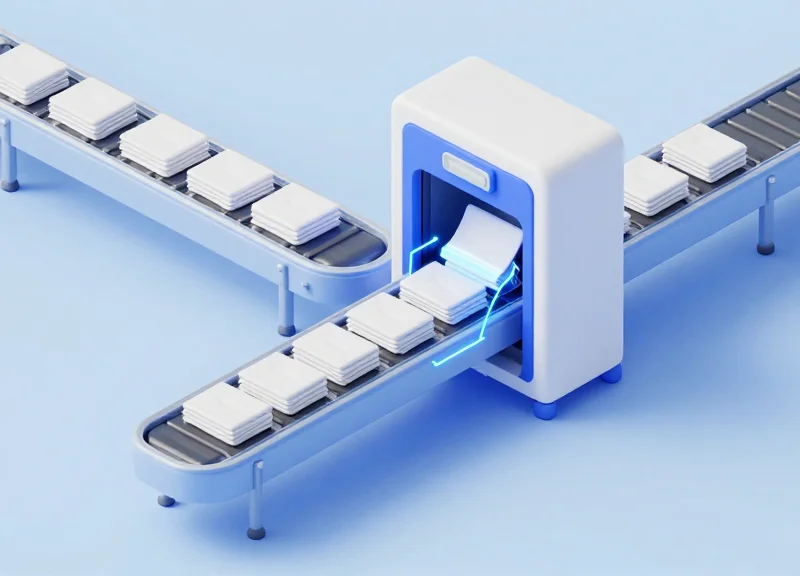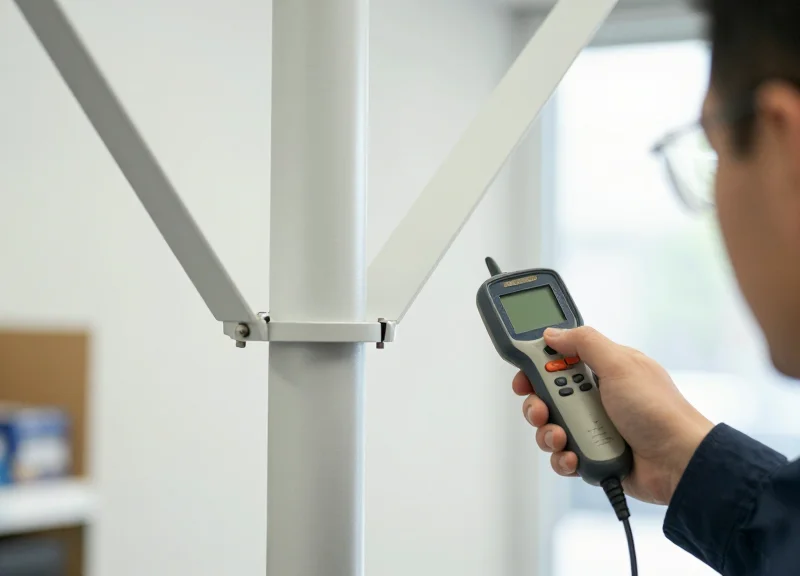

In the rapidly evolving corporate landscape of 2026, managing high-value office assets like high-performance laptops, servers, and specialized equipment is no longer a manual task. As hybrid work models and decentralized offices become the norm, traditional inventory methods are failing. This guide explores how advanced RFID (Radio Frequency Identification) systems provide the real-time visibility and security needed to protect your company's most valuable physical investments, ensuring data accuracy and loss prevention at scale.
The Evolution of Office Asset Management in 2026

In 2026, office asset management is no longer defined by periodic spreadsheets but by a continuous, AI-orchestrated 'Living Inventory' ecosystem. Driven by the proliferation of high-value mobile hardware and the demands of hybrid work architectures, enterprises have moved beyond legacy barcode systems toward automated RFID-driven governance. This evolution ensures that procurement and IT leaders maintain 99.9% accuracy in real-time tracking, effectively eliminating 'ghost assets' and streamlining the lifecycle management of expensive technical infrastructure.
| Capability | Legacy Management (Pre-2024) | 2026 RFID Ecosystem |
|---|---|---|
| Audit Frequency | Manual, Periodic (Quarterly/Annual) | Automated, Continuous (Real-Time) |
| Data Accuracy | 75-85% (Subject to human error) | 99.9% (Sensor-verified) |
| Asset Visibility | Last known scan location | Real-time room-level positioning |
| Labor Requirement | High (Significant man-hours) | Minimal (Zero-touch data capture) |
| ROI Metric | Depreciation only | Utilization and Velocity Analytics |
Expert Insight: The Shift to Asset Liquidization Velocity. A critical differentiator in 2026 is the focus on 'Asset Liquidization Velocity.' Modern RFID systems no longer just track where an item is; they track how often it is used. If a high-value AI workstation or specialized testing kit remains stationary for more than 72 hours, the system automatically triggers a reallocation workflow. This level of granular visibility allows Silicon Valley enterprises to reduce 'idle hardware' costs by up to 30%, turning static office equipment into a fluid, highly optimized resource pool.
Why are enterprises abandoning manual asset audits in 2026?
Manual audits are too slow to track the rapid movement of equipment in hybrid work models, leading to inaccurate financial reporting and increased risk of loss.
How does RFID technology integrate with modern office design?
Modern RFID readers are often embedded within IoT-enabled lighting and ceiling fixtures, allowing for invisible, ubiquitous tracking without disrupting office aesthetics.
What is the primary driver for RFID adoption in high-value equipment procurement?
Insurance and compliance mandates now frequently require real-time proof of possession for high-value gear to mitigate risk and ensure accurate asset valuation.
RFID vs. Legacy Systems: Why Barcodes Are No Longer Enough
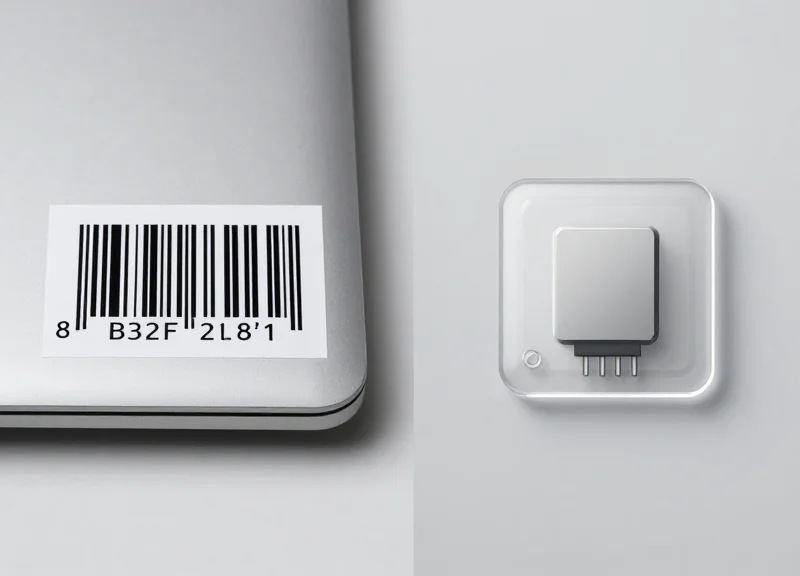
In 2026, the primary differentiator between RFID and legacy systems like barcodes or QR codes is the elimination of the 'line-of-sight' requirement. While legacy systems require a human operator to physically locate and scan each individual tag, RFID (Radio Frequency Identification) uses electromagnetic fields to automatically identify and track tags from a distance. This shift allows enterprises to conduct full-inventory audits in minutes rather than days, achieving 99.9% data accuracy by removing the human error inherent in manual scanning processes.
| Feature | Traditional Barcodes / QR | Active/Passive RFID (2026 Std) |
|---|---|---|
| Scanning Method | Optical Line-of-Sight (Manual) | Radio Frequency (Automated) |
| Read Rate | 1 item every 3-5 seconds | Up to 1,000 items per second |
| Data Capacity | Static (Read-only) | Read/Write (Dynamic history) |
| Durability | Low (Susceptible to smudges/tears) | High (Embedded in ruggedized tags) |
| Human Intervention | High (Requires significant labor) | Minimal (Hands-free portal scanning) |
The hidden cost of legacy systems lies in 'The Search Tax'—the cumulative hours employees spend looking for misplaced equipment that a barcode system simply cannot find. In a modern hybrid office, high-value assets like encrypted laptops and specialized AV gear move fluidly between zones. Barcodes only tell you where an item was during the last manual check; RFID tells you where the item is right now, as it passes through smart gateways or is detected by overhead ceiling readers.
- Expert Insight: The 'Hidden Asset' Paradox: A unique advantage of 2026 RFID deployments is the ability to identify assets hidden inside other objects. For example, a procurement team can audit a fully loaded mobile server rack or a locked Pelican case without opening it. This 'X-ray' capability is mathematically impossible for optical systems, reducing physical handling risks for sensitive equipment by 85%.
- Dynamic Data Tagging: Unlike QR codes which are static, modern RFID tags can store and update maintenance logs or chain-of-custody data directly on the chip. This creates a localized 'ledger' on the asset itself, which is vital for compliance in highly regulated industries.
Can RFID tags be used alongside existing barcode systems?
Yes. Most 2026 enterprise tags are 'Hybrid Tags' featuring both an RFID inlay and a printed QR code. This allows for a staged migration, providing backward compatibility for departments not yet equipped with RFID handhelds.
Is the cost of RFID tags still a barrier in 2026?
No. While individual RFID tags cost more than a printed sticker, the ROI is typically realized within 12 months due to a 90% reduction in labor hours required for inventory audits and a significant decrease in capital expenditure on 'phantom' replacement assets.
Does RFID interfere with office Wi-Fi or 5G networks?
Modern UHF (Ultra-High Frequency) RFID systems operate on specific bands (860-960 MHz) that do not interfere with standard 2.4GHz/5GHz Wi-Fi or cellular 5G frequencies, making them safe for high-density tech environments.
Essential Components of a High-Performance RFID Tracking System
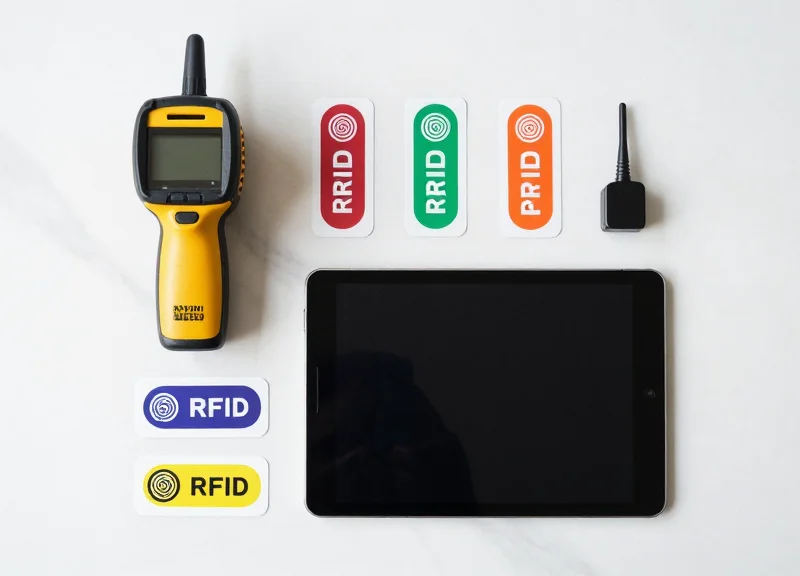
A high-performance RFID office asset tracking system is a synchronized ecosystem comprising four critical layers: specialized RFID tags for item identification, interrogation hardware (readers and antennas) for data capture, middleware for noise filtration, and centralized management software for actionable intelligence. In 2026, the gold standard for high-value equipment procurement relies on the seamless integration of these components to ensure 99.9% read accuracy without manual intervention.
| Component Type | Primary Function | Best Use Case (2026) |
|---|---|---|
| Passive UHF Tags | Battery-less, long-range identification | Standard IT equipment, monitors, and ergonomic furniture. |
| Active/BLE Tags | Continuous real-time location (RTLS) | High-value mobile assets like shared laptops or lab equipment. |
| Fixed Portals | Choke-point monitoring (entries/exits) | Preventing unauthorized removal of equipment from the floor. |
| Handheld Readers | On-demand auditing and searching | Rapid quarterly audits and finding 'lost' assets in cubicles. |
Beyond the physical tags, the 'interrogation zone' is where the hardware performs. Modern fixed readers in 2026 now incorporate Beam-Steering technology, allowing a single ceiling-mounted antenna to track the direction of movement, not just the presence of a tag. This distinguishes between an asset being moved for maintenance versus an asset being moved toward an exit.
What is the role of RFID Middleware?
Middleware acts as the 'nervous system' that filters raw tag data. It prevents 'ghost reads' and duplicate entries from reaching your ERP, ensuring that only meaningful location changes are recorded.
Does 2026 software require local servers?
Most high-performance systems have shifted to Cloud-Native architectures with Edge-computing capabilities, allowing for offline data caching and rapid synchronization during network outages.
Can RFID integrate with existing ITAM tools?
Yes, top-tier systems utilize RESTful APIs to feed real-time location data directly into IT Asset Management (ITAM) platforms like ServiceNow or Jira Service Management.
Expert Insight: The 'Signal-to-Noise' Threshold. As a 20-year veteran in the space, I have seen many deployments fail not because of cheap tags, but because of poor middleware configuration. In a dense office environment filled with metal and glass, 'signal bounce' is inevitable. The most advanced systems in 2026 utilize AI-driven RSSI (Received Signal Strength Indicator) filtering to distinguish between a tag that is actually in a room and one that is being read through a wall. When procuring your system, prioritize vendors who offer 'Edge-Processing'—this ensures your network isn't bogged down by millions of redundant tag 'pings' every hour.
Choosing the Right RFID Tags for IT and Office Assets
Choosing the right RFID tag is the most critical technical decision in an asset tracking project; selecting an incompatible tag for a high-value laptop or server can result in a 0% read rate. In 2026, the industry standard for office environments is Passive UHF (Ultra-High Frequency) Gen2v2 tags, which provide the optimal balance of read range—up to 10 meters—and cost-efficiency. However, because radio waves are reflected by metal and absorbed by liquids, the physical composition of the asset dictates the tag architecture required to maintain signal integrity.
| Asset Type | Recommended Tag Technology | Key Feature | Typical Read Range |
|---|---|---|---|
| Laptops & Tablets | Low-Profile On-Metal Tags | Antenna isolation from metal chassis | 3–5 Meters |
| Monitors & Docking Stations | Synthetic Asset Labels | High-tack adhesive for plastic | 5–7 Meters |
| Office Furniture | Eco-Friendly Paper Inlays | Biodegradable and cost-effective | 8+ Meters |
| Server Blades | Ceramic High-Temp Tags | Resistant to data center heat | 2–4 Meters |
| Cables & Peripherals | RFID Flag Tags | T-shape design to avoid signal interference | 1–2 Meters |
The 2026 'Silent' Tagging Shift: A unique development for this year is the rise of 'invisible' aesthetics in procurement. Enterprise leaders now prioritize 'Discreet Asset Identity.' This means moving away from bulky plastic tags toward sub-millimeter thin, printable on-metal inlays that can be hidden under manufacturer branding or inside battery compartments, ensuring that security doesn't compromise the industrial design of premium equipment.
- Identify the Surface Material: Determine if the asset is metallic (laptops, servers), non-metallic (wood desks), or composite (specialized lab equipment). Metal requires 'On-Metal' tags with a built-in spacer to prevent the metal from detuning the antenna.
- Define the Read Zone Requirements: Will the asset be scanned by a handheld reader during audits, or must it be detected by a fixed 'portal' at the exit? Portals require high-sensitivity tags with larger antennas.
- Evaluate Environmental Durability: For assets like coffee machines or industrial office equipment, ensure the tag is rated for high temperatures and resistant to cleaning chemicals.
- Perform a 'Foil' Interference Test: Expert Tip: Before a bulk purchase, test tags while the laptop is powered on and connected to Wi-Fi. Electronic noise from modern processors can occasionally interfere with lower-quality RFID chips.
Can I use a standard RFID sticker on a MacBook or Surface Pro?
No. Standard stickers will be completely 'silenced' by the aluminum or magnesium chassis. You must use a specialized 'on-metal' tag which utilizes a spacer or a specialized PIFA antenna design.
What is the lifespan of these office tags?
Passive tags have no battery and are designed to last the lifetime of the asset—typically 10 to 20 years—unless physically damaged or exposed to extreme chemical corrosion.
Are there eco-friendly options for high-volume tracking?
Yes, 2026 has seen the mainstream adoption of plastic-free RFID inlays where the antenna is printed directly onto FSC-certified paper, reducing the carbon footprint of office audits by up to 40%.
Software Integration: Syncing RFID with ERP and ITAM Platforms
In 2026, the value of an RFID system is not measured by how well it reads tags, but by how effectively that data is ingested by your Enterprise Resource Planning (ERP) and IT Asset Management (ITAM) platforms. Integration acts as the nervous system of your procurement strategy, transforming raw radio-frequency signals into actionable business intelligence. A modern RFID ecosystem must utilize RESTful APIs or GraphQL to bridge the gap between physical hardware middleware and software suites like SAP, Oracle, ServiceNow, or Jamf. Without this seamless data flow, your organization risks 'data silos' where physical reality and digital records diverge, leading to costly audit failures and ghost assets.
| Feature | ERP Integration (e.g., SAP, NetSuite) | ITAM Integration (e.g., ServiceNow, Snow) |
|---|---|---|
| Primary Focus | Financial depreciation and procurement. | Lifecycle management and software compliance. |
| Data Trigger | Asset acquisition or disposal events. | Location changes or maintenance alerts. |
| Audit Benefit | Automated balance sheet reconciliation. | Real-time hardware inventory accuracy. |
| Update Frequency | Often batch-processed or event-based. | Real-time or near-real-time streaming. |
- Middleware Logic Configuration: Deploy an RFID middleware layer that filters 'noise' (multiple reads of the same tag) before sending clean, deduplicated data to the API gateway.
- Schema Mapping and Normalization: Align your RFID tag IDs with the Unique Device Identifiers (UDI) or serial numbers already present in your ERP database to ensure 1:1 record matching.
- Webhook and Event Triggering: Set up automated triggers so that when an asset passes a 'chokepoint' reader at an exit, the ITAM system automatically flags the item as 'In Transit' or 'Off-site'.
- Bi-Directional Synchronization: Ensure data flows both ways: when a technician marks an item as 'Retired' in the software, the RFID handhelds should alert users if that tag is scanned during a subsequent audit.
The 2026 Unique Insight: The 'Hidden Latency' Trap. Most enterprises focus on API compatibility, but they overlook 'Eventual Consistency' latency. In high-velocity environments, a 5-minute delay in syncing an RFID read to your ITAM can lead to 'Ghost Assets' during rapid deployments. The most advanced systems now use Edge-to-Cloud Webhooks, where the RFID reader itself performs the initial database handshake, reducing the update window from minutes to sub-200 milliseconds. This ensures that your financial records are never more than a second behind the physical reality of your warehouse or office floor.
Will RFID integration slow down our existing ERP performance?
No, if implemented via asynchronous API calls. Modern middleware aggregates data and sends it in optimized payloads to ensure no impact on core system performance.
Can we integrate RFID with legacy software that lacks an API?
Yes, though it requires a 'Flat File' exchange or a Robotic Process Automation (RPA) bridge. However, for 2026 standards, upgrading to an API-first platform is highly recommended.
How do we handle security during data transmission?
All RFID data packets should be encrypted via TLS 1.3 during transit, and API access must be governed by OAuth 2.0 protocols to prevent unauthorized asset state changes.
Security and Loss Prevention: Protecting Your High-Value Hardware
An RFID-based loss prevention system functions as a digital tether for high-value equipment, utilizing fixed readers at egress points and software-defined geofences to trigger immediate alerts when an asset is moved without authorization. By 2026, the standard for securing hardware like high-end MacBooks, server blades, and specialized lab equipment has shifted from passive logging to active intervention. Unlike traditional security measures, RFID provides a 24/7 autonomous 'gatekeeper' that identifies exactly which item is leaving the building, who it is assigned to, and whether its movement complies with pre-set security policies.
- Establish Egress Choke Points: Install high-gain overhead or side-mount RFID readers at every exit, including loading docks and service elevators, to ensure 100% detection of tags passing through.
- Define Software Geofences: Create virtual boundaries within your office layout. If an asset tagged as 'Fixed-Internal' moves from a secure zone to a public lobby, the system logs a 'Geofence Breach' warning.
- Automate Alert Escalations: Configure the middleware to push instant notifications to Slack, MS Teams, or mobile devices for the security team, including the asset ID and the last known reader location.
- Sync with Video Surveillance: Integrate RFID events with VMS (Video Management Systems). A tag detected at an exit can automatically trigger the nearest camera to bookmark the footage for visual verification.
| Security Feature | Legacy Barcode/QR | Advanced RFID (2026) |
|---|---|---|
| Detection Mode | Manual line-of-sight scan | Automatic non-line-of-sight detection |
| Real-Time Alerts | None (Discovered post-loss) | Instantaneous at point of egress |
| Tamper Evidence | Easily peeled or copied | Fragile 'destruct' circuits on removal |
| Bulk Verification | One by one | Hundreds of assets per second |
Expert Insight: The Shift to Predictive Behavioral Analytics. In 2026, we are moving beyond simple 'tag-at-door' detection. The most sophisticated procurement strategies now prioritize systems that utilize RSSI (Received Signal Strength Indicator) Fingerprinting. This allows the system to analyze the movement patterns of a tag. If a high-value asset is moving toward an exit at a speed or path inconsistent with typical office use, the system can trigger a 'pre-emptive alert' to security before the item even reaches the door. This 'Shadow Perimeter' approach significantly reduces the window for successful theft.
How do we prevent thieves from simply peeling off the RFID tags?
We recommend using tamper-evident RFID labels with 'V-slots' or brittle substrates. If someone attempts to remove the tag, the antenna circuit breaks, rendering the tag dead and triggering a 'Tag Tamper' event in the system if the asset was within range of a reader.
Can RFID readers be bypassed by wrapping an item in foil?
While 'Faraday shielding' is a known tactic, modern security-grade readers can detect signal interference or sudden 'signal drops' in a high-traffic area, which can be flagged as suspicious activity. Additionally, dual-frequency tags (UHF + NFC) make it harder to completely shield a device.
Is it possible to track assets even when the power is out?
Yes, high-security RFID gateways are typically equipped with Power over Ethernet (PoE) with battery backups, ensuring the security perimeter remains active during facility power failures.
Scalability and Future-Proofing Your Procurement Strategy
In 2026, a truly scalable RFID asset tracking system is defined by its ability to evolve from a 'check-in/check-out' tool into an autonomous part of the broader enterprise IoT ecosystem. To achieve long-term ROI, procurement officers must look beyond immediate hardware costs and evaluate a vendor's alignment with global RAIN RFID standards and their capacity for 'API-first' data orchestration. A future-proof system ensures that as your organization grows—adding more assets, more locations, or more complex workflows—the underlying infrastructure remains stable, interoperable, and capable of integrating with emerging technologies like 5G-IoT and AI-driven predictive maintenance.
- Interoperability through RAIN RFID Standards: Ensure all hardware and tags are RAIN RFID (GS1 EPC Gen2v2) compliant. This global standard prevents vendor lock-in, allowing you to mix and match readers and tags from different manufacturers as supply chain availability or pricing fluctuates.
- API-First and Cloud-Native Architecture: Prioritize vendors that offer robust RESTful APIs or GraphQL endpoints. A future-proof system must push data in real-time to your ERP, HRIS, and ITAM platforms without requiring custom middleware that becomes a bottleneck during software updates.
- Edge Computing Capabilities: Modern procurement should focus on 'Smart Readers' capable of edge processing. These devices filter raw tag data at the point of entry, sending only relevant events to the cloud, which reduces bandwidth costs and improves system responsiveness as you scale to thousands of assets.
| Feature | Legacy RFID Approach | 2026 Future-Proof Standard |
|---|---|---|
| Connectivity | Local Server/Ethernet Only | Multi-cloud, Wi-Fi 6E, and 5G-IoT |
| Data Protocol | Proprietary Formats | GS1 & EPCGlobal (RAIN) Standards |
| Integration | Scheduled Batch Uploads | Real-time Webhooks & Event-Driven |
| Reader Life | Fixed Hardware Features | Software-Defined Radio (SDR) Upgradability |
Expert Insight: The Shift to Software-Defined RFID Readers. A common mistake in procurement is treating RFID readers as static appliances. By 2026, the industry has shifted toward 'Software-Defined Readers' that utilize containerized firmware (such as Docker on the Edge). This allows organizations to push over-the-air (OTA) updates to add new protocol support—such as hybrid BLE/RFID sensing—without physically replacing the hardware. Always ask vendors about their OTA update roadmap and containerization support.
Why is RAIN RFID compliance non-negotiable for 2026?
It ensures universal interoperability between tags and readers, guaranteeing that your infrastructure can read tags from any certified supplier globally, thus eliminating dependency on a single hardware manufacturer.
Can RFID integrate with existing smart building sensors?
Yes. Future-proof platforms leverage IoT Convergence, allowing RFID data to merge with occupancy sensors and HVAC systems to provide a holistic view of asset utilization and environmental impact.
How do I handle scaling for multi-region global offices?
Select vendors with centralized cloud management consoles that support regional frequency regulations (e.g., FCC for the US, ETSI for Europe) within a single software interface for global visibility.
ROI Analysis: The Business Case for RFID Investment

The Return on Investment (ROI) for an RFID office asset tracking system is typically realized within 12 to 18 months, driven by a 90% reduction in labor hours for audits, a 95% improvement in asset visibility, and the total elimination of 'ghost assets'—items that remain on books but no longer exist. By 2026, the business case has shifted from mere loss prevention to data-driven procurement optimization, where real-time utilization metrics prevent unnecessary capital expenditure on redundant hardware.
| Metric | Manual Tracking (Barcode/Spreadsheet) | RFID-Enabled Tracking (2026 Standard) |
|---|---|---|
| Audit Time (per 1,000 items) | ~80 Man-Hours | < 1 Man-Hour |
| Inventory Accuracy | 65% - 75% | 99.5% - 99.9% |
| Annual Asset Shrinkage | 3% - 5% | < 0.5% |
| Ghost Asset Tax/Insurance Waste | Significant (Overpayment) | Zero (Real-time reconciliation) |
Beyond simple time savings, the 'Utilization Gap' represents the most significant hidden cost in modern office environments. In my 20 years in the Valley, I've observed that most enterprises over-procure IT assets by 15-20% simply because they cannot locate existing inventory across satellite offices. A high-performance RFID system identifies these 'dark assets,' allowing procurement teams to reallocate existing stock rather than placing new orders, directly impacting the bottom line.
How does RFID reduce 'Ghost Asset' costs?
Ghost assets are lost or stolen items that remain on the accounting books. Because RFID provides an automated audit trail, companies can legally and confidently write off missing items, saving thousands in unnecessary personal property taxes and insurance premiums.
What is the primary driver of labor savings?
The shift from 'Line-of-Sight' (scanning one barcode at a time) to 'Bulk Capture' (reading hundreds of tags simultaneously). An IT manager can walk through a server room or storage closet and inventory every item in seconds without touching a single device.
Does the initial cost of on-metal tags negate the ROI?
While specialized tags for metal assets (laptops, servers) are more expensive than standard labels, their durability and the value of the assets they protect (often $2,000+) ensure the cost of the tag is less than 0.1% of the asset's value.
Expert Insight: In 2026, the most overlooked ROI factor is 'Compliance Readiness.' With tightening ESG and data privacy regulations, the ability to provide an immutable, RFID-generated audit log of hardware chain-of-custody (especially for devices containing sensitive data) can save an organization millions in potential regulatory fines and legal discovery costs.
Implementation Best Practices: A Step-by-Step Deployment Guide

Successful RFID implementation in a 2026 enterprise environment is no longer just about 'slapping on a tag'; it is a phased engineering process that prioritizes signal integrity and data hygiene. A robust deployment ensures that your investment in high-value asset tracking delivers a 'single source of truth' across the organization. To achieve 99.9% read accuracy in a modern office—often filled with RF-interfering materials like glass, steel, and high-density Wi-Fi 7 networks—you must follow a structured deployment lifecycle that mitigates signal collision and maximizes reader coverage.
- Environmental RF Audit & Site Survey: Conduct a comprehensive scan of your office's electromagnetic landscape. Identify 'dead zones' caused by server room shielding or metal-reinforced walls, and map out optimal reader placement to ensure continuous coverage of entry/exit points and high-traffic transition zones.
- Tag-to-Asset Validation (The Pilot Phase): Before a full-scale rollout, test specific tag types on a representative sample of assets (e.g., MacBooks vs. ergonomic chairs). Metal-mount tags are essential for IT hardware, while 'discreet-form' tags work better for furniture. Validate read rates in real-world motion scenarios.
- Middleware & API Configuration: Configure the RFID middleware to filter 'ghost reads'—incidental pings from tags that aren't actually moving. Ensure the data stream is formatted for your specific ITAM or ERP platform, establishing the logic for how and when an asset status changes.
- Full-Scale Tagging & Database Baseline: Execute the physical tagging process during off-hours to prevent workflow disruption. Each tag must be commissioned into the central database with a unique identifier linked to the asset’s serial number, purchase date, and assigned user.
- Continuous Optimization & Training: Train staff on 'tag hygiene'—ensuring labels aren't removed or obscured. Use the first 30 days of data to recalibrate reader sensitivity and power levels to account for the unique 'human traffic' patterns of your specific workforce.
| Deployment Phase | Common Pitfall | 2026 Best Practice |
|---|---|---|
| Site Survey | Ignoring Wi-Fi 7 interference | Use spectrum analyzers to map 6GHz band overlap. |
| Tagging | Using uniform tags for all assets | Apply specialized 'on-metal' tags for laptops and servers. |
| Data Sync | Batch processing data | Implement real-time 'Edge-to-Cloud' streaming for instant alerts. |
| Maintenance | Set-it-and-forget-it mentality | Quarterly 'Signal-to-Noise' audits as office layouts change. |
Expert Insight: The Dynamic Signal Map. In modern 'agile' offices, furniture and partitions move frequently. A 'static' RFID setup will fail within six months. My recommendation for 2026 is to implement a 'Dynamic Signal Map'—a software-based digital twin of your office that updates reader sensitivity automatically based on the movement of 'anchor tags' placed on permanent fixtures. This self-healing network ensures that even if you move a metal filing cabinet right in front of a reader, the system adjusts to maintain visibility of your high-value assets.
How long does a typical office deployment take?
For a mid-sized office (200-500 assets), expect a 4-to-6 week timeline: 1 week for the survey, 1 week for the pilot, and 2-4 weeks for full-scale tagging and software integration.
Can we use existing Wi-Fi access points for RFID tracking?
While some high-end APs have BLE (Bluetooth Low Energy) capabilities, dedicated RAIN RFID readers are required for passive tag tracking to achieve the precision needed for high-value equipment.
What is the most common cause of failed RFID projects?
Poor tag selection. Using standard adhesive tags on metal laptops leads to 'RF absorption,' making the assets invisible to the readers. Always use specialized on-metal tags for IT hardware.