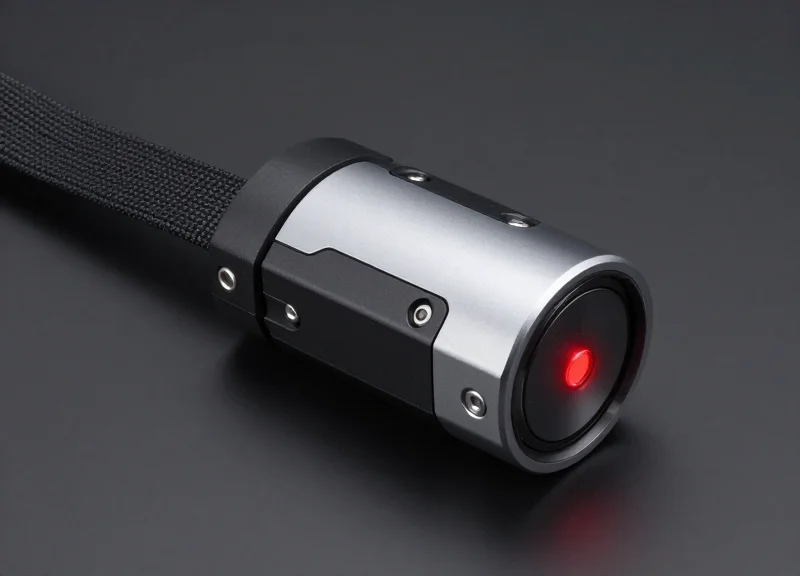
Retailers face a sophisticated threat: the silent cutting of security lanyards. While traditional EAS tags alert staff at the exit, they are often useless once a thief severs the connection mid-aisle. This engineer’s deep-dive explores how DragonGuard's 95dB self-alarming sensors transform passive security into proactive defense by triggering an immediate alert the moment a lanyard is tampered with, ensuring high-value merchandise remains protected throughout the store.
The Critical Vulnerability of Traditional EAS Lanyards

Traditional Electronic Article Surveillance (EAS) lanyards suffer from a structural vulnerability known as 'Loop Dependency.' These devices function as passive transponders, relying on a continuous conductive wire to maintain a resonant frequency—typically 8.2MHz for RF or 58kHz for AM systems. When a shoplifter uses basic metal shears to sever the lanyard, they are not just cutting a string; they are physically opening the electrical circuit. This action immediately shifts the tag's resonance out of range or kills it entirely, rendering the merchandise invisible to detection pedestals at the store exit.
| Security Metric | Standard Passive Lanyards | 95dB Self-Alarming Lanyards |
|---|---|---|
| Detection Mechanism | Gate-dependent Proximity | Internal Continuity + Proximity |
| Response to Cutting | Circuit Termination (Silent) | Immediate 95dB Local Alarm |
| Alert Location | Exit Pedestal Only | Point of Theft (Local) |
| Theft Deterrence | Reactive (Post-Theft) | Proactive (Immediate Detection) |
In my 20 years observing retail loss prevention evolution, the most overlooked flaw is the 'Silent Extraction Window.' Because traditional EAS systems are reactive, they only alarm when a functioning tag passes through the exit field. Once the lanyard is cut, the 'Q-Factor' (the quality of the resonant circuit) collapses to zero. The tag becomes a 'dead' piece of plastic. This creates a zero-risk environment for the thief within the store aisles, as there is no local audible alert to notify floor staff that a security breach has occurred.
Why don't gates beep when a lanyard is cut?
Exit gates work by sending a signal and listening for a reflection from a tuned circuit. Cutting the lanyard breaks that circuit, so there is no signal to reflect, leaving the gate 'blind' to the stolen item.
Can hardened steel cables prevent this?
Hardened cables increase 'Time to Theft' by a few seconds, but they do not solve the fundamental vulnerability. Professional shoplifters use high-leverage mini-cutters that bypass even reinforced cables silently.
What is the 'Engineer’s Blind Spot' in standard retail security?
Many engineers focus on gate sensitivity, but the real weakness is the lack of an onboard power source in the tag itself. Without a 'heartbeat' or battery to monitor its own continuity, a passive tag cannot report its own destruction.
Anatomy of a Self-Alarming Sensor: Technical Architecture
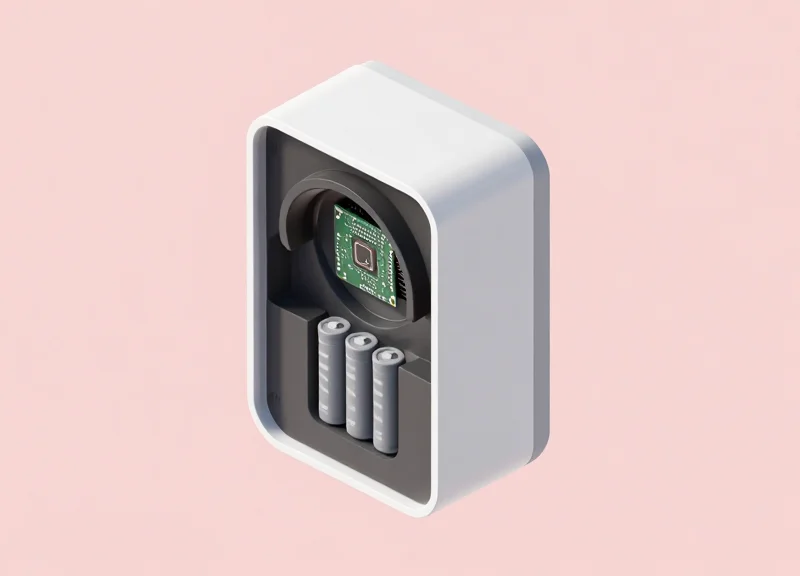
The architecture of a self-alarming sensor is built around an active continuity loop: a low-voltage electrical circuit that flows through the lanyard's steel core and back into the sensor's logic board. Unlike passive EAS tags that only react to external gates, these devices utilize an internal microcontroller (MCU) to constantly monitor for an 'Open-Circuit' state. When a shoplifter cuts the lanyard, the circuit is broken, causing the MCU to instantly transition from a low-power 'sleep' mode to an 'alarm' state, driving 95dB of acoustic pressure through a high-frequency piezoelectric diaphragm.
| Component | Technical Role | Critical Specification |
|---|---|---|
| Microcontroller (MCU) | Logic engine for state monitoring and alarm timing. | Ultra-low standby current (< 2μA) |
| Conductive Lanyard | Hardened steel cable acting as the continuity path. | Multi-strand core for flexibility and low resistance |
| Piezoelectric Buzzer | Electro-acoustic transducer for high-decibel output. | Min. 95dB @ 10cm; Resonant freq. 2-4kHz |
| Power Source | Internal DC supply for localized alarming. | Lithium Manganese Dioxide (CR2032/CR2450) |
| RF/AM Coil | Communication with existing store EAS gates. | Dual-frequency 58kHz/8.2MHz capability |
- The Continuity Handshake: The MCU sends a low-duty cycle pulse through the lanyard to verify integrity. This 'handshaking' consumes negligible battery while ensuring the circuit is closed.
- Interruption Detection: When the lanyard is cut, the return pulse is lost. The MCU detects this 'Open-Circuit' event within approximately 100 milliseconds.
- Amplification Logic: The MCU triggers an oscillator circuit that drives the piezoelectric element, converting electrical energy into mechanical vibration and intense sound.
- Lock-Down State: Once triggered, the alarm enters a locked state, requiring a proprietary magnetic or digital key to reset, preventing the thief from silencing it.
Expert Insight: From an engineering perspective, the biggest challenge is the 'Continuity vs. False Alarm' trade-off. Premium sensors utilize advanced transient suppression—a software filtering algorithm that ignores micro-millisecond interruptions caused by static electricity or physical jostling, ensuring the alarm only fires when a true severance occurs. This prevents the 'phantom alarms' that plague cheaper, less sophisticated models.
How long does the battery last in a self-alarming sensor?
Under standard conditions, the ultra-low power MCU allows for a 2-3 year shelf life. However, once the 95dB alarm is triggered, battery life is consumed rapidly to maintain the high decibel level.
Can the alarm be silenced by re-connecting the cut wires?
No. The architecture is designed with a 'Latching Logic.' Once the continuity loop is broken, the alarm state remains active until physically reset by a secure detacher, regardless of whether the circuit is restored.
Does the internal battery interfere with the EAS gate signal?
Not at all. The passive RF/AM coils operate independently of the internal DC circuit, allowing the sensor to function as both a standard tag and an active alarm.
The Physics of 95dB: Why Sound Intensity is Your Best Deterrent
In the context of retail security, 95dB (decibels) represents a critical threshold of sound pressure level (SPL) that transcends simple noise to become a psychological and physiological deterrent. Because the decibel scale is logarithmic, a 95dB alarm is not merely 'loud'—it is approximately 32 times the perceived loudness and 100 times the acoustic energy of a standard 75dB conversation. This intensity is specifically engineered to exceed the ambient 'noise floor' of a busy retail environment (typically 60-70dB), ensuring the signal-to-noise ratio is high enough to be unmistakable even in high-ceilinged or carpeted spaces.
| Sound Source | Intensity (dB) | Relative Loudness (vs. Quiet Office) | Impact on Shoplifter |
|---|---|---|---|
| Quiet Office/Library | 40 dB | 1x | Negligible |
| Typical Retail Floor | 65-70 dB | ~6x | Masks standard EAS beeps |
| Standard Self-Alarm | 85 dB | ~22x | Noticeable but ignorable |
| High-Output Sensor | 95 dB | 45x+ | Immediate panic/Aversion |
The effectiveness of a 95dB alarm is rooted in the 'Inverse Square Law' of acoustics. As a shoplifter moves away from the source, sound pressure drops by 6dB for every doubling of distance. By starting at a massive 95dB directly at the lanyard source (the point of the crime), the alarm remains at an actionable 80dB+ even 15-20 feet away. Furthermore, these sensors are tuned to the 2.5 kHz to 4 kHz frequency range. This is the 'sweet spot' of human hearing, where the ear canal's natural resonance amplifies sound, making 95dB feel significantly more piercing and urgent than a lower-frequency sound of the same decibel level.
Why is 95dB better than a standard door pedestal alarm?
Door alarms only trigger when the thief is exiting, often too late for intervention. A 95dB self-alarming sensor triggers at the point of the cut, turning the thief into a loud, moving beacon that remains active as they try to flee through the store.
Does the sound penetrate through bags or clothing?
Yes. While a 'booster bag' or heavy coat might muffle lower decibel alarms by 10-15dB, a 95dB source still emits 80-85dB through most shielding, which is still loud enough to alert nearby staff and customers.
How does the sound affect the thief's psychology?
It triggers an 'Acoustic Startle Response.' The high-intensity sound causes a momentary spike in cortisol and adrenaline, disrupting the cognitive focus required to complete a theft and usually forcing an immediate 'drop and run' reaction.
Expert Tip: When evaluating sensors, engineers should look for 'Pulsing Frequency Modulation.' A steady 95dB tone can eventually be mentally filtered out through a process called auditory adaptation. However, a modulated or 'warbling' 95dB siren prevents the brain from habituating to the sound, maintaining peak urgency for the duration of the alarm cycle.
Neutralizing 'Cut-and-Run' Tactics with Tamper-Proof Logic
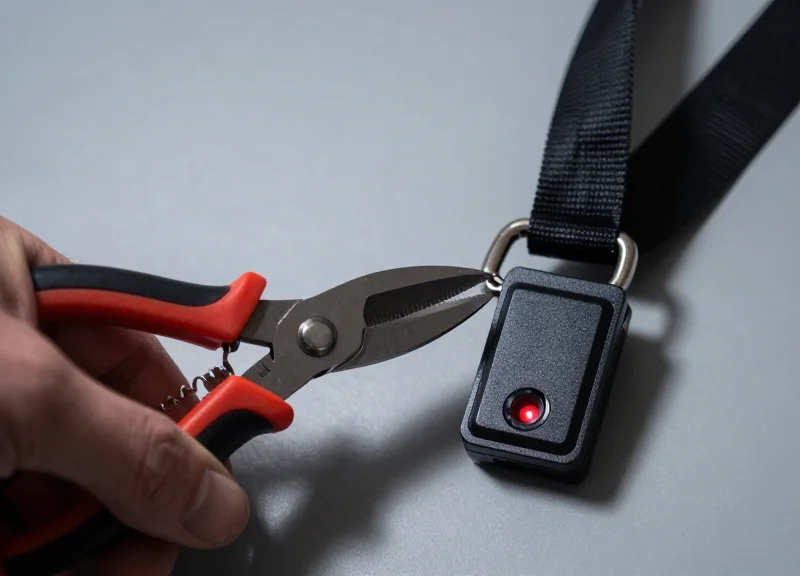
In traditional retail security, 'cut-and-run' refers to the tactic where a shoplifter uses wire cutters to sever a lanyard, rendering a passive EAS tag useless as they sprint out the door. Neutralizing this requires moving the 'intelligence' from the exit pedestal directly onto the tag itself. Tamper-proof logic utilizes an onboard Microcontroller Unit (MCU) that treats the lanyard not just as a physical tether, but as a completed electrical circuit. When this circuit is interrupted—even for a millisecond—the MCU executes a 'tripwire' logic sequence that activates the 95dB siren immediately, regardless of where the thief is standing in the store.
| Feature | Passive EAS Lanyards | Self-Alarming Logic Tags |
|---|---|---|
| Detection Point | Exit Pedestals Only | Point of Infraction (Everywhere) |
| Trigger Mechanism | RF/AM Field Disturbance | Internal Continuity Break |
| Response Time | Delayed (at exit) | Instantaneous (<10ms) |
| Thief Countermeasure | Cut and sprint | Impossible to silence by cutting |
The core of this logic is the 'State Machine' programmed into the tag's silicon. Unlike a simple switch, the MCU monitors the impedance of the loop. If the lanyard is cut, the device enters an 'Alarm State' that is latching. This means that even if the thief attempts to tape the wires back together or toss the device, the 95dB alarm continues to scream until a proprietary magnetic key resets the software. This creates a psychological deterrent: the thief becomes a walking beacon of high-decibel noise the moment they attempt to tamper with the merchandise.
Expert Tip: Look for 'Active Polling' logic. High-end sensors poll the continuity loop at a frequency of 10Hz to 20Hz. This ensures that even high-speed mechanical snips cannot bypass the sensor's detection window, a common flaw in cheaper, lower-frequency 'eco' models.
Does the alarm stop if the thief leaves the store?
No. Because the power source and logic are onboard the tag, the alarm will continue to sound for a pre-programmed duration (usually 5 to 10 minutes) or until manually deactivated, making it easier for security to track the suspect outside the premises.
Can the logic be fooled by a short circuit?
Advanced tamper-proof sensors utilize resistance-sensitive logic. If a thief attempts to bypass the loop by 'bridging' the wire with a conductive material, the MCU detects the change in electrical resistance and triggers the alarm.
How does the logic handle battery depletion?
The logic includes a low-voltage cutoff. Instead of failing silently, the tag will typically emit a distinct 'chirp' or visual LED flash to alert staff that the tamper-protection logic requires a battery replacement or unit swap.
Dual-Frequency Integration: RF, AM, and RFID Compatibility

Dual-frequency integration in self-alarming sensors is the engineering practice of embedding multiple resonance circuits and digital identifiers within a single device to ensure interoperability with existing Electronic Article Surveillance (EAS) infrastructure. By combining active circuitry for 95dB local alarming with passive components for 58KHz (Acousto-Magnetic) or 8.2MHz (Radio Frequency) systems, these sensors provide a fail-safe security layer that works with legacy pedestals while offering localized deterrents against lanyard cutting.
| Technology | Frequency | Primary Function | Role in Self-Alarming Tag |
|---|---|---|---|
| AM (Acousto-Magnetic) | 58 KHz | Wide-exit detection | Triggers pedestal alarm if tag is brought near exit. |
| RF (Radio Frequency) | 8.2 MHz | Cost-effective detection | Provides backward compatibility for standard RF gates. |
| RFID (UHF) | 860-960 MHz | Item-level tracking | Enables serialized inventory data and 'smart' alarming. |
| Self-Alarm Logic | Active Battery | Localized deterrent | Monitors lanyard continuity; triggers 95dB siren if cut. |
Expert Insight: The Interference Mitigation Challenge. In my two decades in the valley, the biggest hurdle I’ve seen in multi-protocol sensor design is electromagnetic interference (EMI). Placing a high-decibel piezo buzzer and an active logic controller in close proximity to passive RF antennas often leads to 'ghosting' or reduced detection ranges. Premium self-alarming sensors utilize high-permeability ferrite shielding to isolate the active alarm components from the passive EAS coils, ensuring that the 95dB circuit does not desensitize the 8.2MHz or 58KHz response.
Can one tag support both AM and RF simultaneously?
While rare due to physical space constraints and signal interference, high-end 'Dual-EAS' tags exist. However, the industry standard is to select a model matching your store's specific pedestal frequency (AM or RF) combined with a universal 95dB self-alarm logic.
How does RFID integration change the security landscape?
RFID adds a 'digital thumbprint.' When a self-alarming tag is tampered with, an RFID-enabled system can not only sound the alarm but also instantly update the inventory management system to identify exactly which SKU was targeted.
Does the 95dB alarm interfere with RFID readers?
No. The 95dB alarm is an acoustic frequency generated by a piezo element, whereas RFID operates in the Ultra-High Frequency (UHF) spectrum. They operate on entirely different physical layers.
Ultimately, the goal of integration is to provide a 'defense-in-depth' strategy. Even if a professional shoplifter uses a signal jammer to bypass the 58KHz pedestals, the internal logic of the self-alarming sensor remains vigilant. The moment the lanyard is cut, the localized 95dB alarm activates, independent of any external frequency or infrastructure, effectively neutralizing the 'blind spots' of traditional EAS systems.
Battery Engineering and Longevity for Enterprise Deployment
Enterprise-grade self-alarming sensors are engineered to solve a difficult thermodynamic paradox: maintaining a constant, high-fidelity monitoring state for 2 to 3 years while possessing enough stored energy to drive a 95dB piezo-electric siren for up to ten minutes of continuous alarm. The core of this system is an ultra-low-power (ULP) logic controller that draws less than 5 microamps (µA) during its 'monitoring' phase. By utilizing high-energy-density Lithium-Manganese Dioxide (Li-MnO2) chemistry, typically in CR2450 or CR2032 form factors, engineers can guarantee shelf lives that match or exceed standard retail refresh cycles, provided the hardware architecture minimizes parasitic drain and Equivalent Series Resistance (ESR).
| Operational State | Typical Current Draw | Duration / Frequency | Impact on 3-Year Lifespan |
|---|---|---|---|
| Quiescent (Monitoring) | <5 µA | 99.9% of time | Negligible (approx. 131mAh) |
| Continuity Check | 15-20 µA | Pulse every 500ms | Moderate (approx. 45mAh) |
| 95dB Active Alarm | 30-50 mA | Max 10 minutes | High (approx. 8.3mAh per event) |
| EAS Pedestal Interaction | 1-2 mA | Seconds per exit | Low |
The technical differentiator in high-performance sensors is the 'Capacitor Buffer Strategy.' Standard coin cells are not designed for the 50mA instantaneous discharge required to hit 95dB; doing so would cause a voltage sag that resets the internal microcontroller, silencing the alarm. To prevent this, professional-grade tags integrate a low-ESR buffer capacitor that stores charge specifically for the piezo-driver. This allows the battery to 'trickle-charge' the capacitor, which then provides the high-current burst necessary for the acoustic transducer without stressing the cell chemistry. This architecture ensures the alarm remains loud and consistent even if the battery is nearing the end of its life cycle.
How does extreme temperature affect the 3-year battery rating?
Cold storage environments can increase the internal resistance of lithium cells, temporarily reducing the decibel output. Sensors designed for enterprise deployment use temperature-compensated oscillators to maintain frequency stability despite these thermal shifts.
Can the battery be replaced to extend the hardware life?
Most high-security self-alarming tags are ultrasonically welded to meet IP67 water-resistance and tamper-proof standards, making them 'disposable' high-value assets. However, some modular designs allow for 'caddy' replacements to reduce electronic waste.
How do engineers prevent 'false alarm' battery drain?
By employing a dual-stage verification logic. The sensor must detect both a break in the physical continuity loop and a specific impedance change before engaging the high-power piezo driver, ensuring energy is only spent on valid theft events.
Expert Tip: When deploying these sensors at scale, always verify the 'Pulse Current' specification of the internal battery. Generic lithium cells often fail in self-alarming applications because they cannot handle the repetitive 95dB oscillations. Enterprise-grade sensors specifically source cells with 'High Pulse' variants to ensure that the 500th alarm is as loud as the first.
Application Scenarios: From Designer Handbags to High-End Electronics

Self-alarming lanyard sensors are most effective in high-shrinkage environments where traditional EAS (Electronic Article Surveillance) tags are vulnerable to quick-cut tools. By integrating a 95dB internal siren directly into the lanyard loop, retailers can protect open-merchandise displays for luxury leather goods, power tools, and high-end electronics. This technology provides an active defense layer that triggers immediately upon a cable breach, regardless of whether the thief has reached the store exit or the security pedestals.
| Product Category | Primary Vulnerability | Security ROI Factor | Recommended Lanyard Type |
|---|---|---|---|
| Designer Handbags | Strap-cutting with ceramic blades | Preservation of resale value/structural integrity | Metal-core, 7-strand stainless steel |
| High-End Electronics | Unboxing or cable snips | Deterrence in low-staffing open displays | Coiled cable for reach/flexibility |
| Premium Outerwear | Sleeve-based tag removal | Prevents high-value bulk 'sweep' theft | Fine-gauge non-marring lanyard |
| Professional Power Tools | Bolt cutter deployment | Audible alerts in high-noise environments | Heavy-duty reinforced tether |
From a Silicon Valley engineering perspective, the unique value of these sensors lies in the 'Time-to-Exit' delay they create. Most professional shoplifting occurs within a 30-second window between the 'cut' and the 'run.' When a 95dB alarm is triggered at the point of the cut, it instantly eliminates the anonymity that professional thieves rely on. My expert tip: For luxury retailers, the 'Soft-Loop Vulnerability Index' suggests that any item with a replacement cost over $500 should utilize a self-alarming lanyard, as the cost of the sensor is typically less than 2% of the potential loss, paying for itself after a single prevented incident.
Can these sensors be used on curved surfaces like camera lenses?
Yes, high-end electronics like DSLR cameras and high-velocity zoom lenses benefit from adjustable lanyard loops that wrap around the barrel, providing security without obstructing customer handling or testing.
How does the alarm react to accidental tugging by customers?
Engineered sensors use a threshold logic; the alarm only triggers upon a total circuit break (cutting) or a physical tamper attempt on the housing, preventing false alarms from standard customer interaction.
Are these sensors compatible with tethered display stands?
Many models offer dual-protection, where the lanyard secures the product to the display stand, and the internal logic provides the 95dB alert if that tether is severed.
Operational Best Practices: Attachment and Detachment Protocols
To maximize the efficacy of 95dB tamper-proof sensors, operational protocols must focus on the 'Electronic Handshake'—the precise moment the lanyard completes the internal circuit to arm the logic controller. Proper attachment ensures the sensor cannot be bypassed via mechanical shimmying, while strict detachment protocols using high-strength magnetic keys prevent accidental triggers that damage brand reputation and create 'alarm fatigue' among floor staff.
- The 'Push-Click-Pulse' Attachment Sequence: Staff should insert the lanyard pin until an audible mechanical click is heard. Following the click, wait 1.5 seconds for the LED to pulse, confirming the onboard microprocessor has verified the circuit continuity and the 95dB alarm is officially 'hot'.
- Strategic Lanyard Threading: Always loop lanyards through non-removable structural elements (e.g., handbag handles or metal grommets). Avoid threading through thin fabric loops or removable straps that can be easily cut or detached at the garment level, rendering the sensor's logic moot.
- The 5-Point Tension Check: Before placing the item on the sales floor, perform a quick 'tug test' to ensure the locking ball-clutch is fully engaged. If there is more than 2mm of 'play' in the pin, the circuit may break intermittently, causing a false alarm.
- Authorized Detachment Authorization: Only use 12,000-15,000 Gauss magnetic detachers. Staff must center the sensor precisely over the magnetic core to disengage the internal locking mechanism without stressing the lanyard cable.
| Common Operational Failure | Technical Root Cause | Corrective Protocol |
|---|---|---|
| Intermittent Chirping | Loose internal circuit contact | Re-seat pin and verify LED pulse |
| Alarm Triggers at POS | Detacher magnetism is weak/worn | Test detacher Gauss levels monthly |
| Lanyard Fraying | Mechanical stress during storage | Retire sensor; replace with aircraft-grade cable |
How should staff respond to a 95dB sensor alarm on the floor?
Protocol dictates an immediate 'Secure and Silence' approach. Staff must approach the item, verify if the lanyard has been cut, and use a master magnetic key to silence the alarm immediately to minimize customer distress while maintaining visual custody of the suspect.
How often should detacher keys be audited?
We recommend a weekly 'Station Audit.' Each POS detacher must be tethered to the counter to prevent internal theft of the tool, and the magnetic flux should be verified to ensure it can still retract the locking pin without excessive force.
Can sensors be attached to leather goods without damage?
Yes, but protocols should mandate the use of protective silicone sleeves on the lanyard wire to prevent the cable from 'biting' or marking soft luxury leathers under tension.
Expert Tip: Implement a 'Zero-Gap' mounting strategy. In Silicon Valley's most secure flagship stores, engineers recommend mounting sensors so the lanyard is under slight, constant tension. This prevents 'mechanical shimmying' where a thief uses a thin wire to try and bypass the locking ball-clutch, as the constant tension keeps the internal electrical contacts firmly pressed together.
ROI Analysis: Comparing Traditional EAS vs. Self-Alarming Technology
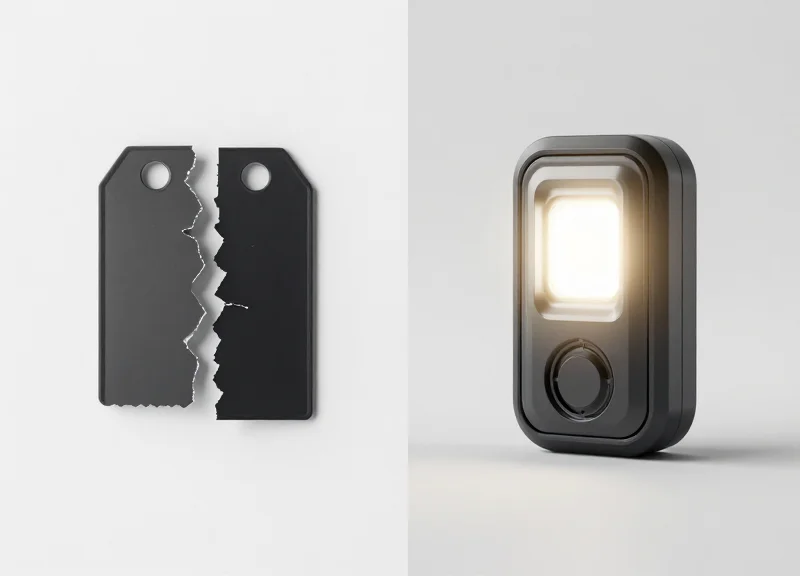
The Return on Investment (ROI) for self-alarming technology is fundamentally driven by its ability to eliminate the 'silent theft' window inherent in traditional Electronic Article Surveillance (EAS). While traditional passive tags only trigger an alarm at the store exit—often after the lanyard has been cut and the tag discarded—95dB self-alarming sensors provide an immediate deterrent at the point of attack. For high-margin goods, the break-even point typically occurs within 120 to 180 days, as the cost of the sensor is offset by the prevention of just one or two high-value 'cut-and-run' incidents that traditional EAS would fail to detect.
| Feature | Traditional Passive EAS Tags | Self-Alarming 95dB Sensors |
|---|---|---|
| Detection Trigger | Exit pedestal proximity only | Lanyard cutting or tampering |
| Alert Location | Store entrance/exit | Directly on the merchandise |
| Shrinkage Focus | Exit-gate shoplifting | Internal 'cut-and-run' and organized crime |
| Typical ROI Cycle | 18-24 Months (Volume based) | 4-8 Months (Value based) |
| Staff Response Time | Delayed (Reactionary) | Instantaneous (Proactive) |
From an engineering economics perspective, we must look at the 'Total Cost of Risk' (TCOR). Traditional EAS systems have lower unit costs but higher 'residual risk' because they do not protect the integrity of the lanyard itself. If a thief cuts a standard lanyard, the asset is effectively 'invisible' to the security system. Self-alarming sensors convert that residual risk into an active alert. In retail environments where high-value items like luxury handbags or professional electronics are displayed, the loss of a single unit ($500+) can equal the cost of outfitting an entire display shelf with 20+ smart sensors, making the 'loss-to-protection' ratio highly favorable.
What is the 'Detection-to-Action' (DtA) Latency advantage?
In traditional systems, DtA latency is the time it takes for a thief to move from the shelf to the exit, often 30-60 seconds. Self-alarming sensors reduce DtA latency to sub-1 second, forcing the thief to abandon the item immediately.
Does battery maintenance impact the long-term ROI?
Modern sensors use ultra-low-power ICs that provide a 2-3 year lifespan. When amortized, the battery maintenance cost represents less than 3% of the total cost of ownership, negligible compared to the 40-60% reduction in lanyard-cutting shrinkage.
How does it affect labor optimization for security staff?
By pinpointing the exact location of the theft attempt via the 95dB alarm, security personnel do not need to monitor exit gates exclusively; they can respond directly to the source, increasing the efficiency of floor staff.
Expert Tip: To maximize ROI, implement a 'Tiered Security Model.' Use traditional EAS for high-volume, low-cost consumables, but reserve self-alarming sensors for items where the 'Value-at-Risk' exceeds the sensor cost by a factor of 10. This surgical application ensures you aren't over-engineering protection for low-risk stock while creating a 'hardened zone' for your most vulnerable assets.