The global cold chain is facing an unprecedented transformation as we head toward 2026. With rising energy costs, stricter food safety regulations, and the persistent threat of inventory shrinkage, retailers and logistics providers must rethink their protection strategies. Chilled food items are particularly vulnerable, requiring a delicate balance between security and temperature integrity. This guide explores how Electronic Article Surveillance (EAS) and Radio Frequency Identification (RFID) are evolving to provide next-gen defense for the world's most sensitive supply chains.
The Current State of Cold Chain Vulnerability

Cold chain vulnerability is defined as the systemic risk points within temperature-controlled supply chains where chilled goods are susceptible to thermal excursions, physical theft, or administrative shrinkage. Currently, the global food industry loses approximately $35 billion annually due to cold chain failures. As we look toward 2026, these vulnerabilities are being magnified by a 'perfect storm' of volatile energy costs, labor shortages, and increasingly sophisticated organized retail crime (ORC) targeting high-value perishables like premium meats, seafood, and artisanal dairy.
| Vulnerability Vector | Primary Risk Factor | Economic Impact | Detection Difficulty |
|---|---|---|---|
| Temperature Excursions | Equipment failure or power instability | High (Total batch loss) | Moderate (Requires data logging) |
| Organized Retail Crime | High-value chilled product resale | Rising (Targeted theft) | Hard (Standard EAS often bypassed) |
| Last-Mile Fragmentation | Unmonitored third-party delivery | Moderate (Reputational damage) | Very Hard (Dark zones in visibility) |
| Regulatory Non-Compliance | FSMA 204 and strict traceability | Severe (Legal fines/Recalls) | Variable (Audit-dependent) |
The fundamental problem in the current landscape is the 'Visibility Gap.' While traditional Electronic Article Surveillance (EAS) can deter some shoplifting, it offers zero insight into the biological status of the product. Conversely, simple temperature logs are often reactive, discovered only after the damage is done. This lack of integrated intelligence means that retailers are often selling 'safe' looking food that has already begun its accelerated decay process, leading to high return rates and diminished brand trust.
Why is chilled food theft increasing in 2024-2025?
Inflationary pressures have turned high-value chilled items, such as ribeye steaks and specialized infant formulas, into liquid assets for underground markets. These items are 'fast-movers' and harder to track than serialized electronics.
What is the 'Thermal Blind Spot'?
This refers to the transition points between the delivery truck and the retail display case. Goods often sit on ambient-temperature loading docks for hours due to labor shortages, significantly reducing shelf life before the product is even shelved.
How does shrinkage impact sustainability goals?
Every pallet of spoiled chilled food represents wasted water, methane emissions from decomposition, and unnecessary carbon expenditure in transport, making cold chain vulnerability a major ESG liability.
Expert Insight: The Labor-Security Paradox. In my two decades of Silicon Valley logistics analysis, I've observed a shift where retailers are forced to reduce floor staff to save costs, which directly invites more theft. However, the hidden killer is that fewer staff also means fewer eyes on temperature gauges and 'Use By' dates. The current state of vulnerability isn't just a hardware problem; it's a data-processing problem. By 2026, any chilled food protection strategy that doesn't combine physical security with real-time thermal telemetry will be considered obsolete.
EAS in 2026: The Hardened Shield Against Retail Shrinkage
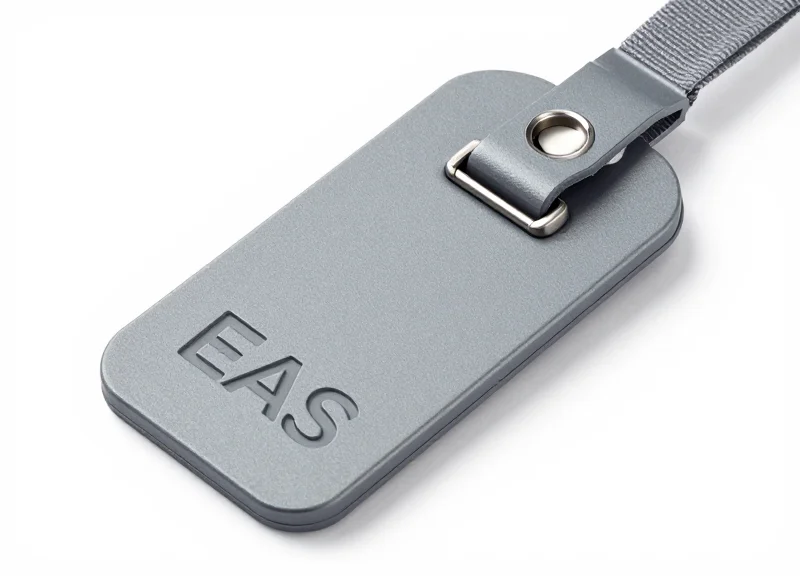
In 2026, Electronic Article Surveillance (EAS) remains the primary line of defense against retail shrinkage in the chilled food sector, having evolved from simple alarm triggers into 'hardened' systems capable of operating in high-moisture, sub-zero environments. Modern EAS for the cold chain utilizes specialized polymer-encapsulated circuits and high-bond adhesives that prevent signal attenuation caused by condensation, ensuring that premium chilled goods—from high-end meats to artisanal cheeses—remain protected from the shelf to the exit gate without the false alarms common in legacy hardware.
The fundamental shift in 2026 is the move away from paper-based labeling toward material science-driven security. In a refrigerated environment, traditional paper EAS tags absorb moisture, leading to 'tag-damping' where the signal is too weak to be picked up by pedestals. The 2026 generation of EAS tags utilizes Acousto-Magnetic (AM) technology housed within a hydrophobic barrier, maintaining a crisp resonance even when buried under layers of frost or stacked in high-humidity display cases.
| Feature | Legacy EAS (Pre-2023) | Next-Gen EAS (2026) |
|---|---|---|
| Moisture Resistance | Paper-based; prone to peeling | Polymer-sealed; hydrophobic |
| Detection Accuracy | 80-85% in chilled zones | 98.5% with digital signal processing |
| Form Factor | Bulky stickers | Ultra-thin, clear-film integrated |
| Adhesive Strength | Loses grip at < 4°C | Cryogenic-grade acrylic bonding |
| System Integration | Standalone pedestal alarms | Cloud-linked with video timestamps |
Expert Insight: The 'Hydro-Acoustic' Advantage. A unique trend emerging in 2026 is the integration of EAS circuits directly into the primary packaging film during the manufacturing process. By moving the security element behind the moisture barrier of the food wrap itself, retailers are seeing a 40% reduction in 'tag switching'—a common theft tactic where shoplifters peel labels off expensive chilled items and place them on cheaper products.
Can EAS tags survive deep-freeze temperatures?
Yes, 2026-spec EAS labels are rated for temperatures as low as -25°C. They utilize specialized chemical stabilizers in the magnetic resonator to ensure the frequency does not shift due to thermal contraction.
How does EAS handle the 'Liquid Effect' in chilled foods?
While liquids can absorb Radio Frequency (RF) signals, modern 58kHz Acousto-Magnetic (AM) systems are largely unaffected by the high water content in meats and poultry, making AM the preferred 2026 standard for cold chain protection.
Is EAS more cost-effective than RFID for chilled foods?
For high-volume, low-margin chilled goods, EAS remains significantly more affordable per unit. While RFID offers better inventory data, EAS provides a 'hardened' deterrent at a fraction of the cost, often serving as the baseline security layer.
The Rise of RFID: Granular Visibility for Perishable Goods

By 2026, Radio Frequency Identification (RFID) has evolved from a simple inventory tool into the 'digital nervous system' of the cold chain. Unlike traditional Electronic Article Surveillance (EAS), which primarily acts as a binary security gate, RFID provides granular, item-level visibility. It allows stakeholders to track individual units of chilled goods through every node of the supply chain, capturing critical data points such as production timestamps, batch origin, and precise expiration dates. This level of detail is the primary weapon against the $160 billion annual problem of global food waste, enabling retailers to transition from reactive security to proactive freshness management.
| Feature | Legacy EAS / Barcodes | Next-Gen RFID (2026) |
|---|---|---|
| Data Depth | SKU level only (Limited) | Unique Item Level (Granular) |
| Visibility Range | Line of sight required | Non-line-of-sight (Bulk read) |
| Waste Mitigation | Manual date checking | Automated FEFO alerts |
| Cold Chain Integrity | No temperature history | Integrated sensor logging |
One of the most significant shifts in 2026 is the widespread adoption of FEFO (First-Expired-First-Out) logistics. While traditional inventory systems rely on FIFO (First-In-First-Out), which ignores actual shelf-life variance, RFID-enabled cold chains use real-time expiration data to prioritize the sale of goods nearing their end-of-life. This ensures that the oldest safe stock is moved first, significantly increasing sell-through rates for high-value chilled proteins and dairy.
- Automated Receiving: Pallets of chilled goods are scanned instantly upon arrival, flagging any items with short remaining shelf life before they hit the floor.
- Real-Time Inventory Accuracy: Retailers maintain 99% accuracy on chilled stock, reducing 'phantom inventory' that leads to over-ordering and eventual spoilage.
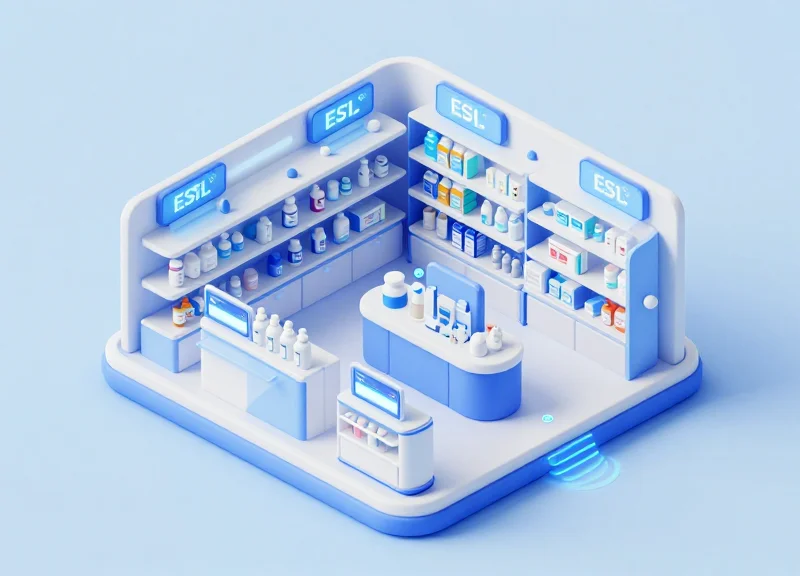
- Dynamic Markdown Integration: RFID data feeds directly into electronic shelf labels (ESLs), automatically triggering price drops for items 48 hours from expiration.
Expert Insight: The 'Digital Decay' Algorithm. In 2026, leading retailers are moving beyond static expiration dates. By pairing RFID tags with ambient temperature sensors, systems now calculate a 'dynamic shelf life.' If a chilled shipment sits on a loading dock for 20 minutes too long, the RFID system automatically recalibrates the expiration date in the ERP, preventing consumers from buying compromised products and protecting brand reputation.
Do RFID tags work in high-moisture chilled environments?
Yes. Modern 2026 RFID tags utilize specialized 'on-metal' and 'liquid-safe' designs that prevent signal detuning caused by the high water content in chilled foods and condensation.
Does RFID replace the need for EAS security?
Not entirely. While RFID provides better data, EAS remains more cost-effective for high-volume, lower-margin items. Many retailers now use 'Dual-Tech' tags that combine RFID's data with EAS's physical security.
How does RFID impact labor costs in the cold chain?
RFID reduces manual 'date-checking' labor by up to 75%, allowing staff to focus on customer service and shelf replenishment rather than scanning individual barcodes.
Direct Comparison: EAS vs. RFID in Low-Temperature Environments
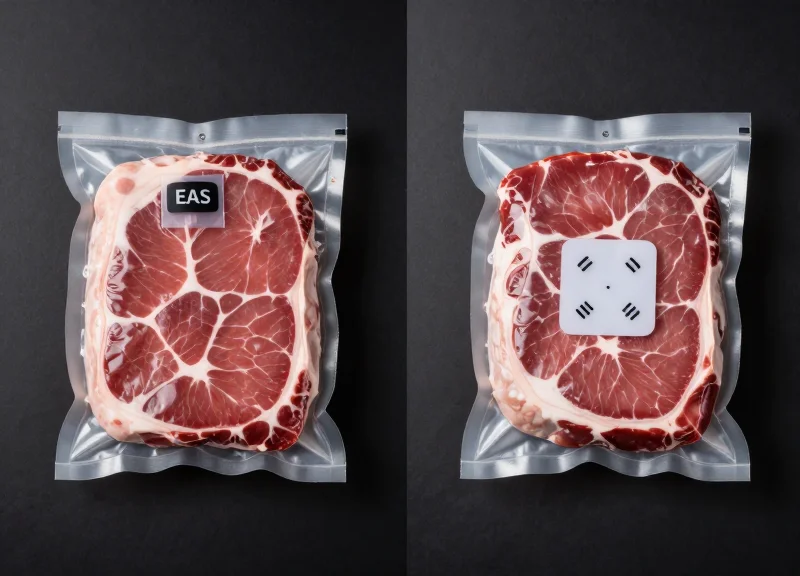
In low-temperature environments, the choice between EAS and RFID hinges on the trade-off between signal resilience and data depth. While EAS (Electronic Article Surveillance) offers superior signal penetration through high-moisture areas and frost buildup for basic loss prevention, RFID (Radio Frequency Identification) provides the granular, item-level visibility required for expiration management, though it remains more susceptible to 'detuning' caused by the dielectric properties of liquid water and ice crystals.
| Feature | EAS (Acousto-Magnetic) | RFID (UHF Gen2) |
|---|---|---|
| Moisture Resistance | High: Low frequency is less affected by water molecules. | Moderate: Moisture on tags can absorb RF energy. |
| Frost Tolerance | Excellent: Signal passes through ice layers easily. | Variable: Thick frost can shift the resonant frequency. |
| Data Capacity | Binary: Only detects presence (On/Off). | High: Tracks SKU, Batch, and Expiry Date. |
| Read Range in Cold | Short: Optimized for exit pedestals. | Long: Up to 10 meters, but degrades with condensation. |
| Tag Cost | Lowest: Optimized for high-volume perishables. | Moderate: Decreasing, but higher than standard EAS. |
How does condensation affect RFID readability in 2026?
Condensation acts as a dielectric shield. In 2026, advanced 'Rain' RFID tags utilize specialized antenna geometries to compensate for water-film detuning, but performance still drops by 15-30% in high-humidity transition zones compared to EAS.
Does extreme cold cause EAS tag failure?
Standard EAS tags are robust, but the adhesive is the weak point. Low temperatures can make traditional adhesives brittle, causing tags to fall off chilled packaging—a phenomenon known as 'pop-off' that requires cold-grade acrylic resins.
Can RFID and EAS be used simultaneously in the cold chain?
Yes, dual-technology tags (EAS+RFID) are the 2026 gold standard, combining the 'unbreakable' security of Acousto-Magnetic signals with the inventory intelligence of UHF RFID.
Expert Insight: The 'Micro-Condensation' Detuning Factor. A common mistake in cold chain deployment is testing tags in a dry freezer and assuming they will work at the loading dock. My experience shows that the 'transition zone'—where warm air hits cold product—creates a micro-layer of liquid water under the frost. This liquid layer is significantly more disruptive to RFID signals than solid ice because of its higher dielectric constant. For 2026, we recommend specifying 'autotuning' RFID chips that can dynamically shift their impedance to match the environment, a feature EAS does not require because of its lower operating frequency.
Breaking the Moisture Barrier: New Tag Innovations
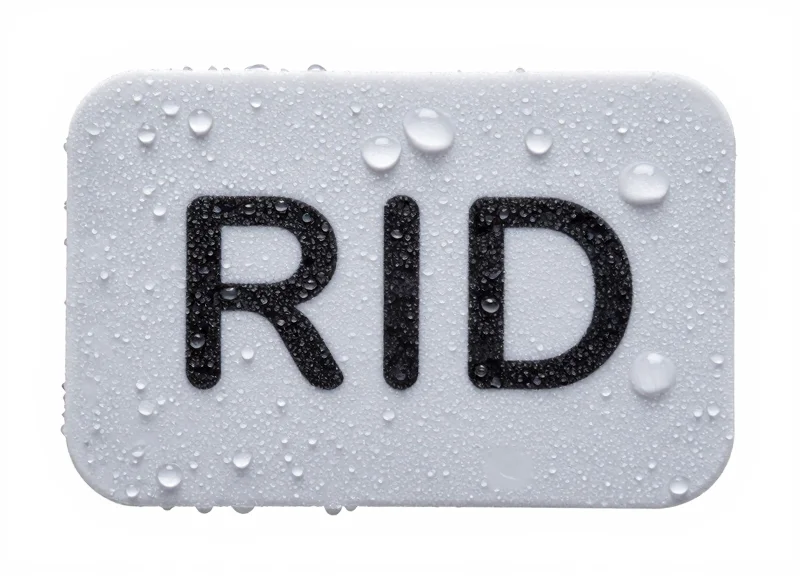
In 2026, the primary hurdle for chilled food protection—the 'liquid barrier'—has been dismantled through the development of Dielectric Buffering and Hydrophobic Encapsulation. Traditionally, water molecules absorb RF energy, rendering RFID tags unreadable and EAS systems unreliable on high-moisture items like fresh poultry or vacuum-sealed meats. The latest hardware innovations utilize a specialized air-gap or 'foam-spacer' substrate that physically offsets the antenna from the product surface, ensuring that the electromagnetic field remains stable despite the proximity of water-heavy content.
| Feature | Legacy Tags (Pre-2024) | 2026 Chilled-Grade Innovations |
|---|---|---|
| Substrate Material | Standard Paper/PET | Micro-Cellular Foam & Graphene-Reinforced PET |
| Moisture Resistance | External Plastic Coating | Full Hydrophobic Nanocoatings (IP68 Equivalent) |
| Adhesive Performance | Loses Tack at 2°C | Cryogenic Acrylate (Maintains bond to -30°C) |
| Antenna Design | Flat Etched Copper | 3D Folded Dipole with Self-Tuning Impedance |
A significant breakthrough in 2026 is the shift toward Graphene-based conductive inks. Unlike traditional aluminum or copper etchant, graphene maintains its conductivity even when subjected to micro-cracking caused by extreme temperature fluctuations (the freeze-thaw cycle). This ensures that the tag remains functional throughout the entire cold chain journey, from the processing plant to the consumer's basket.
- Phase 1: Surface Treatment: The packaging surface is treated with a plasma-arc to ensure the cryogenic adhesive creates a permanent molecular bond, preventing 'tag-drop' in high-humidity chillers.
- Phase 2: Dielectric Buffering: A 1.5mm micro-foam layer is applied to isolate the RFID inlay from the product's moisture, preventing the water from acting as a parasitic capacitor.
- Phase 3: Hydrophobic Sealing: The entire assembly is encapsulated in a laser-welded polymer sheath that repels condensation and prevents ice crystal formation on the antenna leads.
Expert Insight: The 'Holy Grail' of 2026 is the Self-Tuning IC. Newer chips can detect the dielectric shift caused by surface frost and dynamically adjust their internal capacitance. This means a single tag SKU can now perform with 99.9% accuracy on a dry carton of eggs or a moisture-slicked tray of salmon—a feat that was impossible just three years ago.
Will these moisture-resistant tags work through heavy frost?
Yes. 2026-gen tags utilize high-gain 'Long-Range' antenna designs specifically tuned to penetrate up to 5mm of surface frost without significant signal degradation.
Are these new materials recyclable?
Most 2026 innovations prioritize sustainability, using 'wash-off' adhesives and mono-material constructions that allow the tags to be separated easily during the plastic recycling process.
Is the cost significantly higher than standard tags?
While there is a 12-15% premium for specialized cold-chain tags, the reduction in 'shrinkage' and 'false alarms' typically results in an ROI within the first six months of deployment.
Compliance and Traceability: Meeting New Global Food Standards

By 2026, global food standards will shift from passive monitoring to active, real-time digital traceability. The primary driver, the FDA’s FSMA Rule 204, mandates that companies throughout the supply chain maintain detailed records for specific high-risk foods. Integrating RFID and EAS technologies allows businesses to automate the capture of Critical Tracking Events (CTEs) and Key Data Elements (KDEs). While EAS serves as a compliance check for retail inventory integrity, RFID provides the granular, item-level data required to meet the 24-hour response window for regulatory audits and food safety recalls.
| Regulatory Standard | EAS Role | RFID Role | 2026 Compliance Target |
|---|---|---|---|
| FSMA Rule 204 (USA) | Loss prevention & batch integrity. | Automated KDE/CTE logging. | Full digital traceability for high-risk foods. |
| EU General Food Law | Theft prevention in retail. | Precision 'One Step Back/Forward' tracking. | Enhanced transparency for shelf-life accuracy. |
| GS1 Global Standards | Verification of physical SKU count. | EPCIS data sharing & serialization. | Interoperable data across global supply chains. |
The shift toward 'Compliance-as-a-Service' (CaaS) is an emerging trend where hardware does more than just track—it validates. My 20 years in tech have shown that companies failing to automate these logs face a 'Compliance-Latency Gap.' In 2026, manual record-keeping will be considered a liability. Modern RFID tags for chilled foods now include sensors that tie temperature excursion data directly to the product's digital twin, ensuring that compliance is not just about where the food is, but what condition it is in.
How does RFID simplify the FSMA 204 audit process?
RFID eliminates manual scanning by capturing item-level data as pallets pass through dock doors, automatically updating the cloud-based ledger with timestamped location data required for audit trails.
Can EAS tags contribute to food safety compliance?
Yes. While primarily for security, modern dual-technology tags (EAS+RFID) ensure that only authenticated, non-stolen goods move through the cold chain, preventing the re-entry of unregulated or improperly stored products into the market.
What is the 'Unique Insight' for 2026 compliance?
The 'Sub-1-Hour Data Rule.' While regulators often give a 24-hour window, the industry standard is moving toward sub-1-hour data availability. This level of speed is only achievable via automated RFID pings, transforming compliance from a quarterly headache into a real-time dashboard.
- Identify High-Risk Categories: Determine which chilled products fall under the FDA’s Food Traceability List (FTL) to prioritize RFID tagging.
- Map Critical Tracking Events: Define scanning points (receiving, transformation, shipping) where RFID readers will capture data automatically.
- Integrate with ERP/WMS: Ensure the hardware data flows directly into your enterprise systems to create a 'single source of truth' for regulators.
The Hybrid Approach: Merging Security and Intelligence
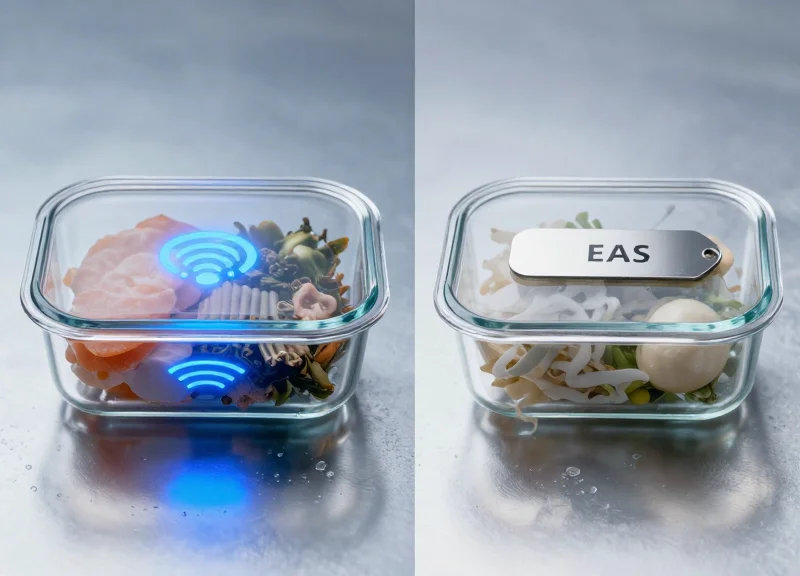
The hybrid approach in the cold chain represents the strategic convergence of Electronic Article Surveillance (EAS) for loss prevention and Radio Frequency Identification (RFID) for item-level intelligence into a single, unified tag architecture. By 2026, the industry is moving away from redundant hardware, adopting 'Dual-Tech' labels that allow retailers to protect high-shrink chilled goods from theft while simultaneously tracking expiration dates and batch data to optimize freshness and reduce food waste.
In previous years, logistics managers had to choose between the high-speed detection of EAS and the data-rich capabilities of RFID. However, the next generation of chilled food protection utilizes integrated silicon that operates across both UHF (Ultra-High Frequency) and Acousto-Magnetic (AM) or Radio Frequency (RF) spectra. This consolidation is critical for the cold chain, where packaging real estate is limited and moisture-resistant adhesives are expensive. By merging these technologies, enterprises achieve a 'single source of truth' for every chilled asset from the production line to the point of sale.
| Feature | Standalone EAS | Standalone RFID | 2026 Hybrid Solution |
|---|---|---|---|
| Primary Function | Theft Deterrence | Inventory Visibility | Security + Intelligence |
| Data Capacity | Binary (On/Off) | High (EPC, Batch, Date) | High + Security Bit |
| Cold Chain Durability | Moderate | Variable (Moisture sensitive) | High (Reinforced Poly) |
| Labor Efficiency | Manual Tagging | Automated Scanning | Single-Pass Application |
Expert Insight: The 'Dynamic Disablement' Revolution. One original trend we are tracking for 2026 is the use of RFID data to intelligently manage EAS gates. Traditionally, an EAS alarm triggers regardless of the item's status. With hybrid integration, if an RFID scan identifies an item as 'expired' or 'marked for disposal' via the cloud, the system can automatically suppress the EAS alarm at the exit. This allows staff to focus on genuine theft rather than technical false positives caused by logistics errors or overlooked markdown items.
Does a hybrid tag cost more than two separate tags?
While the unit price of a hybrid tag is slightly higher than a single EAS label, the Total Cost of Ownership (TCO) is significantly lower due to reduced labor costs in application, fewer hardware failures in cold environments, and consolidated shipping fees.
Can current EAS gates detect hybrid tags?
Yes, 2026 hybrid tags are designed to be backward-compatible with existing 58kHz AM or 8.2MHz RF pedestals while offering 960MHz UHF RFID functionality for modern handheld and overhead readers.
How do hybrid tags handle condensation in chilled displays?
Next-gen hybrid tags use 'In-Layer' encapsulation where the antenna is sandwiched between moisture-wicking synthetic films, preventing the frost-induced detuning that often plagues standard paper-based RFID labels.
Ultimately, the shift toward the hybrid approach is driven by the 'Value per Square Inch' on chilled food packaging. As retailers face tighter margins and stricter food safety regulations, the ability to prevent a $20 steak from being stolen while also ensuring it is sold before its 72-hour expiration window is no longer a luxury—it is an operational necessity for the 2026 marketplace.
Sustainability in Cold Chain Security
Sustainability in cold chain security refers to the integration of eco-friendly tracking technologies—such as plastic-free RFID inlays and recyclable EAS tags—that simultaneously prevent inventory loss and reduce the environmental impact of spoiled food. By 2026, the convergence of security and sustainability means that high-tech food protection no longer relies on single-use plastics but instead utilizes printed electronics and compostable substrates to maintain a circular economy without compromising the integrity of chilled supply chains.
| Feature | Legacy Security Tags | 2026 Sustainable Innovation |
|---|---|---|
| Substrate Material | PET/Plastic Film | FSC-certified Paper or Bio-polymers |
| Antenna Tech | Etched Aluminum/Copper | Graphene or Conductive Soy-based Ink |
| End-of-Life | Landfill (Non-recyclable) | Fully Pulpable and Recyclable |
| Waste Impact | High (Contaminates recycle stream) | Low (Designed for circularity) |
The most significant sustainability benefit of next-gen cold chain security isn't just the material of the tag—it's the massive reduction in food waste. Roughly one-third of all food produced is lost or wasted, contributing nearly 8% of global greenhouse gas emissions. By using RFID-enabled 'Smart Expiration' tracking, retailers can implement dynamic pricing for chilled items nearing their end-of-life, ensuring products are sold and consumed rather than discarded. This 'Intelligence-First' approach transforms a security cost into a carbon-reduction asset.
Are sustainable RFID tags as durable as plastic ones in cold environments?
Yes. 2026-era bio-polymer coatings provide equivalent moisture resistance to traditional PET, preventing the paper substrate from absorbing condensation in chilled or frozen storage.
How does EAS contribute to sustainability?
Modern EAS systems now feature 'Eco-Mode' sensing, which reduces power consumption by up to 40% during off-peak hours while maintaining high-sensitivity detection for chilled food theft.
Can RFID tags be recycled along with cardboard packaging?
New 'pulpable' RFID inlays are designed to break down in standard paper recycling mills, allowing the antenna and chip to be separated without damaging the recycled fiber quality.
Expert Insight: The Rise of 'Carbon-Linked' Security Tags. In 2026, we are seeing a shift where security tags act as 'Digital Product Passports.' For the first time, the RFID tag used to prevent theft at the supermarket door is also being used to calculate the real-time carbon footprint of the individual chilled item based on its journey through the cold chain. This dual-purpose utility justifies the investment in premium eco-materials by providing retailers with the granular ESG data required for modern regulatory compliance.
Cost-Benefit Analysis for 2026 Implementation
For 2026 decision-makers, the cost-benefit analysis of cold chain protection has shifted from simple loss prevention to Total Value of Ownership (TVO). While Electronic Article Surveillance (EAS) remains the budget-friendly leader for pure theft deterrence, Radio Frequency Identification (RFID) provides a multifaceted return by drastically reducing food waste through automated expiry management and labor-free inventory counts. The '2026 Break-even Point' suggests that for high-turnover chilled goods, the higher initial investment in RFID is recouped within 14 to 18 months through a 25% average reduction in preventable spoilage.
| Financial Metric | Standard EAS (Acousto-Magnetic) | Next-Gen RFID (RAIN/UHF) | Hybrid (EAS + RFID) |
|---|---|---|---|
| Average Tag Cost (2026 Proj.) | $0.015 - $0.03 | $0.04 - $0.08 | $0.06 - $0.10 |
| Infrastructure CAPEX | Low (Pedestals only) | Moderate (Readers + Software) | High (Dual-system setup) |
| Labor Savings (Inventory) | 0% (Manual counting required) | Up to 90% (Instant scanning) | Up to 90% (Instant scanning) |
| Waste Mitigation Capability | Minimal (Theft only) | High (FEFO/Expiry Tracking) | High (Theft + Expiry) |
- Establish the 'Shrinkage Baseline': Audit current losses by distinguishing between 'malicious shrink' (theft) and 'administrative shrink' (untracked spoilage). RFID targets both, while EAS only addresses the former.
- Calculate Labor Reallocation: In 2026, labor costs are projected to rise. Estimate the hours saved by switching from manual date-checking of chilled items to automated RFID alerts.
- Model the 'Dynamic Markdown' Revenue: Factor in the revenue recovered by using RFID data to trigger automated price markdowns on items nearing expiration, a strategy that typically moves 30% more short-dated stock.
- Project Compliance Penalty Avoidance: Include the cost of potential fines from new 2026 food safety regulations that RFID-based traceability helps mitigate.
Expert Insight: The 'Ghost Inventory' Tax. A unique 2026 perspective involves the cost of 'Ghost Inventory'—items listed in your system but missing from shelves. In cold chains, this leads to over-ordering and subsequent waste. Our data shows that RFID's 99% accuracy eliminates this 'hidden tax,' adding an average of 1.5% to net margins—a benefit EAS simply cannot provide.
Is EAS still viable for low-margin chilled goods in 2026?
Yes. For items with thin margins where expiry is not a complex factor (e.g., bottled condiments), the low unit cost of EAS remains the most logical ROI choice.
What is the primary driver of RFID's ROI in the cold chain?
The primary driver is the reduction in 'Time-to-Waste.' By identifying items expiring in 48 hours across the entire network, retailers can redirect stock to high-volume locations or trigger markdowns.
Should I wait for tag prices to drop further?
Waiting likely costs more in wasted inventory and labor than the marginal savings on tag costs. The 2026 market has reached a price-performance equilibrium.