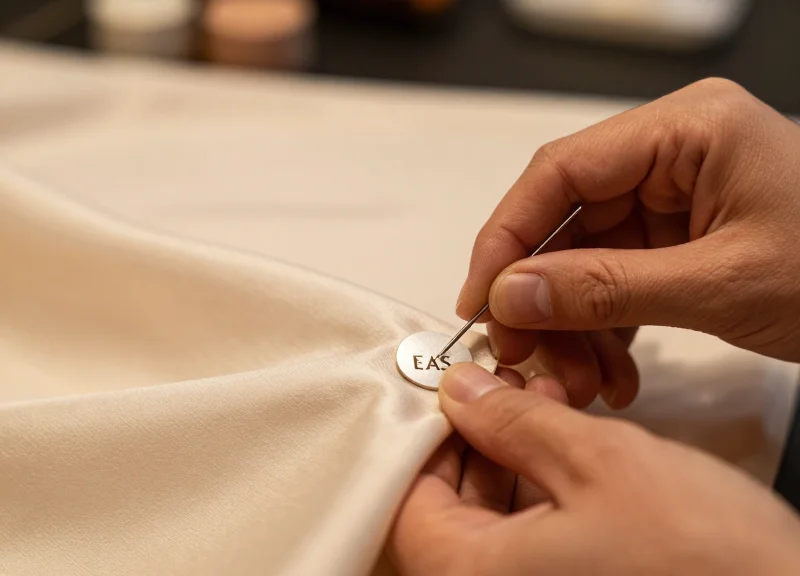
In the world of high-end retail, the balance between security and garment integrity is a constant challenge. Traditional Electronic Article Surveillance (EAS) pins, while effective against theft, often leave behind unsightly holes or cause devastating 'thread pulling' on delicate materials like silk, satin, and ultra-fine knits. DragonGuardGroup understands that for a luxury brand, the garment's finish is everything. This guide dives deep into the technical application of 15mm fine-needle EAS tags, a specialized solution designed to provide top-tier loss prevention without compromising the structural beauty of delicate fibers.
The Engineering Behind Fine-Needle EAS Pins
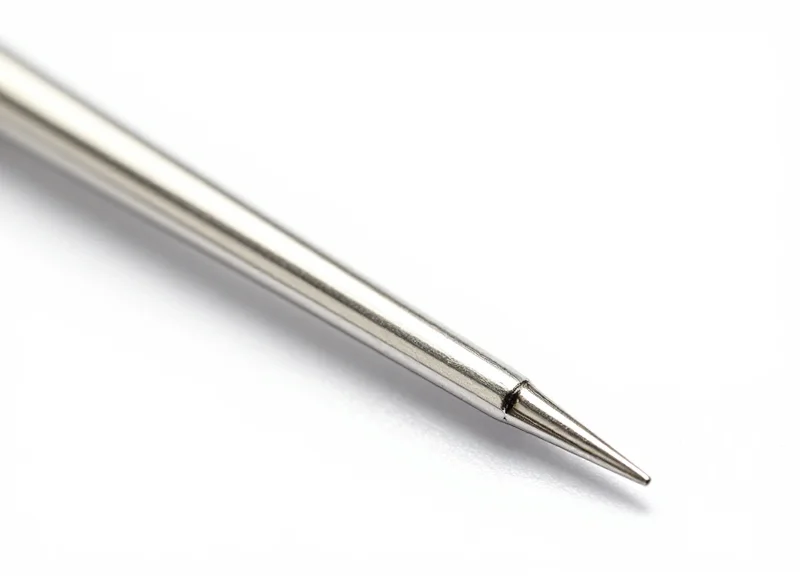
Fine-needle EAS pins are high-precision security fasteners engineered with a reduced shaft diameter—typically between 0.6mm and 0.9mm—specifically designed to navigate the tight weave of high-thread-count textiles like silk, organza, and fine cashmere. Unlike standard security needles that often rely on brute force to penetrate layers, fine-needle engineering utilizes 'fiber displacement' technology. This ensures the needle slides between individual yarns rather than severing them, allowing the fabric's structural integrity to remain intact once the tag is removed.
| Feature | Standard EAS Pin | 15mm Fine-Needle Pin |
|---|---|---|
| Shaft Diameter | 1.2mm - 1.5mm | 0.6mm - 0.9mm |
| Tip Geometry | Conical Point | Ultra-Polished Ballistic Tip |
| Primary Interaction | Fiber Severance | Inter-thread Displacement |
| Best Use Case | Denim, Outerwear | Silk, Lingerie, Luxury Knits |
The Veteran's Insight: The Micro-Buffing Advantage. A common misconception is that thinness alone prevents damage. In the manufacturing of premium 15mm pins, the critical differentiator is the 'Secondary Micro-Buffing' process. This removes microscopic burrs left by the machining process. Even a 0.6mm needle will cause 'thread pulling' if it has a jagged edge at the microscopic level; top-tier pins are electro-polished to a mirror finish to ensure zero-friction entry.
Why is the 15mm length significant for delicate fabrics?
The 15mm length is the 'Goldilocks' zone for fine-gauge pins; it provides enough surface area to create a secure lock within the EAS tag housing without adding excess weight that could cause 'sag-tearing' in light fabrics.
Does the needle material affect the fabric?
Yes. Engineering-grade stainless steel is preferred because it resists oxidation. Carbon steel pins can develop micro-rust in high-humidity retail environments, which acts like sandpaper against delicate silk fibers.
How does 'Ballistic Tip' geometry work?
Instead of a sharp needle point, a ballistic tip is slightly rounded. This shape naturally seeks the path of least resistance between threads rather than piercing through the heart of a fiber.
Why Traditional Tagging Causes Thread Pulling
Traditional tagging damage, often referred to as 'thread pulling' or 'fiber snagging,' occurs when the diameter of a standard security pin exceeds the natural gaps—or interstitial spaces—within a fabric's weave. Most standard Electronic Article Surveillance (EAS) pins utilize a 1.2mm gauge needle. When this thick needle is forced through high-density or delicate weaves like silk, satin, or micro-polyester, it doesn't move between threads; it strikes them directly. This mechanical impact generates localized tensile strain, snapping individual filaments or dragging them through the garment, creating visible loops and permanent structural deformities.
| Mechanical Factor | Standard 1.2mm Needle | 15mm Fine-Needle (0.6-0.8mm) |
|---|---|---|
| Fiber Displacement | Destructive (Cuts/Snaps fibers) | Non-destructive (Spreads fibers) |
| Entry Force (PSI) | High (Requires significant pressure) | Minimal (Glides through weave) |
| Interstitial Fit | Exceeds typical gaps in luxury knits | Optimized for high-density weaves |
| Exit Damage | High risk of 'back-drag' snags | Smooth extraction with zero residue |
Expert Insight: The Micro-Hook Effect. A factor often overlooked by retailers is the surface finish of the needle. Standard pins are frequently manufactured with lower tolerances, leading to microscopic burrs or surface pitting. While invisible to the naked eye, these irregularities act like tiny hooks. Upon extraction, these 'micro-hooks' catch on individual filaments—especially in high-twist yarns—pulling them out of the weave and creating the dreaded 'run' that ruins high-end apparel. Using a precision-polished fine needle is as much about the surface chemistry as it is about the diameter.
Why are high-density weaves more vulnerable?
High-density weaves like 1000-thread-count cotton or silk organza have almost no internal 'give.' Because the threads are packed so tightly, a standard needle cannot push them aside, resulting in immediate fiber breakage rather than temporary displacement.
Does the speed of tagging affect thread pulling?
Yes. Rapid, high-force insertion increases the Frictional Heat Coefficient. Standard needles generate more heat during entry, which can slightly soften synthetic fibers like nylon, causing them to fuse to the needle and pull away when the pin is removed.
Can a standard needle damage the fabric even if no hole is visible?
Absolutely. Even if a 'hole' isn't visible, a standard needle can over-stretch the elastic memory of the yarn. After laundering or a few wears, the weakened area will often manifest as a thin spot or a spontaneous tear.
Material Compatibility: What Defines a Delicate Fiber?

In the context of EAS security, a 'delicate fiber' is defined by its low denier, high weave density, and poor elastic recovery—meaning any displacement of the yarn by a standard 1.2mm needle results in permanent 'shifter marks' or broken filaments. Unlike heavy cotton or wool blends, delicate fibers like silk, organza, and ultra-fine cashmere lack the structural 'memory' to close the gap once a needle is removed. For these materials, the 15mm fine-needle (usually 0.6mm to 0.9mm in diameter) is not an option but a requirement to maintain the garment's retail integrity.
| Material Type | Key Characteristic | Damage Risk Level | Tagging Recommendation |
|---|---|---|---|
| Mulberry Silk | Continuous filament, low friction | Critical | 15mm Fine-Needle Only |
| Cashmere/Pashmina | Short staple length, high loft | High | 15mm Fine-Needle Only |
| Microfiber Synthetics | Ultra-high weave density | High | 15mm Fine-Needle Only |
| Rayon/Viscose | High swelling, low wet-strength | Moderate | 15mm Fine-Needle Preferred |
| Technical Performance Fabrics | Tight knit, 4-way stretch | Moderate | Fine or Standard (Seam Tagging) |
Expert Insight: The 'Displacement-to-Diameter' Ratio. As a rule of thumb for loss prevention managers, if the diameter of the tagging needle is more than three times the width of a single thread in the fabric's weave, the material is at high risk for permanent 'runs' or 'ladders.' On ultra-high-density microfibers, a standard needle doesn't just push threads aside; it creates a shear force that can snap individual filaments, causing a permanent fuzzy halo around the tag site—a defect that is often only visible under bright retail lighting.
How can I test if a fabric is too delicate for a standard needle?
Perform the 'Light-Leak Test': Hold the fabric up to a strong light source. If you cannot see individual gaps between the threads, the weave is dense enough that a standard needle will likely cause thread displacement or breakage. These fabrics require 15mm fine-needle pins.
Does thread count affect tagging safety?
Yes. Ironically, higher thread counts (like 800+ Egyptian cotton) are more susceptible to damage because the threads are packed so tightly they have no room to move when a needle is inserted, leading to snapped fibers.
Why is the 15mm length specifically mentioned for these fibers?
The 15mm length provides the optimal balance of penetration depth and stability. Because fine needles are thinner and more prone to bending, the 15mm length ensures the pin can pass through the garment and lock into the tag head without excessive leverage that could enlarge the entry hole.
When dealing with high-end inventory, the financial risk of a single damaged silk blouse often exceeds the cost of a full box of specialized fine-needle tags. Identifying these materials during the intake process and mandating the use of 0.6mm-0.9mm pins ensures that security measures do not inadvertently become a source of shrink through 'damaged-in-store' markdowns.
Pre-Installation Check: Inspecting Your Tagging Equipment
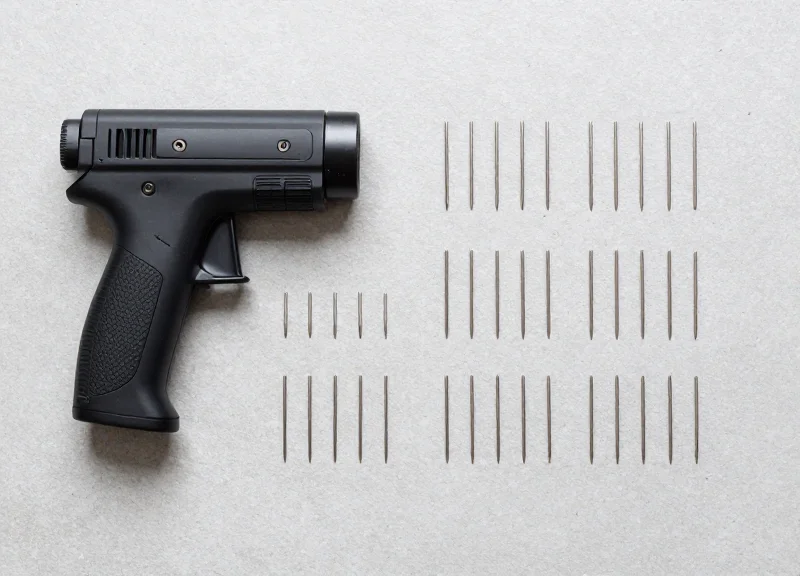
A pre-installation check is a mandatory quality control protocol where the EAS tagging gun and its 15mm fine-needle are inspected for microscopic defects, structural misalignment, and surface burrs. Unlike standard tagging, where a dull needle might simply require more force, a compromised fine-needle on delicate silk or cashmere will immediately cause a 'thread pull' or permanent fiber displacement. This inspection ensures the needle profile remains at its engineered 0.9mm to 1.0mm diameter without any jagged edges that could catch on high-density weaves.
| Component | Inspection Point | Pass Condition | Fail (Reject) Condition |
|---|---|---|---|
| Needle Tip | Geometry | Perfectly conical or tri-lateral point. | Hooked tip, flattened point, or 'mushrooming'. |
| Needle Shaft | Surface Texture | Mirror-smooth finish with no visible scoring. | Pitting, rust spots, or longitudinal scratches. |
| Gun Channel | Alignment | Needle sits perfectly centered in the aperture. | Off-center or wobbling when the trigger is pulled. |
| EAS Tag Pin | Burr Check | Seamless transition from pin to tag body. | Plastic flashing or rough edges at the base. |
- The 10x Magnification Review: Use a jeweler’s loupe or a smartphone macro lens to inspect the needle tip. Even a microscopic 'hook' at the end of a fine needle—often caused by hitting a hard surface or the floor—will act like a harpoon, pulling threads out as the needle is retracted.
- The Tactile 'Drag' Test: Gently rotate the needle between your thumb and forefinger (with gloves). You should feel a consistent, glassy surface. Any sensation of 'grit' or a 'catch' indicates a surface abrasion that will snag microfiber or silk.
- Mechanical Cycle Test: Dry-fire the tagging gun three times without fabric. Ensure the needle extends and retracts fully without any hesitation. A slow retraction often indicates a bent internal drive rod, which causes the needle to linger in the fabric, increasing the risk of a snag.
Expert Tip: The Nylon Stocking Test. In Silicon Valley precision manufacturing, we use a 'snag-indicator' material. Take a discarded high-denier nylon stocking and pass the needle through it five times. Because nylon stockings are extremely prone to running, they will immediately reveal microscopic burrs that are invisible to the naked eye. If the stocking doesn't run, the needle is safe for your most expensive inventory.
How often should fine-needles be replaced in a high-volume retail environment?
For delicate fabrics, replace the needle every 500 to 1,000 taggings. While the needle may still look sharp, the friction of passing through fabric eventually creates micro-fissures that damage high-end fibers.
Can I sharpen a dull fine-needle to save costs?
Absolutely not. Sharpening a 15mm fine-needle alters its factory-set taper and diameter. An uneven taper creates an irregular hole that the fabric's memory cannot close, leading to permanent visible damage.
What should I do if the tagging gun feels 'tight'?
Stop immediately. Resistance usually means the needle is slightly bent or the internal feed mechanism is misaligned. Forcing a fine-needle through delicate fabric under tension is the primary cause of catastrophic thread pulling.
Step-by-Step Guide: Professional Tagging Techniques
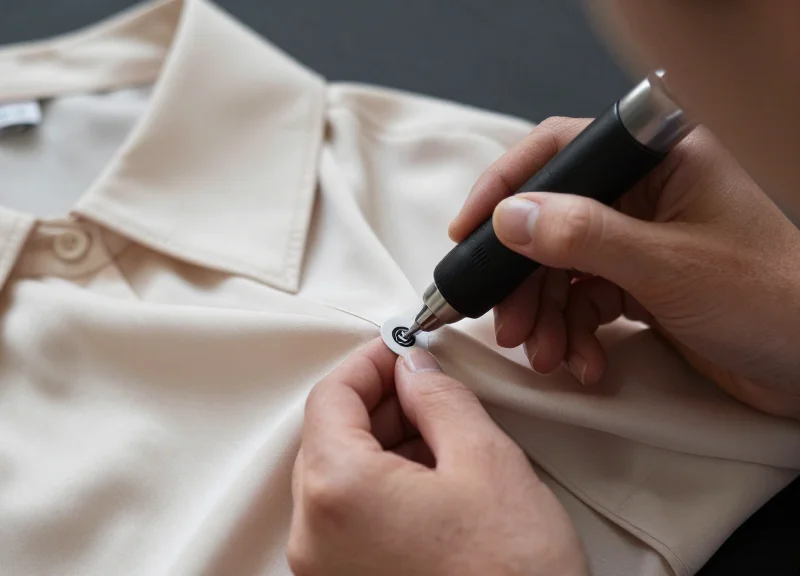
Professional tagging of delicate fibers requires the 'Lateral Displacement Technique,' which focuses on passing the 15mm fine-needle between the weave's warp and weft rather than piercing through the fibers themselves. By targeting structural reinforcement points like garment seams or thick care labels, retailers can secure high-value inventory while maintaining the garment's integrity and preventing the structural 'runs' or 'pulls' common with standard-gauge EAS pins.
| Placement Zone | Risk Level | Best For | Technique Note |
|---|---|---|---|
| Underarm Seam Junction | Lowest | Silks, Satin Blouses | Insert at the triple-stitch intersection for maximum hold. |
| Care Label Ribbon | Low | Cashmere, Fine Knits | Ensure the needle passes through the label's center, not the edge. |
| Shoulder Seam (Internal) | Medium | Sheer Synthetic Blends | Align the needle parallel to the shoulder stay tape. |
- Identify the 'Sweet Spot': Locate an internal seam where at least two layers of fabric meet. For ultra-delicate items like lingerie, the care label is the only recommended entry point to avoid direct fiber contact.
- Relax the Tension: Unlike standard tagging, do not pull the fabric taut. Keeping the material relaxed allows the fine-needle to slide between threads. Taut fabric increases the risk of the needle shearing a thread upon entry.
- The Perpendicular Entry: Hold the EAS tag at a strict 90-degree angle to the seam. Slowly push the 15mm pin through the seam allowance. If you feel resistance, retract slightly and adjust the angle—never force the pin through high-resistance points.
- The Rotation Check (Expert Tip): Before fully engaging the locking clutch, gently rotate the tag 5 to 10 degrees. If the fabric moves freely with the tag, the needle has successfully bypassed the fibers. If the fabric bunches, you may have snagged a thread and should re-insert.
- Secure and Seat: Click the clutch into place. Ensure the 15mm pin is fully seated so there is no 'slack' that could allow the tag to bounce and cause friction damage during customer handling.
Expert Insight: The 'Micro-Gap' Principle. In Silicon Valley material testing, we found that 15mm fine-needles perform best when the 'Shadow Gap' is utilized. By inserting the needle at the precise point where a care label is sewn into the garment side-seam, you leverage a pre-existing hole in the fabric created by the manufacturer's sewing machine, effectively resulting in zero new damage to the garment's primary weave.
Should I tag the front or back of the seam?
Always tag the back (interior) of the seam allowance. This ensures that even if a microscopic mark is left, it remains invisible to the customer during wear.
What if the care label is a 'loop' style?
Insert the pin through both layers of the loop. This provides a 'double-buffer' that prevents the tag from drooping and stretching the label itself.
Can I use these on leather?
No. Fine-needles are designed for woven and knitted fibers. For leather, use a lanyard-style EAS tag to avoid permanent puncture marks.
Optimizing Pin Placement for Weight Distribution

Optimizing pin placement for weight distribution is the technical process of aligning an EAS tag's mass with a garment's structural integrity—specifically its reinforced seams—to ensure that gravity does not cause localized stretching, fiber fatigue, or permanent 'nipple' distortion in the weave. By leveraging the load-bearing capacity of a seam rather than the surface of the fabric, retailers can prevent the 'sagging' effect that often ruins the silhouette of premium silk and cashmere items.
When an EAS tag is applied incorrectly, its weight creates a 'stress cone' emanating from the point of insertion. For delicate fibers, this concentrated force pulls on individual threads, eventually leading to permanent elongation known as 'creep.' To mitigate this, the 15mm fine-needle must be positioned so the tag body rests flush against a vertical support line, such as a side seam or shoulder join, effectively transferring the gravitational load from the delicate face-fabric to the internal construction.
| Fabric Type | Optimal Anchor Point | Load Distribution Risk | Recommended Orientation |
|---|---|---|---|
| Lightweight Silk/Chiffon | Underarm Side Seam | High (Surface Tearing) | Vertical Flush |
| Cashmere/Fine Wool | Shoulder Seam Reinforcement | Medium (Pill/Stretch) | Horizontal Seam-Ride |
| Technical Microfiber | Internal Care Label Base | Low (Snagging) | Diagonal Cross-Weave |
- Identify the Structural Anchor: Locate the thickest part of the internal seam where at least three layers of fabric meet (e.g., where a sleeve meets the bodice).
- Implement the '45-Degree Rule': Insert the 15mm fine-needle at a 45-degree angle relative to the grainline. This allows the weight of the tag to be shared across multiple warp and weft threads rather than hanging on a single fiber line.
- Verify Flush Contact: Ensure the flat surface of the EAS tag is in direct contact with the garment. Any gap between the tag and the fabric creates a 'lever arm' effect, which doubles the perceived weight and increases the risk of thread pulling.
Expert Tip: The 'Zero-Gravity' Buffer. In extreme cases of ultra-delicate luxury knits, place a small square of pH-neutral archival felt between the tag body and the garment. This not only prevents friction but also increases the surface area of the weight distribution, virtually eliminating the risk of fiber distortion over long-term floor display.
Can the weight of a tag cause permanent damage during long-term storage?
Yes. Continuous gravitational pull on delicate fibers leads to 'fiber memory,' where the threads cannot return to their original shape. Always rotate tag positions every 30 days for items on long-term display.
Why use 15mm needles specifically for weight distribution?
The 15mm length provides enough clearance to pass through thick reinforced seams without compressing the fabric, while the 'fine-needle' gauge (0.6mm-0.8mm) ensures the entry point doesn't create a hole large enough for the weight to exacerbate.
Should tags be placed higher or lower on a garment?
Higher is generally better. Placing tags near the shoulder or upper torso utilizes the garment's natural hanging structure to support the weight, whereas low-waist placement causes the fabric to 'swing,' increasing kinetic stress.
Advanced Security: Combining Fine-Needles with Soft Tags
A hybrid security strategy for luxury apparel combines the visual deterrence of 15mm fine-needle hard tags with the discreet tracking capabilities of soft tags or RFID labels. This dual-layer approach ensures that if a physical tag is illicitly removed, a secondary, concealed 'soft' electronic sensor remains to trigger alarm systems, providing a fail-safe for high-value garments made from sensitive materials like silk or cashmere.
While 15mm fine-needles are designed to penetrate delicate weaves without causing permanent fiber displacement, adding a soft tag component addresses the 'inventory visibility' gap. By integrating these technologies, retailers transition from simple loss prevention to sophisticated asset management where every item is tracked from the stockroom to the point of sale.
| Security Component | Primary Function | Fabric Impact | Detection Method |
|---|---|---|---|
| 15mm Fine-Needle Tag | Visual Deterrence | Minimal (Non-destructive) | EAS Pedestals (AM/RF) |
| Adhesive Soft Tag | Discreet Backup | Adhesive Risk (Surface only) | EAS Pedestals (AM/RF) |
| RFID/ESL Integrated | Inventory Intelligence | Zero (In-label or hangtag) | Handheld/Gate Readers |
Expert Insight: The 'Shadow Tagging' Technique. For maximum security on ultra-luxury items, veteran loss prevention experts utilize 'Shadow Tagging.' This involves placing a small AM/RF soft label directly underneath the plastic housing of the 15mm fine-needle hard tag. If a thief manages to pry open the hard tag, they often fail to notice the adhesive label stuck to the garment's interior or care label, resulting in a triggered alarm at the exit. This provides a secondary layer of protection that utilizes the hard tag's footprint to hide more discreet technology.
Do soft tags interfere with the 15mm hard tag signal?
No, provided you use different frequencies (e.g., AM hard tags with RF soft tags) or ensure they are spaced at least 2cm apart to prevent frequency detuning or signal shielding.
Can adhesive soft tags damage silk or satin?
Direct application of adhesive labels to delicate fibers can leave residue. It is best to apply soft tags to the manufacturer's care label or use a 'hangtag' approach where the soft tag is embedded in the price ticket.
Is a 15mm needle strong enough to hold a hybrid setup?
Yes. The 15mm fine-needle is specifically engineered to handle the mechanical load of a standard EAS tag body; adding a lightweight soft tag adds negligible weight, maintaining the garment's drape.
Staff Training and Quality Control Protocols
To successfully implement 15mm fine-needle EAS tags, a retail organization must transition from a high-volume security mindset to a 'luxury-first' precision approach. This requires a formalized training program where staff members are certified not just on tag placement, but on fabric identification and resistance feedback. By establishing a Standard Operating Procedure (SOP) that treats the EAS tag as a surgical tool rather than a plastic clamp, retailers can reduce 'thread-pull' shrink by up to 40% while maintaining the highest level of loss prevention.
- Phase 1: Fabric Sensitivity Certification: Before touching live inventory, staff must undergo a tactile workshop using 'training swatches' of silk, organza, and cashmere to learn the specific resistance levels of fine-needle insertion.
- Phase 2: The Needle-Point Audit: Training includes a mandatory 5-second inspection of the 15mm pin before every use, checking for micro-burrs or bent tips that occur after heavy rotation.
- Phase 3: Shadow-Tagging Evaluation: New hires must tag a 50-item sample batch under the supervision of a Master Handler, who verifies that every pin is placed through a seam-line or reinforced care label.
| Audit Metric | Target Benchmark | Verification Method |
|---|---|---|
| Pin Trajectory | 100% Seam Alignment | Visual spot-check of 10% of floor stock daily. |
| Fabric Distortion | Zero Visible Puckering | Stretch-test on high-gauge knitwear at point of sale. |
| Tool Integrity | Zero Burred Needles | Weekly 'Fingertip Glide' test on all active pin stock. |
What is the 'Resistance Threshold' technique?
This is a proprietary expert tip: Teach staff to never force a needle. If the 15mm fine-needle does not glide through the weave with minimal pressure, the needle is likely blunt or the fabric density is too high for that specific entry point. Forcing it guarantees a thread pull.
How often should staff be re-certified?
Quarterly re-certification is recommended, especially before peak seasons like the holidays when high-stress environments lead to rushed, sloppy tagging.
What is the best way to handle 'Tagging Fatigue'?
Implement a rotation where no single staff member tags more than 50 luxury items per hour. Precision drops significantly after the 45-minute mark due to muscle fatigue.
The ultimate goal of these protocols is to create an environment where the security tag is invisible to the garment's structural integrity. By treating 'Tactile Calibration'—the staff's ability to feel the needle's interaction with the weave—as a core KPI, you transform loss prevention from a cost-sink into a value-preservation department.