As the pharmaceutical landscape edges toward 2026, the definition of success is shifting from simple loss prevention to comprehensive inventory intelligence. For decades, Electronic Article Surveillance (EAS) has been the gold standard for deterring theft, yet its limitations are becoming apparent in a data-driven world. Today’s pharmacies face a dual challenge: protecting high-value assets while meeting stringent regulatory requirements like the DSCSA. This article dives deep into the technological evolution from traditional EAS to next-gen RFID, helping pharmacy owners and logistics managers navigate the transition toward a smarter, more efficient future.
The Evolution of Pharmacy Loss Prevention: Why EAS is No Longer Enough
Traditional Electronic Article Surveillance (EAS) is no longer sufficient for modern pharmacies because it operates as a 'binary' security measure—it only triggers an alarm when a tagged item crosses a pedestal, offering zero visibility into which specific item was taken or why. As we approach 2026, pharmacies are shifting toward 'Inventory Intelligence,' where loss prevention is integrated with real-time stock accuracy, expiration management, and internal supply chain visibility. While EAS acts as a basic gatekeeper, it fails to address the $50 billion annual industry problem of 'hidden shrink' caused by internal theft, misdirected shipments, and out-of-date medication.
For decades, the pharmacy industry relied on the acoustic-magnetic or radio-frequency pulses of EAS to deter shoplifters. However, the rise of Organized Retail Crime (ORC) and the increasing complexity of pharmaceutical regulations require more than just a loud beep at the door. Pharmacy managers now need to know the exact SKU, lot number, and expiration date of every item that moves. The paradigm shift is moving from 'Prevention' (stopping a theft) to 'Intelligence' (understanding the lifecycle of every bottle).
| Feature | Traditional EAS (Binary) | Next-Gen RFID (Intelligence) |
|---|---|---|
| Primary Function | Exit-point theft deterrence | Real-time item-level visibility |
| Data Granularity | None (Alarm only) | Unique Serial ID, Lot, Expiry |
| Internal Shrink Support | Low (Detects exit only) | High (Tracks movement within store) |
| Inventory Integration | Non-existent | Direct link to POS and ERP |
| Labor Efficiency | Manual tag application | Automated scanning and counts |
A unique insight for 2026 is the concept of the 'Self-Auditing Pharmacy.' Unlike EAS, which is a passive system, next-gen RFID allows the pharmacy shelf to audit itself every hour. This eliminates the 'phantom inventory' problem—where the system thinks an item is in stock because no EAS alarm went off, but the item was actually lost to internal shrink or misplaced. In a high-stakes environment like a pharmacy, knowing that a specific life-saving medication is physically present is as critical as ensuring it isn't stolen.
Can EAS systems tell me which medication was stolen?
No. EAS only alerts staff that 'something' with a tag passed the sensors. It cannot distinguish between a high-value biologic and a low-cost over-the-counter item.
Why is EAS failing to stop modern shoplifting?
Modern theft rings often use 'booster bags' or simply overpower the alarm's psychological deterrent. Without item-level data, pharmacies cannot provide police with the specific evidence needed for prosecution or track the stolen goods in the secondary market.
What is the biggest ROI difference between EAS and RFID?
EAS is a pure cost center for security. RFID is a revenue generator that reduces labor costs for cycle counts by up to 90% and prevents stockouts, providing a faster return on investment through operational efficiency.
Understanding Traditional EAS: The Foundation of Retail Security
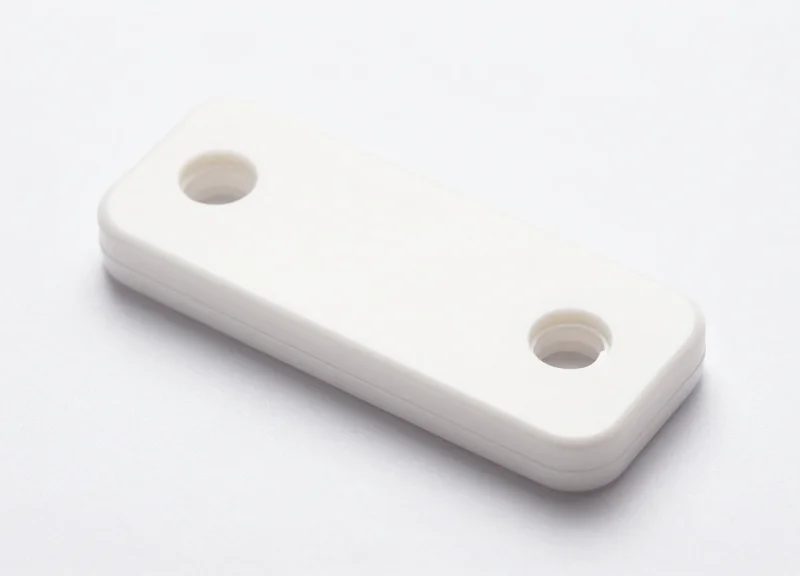
Traditional Electronic Article Surveillance (EAS) is a technology-driven deterrent system designed to prevent shoplifting by alerting staff when an active security tag or label passes through detection pedestals at a store exit. Unlike advanced tracking systems, EAS serves a singular, binary purpose: it acts as a digital gatekeeper that signals a 'yes/no' condition regarding the presence of protected merchandise, providing the fundamental layer of loss prevention that has stabilized retail shrinkage for decades.
In the pharmacy environment, two primary types of EAS technologies dominate the landscape: Acousto-Magnetic (AM) and Radio Frequency (RF). While both rely on the communication between a transmitter, a tag, and a receiver, they operate on different frequencies and physical principles to suit specific product types and store layouts.
| Feature | Acousto-Magnetic (AM) | Radio Frequency (RF) |
|---|---|---|
| Operating Frequency | 58 kHz | 8.2 MHz |
| Best Use Case | Liquid goods, metallic packaging | High-volume, flat paper labels |
| Detection Range | Wide exits (up to 2.4m) | Standard exits (up to 1.8m) |
| Deactivation | Distance deactivation possible | Requires contact or proximity |
The 'Unique Insight' for 2026: While EAS is effective at deterring the casual shoplifter, it creates a 'Data Black Hole.' Traditional EAS tells you that something was taken, but it cannot tell you what or how many. In a modern pharmacy, this lack of SKU-level visibility leads to 'phantom inventory' where the system believes a product is in stock (because no sale was recorded) when it has actually been stolen, leading to missed replenishment cycles and lost sales.
Why do EAS systems frequently trigger false alarms?
False alarms, or 'tag pollution,' occur when active tags from other stores enter the detection zone or when environmental electronic noise interferes with the 8.2 MHz or 58 kHz frequencies.
Can EAS identify the specific medication being stolen?
No. Traditional EAS is non-intelligent; it only detects the presence of a resonator or circuit, providing zero data on the specific SKU, expiration date, or batch number.
Is EAS still relevant in a high-tech pharmacy?
Yes, as a visible deterrent. However, it is increasingly being viewed as a 'dumb' sensor that needs to be augmented by RFID to provide actionable inventory intelligence.
The Rise of RFID: Transforming Security into Real-Time Intelligence

Radio Frequency Identification (RFID) in the pharmacy sector represents a fundamental shift from reactive loss prevention to proactive business intelligence. Unlike traditional Electronic Article Surveillance (EAS) which only identifies if a tagged item is crossing a threshold, RFID utilizes unique digital identifiers (EPC) to recognize precisely which product is moving, its expiration date, and its specific batch number without requiring a direct line of sight. By 2026, this technology will be the backbone of 'Inventory Intelligence,' allowing pharmacies to treat every item as a data point that contributes to supply chain visibility and patient safety.
| Feature | Traditional EAS (AM/RF) | Next-Gen RFID (RAIN) |
|---|---|---|
| Data Granularity | Binary (Alarm/No Alarm) | Item-Level (Unique Serial ID) |
| Read Capability | Single tag at gates | Bulk reads (1,000+ items/sec) |
| Inventory Visibility | None (Requires manual count) | Real-time (99% accuracy) |
| Expiration Tracking | No | Yes (Automated alerts) |
| Primary Value | Theft Deterrence | Operational Intelligence |
The true power of RFID lies in its ability to solve the 'Black Box' problem of the pharmacy floor. When a traditional EAS alarm sounds, staff often find themselves in a guessing game regarding what was taken or if it was a false positive. RFID eliminates this ambiguity by instantly logging the exact SKU and serial number of the departing item. This allows for 'Invisible Inventory'—stock that is present but misplaced or expired—to be identified and corrected before it impacts the bottom line or patient care.
- Automated Cycle Counting: RFID enables daily or even hourly inventory counts via handheld scanners or fixed overhead readers, reducing manual labor by up to 90% while maintaining near-perfect stock accuracy.
- Cold Chain Integrity: Advanced RFID sensors can now monitor the temperature history of biologics and vaccines, ensuring that security includes 'quality security' as much as 'theft security.'
- Omnichannel Fulfillment: Accurate item-level data is the only way to safely offer 'Buy Online, Pick Up In-Store' (BOPIS) for high-value medications without the risk of out-of-stock cancellations.
Expert Insight: In my 20 years of observing retail tech cycles, the biggest mistake pharmacies make is viewing RFID as a 'better tag.' It is actually a 'digital twin' strategy. By 2026, the competitive advantage will shift from those who can stop a shoplifter to those who can use 'Inventory Velocity' data—the speed at which a specific serial number moves from receiving to dispensing—to optimize their working capital. RFID doesn't just catch thieves; it catches waste.
Does RFID replace the need for physical gates?
Not necessarily. While RFID can be integrated into 'gate-less' overhead systems for a better aesthetic, many pharmacies use hybrid RFID-EAS gates to maintain a visible deterrent while capturing item-level data.
Is RFID too expensive for low-cost items?
As tag prices have dropped significantly, the ROI is no longer just about the tag cost vs. the item cost; it is about the labor savings and the prevention of 'ghost stock' errors that affect the entire pharmacy's efficiency.
How does RFID handle liquid or metal packaging?
Modern 'on-metal' and 'flag' tags have solved the historical interference issues with foil packaging and liquids, making RFID viable for 99% of pharmacy stock by 2026.
Side-by-Side Comparison: Security vs. Visibility in the Pharmacy
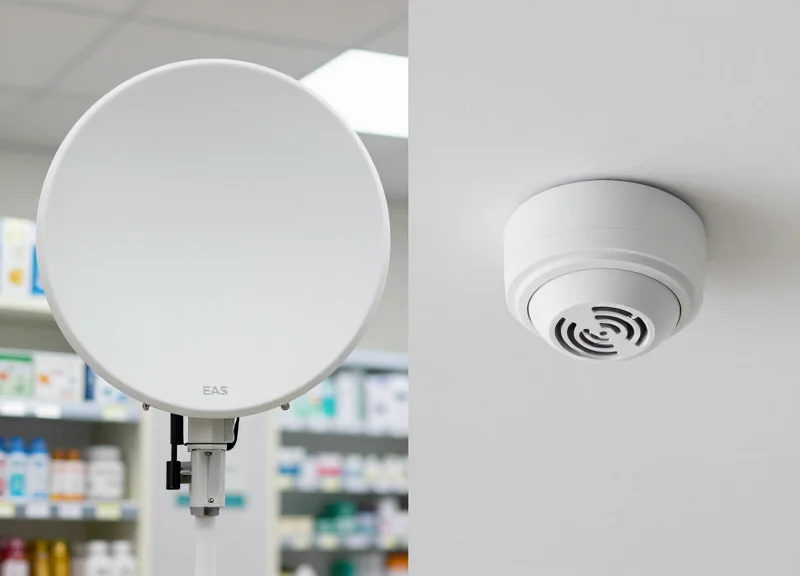
In the modern pharmacy environment, the difference between Electronic Article Surveillance (EAS) and Radio Frequency Identification (RFID) is the difference between an alarm and an insight. While EAS functions as a binary 'security gate' that merely detects the presence of a tag to prevent theft, RFID acts as a digital ledger, providing real-time visibility into exactly which item is moving, where it is located, and its current expiration status. For 2026 planning, pharmacies must look beyond basic loss prevention and prioritize systems that support the granular traceability required for both operational efficiency and regulatory compliance.
| Feature | Traditional EAS (AM/RF) | Next-Gen RFID (UHF) |
|---|---|---|
| Detection Logic | Binary (Alarm / No Alarm) | Granular (Individual Serial Numbers) |
| Data Capacity | 1-Bit (Presence only) | 96-bit to 512-bit (ID, Lot, Expiry) |
| Read Range | 1.5 - 2.5 Meters (Fixed Gates) | Up to 12 Meters (Fixed & Handheld) |
| Bulk Scanning | No (One alarm per event) | Yes (Hundreds of items per second) |
| Liquid/Metal Performance | High (Stable in complex packaging) | Moderate (Requires specialized on-metal/flag tags) |
Expert Insight: The 'Phantom Stock' Recovery Loop. A unique advantage of RFID over EAS is the ability to reconcile 'phantom stock.' When an EAS alarm goes off and a suspect flees, you know something was taken, but not exactly what. RFID instantly updates your inventory system to show the specific NDC and serial number lost, triggering an automated reorder and providing an immutable audit trail for insurance claims—turning a security event into a data-driven recovery process.
How does RFID handle liquid medications and foil packaging compared to EAS?
Traditional EAS (especially Acoustic-Magnetic) is naturally resistant to interference from liquids and metals. RFID signals can be absorbed by liquids or reflected by metals, but 2026-spec 'Flag Tags' and specialized spacers now allow RFID to achieve near-100% read rates even on insulin vials and foil-backed blister packs.
Does RFID replace the need for security gates at the pharmacy exit?
Not necessarily. While RFID can trigger alarms, many pharmacies use a 'Hybrid' approach: EAS for high-volume deterrence and RFID for high-value inventory intelligence. However, as RFID overhead readers improve, they are increasingly replacing physical pedestals to create a more 'frictionless' pharmacy entrance.
Is the read range of RFID too wide for small pharmacy footprints?
This is a common misconception. Modern RFID software uses 'RSSI' (Received Signal Strength Indicator) and 'Phase Angle' filtering to define digital zones. This prevents 'stray reads' from items sitting on shelves near the exit while still providing a much wider detection zone than narrow EAS gates.
Meeting 2026 Regulatory Challenges: How RFID Supports DSCSA Compliance
By 2026, the Drug Supply Chain Security Act (DSCSA) mandates that the U.S. pharmaceutical supply chain achieve full, interoperable electronic tracing of products at the package level. While traditional EAS systems are blind to item identity, RFID technology provides the granular data required to automate the capture of Transaction Information (TI) and Transaction Statements (TS). By leveraging RFID, pharmacies can transition from manual, error-prone barcode scanning to an automated environment where every unit's lineage is verified instantly upon receipt, ensuring 100% compliance with federal track-and-trace laws.
| Compliance Workflow | Manual 2D Barcode Process | Next-Gen RFID Automation |
|---|---|---|
| Receiving & Verification | Line-of-sight scan of every individual bottle. | Bulk scanning of entire pallets/totes in seconds. |
| Data Integration | Manual entry or tethered scanner upload. | Real-time cloud sync with EPCIS repositories. |
| Exception Handling | High risk of manual data entry errors. | Automated alerts for serial number mismatches. |
| Audit Readiness | Time-consuming paper/digital trail search. | Instant digital history for any serial number. |
Expert Insight: The 'Shadow Cost' of Compliance. Many pharmacy operators underestimate the labor burden of 2026 requirements. Industry data suggests that manual 2D barcode scanning for DSCSA compliance can increase receiving labor time by up to 300%. RFID effectively eliminates this 'shadow cost,' allowing technicians to focus on patient care rather than scanning individual bottles to satisfy regulatory auditors.
Does DSCSA explicitly require RFID?
No, the law requires electronic tracing which can be done via 2D barcodes. However, RFID is the only technology that allows for the 'interoperable' and 'automated' aspect of the law to be met without massive increases in manual labor.
How does RFID help with the 2026 'Stabilization Period'?
The FDA's stabilization period allows pharmacies to refine their electronic systems. RFID provides the most robust data set to prove to regulators that your pharmacy has a secure, functioning system for identifying illegitimate products.
Can RFID manage DSCSA-mandated recalls?
Yes. RFID can locate specific serial numbers involved in a recall across multiple locations instantly, whereas EAS and standard barcodes require a manual search of every shelf.
Beyond mere compliance, RFID-enabled DSCSA workflows create a 'Digital Twin' of your inventory. This means that while you are satisfying federal law by tracking a bottle's serial number, you are simultaneously gaining the inventory intelligence needed to prevent stockouts and reduce expiry waste—capabilities that traditional EAS simply cannot offer.
Operational Efficiency: Reducing Manual Inventory and Expiry Management
Operational efficiency in the modern pharmacy is defined by the transition from reactive loss prevention to proactive inventory orchestration. While traditional Electronic Article Surveillance (EAS) serves as a digital 'wall' against theft, it offers zero visibility into the status of the products on the shelf. In contrast, RFID-driven inventory intelligence automates the labor-intensive process of stock reconciliation and expiry monitoring, turning a once-manual multi-day task into a real-time digital dashboard. By 2026, pharmacies leveraging RFID are projected to reduce labor costs associated with inventory by over 70%.
| Operational Task | Traditional EAS / Manual Method | Next-Gen RFID Intelligence |
|---|---|---|
| Full Inventory Count | 8-12 labor hours (quarterly/annual) | 5-10 minutes (daily/on-demand) |
| Expiry Management | Manual visual check of every bottle | Automated alerts for 'soon-to-expire' batches |
| Stock Accuracy | 60-80% due to human error/shrink | 99%+ real-time accuracy |
| FEFO Compliance | Inconsistent; relies on staff training | Guaranteed through digital shelf mapping |
The most significant operational drain for pharmacists isn't just the counting—it’s the 'silent shrinkage' of expired medications. When a product expires on the shelf, its value drops to zero or becomes a liability. RFID tags allow the system to flag specific serial numbers as they approach their expiration date, enabling 'First-Expired, First-Out' (FEFO) dispensing. This ensures that high-value biologics and specialty drugs are utilized before they become waste, directly impacting the pharmacy's bottom line.
How does RFID reduce 'walk-aways'?
By providing near-perfect stock accuracy, RFID ensures that when a system says a medication is in stock, it is physically on the shelf. This prevents patients from leaving due to perceived out-of-stocks caused by inventory lag.
Can RFID help with product recalls?
Yes. Unlike EAS, which cannot identify specific bottles, RFID allows a pharmacy to locate every unit of a recalled lot number across multiple locations in seconds, rather than hours.
Does this replace the need for staff?
It doesn't replace staff; it reallocates them. Instead of spending hours in the backroom scanning barcodes, pharmacists can focus on clinical consultations and patient care, which are higher-margin activities.
Expert Insight: The 'Search Labor' Tax. A unique perspective often overlooked in ROI calculations is 'Search Labor.' In a typical retail pharmacy, staff spend an average of 30 to 45 minutes per day simply looking for misplaced medications or verifying if a product is truly out of stock. RFID's 'Geiger-counter' search functionality eliminates this hidden tax, allowing staff to locate a specific misplaced item within inches, effectively adding nearly 200 hours of productive capacity back to the pharmacy team every year.
Calculating the ROI: Weighing Initial Investment Against Long-Term Gains
Calculating the Return on Investment (ROI) for pharmacy inventory technology requires moving beyond simple hardware costs to evaluate the Total Cost of Ownership (TCO). While Traditional Electronic Article Surveillance (EAS) remains the budget-friendly choice for basic theft deterrence with lower entry costs, Next-Gen RFID delivers a compounding ROI by transforming inventory from a stagnant physical asset into a stream of real-time data. By 2026, the ROI of RFID will be driven not just by shrinkage reduction, but by the 'Cost of Inertia'—the financial penalty of manual DSCSA compliance and inefficient stock rotations that EAS cannot address.
| Financial Metric | Traditional EAS (Security-Only) | Next-Gen RFID (Intelligence-Led) |
|---|---|---|
| Initial CAPEX | Low ($5k - $15k per location) | Moderate to High ($25k - $60k per location) |
| Tagging Unit Cost | $0.02 - $0.05 (Reusable or Disposable) | $0.08 - $0.15 (Digital Identity Tags) |
| Labor Savings | Negligible (Requires manual counts) | High (90% reduction in cycle count time) |
| Shrinkage Reduction | 15% - 25% (Deterrence only) | 40% - 60% (Deterrence + Precise Tracking) |
| Regulatory Value | Zero (Non-compliant with DSCSA) | High (Automated 2026 Traceability) |
The Data Liquidity Factor: A unique financial advantage of RFID often overlooked is 'Data Liquidity.' In a 2026 pharmacy ecosystem, the granular data captured by RFID tags—such as exact dwell times of high-value biologics or real-time shelf-life status—can be leveraged to negotiate better rebates with manufacturers or optimize 'Just-in-Time' (JIT) ordering, potentially reducing standing inventory capital by 12-18% annually. This turns a security expenditure into a strategic cash-flow driver.
- Audit Manual Labor Hours: Quantify the current cost of pharmacists and techs performing manual inventory counts and expiration checks. This is usually the largest 'hidden' cost recovered by RFID.
- Project Shrinkage Recovery: Apply a conservative 30% improvement over EAS performance specifically for high-theft or high-value specialty medications.
- Factor in DSCSA Non-Compliance Risks: Estimate potential fines or the cost of administrative delays associated with manual unit-level tracing required by November 2023/2024 and 2026 milestones.
- Calculate the 36-Month TCO: Aggregate hardware, software subscriptions, and tag costs against labor savings and waste reduction to find the break-even point, typically seen within 14-22 months for high-volume pharmacies.
Is RFID too expensive for small independent pharmacies?
While CAPEX is higher, many vendors now offer 'Hardware-as-a-Service' models that convert the initial investment into a predictable monthly OPEX, making it accessible for smaller footprints.
Doesn't EAS have a shorter payback period?
Yes, EAS often pays for itself in 6 months through theft reduction, but it plateaus there. RFID continues to save money through operational efficiencies that EAS cannot provide.
What is the biggest risk to RFID ROI?
The 'Garbage In, Garbage Out' risk. If staff are not trained to utilize the data for ordering and expiration management, the additional intelligence of RFID goes to waste.
Hybrid Strategies: Navigating the Transition Period
A hybrid strategy for pharmacy inventory involves the simultaneous operation of legacy Electronic Article Surveillance (EAS) for theft deterrence and Radio Frequency Identification (RFID) for item-level visibility. This 'coexistence' model allows pharmacies to preserve their existing hardware investments while incrementally deploying high-intelligence tracking for high-value medications and DSCSA-regulated products, ensuring a zero-downtime transition toward the 2026 data standards.
| Feature | Legacy EAS Component | Next-Gen RFID Component | Hybrid Synergy |
|---|---|---|---|
| Primary Goal | Loss Prevention (Alarms) | Inventory Intelligence | Secure Visibility |
| Tagging Focus | General Front-Store Items | High-Value / Controlled Rx | Unified Protection |
| Infrastructure | Acousto-Magnetic Pedestals | Fixed Overhead Readers | Dual-Mode Gateways |
| Data Output | Binary (On/Off) | Granular (EPC Data) | Actionable Insights |
Transitioning doesn't require a 'rip-and-replace' approach. Instead, the most successful Silicon Valley infrastructure models suggest a 'straddle' period where hardware is optimized for both signals. Many modern pharmacy pedestals can now be retrofitted with RFID inserts, allowing one gate to perform dual functions: sounding the alarm for a shoplifted item and simultaneously logging exactly which NDC (National Drug Code) left the building.
- Phase 1: The 'High-Value' Pilot: Continue using EAS for bulk front-store items while applying RFID tags to the top 20% of high-value or highly regulated medications to solve immediate DSCSA tracking needs.
- Phase 2: Dual-Tagging Integration: Utilize dual-technology tags (EAS + RFID in one sticker) for high-shrink items. This minimizes labor while providing a safety net as staff becomes accustomed to RFID software.
- Phase 3: Hardware Overlay: Install RFID 'Smart Shelves' in the pharmacy back-end for real-time inventory counts while keeping EAS at the exit for traditional security.
- Phase 4: Full Cutover: Once RFID accuracy reaches 99.9%, phase out legacy EAS tags and use RFID for both security and inventory, repurposing old pedestals or upgrading to 'invisible' overhead readers.
Expert Insight: The Shadow Inventory Reconciliation. One unique advantage of the hybrid period is the ability to run 'Shadow Inventory' audits. By comparing EAS alarm logs (which tell you something was taken) against RFID delta reports (which tell you exactly what is missing from the shelf), pharmacies can identify 'Internal Shrink' patterns that were previously invisible. This data reconciliation typically uncovers a 15-20% discrepancy in inventory accuracy that EAS alone could never detect.
Can I use my existing EAS gates for RFID?
Generally no, but many vendors offer 'Upgrade Kits' that allow you to mount RFID antennas inside your existing EAS pedestals, saving on installation costs and floor space.
Will RFID tags interfere with EAS signals?
Standard UHF RFID and Acousto-Magnetic (AM) EAS operate on significantly different frequencies (860-960 MHz vs 58 kHz), meaning they can coexist on the same product without signal interference.
Is dual-tagging too labor-intensive for pharmacy staff?
By 2026, many manufacturers will provide pre-tagged medications. During the transition, pharmacies should focus manual dual-tagging only on high-risk categories to manage labor costs.
Future-Proofing Your Pharmacy: Key Considerations for 2026 and Beyond
To future-proof a pharmacy in 2026, stakeholders must look beyond simple 'beeping' alarms and evaluate technology partners based on their ability to deliver a seamless 'Data-to-Shelf' ecosystem. This involves selecting vendors who prioritize API-first architectures, allowing for frictionless integration with existing Pharmacy Management Systems (PMS) and Warehouse Management Systems (WMS). By 2026, the baseline for success will not be the prevention of theft alone, but the real-time granular visibility of every unit, ensuring compliance with evolving DSCSA (Drug Supply Chain Security Act) mandates and optimizing the patient care experience through guaranteed stock availability.
| Selection Criteria | Legacy EAS Consideration | Next-Gen RFID Requirement |
|---|---|---|
| System Interoperability | Stand-alone; rarely communicates with inventory software. | Full API integration with PMS/WMS for real-time updates. |
| Hardware Durability | Mechanical pedestals with 5-7 year lifespans. | Solid-state, high-MTBF readers with remote diagnostics. |
| Scalability | Limited to physical exits; difficult to expand. | Software-defined zones; easily scalable across departments. |
| Data Utility | Binary 'Alarm' or 'No Alarm' output. | Rich item-level metadata (Expiry, Lot, NDC, Serial Number). |
- Assess Hardware Resilience and Silicon Longevity: Ensure hardware is built with industrial-grade components capable of 24/7 operation. In 2026, the cost of a 'truck roll' for repairs will outweigh the initial savings of cheap hardware; prioritize vendors offering robust remote monitoring and over-the-air (OTA) firmware updates.
- Validate Cloud-Native Architecture: Avoid 'on-premise only' solutions that create data silos. A future-proof partner provides a cloud-native platform that aggregates data across multiple pharmacy locations, enabling enterprise-wide inventory intelligence and predictive analytics.
- Prioritize Security and Encryption: As inventory data becomes more detailed, it becomes a target. Ensure your RFID or EAS partner utilizes end-to-end encryption for data in transit and at rest, meeting SOC2 Type II compliance standards.
Will legacy EAS systems be obsolete by 2026?
While not entirely obsolete, EAS will become a secondary layer. Pharmacies focused on growth will transition to RFID to meet regulatory data requirements that EAS simply cannot provide.
How do I ensure a vendor's software won't be outdated in two years?
Look for a 'Software-as-a-Service' (SaaS) model with a proven roadmap of monthly feature releases and open documentation for their API endpoints.
What is the biggest risk in technology adoption today?
The 'Vendor Lock-in' risk. Choose partners who use open standards (like GS1 EPC Gen2) to ensure you aren't forced into a proprietary ecosystem that prevents future upgrades.
Expert Insight: The 'Latency of Intelligence' will be the most critical metric for pharmacies in 2026. A traditional EAS system has a latency of zero regarding a theft event, but near-infinite latency regarding inventory accuracy. Next-gen RFID reduces inventory latency from weeks (manual counts) to minutes. When choosing a partner, ask for their 'Average Time-to-Insight'—the time it takes for a physical product movement to be reflected in your financial and operational dashboards.