In the rapidly evolving industrial landscape of 2026, asset tracking has transitioned from a logistical luxury to a strategic necessity. With global supply chains demanding real-time precision and sustainability regulations requiring detailed lifecycle histories, choosing the right RFID solution is critical. This guide breaks down the complexities of modern asset tracking, providing a roadmap for decision-makers to achieve seamless visibility from the moment a product is manufactured until its final disposal, ensuring operational efficiency and high-level ROI.
The Evolution of Asset Tracking: Why 2026 is a Turning Point

2026 marks the year of Visibility Convergence, where RFID asset tracking transcends its legacy role as a simple inventory tool to become the backbone of the global circular economy. The shift is driven by the maturation of AI-integrated sensor networks and the implementation of mandatory Digital Product Passports (DPP) which require enterprises to maintain a verifiable, real-time 'birth-to-death' record for every physical asset. Unlike previous iterations of the technology, 2026-era RFID solutions offer sub-meter accuracy and autonomous edge-processing, enabling companies to pivot from reactive management to predictive, automated orchestration of their entire capital base.
| Feature | Legacy Asset Tracking (Pre-2024) | 2026 Modern Visibility |
|---|---|---|
| Data Capture | Manual or Portal-based scanning | Continuous, autonomous IoT mesh sensing |
| Scope | Warehouse & Distribution focus | End-to-end (Production-to-Disposal) |
| Primary Driver | Efficiency & Loss Prevention | Sustainability, ESG Compliance & AI Optimization |
| Granularity | Batch or Item-level identification | Dynamic 'Digital Twin' state monitoring |
| Lifecycle | Closed-loop (Internal only) | Open-loop (Interoperable across supply chain) |
The primary catalyst for this turning point is the integration of Artificial Intelligence at the edge. By 2026, RFID readers are no longer just data conduits; they are intelligent nodes capable of identifying anomalies in asset flow before they impact the bottom line. For instance, an AI-enabled RFID system can now predict equipment failure by correlating an asset's movement patterns with its maintenance history, a level of insight that was previously siloed or technically impossible.
How does the Digital Product Passport (DPP) affect RFID selection?
The DPP mandate requires assets to carry accessible data regarding their composition and origin. Modern RFID tags are now selected based on their memory capacity and ability to store encrypted, immutable links to these digital records, ensuring compliance with upcoming 2026 environmental regulations.
Is AI required for asset tracking in 2026?
While not strictly 'required' for basic counts, AI is essential for 'visibility.' Without AI-driven analytics, the sheer volume of data generated by continuous RFID sensing becomes a bottleneck rather than an asset.
What is the impact of 5G/6G on 2026 RFID deployments?
The rollout of ultra-low latency networks allows for massive-scale RFID deployments (Massive IoT) where millions of tags can be processed in real-time across wide geographic areas without local infrastructure constraints.
Expert Insight: In 2026, the most successful enterprises will stop viewing RFID as a 'cost per tag' and start viewing it as 'intelligence per asset.' The real value has shifted from knowing where an item is to knowing its state, history, and carbon footprint at any given second. If your current selection criteria doesn't account for the 'Disposal' and 'Recycle' phase of the asset, you are effectively building a legacy system that will be obsolete by the end of the decade.
Criterion 1: Environmental Durability and Tag Form Factor Alignment
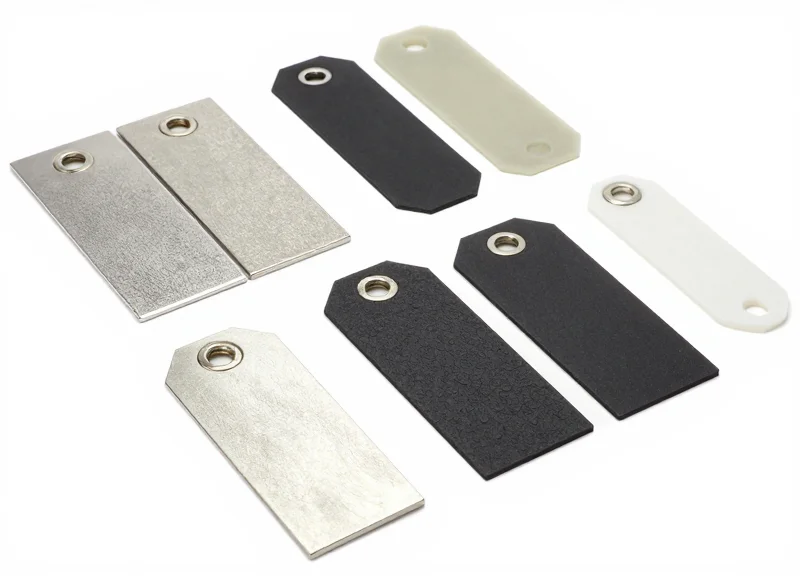
Environmental durability in RFID asset tracking is the capacity of a tag to maintain its structural integrity and data readability while subjected to the stressors of its operating environment, including extreme temperatures, chemical exposure, and mechanical impact. In the 2026 landscape, visibility is no longer optional; if a tag fails during the manufacturing 'heat phase' or the logistics 'moisture phase,' the digital thread is severed, rendering your AI-driven analytics useless. Proper alignment involves choosing a tag form factor—the physical design and mounting method—that survives the asset's worst-case scenario while remaining unobtrusive to its function.
| Environmental Stressor | Typical Industry Application | Required Tag Specification |
|---|---|---|
| Extreme Heat (200°C+) | Automotive Paint & Curing | High-Temp FR4 or Ceramic Tags |
| Chemical/Corrosive Washdown | Food Processing & Pharma | IP69K Rated Encapsulation |
| Outdoor/UV Exposure | Construction & Heavy Equipment | UV-Stabilized ABS or Polycarbonate |
| High Impact/Vibration | Aerospace & Mining | Metal-Mount Ruggedized Shells |
- Mounting Method Matters: Mechanical fasteners (rivets/screws) are preferred for high-vibration assets, whereas high-grade industrial adhesives are better suited for assets where surface integrity cannot be breached.
- Size vs. Read Range Trade-off: Smaller tags often have shorter read ranges due to antenna size constraints. In 2026, miniaturized 'On-Metal' tags have bridged this gap, but testing in situ is still mandatory.
- End-of-Life (EoL) Degradation: The tag must survive until the moment of disposal or recycling to ensure the 'Digital Birth Certificate' is closed out correctly in your ERP system.
Expert Insight: The 'Thermal Memory' Margin. For 2026, we are seeing a shift from 'survivability' to 'performance stability.' Many tags survive high heat but suffer from 'thermal memory'—a gradual degradation of the antenna's impedance that reduces read range by 15-20% after repeated cycles. My recommendation: Always specify tags with a 10% buffer above your maximum recorded temperature and insist on testing for 'Cyclic Stability' rather than just peak temperature survival. This ensures the tag is as readable at the disposal facility as it was on the production line.
Why is IP69K important for 2026 asset tracking?
IP69K is the highest protection rating against high-pressure, high-temperature washdowns. As hygiene regulations tighten in food and pharma, your tags must withstand steam cleaning without delaminating.
Can I use the same tag for metal and plastic assets?
Generally, no. Standard RFID tags are detuned by metal surfaces. You must use specific 'On-Metal' tags for metallic assets, which use the metal itself or a spacer to enhance signal reflection.
Are there eco-friendly tag options for disposal visibility?
Yes, 2026 has seen a surge in 'Green RFID' using paper-based substrates and aluminum-etched antennas that are easier to recycle or decompose, ideal for short-lived or high-turnover assets.
Criterion 2: Read Range and High-Density Scanning Scalability

In the context of 2026 asset tracking, Read Range and High-Density Scanning Scalability refer to a system's ability to accurately identify thousands of unique tags simultaneously at distances ranging from a few centimeters to over 15 meters. While raw distance was once the primary metric, modern production-to-disposal visibility hinges on 'Spatial Resolution'—the capacity to distinguish between tightly packed assets in signal-congested areas without suffering from data collisions or 'ghost reads' caused by signal bounce.
| Use Case Environment | Target Read Range | Tag Density (per m³) | Critical Performance Metric |
|---|---|---|---|
| High-Speed Conveyor/Sorting | 1.5m - 3m | 50-200 tags | Read Rate (Tags per Second) |
| Smart Warehouse Shelving | 0.5m - 2m | 500-1,000 tags | Anti-Collision Efficiency |
| Loading Dock / Portal | 5m - 12m | 2,000+ tags | Beamforming Sensitivity |
| End-of-Life Sorting (Disposal) | 1m - 5m | Mixed Bulk | Interference Mitigation |
To achieve 2026 performance standards, your selection must prioritize reader sensitivity over raw power. High-sensitivity readers can detect the faint 'backscatter' signals from passive tags even when they are shielded by other assets. This is particularly vital in the disposal phase, where assets are often piled haphazardly. Furthermore, ensure the hardware supports adaptive power settings; a reader that blasts maximum power in a high-density zone will create a 'noise floor' that obscures smaller, weaker signals from edge-case assets.
- The 2026 Edge: Reflection-Aware Beamforming: A unique differentiator in top-tier 2026 systems is the move toward AI-driven beamforming antennas. Unlike static antennas that flood a zone with radio frequency (RF) energy, these systems use phased-array technology to 'steer' the signal toward specific tag clusters. This eliminates 'ghost reads'—where a reader incorrectly logs a tag behind a metal wall or inside a passing truck—saving thousands of hours in inventory reconciliation.
- Antenna Polarization Alignment: For seamless visibility, evaluate whether your application requires Linear or Circular polarization. Circular polarization is the gold standard for high-density scalability as it captures tags in any orientation, which is essential when assets are tossed into disposal bins or transit containers without regard for alignment.
Can I simply increase the reader power to improve the read range?
Increasing power (RSSI) can actually decrease accuracy in high-density environments. High power creates multi-path interference and signal reflections off metal surfaces, causing the reader to miss tags or report false locations. Success in 2026 is found in 'RF tuning' and using high-gain antennas rather than brute force.
How does 'Tag Collision' affect production-to-disposal visibility?
Tag collision occurs when multiple tags respond to a reader simultaneously, garbling the signal. Advanced ALOHA-based anti-collision protocols are required to ensure that even in a bin of 5,000 tagged components, every single serial number is accounted for during the final disposal audit.
What is the role of reader 'Sensitivity' in asset tracking?
Sensitivity determines the lowest signal level a reader can accurately process. In industrial settings where assets may be partially obscured by moisture or packaging, a reader with -85dBm sensitivity will significantly outperform a standard -70dBm reader, ensuring no asset is 'lost' in the transition from production to the loading dock.
Criterion 3: Software Interoperability and Cloud-Edge Integration

Software interoperability in RFID systems refers to the seamless communication between hardware (readers and tags) and enterprise platforms like ERP, WMS, or MES systems without requiring proprietary middleware. As we move into 2026, the 'single pane of glass' visibility requires that an RFID read event in a remote warehouse instantly triggers a business logic update in a central database. This is achieved through robust Cloud-Edge integration, where data is filtered at the point of capture (the Edge) before being synchronized with high-level analytical tools in the Cloud.
| Feature | Edge Computing (On-Site) | Cloud Integration (Centralized) |
|---|---|---|
| Primary Purpose | Real-time processing and noise filtering. | Long-term analytics and historical reporting. |
| Latency | Ultra-low (Sub-10ms). | Variable (Dependent on network). |
| Data Volume | Handles millions of raw pings. | Processes summarized, actionable events. |
| Ideal Use Case | Automated conveyor sorting/diverting. | Global inventory lifecycle optimization. |
- Native RESTful APIs: Ensure your RFID hardware supports modern web standards (REST/JSON) to reduce integration time from months to days.
- MQTT Protocol Support: Crucial for IoT-heavy environments, MQTT allows for lightweight messaging that doesn't overwhelm industrial networks.
- EPCglobal Standards Compliance: Maintains compatibility across different vendors and ensures that data remains portable throughout the supply chain.
The Veteran's Tip: Beware of 'Data Gravity'. In high-volume production, RFID readers can generate terabytes of 'junk' data—pings from tags that aren't moving. A modern system must utilize 'Edge Filtering.' By the time data reaches your ERP, it should no longer be a raw 'read'; it should be a 'business event' (e.g., 'Item A has entered Zone B'). If your vendor can't explain their edge-filtering logic, you are purchasing a future bottleneck.
Can I integrate RFID with my existing legacy ERP?
Yes, but it typically requires a middleware layer that translates RFID protocols into CSV or SQL-friendly formats that older systems can ingest.
Why is 'Cloud-Native' better for 2026?
Cloud-native architectures allow for AI-driven predictive maintenance and automatic scaling as your asset count grows, providing better ROI than fixed-capacity on-premise servers.
Does edge processing compromise data security?
On the contrary, edge processing can enhance security by filtering sensitive data locally and only transmitting encrypted, non-sensitive summaries to the cloud.
Criterion 4: Security Protocols and Data Integrity Standards
In the 2026 industrial landscape, an RFID tag is no longer just a digital barcode; it is a network endpoint that must be secured with the same rigor as a corporate laptop. Criterion 4 focuses on hardware-level encryption, mutual authentication, and data integrity protocols that prevent unauthorized 'skimming,' tag cloning, and man-in-the-middle attacks. For enterprises handling sensitive intellectual property or high-value consumer goods, selecting a system that supports AES-128 or higher encryption and decentralized identity standards is the only way to ensure production-to-disposal visibility without compromising privacy.
| Security Feature | Legacy RFID (Pre-2024) | Next-Gen Standards (2026+) |
|---|---|---|
| Encryption | None or Basic Password | AES-128/256 Cryptography |
| Authentication | One-way (Tag to Reader) | Mutual (Two-way cryptographic handshake) |
| Data Privacy | Static ID (Easily Trackable) | Untraceable/Randomized Header IDs |
| Anti-Counterfeit | Visual Inspection/Overt Features | Digital Physical Unclonable Functions (PUF) |
- End-to-End Encryption (E2EE): Modern tags must encrypt data at rest. When a tag is read, the payload should remain encrypted until it reaches the authorized application layer, preventing interceptors from gaining actionable intelligence.
- Tamper-Evident Digital Audits: Use tags that log 'seal-break' events digitally. If a package is opened during transit, the RFID chip updates its internal state, providing an immutable record of the breach upon the next scan.
- Privacy and 'Kill' Command Protocols: For consumer-facing assets, the ability to permanently disable or 'de-privatize' a tag at the point of sale is critical for GDPR and CCPA compliance.
Expert Insight: The Shift to Silicon Fingerprinting. A unique differentiator for 2026 is the adoption of Physical Unclonable Functions (PUF). Unlike traditional secret keys stored in memory—which can be extracted via sophisticated side-channel attacks—PUF leverages the unique, microscopic variations in the silicon chip itself to create a 'digital fingerprint.' This makes it mathematically impossible to clone a tag, providing an ultimate layer of defense for high-stakes manufacturing and defense-grade assets.
How does RFID security prevent corporate espionage?
By utilizing mutual authentication, only authorized readers with the correct cryptographic keys can 'unlock' the data stored on the tag, preventing competitors or bad actors from scanning your inventory or work-in-progress.
Is encrypted RFID significantly more expensive?
While there is a slight premium on hardware, the cost is offset by the reduction in shrink, insurance premiums, and the avoidance of regulatory fines associated with data breaches.
Does encryption affect read speed?
Modern 2026-spec chips are optimized for sub-millisecond cryptographic processing, meaning there is negligible impact on high-speed sorting or bulk-reading performance.
Criterion 5: Total Cost of Ownership (TCO) vs. Lifecycle Value
Total Cost of Ownership (TCO) for RFID asset tracking represents the sum of all expenses incurred from initial acquisition to final decommissioning, while Lifecycle Value (LCV) measures the total economic benefit generated by that asset across its lifespan. In the 2026 landscape, savvy procurement teams are moving away from 'lowest tag price' metrics. Instead, they are adopting a value-centric approach that balances the upfront CAPEX of high-durability hardware against the long-term OPEX savings found in automated inventory cycles, reduced shrinkage, and the ability to meet emerging ESG (Environmental, Social, and Governance) reporting requirements through transparent tracking.
| Cost/Value Category | Direct Costs (TCO Focus) | Value Drivers (LCV Focus) |
|---|---|---|
| Hardware | Unit cost of RFID tags, fixed readers, and handheld devices. | Durability reduces replacement rates; high-sensitivity readers prevent data loss. |
| Software & Integration | Initial licensing fees and API integration costs. | Real-time visibility reduces buffer stock and optimizes working capital. |
| Operations | Labor for tagging and system maintenance. | 90% reduction in manual audit time; 30% increase in workflow velocity. |
| End-of-Life | Decommissioning and disposal costs. | Circular economy credits and automated compliance reporting for DPP. |
The 2026 Alpha Factor: The 'Sustainability Dividend'. A unique insight for 2026 is the emergence of the 'Sustainability Dividend.' Regulatory bodies in the EU and North America now increasingly mandate Digital Product Passports (DPP). An RFID system that captures disposal and recycling data doesn't just track an asset; it generates 'Compliance Credits.' This transforms the RFID tag from a line-item expense into a financial instrument that mitigates regulatory fines and enhances brand equity, often paying for the entire system's TCO within the first 18 months of operation.
- Quantify Labor Displacement: Calculate the hourly savings by replacing manual cycle counts with automated RFID gates or overhead 'smart' zones.
- Factor in Data Accuracy Gains: Assign a dollar value to the reduction of 'ghost assets'—items that appear in the ledger but are not physically present.
- Evaluate Tag Reuse Potential: For closed-loop production, consider ruggedized tags with a 10-year lifespan that can be reassigned thousands of times, significantly lowering the per-use cost compared to cheap disposable labels.
How long does it typically take to see a positive ROI on RFID?
Most enterprise-scale RFID deployments reach the break-even point within 12 to 24 months, primarily driven by labor savings and improved inventory accuracy.
Are subscription-based RFID models (RaaS) better than buying hardware?
RFID-as-a-Service (RaaS) is ideal for companies wanting to preserve capital, as it shifts costs to OPEX and includes automatic hardware refreshes, though it may result in higher TCO over a 10-year horizon.
Should I factor in the cost of tag recycling?
Yes. As of 2026, sustainable tag disposal is a critical TCO component. Choosing tags with recyclable antennas or compostable substrates can reduce disposal fees and improve your ESG rating.
Integrating RFID with Circular Economy Goals

In 2026, the shift from linear 'take-make-waste' models to a circular economy is no longer optional; it is a regulatory and operational imperative. RFID technology serves as the 'Digital Thread' that connects an asset's initial production data to its eventual disposal or repurposing. By embedding identity and material composition data directly into the asset, organizations can automate the verification of recycled content, track repair cycles to extend product life, and ensure that hazardous materials are diverted from landfills toward specialized recovery facilities.
| Feature | Linear Asset Management | Circular Asset Management (RFID-Enabled) |
|---|---|---|
| Data Focus | Location and Loss Prevention | Material Provenance and Lifecycle Health |
| End-of-Life | Landfill or Unverified Scrap | Automated Sorting and Certified Recycling |
| Regulation | Basic Inventory Accounting | Digital Product Passport (DPP) Compliance |
| Value Recovery | Depreciated to Zero | Residual Value via Refurbishment/Resale |
Expert Insight: The 2026 'Silent Audit' Advantage. A unique advantage of modern RFID deployments is the ability to perform 'Silent Audits' for ESG (Environmental, Social, and Governance) reporting. Unlike manual audits that interrupt production, high-frequency RFID sensors can automatically log the number of times a heavy-duty container has been reused or identify the exact chemical grade of a component during high-speed sorting, providing verifiable data for carbon credit markets that competitors using barcodes simply cannot match.
- Implement Digital Product Passports (DPP): Store critical material data, such as alloy types or battery chemistry, on the RFID tag or a linked cloud twin to meet emerging global transparency standards.
- Track Maintenance for Longevity: Use the tag's unique ID to log every repair and service event, ensuring assets reach their maximum possible lifespan before being retired.
- Automated End-of-Life Sorting: Deploy RFID tunnels at waste management sites to automatically categorize returned assets into 'Refurbish,' 'Cannibalize for Parts,' or 'Raw Material Recovery' streams.
Can RFID tags themselves be recycled?
Yes, modern 2026-spec tags are increasingly designed with 'green' substrates like paper or recyclable PET, and some use screen-printed antennas to eliminate chemical etching, minimizing their own environmental footprint.
How does RFID help with E-waste compliance?
RFID provides an immutable record of an asset's journey, allowing companies to prove to regulators that electronic components were handed off to certified recyclers rather than exported illegally.
Does this integration require expensive software?
Most modern ERP systems now include 'Circular modules' that natively ingest RFID data to calculate Scope 3 emission reductions and material recovery rates.
Common Implementation Pitfalls and How to Avoid Them
Even the most advanced RFID systems can fail if the implementation lacks a holistic understanding of the physical environment and digital architecture. The most common pitfall in RFID asset tracking is 'Pilot Purgatory'—the inability to scale a successful small-scale test because the initial design ignored the complex physics of industrial settings or the bandwidth requirements of real-time data streaming. To achieve seamless production-to-disposal visibility, organizations must move beyond simply 'buying tags' and instead design a resilient ecosystem that accounts for RF interference, software latency, and human factors from day one.
| Common Pitfall | The Impact | The 2026 Proactive Solution |
|---|---|---|
| The 'Metal/Liquid' Blind Spot | Tags fail to read near machinery or chemical vats. | Utilize specialized 'On-Metal' or 'Flag' tags and conduct RF site surveys early. |
| Data Gravity Silos | Tracking data exists but isn't accessible by the ERP or WMS. | Implement Edge-to-Cloud middleware that standardizes data formats (JSON/MQTT) for instant integration. |
| Underestimating Tag Longevity | Tags deteriorate before the asset reaches the disposal phase. | Source tags with environmental ratings (IP68/69K) that match the asset's full lifecycle stressors. |
| The 'One-Size-Fits-All' Tagging Strategy | High-value assets and low-cost consumables are tagged with identical hardware. | Adopt a tiered tagging strategy: Active/UHF for high-value items, eco-friendly printable tags for disposables. |
Expert Tip: Beware the 'Frequency Collision Paradox'. As we move into 2026, the density of IoT devices in smart factories is skyrocketing. An often-overlooked pitfall is 'Reader Collision' and 'Tag Interference,' where too many readers operating in a confined space cause signal degradation. To avoid this, utilize 'Dense Reader Mode' (DRM) configurations and AI-driven reader coordination software that dynamically adjusts power levels and frequency channels based on real-time traffic.
How do we prevent 'garbage in, garbage out' with our RFID data?
Implement automated data validation at the 'Edge' level. By filtering out redundant reads and false positives before the data hits your ERP, you ensure that only actionable business intelligence is recorded.
Why do RFID projects often exceed their initial budget?
Scope creep and hidden infrastructure costs are the main culprits. Many firms forget to budget for professional cable installation, network upgrades, and ongoing firmware maintenance. Always include a 15% buffer for environmental tuning post-deployment.
How can we ensure staff actually use the system correctly?
User adoption fails when the technology adds friction. Design the workflow so that asset scanning happens 'in-stride' (e.g., portal readers at dock doors) rather than requiring manual scans by employees.
- Phase 1: Environmental Audit: Conduct a spectrum analysis to identify existing RF noise and physical obstacles that could block signals.
- Phase 2: Use Case Segmentation: Define specific visibility goals for each stage (Production, Storage, Disposal) to select the right tag durability and memory size.
- Phase 3: Middleware Stress Testing: Simulate peak-load scenarios where thousands of tags are read simultaneously to ensure the software back-end can handle the throughput without crashing.
The DragonGuard Advantage: Tailored RFID for 2026

The DragonGuard advantage lies in moving beyond off-the-shelf hardware to provide 'application-engineered' RFID solutions that address the specific physics and data challenges of 2026 production cycles. While standard vendors offer generic tags, DragonGuard specializes in the integration of specialized material science with high-performance ICs, ensuring that your tracking infrastructure remains resilient from the factory floor to the final recycling facility. In an era where data integrity is the primary currency, we provide the physical foundation that makes seamless production-to-disposal visibility a reality.
- Customized Form Factors: We design tags tailored to unique asset geometries and materials, ensuring 99.9% read rates even on liquid-filled containers or curved metallic surfaces.
- Advanced Material Resilience: Our 2026 lineup features aerospace-grade polymers and specialized adhesives designed to withstand extreme thermal cycling and chemical exposure without signal degradation.
- Integrated Security Layers: DragonGuard hardware supports the latest NXP and Impinj security protocols, providing hardware-level encryption to prevent cloning and data tampering.
- Circular Economy Readiness: Our tags are engineered for the 'cradle-to-cradle' lifecycle, featuring eco-friendly substrates that simplify the reclamation process at the end of an asset's life.
| Feature | Standard RFID Vendors | DragonGuard Advantage |
|---|---|---|
| Material Compatibility | Limited to standard plastic/paper | Bespoke 'Material-Match' engineering |
| Environmental Range | -20°C to +60°C | Ultra-high temp (-50°C to +250°C+) |
| Data Retention | 5-7 Years | 10-20 Year industrial-grade memory |
| Integration Support | Hardware sales only | Full ecosystem API & firmware alignment |
A unique insight for 2026: Success in modern asset tracking is no longer just about the chip; it is about 'Material-Match Engineering.' DragonGuard experts analyze the molecular bond between the tag adhesive and the asset substrate to eliminate signal attenuation and physical detachment over a 10-year lifecycle. This granular focus ensures that your digital twin remains synchronized with its physical counterpart, even in high-vibration or corrosive environments that would cause standard tags to fail within months.
Can DragonGuard customize tags for small batch productions?
Yes. Unlike competitors who require massive minimum orders, our agile manufacturing process allows for high-performance custom tags for niche industrial applications and pilot programs.
How does DragonGuard support global compliance?
All our hardware is pre-certified for global frequency regulations (FCC, ETSI) and matches international ISO standards for data structure, ensuring your assets are visible across borders.
Does DragonGuard provide software integration services?
While we are hardware specialists, we provide robust SDKs and middleware support to ensure our tags communicate flawlessly with your chosen ERP, WMS, or custom cloud platforms.