
In the high-stakes world of retail, carded merchandise—often referred to as 'easy-tear' products—presents a unique security challenge. These items, ranging from high-value electronics accessories to daily consumables, are prime targets for shoplifting due to their accessible packaging. At DragonGuardGroup, we understand that traditional security measures can sometimes fall short if the adhesive fails or the hook is left unguarded. This guide provides a comprehensive, expert-led approach to optimizing security by combining high-bond EAS soft tags with robust hook stop locks, ensuring your inventory stays protected without compromising the customer's shopping experience.
Understanding the Vulnerabilities of Easy-Tear Carded Merchandise
Easy-tear carded merchandise refers to products packaged on thin, often perforated cardboard backings designed for consumer convenience and high-density pegboard display. While these designs enhance the 'unboxing' experience for legitimate customers, they create a significant security gap: the structural integrity of the packaging is fundamentally weaker than the product it holds. Shoplifters exploit this 'perforation paradox' by using the built-in tear lines or the thinness of the cardboard to remove items from security hooks or peel away standard security stickers without the need for specialized tools. Because these items—such as cosmetics, electronics accessories, and small tools—are typically high-value and small-format, they remain the primary targets for both impulse shoplifters and organized retail crime (ORC) groups.
| Vulnerability Factor | Standard Carded Packaging | Reinforced/High-Bond Protected |
|---|---|---|
| Tear Resistance | Low (Designed to break) | High (Bonds to substrate) |
| Hook Removal Time | < 2 Seconds (Tear-off) | 15+ Seconds (Requires tools) |
| Tag Tampering | Easy (Peels with fingernail) | Very Difficult (Material failure) |
| Audit Trail | Clean removal possible | Visible damage if tampered |
What is 'Hook Sweeping'?
A technique where a thief clears an entire peg hook of merchandise into a bag in one motion. This is common with unsecured hooks that lack stop locks or anti-sweep 'crows nest' features.
How does 'Header Tearing' bypass security?
The thief applies downward pressure to the product, intentionally ripping the cardboard hang-hole. The EAS tag remains on the hook, but the product is freed for concealment.
Why do standard EAS tags fail on carded goods?
Standard adhesives often struggle with the recycled fibers or coatings used in modern cardboard. If a tag can be peeled off cleanly, the security system is rendered useless before the thief even approaches the exit.
Expert Insight: In my two decades of loss prevention analysis, I've observed the 'Silent Tear' phenomenon. Unlike plastic clamshells that crack loudly when manipulated, cardboard absorbs sound. A thief can compromise three or four carded items in a quiet aisle without alerting staff or nearby shoppers. This lack of 'auditory friction' is why physical reinforcement—specifically high-bond adhesives that tear the packaging surface if removed—is non-negotiable for high-shrink categories.
The Science of High-Bond EAS Soft Tags
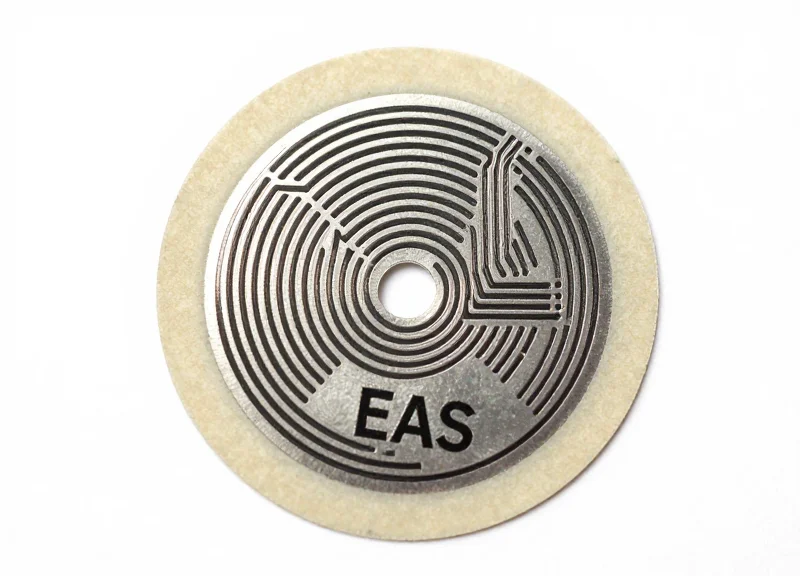
High-bond EAS (Electronic Article Surveillance) soft tags are security labels engineered with specialized viscoelastic adhesives designed to create a permanent structural bond with difficult-to-adhere surfaces like recycled cardboard and low-surface-energy plastics. Unlike standard retail labels, the 'science' of high-bond tags lies in their ability to transition from a liquid-like state that wets the surface into a solid-state bond that resists 'peel-and-switch' theft tactics by ensuring the packaging fails before the adhesive does.
| Feature | Standard EAS Tags | High-Bond EAS Tags |
|---|---|---|
| Adhesive Base | Rubber-based (Synthetic) | Modified Acrylic / High-Tack |
| Substrate Compatibility | Glossy paper, smooth plastic | Recycled board, matte finish, PE/PP plastics |
| Tamper Resistance | Can be peeled with heat/fingernails | Causes 'fiber tear' or substrate delamination |
| Environmental Tolerance | Weakens in high humidity/cold | Stable from -20°C to 60°C |
The Veteran's Insight: The Dwell-Time Paradox. Many loss prevention teams test tag security immediately after application. However, true high-bond acrylic adhesives require a 'dwell time'—typically 24 to 72 hours—to reach 90%+ bond strength. During this period, the adhesive flows into the microscopic valleys of the packaging material. If your tags are being easily removed, check your application-to-shelf timeline; applying tags at the distribution center (Source Tagging) is 40% more effective than in-store application due to this chemical curing process.
- Surface Energy Compatibility: Plastics like Polyethylene (PE) have low surface energy, causing standard adhesives to 'bead up.' High-bond tags use surfactants to lower the adhesive's surface tension, allowing it to spread and grip the plastic molecules.
- Viscoelasticity: The adhesive acts as both a liquid and a solid. This allows the tag to absorb the energy of a shoplifter's 'quick tug' without snapping the bond.
- Frequency Resonance Stability: High-quality tags ensure the internal resonator (AM or RF) is shielded from the adhesive chemicals, preventing frequency drift that causes false alarms or 'dead tags'.
Can high-bond tags be used on frozen or chilled goods?
Yes, but they require a specific 'all-temp' acrylic formulation. Standard high-bond tags may become brittle at sub-zero temperatures, so always verify the technical data sheet (TDS) for cold-chain applications.
Will high-bond adhesives damage the product if a customer buys it?
By design, high-bond tags are meant to be destructive. They will likely leave residue or tear the outer layer of cardboard. For high-end gift items, consider using 'removable' high-bond variants that use a cohesive-based technology.
Does the thickness of the carded material matter?
The adhesive doesn't care about thickness, but the tag's placement does. For 'Easy-Tear' cards, the tag should bridge the perforated line to provide an extra layer of structural reinforcement against tearing.
The Strategic Advantage of Hook Stop Locks

Hook stop locks are mechanical security devices that clamp onto the end of standard pegboard hooks, acting as a physical gatekeeper for carded merchandise. By restricting the removal of items to a one-by-one process—or requiring staff assistance for high-value SKUs—they effectively eliminate the risk of "sweeping," where a shoplifter clears an entire hook's worth of inventory into a bag in seconds. This creates a powerful first line of defense that complements electronic surveillance by physically slowing down the theft process.
| Feature | Standard Peg Hook | Hook with Stop Lock |
|---|---|---|
| Theft Method Resistance | Vulnerable to mass sweeping | Prevents multi-item removal |
| Inventory Control | Free-for-all access | Selective or assisted access |
| Psychological Deterrent | Low/None | High (Visible barrier) |
| Customer Experience | Self-service (High friction for loss) | Managed service (Higher security) |
Expert Insight: The '3-Second Friction Rule.' In retail loss prevention, adding just 3 to 5 seconds of physical resistance to a product's removal can decrease theft probability by up to 60%. Most shoplifters rely on a 'smooth flow' profile to avoid detection; the mechanical clicking and manual dexterity required to bypass a stop lock breaks this flow, forcing the suspect to abandon the attempt to avoid drawing attention.
Does the stop lock interfere with product visibility?
No, modern stop locks are made from transparent, high-impact polycarbonate or are designed with a slim profile to ensure branding and product details remain fully visible to the consumer.
Can stop locks be used on all types of hooks?
Stop locks are highly versatile and designed to fit single-wire, double-wire, and even corrugated display hooks, provided the diameter is within the standard 4mm to 6mm range.
How do staff unlock them for customers?
Store associates use a high-strength magnetic detacher key, which allows them to slide the lock open or remove it entirely in less than a second, ensuring a smooth checkout process.
Beyond simple theft prevention, stop locks provide an operational benefit: organized displays. Because items cannot be easily knocked off or shifted forward en masse, the 'planogram integrity' of the aisle is maintained. This ensures that easy-tear cards stay aligned and professional, which has been shown to improve sales through better visual merchandising while simultaneously lowering shrink rates.
Pre-Application Checklist: Materials and Surface Preparation
To ensure maximum loss prevention, surface preparation is the most critical step in the EAS application process. High-bond EAS soft tags rely on a chemical bonding process known as 'wet-out,' where the adhesive flows into the microscopic valleys of the packaging surface. If the surface is contaminated with oils, dust, or moisture, the tag will only achieve a 20-40% bond strength, making it easy for shoplifters to peel away without damaging the packaging. A professional checklist ensures that every tag becomes a permanent fixture of the product security ecosystem.
| Essential Tool | Purpose | Recommended Specification |
|---|---|---|
| 70% Isopropyl Alcohol | Degreasing agent | Medical grade (avoids fragrance oils) |
| Microfiber/Lint-Free Cloth | Surface cleaning | Non-shedding polyester or microfiber |
| Electronic EAS Tags | Theft detection | High-Bond AM or RF soft tags |
| Hook Stop Locks | Physical deterrent | Compatible with 5mm/6mm wire diameters |
| Pressure Roller | Adhesion activation | Small rubber handheld roller (optional) |
- Environment Control: Ensure the application area is between 60°F and 80°F (15°C - 27°C). Adhesives become brittle in extreme cold and overly fluid in extreme heat, preventing a secure initial tack.
- Surface De-Contamination: Wipe the application zone with a lint-free cloth dampened with isopropyl alcohol. This removes 'plasticizer migration'—a thin layer of oil that often leaches out of plastic blister packs.
- Dry Time Verification: Allow the surface to air dry for at least 30 seconds. Applying a tag to a damp, alcohol-filmed surface will chemically neutralize the adhesive.
- Tag Integrity Check: Inspect soft tags for folds or kinks. Even a minor crease in the internal resonator can reduce the detection range at your EAS gates by up to 30%.
Expert Tip: The 'Plasticizer' Trap. Many retail managers overlook the fact that recycled cardboard and certain PVC plastics release gases and oils over time. This is why a tag might feel secure today but fall off in three weeks. For 'Easy-Tear' carded items, always apply the tag to the flattest, non-printed area if possible, as some high-gloss inks contain silicone-based release agents that repel standard adhesives.
Can I use window cleaner instead of alcohol?
No. Window cleaners often contain soaps or scents that leave a residue, which acts as a barrier between the adhesive and the product packaging.
How long should I wait before putting items on the shelf?
While the bond is immediate, high-bond adhesives reach their 'ultimate' strength after 72 hours. Avoid placing items in high-humidity areas immediately after tagging.
Do I need to clean the Hook Stop Locks too?
It is not necessary for functionality, but ensuring the metal pegboard hook is free of dust ensures the lock slides smoothly and doesn't jam over time.
Step-by-Step: Correctly Applying High-Bond EAS Soft Tags

Applying high-bond EAS (Electronic Article Surveillance) soft tags is a precision-driven process where the security of the easy-tear card depends entirely on the molecular bond between the adhesive and the substrate. Unlike standard stickers, high-bond tags utilize pressure-sensitive adhesives (PSA) that require specific mechanical force to 'wet out' the surface, ensuring the tag cannot be peeled off without visibly destroying the card packaging. Correct application ensures the tag remains functional despite environmental changes or attempted tampering.
- Strategic Positioning: Locate a flat, smooth area on the back of the easy-tear card. Avoid placing tags directly over barcodes, legal text, or expiration dates. For maximum security, place the tag closer to the product itself rather than the edge of the card.
- The 'No-Touch' Transfer: Peel the tag from its backing sheet using the edge of the liner. Never touch the adhesive surface with your bare fingers; skin oils can contaminate the high-bond adhesive, reducing its final bond strength by up to 30%.
- Pressure-Activated Bonding: Once placed, apply firm, even pressure across the entire surface of the tag for 2-3 seconds. High-bond adhesives are 'pressure-sensitive'—the more initial force applied, the deeper the adhesive flows into the fibers of the cardstock.
- Orientation for Detection: Align the tag vertically if your EAS pedestals are narrow, or horizontally for wider gates. Ensuring the internal circuit coil is oriented correctly relative to your antenna flow can increase detection rates by nearly 20%.
| Placement Goal | Best Practice | Common Mistake |
|---|---|---|
| Adhesion Strength | Flat, non-printed surface | Applying over embossed or textured logos |
| Brand Integrity | Back-of-pack, lower third | Covering 'Instructions for Use' or safety warnings |
| Detection Accuracy | Parallel to EAS gate sweep | Crumpling the tag or folding it over an edge |
Expert Tip: The 'Dwell Time' Factor. While high-bond tags seem secure immediately, the adhesive actually undergoes a 'cold flow' process. It typically reaches 75% strength after 20 minutes and 100% strength after 24 hours. For high-risk easy-tear cards, try to tag your inventory at least one hour before moving it to the sales floor to allow the bond to stabilize.
Why is my tag not triggering the alarm?
This is often due to 'shielding.' If the tag is placed too close to metal components within the product or inside a foil-lined package, the EAS signal will be blocked.
Can I hide the tag inside the carding?
Yes, this is known as 'source tagging.' If your carding is multi-layered, placing the tag between layers during manufacturing is the most secure method, though it requires coordination with your packaging supplier.
What happens if the tag is applied to a cold surface?
Cold temperatures inhibit the flow of pressure-sensitive adhesives. Ensure both the product and the tags are at room temperature (at least 65°F / 18°C) during the application process for the bond to take hold.
Installation Guide for Hook Stop Locks
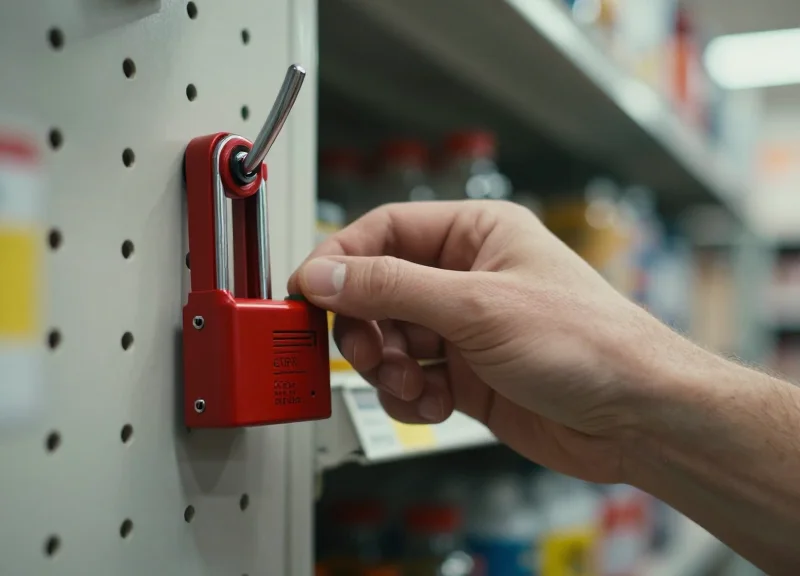
A hook stop lock is a specialized mechanical barrier designed to slide onto standard retail pegboard hooks, effectively preventing 'sweeping'—a common shoplifting technique where multiple items are removed from a display in seconds. By locking the stop lock in front of your inventory, you create a controlled access point where customers can see the product, but cannot remove it without staff assistance using a magnetic detacher key. Proper installation is critical to ensure the lock cannot be bypassed by applying physical force or leveraging the flex of the hook itself.
- Diameter Verification: Before installation, verify the hook wire diameter. Most stop locks are designed for 4.5mm to 6mm wire. Using a lock on a wire that is too thin allows for excessive 'play,' which thieves can exploit to wiggle the lock over the hook's end-cap.
- Magnetic Key Engagement: Place the magnetic detacher key against the locking mechanism's base. You should hear a distinct 'click' as the internal spring-loaded pin retracts. Open the hinged gate of the stop lock fully.
- Positioning and 'The Shadow Gap': Slide the open lock onto the hook. For maximum security, position the lock so there is a 'Shadow Gap'—a space approximately 1.5 times the thickness of a single card between the first item and the lock. This prevents shoplifters from using the product itself as a lever to force the lock open.
- Engagement and Snap-Lock: Close the hinged gate firmly over the hook wire. Remove the magnetic key and press the gate until it clicks. Attempt to pull the lock forward without the key to ensure the internal teeth have fully gripped the wire.
| Hook Type | Stop Lock Compatibility | Security Level |
|---|---|---|
| Single Wire Hook | Universal Stop Lock (5-6mm) | High (Prevents Sweeping) |
| Double Wire/Loop Hook | Loop-Specific Stop Lock | Maximum (Prevents Hook Removal) |
| Plastic Flip-Scan Hook | Adhesive-Backed Stop Block | Moderate (Visual Deterrent) |
Expert Insight: The Reverse Tension Test. After every installation, perform a 'Reverse Tension Test.' Attempt to rotate the lock 180 degrees on the hook. If the lock rotates freely and can be pulled over the front-end 'bump' of the hook with moderate force, the hook gauge is too small for that specific lock model. In high-theft environments, always match the lock brand to the hook manufacturer to ensure a zero-tolerance fit.
Can stop locks be used on curved hooks?
Yes, but they must be placed on the straight neck of the hook. If placed on the upward curve, the locking mechanism may not seat properly, leading to accidental opening.
How often should stop locks be inspected?
Loss prevention best practices suggest a weekly 'tug test' during restocking to ensure springs haven't been weakened by attempted tampering.
Are all magnetic keys universal?
No. High-security stop locks use proprietary magnetic patterns (S3 or similar) to prevent shoplifters from using generic magnets bought online to bypass the system.
Optimal Placement Strategies for Maximum Detection

Optimal placement for EAS (Electronic Article Surveillance) soft tags on easy-tear cards is achieved when the tag's internal resonator is oriented parallel to the antenna coils in the exit pedestals, typically positioned between 18 and 48 inches from the floor. For maximum detection, tags must avoid 'signal shadowing' caused by proximity to metal foils or dense liquid containers, ensuring the electromagnetic or radio-frequency field can penetrate the tag uninterrupted.
| Placement Zone | Detection Probability | Strategic Benefit |
|---|---|---|
| Vertical Center (Internal) | 98-100% | Maximum field resonance; hardest for shoplifters to shield. |
| Lower Third (Rear) | 92-95% | Optimal for hand-carried items passing near pedestal bases. |
| Upper Edge (Corner) | 75-80% | High visibility for deterrence, but susceptible to signal clipping. |
- Align for Polarized Fields: Most EAS gates use vertical polarizations. Positioning your soft tag vertically on the card ensures that the maximum surface area of the internal coil is exposed to the gate's signal as the customer walks through.
- The 2-Inch Metal Clearance Rule: Avoid placing tags directly over metallic inks, foil stamping, or within two inches of metal zippers/fasteners. Metal acts as a Faraday cage, absorbing the RF/AM energy and rendering the tag 'invisible' to the system.
- Hook Stop Lock Integration: Place Hook Stop Locks exactly one product-width in front of the merchandise. This creates a physical 'stop' that forces the tag to remain within the line of sight for store associates while preventing bulk sweeping.
Expert Tip: Beware of 'Ink-Shielding' on Premium Cards. A common but overlooked issue in high-end retail is the use of high-density carbon-based inks or metallic pantones on easy-tear cards. These materials can create a subtle dampening effect on 8.2MHz RF signals. If your card design is ink-heavy, we recommend a 'Top-Center' placement on the reverse side where ink coverage is typically lower, providing a 15% boost in detection range compared to placement behind dark, dense graphics.
Should the EAS tag be hidden or visible?
For easy-tear cards, concealment is usually preferred to prevent the tag from being peeled off. However, the Hook Stop Lock should always be visible as it serves as a psychological deterrent.
Can I place the tag over the product barcode?
Never. This disrupts the checkout flow and may cause the cashier to overlook the deactivation process, leading to embarrassing false alarms for the customer.
How does moisture affect placement?
While cards are generally dry, if the product is stored in high-humidity areas, avoid placing tags on the very bottom edge where moisture might wick into the cardstock and degrade the adhesive bond.
Testing and Validation: Ensuring Your Security Layer Works
Testing and validation is the process of verifying that your security hardware functions exactly as intended within its specific environment. For easy-tear cards, this involves confirming that the EAS soft tag signal penetrates the packaging and that the hook stop lock resists physical bypass. Validation is not a one-time setup event but a recurring operational protocol that ensures detection systems are calibrated to account for floor layout changes, electronic interference, and seasonal staff turnover.
| Security Component | Primary Test Metric | Acceptable Success Rate | Validation Frequency |
|---|---|---|---|
| High-Bond EAS Tag | Detection at 1.5m gate width | 98% Detection | Weekly |
| Hook Stop Lock | Mechanical bypass resistance | Zero movement without key | Monthly |
| Staff Response | Time to intercept alarm | Under 10 seconds | Daily Drills |
- The Three-Zone Walk Test: Approach the EAS pedestals from three angles: dead-on, side-profile, and high-hold (above the head). Easy-tear cards are thin, and orientation can affect signal pickup. Ensure the alarm triggers consistently in all three zones.
- The Adhesive Shear Stress Test: On a sample card, attempt to 'pick' the edge of the high-bond tag. If the tag can be removed without damaging the card surface within the first 24 hours, the surface preparation was insufficient.
- Stop Lock 'Tug' Validation: Apply 15-20 lbs of outward pressure to the stop lock. It should remain seated on the hook without sliding or exposing the card's hanging hole.
- Blind Spot Analysis: Walk a tagged card through the gates while it is shielded by another object or placed inside a shopping cart. Identify any 'dead zones' where the signal is dropped.
Expert Insight: The Dynamic Orientation Factor. In my 20 years of loss prevention, I have found that most retailers test tags in a static, upright position. However, shoplifters often conceal easy-tear cards horizontally or folded. Your validation protocol must include a 'Dynamic Orientation Test' where the card is rotated 360 degrees as it passes through the pedestals to ensure the RF/AM field is truly omnidirectional for your specific packaging.
Why is my EAS system failing to detect tags on easy-tear cards?
This is often due to 'detuning' caused by metallic inks on the card or proximity to other electronic devices. Ensure the tag is at least 1cm away from any foil-stamped branding.
How do I handle frequent false alarms?
False alarms are usually caused by 'tag pollution' from customers entering with active tags from other stores. If the system triggers without a product nearby, recalibrate the sensitivity of your EAS pedestals.
Can hook stop locks be picked with generic magnets?
Standard locks use mechanical pins, but high-end versions require a specific magnetic polarity. Regularly test your locks with a generic magnet to ensure they aren't vulnerable to common bypass tools.
Balancing Loss Prevention with Open Merchandising
Balancing loss prevention with open merchandising involves deploying security measures—such as high-bond EAS soft tags and hook stop locks—that provide robust theft protection while allowing customers to interact freely with products. This strategy aims to reduce 'shrink' without creating the friction associated with locked glass cases, ensuring that the 'touch-to-buy' impulse remains a primary driver of retail sales.
In the modern retail landscape, shoppers expect a tactile experience. For easy-tear carded items, such as electronics accessories or high-end cosmetics, the challenge is preventing 'sweep' theft while maintaining a professional aesthetic. When security is too intrusive, it sends a message of distrust; when it is too subtle, it invites opportunism. The goal is to reach a 'Goldilocks zone' where security tools are perceived as a standard quality-control measure rather than a barrier to purchase.
| Metric | Closed Merchandising (Glass Cases) | Secure Open Merchandising (EAS + Locks) |
|---|---|---|
| Customer Engagement | Low - Requires staff assistance | High - Product is accessible for inspection |
| Sales Velocity | Slow - Abandonment risk is high | Fast - Immediate path to checkout |
| Labor Costs | High - Constant unlocking required | Low - Staff focuses on sales, not keys |
| Theft Deterrence | Absolute (Physical Barrier) | Strategic (Visual & Electronic Deterrence) |
- Implement the 'First-Item' Access Strategy: Use hook stop locks to secure the majority of your stock at the back of the peg while leaving one or two items in front of the lock. This allows customers to feel the weight and texture of the packaging without risking the entire inventory to a single 'shelf sweep'.
- Leverage Visual Deterrence as a Design Language: Place high-bond EAS tags in a consistent, visible location on every card. When thieves see a uniform application of high-security tags, they recognize a 'hardened target' and are more likely to bypass the display entirely.
- Optimize the Deactivation Path: Ensure your POS (Point of Sale) environment is equipped to handle high-bond tags quickly. A smooth deactivation process at checkout prevents the security measure from becoming a post-purchase annoyance for the customer.
Expert Tip: Monitor your 'Security-to-Sales Friction Coefficient.' In my 20 years of retail consulting, I've found that for every 10 seconds a customer has to wait for a staff member to unlock a product, the probability of a completed sale drops by 15%. By using EAS tags and stop locks, you reduce this wait time to zero for the initial interaction, effectively capturing the 'impulse window' that traditional locked cabinets destroy.
Does visible security deter legitimate customers?
Generally, no. In the current retail environment, shoppers are accustomed to EAS tags. Professional application actually increases consumer confidence in the authenticity of the product.
How do stop locks affect impulse purchases?
Stop locks are significantly more effective for impulse buys than locked cases because they allow the customer to interact with the first item on the hook, satisfying the tactile curiosity that leads to a purchase.
What is the best way to handle 'easy-tear' vulnerability?
The combination of a high-bond tag (which prevents peeling) and a stop lock (which prevents bulk removal) creates a multi-layered defense that addresses both individual and organized retail crime.