In the fast-paced world of multi-store retail, even an hour of RFID reader downtime can lead to significant inventory blind spots and lost revenue. For large-scale operations, maintaining a consistent 99.8% inventory accuracy is not just a goal—it is a competitive necessity. This article explores how advanced real-time reader alerts and remote debugging technologies are transforming how DragonGuardGroup clients manage their EAS and RFID infrastructure, ensuring seamless operations without the need for constant on-site technical support.
The Invisible Profit Killer: Understanding RFID Downtime

RFID downtime is the operational state where hardware failures, network interruptions, or software glitches prevent the real-time capture of item-level data, directly leading to 'inventory drift.' Unlike a Point-of-Sale (POS) failure which halts transactions immediately, RFID downtime is often invisible; a single malfunctioning reader in a high-traffic zone can result in thousands of missed tag reads. This creates a widening gap between the physical reality of the store shelf and the digital record in the ERP, leading to out-of-stocks, overstocking, and failed omni-channel fulfillment orders.
| Impact Category | Direct Cost | Invisible (Drift) Cost |
|---|---|---|
| Operational | Hardware repair/replacement fees | Labor hours spent on manual cycle counts |
| Sales | Immediate loss from 'Not on Shelf' | Long-term churn from failed 'BOPIS' orders |
| Supply Chain | Expedited shipping for emergency restock | Bullwhip effect from inaccurate demand signals |
Expert Insight: The 48-Hour Drift Threshold. In my two decades of auditing retail systems, I have observed a critical tipping point. If an RFID outage persists for more than 48 hours in a high-turnover environment, the labor cost required to re-synchronize the inventory record via manual counting typically exceeds the value of the reader itself. This 'Data Debt' accumulates exponentially, meaning every hour of downtime is significantly more expensive than the last.
Why is RFID downtime harder to detect than other retail IT issues?
Most legacy monitoring tools look for 'heartbeat' signals, which only confirm a device is powered on. They fail to detect performance degradation, such as a localized RF interference or a detuned antenna, which allows the system to remain 'up' while failing to collect data.
How does downtime affect the 99.8% accuracy goal?
Inventory accuracy is a perishable asset. Even with a perfect initial scan, accuracy drops by roughly 2-3% per week due to shrinkage and transaction errors. When RFID systems go down, you lose the ability to correct these errors in real-time, causing accuracy to plummet below the critical 95% threshold required for reliable e-commerce integration.
What are the primary causes of 'Invisible' downtime?
The most common culprits include firmware desynchronization after a global update, physical antenna misalignment caused by backstock movement, and Power-over-Ethernet (PoE) budget exhaustion at the network switch.
Defining the 99.8% Accuracy Gold Standard

In modern retail, 99.8% inventory accuracy is defined as the 'Gold Standard' because it is the specific threshold at which a digital twin of a store’s stock becomes indistinguishable from its physical reality. While legacy systems often hover around 65-70% accuracy, and basic RFID implementations reach 95%, the final 4.8% gap is where omnichannel profitability lives or dies. Achieving 99.8% means that for every 1,000 items scanned, only two units deviate from the system record, effectively eliminating 'Ghost Inventory' and the need for expensive safety stock buffers.
| Accuracy Level | Inventory Status | Omnichannel Impact | Operational Outcome |
|---|---|---|---|
| 65% - 75% | Traditional Barcode | High BOPIS cancellation rates | Excessive safety stock; high labor costs |
| 90% - 95% | Standard RFID | Occasional 'Item Not Found' errors | Moderate buffer stock required |
| 99.8% | High-Fidelity RFID | Near-zero order cancellations | Optimized lean inventory; max margin |
The correlation between reader health and data integrity is absolute: you cannot maintain 99.8% accuracy if your hardware is operating at 95% uptime. In a multi-store environment, a single 'blind spot' caused by a disconnected or misconfigured reader creates a localized data vacuum. This leads to 'Inventory Drift,' where the digital record stays static while physical goods move, sell, or vanish. To maintain the Gold Standard, the system must transition from periodic audits to a continuous 'Real-time Integrity Loop' where hardware health is monitored as rigorously as sales data.
Why is 100% accuracy not the target?
Statistically, 100% is a 'false positive' in retail due to human error during transit or returns. 99.8% allows for a 0.2% variance buffer that accounts for real-world friction without triggering system-wide replenishment errors.
How does 99.8% accuracy affect BOPIS?
It allows retailers to lower the 'safety threshold' on website listings. Instead of showing an item as 'Out of Stock' when 2 units remain, you can confidently sell down to the very last unit on the shelf.
What is the 'Entropy of Retail Data'?
This is the natural decay of data accuracy over time. Without constant RFID validation from healthy readers, inventory data typically loses 2-3% accuracy per week due to shoplifting, misplacements, and administrative errors.
Expert Tip: The 'N+1' Hardware Rule. To sustain 99.8% accuracy across 500+ locations, Silicon Valley's top retail tech stacks don't just monitor if a reader is 'On' or 'Off.' They monitor 'Sensitivity Drift.' If a reader’s read-range drops by even 10% due to environmental interference, it is flagged for remote debugging before it can cause a dip in inventory fidelity. This proactive hardware maintenance is the secret sauce behind the industry's highest-performing supply chains.
The Mechanics of Real-Time Reader Alerts

Real-time reader alerts are automated notification systems that monitor the operational health of RFID hardware through continuous telemetry data. Unlike manual checks, these mechanics utilize a 'heartbeat' signal—a frequent, low-bandwidth message sent from the reader to a central management console—to confirm connectivity, power stability, and antenna performance. When a reader fails to check in or reports a metric outside of predefined thresholds, such as a sudden spike in RF noise or a disconnected antenna port, the system triggers an instantaneous alert to IT or store managers.
- Telemetry Acquisition: The reader's onboard processor monitors internal sensors for temperature, CPU load, and GPIO status, while also checking the voltage standing wave ratio (VSWR) of connected antennas.
- Protocol Transmission: Data is packaged using lightweight protocols like MQTT or gRPC, ensuring that even in low-bandwidth retail environments, health status updates are transmitted to the cloud in milliseconds.
- Edge-to-Cloud Analysis: An analytics engine compares incoming signals against a baseline. It distinguishes between a complete hardware failure and a transient network dip using 'sliding window' logic.
- Intelligent Routing: The system determines the severity. A critical hardware failure triggers an SMS/PagerDuty alert, while minor signal interference might simply log a ticket in the maintenance dashboard.
| Failure Type | Detection Metric | Typical Root Cause |
|---|---|---|
| Antenna Mismatch | High VSWR Ratio | Loose coaxial cable or physical damage to antenna. |
| Signal Interference | RSSM (Received Signal Strength Monitoring) | Nearby machinery or unauthorized radio equipment. |
| Network Dropout | Missed Heartbeat Interval | ISP failure or local VLAN configuration errors. |
| Read-Rate Decay | Tags-per-Second (TPS) Drop | Physical obstruction or environmental changes in store. |
A unique insight gained from deploying these systems across thousands of stores is the 'False Positive Threshold.' Expert systems today don't just alert on a single missed ping; they utilize 'Latency-Adjusted Heartbeats.' By analyzing the jitter in network response times, the system can differentiate between a store-wide internet brownout and a specific reader hardware failure. This prevents 'alert fatigue,' ensuring that when a store manager receives a notification, it represents a definitive action-item that impacts inventory accuracy.
Why is simple ICMP 'pinging' insufficient?
A reader might respond to a ping (ICMP) while its RFID radio module is completely unresponsive. Real-time alerts must monitor the application layer, not just the network layer, to ensure the device is actually reading tags.
Can these alerts detect environmental changes?
Yes. If a metal display rack is moved directly in front of a portal reader, the system detects a change in the reflected power (Backscatter) and can alert staff to a physical obstruction.
What is the typical 'Time-to-Alert'?
In a high-performance configuration, the latency from hardware failure to notification is typically under 15 seconds, allowing for immediate remediation before the next inventory cycle.
Remote Debugging: The End of Costly On-Site Visits

Remote debugging for retail RFID systems is the ability to diagnose, troubleshoot, and repair reader hardware and software through a centralized cloud management platform or secure network tunnel, effectively removing the need for physical 'truck rolls.' By leveraging protocols such as MQTT for messaging and SSH or WebSockets for secure terminal access, IT teams can perform everything from log analysis to firmware patches remotely. This capability transforms hardware maintenance from a reactive, multi-day logistical challenge into a proactive, five-minute software task, ensuring that inventory data streams remain uninterrupted across hundreds of global locations.
| Metric | Traditional On-Site Visit | Remote Debugging & Management |
|---|---|---|
| Average Resolution Time | 24 - 72 Hours | 15 - 45 Minutes |
| Direct Cost per Incident | $300 - $800 (Travel + Labor) | Included in System SaaS/OpEx |
| Technical Capability | Limited to toolset on truck | Full access to cloud logs and DevTools |
| Inventory Impact | Prolonged 'Blind Spot' period | Near-zero data gaps |
One of the most powerful aspects of remote debugging is the ability to perform 'Dynamic Environment Recalibration.' In retail, the physical environment is constantly changing—new metal shelving, holiday displays, or even the relocation of a checkout counter can introduce signal interference (multipath) that causes readers to miscount. Remote tools allow engineers to adjust the Receive Signal Strength Indicator (RSSI) thresholds and transmit power levels in real-time, matching the reader's sensitivity to the store’s current physical layout without ever touching the hardware.
- Identify the Anomaly: The central management console flags a reader that is reporting lower-than-average 'read rates' or heartbeat latency.
- Secure Tunnel Establishment: The IT engineer opens a secure, encrypted tunnel to the specific reader's IP address, bypassing firewalls without compromising store security.
- Log Analysis and Health Check: The engineer reviews system logs to determine if the issue is a software hang, a memory leak, or physical interference.
- Execution of Fix: This may involve a remote service restart, a firmware roll-back, or recalibrating the antenna's power gain levels.
Is remote debugging secure for PCI-compliant environments?
Yes. Modern systems use outbound-only connections and certificate-based authentication, ensuring the store's internal network remains shielded from external threats while allowing authorized IT access.
Can firmware be updated across 1,000+ stores simultaneously?
Absolutely. Remote management allows for 'staged rollouts,' where updates are pushed to a small group of stores first, verified for stability, and then deployed globally with a single click.
What happens if a reader loses its internet connection?
Advanced RFID readers utilize 'Edge Persistence.' They continue to collect data locally and will automatically sync and check for remote commands once connectivity is restored.
Synergizing EAS, RFID, and ESL Systems
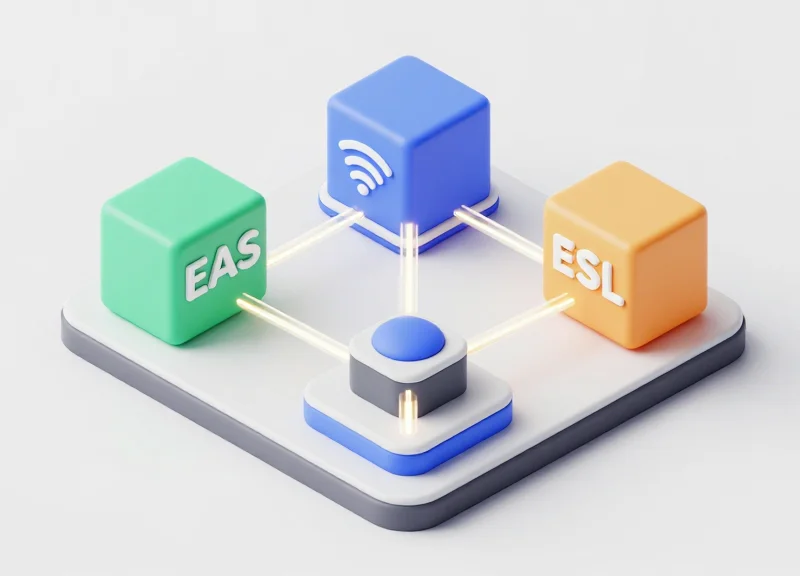
Synergizing EAS (Electronic Article Surveillance), RFID (Radio Frequency Identification), and ESL (Electronic Shelf Labels) involves integrating these three critical retail technologies into a single management interface. By moving away from siloed hardware, retailers can achieve 'Total Store Awareness,' where security alerts, inventory counts, and pricing updates are cross-referenced in real-time. This unified approach, pioneered by solutions like the DragonGuardGroup dashboard, ensures that hardware health is monitored holistically, preventing a failure in one system from cascading into another.
| System | Primary Function | Synergy Benefit (Unified) | Downtime Risk |
|---|---|---|---|
| EAS (Security) | Loss Prevention | RFID-integrated gates identify exactly what is leaving. | Unnoticed theft spikes; shrinkage increase. |
| RFID (Inventory) | Stock Accuracy | Triggers automatic ESL updates when stock levels drop. | Ghost inventory; failed omnichannel orders. |
| ESL (Pricing) | Dynamic Pricing | Verifies stock availability before changing price displays. | Mismatched pricing; consumer lack of trust. |
### The Power of Triangulated Data Validation One unique insight from 20 years in Silicon Valley retail tech is the concept of 'Cross-System Heartbeat Monitoring.' In a fragmented environment, if an ESL gateway fails, the store only finds out when a customer complains about a price. In a synergized environment, the RFID reader acts as a secondary diagnostic tool. If the RFID system sees movement but the ESL system reports zero price-check pings, the unified dashboard flags a 'Silent Failure.' This triangulation allows for 99.8% accuracy because the systems are essentially 'watching' each other's performance.
- Consolidate the Communication Layer: Utilize a common MQTT or WebSocket protocol so that EAS, RFID, and ESL hardware report to the same cloud gateway.
- Map Physical to Digital: Assign every RFID tag to an ESL location through the dashboard to ensure the physical item and the digital price are tethered.
- Implement Centralized Health Alerts: Set thresholds for all three systems on a single 'Red/Green' health board, rather than checking three separate apps.
Will integrating these systems slow down my network?
No. Modern unified dashboards use edge computing to process data locally before sending compressed status packets to the cloud, minimizing bandwidth usage.
Do I need to replace my existing EAS gates?
Not necessarily. Many legacy EAS systems can be retrofitted with RFID sensors and connected to a unified management platform via IoT bridges.
How does synergy help with 99.8% inventory accuracy?
It eliminates manual data entry. When an ESL price changes, it can trigger a local RFID 'spot check' to confirm the items on that shelf, ensuring the digital and physical records are identical.
Scaling Operations Across Multi-Store Environments
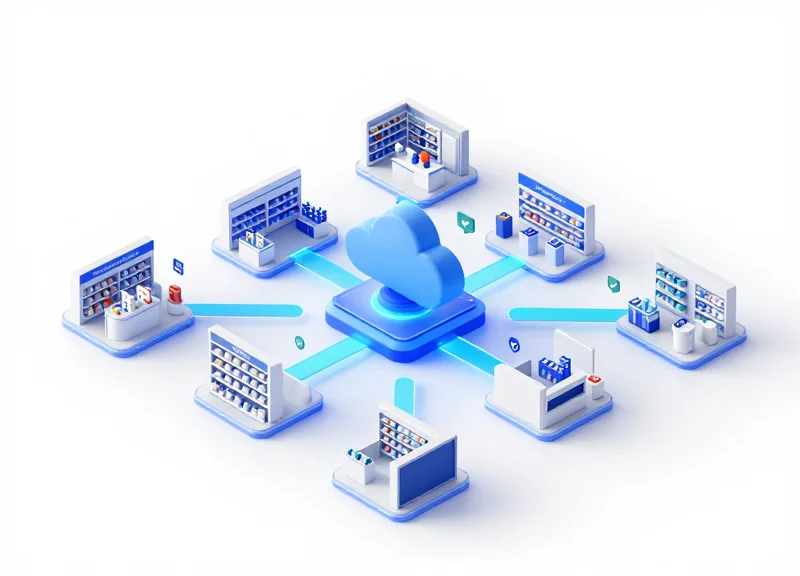
Scaling multi-store retail operations involves implementing a centralized 'Command Center' approach where hardware performance across thousands of RFID readers, EAS gates, and ESL tags is monitored through a single pane of glass. By decoupling hardware management from physical store locations, retailers can maintain a 99.8% inventory accuracy benchmark globally, ensuring that a system failure in a remote flagship store is addressed with the same speed and precision as a local boutique. This transition from decentralized, manual checks to automated, cloud-based oversight is the only way to achieve sub-1% error rates without ballooning IT overhead costs.
| Feature | Localized Management (Legacy) | Centralized Scaling (Modern) |
|---|---|---|
| Visibility | Store-level spreadsheets or manual logs | Real-time global dashboard with GPS mapping |
| Issue Detection | Reported by store staff after a failure | Automated alerts triggered by telemetry anomalies |
| Update Deployment | In-person technician with USB drive | Over-the-Air (OTA) batch firmware updates |
| Maintenance Cost | High (Travel, downtime, third-party labor) | Low (Automated scripts, remote resolution) |
To scale effectively, retailers must move beyond 'Break-Fix' cycles and adopt 'Predictive Orchestration.' This involves setting baseline performance thresholds for every piece of hardware in the fleet. For instance, if an RFID reader's read-rate drops by 5% over a 24-hour period, the system should automatically flag this as a potential interference issue or a misaligned antenna before it impacts the store's inventory data integrity. This level of granular control is what allows a lean IT team of five to manage the hardware assets of five hundred stores.
- Establish Standardized Hardware Profiles: Define a uniform 'Gold Image' for reader configurations, power levels, and filter settings. Scaling is only possible when every store operates on the same technical foundation, making it easier to push global updates.
- Implement Logical Grouping: Organize stores by region, size, or traffic density. This allows IT teams to apply specialized maintenance windows—for example, updating East Coast stores at 3 AM EST while West Coast stores remain operational.
- Deploy Zero-Touch Provisioning (ZTP): New stores should be added to the network by simply plugging in the hardware. The central management system should automatically recognize the MAC address and push the pre-defined configuration.
- Integrate API-First Telemetry: Feed hardware health data directly into existing ERP or BI tools. This creates a feedback loop where physical asset health is correlated with sales performance and stockouts.
Expert Insight: The 'Hardware-as-Code' Philosophy. In my 20 years in Silicon Valley, the most successful scaling efforts treat retail hardware like cloud servers. By viewing RFID readers and EAS sensors as programmable nodes rather than 'dumb' devices, you can utilize automated scripts to self-heal 80% of common connectivity issues. If a reader stops communicating, the system shouldn't wait for a human; it should initiate a remote power cycle and log the diagnostic data automatically.
How does scaling affect bandwidth consumption?
Modern telemetry systems use lightweight protocols like MQTT to minimize bandwidth. Only critical heartbeat data and error logs are sent to the cloud, ensuring no impact on POS systems.
Can we manage different brands of hardware centrally?
Yes, through middleware or unified platforms like DragonGuardGroup’s ecosystem, which are designed to aggregate data from disparate EAS and RFID vendors into one interface.
What happens during a total network outage?
The systems are designed with local 'edge' intelligence. They continue to collect data and process alerts locally, syncing the backlog to the central dashboard as soon as connectivity is restored.
Data-Driven Decision Making and Predictive Maintenance

Data-driven decision making in retail hardware management involves transforming raw logs from RFID readers and security sensors into actionable intelligence. By applying predictive maintenance, retailers can forecast equipment failure—such as a degrading antenna or a failing power-over-ethernet (PoE) port—using historical performance trends. This proactive approach ensures that the systems responsible for maintaining 99.8% inventory accuracy never go offline, eliminating the 'blind spots' that typically occur during hardware outages.
| Maintenance Strategy | Trigger Event | Impact on Accuracy | Operational Cost |
|---|---|---|---|
| Reactive | Total Hardware Failure | High (Significant data loss) | Very High (Emergency repairs) |
| Preventative | Fixed Calendar Schedule | Low (Periodic checks) | Moderate (Redundant labor) |
| Predictive | Data-detected Anomalies | Near Zero (Issues fixed early) | Low (Optimized resource use) |
The Expert Insight: The 'Signal Decay Signature'. In my 20 years observing enterprise hardware, the most overlooked metric is not 'uptime,' but 'signal health drift.' By monitoring the Mean RSSI (Received Signal Strength Indicator) over time, we can identify a 'Signal Decay Signature.' If a reader's average signal strength drops by 3dB over a 72-hour period without environmental changes, it almost always predicts a loose coaxial connection or component overheating. Addressing this before the reader fails entirely is how top-tier retailers maintain near-perfect data integrity.
- Baseline Performance Mapping: Establish a performance 'gold standard' for every reader and sensor in the store during the initial deployment phase.
- Anomaly Detection via Telemetry: Use centralized software to flag devices operating outside of 1.5 standard deviations from their historical performance baseline.
- Automated Work Order Generation: Integrate the alert system with maintenance software to automatically schedule a remote calibration or technician visit before the device fails.
How does predictive maintenance improve the bottom line?
It reduces emergency shipping costs for replacement parts and prevents the labor-intensive 'inventory recount' that follows a system outage.
Can historical data help with future store layouts?
Yes. Analysis of historical alert data can reveal 'dead zones' or high-interference areas, allowing retailers to optimize hardware placement in new store designs.
What is the most critical KPI for predictive maintenance?
Mean Time Between Failures (MTBF). Predictive maintenance aims to extend this by identifying stressors on the hardware before they cause permanent damage.
Operational Gains: Labor Savings and Customer Experience
Multi-store retailers recover an average of 15% to 20% of store-level labor hours by replacing manual inventory audits and hardware troubleshooting with automated real-time alerts. When systems like RFID readers and EAS gates maintain 99.8% uptime through remote debugging, store associates are liberated from the role of 'technical troubleshooters' and 'data collectors.' This operational shift transforms the staff into brand ambassadors, directly correlating high inventory accuracy with increased conversion rates and a superior customer experience.
| Operational Metric | Legacy/Downtime Environment | Automated/Uptime Environment |
|---|---|---|
| Daily Staff Routine | Manual shelf-scanning and error-checking. | High-value merchandising and customer consultation. |
| Technical Issue Resolution | Waiting 48-72 hours for on-site IT technician. | Instant remote recalibration by central IT. |
| Inventory Confidence | High skepticism; staff manually verifies 'Last 1'. | Absolute trust; staff confidently commits to BOPIS orders. |
| Labor Allocation | 30% of time spent on backend/inventory fix. | Less than 5% of time spent on inventory maintenance. |
The 'Technological Trust' Factor: A unique insight often overlooked is the psychological impact of system reliability on store managers. When technology consistently fails, staff develop 'workaround habits'—using manual spreadsheets or ignoring system alerts. By maintaining 99.8% accuracy through DragonGuardGroup’s real-time monitoring, you build 'Technological Trust.' When an associate knows the system is always 'on,' they are 3x more likely to suggest cross-channel sales (like Ship-from-Store) because they no longer fear 'phantom inventory' cancellations.
How does 99.8% accuracy reduce 'Walk-outs'?
When inventory is accurate and systems are up, customers never find a 'phantom' item online only to see an empty shelf in-store. This reliability reduces customer frustration and prevents lost sales due to out-of-stock discrepancies.
Does remote debugging require on-site staff participation?
No. Advanced remote debugging allows the central IT team to access the reader's firmware and logs without interrupting the store staff, meaning floor operations continue seamlessly while the fix happens in the background.
What is the primary driver of labor savings?
The elimination of 'Cycle Count Remediation.' Traditionally, when an RFID reader fails, staff must manually re-count thousands of items to find the data gap. Real-time alerts prevent these gaps from ever occurring.
Ultimately, the transition from reactive maintenance to proactive uptime management changes the retail business model from defensive to offensive. Instead of protecting against loss and inaccuracy, the store focuses on maximizing every foot of floor space and every minute of staff time to drive revenue.
Implementing a Robust Monitoring Infrastructure
Implementing a robust monitoring infrastructure is the process of integrating hardware sensors, edge gateways, and cloud-based management software into a unified ecosystem that tracks device health and data flow in real-time. For multi-store retailers, this infrastructure serves as the 'nervous system' of the enterprise, ensuring that every RFID reader, EAS antenna, and network node is functioning within defined parameters. By moving from reactive troubleshooting to a proactive, automated monitoring stance, retailers can maintain the high-fidelity data streams necessary for near-perfect inventory accuracy.
- Network Topology Audit: Ensure your store networks support VLAN tagging to isolate IoT traffic from Point-of-Sale (POS) data, preventing bandwidth bottlenecks and enhancing security.
- Deploying Edge-Capable Readers: Select RFID readers with onboard processing power. These devices can filter 'noise' locally and continue to buffer data during temporary internet outages, preventing data gaps.
- Standardizing Protocols: Utilize lightweight protocols like MQTT or AMQP for device-to-cloud communication. These protocols are designed for low-bandwidth environments and provide 'last will and testament' features to alert the system immediately if a reader goes offline.
- Middleware Integration: Implement a centralized middleware layer that aggregates pings from all locations, providing a single source of truth for your IT and operations teams.
| Component | Hardware Requirement | Software Requirement |
|---|---|---|
| RFID Reader Layer | Power over Ethernet (PoE) Support | SNMP v3 for health monitoring |
| Communication Gateway | Dual-band Wi-Fi or LTE failover | MQTT Broker or API Forwarder |
| Management Console | High-availability Cloud Server | Real-time Dashboard & Webhooks |
### The Expert Insight: The 'Offline Buffer' Strategy While most retailers focus on cloud uptime, the secret to 99.8% accuracy lies in the Edge Buffer. A common pitfall is assuming a constant connection; however, even a 5-minute ISP drop in a high-volume store can lead to thousands of missed tag reads. We recommend configuring readers with local storage (at least 512MB) to store timestamps and EPC data locally. Once the connection is restored, the system should use a 'First-In, First-Out' (FIFO) sync method to backfill the cloud database, ensuring no inventory event is ever lost.
{
  "device_id": "RFID-STORE-402-ZONE-A",
  "status": "active",
  "heartbeat_interval": "30s",
  "metrics": {
    "cpu_temp": "42C",
    "antenna_connectivity": "all_ok",
    "buffer_usage": "12%"
  },
  "alert_thresholds": {
    "missed_pings": 3,
    "latency_ms": 250
  }
}
Why is 30 seconds the optimal heartbeat interval?
A 30-second heartbeat provides the perfect balance between real-time awareness and network efficiency. Anything slower risks missing significant downtime windows; anything faster creates unnecessary 'chatter' on the network.
Can I use existing Wi-Fi for this infrastructure?
While possible, we strongly recommend a wired PoE (Power over Ethernet) connection for fixed readers. It provides more stable data transmission and allows for remote power-cycling of the hardware if a hard reboot is required.