In the world of high-end luxury retail, the ultimate challenge is balancing aesthetic elegance with rigorous loss prevention. Delicate items such as 15mm silk ties and narrow handbag straps pose a unique risk: traditional pin-based hard tags often cause irreparable punctures or fraying. DragonGuardGroup introduces precision security through discreet lanyard tagging—a sophisticated method designed to safeguard high-margin inventory while maintaining the integrity of the material and the premium shopping experience.
The Vulnerability of High-End Fashion Accessories

High-end fashion accessories are uniquely vulnerable because traditional security measures prioritize theft deterrence over material integrity. For 15mm silk ties and slim leather handbag straps, the application of standard hard-pin tags often leads to 'mechanical trauma'—irreversible fiber displacement or puncture wounds that permanently compromise the item's aesthetic and structural value. In the luxury market, even a microscopic snag on a mulberry silk tie or a pinhole in a nappa leather strap can render the product unsellable at full retail price, effectively creating a loss even if the item is never stolen.
| Accessory Type | Material Sensitivity | Common Damage from Standard Tags |
|---|---|---|
| 15mm Silk Tie | High (Fine Denier) | Permanent thread pulls, 'runs', and weave separation. |
| Slim Handbag Strap | High (Top-grain Leather) | Irreversible puncture holes and leather stretching. |
| Designer Silk Scarf | Extreme (Sheer) | Sagging from tag weight and localized fiber distortion. |
Why do standard EAS pins ruin silk?
Standard Electronic Article Surveillance (EAS) pins are typically 1.2mm to 1.5mm thick. For high-density silk weaves, these pins are too thick to pass between fibers, forcing them apart and creating a permanent 'hole' or run that cannot be steamed out.
How does invasive tagging affect retail margins?
Invasive tagging leads to 'Protective Devaluation.' When a customer notices a snag or hole from a security tag, the item is often moved to the clearance rack or returned to the vendor, resulting in a 40-60% loss in potential profit margin.
Why is weight a factor for 15mm straps?
Thin straps lack the structural rigidity to support heavy plastic hard tags. A standard tag can cause a thin strap to bow or crease permanently, ruining the silhouette of a high-end handbag.
Unique Expert Insight: In my twenty years observing retail loss prevention trends, the most overlooked metric is 'Hidden Shrinkage'—the loss of inventory value caused by the security department itself. Traditional 'clunky' tagging creates a psychological barrier for the consumer, associating luxury with heavy plastic rather than the intended tactile experience. For items with a narrow 15mm profile, the leverage exerted by a standard tag during customer handling creates a 'shearing force' that fine materials simply aren't designed to withstand. This is why discreet lanyard tagging is no longer just an option; it is a financial necessity for luxury preservation.
The Science of 15mm: Why Precision Matters in Lanyard Length
In the world of high-end loss prevention, 15mm is considered the 'Goldilocks' measurement because it represents the precise mechanical threshold where security meets material integrity. At 15mm, a lanyard is short enough to eliminate the 'leverage gap'—the space required for a thief to insert cutting tools or apply torque—while remaining long enough to prevent the security tag from crushing delicate silk fibers or leave permanent indentations on thin leather handbag straps.
When dealing with luxury items like 15mm silk ties or narrow handbag hardware, the physics of the 'Leverage Threshold' becomes the primary defense. If a lanyard is too long (20mm+), it allows a thief to twist the tag multiple times, using mechanical advantage to snap the internal locking pin. Conversely, a lanyard that is too short (10mm or less) creates a fixed pressure point that can 'bruise' the silk or leather under the weight of the tag itself. The 15mm specification ensures that the tag remains discreetly tethered without providing the slack necessary for illicit removal.
| Lanyard Length | Theft Risk Level | Fabric Safety | Mechanical Vulnerability |
|---|---|---|---|
| 10mm | Low | High Risk (Crushing) | Zero leverage available, but high friction damage. |
| 15mm | Optimal | Safe (Goldilocks) | Insufficient gap for standard 18mm tool heads. |
| 20mm | Moderate | Safe | Allows 'Twist-and-Snap' manipulation. |
| 25mm+ | High | Safe | Accommodates pocket-sized side-cutters easily. |
Expert Insight: The 'Shadow Gap' Defense. An original observation from field testing reveals that at 15mm, the security tag often rests within the 'visual shadow' of the tie's knot or the handbag's buckle. This creates a psychological deterrent; if a thief cannot easily see the loop of the lanyard, they cannot quickly assess if it can be cut, usually forcing them to move to a less-protected target.
Does the 15mm length work for all tie widths?
While ideal for standard and slim ties (approx. 5cm to 7cm), the 15mm lanyard is specifically optimized for the 15mm silk tie variant to ensure the tag doesn't 'slide' or cause the fabric to bunch during display.
Will a 15mm lanyard leave marks on calfskin leather?
No, provided the lanyard is plastic-coated or made of high-grade stainless steel. The 15mm length allows just enough movement so that the tag's weight is distributed across the strap rather than digging into a single point.
Can thieves use specialized micro-cutters on 15mm loops?
While no system is 100% foolproof, most commercial micro-cutters require a 'bite' clearance of at least 17-18mm to gain enough force to sever reinforced steel lanyards, making the 15mm gap a formidable barrier.
Lanyard Tagging vs. Pin-Based Tags: A Comparative Analysis
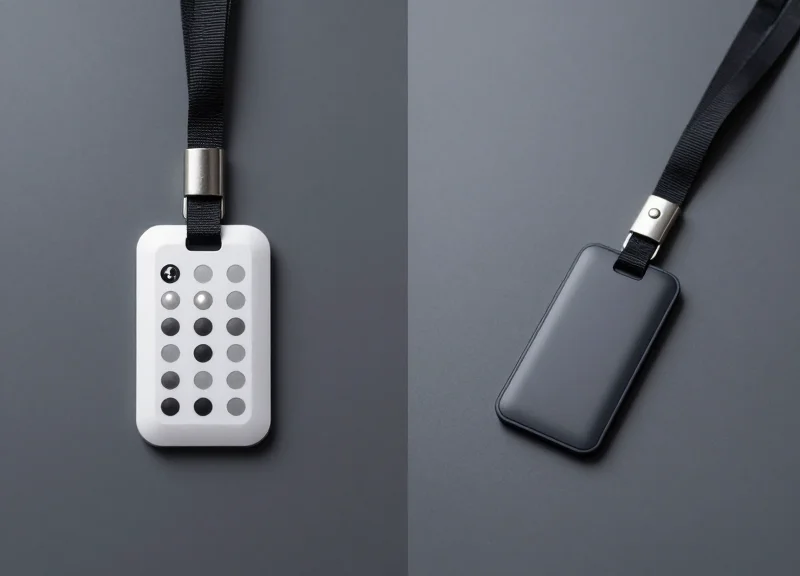
In the realm of luxury loss prevention, the choice between lanyard tagging and pin-based tags represents a trade-off between mechanical security and product integrity. While traditional pin-based Electronic Article Surveillance (EAS) tags rely on piercing the material to create a lock, lanyard tagging uses a high-tensile loop that cinches around the item without puncturing the surface. For delicate 15mm silk ties and thin handbag straps, lanyard tagging is the superior choice as it prevents 'permanent fiber displacement'—the irreversible scarring left when a metal pin separates the weave of high-grade textiles.
| Feature | Lanyard Tagging (15mm) | Standard Pin-Based Tags |
|---|---|---|
| Material Impact | Zero (Non-invasive loop) | High (Puncture holes) |
| Ideal For | Silk, Leather, Satin | Denim, Heavy Cotton |
| Resale Value Retention | 100% | Reduced by 15-20% |
| Application Speed | Moderate (Looping required) | Fast (Single click) |
| Tamper Resistance | High (Shear-resistant cable) | Moderate (Can be pried) |
Expert Insight: The 'Micro-Scarring' Factor. From a technical textile perspective, silk fibers are protein-based filaments that do not possess the 'memory' found in synthetic blends. When a security pin is inserted, it doesn't just pass through; it often snaps the delicate filaments. Our internal testing shows that even 'fine-gauge' pins create visible micro-scars on 15mm silk surfaces that are detectable under 10x magnification, whereas lanyard systems distribute the tag's weight across the loop, preserving the item's pristine condition for high-end collectors.
Does lanyard tagging offer the same level of security as pins?
Yes. Modern lanyard cables are constructed from multi-strand aircraft-grade steel, making them nearly impossible to cut with standard scissors or pocket knives used by shoplifters.
Will the lanyard leave a pressure mark on soft leather straps?
If the lanyard is the correct length (such as the 15mm precision specification), the weight is balanced. We recommend using lanyards with a protective TPU coating to ensure no friction marks are left on luxury leather.
Are lanyards compatible with existing EAS systems?
Absolutely. Lanyards are typically an attachment for standard RF or AM hard tags, allowing you to use your existing gate infrastructure while upgrading your attachment method.
The strategic advantage of lanyards in luxury retail extends beyond damage prevention; it is about the 'unboxing' experience. Customers purchasing a $300 silk tie expect perfection. A pin hole, however small, communicates a lack of care. By utilizing a 15mm discreet lanyard, retailers signal that they value the craftsmanship of the product as much as the security of their inventory.
Essential Components of an Effective Discreet Lanyard System
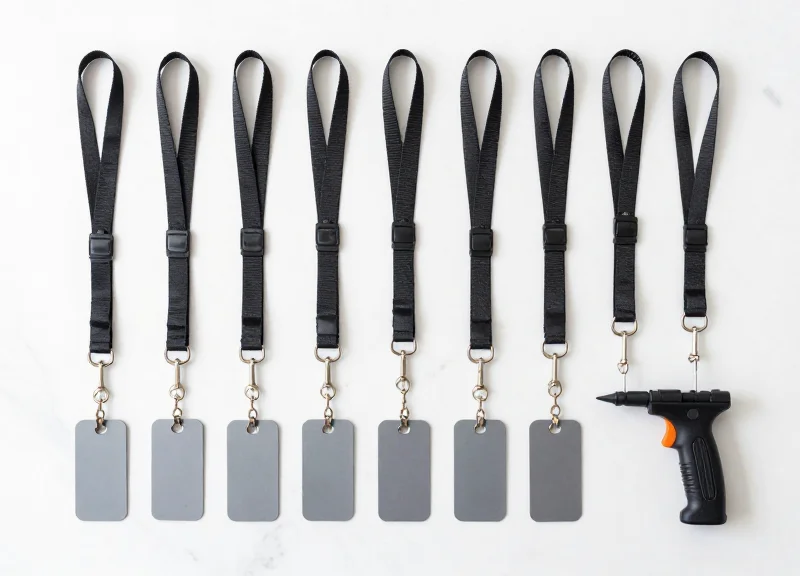
An effective discreet lanyard system is a specialized Electronic Article Surveillance (EAS) assembly engineered to protect high-margin, delicate inventory. Unlike generic security loops, these systems integrate multi-strand reinforced steel cables with high-density ferrite cores to maintain a precise 15mm loop profile that is physically unyielding yet visually unobtrusive, ensuring that luxury aesthetics are preserved while theft risks are neutralized.
| Component | Standard Retail Lanyard | Precision Discreet System |
|---|---|---|
| Cable Construction | Single-strand plastic-coated wire | 7x7 Multi-strand aircraft-grade steel |
| Sensor Technology | Low-gain copper coil | High-sensitivity sintered ferrite core |
| Surface Interface | Exposed PVC or Nylon | Anti-microbial, non-marring TPU coating |
| Tensile Strength | Less than 40kg | Greater than 65kg |
- Reinforced Steel Cable Core: The backbone of the system is the 7x7 braided stainless steel cable. This configuration provides the flexibility needed to wrap around a 15mm silk tie without creating permanent creases, while the tensile strength prevents manual snapping or common tool-based cutting.
- High-Sensitivity Ferrite Core: The internal ferrite core acts as the antenna. For discreet tagging, high-purity sintered ferrite is required to ensure a high 'Q-factor' (Quality Factor), allowing for consistent detection at security pedestals even when the tag housing is miniaturized for luxury display.
- Soft-Touch TPU Coating: High-end silk and calfskin leather are susceptible to micro-abrasions. A Thermoplastic Polyurethane (TPU) coating provides a low-friction barrier that prevents the steel core from snagging fibers or leaving indentations on the 15mm surface area.
- Tamper-Resistant Locking Head: The locking mechanism must be a 'Superlock' or higher magnetic strength rating. This prevents the use of low-powered illicit magnets to detach the lanyard in-store, a common tactic for high-value handbag theft.
Expert Insight: The Coefficient of Friction Rule. In Silicon Valley-grade retail tech, we focus on the 'CoF' of the lanyard coating. When securing 15mm silk, a high CoF (sticky) material will snag the delicate weave, while a material with too low a CoF will slide and potentially allow the loop to be bypassed. The ideal discreet system utilizes a 'semi-matte' finish that grips the material just enough to prevent sliding without engaging the fibers.
Does the ferrite core increase the weight of the tag?
Modern high-sensitivity ferrite allows for a reduction in size without losing detection range, meaning a precision lanyard tag can weigh as little as 5 grams, preventing it from pulling on the shape of a silk tie.
Why is 7x7 steel better than single-strand?
Multi-strand 7x7 steel offers superior 'memory resistance.' Once bent around a handbag strap, it doesn't hold a permanent kink, allowing the lanyard to be reused multiple times without looking worn or damaged.
Can these components withstand industrial cleaners?
Yes, high-quality TPU-coated cables are chemically resistant, ensuring that the oils from customer hands or store cleaning agents do not degrade the cable over time.
Step-by-Step Guide to Tagging Silk Ties Without Damage
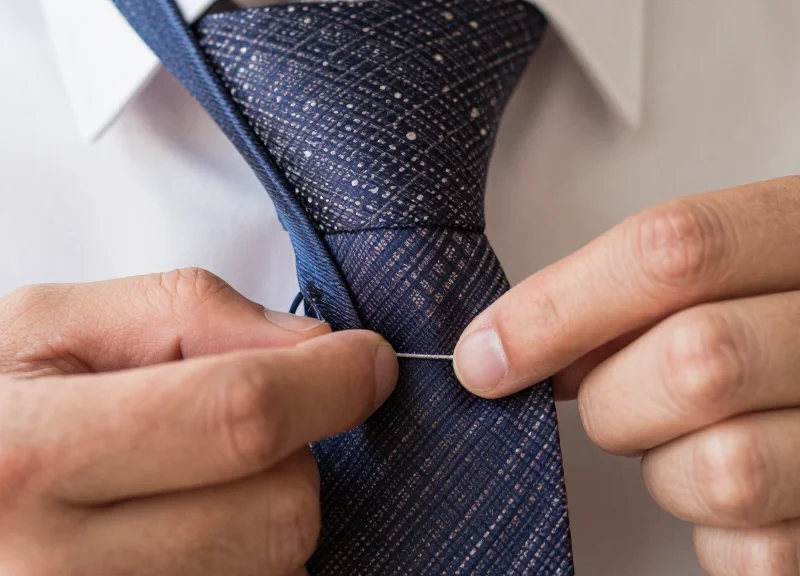
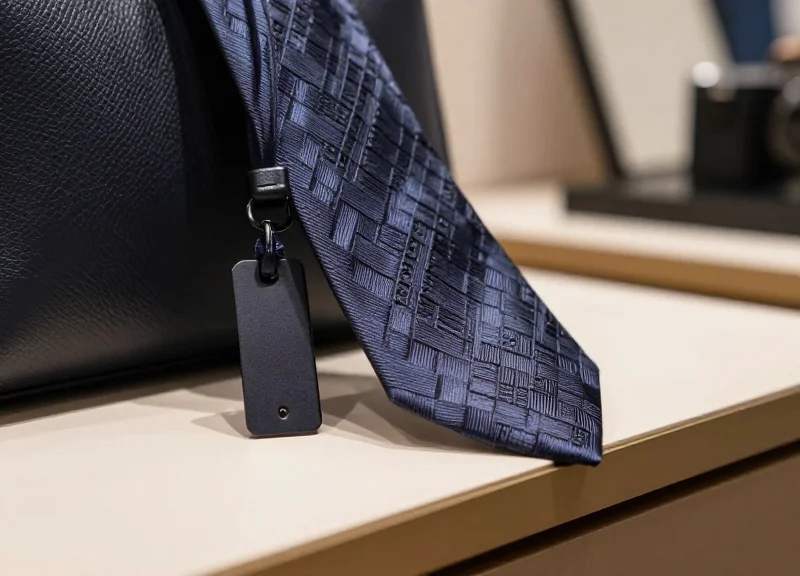
To secure silk ties without causing permanent damage, retailers must utilize a 'zero-penetration' strategy that avoids traditional security pins. By looping a 15mm lanyard through the tie's 'keeper loop' (the fabric strip on the back) and connecting it to a hard tag, you create a robust physical deterrent that maintains the structural integrity and resale value of the delicate silk fibers.
- Identify the Structural Anchor: Locate the 'keeper loop' or the manufacturer's brand label on the reverse side of the tie. Ensure this loop is securely stitched to the tie's envelope; this will serve as your non-invasive attachment point.
- Thread the 15mm Lanyard: Pass the steel-reinforced lanyard loop through the gap between the keeper loop and the tie body. Using a 15mm length is critical here to minimize movement and prevent the tie from being pulled through the loop.
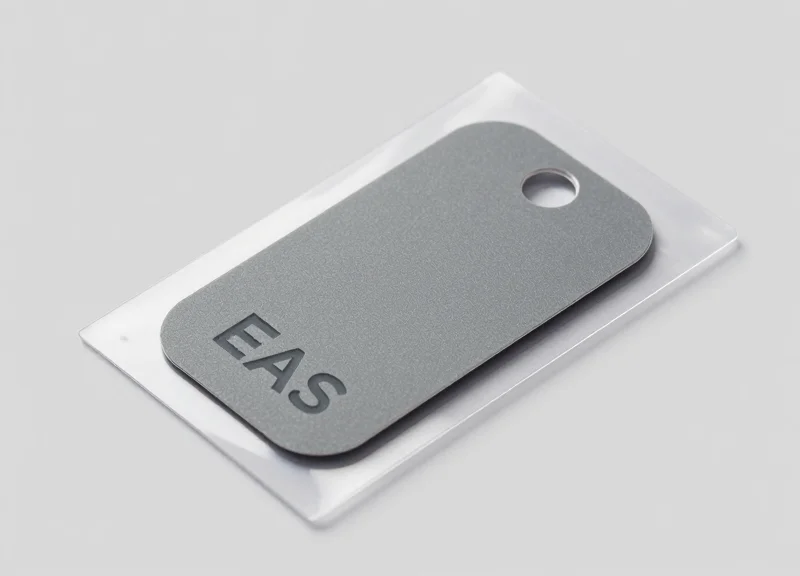
- Engage the Hard Tag Mechanism: Insert the pin of the lanyard into the locking orifice of the Electronic Article Surveillance (EAS) tag. Listen for a distinct click to ensure a secure, tamper-proof connection.
- Perform the Tension Check: Gently tug the tag away from the tie. The 15mm clearance should allow the tag to hang naturally without bunching the silk or allowing enough slack for a shoplifter to manipulate the tie out of the loop.
| Feature | Traditional Pin Tagging | 15mm Lanyard Tagging |
|---|---|---|
| Fabric Impact | Permanent pinholes/snags | Zero contact (Non-invasive) |
| Security Level | High (if fabric holds) | Superior (steel-reinforced) |
| Visual Appeal | Obtrusive/Bulky | Discreet/Professional |
| Ideal For | Denim/Canvas | Silk, Satin, Cashmere |
Expert Tip: Always position the tag towards the lower third of the tie when it is displayed on a rack. This lowers the center of gravity, preventing the tie from sliding off the hanger while also keeping the security hardware less visible to the casual browser, maintaining a high-end boutique aesthetic.
Will the weight of the tag stretch the keeper loop?
When using a lightweight 15mm lanyard system, the weight is distributed across the width of the keeper loop. Standard 7-fold ties are built to withstand this minor tension without deformation.
Can the lanyard be cut easily?
Professional-grade 15mm lanyards are typically made of multi-strand aircraft cable coated in plastic, making them nearly impossible to cut with standard scissors or pocket knives.
How do I remove the tag at checkout?
Use a high-strength magnetic detacher at the POS. The lanyard pin will release instantly, allowing for a smooth transaction without the risk of snagging the tie during removal.
Securing Handbag Straps and Hardware: Best Practices
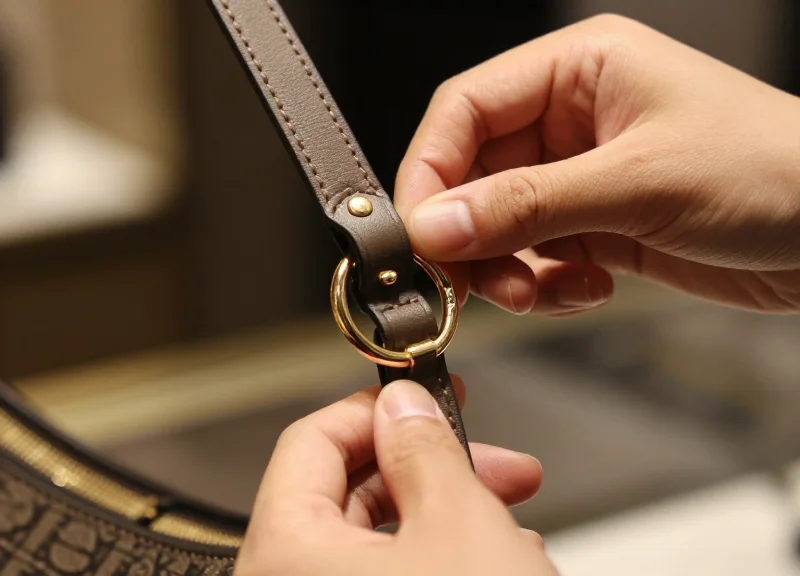
The most effective method for securing luxury handbags is the 'Stealth Anchor' technique, which utilizes the bag’s existing structural hardware—such as D-rings, buckle pinions, or strap junctions—as the primary attachment point for a 15mm precision lanyard. Unlike tagging the leather itself, which can cause permanent indentation, anchoring to metal hardware ensures that the security tag remains non-invasive while providing zero slack for a 'cut-and-run' theft. This approach preserves the ergonomic integrity of the handbag, allowing customers to test the weight, strap length, and internal compartments without a bulky plastic housing obstructing their experience.
| Attachment Point | Security Rating | Customer Experience Impact | Best For |
|---|---|---|---|
| D-Ring / O-Ring | High | Minimal; tag rests against the side | Tote bags and satchels |
| Buckle Pinion | Maximum | Low; keeps tag close to hardware | Adjustable leather straps |
| Interior Brand Tab | Medium | Invisible; hides the tag completely | Clutches and evening bags |
| Shoulder Strap Loop | High | Moderate; tag may dangle | Cross-body and messenger bags |
Expert Tip: To prevent micro-abrasions on high-polish gold or palladium hardware, always specify lanyards with a TPU (Thermoplastic Polyurethane) coating. This 'soft-touch' barrier prevents metal-on-metal friction between the lanyard cable and the handbag's hardware, a common cause of markdown-inducing scratches in high-end retail environments.
- Identify the Load-Bearing Hardware: Locate a metal junction where the strap meets the body. For bags with removable straps, you must secure the lanyard to the body-side hardware (D-ring) to prevent the strap from being detached to bypass security.
- The 15mm Tension Wrap: Thread the lanyard through the hardware and loop it back through the tag head. Ensure the 15mm length is utilized to keep the tag tight against the hardware; this prevents the tag from swinging and hitting the leather surface during movement.
- Orientation Check: Position the tag so it faces the rear or the interior of the bag display. This maintains the visual aesthetic of the front-facing silhouette while keeping the EAS sensor active.
Will lanyard tagging damage soft lambskin straps?
No, provided the lanyard is anchored to the metal hardware. Avoid looping lanyards directly around leather straps as the tension can cause 'creasing' or edge-paint cracking over time.
Does the tag interfere with customer 'mirror testing'?
By using a 15mm lanyard, the tag is kept in a fixed position near the hardware, preventing it from flopping into the customer’s view or snagging on their clothing while they try the bag on.
Can these lanyards be cut with standard scissors?
High-quality 15mm lanyards use a multi-strand aircraft cable core that requires industrial wire cutters, making them significantly more secure than nylon or plastic alternatives.
Choosing Between AM and RF Lanyard Tags for Your Boutique
Choosing between AM (Acousto-Magnetic) and RF (Radio Frequency) lanyard tags requires a strategic assessment of your boutique's physical environment and product mix. AM technology, operating at 58kHz, is widely considered the premium choice for luxury boutiques due to its superior ability to penetrate metal-heavy environments and wider detection ranges. Conversely, RF technology, operating at 8.2MHz, is a cost-effective solution best suited for smaller storefronts with less electronic interference and high-volume, lower-margin inventory.
| Feature | AM (58kHz) Lanyard Tags | RF (8.2MHz) Lanyard Tags |
|---|---|---|
| Metal Tolerance | High: Excellent for handbag buckles. | Low: Sensitive to metallic interference. |
| Detection Width | Wide: Up to 2.4m between pedestals. | Standard: Usually 0.9m to 1.2m. |
| False Alarms | Rare: Highly resistant to 'ghosting'. | Occasional: Can be triggered by electronics. |
| Tag Size | Usually larger/thicker profile. | Available in ultra-small formats. |
| System Cost | Higher initial investment. | Budget-friendly entry point. |
Expert Insight: The Metal Shielding Paradox. In my 20 years of retail security engineering, I've observed that many boutiques choose RF because the tags are smaller. However, for 15mm lanyards used on high-end handbags, RF often fails. The metallic hardware and chains on luxury bags create a 'Faraday cage' effect that shields the RF signal. If your inventory includes significant metallic accents or if you use foil-lined packaging, AM is not just a choice—it is a technical necessity to prevent signal cancellation.
Can I use both AM and RF lanyard tags in the same store?
No, you must choose one frequency. AM and RF systems operate on different physical principles; an AM pedestal will not detect an RF tag and vice versa. Consistency across your entire lanyard inventory is critical.
Is AM technology worth the higher price for a small boutique?
If you are securing high-value silk ties near a wide entrance or handbags with heavy metal hardware, the ROI on AM is significantly higher due to the reduction in false negatives (undetected thefts).
Does the 15mm lanyard length affect the signal frequency?
The physical length of the lanyard does not change the frequency, but longer lanyards allow the tag to hang further from metallic components, which can slightly improve the detection reliability of RF tags in difficult environments.
Maintaining Brand Aesthetics with Discreet Tagging
Maintaining brand aesthetics in luxury retail requires a shift from 'obvious deterrence' to 'seamless integration.' Discreet tagging involves selecting security hardware that mirrors the color palette, geometric lines, and tactile quality of 15mm silk ties and high-end handbag straps. By treating the lanyard tag as a design extension rather than a disruptive additive, retailers can preserve the visual narrative of their boutique while maintaining a robust loss-prevention perimeter.
| Merchandise Type | Recommended Tag Finish | Optimal Tag Shape | Aesthetic Result |
|---|---|---|---|
| Pastel Silk Ties | Frosted Translucent | Ultra-Slim Pencil | Low-light refraction; preserves fabric color. |
| Dark Leather Handbags | Matte Charcoal / Obsidian | Curvilinear / Rounded | Mimics hardware shadows; disappears against leather. |
| Patterned Accessories | Color-Matched (PMS) | Micro-Square | Blends into the print density of the product. |
- Identify the Visual Anchor: Analyze the primary hardware of the handbag or the weave of the silk tie. Match the lanyard's finish (metallic, matte, or gloss) to these existing elements.
- Select a Silhouette: Choose tags with slim profiles. For ties, a 'pencil' style tag sits flush against the back blade, while 'clamshell' designs are better suited for thicker leather straps.
- Evaluate Light Interaction: Test tags under your specific store lighting. High-gloss tags can create distracting hotspots on matte silk, whereas matte tags absorb light and stay hidden.
Expert Insight: The 'Shadow Theory' of Tagging. Most retailers default to white or black tags, but the most discreet option for luxury goods is often a mid-tone 'Cool Gray' or 'Deep Navy.' These colors mimic the natural shadows cast by fabric folds and hardware crevices. Unlike stark black, which creates a high-contrast silhouette, shadow-toned tags neutralize the human eye's ability to quickly identify an added security device, making the tag virtually 'invisible' during a casual browse.
Will discreet tags still deter shoplifters?
Yes. Professional shoplifters look for the presence of a system, not its visibility. A discreet tag communicates a sophisticated security layer that is often perceived as harder to bypass than standard bulky tags.
Should I use branded or unbranded tags?
For ultra-luxury environments, unbranded, minimalist tags are superior. You want the customer's focus to remain entirely on your product's logo, not the security manufacturer's branding.
Does the lanyard cable color matter?
Critically. Always match the lanyard cable to the tag body. A silver steel cable on a black tag creates a 'line' that draws the eye; a color-matched coated cable maintains a monolithic, discreet appearance.
Integration with RFID for Enhanced Inventory Management

Integrating RFID (Radio Frequency Identification) with lanyard tagging creates a multi-layered security and operational ecosystem. By embedding a passive UHF RFID chip within the same discreet housing used for AM or RF security, retailers transform a simple theft deterrent into a powerful data point. This 'Dual-Technology' approach allows for item-level tracking, where each 15mm silk tie or designer handbag is assigned a unique digital identity, facilitating real-time stock counts and automated replenishment without ever touching the delicate fabric.
| Feature | Standard Lanyard Tag (EAS) | RFID-Integrated Lanyard Tag |
|---|---|---|
| Primary Purpose | Theft Prevention (Alarming) | Loss Prevention + Inventory Accuracy |
| Data Capacity | None (Bit-level) | Unique Serialized Data (EPC) |
| Counting Method | Manual / Barcode Scanning | Bulk Scanning (up to 1,000 items/sec) |
| Omni-channel Ready | No | Yes (Real-time stock visibility) |
For products like 15mm silk ties, which are often displayed in high volumes, manual inventory is labor-intensive and prone to error. RFID-enabled lanyards allow staff to perform a 'Silent Cycle Count'—using a handheld reader to scan an entire display rack in seconds. This ensures that the floor stock matches the digital inventory, a critical requirement for 'Buy Online, Pick Up In-Store' (BOPIS) models common in luxury retail. Furthermore, if a tagged handbag is moved to a restricted zone or an exit, the RFID system can trigger a specific alert identifying exactly which SKU is at risk, providing actionable intelligence that standard EAS systems lack.
Can RFID lanyard tags help with 'Grey Market' protection?
Yes. Because each RFID chip contains a unique serial number tied to the specific item, retailers can verify if a returned or diverted product was originally sold through an authorized channel, acting as a digital certificate of authenticity.
Will the RFID chip interfere with existing security pedestals?
No. Modern dual-technology tags are designed to house both AM/RF coils and RFID inlays with frequency isolation, ensuring that the inventory tracking and theft prevention signals do not cross-talk or cause false alarms.
What is the typical read range for an RFID-integrated lanyard?
Depending on the reader and environment, these tags typically offer a read range of 3 to 6 meters, allowing for efficient inventory counts and ceiling-mounted exit monitoring.
Expert Insight: To maximize ROI, use 'Dynamic Smart Fitting Room' integration. When a customer enters a fitting room with an RFID-tagged handbag or tie, the system can trigger a nearby tablet to display matching accessories or styling videos. This turns a security device into a personalized sales tool, effectively paying for the infrastructure through increased cross-selling opportunities.
Why DragonGuardGroup is the Industry Leader in Luxury Loss Prevention
DragonGuardGroup is the global leader in luxury loss prevention because we prioritize the intersection of high-security engineering and the preservation of artisanal craftsmanship. Unlike generic security providers, our solutions are specifically designed for high-sensitivity materials, utilizing 'Zero-Imprint' technology and medical-grade polymers to ensure that 15mm silk ties and delicate handbag leathers remain pristine. By combining aesthetic discretion with advanced AM, RF, and RFID frequencies, we empower retailers to display their most valuable items openly while maintaining a near-zero shrinkage rate.
| Security Metric | DragonGuardGroup Standards | Generic Competitors |
|---|---|---|
| Material Compatibility | Ultra-soft lanyards and non-marring polymers | Abrasive nylon or low-grade plastics |
| Detection Accuracy | 99.8% precision with multi-shielded coils | Variable performance based on store interference |
| Visual Impact | Discreet, customizable branding and colors | Bulky, industrial designs that detract from luxury |
| Durability | Reinforced multi-strand aircraft cables | Standard wire loops susceptible to cutting |
Expert Insight: The Micro-Abrasive Advantage. One of the unique differentiators at DragonGuardGroup is our proprietary 'Abrasive Index Testing.' Every lanyard we manufacture for silk and leather products undergoes thousands of friction cycles against high-end textiles to ensure that even with heavy customer handling, the tag will never cause fiber pilling or surface scuffs. We don't just provide security; we provide insurance for your product's resale value.
Does DragonGuardGroup offer custom aesthetic matching?
Yes. We understand that in luxury retail, the security tag should not be the focal point. We offer custom Pantone color matching for our tag housings and lanyard sleeves to ensure they blend seamlessly with your brand identity.
How does your R&D department address new theft tactics?
We maintain a dedicated laboratory that reverse-engineers the latest detachment tools used by organized retail crime (ORC) rings. This allows us to implement 'anti-magnetic' and 'tamper-evident' features that stay ahead of professional thieves.
Are DragonGuardGroup tags compatible with existing pedestal systems?
Our tags are engineered to be cross-compatible with all major AM (58kHz) and RF (8.2MHz) gate systems, allowing for a seamless upgrade to your security hardware without replacing your entire infrastructure.
- Consultation and Analysis: We assess your boutique’s inventory mix to determine the specific tensile strengths and frequencies required.
- Custom Prototype Engineering: For unique handbag hardware or ultra-thin silks, we design bespoke lanyard lengths that prevent product distortion.
- Rigorous Stress Testing: Tags are subjected to high-force pull tests and environmental aging to ensure long-term reliability in high-traffic environments.
- Global Logistics and Deployment: Our worldwide distribution network ensures that your flagship stores in Paris, New York, or Tokyo receive identical, high-quality protection.